3D Laser Scanning Marsden Park | Warehouse Engineering

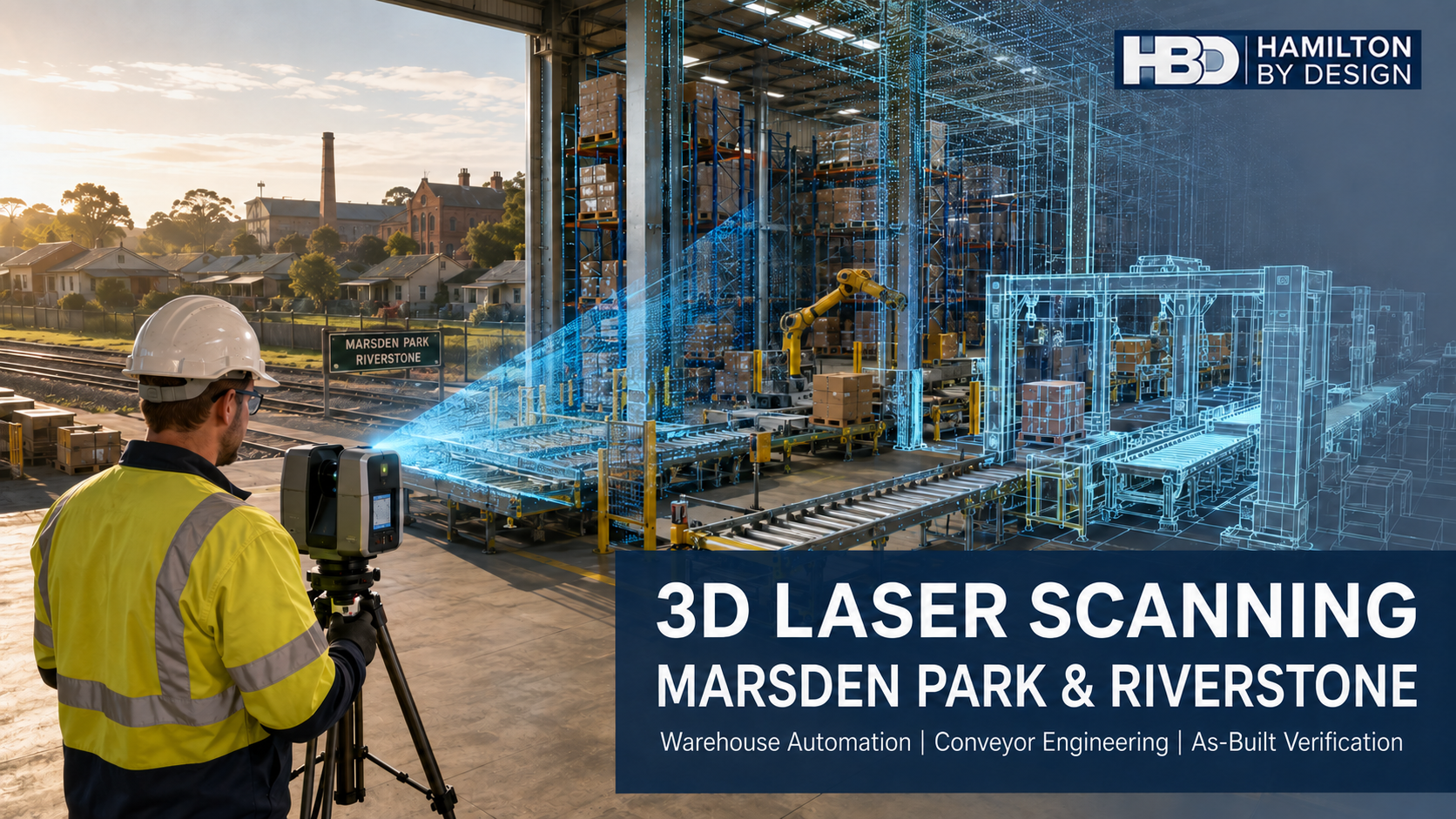
Hamilton By Design engineer using 3D laser scanning to capture an automated warehouse and conveyor system in the Marsden Park and Riverstone industrial area.

3D Laser Scanning Marsden Park and Riverstone: Engineering for a Changing Industrial Area

Blue 3D LiDAR scanner icon on a tripod with scanning waves

Marsden Park and Riverstone are part of one of the fastest-changing industrial and employment areas in north-western Sydney. What was once predominantly farmland, livestock country and traditional industry is becoming a major centre for warehousing, distribution, construction products, advanced manufacturing and logistics automation.

This transformation creates significant opportunities for local businesses. It also introduces engineering challenges. Warehouses must accommodate increasingly complex conveyors, racking, automated storage systems, machinery, fire services, building services and vehicle movements. New equipment must fit around existing structures, while established facilities may no longer have drawings that accurately represent what has been installed.

Hamilton By Design provides engineering-led 3D laser scanning in Marsden Park and Riverstone, helping manufacturers, warehouse operators, automation integrators, builders and asset owners establish an accurate record of their facilities before design, fabrication or installation begins.

By combining reality capture with industrial scanning in Western Sydney, mechanical engineering, point-cloud modelling and engineering drafting, Hamilton By Design can help local project teams reduce dimensional uncertainty and make better-informed engineering decisions.

From Riverstoneโ€™s Meatworks to Marsden Parkโ€™s Automated Warehouses

Riverstone has a particularly strong industrial history. The Riverstone Meatworks, established during the nineteenth century, became one of the districtโ€™s major employers and helped shape the development of the town.

Its position beside the Richmond railway line was central to its success. Livestock could arrive by rail from regional areas, while processed meat could be transported into Sydney. Over time, the operation expanded to include refrigeration, freezing, canning, smallgoods, by-product processing and other supporting activities.

For many local families, the meatworks was more than an industrial facility. It influenced housing, employment, sport, social events and everyday life. Former residents remember workersโ€™ cottages along Butchers Row, stockmen and their dogs, livestock arriving by train during the night and generations of families working at the same facility.

The Riverstone and District Historical Society records local memories of the meatworks as the โ€œlife bloodโ€ of Riverstone and Butchers Row as its heart. These memories describe a self-contained industrial community where the workplace and the town were closely connected. Riverstone Historical Society โ€“ Butchers Row memories

The industrial character of the wider area has since changed dramatically.

Marsden Park now accommodates modern retail distribution, warehouse automation, manufacturing, equipment supply and construction-product businesses. The precinct includes major organisations such as IKEA, ASICS Oceania, ActronAir, Garmin, Bucher Municipal, Lindt, Dulux, Axalta, Bunnings and Costco.

This contrast is part of what makes the Marsden Parkโ€“Riverstone industrial area distinctive. Riverstone reflects an earlier era of rail-connected processing and labour-intensive production. Marsden Park represents the contemporary industrial economy: large buildings, high-bay storage, automated conveyors, digital inventory systems and tightly coordinated logistics.

However, the underlying engineering requirement remains familiar. Industrial operations depend on machinery, access, reliable interfaces and accurate technical information.

A Major Employment Corridor in North-Western Sydney

The Marsden Park Industrial Precinct is an important employment component of the NSW Governmentโ€™s North West Growth Area. Planning for the precinct provides for industrial development, business activity and thousands of local jobs. NSW Planning โ€“ Marsden Park Industrial

Nearby Riverstone West covers approximately 285 hectares between the Richmond railway line and Eastern Creek. It includes land intended for industrial, light-industrial and business-park development, together with environmental corridors and supporting transport infrastructure. NSW Planning โ€“ Riverstone West

The corridor benefits from its connection to Richmond Road and the M7 and M2 motorway network. This makes it attractive to organisations moving goods across Greater Sydney and regional NSW.

Its continued development is creating demand for:

  • New warehouses and distribution centres
  • Automated storage and retrieval systems
  • Conveyor and sortation equipment
  • Manufacturing and assembly facilities
  • Equipment-maintenance workshops
  • Building and construction-product suppliers
  • Loading docks and freight-handling areas
  • Racking, mezzanines and access platforms
  • Plant and equipment relocation
  • Facility extensions and tenancy modifications

These projects require more than an architectural floor plan. They require reliable information about the physical location of columns, floors, walls, services, machinery, access routes and equipment interfaces.

Why Scan a New Facility?

It is sometimes assumed that 3D scanning is only required for old factories with missing drawings. In practice, new-facility scanning can be equally valuable.

A new warehouse may have a complete set of design and construction drawings, but those drawings represent the design intent. They do not necessarily record every construction tolerance, service alteration, subcontractor change or final equipment position.

Before installing an automated conveyor or storage system, a project team may need to confirm:

  • The actual position of columns and portal frames
  • Floor levels and local changes in elevation
  • Door and loading-dock clearances
  • The position of sprinklers and fire services
  • Lighting, cable trays, ducting and pipework
  • Racking and mezzanine interfaces
  • Equipment bases and anchor locations
  • Maintenance and removal clearances
  • Forklift and pedestrian routes
  • Available installation access

A coordinated scan can provide a measurable record of these conditions.

Hamilton By Designโ€™s approach to 3D laser scanning for Sydney industrial plants is based on connecting site capture to the intended engineering outcome. Scanner positions, coverage, resolution and modelling detail can therefore be planned around the equipment or facility decision that the client needs to make.

Warehouse Automation and Conveyor Interfaces

Marsden Park contains some of Sydneyโ€™s most substantial warehouse and distribution operations. These facilities may use pallet conveyors, carton conveyors, sortation systems, shuttle storage, automated cranes, picking stations and increasingly autonomous equipment.

Automation depends on physical interfaces being correct.

A conveyor may need to pass through structural bays, connect with another supplierโ€™s equipment and remain clear of fire services. Its supports must suit the available floor or structure. Guards must protect hazardous areas without preventing maintenance. Operators must be able to access workstations, emergency stops and inspection points.

Small discrepancies can become major project problems. A column positioned differently from the design model, an undocumented service or an unsuitable floor area can force equipment modifications during installation.

The issues are similar to those discussed in Hamilton By Designโ€™s article on warehouse and conveyor 3D scanning in Western Sydney. Accurate site capture can help an automation integrator coordinate its proposed equipment against the real facility rather than relying exclusively on nominal dimensions.

For conveyor engineering in Marsden Park, Hamilton By Design can assist with:

  • Existing conveyor surveys
  • Proposed conveyor layouts
  • Transfer and interface modelling
  • Support-frame arrangements
  • Maintenance-access studies
  • Guarding layouts
  • Clearance assessment
  • General arrangement drawings
  • Fabrication details
  • Installation drawings
  • Post-installation verification

The resulting model can also be reviewed in conjunction with supplier CAD files. This allows the project team to examine clearances and potential clashes before components arrive on site.

Turning Point Clouds into Engineering Information

A point cloud is a dense three-dimensional record of the surfaces visible to the scanner. It may capture floors, walls, roof members, columns, conveyors, racking, machinery, platforms, pipework and building services.

However, collecting data is only the first stage. The information must be processed and converted into a form appropriate to the project.

Hamilton By Design provides point-cloud-to-CAD services in Sydney, allowing selected geometry to be developed into:

  • Two-dimensional facility plans
  • Elevations and sections
  • Equipment-location drawings
  • Three-dimensional plant layouts
  • Conveyor and machinery models
  • General arrangement drawings
  • Installation-interface models
  • As-built documentation
  • STEP or Parasolid exchange models
  • SolidWorks or Inventor models
  • DWG and DXF drawings
  • BIM-ready geometry where required

Not every visible object needs to be converted into CAD. The modelling scope should reflect the intended use.

For example, a conveyor installation may require detailed modelling of structural columns, floor levels, adjacent equipment and services crossing the proposed route. Pallets, signs and unrelated warehouse contents may not need to be recreated.

Defining this purpose early keeps the model practical and avoids unnecessary cost.

As-Built Verification Before and After Installation

As-built verification can be performed at several stages of a Marsden Park or Riverstone project.

Before installation, Hamilton By Design can scan the facility and compare proposed equipment against the available envelope. Fabricated steelwork or machinery can also be checked before delivery where the agreed tolerance and measurement method are suitable.

During installation, progressive scans can document concealed interfaces, equipment bases or work completed before access becomes restricted.

After installation, another scan can confirm:

  • Final machinery position
  • Conveyor centre-lines and elevations
  • Support-frame locations
  • Clearances around equipment
  • Access-platform and guarding arrangements
  • Interfaces with surrounding services
  • Differences between the approved model and installed condition

This creates a more useful handover record for the facility operator. Instead of receiving only a supplierโ€™s design model, the operator can retain information representing what was actually installed.

Mechanical Engineering and Drafting Support

Hamilton By Design provides mechanical engineering services in Sydney for machinery, materials handling, plant modifications and fabrication-based projects.

For Marsden Park and Riverstone clients, relevant services may include:

  • Conveyor and materials-handling design
  • Machinery and production-line layouts
  • Equipment support frames
  • Maintenance platforms and access
  • Machine guarding
  • Equipment bases and mounting arrangements
  • Fabricated components and assemblies
  • Installation and removal-path studies
  • Reverse engineering
  • Mechanical design verification
  • Finite element analysis where appropriate
  • General arrangements and fabrication drawings
  • Bills of materials and cutting profiles

Mechanical drawings can be developed in accordance with the applicable principles of the AS 1100 technical-drawing series and the clientโ€™s CAD and document-control requirements.

Depending on the project, engineering work may also consider:

  • AS/NZS 4024 series for machinery safety
  • AS/NZS 4024.3610 for conveyor systems
  • AS 1657 for fixed platforms, walkways, stairs and ladders
  • AS 3990 for mechanical equipment steelwork
  • AS 4100 for steel structures where applicable
  • AS/NZS 1170 series for relevant structural design actions
  • AS 4084.1 for steel storage racking
  • AS 4991 for lifting devices

The standards and editions required must be established for each project. Where structural, electrical, fire-engineering or building certification is required, those matters should be coordinated with appropriately qualified specialists.

Machinery Safety and Risk Management

Warehouses combine people, forklifts, trucks, conveyors, stored goods and automated equipment within the same operating environment. As throughput increases, the consequences of poorly coordinated machinery and access arrangements can also increase.

Common hazards include:

  • Conveyor nip and entanglement points
  • Unexpected machinery movement
  • Inadequate fixed or interlocked guarding
  • Restricted maintenance access
  • Falls from platforms or mezzanines
  • Poor headroom and walkway clearances
  • Interaction between pedestrians and mobile plant
  • Unprotected floor or platform openings
  • Difficult access to isolation points
  • Unsafe lifting or equipment-removal arrangements

A point cloud does not by itself demonstrate compliance. It provides reliable spatial information that can support engineering review and risk assessment.

Hamilton By Design can document existing machinery, access routes and guarding arrangements, then use the captured geometry to develop practical improvements. The process may be informed by NSW work health and safety requirements, the AS/NZS 4024 machinery-safety series, AS 1657 and the risk-management principles of AS ISO 31000.

This is particularly useful when improvements must be installed around operating equipment and existing structures.

Retaining a Digital Baseline for Future Projects

Facilities in Marsden Park are likely to continue changing as businesses expand, introduce automation and respond to new distribution requirements.

If engineering information is not retained, every upgrade can begin with another round of measurements and uncertainty.

Hamilton By Design can help clients establish a controlled digital baseline containing:

  • Registered point clouds
  • Facility layouts
  • Conveyor models
  • Equipment locations
  • CAD assemblies
  • General arrangements
  • Fabrication and installation drawings
  • Photographic records
  • Verification results
  • Issued revisions
  • Modification histories

The value of this approach is explained further in Hamilton By Designโ€™s article on 3D LiDAR scanning and engineering data governance.

The initial scan becomes more than a survey. It becomes a reference for future equipment replacement, warehouse expansion, safety improvement and asset management.

Supporting Marsden Park, Riverstone and North-Western Sydney

Hamilton By Design can support projects throughout Marsden Park, Riverstone, Riverstone West and surrounding north-western Sydney employment areas.

The service is suitable for:

  • Manufacturers
  • Warehouse operators
  • Logistics companies
  • Automation integrators
  • Conveyor suppliers
  • Machine builders
  • Construction-product businesses
  • Equipment installers
  • Builders and contractors
  • Industrial property owners
  • Facility managers
  • Maintenance teams
  • Engineering consultants

Hamilton By Design also provides broader reverse-engineering and 3D scanning services in Sydney where existing machinery, fabricated components or equipment interfaces must be recreated without reliable original drawings.

Frequently Asked Questions

Can Hamilton By Design scan an entire warehouse in Marsden Park?

Yes. The scanning scope can cover a defined equipment area, a production line, a conveyor route or an entire warehouse. The required coverage and scan density should be based on how the data will be used.

Can 3D laser scanning confirm whether new equipment will fit?

Scanning can capture the available installation envelope and critical interfaces. The proposed equipment model can then be positioned within the point cloud to identify potential dimensional conflicts before installation.

Is scanning useful for a newly constructed warehouse?

Yes. Construction drawings record design intent, while scanning records the visible constructed condition. New-facility scanning can confirm columns, floor levels, services, openings and equipment positions before automation or machinery installation begins.

Can Hamilton By Design develop conveyor layouts from the scan?

Yes. Point-cloud data can provide the basis for conveyor routing, interface development, support arrangements, maintenance-access planning and general arrangement drawings.

Can scanning measure warehouse-floor level?

Laser scanning can document floor geometry and identify changes in level across a defined area. The required method, control network and reporting tolerance must be agreed before the survey, particularly where the information will support precision automation or structural decisions.

Can the scan be used for machine guarding improvements?

Yes. Scanning can record the relationship between machinery, hazards, access routes and surrounding structures. The resulting CAD model can support guarding concepts and detailed mechanical drawings. Scanning alone does not certify machinery compliance.

What files can Hamilton By Design provide?

Depending on the scope, deliverables may include E57, RCP, RCS, LAS, DWG, DXF, STEP, Parasolid, PDF, SolidWorks and Inventor files. Required formats should be nominated before work begins.

Can Hamilton By Design retain the point cloud?

Yes. Baseline point clouds, facility layouts, equipment models, drawings and revision records can be retained under an agreed data-management arrangement. Ownership, access, confidentiality and retention periods should be defined in the project documentation.

Does the whole point cloud need to be converted into CAD?

No. Usually, only the geometry required for the engineering decision needs to be modelled. Selective modelling provides a more efficient and manageable result.

Can Hamilton By Design verify equipment after installation?

Yes. A post-installation scan can document final equipment locations, conveyor alignments, support positions, clearances and interfaces. The installed condition can then be compared with the approved model where required.

Discuss a Marsden Park or Riverstone Industrial Project

Accurate facility information can reduce uncertainty before machinery installation, conveyor modifications, warehouse automation or fabrication begins.

Hamilton By Design combines 3D laser scanning in Marsden Park, warehouse scanning, point-cloud modelling, mechanical engineering and drafting to support practical industrial outcomes throughout Riverstone and north-western Sydney.

Whether the requirement is a baseline facility scan, an equipment layout, conveyor-interface engineering, as-built verification or a controlled record for future upgrades, the process should begin with a clearly defined engineering purpose.

Scan the existing conditions. Coordinate the proposed equipment. Verify the completed installation.


Hamilton By Design logo displayed on a blue tilted rectangle with a grey gradient background

Contact Us – Talk To Us

Name
Would you like us to arrange a phone consultation for you?
Address

Our clients:


3D Laser Scanning Warriewood & Mona Vale | HBD

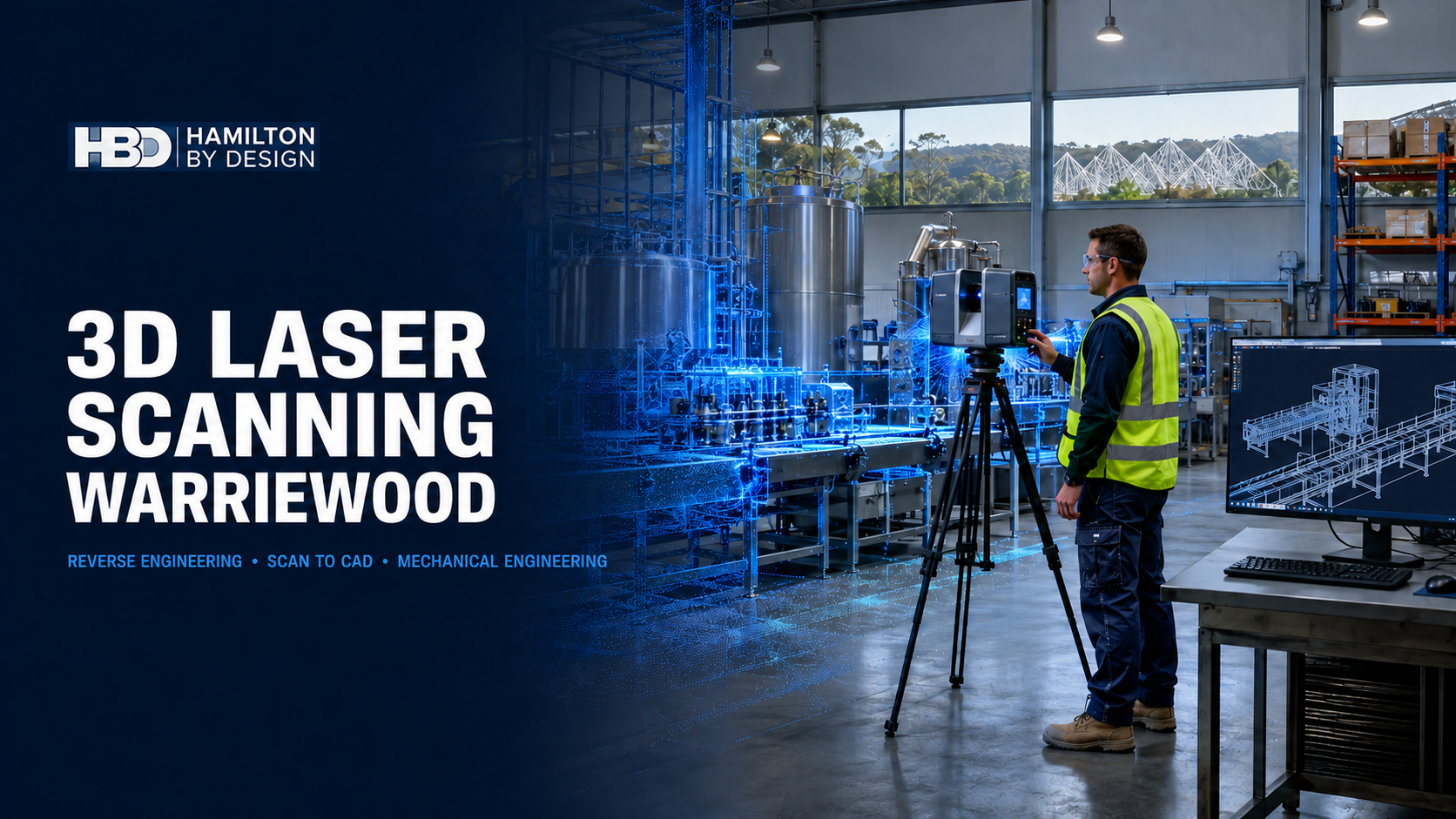
Mechanical engineer performing 3D laser scanning inside a Warriewood factory, with point-cloud data and a scan-to-CAD model.

3D Laser Scanning Warriewood and Engineering Support for Mona Vale Industry

Blue 3D LiDAR scanner icon on a tripod with scanning waves

The Warriewood and Mona Vale industrial area is an important employment precinct on Sydneyโ€™s Northern Beaches. Although the region is better known for its beaches, residential neighbourhoods and natural environment, it also supports light manufacturing, food-processing technology, electronic products, industrial equipment suppliers, workshops, warehousing and specialised technical businesses.

These operations depend on factories, machinery and physical components that must be maintained, modified and periodically replaced. However, the engineering information needed to undertake that work is not always complete. Original drawings may be unavailable, machinery may have been modified without documentation, and imported replacement parts can be difficult to obtain.

Hamilton By Design provides 3D scanning services in Sydney to help businesses capture existing facilities, machinery and equipment. The resulting point clouds and CAD models can support reverse engineering, factory modifications, equipment relocation, fabrication and long-term asset documentation.

A distinctive Northern Beaches industrial precinct

Warriewood and Mona Vale differ from the large industrial estates of Western Sydney. The precinct contains a mixture of factories, technical businesses, warehouses, workshops, offices and residential development within a relatively constrained coastal area.

Northern Beaches Council describes the regional economy as a combination of established industrial zones, manufacturing businesses, small and medium enterprises, โ€œmicro innovatorsโ€ and global companies. Warriewood contributes to this economy through a concentration of businesses around Jubilee Avenue, Daydream Street, Apollo Street, Ponderosa Parade and the surrounding industrial streets.

The precinct includes health-products production and distribution, food-processing machinery, electronics manufacturing, audiovisual technology, fabrication equipment, machinery servicing and warehouse operations. Businesses range from major facilities to smaller specialist workshops occupying strata industrial units.

At the same time, Warriewood Valley has undergone substantial residential and commercial growth. Northern Beaches Council states that the wider land-release area now covers approximately 195 hectares and anticipates 2,544 dwellings together with community infrastructure and employment-generating development.

This changing land-use pattern creates engineering challenges. Industrial operators must use their available floorspace efficiently while managing access, noise, drainage, delivery movements, equipment safety and their interfaces with surrounding properties.

From โ€œGlass Cityโ€ to a modern technology and industrial area

One of the most interesting aspects of Warriewood is its agricultural history.

During the middle of the twentieth century, Warriewood Valley was known as โ€œGlass Cityโ€ because approximately 3,500 glasshouses covered the area at the peak of production between 1947 and 1954. Many were used to grow tomatoes by migrant families from Italy and the former Yugoslavia.

This history remains visible in the names of local streets. Jubilee, Daydream, Apollo, Ponderosa and Prosperity were tomato varieties grown in Warriewood. Today, these names are associated with business premises, warehouses and industrial operations, but they preserve a direct connection to the valleyโ€™s earlier production economy.

Warriewood also contains an important environmental feature. The 26-hectare Warriewood Wetlands is described by Northern Beaches Council as the largest remaining low-lying freshwater sandplain ecosystem in northern Sydney. The wetlands contribute to flood mitigation, nutrient recycling and sediment filtration.

The relationship between industrial land, residential development, creeks and wetlands makes Warriewood unusual. Factory and warehouse projects may need to consider flooding, stormwater, equipment elevations, external access and environmental interfaces alongside normal production requirements.

Industrial operations in Warriewood and Mona Vale

The local business base demonstrates the range of engineering requirements that can arise within the precinct.

The Blackmores campus in Warriewood combines offices, production and distribution. Published information about the site describes a 25,000-square-metre facility, storage for approximately 5,000 pallets, a production and distribution operation running 24 hours a day for six days each week, and thousands of weekly shipments.

CBS Foodtech supplies and supports machinery used in food manufacturing. Its applications centre includes processes such as mincing, mixing, filling, cutting, slicing, cooking, smoking and packaging. These operations involve complex machinery, cleaning requirements, product flow, conveyors, access and guarding.

Pivot Electronics designs and manufactures electrical products for rail, utilities, industrial automation, mining, solar and telecommunications applications. Product-based businesses of this kind may require mechanical enclosures, brackets, mounting systems, prototype parts and controlled CAD records.

Amber Technology operates warehouse, service and technical-support activities for professional audiovisual, communications, security and entertainment equipment. Power Machinery Australia, based in Mona Vale, supplies and services equipment such as bandsaws, press brakes, guillotines, fibre lasers, folding machines and workshop machinery.

These companies are examples of the precinctโ€™s industrial character and are not represented as existing Hamilton By Design clients. They illustrate the types of local operations that may benefit from engineering services across Sydney.

Why existing-condition information matters

An engineering project is only as reliable as its starting information.

Factories commonly change over time. Machines are moved, platforms are added, pipework is rerouted and storage areas are reorganised. When these modifications are not incorporated into the facility drawings, later projects may be designed from information that no longer represents the actual installation.

Manual measurement can provide individual dimensions, but it may not adequately record the relationships between machinery, structures, services and access routes. Missed dimensions can cause fabrication errors, installation delays or the need for site modifications.

Hamilton By Design provides industrial 3D scanning in Sydney to capture the observable condition of a facility. A registered point cloud can record:

  • machinery positions;
  • floor and equipment levels;
  • building columns;
  • access platforms;
  • conveyors;
  • storage areas;
  • door openings;
  • services and pipe routes;
  • equipment clearances; and
  • surrounding structures.

The point cloud becomes a reference dataset from which plans, elevations, sections and three-dimensional models can be developed.

Factory scanning Warriewood

Factory scanning is particularly useful in Warriewood because many businesses operate within relatively constrained premises. New equipment may need to fit around existing machinery, racking, fire services, columns and production areas.

A scan can support the investigation of machinery footprints, maintenance access, operator space and installation routes before equipment is purchased or fabricated. It can also help determine whether an assembled machine can pass through an existing opening or whether it must be delivered in separate modules.

Hamilton By Designโ€™s 3D laser scanning for industrial plants connects reality capture with practical engineering requirements. The objective is not merely to create a visual point cloud. It is to produce information that can assist designers, fabricators, installers and asset owners.

For larger areas, Hamilton By Design can use a FARO Focus S70 terrestrial laser scanner. Smaller components and detailed product geometry may be captured using a component scanner. The appropriate method depends on the size of the subject, required accuracy, surface condition and intended deliverable.

Scan to CAD Warriewood

A point cloud contains large quantities of spatial information, but it is not automatically a fabrication or manufacturing model. Engineering interpretation is required to convert the captured surfaces into suitable CAD geometry.

Through point-cloud-to-CAD services, Hamilton By Design can create:

  • simplified equipment models;
  • factory layouts;
  • machinery envelopes;
  • existing-condition drawings;
  • mechanical assemblies;
  • fabricated components;
  • equipment interfaces; and
  • installation models.

The required level of detail should be established at the start of the project. A model intended for spatial coordination does not necessarily require every fastener and small feature. A model intended for component manufacture requires greater attention to datums, functional surfaces, tolerances, fits and material requirements.

Hamilton By Designโ€™s broader scan-to-CAD services in Sydney can provide outputs including STEP, Parasolid, DXF, PDF, E57 and Autodesk ReCap-compatible files, depending on the agreed scope.

Reverse engineering Mona Vale

Industrial and workshop machinery can remain in operation for decades. During that time, original suppliers may cease trading, parts may be discontinued and machinery may be modified to suit changing production requirements.

Reverse engineering and 3D scanning can help recover the geometry of an existing component. Potential examples include:

  • machine guards and covers;
  • brackets and mounting plates;
  • shafts and couplings;
  • housings;
  • change parts;
  • guides and product-contact components;
  • fabricated transitions;
  • equipment supports; and
  • replacement mechanical assemblies.

The physical component is scanned and interpreted to create suitable CAD geometry. Critical interfaces may also require manual measurement or other inspection methods, especially for threads, bores, bearing seats and inaccessible features.

A scan cannot independently identify material grade, heat treatment, design load or the original manufacturing tolerance. These matters should be established through available records, testing, operating information and engineering assessment.

The completed CAD model can provide a controlled technical baseline for local manufacture, modification or future replacement.

Mechanical engineering Northern Beaches

Hamilton By Design offers mechanical engineering services in Sydney that connect existing-condition capture with practical design development.

Services relevant to Warriewood and Mona Vale may include:

  • machinery and equipment design;
  • reverse engineering;
  • conveyor and materials-handling modifications;
  • equipment bases and support frames;
  • maintenance-access improvements;
  • machine guarding;
  • lifting-device design and verification;
  • production-layout studies;
  • static and fatigue FEA;
  • wear and existing-condition studies; and
  • fabrication support.

Potentially applicable standards include the AS/NZS 4024 Safety of Machinery series, AS ISO 12100 for machinery risk assessment and risk reduction, AS 3990 for mechanical equipment steelwork, AS 4100 for steel structures and AS/NZS 1554 for welded fabrication.

Platforms, walkways, stairs and ladders may require consideration of AS 1657. Lifting devices may fall within AS 4991, while cranes, hoists and their use may involve the AS 1418 and AS 2550 series.

The applicable standard depends on the machine, duty, material, hazards, site requirements and contractual scope. A standard should only be nominated after its relevance to the particular project has been established.

Mechanical drafting and fabrication documentation

A three-dimensional model communicates shape, but manufacturers also require clearly defined production information.

Hamilton By Design provides mechanical drafting services in Sydney for:

  • general arrangement drawings;
  • component and machining drawings;
  • fabrication drawings;
  • welded assemblies;
  • sheet-metal details;
  • flat patterns;
  • bills of materials;
  • exploded assemblies;
  • equipment layouts;
  • installation drawings; and
  • as-built records.

Technical drawings may be prepared with reference to AS 1100.101 for general drawing principles and AS 1100.201 for mechanical engineering drawing. Steelwork drawings may also need to reflect AS 3990, AS 4100, AS/NZS 1554 and the clientโ€™s fabrication requirements.

Dimensions, tolerances, materials, finishes, welds, datums and inspection requirements should be defined according to the intended manufacturing process. A scan-derived model should not be issued for manufacture without suitable review and engineering interpretation.

Hamilton By Design also offers 3D scanning for fabrication in Sydney, helping fabricators design against actual installation interfaces rather than incomplete or assumed dimensions.

Machinery safety and guarding

The Warriewoodโ€“Mona Vale precinct contains food-processing machinery, metalworking equipment, production machinery, conveyors and workshop plant. These assets can introduce cutting, crushing, drawing-in, entanglement, impact and ejection hazards.

Hamilton By Design can provide machine-guarding assistance including machinery surveys, fixed and removable guarding concepts, access layouts and fabrication drawings.

Three-dimensional scanning can record the actual positions of drives, frames, control panels, access platforms and surrounding obstructions. This allows guarding to be developed around the real installation.

A suitable risk review should consider:

  • normal operation;
  • cleaning;
  • adjustment;
  • fault finding;
  • maintenance;
  • foreseeable misuse;
  • isolation requirements;
  • guard removal; and
  • safe access.

The AS/NZS 4024 series and AS ISO 12100 provide important guidance for machinery risk reduction. SafeWork NSWโ€™s plant code also requires hazards to be identified and risks eliminated or minimised so far as reasonably practicable.

Specialist electrical, functional-safety, hazardous-area, food-hygiene or fire-engineering input may be required in addition to the mechanical scope.

Production and logistics improvements

Warriewood includes significant warehouse and distribution activity. Common issues include congested storage, inefficient picking routes, limited loading space and interaction between vehicles and pedestrians.

Hamilton By Designโ€™s manufacturing layout design services can use scanned existing conditions to investigate:

  • machinery placement;
  • pallet and storage areas;
  • conveyor routes;
  • pedestrian access;
  • forklift movements;
  • maintenance clearances;
  • loading and unloading areas;
  • emergency access; and
  • future production expansion.

Steel storage racking may require consideration of AS 4084.1:2023 and AS 4084.2:2023. Conveyors and powered machinery may involve the AS/NZS 4024 series. Lifting frames, spreaders and other lifting devices may require AS 4991, while cranes and hoists can involve the AS 1418 and AS 2550 series.

A digital layout allows alternatives to be compared before machinery, racks or services are physically moved.

Environmental and site risks

Warriewoodโ€™s low-lying landscape, creek system and proximity to the coast create additional considerations for industrial projects.

Potential issues include:

  • surface-water entry;
  • localised flooding;
  • restricted stormwater routes;
  • corrosion of external equipment;
  • slippery access surfaces;
  • environmental constraints;
  • equipment installed at unsuitable levels; and
  • reduced emergency or maintenance access during severe weather.

LiDAR scanning can record visible levels, drainage features, equipment positions and access routes. This information may assist further engineering, drainage or environmental assessments.

Hamilton By Design is a mechanical engineering consultancy. Specialist civil, hydraulic, structural, environmental or flood-engineering advice should be obtained where those disciplines govern the project.

Engineering data as a long-term asset

One of the enduring benefits of 3D scanning is the creation of a digital existing-condition record.

Hamilton By Design can retain agreed project information such as facility scans, equipment CAD, component geometry, drawings and dimensional records. A controlled dataset can reduce repeated site visits and provide a starting point for later modifications.

Good engineering data governance should distinguish between raw scans, working models, approved designs, fabrication revisions and final as-built information.

For smaller businesses, this approach creates greater continuity when staff, contractors or equipment suppliers change.

Frequently asked questions

What can Hamilton By Design scan in Warriewood?

Hamilton By Design can scan factories, warehouses, machinery, equipment interfaces, access systems and individual components. The selected scanning method depends on the asset size, required accuracy and intended output.

Can scanning be completed while a factory is operating?

Often it can. The scanning plan must consider moving machinery, people, restricted areas, hygiene requirements and site safety. Some areas may need controlled access or a shutdown period.

Is a point cloud the same as a CAD model?

No. A point cloud is captured spatial data. A CAD model is interpreted engineering geometry developed from that data. The modelling effort depends on the required detail and purpose.

Can Hamilton By Design reverse engineer an obsolete component?

Yes, subject to access, condition and the required accuracy. The physical geometry can be captured and reconstructed, but material properties, internal features and original design loads may require additional investigation.

Can the scan be used to check whether new machinery will fit?

Yes. Supplier models can be positioned within the scanned environment to investigate footprints, clearances, access and potential clashes before installation.

What file formats can be supplied?

Possible formats include E57, RCP, STEP, Parasolid, DXF, PDF and native SolidWorks files where included in the agreed deliverables.

Can Hamilton By Design provide fabrication drawings?

Yes. Drawings can be developed for components, guards, equipment supports, assemblies and installation arrangements. The content depends on the manufacturing process and project scope.

Can Hamilton By Design help with machine guarding?

Yes. Hamilton By Design can survey existing machinery, develop mechanical guarding concepts and prepare fabrication drawings with reference to applicable machinery-safety requirements.

Can warehouse and production layouts be developed from scans?

Yes. Point clouds can support layouts for equipment, racks, conveyors, access routes and production cells. They can also assist with relocation and future-expansion planning.

Does Hamilton By Design retain the project information?

Hamilton By Design can retain agreed facility scans, CAD models, component data, drawings and existing-condition records subject to the projectโ€™s confidentiality and data-management requirements.

Additional Sydney-wide resources include:

3D laser scanning Warriewood and Mona Vale

Warriewood and Mona Vale support a technically diverse group of manufacturers, equipment suppliers, food businesses, workshops, warehouses and technology companies. Their physical assets must operate within a constrained and changing coastal precinct.

Hamilton By Design can help these businesses document existing facilities, recover component geometry, plan equipment modifications and create practical manufacturing information.

By integrating 3D laser scanning Warriewood, reverse engineering Mona Vale, mechanical engineering Northern Beaches, factory scanning Warriewood and scan-to-CAD Warriewood, Hamilton By Design provides a coordinated pathway from the physical asset to controlled engineering data, CAD models and fabrication drawings.


Hamilton By Design logo displayed on a blue tilted rectangle with a grey gradient background

Contact Us – Talk To Us

Name
Would you like us to arrange a phone consultation for you?
Address

Our clients:


Reverse Engineering Brookvale | 3D Scanning & CAD

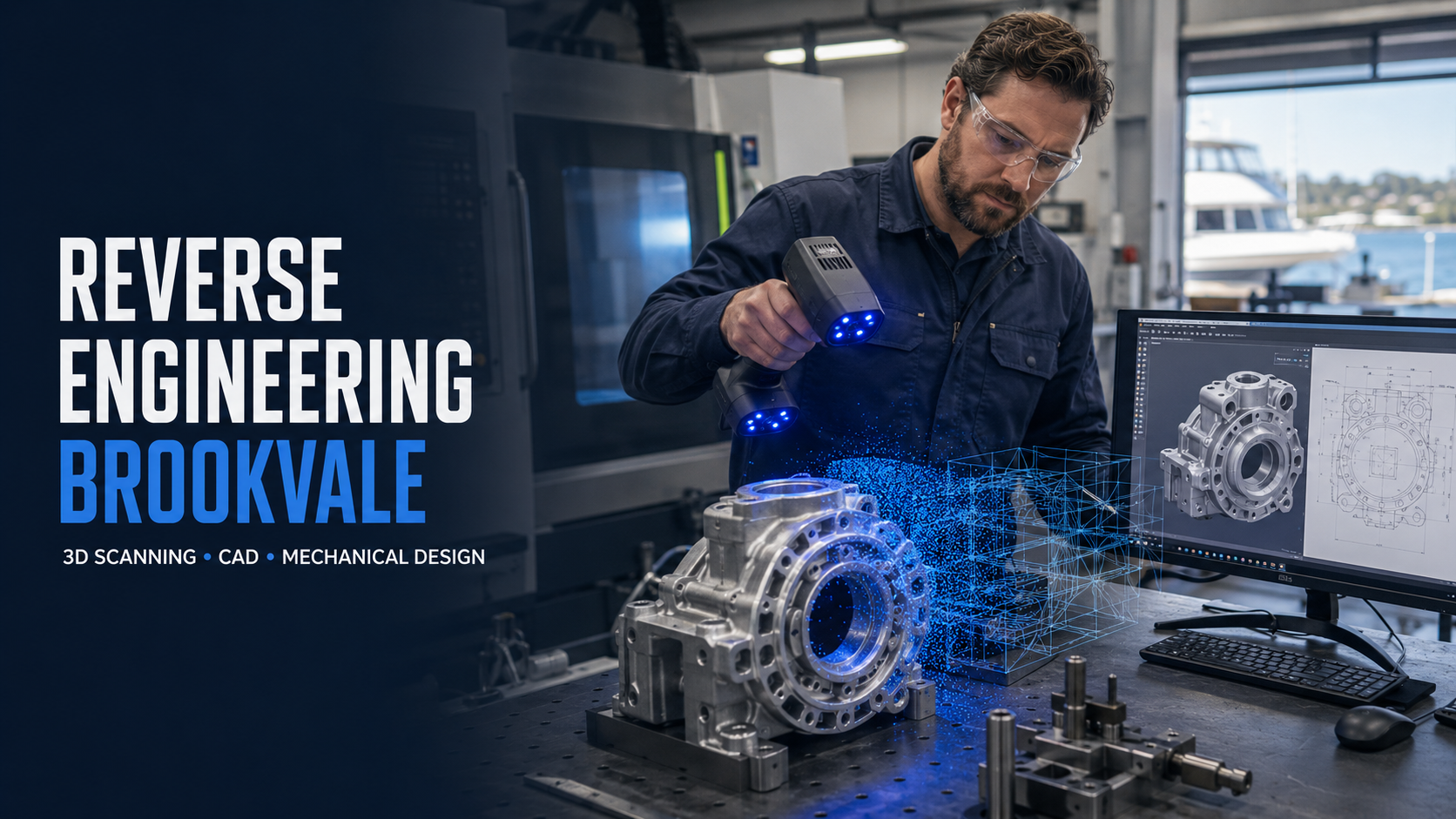
Mechanical engineer 3D scanning a machinery component for reverse engineering and CAD modelling in Brookvale, NSW.

Reverse Engineering Brookvale: 3D Scanning, Mechanical Design and Manufacturing Documentation

Blue 3D LiDAR scanner icon on a tripod with scanning waves

Brookvale is one of the Northern Beachesโ€™ most important employment and industrial centres. Although the suburb is widely associated with retailing and Warringah Mall, its broader economy includes precision manufacturing, CNC machining, electronics, marine technology, food and beverage production, steel supply, warehousing, surf products and specialised machinery.

These industries frequently depend on physical equipment and components for which accurate engineering information may be incomplete, outdated or unavailable. A machine may have been modified several times without its drawings being updated. An imported component may no longer be supported by its original manufacturer. A prototype may exist physically but not as an editable three-dimensional model. In each of these situations, reverse engineering provides a practical way to recover the necessary technical information.

Hamilton By Design provides reverse engineering and 3D scanning services in Sydney to help manufacturers, machinery owners, maintenance contractors and product developers convert existing physical assets into useful engineering data. Depending on the project, the resulting information may include component scans, point clouds, three-dimensional CAD models, fabrication drawings, machining information and dimensional inspection records.

Brookvaleโ€™s changing industrial character

Brookvale developed as an industrial centre during the twentieth century and remains the Northern Beachesโ€™ largest employment hub. Its industrial areas accommodate an unusually diverse mixture of production, workshop, warehouse, retail and creative activities.

The Brookvale Structure Plan adopted by Northern Beaches Council identifies the suburb as an employment and innovation centre. It seeks to preserve important industrial land while encouraging higher-value technical, commercial and creative employment. The plan anticipates approximately 900 additional jobs and recognises the importance of Brookvaleโ€™s industrial and urban-services land to the wider Northern Beaches economy.

The precinct already demonstrates this industrial diversity. Sorensen Engineering operates precision CNC manufacturing, robotics, prototyping and product-development facilities in Brookvale. Benbro Electronics manufactures power and communications products, including electronic assemblies, enclosures and cable harnesses. Electrotech Australia supplies and supports marine navigation and communications equipment, while Symetec supports food-processing machinery and spare parts.

Brookvale also contains brewing and distilling operations, including the 4 Pines Brewery headquarters and Manly Spirits Co. Distillery. Steel suppliers, automotive workshops, surfboard manufacturers, fabricators, food businesses and warehouse operators add further complexity to the local economy.

This combination creates opportunities for specialised engineering support. While the products differ, many businesses face the same fundamental problem: they need accurate information about an existing component, machine or facility before they can confidently repair, reproduce, modify or replace it.

What is reverse engineering?

Reverse engineering is the systematic process of examining an existing product or machine to understand its geometry, interfaces, materials and intended function. The objective is not simply to create a visual copy. Effective reverse engineering produces engineering information that can support decisions about manufacture, maintenance, design improvement and safety.

A typical project may begin with engineering-grade 3D scanning or detailed component scanning. The captured data records the observable surfaces of the component or installation. This data is then processed, reviewed and converted into suitable CAD geometry.

The required output depends on the clientโ€™s purpose. A visualisation model may only need to represent the overall shape. A replacement component may require careful reconstruction of mounting faces, shaft centres, hole patterns, fits, clearances and other functional features. A fabrication project may require a general arrangement, individual part drawings, weld details, materials and a bill of materials.

Hamilton By Designโ€™s point-cloud-to-CAD services in Sydney connect physical measurement with practical mechanical design and drafting. This means the scan is treated as engineering source data rather than as the final deliverable.

Why Brookvale businesses may need reverse engineering

Obsolete or unavailable replacement parts

Industrial machinery often remains operational for much longer than the commercial life of its individual components. Bearings and standard fasteners may remain available, but proprietary housings, covers, brackets, shafts, impellers, guides and change parts may no longer be supplied.

An obsolete component can potentially be scanned and reconstructed to create a controlled CAD model and manufacturing drawing. Where appropriate, the part can also be reviewed for improved materials, easier manufacture or increased service life.

Hamilton By Designโ€™s experience with reverse engineering replacement components in Sydney illustrates how physical parts can be converted into repeatable engineering records. The same general workflow can be applied to manufacturing, marine, food-processing and specialised product components in Brookvale.

Reverse engineering does not remove the need for engineering judgement. Material grade, heat treatment, surface finish, loading, tolerances and failure history may not be visible in a scan. These requirements must be established from operating information, testing, client records or an appropriate engineering assessment.

Missing or unreliable drawings

Many workshops possess machinery that has been moved, repaired or modified repeatedly. Drawings may represent the equipment when it was first installed but not its current configuration. In other cases, workshop knowledge may exist only in handwritten dimensions or in the experience of individual employees.

3D laser scanning for industrial plants in Sydney can capture the current spatial arrangement of machinery, structures, services and access areas. The resulting point cloud provides a permanent record of the observed condition at the time of scanning.

This information can support equipment relocation, new production lines, conveyor modifications, access improvements and installation planning. It can also reduce dependence on repeated site measurement and preserve knowledge that could otherwise be lost when personnel or contractors change.

Components that are difficult to measure manually

Curved housings, castings, moulds, composite products and fabricated transitions can be difficult to describe using rulers and callipers alone. Manual measurement remains important, particularly for critical functional dimensions, but dense three-dimensional surface capture can provide a more complete representation of complex shapes.

For smaller components, detailed component scanning can capture product geometry for reconstruction in SolidWorks. For factories, machinery and larger installations, terrestrial LiDAR can record the surrounding environment. Combining these methods allows both detailed part geometry and the wider installation context to be considered.

Hamilton By Design can use 3D scanning and CAD modelling to identify equipment interfaces, access constraints and surrounding obstructions before a replacement or modification is fabricated.

From physical component to manufacturing information

A reverse-engineering project normally follows a controlled series of stages.

First, the required outcome is defined. The team must establish whether the client needs a reference model, replacement component, dimensional comparison, modification design or complete fabrication package. Required accuracy, critical features and proposed manufacturing processes should be agreed before scanning begins.

Second, the component or machinery is inspected and captured. Small objects may be scanned using a detailed component scanner, while machinery and factory environments may be recorded using a FARO terrestrial laser scanner. Supplementary manual measurements may be taken for bores, threads, bearing seats, hidden faces and other features that cannot be fully observed.

Third, the data is processed and checked. Noise, unwanted geometry and incomplete areas are identified. Multiple scans may be registered into a common coordinate system, and the processed data can then be transferred into the selected modelling environment.

Fourth, the engineering geometry is reconstructed. This may involve creating parametric features, surfaces, reference planes, axes, hole patterns and assembly interfaces. The resulting model should represent the intended functional geometry rather than reproduce every instance of wear, damage or distortion without interpretation.

Finally, the necessary documentation is prepared. Hamilton By Designโ€™s mechanical drafting services in Sydney can provide general arrangements, component drawings, welded-assembly drawings, sheet-metal details, bills of materials and installation drawings.

Depending on the project, deliverables may include STEP, Parasolid, DXF, native SolidWorks files, PDFs, E57 point clouds or Autodesk ReCap files.

Supporting machinery and production improvements

Reverse engineering is not limited to reproducing broken parts. It can also provide the foundation for improving equipment and production systems.

Hamilton By Design offers mechanical engineering services in Sydney for machinery design, plant modifications, equipment supports, access arrangements, fabrication documentation and engineering studies. For a Brookvale manufacturer, this could include redesigning a recurring failure point, developing a new mounting arrangement or adapting an existing machine for a different product.

Factories with limited floor area may benefit from a scanned layout before new equipment is purchased. A three-dimensional model can be used to investigate operating clearances, maintenance access, product flow, forklift movements and installation paths. Hamilton By Designโ€™s manufacturing layout design services can combine existing-condition data with proposed equipment to support more informed planning.

For businesses operating from compact industrial units, this approach can be particularly valuable. Brookvale has limited industrial land and a mixture of older buildings, modern strata warehouses and intensively occupied workshops. Equipment must often be installed without interrupting neighbouring operations or unnecessarily reducing production space.

Fabrication drawings and Australian Standards

A CAD model is not automatically sufficient for manufacture. Fabricators and machinists need clear information defining dimensions, tolerances, materials, finishes, welds, interfaces and inspection requirements.

Hamilton By Design provides 3D scanning for fabrication in Sydney and can develop:

  • general arrangement drawings;
  • component and machining drawings;
  • fabrication drawings;
  • welded-assembly drawings;
  • sheet-metal details and flat patterns;
  • bills of materials;
  • equipment layouts;
  • installation drawings; and
  • as-built documentation.

Technical drawings may be prepared with reference to the applicable parts of AS 1100, including AS 1100.101 for general drawing principles and AS 1100.201 for mechanical engineering drawing. Fabricated steelwork may also require consideration of AS 3990, AS 4100 and the relevant parts of AS/NZS 1554.

Standards must be selected according to the actual component, duty, material, fabrication process and client specification. Listing a standard on a drawing is not a substitute for determining whether it governs the particular design.

Machinery safety and risk reduction

Machinery modifications can create new hazards or expose risks that were not adequately controlled in the original arrangement. Common issues include accessible rotating components, crushing and shearing points, conveyor nip points, inadequate maintenance access, poor isolation arrangements and guards that are difficult to remove or replace safely.

Hamilton By Designโ€™s machine-guarding services can assist with machinery surveys, guarding concepts, access layouts and fabrication documentation. Three-dimensional scanning is useful because it records the position of drives, frames, controls, walkways and surrounding obstructions. A guard can then be designed around the actual installation rather than an assumed arrangement.

Potentially applicable standards include the AS/NZS 4024 Safety of Machinery series, AS ISO 12100 for machinery risk assessment and risk reduction, and AS 1657 for platforms, walkways, stairways and ladders. Lifting devices may require assessment under AS 4991, while cranes, hoists and associated operations may involve the AS 1418 and AS 2550 series.

The broader risk-management process can be aligned with AS ISO 31000:2018. This involves identifying hazards, analysing exposure and consequences, evaluating existing controls, selecting appropriate risk treatments and recording residual risks.

Hamilton By Design can assist with the mechanical engineering and documentation aspects of this process. Specialist electrical, functional-safety, hazardous-area or process-safety advice may also be required, depending on the equipment.

Engineering data as a long-term asset

One of the most valuable outcomes of reverse engineering is the creation of a controlled engineering record.

Hamilton By Design can retain component scans, CAD models, product geometry, fabrication drawings and dimensional records, subject to the agreed project and confidentiality requirements. Rather than repeating the complete measurement process when another part is required, the client can return to an established technical baseline.

Version control is particularly important when a product continues to evolve. The approved model and drawing should be distinguishable from preliminary scans, superseded revisions and workshop mark-ups. Hamilton By Designโ€™s approach to engineering data governance can support controlled reviews, revision history and collaborative access.

For smaller Brookvale manufacturers, this creates some of the discipline associated with a larger engineering department without requiring the business to maintain every specialist capability internally.

A practical Brookvale engineering workflow

For a typical Brookvale project, Hamilton By Design can:

  1. Review the component, machinery problem or proposed modification.
  2. Define the required accuracy, outputs and critical interfaces.
  3. Scan the component, machine or surrounding factory area.
  4. Process and verify the captured data.
  5. Develop a suitable CAD model.
  6. Review function, access, manufacture and safety.
  7. Prepare drawings for quotation, manufacture or installation.
  8. Incorporate fabrication feedback and controlled revisions.
  9. Retain the agreed engineering records for future use.

This integrated scan, model, engineer and document approach helps reduce dimensional assumptions between the existing asset and the proposed solution.

Frequently asked questions

What types of components can be reverse engineered?

Potential examples include shafts, housings, guards, brackets, covers, impellers, machine change parts, fabricated transitions, moulded products and equipment interfaces. Suitability depends on access, component size, surface condition, required accuracy and the information needed for manufacture.

Can a component be reverse engineered without an original drawing?

Yes. A physical component can provide the starting geometry. However, material specifications, heat treatment, design loads, tolerances and intended performance may require additional investigation because these properties cannot necessarily be determined from surface geometry.

Is 3D scanning accurate enough for manufacturing?

It can be, provided the selected scanner, scanning method and verification process are suitable for the required tolerance. Critical bores, fits, threads and inaccessible features may require supplementary measurement. Accuracy requirements should be agreed before work begins.

Can machinery be scanned while the factory is operating?

In many cases, yes. The scanning plan must consider moving equipment, personnel, restricted areas, reflective surfaces and site safety requirements. Some areas may need to be captured during a shutdown or controlled access period.

What CAD and point-cloud formats can be supplied?

Typical formats include STEP, Parasolid, DXF, PDF, E57 and Autodesk ReCap-compatible files. Native SolidWorks models may also be provided when included in the agreed deliverables.

Can Hamilton By Design prepare drawings for local manufacture?

Yes. Hamilton By Design can produce machining, fabrication and assembly drawings for review by the selected manufacturer. Final requirements depend on the component, material, manufacturing process and applicable standards.

Can reverse engineering improve an existing component?

Yes. Once the existing geometry and operating requirements are understood, the component may be reviewed for manufacturability, maintenance, material selection, strength, weight or service life. Any change should be assessed against the componentโ€™s function and loading.

Does Hamilton By Design provide machinery guarding assistance?

Yes. Hamilton By Design can survey existing machinery, identify mechanical guarding requirements, develop guarding concepts and prepare fabrication drawings with reference to the applicable AS/NZS 4024 requirements.

Can factory layouts be created from point clouds?

Yes. Point-cloud data can support existing-condition plans, equipment layouts, sections and three-dimensional coordination models. These can be used for equipment relocation, new production cells, conveyors, storage systems and maintenance-access planning.

Does Hamilton By Design service the wider Sydney region?

Yes. Hamilton By Design provides engineering services across Sydney, including industrial 3D scanning, scan-to-CAD services, 3D point-cloud modelling and SolidWorks design services.

Reverse engineering support for Brookvale

Brookvaleโ€™s combination of established manufacturing, specialised products, marine technology, food production and growing warehouse activity creates a strong need for accurate, adaptable engineering information.

Hamilton By Design can help Brookvale businesses recover missing component geometry, document existing machinery, develop product improvements, plan factory modifications and prepare controlled fabrication information. By integrating component scanning, LiDAR capture, CAD modelling, mechanical engineering and drafting, physical assets can be converted into practical information for maintenance, manufacture and future development.

For businesses searching for reverse engineering Brookvale, 3D scanning Brookvale, mechanical engineering Brookvale, machinery scanning Northern Beaches or fabrication drawings Brookvale, Hamilton By Design provides an engineering-led pathway from the existing physical asset to usable CAD models and manufacturing documentation.


Hamilton By Design logo displayed on a blue tilted rectangle with a grey gradient background

Contact Us – Talk To Us

Name
Would you like us to arrange a phone consultation for you?
Address

Our clients:
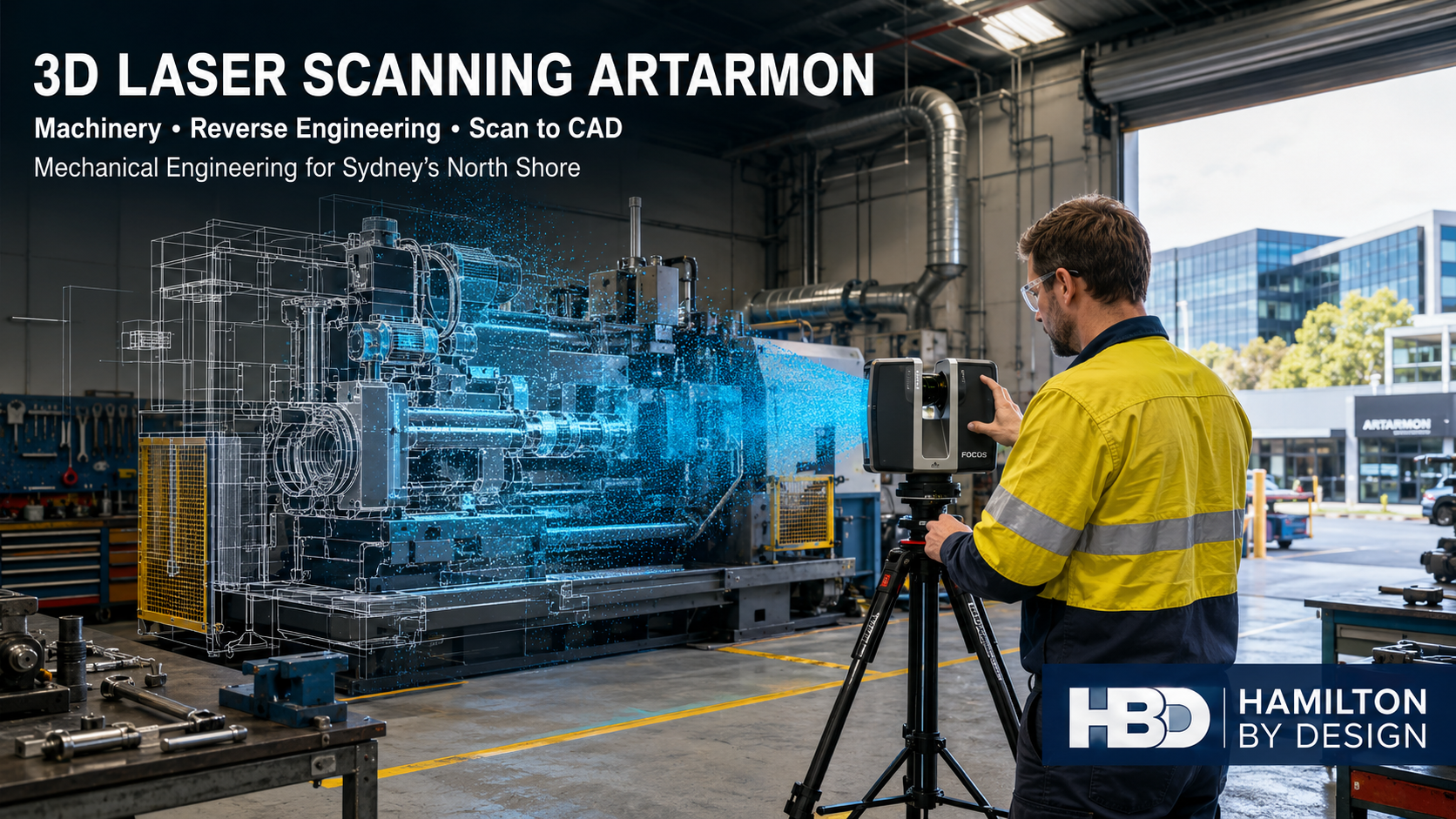


3D Laser Scanning Artarmon | Reverse Engineering & CAD

Hamilton By Design engineer using a 3D laser scanner to capture industrial machinery in an Artarmon workshop for reverse engineering and scan-to-CAD modelling.

Laser Scanning Artarmon: Machinery, Reverse Engineering and CAD Support

Blue 3D LiDAR scanner icon on a tripod with scanning waves

Artarmon is one of Sydneyโ€™s most strategically positioned urban industrial areas. Located close to the Sydney CBD, North Sydney, Chatswood and St Leonards, the precinct supports a diverse combination of specialised manufacturing, automotive servicing, machinery maintenance, broadcasting, construction materials, warehousing, logistics and technical businesses.

This industrial diversity creates a particular engineering challenge. Many Artarmon businesses operate from established facilities containing machinery, services and building elements that have been modified progressively over many years. Original drawings may be incomplete, existing layouts may not reflect actual site conditions, and replacement components may no longer be available from the original manufacturer.

Hamilton By Design provides engineering-led 3D laser scanning in Artarmon, supported by reverse engineering, mechanical design, point-cloud processing and CAD drafting. These services help businesses understand what currently exists, plan modifications with greater confidence and retain dependable engineering information for future maintenance and asset management.

Our wider 3D laser scanning services for Sydney combine site capture with practical mechanical and digital-engineering experience. This means the scan is not treated merely as a visual record. It becomes the foundation for drawings, equipment layouts, replacement parts, fabrication models, clearance assessments and safer brownfield modifications.

Supporting Artarmonโ€™s diverse industrial character

Artarmon is significantly different from a conventional outer-metropolitan industrial estate. It is a compact urban-services precinct with close connections to the Pacific Highway, Gore Hill Freeway, Lane Cove Tunnel and Sydneyโ€™s North Shore commercial and healthcare centres.

Its industrial character includes:

  • Automotive dealerships, service centres and repair workshops
  • Specialised manufacturing and engineering workshops
  • Concrete-production and construction-material facilities
  • Waste transfer and resource-recovery operations
  • Broadcasting, media and technical facilities
  • Warehouses and integrated officeโ€“distribution operations
  • Bulky-goods retail and trade supplies
  • Medical-equipment and hospital-support businesses
  • Machinery servicing and maintenance providers
  • Building-services and technical contractors

These businesses may operate very different equipment, but they often face similar engineering problems: restricted floor space, incomplete records, congested services, limited shutdown periods and the need to modify existing facilities without disrupting normal operations.

Hamilton By Designโ€™s broader Greater Sydney 3D scanning and digital-twin services are particularly applicable to these brownfield conditions. Accurate point-cloud data allows project teams to work from the physical facility rather than relying solely on drawings that may be outdated.

What is engineering-grade 3D laser scanning?

A terrestrial laser scanner captures large numbers of spatial measurements from the surfaces around it. Together, these measurements create a three-dimensional point cloud representing the visible geometry of machinery, buildings, structural elements, pipework, services and other physical assets.

Multiple scans can be registered into a common coordinate system to create a coordinated record of the required work area. Depending on the project scope, this data can then be supplied as a registered point cloud or converted into engineering deliverables.

Typical deliverables include:

  • E57, RCP, RCS or LAS point-cloud files
  • Existing facility and workshop layouts
  • Plans, elevations and sections
  • General arrangement drawings
  • SolidWorks machinery and equipment models
  • AutoCAD drawings
  • STEP, Parasolid and DXF files
  • Simplified coordination models
  • As-built drawings
  • Fabrication and manufacturing documentation
  • Clearance and clash-review models

Hamilton By Designโ€™s 3D laser scanning for engineering projects is intended to connect reality capture with a defined engineering purpose. Before scanning begins, the required deliverables, areas of interest, critical interfaces, coordinate requirements and appropriate level of detail should be established.

This is important because a visually impressive point cloud is not automatically an engineering model. The dataset must be captured, registered, checked and interpreted according to the decisions it is expected to support.

Machinery scanning in Artarmon

Machinery scanning is valuable when equipment must be modified, relocated, documented or integrated with new systems. Conventional hand measurement can be effective for simple components, but it becomes difficult when a machine contains complex geometry, inaccessible surfaces or numerous interfaces.

An engineering scan can capture:

  • Overall machine envelopes
  • Mounting points and baseplates
  • Connections and service interfaces
  • Guarding arrangements
  • Operator and maintenance access
  • Adjacent columns, walls and equipment
  • Platforms, stairs and walkways
  • Pipework and ducting near the machine
  • Overhead restrictions
  • Removal and installation routes

The scan can then be used to develop a simplified but accurate CAD representation. Rather than modelling every bolt or minor feature, the model can concentrate on the geometry required for the project.

For example, an automotive workshop may need to install a new vehicle lift, exhaust-extraction system or specialised test machine. A manufacturing business may need to extend an existing machine, add guarding or replace a feed arrangement. A technical facility may need new equipment installed around existing cable trays, cooling services and access routes.

Hamilton By Designโ€™s mechanical engineering services for plant and production problems can connect the captured geometry with practical modification design, equipment layouts and production-focused engineering decisions.

Reverse engineering obsolete components

Artarmonโ€™s machinery, automotive and specialist technical businesses may operate equipment for which original drawings, replacement parts or OEM support are no longer available. Replacing an entire machine because one component is obsolete can be financially inefficient and operationally disruptive.

Reverse engineering provides another option.

The process may include:

  1. Examining the component and understanding its function.
  2. Recording its relationship with the surrounding assembly.
  3. Scanning or measuring the existing geometry.
  4. Identifying worn, damaged or deliberately modified features.
  5. Reconstructing the intended geometry in CAD.
  6. Reviewing materials, tolerances and manufacturing methods.
  7. Producing a manufacturing model and controlled drawing.
  8. Supporting prototype manufacture, fit checking and testing.

This process requires engineering judgement. A worn component should not always be copied exactly because the scanned surface may represent damage rather than the original design. Critical dimensions, fits, sealing surfaces, load paths and operating conditions must be considered.

Hamilton By Designโ€™s approach to 3D laser scanning for engineering integrates physical measurement with CAD modelling and mechanical assessment. Where necessary, stress calculations or finite element analysis can be considered, subject to the information available and the significance of the component.

Reverse-engineered deliverables can include SolidWorks models, STEP files, Parasolid files, DXF profiles, machining drawings, fabrication drawings, assembly drawings and bills of materials.

Scan to CAD for brownfield modifications

Brownfield engineering begins with an existing asset or facility. This creates a different set of constraints from greenfield design because the new work must fit around what is already present.

Common brownfield risks include:

  • Existing drawings not matching the site
  • Previously undocumented modifications
  • Services crossing the proposed installation area
  • Insufficient maintenance access
  • Equipment that cannot pass through available openings
  • Structural or mechanical interfaces in unexpected locations
  • Fabrication based on assumed dimensions
  • New guarding conflicting with normal operations
  • Inadequate installation or lifting space

Hamilton By Designโ€™s CAD services in Sydney can convert point-cloud information into engineering-ready models and drawings. Depending on the project, this may include an existing-condition model, a proposed design model and a combined model used for spatial coordination.

The practical workflow is:

scan โ†’ register โ†’ model โ†’ engineer โ†’ detail โ†’ review โ†’ fabricate

This process reduces the dependence on repeated site measurement and provides designers, operators and fabricators with a shared spatial reference.

It does not remove the need for engineering review or installation planning. Instead, it improves the quality of information used in those activities.

Mechanical engineering for equipment modifications

Three-dimensional scanning establishes geometry, but geometry alone does not determine whether a modification is safe, functional or suitable for manufacture.

Hamilton By Design can support Artarmon clients with mechanical engineering for:

  • Machinery modifications
  • Equipment relocation
  • Machine bases and support frames
  • Guards, covers and barriers
  • Maintenance platforms and access
  • Brackets, frames and enclosures
  • Conveyor and material-handling modifications
  • Lifting attachments
  • Component replacement
  • Workshop and production layouts
  • Fabrication support
  • Load and clearance assessments
  • Preliminary FEA where appropriate

The companyโ€™s mechanical engineering services in Sydney can be delivered as a defined in-house package or integrated with the clientโ€™s existing project, maintenance or fabrication team.

Relevant Australian Standards depend on the equipment and the nature of the modification. They may include the AS/NZS 4024 machinery-safety series, AS ISO 12100 for machinery risk assessment, AS 1657 for fixed access, AS 3990 for mechanical equipment steelwork, AS 4991 for lifting devices and relevant parts of AS 1418 and AS 2550 for lifting equipment.

Where structural, electrical, fire or other specialist disciplines are involved, those aspects should be reviewed by appropriately qualified practitioners.

Mechanical drafting and manufacturing documentation

Good engineering information must be communicated clearly. A 3D model may assist visualisation, but workshops, fabricators, machine shops and site teams still require controlled documentation.

Hamilton By Design can prepare:

  • General arrangement drawings
  • Part and assembly drawings
  • Fabrication drawings
  • Machining drawings
  • Sheet-metal developments
  • Welded assembly details
  • Equipment and workshop layouts
  • Installation drawings
  • Exploded assembly views
  • Bills of materials
  • As-built drawings
  • DXF cutting profiles
  • STEP and Parasolid models
  • Revision-controlled drawing packages

The CAD and drafting services available in Sydney can also support drawing registers, revision tracking and issue statuses such as Issue for Review, Issue for Approval and Issue for Construction.

Where relevant, drawings can be prepared with reference to the AS 1100 technical-drawing series. Project-specific documentation should clearly communicate critical dimensions, tolerances, materials, finishes, weld requirements, interfaces and revision status.

Machinery safety and risk management

Modifying an existing machine may introduce new hazards even when the modification appears minor. A relocated guard may create a reach-through hazard. A new access platform may restrict emergency egress. Moving equipment may introduce a collision risk between forklifts and pedestrians.

Hamilton By Design can assist with engineering-focused risk reduction by documenting existing conditions and considering hazards such as:

  • Rotating and reciprocating components
  • Crushing and shearing points
  • Drawing-in and entanglement hazards
  • Ejected materials or failed components
  • Unexpected movement
  • Maintenance and isolation access
  • Falls from platforms or machinery
  • Vehicle and pedestrian interaction
  • Manual handling
  • Restricted emergency access

Three-dimensional scanning can make these risks easier to understand because proposed controls can be modelled in their actual physical context. Guards, barriers, access platforms and exclusion zones can be reviewed against the surrounding machinery before fabrication begins.

Risk management should follow a systematic process: identify hazards, assess credible consequences, apply the hierarchy of controls, document residual risks and review the effectiveness of the completed modification.

Logistics, warehousing and workshop layouts

Artarmonโ€™s proximity to major arterial roads supports warehousing, local distribution, trade supplies and automotive operations. However, its urban location also creates constrained sites, limited parking and frequent interaction between delivery vehicles, forklifts, workers and visitors.

Facility scanning can assist with:

  • Warehouse and workshop layouts
  • Loading and unloading zones
  • Storage-racking arrangements
  • Pedestrian and forklift separation
  • Bollards and impact protection
  • Equipment and production-flow planning
  • Material-handling systems
  • Truck access
  • Maintenance routes
  • Emergency access
  • Equipment relocation
  • Clearance beneath services and structures

Applicable requirements may include AS 4084 for steel storage racking, AS/NZS 4024.3610 for conveyors, AS 1657 for fixed access and relevant workplace traffic-management guidance.

A coordinated model allows safety, operations and engineering personnel to review a proposed layout together. This is particularly useful where additional equipment must be introduced without reducing access, storage capacity or operational safety.

From point cloud to digital asset record

The value of a scan does not necessarily end when the immediate project is completed. Properly managed data can become part of the organisationโ€™s engineering information system.

Hamilton By Design can retain:

  • Registered facility point clouds
  • Machine scans
  • CAD models
  • Workshop and warehouse layouts
  • Replacement-part models
  • Fabrication and machining drawings
  • Equipment interfaces
  • Revision histories
  • As-built project data

The principles discussed in digital twin creation and long-term asset management are relevant to Artarmon facilities that expect continuing modification, maintenance or tenancy change.

For larger facilities, selected information can also be incorporated into a Scan to BIM workflow. The appropriate approach depends on the intended use. A mechanical workshop may need fabrication-ready equipment geometry, while a commercial or technical facility may require a broader coordination or asset-management model.

Why use an engineering-led scanning service?

The most important question is not simply, โ€œHow accurately can the scanner measure?โ€ It is, โ€œWhat decision must be made using the resulting information?โ€

An engineering-led service considers:

  • Why the area is being scanned
  • Which interfaces are critical
  • What level of detail is necessary
  • Which output formats the client can use
  • Whether the model is for coordination, fabrication or asset records
  • How scanning uncertainty affects the design
  • Whether verification measurements are required
  • How data and revisions will be managed
  • What specialist reviews are needed

Hamilton By Design combines reality capture with mechanical engineering, reverse engineering and drafting. Its wider Sydney LiDAR scanning services support projects from initial site capture through to usable engineering documentation.

Examples of related applications can also be found through Hamilton By Designโ€™s engineering and 3D scanning case studies.

Frequently asked questions

What can be scanned in an Artarmon industrial facility?

Hamilton By Design can scan machinery, workshops, warehouses, plantrooms, equipment layouts, access platforms, structural interfaces, pipework and other visible facility elements. Smaller components may require a dedicated close-range scanning or measurement method.

Can machinery be scanned while a facility remains operational?

Often it can, provided the scan can be completed safely and moving people, vehicles or equipment do not prevent reliable data capture. Restricted or hazardous areas may require isolation, barricading, an escort or scanning during a planned quiet period.

How accurate is 3D laser scanning?

Accuracy depends on the scanner, range, environment, surface condition, scan geometry and registration method. Component reverse engineering and whole-facility capture may require different instruments and verification methods. Accuracy requirements should therefore be defined during scoping rather than assumed.

Can the point cloud be converted into SolidWorks or AutoCAD?

Yes. Required geometry can be converted into SolidWorks models, AutoCAD drawings, STEP files, Parasolid files, DXF profiles or simplified coordination models. The level of modelling should be selected according to the intended engineering use.

Can Hamilton By Design recreate an obsolete replacement part?

Potentially. The component must first be inspected to understand its function, damage, wear, interfaces, material and operating conditions. The objective is to reconstruct the intended functional geometry rather than blindly reproduce a worn surface.

Can scanning assist with machinery guarding?

Yes. Scanning can capture the machine, access routes, operating positions and surrounding obstructions. This information can support the design of guards, barriers and maintenance access with reference to the AS/NZS 4024 machinery-safety series.

Is a point cloud the same as a CAD model?

No. A point cloud is a measured collection of spatial points. A CAD model is interpreted geometry created for a defined purpose. Hamilton By Design can supply the registered point cloud, develop selected CAD geometry or provide both.

Can scanning help relocate machinery?

Yes. The existing machine and destination facility can be captured and compared. The resulting information can support equipment-envelope checks, access-route planning, service coordination, baseplate design and maintenance-clearance assessment.

What information can Hamilton By Design retain?

Subject to the agreed scope and data arrangements, Hamilton By Design can retain machine scans, facility point clouds, CAD models, layouts, replacement-part data and controlled drawings for future maintenance or modification work.

Does Hamilton By Design service areas near Artarmon?

Yes. Hamilton By Design supports projects across Artarmon, Chatswood, St Leonards, North Sydney and Greater Sydney. Related regional coverage is outlined on the Engineering and 3D Scanning Services NSW page, while Sydney construction applications are discussed in Building with Precision: 3D Scanning and LiDAR Modelling.

Discuss a 3D laser scanning project in Artarmon

Whether the requirement involves an undocumented machine, an obsolete component, a workshop modification or a complete facility layout, accurate existing-condition information provides a stronger basis for engineering decisions.

Hamilton By Design provides 3D laser scanning in Artarmon, reverse engineering, mechanical design, scan-to-CAD and engineering drafting for industrial, automotive, technical, warehousing and urban-service businesses across Sydneyโ€™s North Shore.

Our approach connects the physical asset with practical engineering deliverables:

scan โ†’ model โ†’ engineer โ†’ document โ†’ modify

Contact Hamilton By Design to discuss machinery scanning, reverse engineering, facility documentation or equipment modifications in Artarmon and the surrounding North Sydney region.


Hamilton By Design logo displayed on a blue tilted rectangle with a grey gradient background

Contact Us – Talk To Us

Name
Would you like us to arrange a phone consultation for you?
Address

Our clients:


Industrial 3D Laser Scanning Kurnell | Hamilton By Design

Industrial 3D Laser Scanning Kurnell NSW: Accurate Data for Fuel Terminals, Process Plants and Brownfield Engineering

Blue 3D LiDAR scanner icon on a tripod with scanning waves

Kurnell occupies a distinctive position within Sydneyโ€™s industrial landscape. Located on the southern side of Botany Bay, the area combines fuel-import infrastructure, tank farms, pipelines, water-processing facilities, resource-recovery operations, marine interfaces and former refinery land undergoing continuing transformation.

These facilities are very different from a new industrial development constructed from a coordinated set of current drawings. Much of Kurnellโ€™s infrastructure has been modified, extended, repaired or repurposed over many years. Consequently, the arrangement that exists on site may no longer agree with the original engineering documentation.

Hamilton By Design provides industrial 3D laser scanning in Kurnell to help asset owners, engineers, maintenance teams, contractors and fabricators establish an accurate understanding of existing conditions. Our engineering-led workflow combines terrestrial LiDAR scanning, point-cloud processing, scan-to-CAD modelling, mechanical engineering and technical drafting.

The objective is straightforward: capture the plant as it actually exists before new equipment, pipework, structural supports or access systems are designed.

Hamilton By Design provides these capabilities across the wider metropolitan area through its established 3D laser scanning services in Sydney and its broader engineering and 3D scanning services throughout NSW.

Why Kurnell Requires an Engineering-Led Scanning Approach

Kurnellโ€™s industrial environment includes operating fuel infrastructure, tanks, process pipework, pumping systems, treatment equipment, loading areas, marine-transfer infrastructure and extensive utility networks. The area also includes sensitive coastal and environmental interfaces that can affect access, construction methodology and project planning.

These conditions create several recurring engineering challenges:

  • Original drawings may be incomplete or out of date.
  • Plant modifications may not have been incorporated into the drawing register.
  • Tanks, pipework and structural members can obstruct conventional measurement.
  • Access may be restricted by operational, environmental or safety controls.
  • Shutdown periods may provide only a limited opportunity to complete physical work.
  • New equipment must often fit within congested existing infrastructure.
  • Prefabricated components need to arrive on site with a high probability of fitting correctly.

Traditional measurement remains useful for individual dimensions, but it becomes inefficient when hundreds or thousands of spatial relationships must be understood. A terrestrial laser scanner captures a dense three-dimensional record of visible surfaces. Multiple scan positions can then be registered into a coordinated point cloud representing the accessible plant environment.

Hamilton By Design applies this method to capture existing conditions before plant upgrades, helping project teams begin design with better evidence.

3D Scanning Fuel Terminals, Tanks and Pipework

Fuel terminals contain highly interconnected assets. Tanks, pumps, valves, manifolds, transfer lines, pipe racks, platforms, bunds and drainage systems must work together within an established operating environment.

A dimensional error at one interface can have consequences elsewhere. An incorrectly positioned flange may affect a complete pipe spool. An inaccurate support location may prevent the installation of new pipework. An overlooked platform member can obstruct valve access, while an undocumented service may conflict with proposed excavation or foundation work.

Industrial 3D laser scanning can assist with:

  • Tank location and external-geometry capture
  • Tank-nozzle and flange-position verification
  • Pipework-route documentation
  • Pipe-rack and support modelling
  • Pump, valve and manifold replacement projects
  • Bund, drainage and containment-area surveys
  • Loading and unloading infrastructure
  • Access-platform and stair documentation
  • Maintenance-clearance assessments
  • Proposed tie-in verification
  • Demolition and retained-asset boundaries
  • Post-installation as-built records

Kurnellโ€™s connection with marine fuel movements also makes Hamilton By Designโ€™s experience in 3D scanning for Sydney ports and marine infrastructure particularly relevant. Where detailed engineering models are required, point-cloud information can be transformed through scan-to-CAD services for Sydney port projects.

Laser scanning records visible geometry and spatial position. It does not, by itself, determine tank-wall thickness, internal corrosion, material properties or remaining service life. These matters require appropriate inspection records, non-destructive testing and engineering assessment. The value of scanning is that it establishes a reliable geometric basis to which those additional forms of asset information can be connected.

Process Plant and Water Infrastructure at Kurnell

Kurnell is also home to major water-processing infrastructure. Desalination facilities contain pumps, filters, pressure pipework, valves, chemical systems, process vessels, access structures and extensive mechanical and electrical interfaces.

Brownfield work in these environments may involve replacing pumps, rerouting pipework, modifying platforms, improving maintenance access or introducing new treatment equipment. The design challenge is not limited to the replacement component. Engineers must understand how that component fits into the surrounding operating system.

Hamilton By Design supports this type of work through its water infrastructure engineering services in NSW. Terrestrial scanning can record the relationship between equipment foundations, pump centre-lines, flanges, structural supports, overhead services and available maintenance space.

For pumping systems, 3D laser scanning of Sydney pump stations can support equipment replacement, reverse engineering and asset-life-extension programs. Where original equipment is obsolete or manufacturer support is no longer available, Hamilton By Design can also assist with Sydney water-infrastructure asset life extension through reverse engineering.

This integrated approach is important because a replacement pump or mechanical component may satisfy its individual design requirements but still be difficult to install, operate or maintain if the surrounding plant has not been considered.

Supporting Brownfield Engineering and Plant Modifications

Brownfield engineering deals with an existing, operating asset rather than an empty site. Every proposed modification must be coordinated with what is already present, what must remain operational and what can be removed.

Hamilton By Designโ€™s 3D LiDAR scanning for as-built and brownfield engineering provides an evidence-based starting point for this work.

A typical Kurnell brownfield project could involve:

  1. Defining the area and purpose of the survey.
  2. Reviewing available drawings and client asset information.
  3. Planning scanner positions, access and site controls.
  4. Capturing the accessible plant from multiple locations.
  5. Registering the scans into one coordinated point cloud.
  6. Checking registration quality and required areas of coverage.
  7. Modelling selected equipment, pipework and structural interfaces.
  8. Developing proposed modifications in the context of existing conditions.
  9. Reviewing access, clearances and potential clashes.
  10. Producing drawings and models for review, fabrication or construction.
  11. Returning after installation where an updated as-built record is required.

This process does not require every visible object to be converted into a detailed model. A fit-for-purpose approach is normally more efficient. The modelling scope should reflect the engineering decision being made. A pipe tie-in project, for example, may require detailed flange, pipe and support geometry but only simplified representations of distant equipment.

Shutdown Planning and Reducing Installation Risk

Shutdown work frequently involves strict time constraints. Once equipment has been isolated and access is available, there may be little tolerance for discovering that a fabricated component does not fit.

Capturing the plant before the shutdown allows more design and coordination work to be completed in advance. Engineers and fabricators can review the spatial environment remotely, test proposed arrangements and identify potential installation restrictions.

Point-cloud and CAD information can support:

  • Fabrication of replacement pipe spools
  • Equipment-removal path studies
  • Mobile-crane and lifting-access reviews
  • Temporary access planning
  • Scaffold and work-area coordination
  • Demolition sequencing
  • Isolation-boundary documentation
  • Pre-assembly and modularisation
  • Contractor tender packages
  • Post-shutdown verification

The ability to revisit a digital record also reduces repeated trips into difficult or controlled areas. This does not eliminate the need for appropriate site verification, but it can substantially reduce uncertainty during design development.

Mechanical Engineering and Drafting Support

Capturing a point cloud is only the beginning of the engineering process. The commercial benefit emerges when the captured information is converted into a form that supports decisions, fabrication and installation.

Hamilton By Design provides mechanical engineering support in Sydney for industrial and infrastructure projects. Depending on the agreed scope, services may include:

  • Mechanical-equipment layout and replacement
  • Pump, valve and piping-interface coordination
  • Equipment supports and maintenance platforms
  • Machinery guarding
  • Lifting and component-handling arrangements
  • Access and maintainability reviews
  • Materials-handling equipment
  • General arrangements and fabrication drawings
  • Three-dimensional mechanical models
  • Engineering calculations and FEA where required
  • Design-risk and constructability reviews

Hamilton By Designโ€™s CAD services in Sydney can convert selected point-cloud geometry into plans, elevations, sections, equipment layouts and fabrication-ready documentation.

Typical deliverables may include:

  • Registered E57 or RCP point clouds
  • AutoCAD DWG and DXF drawings
  • SolidWorks models and assemblies
  • STEP or Parasolid exchange models
  • General arrangement drawings
  • Fabrication and assembly drawings
  • Pipework and tie-in layouts
  • Structural-interface models
  • Demolition and proposed-work drawings
  • Bills of materials
  • PDF drawing packages
  • Post-installation as-built documentation

Australian Standards and Engineering Governance

Applicable standards depend on the type of asset, service conditions, client requirements and regulatory environment. Standards should therefore be selected and confirmed during project definition rather than applied as a generic checklist.

Potentially relevant standards for Kurnell industrial projects may include:

  • AS 4041 for pressure piping
  • AS/NZS 1200 for pressure equipment
  • AS 1210 for pressure vessels
  • AS 1940 for the storage and handling of flammable and combustible liquids
  • AS/NZS IEC 60079 series for explosive atmospheres
  • AS/NZS 4024 series for machinery safety
  • AS 1657 for fixed platforms, walkways, stairs and ladders
  • AS 3990 for mechanical equipment steelwork
  • AS 4991 for lifting devices
  • AS ISO 31000 for risk-management principles
  • AS 1100 series for technical drawing
  • AS/NZS 1170 series and AS 4100 where structural actions and steel design are within the project scope

Structural design and certification should be undertaken or reviewed by an appropriately qualified structural engineer. Hazardous-area classification, electrical certification, pressure-equipment inspection, fire engineering and environmental approval similarly require competent specialists in those disciplines.

Hamilton By Design can provide the dimensional information, mechanical design, drafting and coordinated models required to support these broader specialist assessments.

Safety and Risk Management

Industrial scanning should be planned as part of the siteโ€™s safety-management system. Fuel-terminal and process-plant environments may include hazardous areas, operating vehicles, pressure systems, chemicals, work at height, confined spaces and restricted-access zones.

Scanning equipment should not be assumed to be intrinsically safe. Before scanning near a classified hazardous area, the equipmentโ€™s suitability, required exclusion distances and site controls must be confirmed with the asset owner.

An engineering-led survey can nevertheless contribute to risk reduction by:

  • Limiting time spent taking manual measurements near operating equipment
  • Allowing remote review of difficult areas
  • Identifying access restrictions and physical obstructions
  • Supporting machinery-guarding and safe-access reviews
  • Detecting potential design clashes before construction
  • Documenting emergency access and maintenance space
  • Recording assumptions and residual risks
  • Verifying whether installed work agrees with the approved design

The point cloud becomes one input into the risk-management process. It should be combined with operational knowledge, inspection information, site procedures and consultation with the people who operate and maintain the plant.

Creating a Long-Term Plant Baseline

A registered point cloud is valuable beyond the immediate project. With appropriate client approval and data-governance arrangements, it can form part of a long-term digital record of the facility.

Hamilton By Design can retain project information such as:

  • Point clouds
  • Pipework routes
  • Tank and equipment geometry
  • Structural interfaces
  • Tie-in locations
  • Plant baseline models
  • Shutdown-specific records
  • Drawing revisions
  • Post-installation as-built information

This supports a more mature asset-information strategy. Instead of starting from incomplete drawings during every future project, the client can progressively develop a controlled digital baseline.

Hamilton By Designโ€™s wider work in 3D scanning across Greater Sydney for point clouds, BIM and digital twins demonstrates how reality-capture data can be used across design, construction, maintenance and asset-management activities.

Industrial 3D Scanning Across Southern Sydney

Kurnell does not operate in isolation. Its fuel, water, port, logistics and industrial activities connect with the wider Botany Bay and Sutherland Shire economy.

Hamilton By Design also provides industrial 3D laser scanning in Botany, where port, logistics, processing and industrial facilities present many of the same brownfield challenges.

Within the Sutherland Shire, related services include 3D laser scanning in Kirrawee and Caringbah, reverse engineering in Kirrawee and reverse engineering in Taren Point.

These locations contain different industries, but the underlying engineering requirement is consistent: obtain reliable existing-condition data before committing resources to detailed design, procurement and fabrication.

Why Choose Hamilton By Design?

Hamilton By Design combines practical industrial experience with terrestrial LiDAR scanning, mechanical engineering, reverse engineering and CAD modelling.

Clients can engage Hamilton By Design for one stage of a projectโ€”such as site scanningโ€”or for a connected workflow that progresses from reality capture through to engineering and fabrication documentation.

Our approach is intended to provide:

  • A clear definition of the scanning and modelling scope
  • Engineering-focused capture of important interfaces
  • Fit-for-purpose point-cloud and CAD deliverables
  • Practical consideration of fabrication and installation
  • Coordination between existing and proposed conditions
  • Controlled revisions and project records
  • Support from concept through to the completed as-built condition

For industrial facilities in Kurnell, this combination can improve design confidence, reduce avoidable site remeasurement and provide better information for plant modifications, maintenance and shutdown work.

Frequently Asked Questions

What is industrial 3D laser scanning?

Industrial 3D laser scanning is a method of capturing the visible geometry of a plant, structure or item of equipment. The scanner records millions of measured points, which are registered to create a three-dimensional point cloud representing accessible existing conditions.

What can Hamilton By Design scan in Kurnell?

Potential applications include fuel terminals, tanks, pipe racks, process pipework, pumps, valves, treatment equipment, loading infrastructure, platforms, buildings, structural interfaces, bunds and materials-handling equipment.

Can laser scanning locate pipework tie-in points?

Yes. Visible pipes, flanges, valves, supports and surrounding obstructions can be captured and modelled. The required accuracy, survey control and tie-in-verification procedure should be agreed before the survey.

Can scanning be completed while the plant remains operational?

It may be possible, subject to the asset ownerโ€™s permits, inductions, hazardous-area requirements, exclusion zones and operational controls. Each work area must be assessed before scanning begins.

Is the scanner intrinsically safe?

Standard terrestrial laser scanners should not be assumed to be intrinsically safe. Use in or near a classified hazardous area requires consultation with the asset owner and confirmation of the siteโ€™s hazardous-area controls.

Does a point cloud replace engineering drawings?

Not necessarily. A point cloud is a detailed spatial record, but drawings and CAD models are often required for engineering review, fabrication, approvals and construction. Hamilton By Design can convert the relevant portions of the point cloud into fit-for-purpose documentation.

Can Hamilton By Design model an entire plant?

Yes, but whole-of-plant modelling is not always the most economical solution. The required level of detail should be based on the project purpose. Selective modelling of the affected equipment, pipework and interfaces may provide better value.

What deliverable formats are available?

Depending on scope, deliverables may include E57, RCP, LAS, DWG, DXF, SolidWorks, STEP, Parasolid and PDF files. The required coordinate system, file structure and software compatibility should be established at the start of the project.

Can the scan be used for fabrication?

Yes, when the project includes appropriate modelling, interface verification, tolerances and engineering review. Raw point-cloud data alone should not automatically be treated as fabrication documentation.

Can laser scanning identify corrosion or wall thickness?

Laser scanning can record accessible external surface geometry and may show significant visible deformation or surface loss. It does not replace ultrasonic thickness testing, material identification, internal inspection or formal condition assessment.

How does scanning assist shutdown planning?

Scanning allows designers and contractors to review existing conditions before shutdown work begins. It can support clash checks, spool design, equipment-removal planning, lifting studies, prefabrication and post-installation verification.

Can Hamilton By Design retain the scan data for future projects?

Yes, subject to agreed ownership, confidentiality, access, cybersecurity and retention requirements. The information can provide a useful baseline for future maintenance, shutdowns and plant modifications.

Does Hamilton By Design provide services outside Kurnell?

Yes. Hamilton By Design provides industrial scanning, mechanical engineering, drafting and reality-capture services across Greater Sydney and NSW, including Botany, Sydney ports, Kirrawee, Caringbah and Taren Point.

Discuss an Industrial 3D Scanning Project in Kurnell

Whether the project involves a fuel terminal, tank farm, water-processing facility, pipework modification, shutdown, structural interface or brownfield upgrade, accurate existing-condition information can substantially improve project certainty.

Hamilton By Design can capture the accessible plant, create a registered point cloud and convert the required geometry into practical engineering and CAD deliverables.

Contact Hamilton By Design to discuss industrial 3D laser scanning, scan-to-CAD, mechanical engineering and as-built verification for projects in Kurnell and across Sydney.


Hamilton By Design logo displayed on a blue tilted rectangle with a grey gradient background

Contact Us – Talk To Us

Name
Would you like us to arrange a phone consultation for you?
Address

Our clients:


Reverse Engineering Kirrawee | 3D Scanning & CAD

Mechanical engineer 3D scanning a machinery component for reverse engineering, CAD modelling and fabrication drawings in Kirrawee NSW.

Reverse Engineering Kirrawee: 3D Scanning, CAD Modelling and Fabrication Drawings for Local Industry

Blue mechanical engineering icon with gear and wrench

Kirrawee has an established industrial character shaped by fabrication workshops, specialist manufacturers, machinery businesses, automotive operations, construction suppliers and small industrial warehouses. Although the suburb is not a heavy-industrial centre, it contains a valuable concentration of businesses that manufacture, modify, repair and maintain physical equipment.

These operations regularly encounter a practical engineering problem: an important component, machine or fabricated assembly must be repaired or reproduced, but its original drawings are missing, incomplete or no longer accurate.

In other situations, drawings may exist but fail to reflect years of wear, modifications and workshop repairs. A replacement component manufactured directly from the old drawing may therefore reproduce the original geometry without fitting the equipment as it exists today.

Hamilton By Design provides reverse engineering in Kirrawee, combining detailed measurement, 3D scanning, mechanical engineering, CAD modelling and fabrication drawing services. This integrated process helps local manufacturers, workshop owners, fabricators, maintenance contractors and equipment operators convert physical assets into useful digital engineering information.

For larger machinery, workshop layouts and surrounding buildings, Hamilton By Design can provide 3D laser scanning in Kirrawee and Caringbah. For smaller parts and complex components, close-range scanning can capture detailed surface geometry before the information is converted into a practical CAD model.

The objective is not simply to produce a visually accurate model. It is to understand what the component does, identify its critical interfaces and create information that can support manufacturing, inspection, modification and future maintenance.

What Is Reverse Engineering?

Reverse engineering is the process of examining an existing physical product, component or assembly to determine its geometry, function, material characteristics and relationship with surrounding equipment.

In a manufacturing context, the process may be used to:

  • Reproduce an obsolete replacement part
  • Replace a component for which drawings are unavailable
  • Convert a physical item into a 3D CAD model
  • Document a machine that has been modified over time
  • Develop fabrication drawings from an existing assembly
  • Investigate premature wear or failure
  • Improve an existing component
  • Create a dimensional baseline for future inspections
  • Establish manufacturing information for a local supplier
  • Capture engineering knowledge before it is lost

A straightforward component may only require conventional measurement and a machining drawing. More complex objects may require a combination of detailed 3D scanning, physical inspection, material investigation, engineering calculations and manual verification of critical dimensions.

Hamilton By Designโ€™s broader approach to reverse engineering industrial equipment using 3D scanning is especially useful for castings, housings, curved fabrications, guards, ducts, machine frames and other components that cannot be described adequately using a small number of manual measurements.

Why Reverse Engineering Matters to Kirrawee Businesses

Kirraweeโ€™s industrial precinct includes CNC machining, metal fabrication, sheet-metal work, specialist tool manufacture, steel supply, equipment servicing and construction-related operations.

Companies in these sectors often work with machinery that has remained in service for many years. The equipment may still perform its intended function, but replacement parts can become increasingly difficult to obtain.

The original manufacturer may have:

  • Discontinued the machine
  • Withdrawn support for an older model
  • Lost or archived the relevant drawings
  • Changed ownership
  • Moved production overseas
  • Introduced an expensive minimum order
  • Imposed an unacceptable delivery period
  • Supplied a replacement that no longer matches the modified machine

These problems can create a disproportionate operational risk. A relatively small shaft, bracket, housing, guard, coupling or support may prevent an otherwise serviceable machine from operating.

Reverse engineering provides another pathway. Instead of treating the absence of OEM information as the end of the equipmentโ€™s useful life, the existing component can become the starting point for a new engineering record.

This approach can help Kirrawee businesses extend asset life, improve supply-chain independence and support local manufacturing. It can also create a controlled digital record so that the same investigative work does not have to be repeated the next time the component is required.

Kirraweeโ€™s Industrial and Manufacturing Profile

The broader Sutherlandโ€“Kirrawee area has strong connections to construction, trade supply, light manufacturing, automotive services and professional technical services. Kirrawee also benefits from access to the Princes Highway, Sydney Airport, Port Botany, southern Sydney and the Illawarra.

Local operations include:

  • CNC turning and milling
  • Component and tool manufacturing
  • Sheet-metal cutting and folding
  • Aluminium and stainless-steel fabrication
  • Structural and miscellaneous steel fabrication
  • Machinery servicing and modification
  • Automotive equipment and vehicle-related services
  • Building-product manufacture
  • Warehousing and trade supply
  • Small-batch production
  • Specialist installation work
  • Equipment repair and refurbishment

These businesses may both use and supply reverse-engineering services.

A machine shop, for example, may have the equipment needed to manufacture a replacement part but require a verified CAD model or machining drawing before production can begin. A fabricator may be capable of producing a platform, guard or support frame but need accurate information about the existing site. An asset owner may understand the operational problem but require engineering assistance to convert a damaged component into a suitable manufacturing package.

Hamilton By Design can help connect these stages through mechanical engineering consulting, scanning, modelling and documented engineering information.

The Five Major Problems Reverse Engineering Can Address

1. Missing or Unreliable Drawings

Many industrial assets do not have a complete drawing history. Original documents may have been lost during a company acquisition, workshop relocation or change of maintenance contractor.

Even where drawings remain available, they may not represent the current machine. Equipment is often altered during breakdowns, production changes and safety upgrades. Replacement components made from the original drawing may consequently fail to match the present arrangement.

Reverse engineering establishes a new dimensional record based on the actual asset.

2. Obsolete or Unavailable Components

A machine does not necessarily become technically unsuitable when its manufacturer stops supplying parts. In some circumstances, a locally manufactured replacement can extend its useful operating life.

This decision requires more than copying the visible shape. The componentโ€™s loading, interfaces, fits, material, manufacturing process, surface finish and likely failure mechanisms may all need consideration.

3. Complex Geometry

Castings, curved housings, fabricated transitions, ducts, guards and worn surfaces can be difficult to measure with rulers, tapes and callipers alone.

Three-dimensional scanning captures a dense surface record that can be inspected from different directions. Sections can be taken through the scan, symmetry can be evaluated, and complex geometry can be reconstructed in CAD.

4. Fabrication and Installation Errors

A new component may be dimensionally correct in isolation but still fail to fit the available space. Nearby steelwork, services, guards, floors and access restrictions can all affect installation.

Hamilton By Designโ€™s 3D scanning for fabrication in Sydney can capture both the component and its surrounding installation envelope. The proposed design can then be reviewed against existing conditions before material is cut.

5. Loss of Engineering Knowledge

In many workshops, essential knowledge is held by a small number of experienced employees. They may know which parts have been altered, which dimensions are critical and how an assembly must be installed.

If this knowledge is not documented, it can be lost when people retire, change roles or leave the business.

A controlled CAD model, drawing package and dimensional record help convert individual knowledge into an enduring business asset.

What Can Be Reverse Engineered?

Hamilton By Design can investigate a wide range of mechanical and fabricated items, including:

  • Machine components
  • Shafts and couplings
  • Bearing housings
  • Pump components
  • Brackets and mounting plates
  • Guards and access covers
  • Chutes, hoppers and transitions
  • Ductwork
  • Frames and skids
  • Equipment supports
  • Sheet-metal enclosures
  • Wear plates and liners
  • Pipework interfaces
  • Flanges and nozzles
  • Special-purpose tools
  • Fabricated assemblies
  • Obsolete replacement parts
  • Workshop machinery layouts

The appropriate capture method depends on the size, shape, material, surface condition and required manufacturing tolerance.

A complete workshop or large machine may be suited to terrestrial LiDAR scanning. A smaller casting or mechanical component may require close-range scanning. Precision features such as bearing seats, seal surfaces, threads and accurately machined bores should normally be verified using suitable contact-measurement or metrology equipment.

From Physical Component to CAD Model

A scan is not automatically a manufacturing model.

Raw scan data usually represents millions of measured surface points. It may include dirt, wear, corrosion, reflective noise, nearby equipment and areas hidden from the scanner. Engineering interpretation is needed to convert this information into deliberate design geometry.

The process generally includes the following stages.

Initial Scope Review

The first step is to understand why the component is being reverse engineered.

Questions may include:

  • Is an exact replacement required?
  • Has the original component worn or deformed?
  • What features connect with other equipment?
  • Which dimensions determine fit and function?
  • Is the proposed component safety-critical?
  • What loads does it experience?
  • What material was originally used?
  • Does the client want a model, drawing or complete engineering review?
  • Will one component or a production batch be manufactured?

This review determines the required level of detail and the most appropriate measurement method.

Physical Inspection and Data Capture

The component is photographed, measured and scanned as appropriate. Associated equipment may also need to be captured to establish mounting points, clearances and operating relationships.

Hamilton By Design provides 3D laser scanning for engineering projects where larger areas or complex existing conditions must be documented.

Point-Cloud or Mesh Processing

The scan data is aligned, checked and cleaned. Unwanted background information is removed, and the relevant surfaces are prepared for engineering interpretation.

The quality of this stage matters. Poorly aligned scan data can create false geometry and misleading measurements.

CAD Reconstruction

A practical CAD model is developed from the measured information. Depending on the component, this may involve:

  • Identifying axes and centre planes
  • Reconstructing nominal radii
  • Restoring symmetry
  • Establishing machined features
  • Defining plate thicknesses
  • Rebuilding sheet-metal geometry
  • Modelling weldments
  • Creating assemblies
  • Separating deliberate geometry from wear
  • Defining replaceable subcomponents

Hamilton By Design uses SolidWorks for engineering modelling and drafting where parametric, editable models are required.

Verification

Critical dimensions are checked against the physical component and its mating parts. Any assumptions, inaccessible areas or uncertain features should be documented.

Verification is particularly important where a part contains precision fits or performs a safety-related function.

Drawing and Manufacturing Information

The CAD model can then support:

  • Machining drawings
  • Fabrication drawings
  • Assembly drawings
  • General arrangements
  • DXF cutting profiles
  • Sheet-metal flat patterns
  • Bills of materials
  • Weld details
  • STEP or Parasolid files
  • Inspection dimensions
  • As-built records

Hamilton By Designโ€™s Australian design and drafting services can support the conversion of engineering geometry into controlled information suitable for review and manufacture.

Reproducing Worn or Damaged Parts

One of the most important reverse-engineering decisions is whether to copy the measured part exactly.

A worn component represents its present condition, not necessarily its original design. Copying every measured surface may reproduce defects such as:

  • Elongated holes
  • Uneven wear
  • Distorted plates
  • Bent shafts
  • Damaged sealing surfaces
  • Weld shrinkage
  • Corrosion loss
  • Previous repair material
  • Misalignment
  • Heat-related deformation

Engineering judgement is required to identify the likely nominal geometry.

Where possible, this may involve comparing opposite sides, evaluating symmetry, examining mating components, reviewing standard bearing or seal sizes and consulting maintenance personnel.

The final model should clearly distinguish measured information from reconstructed or assumed geometry. This traceability is important because it allows the client and manufacturer to understand the basis of the design.

Mechanical Engineering Support

Reverse engineering can lead directly into a wider mechanical engineering project.

Once the existing component has been documented, Hamilton By Design may assist with:

  • Functional assessment
  • Design improvement
  • Material review
  • Design for manufacture
  • Assembly and maintenance access
  • Component strengthening
  • Guarding integration
  • Load-path review
  • Connection detailing
  • Finite element analysis where appropriate
  • Prototype development
  • Fabrication support
  • Installation planning

Hamilton By Design provides broader mechanical engineering services in Sydney for manufacturing, industrial and equipment-related projects.

Where a modification affects a building or primary structural system, appropriately qualified structural engineering input may also be required. Hamilton By Design can provide mechanical design and drafting information and coordinate with the clientโ€™s structural engineer where necessary.

Mechanical Drafting and Fabrication Drawings

A sound model is only useful when the required information is communicated clearly.

Mechanical drafting can provide the bridge between the engineering investigation and the workshop. Depending on the project, the drawing package may include:

  • Overall and detail dimensions
  • Tolerances and fits
  • Material specifications
  • Weld symbols
  • Surface-finish requirements
  • Machining notes
  • Fastener information
  • Assembly relationships
  • Critical inspection points
  • Revision information
  • Drawing status
  • Parts lists
  • Cutting profiles

The AS 1100 technical-drawing series may provide the general foundation for drawing presentation. Other standards may apply depending on the component, manufacturing process and client requirements.

For welded steelwork, AS/NZS 1554.1 and AS/NZS 5131 may be relevant. Mechanical equipment steelwork may require consideration of AS 3990. Access platforms, walkways and stairs may involve AS 1657. The applicable standard should always be confirmed against the actual duty and project scope.

Machinery Safety and Guarding

Reverse engineering should not reproduce an unsafe condition without review.

Older machinery may contain exposed drives, belts, chains, shafts, cutting tools, pinch points or accessible moving parts. Existing guards may have been removed, damaged or modified to make maintenance easier.

Hamilton By Design can assist with:

  • Capturing existing machinery
  • Identifying guarding interfaces
  • Developing fixed-guard layouts
  • Designing removable covers
  • Reviewing maintenance access
  • Documenting doors and panels
  • Checking operator clearances
  • Preparing fabrication drawings
  • Recording residual design risks
  • Coordinating mechanical guarding with control-system specialists

The AS/NZS 4024 series is an important reference for machinery safety. SafeWork NSW guidance also emphasises suitable guarding, safe isolation, prevention of unexpected restart and consultation with the people who operate and maintain the machine.

Scanning can make guarding design more reliable because mounting points, surrounding equipment and access constraints are captured before the guard is fabricated.

However, a physical guard is only one part of machine safety. Electrical controls, interlocks, safety functions, isolation, operating procedures and worker training may require specialist input beyond the mechanical scope.

Supporting Workshop and Logistics Improvements

Reverse-engineering projects often reveal wider opportunities to improve a workshop or production area.

A scan can document not only the component but also:

  • Machine positions
  • Operator work areas
  • Maintenance clearances
  • Forklift routes
  • Pedestrian access
  • Loading areas
  • Storage locations
  • Overhead obstructions
  • Crane or hoist coverage
  • Equipment-removal paths
  • Service connections
  • Emergency access

Hamilton By Design can use this information to support machinery relocation, workshop layout development, lifting studies, fabricated transport frames and installation sequencing.

AS 4991 may apply to purpose-designed lifting devices. The AS 1418 and AS 2550 series may be relevant to cranes and their safe use. AS 1657 may apply to fixed access systems, while AS/NZS 4024 may apply where people interact with machinery.

The relevant requirements depend on the equipment, site and intended operation.

Risk Management and Design Documentation

Reverse engineering does not eliminate risk by itself. It provides better information from which risks can be identified, assessed and controlled.

Hamilton By Design can assist with engineering inputs to:

  • Design risk assessments
  • Plant hazard reviews
  • Machinery-modification assessments
  • Fabrication risk reviews
  • Installation planning
  • Maintenance-access reviews
  • Lifting assessments
  • Inspection and verification plans
  • Management-of-change records
  • Residual-risk registers

AS ISO 31000 provides general risk-management principles. Machinery projects may also require reference to the AS/NZS 4024 series, WHS legislation, applicable codes of practice and the clientโ€™s internal engineering standards.

The client or person conducting a business or undertaking retains responsibility for workplace risk management. Hamilton By Designโ€™s role is to contribute accurate site information, mechanical engineering analysis and documented design information within the agreed scope.

Engineering Data as a Long-Term Asset

A major benefit of reverse engineering is the creation of reusable data.

Depending on the project agreement, Hamilton By Design can retain or manage:

  • Machinery scans
  • Component scans
  • Registered point clouds
  • Native CAD models
  • STEP and Parasolid files
  • Replacement-part drawings
  • Fabrication drawings
  • Dimensional records
  • Revision histories
  • As-built documentation
  • Inspection information

This information can help the client avoid repeating site measurements and investigative work. It can also support future procurement, maintenance planning, design modifications and supplier changes.

The value is therefore greater than the immediate replacement component. The project can establish a controlled engineering record that supports the asset over the remainder of its operating life.

Why an Engineering-Led Approach Matters

Many technologies can produce a 3D image of an object. Fewer processes produce dependable engineering information.

Engineering-led reverse engineering considers:

  • What the component is intended to do
  • Which features are functionally important
  • Which surfaces are worn
  • Where tolerances are required
  • How the component will be manufactured
  • How it will be assembled
  • Whether it can be inspected
  • How it affects machinery safety
  • Whether the replacement will fit the existing equipment
  • What assumptions must be recorded

Hamilton By Design combines practical industry experience with scanning, CAD modelling, mechanical design and fabrication-aware drafting.

This approach supports the broader Hamilton By Design workflow of scan, model, engineer and upgrade.

Reverse Engineering Across Kirrawee and Southern Sydney

Hamilton By Design can support projects throughout Kirrawee, Sutherland, Caringbah, Taren Point, Miranda, Gymea, Heathcote, Menai, Cronulla and surrounding areas.

The reverse engineering services available in Taren Point are particularly relevant to businesses operating across the wider Sutherland Shire industrial market.

For organisations with facilities elsewhere in the metropolitan area, Hamilton By Design also provides engineering-led 3D scanning across Sydney and broader engineering and 3D scanning services throughout NSW.

Frequently Asked Questions

What is reverse engineering?

Reverse engineering is the process of examining an existing physical component, machine or assembly and converting the measured information into usable engineering data. The resulting information may include a CAD model, machining drawing, fabrication drawing, dimensional record or complete replacement-part package.

Can Hamilton By Design reverse engineer a component without drawings?

Yes. A physical component can be measured and scanned even when the original drawings are unavailable. The required process depends on its size, geometry, condition, function and manufacturing tolerance.

Can a worn component be used to create a new part?

Often, yes. However, the worn surface should not necessarily be copied directly. Hamilton By Design can evaluate symmetry, mating parts, standard component sizes and functional interfaces to estimate the intended nominal geometry. Important assumptions should be recorded for client review.

Is 3D scanning accurate enough to manufacture a replacement component?

It depends on the component and required tolerance. Scanning can be highly effective for overall geometry, curved surfaces, castings and fabricated assemblies. Precision features such as bearing seats, threads, shafts and seal surfaces should normally be checked with appropriate contact-measurement or metrology equipment.

What is the difference between a point cloud, mesh and CAD model?

A point cloud is a collection of measured points representing visible surfaces. A mesh joins surface information into interconnected triangles. A CAD model reconstructs deliberate engineering geometry such as planes, cylinders, holes, features and sheet-metal components. Manufacturing generally requires an appropriate CAD model or drawing rather than raw scan data alone.

Can Hamilton By Design produce fabrication drawings?

Yes. Depending on the agreed scope, Hamilton By Design can prepare general arrangements, fabrication drawings, machining drawings, assembly drawings, DXF profiles, sheet-metal flat patterns and bills of materials.

Can the model be supplied to a Kirrawee machine shop?

Yes. Deliverables may include STEP, Parasolid, DXF, DWG, SolidWorks and PDF files. The appropriate format should be agreed with the selected manufacturer before the drawing package is finalised.

Can reverse engineering improve the original component?

Yes. Once the original geometry and function are understood, the component may be reviewed for material changes, improved strength, reduced weight, easier manufacture, better maintenance access or improved safety. Any design change should be properly assessed rather than treated as a simple copy.

Can Hamilton By Design scan a complete workshop or machine?

Yes. Terrestrial 3D laser scanning can capture complete machinery, building geometry, nearby services, access routes and installation constraints. This is useful when a replacement assembly must fit within an existing operating area.

Can 3D scanning help prevent fabrication errors?

Yes. Proposed CAD geometry can be compared with the captured site condition before manufacture. This can identify clashes, incorrect connection positions, access restrictions and installation problems earlier in the project.

Can Hamilton By Design assist with machine guarding?

Hamilton By Design can assist with mechanical guard surveys, layouts, CAD models and fabrication drawings. The design may be reviewed against relevant parts of AS/NZS 4024. Electrical interlocks, safety-control systems and functional-safety validation may require appropriately qualified electrical or control-system specialists.

Which Australian Standards may apply?

Applicable standards depend on the component and project. Common references may include the AS 1100 technical-drawing series, AS/NZS 4024 for machinery safety, AS 3990 for mechanical equipment steelwork, AS 1657 for fixed access systems, AS 4991 for lifting devices, AS/NZS 1554.1 for welding and AS/NZS 5131 for structural steelwork fabrication and erection.

Can Hamilton By Design retain the scan and CAD information?

Data retention can be included in the project scope. Machinery scans, CAD files, dimensional records, drawings and revision histories can provide a valuable baseline for future maintenance, procurement and modification work.

Does reverse engineering breach the original manufacturerโ€™s intellectual property?

Reverse engineering can raise intellectual-property, licence or contractual issues, particularly where a component is protected by patents, copyright, confidentiality agreements or other restrictions. The asset owner should confirm that it has the legal right to reproduce or modify the component. Technical feasibility does not automatically establish a legal right to manufacture it.

How does a reverse-engineering project begin?

The project normally begins with photographs, available drawings, approximate component dimensions, the reason for replacement and a description of the equipmentโ€™s operation. Hamilton By Design can then recommend the appropriate inspection, scanning, modelling and engineering scope.

Discuss a Reverse Engineering Project in Kirrawee

A missing drawing or discontinued component does not always mean that an otherwise useful machine must be replaced.

Hamilton By Design can assist Kirrawee and Sutherland Shire businesses with machinery scanning, close-range component capture, CAD modelling, mechanical drafting, fabrication drawings and engineering review.

Whether the requirement involves one obsolete component, a modified machine, a new guard or a complete workshop upgrade, the process can begin by documenting what physically exists.

Visit Hamilton By Design to discuss reverse engineering, 3D scanning or mechanical drafting support for a Kirrawee project.


Hamilton By Design logo displayed on a blue tilted rectangle with a grey gradient background

Contact Us – Talk To Us

Name
Would you like us to arrange a phone consultation for you?
Address

Our clients: