


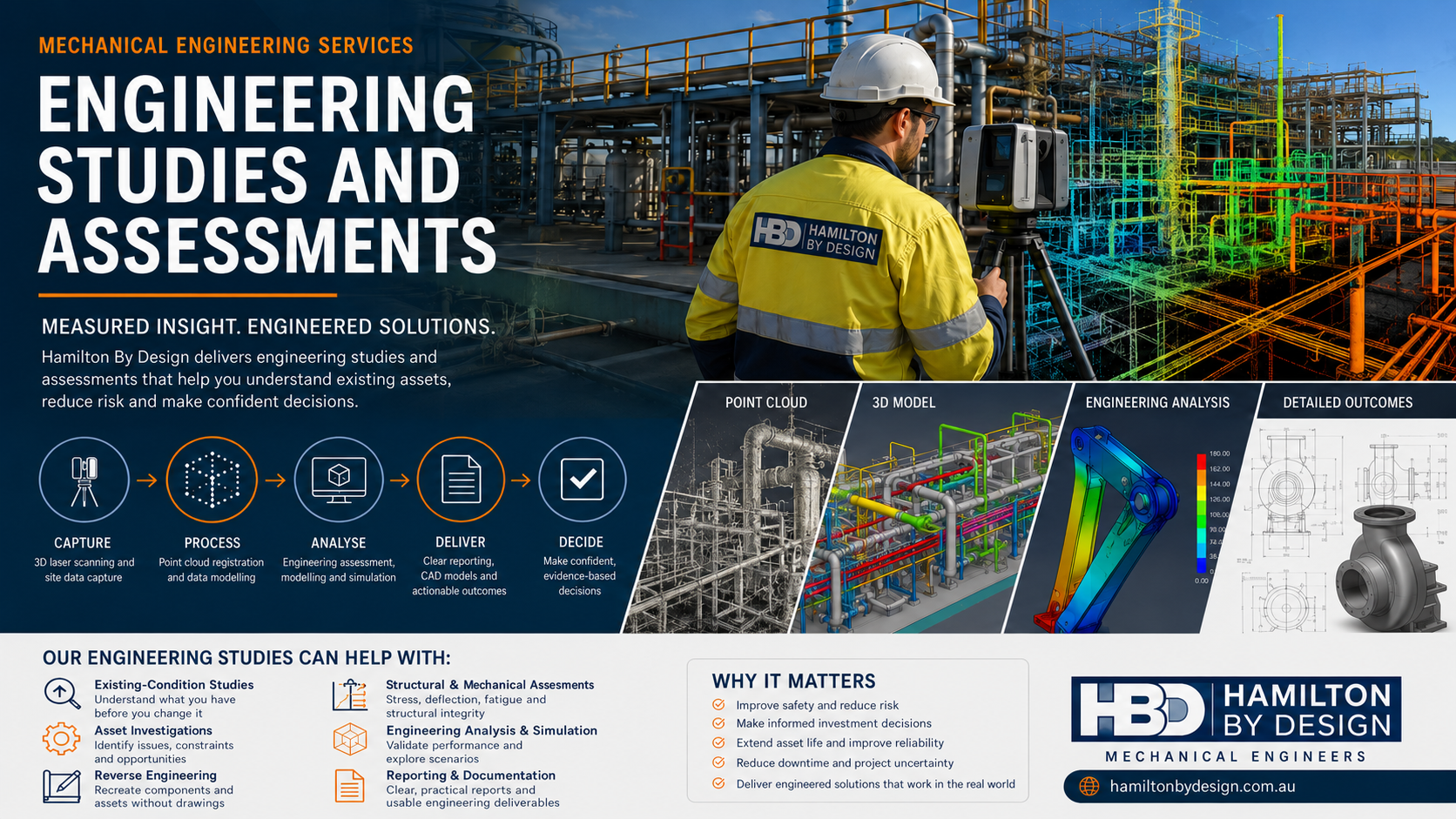
Engineering Studies and Assessments
Practical Engineering Information for Better Project Decisions
Engineering projects often begin with questions.
Is the existing equipment suitable for continued service?
Will a proposed modification work?
What is causing the recurring problem?
Do the existing drawings match the installed plant?
Can an asset be repaired, upgraded or safely replaced?
Hamilton By Design provides practical engineering studies and assessments for industrial machinery, mining equipment, materials-handling systems, manufacturing facilities and existing plant.
Our studies help clients understand existing conditions, investigate engineering problems and make informed decisions before progressing into detailed design, fabrication or site installation.
Engineering Studies for Existing Industrial Assets
Existing equipment and industrial facilities do not always match their original drawings.
Assets may have been modified, repaired, relocated or altered over many years. Drawings may be incomplete, outdated or unavailable. Operating conditions may also have changed since the equipment was originally installed.
Hamilton By Design can combine site inspections, engineering measurements, 3D LiDAR scanning, CAD modelling and engineering analysis to establish a clearer understanding of the asset and the problem being investigated.
Depending on the project, an engineering study may support:
- Maintenance planning
- Plant modifications
- Equipment upgrades
- Replacement projects
- Shutdown preparation
- Failure investigations
- Safety improvements
- Fabrication planning
- Asset-life extension
- Capital-project development
Our Engineering Studies and Assessments
Existing-Condition Studies
Existing-condition studies establish what is currently installed on site.
This may involve reviewing available drawings, completing site measurements, capturing 3D scan data and comparing the physical asset against existing documentation.
Typical applications include:
- Brownfield plant modifications
- Existing-drawing verification
- Equipment replacement
- Plant-layout confirmation
- Structural and mechanical documentation
- Development of as-built CAD models
Feasibility Studies
A feasibility study helps determine whether a proposed engineering solution is practical before significant resources are committed to detailed design.
The study may consider:
- Existing site constraints
- Available installation space
- Access and maintainability
- Preliminary equipment selection
- Constructability
- Indicative engineering requirements
- Potential project risks
- Alternative design concepts
Mechanical Equipment Assessments
Mechanical-equipment assessments examine the condition, arrangement or suitability of existing machinery and components.
Assessments may be completed for:
- Conveyors
- Chutes and transfer stations
- Hoppers and bins
- Rotating equipment
- Machine frames
- Guards and access systems
- Fabricated equipment
- Production machinery
- Mining and materials-handling equipment
The assessment can help identify visible damage, deformation, wear, alignment concerns, access limitations and opportunities for improvement.
Dimensional and Geometric Assessments
Manual measurements can be difficult when equipment is large, complex, obstructed or irregularly shaped.
Hamilton By Design can use engineering-grade 3D LiDAR scanning and CAD comparison techniques to assess:
- Equipment geometry
- Alignment
- Clearances
- Deformation
- Mounting locations
- Interface dimensions
- Fabrication fit-up
- Available installation envelopes
This information can support replacement components, modification work, prefabrication and installation planning.
Kinematic and Motion Studies
Kinematic studies examine how mechanical components move and interact through their operating range.
These studies can be used to investigate:
- Mechanical linkages
- Moving machinery
- Hydraulic-cylinder travel
- Equipment articulation
- Component clearances
- Potential mechanical interference
- Operating envelopes
- Maintenance and removal paths
Existing equipment can be captured using 3D scanning and recreated in CAD to assist with motion analysis and design development.
Finite Element Analysis and Structural Assessment
Finite element analysis can be used to investigate how a component or structure may respond to applied loads.
Depending on the available information and project requirements, an assessment may consider:
- Stress distribution
- Deflection
- Load paths
- Localised stress concentrations
- Connection behaviour
- Proposed design changes
- Existing damage or deterioration
- Reinforcement concepts
Finite element analysis should be supported by suitable engineering assumptions, load information, material data and clearly defined assessment criteria.
Failure and Root-Cause Investigations
Repeated equipment failures should not always be treated as isolated maintenance events.
An engineering investigation can help examine the underlying factors contributing to a problem.
The investigation may consider:
- Operating conditions
- Equipment geometry
- Load paths
- Material selection
- Wear patterns
- Misalignment
- Fatigue-sensitive details
- Maintenance history
- Previous repairs or modifications
- Interaction with surrounding equipment
The objective is to establish the available facts, identify likely contributing factors and develop practical recommendations.
Reliability and Asset-Condition Assessments
Reliability assessments can help maintenance and operations teams understand recurring equipment problems and prioritise improvement work.
Depending on the asset, the assessment may include:
- Visual condition review
- Review of maintenance information
- Wear and deformation assessment
- Vibration-related observations
- Alignment and support conditions
- Maintainability review
- Replacement or refurbishment considerations
- Recommendations for further investigation
Safety and Compliance Assessments
Existing machinery and access systems may no longer reflect current operating practices, site requirements or applicable engineering standards.
Hamilton By Design can assist with engineering reviews relating to:
- Machine guarding
- Maintenance access
- Platforms and walkways
- Stairs and ladders
- Handrails
- Equipment isolation considerations
- Mechanical hazards
- Proposed safety modifications
The scope and applicable standards should be clearly established before the assessment begins.
Reverse-Engineering Assessments
When original drawings, models or manufacturer information are unavailable, reverse engineering can be used to document an existing component or assembly.
The process may involve:
- Site measurement
- 3D laser scanning
- Component scanning
- Point-cloud processing
- CAD reconstruction
- Material and manufacturing review
- Development of replacement drawings
- Design improvement recommendations
Engineering Tools That Support Our Studies
The tools used will depend on the asset, available information and purpose of the assessment.
Hamilton By Design may use:
- 3D terrestrial LiDAR scanning
- Point-cloud registration and analysis
- Traditional engineering measurements
- SolidWorks
- SolidWorks Simulation
- Autodesk Inventor
- AutoCAD
- Autodesk ReCap
- FARO SCENE
- Navisworks
- Finite element analysis
- CAD interference and motion analysis
- Existing-drawing comparison
- Engineering calculations and technical documentation
The purpose of these tools is not simply to produce more data. It is to convert site information into practical engineering information that supports a decision.
Typical Engineering Study Deliverables
Deliverables will be selected to suit the purpose and agreed scope of the study.
They may include:
- Engineering study report
- Existing-condition assessment
- Site-inspection findings
- Point-cloud dataset
- Existing-condition CAD model
- Marked-up drawings
- General arrangement drawings
- Dimensional comparison
- Photographic record
- Preliminary calculations
- FEA results
- Concept-design options
- Risk and constraint register
- Recommended further investigations
- Repair, replacement or improvement recommendations
Our Engineering Study Process
1. Define the Question
We begin by establishing the engineering problem, the required decision and the intended use of the study.
2. Review Available Information
Existing drawings, photographs, maintenance records, equipment information and previous reports are reviewed where available.
3. Inspect and Capture Existing Conditions
Depending on the project, this may involve a site inspection, traditional measurements, photographs, 3D laser scanning or component scanning.
4. Analyse the Information
The collected information is reviewed using appropriate engineering calculations, CAD modelling, dimensional comparison, motion analysis or finite element analysis.
5. Document the Findings
The findings, assumptions, limitations and recommendations are documented in a format suited to the project.
6. Support the Next Stage
The completed study can support feasibility development, detailed design, budgeting, procurement, fabrication, maintenance or shutdown planning.
Why Work With Hamilton By Design?
Hamilton By Design combines engineering analysis with practical experience in drafting, manufacturing, fabrication, site measurement and existing industrial assets.
Our approach is focused on producing information that can be used by:
- Asset owners
- Engineering managers
- Maintenance teams
- Project engineers
- Reliability engineers
- Fabricators
- Installation contractors
- Operations personnel
We aim to provide practical, clearly documented engineering information that helps clients understand the problem and determine the next appropriate step.
Industries We Support
Our engineering studies and assessments can support projects across:
- Mining and mineral processing
- Materials handling
- Steelmaking and smelting
- Manufacturing
- Food and beverage production
- Water and wastewater
- Power generation
- Transport infrastructure
- Heavy industrial facilities
- Bulk-material storage and handling
Hamilton By Design supports projects throughout Australia, including New South Wales, Queensland, Victoria, Western Australia, South Australia and regional mining locations.
Not Sure Which Engineering Study You Need?
You do not need to know the exact name of the study before contacting us.
Tell us:
- What asset or equipment is involved
- What problem has been observed
- What information is currently available
- What decision needs to be made
- When the information is required
We can then help define an appropriate scope for the engineering study or assessment.
Discuss Your Engineering Study
Hamilton By Design provides practical engineering studies, site assessments, 3D scanning, CAD modelling and engineering analysis for existing industrial assets.
Contact our team to discuss your equipment, engineering problem or proposed project.

Contact Us – Talk To Us
Our clients:
























