


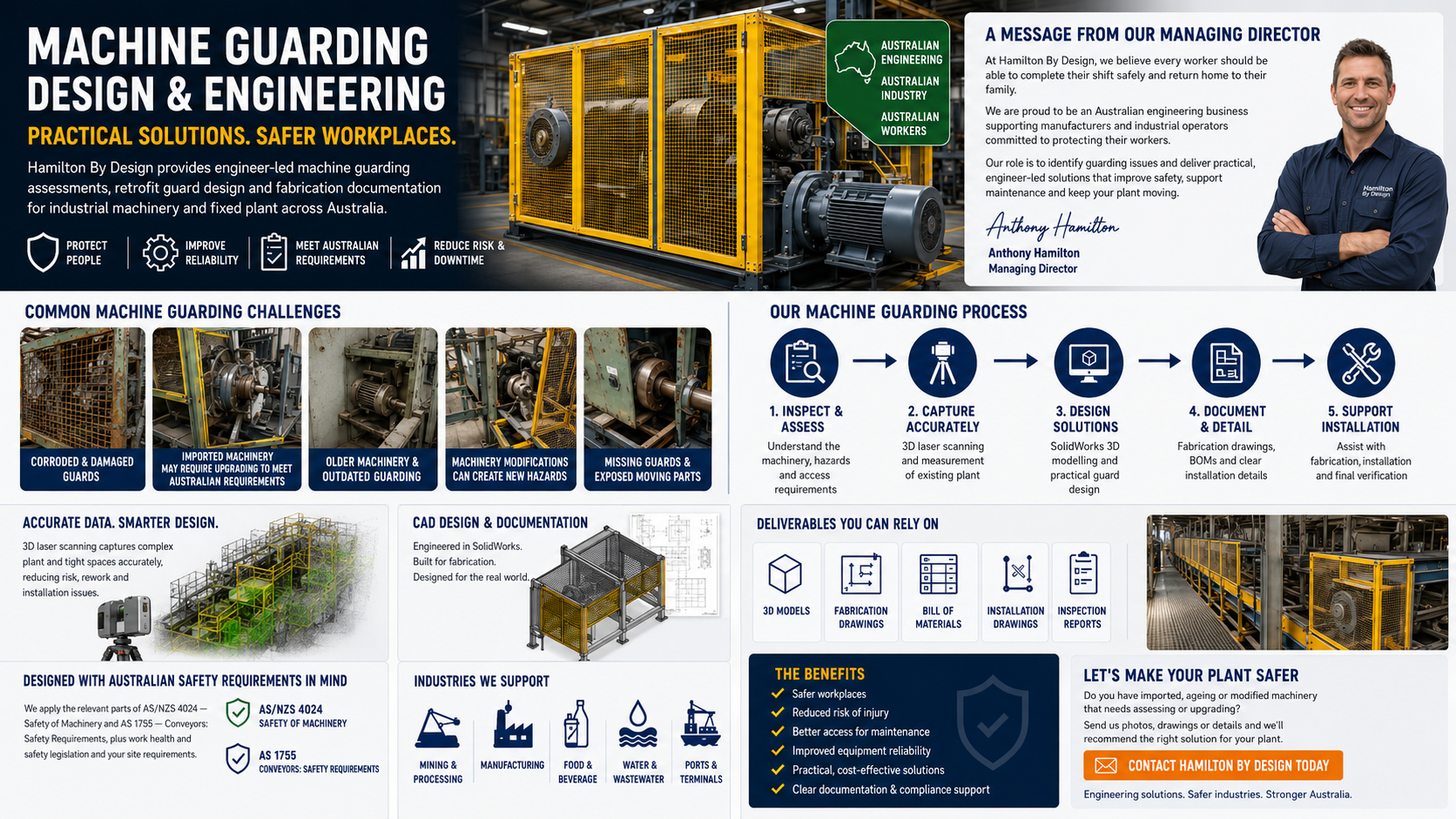
Machine Guarding Design and Engineering
Practical guarding solutions for Australian industry
Hamilton By Design provides engineer-led machine guarding assessments, retrofit guard design and fabrication documentation for industrial machinery and fixed plant.
We assist manufacturers, mining operations and industrial facilities with imported machinery, ageing guards, modified equipment, exposed moving components and guarding systems that may no longer be suitable for their intended purpose.
Our machine guarding services combine site inspection, mechanical engineering, 3D laser scanning and SolidWorks design to develop practical solutions that consider worker safety, operation, maintenance, fabrication and installation.
Hamilton By Design also provides broader mechanical engineering consulting for machinery, fixed plant, conveyors and brownfield industrial upgrades.
Discuss Your Machine Guarding Requirements
A Message from Our Managing Director
At Hamilton By Design, we believe every worker should be able to complete their shift safely and return home to their family.
We are proud to be an Australian engineering business supporting manufacturers, ports, mining operations and industrial facilities that take the safety of their workers seriously.
Effective machine guarding is not simply a metal barrier placed around moving machinery. It requires an understanding of the hazards, the way operators use the equipment and how maintenance personnel need to inspect, clean, lubricate and repair it.
Imported machinery, corrosion, damage, plant modifications and changing work practices can all result in guarding that is no longer suitable for its intended purpose.
Our role is to help clients identify these issues and develop practical, engineer-led guarding solutions that support worker safety, reliable production and maintainable plant.
Anthony Hamilton
Managing Director
Hamilton By Design
When Does Machine Guarding Need Attention?
Machine guarding may require assessment, replacement or redesign when:
- machinery has been imported into Australia;
- existing guards are missing or incomplete;
- corrosion has reduced the condition or strength of the guard;
- guards have been bent, cracked or damaged;
- machinery has been modified or relocated;
- motors, gearboxes, conveyors or drives have been replaced;
- workers can reach through, over, under or around the guard;
- guards are frequently removed for cleaning or maintenance;
- access gates or interlocks can be bypassed;
- moving shafts, couplings, chains, belts or pulleys remain accessible;
- there are no drawings or records for the existing guarding;
- an inspection, audit, incident or near miss has identified a guarding issue; or
- older guards may not reflect current Australian machinery-safety requirements.
Hamilton By Design can undertake a focused inspection or provide broader machine guarding certification and engineering verification for existing fixed plant.
Guarding Upgrades for Imported Machinery
Industrial machinery manufactured overseas may have been designed for a different regulatory environment, operating practice or level of worker access.
Machinery imported from China, Europe, the United States and other markets may require assessment after it arrives in Australia.
Potential issues can include:
- openings that allow access to moving parts;
- insufficient separation between the guard and the hazard;
- partially enclosed drives or transmissions;
- removable panels that do not require tools;
- access doors without appropriate control measures;
- unsuitable mesh sizes;
- guards that do not suit local maintenance practices;
- incomplete machinery documentation;
- exposed electrical, pneumatic or hydraulic components; and
- guarding that no longer fits after installation or modification.
The presence of a factory-supplied guard does not necessarily mean every hazard has been addressed. The machinery should be considered in the context of its actual Australian workplace, intended use and maintenance requirements.
Replacement of Corroded and Damaged Guards
Machine guards can deteriorate during service, particularly in mining, processing, coastal, chemical and washdown environments.
Common forms of deterioration include:
- surface corrosion;
- loss of material thickness;
- cracked welds;
- fatigue around brackets and mounting points;
- loose or missing fasteners;
- damaged mesh;
- bent frames and panels;
- impact damage from mobile equipment;
- chemical attack;
- vibration damage; and
- temporary repairs that have remained in service.
A guard may still appear to be in place while no longer having sufficient condition, rigidity or secure attachment to perform its intended function.
Hamilton By Design can document the existing arrangement and produce replacement guard designs that suit the machinery, surrounding plant and available mounting points.
Guarding for Older and Modified Machinery
Older machinery may have undergone several modifications during its working life.
A motor, gearbox, drive arrangement, conveyor, platform or process component may have been changed without redesigning the original guarding.
Common problems include:
- original guards no longer fitting the equipment;
- gaps created around replacement components;
- missing guard sections;
- exposed shafts and couplings;
- guards cut to clear new pipes or cables;
- platforms providing new access to hazards;
- machinery relocated without reassessing worker access;
- maintenance tasks changing over time; and
- old guards being replaced with temporary barriers.
Hamilton By Design can assess the current machinery configuration rather than relying solely on outdated drawings or original equipment information.
Machine Guard Design Services
Our machine guarding design services can include:
- fixed machine guards;
- removable guards;
- mesh guarding;
- sheet-metal guards;
- motor and gearbox guards;
- belt and chain-drive guards;
- shaft and coupling guards;
- pulley and roller guards;
- perimeter guarding;
- modular guarding systems;
- access gates and panels;
- maintenance access openings;
- inspection panels;
- guard frames and mounting brackets;
- supports and structural interfaces; and
- concepts for interlocked access where required.
The appropriate guarding arrangement depends on the machinery, identified hazards, access frequency, operating environment and maintenance tasks.
Conveyor and Rotating-Equipment Guarding
Conveyors contain multiple moving components that may create drawing-in, entanglement, crushing and shearing hazards.
Guarding projects may involve:
- head and tail pulleys;
- take-up pulleys;
- return rollers;
- idlers;
- drive assemblies;
- drive belts and chains;
- rotating shafts;
- flexible couplings;
- gearboxes;
- transfer points;
- exposed nip points;
- elevated conveyors; and
- access around walkways and platforms.
Our article on AS 1755 conveyor safety and guarding provides additional information about conveyor operation, inspection, cleaning and maintenance considerations.
For larger materials-handling assets, see our experience with guarding for ship loaders, stackers and reclaimers.
Maintenance-Friendly Guarding
A guard must protect workers without creating unnecessary obstacles to inspection, cleaning and maintenance.
Poorly designed guards may be repeatedly removed, left off after maintenance or modified by workers trying to access the equipment.
Maintenance-friendly guarding may consider:
- frequency of access;
- inspection requirements;
- cleaning and washdown;
- lubrication points;
- access to bearings and adjustment systems;
- component removal paths;
- lifting and handling of guard panels;
- visibility of the operating process;
- safe access to fasteners;
- drainage and material build-up;
- shutdown duration; and
- the possibility of foreseeable bypassing.
Where appropriate, guard design can incorporate inspection panels, removable sections, remote lubrication points and modular components.
Guarding does not replace the need for appropriate isolation, safe work procedures, training and operational controls.
3D Laser Scanning for Retrofit Machine Guards
Retrofit guarding is often required in congested brownfield environments where original drawings are unavailable or no longer reflect the installed machinery.
3D laser scanning can capture:
- machinery geometry;
- existing guard mounting points;
- motors and gearboxes;
- structural steel;
- floors and foundations;
- pipework;
- electrical cable trays;
- platforms and walkways;
- handrails;
- surrounding equipment;
- restricted access areas; and
- potential installation obstructions.
The captured point cloud can be used to develop the guarding arrangement within the existing plant environment.
This can help reduce:
- incorrect site measurements;
- guard panels that do not fit;
- clashes with existing services;
- site cutting and welding;
- fabrication rework;
- installation delays; and
- repeated site visits.
SolidWorks Guard Design and Fabrication Documentation
Hamilton By Design uses SolidWorks and supporting engineering software to develop practical guarding systems from site measurements, scan data and available equipment information.
Project deliverables may include:
- 3D CAD models;
- general arrangement drawings;
- fabrication drawings;
- panel and frame details;
- mounting and fixing details;
- material specifications;
- bills of materials;
- installation drawings;
- existing-condition models;
- guard identification schedules;
- inspection reports;
- design risk information; and
- recommended corrective actions.
The level of documentation can be adjusted to suit a single replacement guard, a machinery upgrade or a broader site-wide guarding program.
Guarding Inspections and Gap Assessments
A guarding inspection can help identify deficiencies before they contribute to an injury, production interruption or regulatory issue.
An assessment may consider:
- access to hazardous moving parts;
- gaps around panels and frames;
- mesh openings;
- reach over, under or around guards;
- guard condition;
- structural rigidity;
- fasteners and fixings;
- removable panels;
- access gates;
- maintenance requirements;
- visibility;
- signs of bypassing or modification;
- missing documentation; and
- consistency across similar machinery.
Findings can be documented in a prioritised register showing the location, observed issue, recommended response and suggested level of urgency.
For broader industry context, read Machine Guarding in Australia: A Decade of Lessons for Leaders, Asset Owners and Engineers.
Machine Guarding and Australian Requirements
Machine guarding requirements depend on the machinery, identified hazards, operating environment, worker access, maintenance activities and applicable legislation.
Projects may require consideration of:
- the applicable parts of the AS/NZS 4024 Safety of Machinery series;
- AS 1755 for conveyor safety;
- relevant work health and safety legislation;
- plant-specific safety requirements;
- client engineering standards;
- equipment manufacturer information; and
- other machinery-specific standards.
Hamilton By Design applies the relevant requirements in the context of the particular machine and workplace rather than treating machinery safety as a generic checklist.
Further information is available on our Australian engineering standards page.
Industries We Support
Hamilton By Design provides machine guarding services for:
Mining and mineral processing
- conveyors;
- crushers;
- screens;
- feeders;
- pumps;
- rotating drives;
- transfer stations; and
- processing equipment.
Manufacturing
- production machinery;
- presses;
- rollers;
- cutting equipment;
- packaging lines;
- automated systems; and
- special-purpose machinery.
Bulk-materials handling
- conveyors;
- stackers;
- reclaimers;
- ship loaders;
- hoppers;
- chutes; and
- transfer equipment.
Food and beverage
- mixers;
- conveyors;
- packaging machinery;
- rotating equipment;
- washdown areas; and
- hygienic production environments.
Water and wastewater
- pumps;
- screens;
- mixers;
- drives;
- treatment equipment; and
- machinery exposed to corrosion.
Ports and terminals
- conveyors;
- winches;
- loading equipment;
- drive systems; and
- plant exposed to coastal environments.
Our Machine Guarding Process
1. Initial review
Provide photographs, machinery information, existing drawings and details of the identified guarding concern.
2. Site inspection
We inspect the machinery, surrounding plant, worker access and maintenance requirements.
3. Existing-condition capture
The machinery may be measured manually or captured using 3D laser scanning, depending on its size and complexity.
4. Hazard and access review
The project requirements are developed around the identified hazards, operating tasks and foreseeable access.
5. Guard design
The proposed guarding is developed in 3D and coordinated with the existing machinery and plant environment.
6. Fabrication documentation
Drawings, models, material information and bills of materials are prepared to suit the agreed scope.
7. Installation support
Design clarification and installation support can be provided where required.
8. Final review
The installed guarding can be reviewed against the agreed design documentation and identified project requirements.
Why Effective Machine Guarding Matters
Australian workplace incidents and prosecutions continue to involve unguarded machinery, removed guards, accessible augers, rotating drives and equipment that can restart while workers are cleaning, maintaining or clearing blockages.
These outcomes demonstrate that effective guarding requires more than installing a physical barrier.
Guarding should be considered as part of the complete operating and maintenance system, including:
- the way the machinery is used;
- how frequently workers require access;
- the location of hazardous movement;
- the possibility of reaching around the guard;
- maintenance and lubrication activities;
- isolation requirements;
- foreseeable worker behaviour; and
- the ongoing condition of the guard.
A practical guarding solution should protect workers while supporting safe operation, inspection and maintenance.
Why Hamilton By Design?
Hamilton By Design combines practical trade experience with mechanical engineering, industrial design and modern reality-capture technology.
Our capabilities include:
- engineer-led site inspections;
- fixed-plant and machinery experience;
- 3D laser scanning;
- reverse engineering;
- SolidWorks design;
- fabrication-ready drawings;
- brownfield plant integration;
- conveyor and materials-handling experience;
- maintenance-focused design; and
- clear engineering documentation.
We understand that a guard must not only address the identified hazard—it must also fit the machinery, be practical to fabricate and remain usable throughout the operating life of the plant.
Discuss Your Machine Guarding Requirements
Do you have imported, ageing, damaged or modified machinery requiring new or replacement guarding?
Send Hamilton By Design:
- photographs of the machinery;
- details of the moving components;
- available drawings;
- equipment manuals;
- previous inspection findings;
- audit actions; or
- a description of the problem.
We can review the application and recommend an appropriate inspection, scanning, assessment and design process.
Contact Hamilton By Design to discuss your machine guarding project.

Contact Us – Talk To Us
Our clients:
























