
Reverse Engineering Condell Park: 3D Scanning, Mechanical Design and Manufacturing Support

Condell Park is part of Sydney’s established south-western industrial corridor. The area supports engineering workshops, metal fabricators, machinery operators, specialist manufacturers and industrial service providers. These businesses depend on reliable equipment, accurate technical information and replacement components that can be manufactured without unnecessary delay.
However, many industrial businesses operate machinery that has been in service for years or even decades. Original drawings may be missing, components may have been modified, and equipment manufacturers may no longer provide replacement parts. Even when drawings remain available, they may not accurately represent the machinery installed on the workshop floor.
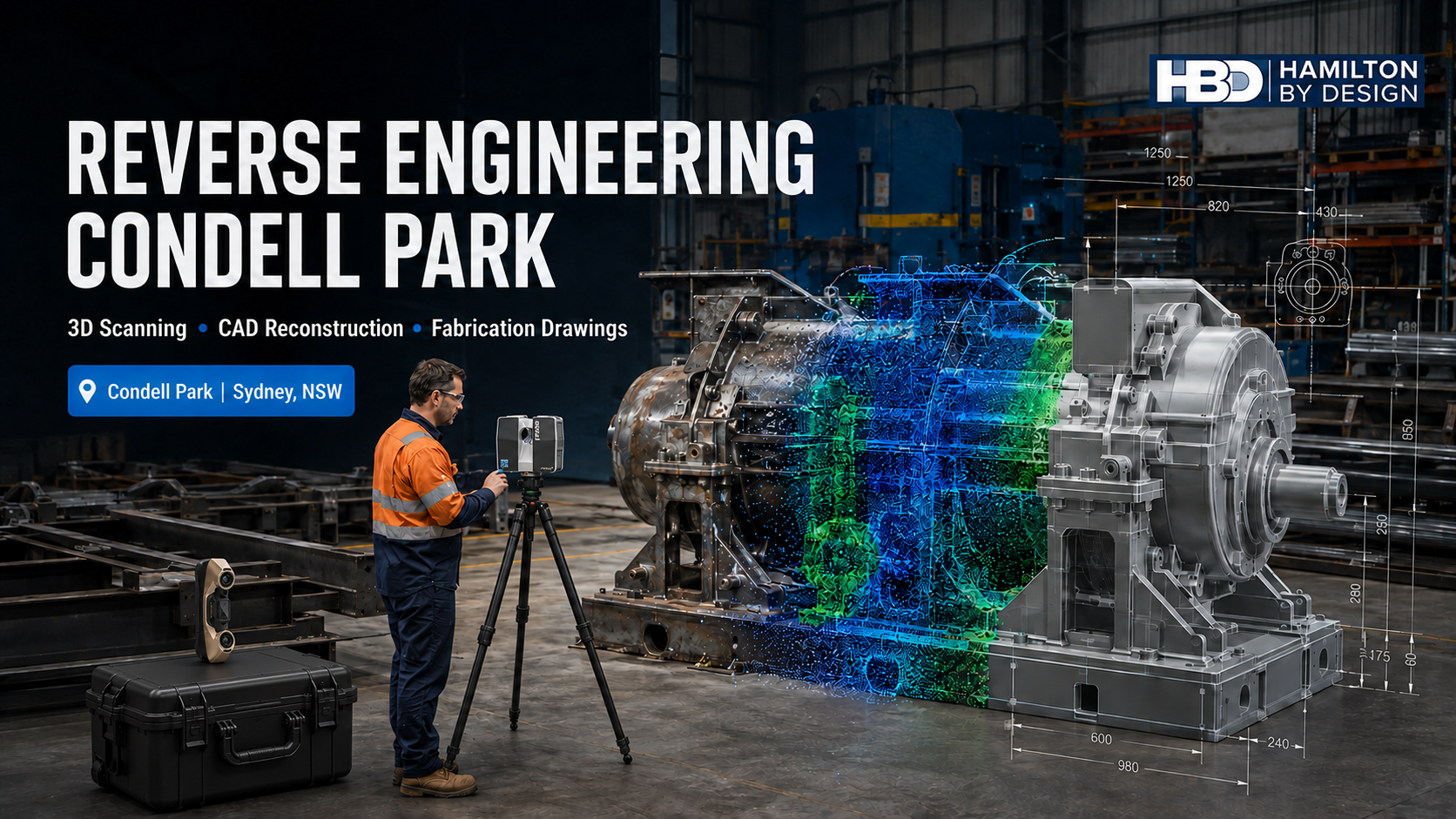
Hamilton By Design provides reverse engineering in Condell Park, combining engineering-grade measurement, 3D scanning, CAD reconstruction, mechanical design and fabrication documentation. These services help manufacturers understand existing equipment, reproduce difficult components and plan machinery modifications using reliable engineering information.
The objective is not simply to generate a 3D model. It is to create practical engineering data that can support manufacturing, maintenance, safety, procurement and future asset-management decisions.
Why reverse engineering is important to Condell Park businesses
Manufacturing businesses frequently rely on machines that cannot be readily replaced. A single machine may contain specialised shafts, guards, brackets, housings, tooling or fabricated assemblies that are essential to production.
When one of these components fails, the business may encounter several problems:
- The original manufacturer no longer supports the machine.
- Replacement parts must be imported.
- Delivery periods are incompatible with production requirements.
- Original drawings are unavailable or unreliable.
- The component is too complex to measure accurately by hand.
- Previous modifications have changed its original dimensions.
- A new component must interface with several surrounding parts.
- The workshop can manufacture the replacement but lacks a usable drawing.
Hamilton By Design’s reverse engineering and Scan-to-CAD services provide a structured pathway from an existing physical component to a practical digital engineering model.
Depending on the project, that pathway may include component inspection, 3D scanning, dimensional verification, parametric CAD reconstruction, material review and preparation of manufacturing or fabrication drawings.
Five common engineering problems in local industry
1. Missing or outdated technical drawings
Older machinery often changes throughout its operating life. Maintenance teams may replace motors, reposition guards, modify frames or introduce new production equipment. Unfortunately, the drawings are not always updated after these modifications.
This creates uncertainty for subsequent projects. A drawing may appear authoritative while describing a configuration that no longer exists.
Engineering-grade 3D scanning can capture the actual installed condition. The resulting point cloud provides a measurable digital record of the machinery, nearby structures, pipework, services and access constraints. Engineers and designers can then compare the physical installation with existing documents and develop revised models or as-built drawings.
Hamilton By Design’s 3D laser scanning services can be used to capture these existing conditions before a component is redesigned or equipment is relocated.
2. Obsolete and unavailable replacement parts
Obsolescence is a major problem for manufacturers operating legacy machinery. A machine may remain mechanically serviceable even though its replacement components are no longer commercially available.
Reverse engineering can help reproduce selected components where doing so is technically appropriate and legally permissible. The original item can be scanned, measured and reconstructed as a controlled CAD model. A manufacturing drawing can then define its key dimensions, tolerances, interfaces and material requirements.
This approach is particularly useful for brackets, spacers, housings, guards, covers, fabricated assemblies and other non-proprietary components. More critical items require additional engineering investigation. Loads, fatigue, wear, material properties, heat treatment and failure consequences may need to be assessed before manufacture.
Reverse engineering should therefore be treated as an engineering process rather than simple geometric copying.
3. Production downtime
A failed component can stop an entire production process. The repair period becomes longer when measurements, drawings and supplier quotations only begin after the failure occurs.
A more proactive strategy is to identify critical or difficult-to-source components before they fail. These items can be scanned during planned maintenance, modelled in CAD and added to a controlled replacement-parts library.
Hamilton By Design can help retain:
- Component scans
- CAD parts and assemblies
- Workshop and fabrication drawings
- Machine layouts
- Drawing revisions
- Replacement-part histories
- Relevant inspection information
This information can reduce future investigation time and provide a clearer starting point for quotation and manufacture. It does not eliminate the need for verification, but it can significantly improve maintenance preparedness.
4. Complex components that are difficult to measure
Traditional measurement remains appropriate for many components. Callipers, micrometers, height gauges and coordinate-measuring equipment can provide highly accurate measurements when the relevant features are accessible.
However, manual measurement becomes difficult when a component contains irregular surfaces, compound curves, worn profiles or multiple interfaces. Large machinery and crowded workshop installations can also be impractical to measure using tapes and hand tools alone.
Engineering-grade LiDAR scanning can capture large plant areas and their spatial relationships. Close-range component scanning can record smaller and more detailed geometry. These datasets can then be interpreted and reconstructed in CAD.
The selected technology should reflect the required tolerance, component size, surface condition, access and intended manufacturing method. A scanner is a measurement tool; engineering judgement is still required to determine which dimensions are functionally important.
5. Unsafe or poorly integrated machinery modifications
A machinery modification may solve one operational problem while creating another. A new guard could restrict maintenance access. A replacement motor might reduce the available walkway width. A relocated conveyor could introduce a pinch point or interfere with nearby services.
Capturing the existing environment before design allows modifications to be assessed in context. Hamilton By Design discusses this relationship between existing-condition information and safer engineering in Why Existing Conditions Matter.
Three-dimensional models can support clearance checking, maintenance reviews and installation planning. They can also provide workshop personnel with an opportunity to review the proposed arrangement before fabrication begins.
Mechanical engineering services for Condell Park manufacturers
Hamilton By Design can provide mechanical design and engineering services for existing machinery, fabricated equipment and industrial improvements.
Potential services include:
- Reverse engineering of components and assemblies
- Replacement-part development
- Machinery modifications
- Equipment frames and support structures
- Brackets, bases and mechanical interfaces
- Guarding and access improvements
- Workshop and production layouts
- Conveyor and materials-handling modifications
- Fit and clearance studies
- Fabrication and product development
- Selected engineering calculations
- Finite Element Analysis
- Engineering documentation and design reviews
Finite Element Analysis may help investigate the behaviour of selected components under defined loading conditions. However, an FEA result is only as reliable as its assumptions, loads, boundary conditions, material data and interpretation. Analysis should form part of an appropriate engineering assessment rather than being treated as an automatic statement of compliance.
Mechanical drafting and fabrication documentation

A 3D model is valuable, but manufacturers generally require controlled drawings before a component can be quoted, checked and manufactured.
Hamilton By Design’s mechanical drafting services in Sydney can support engineering workshops with:
- 3D part and assembly models
- General arrangement drawings
- Fabrication and workshop drawings
- Machined-component drawings
- Plate profiles and cut details
- Sheet-metal developments
- Weld symbols and fabrication notes
- Bills of materials
- Exploded assemblies
- Installation drawings
- Guarding drawings
- Equipment and workshop layouts
- As-built drawing updates
- Drawing registers and revision control
Drawings can be developed with reference to the relevant requirements of the AS 1100 technical drawing series. Depending on the project, other standards may cover structural steel, welding, tolerances, machinery safety, platforms or lifting equipment.
Relevant standards may include AS 1100.101 for general technical drawing principles, AS 1100.201 for mechanical engineering drawing, AS/NZS 1100.501 for structural engineering drawing and AS/NZS ISO 2553 for the symbolic representation of welded joints.
The exact standards should be nominated for the project. The applicable tolerances, materials, finishes, inspection criteria and fabrication requirements should be stated rather than assumed.
Hamilton By Design provides further discussion of the role of standards in Australian engineering, scanning and documentation projects.
Machinery guarding and safety assistance
Machinery can expose workers to rotating shafts, belts, chains, couplings, blades, conveyors, crushing areas and drawing-in points. Risks may arise during normal production, but they can also occur during cleaning, adjustment, fault recovery and maintenance.
Hamilton By Design can assist with machine-guarding design and engineering for existing industrial equipment.
This assistance may include:
- Existing guarding inspections
- Hazard-area documentation
- Fixed and removable guard design
- Perimeter fencing and access gates
- Guard-opening and reach-distance reviews
- Interlocked-guard concepts
- Protection around belts, chains, shafts and couplings
- Conveyor nip-point protection
- Maintenance and inspection access
- Retrofit guarding for legacy machinery
- Guard fabrication drawings
- Three-dimensional clearance assessments
The AS/NZS 4024 Safety of Machinery series provides important guidance for machinery risk assessment, safeguarding and safety-related control principles. AS 1657 may also apply to fixed platforms, walkways, stairways and ladders.
Mechanical guarding must be coordinated with isolation systems, electrical controls and operating procedures. Safety PLCs, electrical interlocks and functional-safety systems should be designed and validated by appropriately competent specialists.
Hamilton By Design can provide engineering-led support and documentation, but the owner or operator retains responsibility for workplace risk management, consultation, implementation and ongoing safe operation.
Engineering support for logistics and materials handling

Manufacturing performance depends on more than individual machines. Materials must move safely between receiving, storage, production, assembly and dispatch.
Poorly planned layouts can create congestion, handling delays, forklift interactions and restricted access. Existing drawings may not show columns, services, barriers or equipment that affect a proposed installation.
Hamilton By Design can assist logistics and materials-handling projects with:
- Workshop and warehouse scanning
- Production-line relocation planning
- Conveyor layouts and modifications
- Transfer-point design
- Equipment clearances
- Forklift and pedestrian interface reviews
- Pallets, stillages, trolleys and handling aids
- Loading and unloading equipment
- Lifting-device concepts and drawings
- Maintenance-access planning
- Clash detection
- Installation and fabrication documentation
The application of digital engineering to conveyor and materials-handling systems can improve design accuracy and identify spatial conflicts before equipment reaches the workshop.
Standards potentially relevant to logistics projects include AS 4084 for steel storage racking, AS 2359 for powered industrial trucks, AS 4991 for lifting devices, AS 1418 for cranes and hoists, AS 2550 for their safe use and AS/NZS 4024 for machinery and conveyor safety.
A structured risk-management approach
Engineering risk management should be systematic, documented and proportionate to the potential consequences.
A practical process may include:
- Define the equipment and its operating limits.
- Capture the existing installation.
- Consult operators, maintainers and supervisors.
- Identify hazards during operation, cleaning and maintenance.
- Assess the initial risk.
- Eliminate hazards where reasonably practicable.
- Develop engineered controls where elimination is not practicable.
- Review the proposed design with affected personnel.
- Record residual risks and operational requirements.
- Verify that the installed modification reflects the approved design.
AS ISO 31000 provides general risk-management principles, while AS/NZS 4024 provides machinery-specific guidance. Applicable work health and safety legislation, codes of practice and site requirements must also be considered.
Building a useful digital equipment history
One of the longer-term benefits of reverse engineering is the creation of a reusable engineering record.
A structured asset library can connect a machine with its scans, CAD models, drawings, modifications and replacement components. When another repair is required, the organisation is not forced to begin again.
Good engineering-data governance should include clear filenames, asset identifiers, drawing numbers, revision status, approval records and superseded-document controls. Access should be managed so that workshop personnel receive the correct released information.
The goal is not to collect files without purpose. It is to create traceable engineering information that supports maintenance, procurement, manufacturing and future improvements.
Frequently asked questions
What is reverse engineering?
Reverse engineering is the process of examining an existing component or machine to understand its geometry, interfaces and function. The information can then be reconstructed as a CAD model and, where appropriate, developed into drawings for replacement, modification or documentation.
Can Hamilton By Design reproduce a component without an original drawing?
Potentially, yes. The component may be scanned and measured to develop a CAD model and drawing. Feasibility depends on its condition, function, material, required tolerance and safety significance.
Is 3D scanning accurate enough for manufacturing?
It can be, provided the scanning method is appropriate for the component and required tolerance. Critical features may still require verification using conventional metrology. The required manufacturing accuracy should be established before scanning begins.
Can worn components be scanned?
Yes, but a scan records the component in its current condition. Engineering judgement is required to distinguish original geometry from wear, damage and deformation. Mating parts or equivalent components may also need to be examined.
What files can be supplied?
Deliverables may include point clouds, 3D CAD parts, assemblies, neutral CAD formats, review models, PDFs, general arrangements and fabrication drawings. The required formats should be agreed at the start of the project.
Can scanning be completed without stopping production?
Some external scanning may be possible while equipment remains operating. However, movement, vibration, restricted access and safety controls can affect the quality and completeness of the data. Component inspection and close-range scanning will often require safe isolation.
Does a reverse-engineered drawing certify that a part is safe?
No. A geometric model or manufacturing drawing does not automatically verify material properties, loading capacity, fatigue life or fitness for service. Safety-critical components may require calculations, testing, inspection or specialist certification.
Can Hamilton By Design help with machine guarding?
Yes. Hamilton By Design can assist with guarding inspections, 3D capture, mechanical guard design, access reviews and fabrication documentation. Services can be developed with reference to the relevant AS/NZS 4024 machinery-safety requirements.
Can Hamilton By Design assist local fabrication workshops?
Yes. A workshop may have the equipment and experience to manufacture a component but require additional scanning, CAD or drafting capacity. Hamilton By Design can help convert physical components, sketches or concepts into controlled models and fabrication drawings.
What information can be retained for future maintenance?
Subject to the agreed scope and data arrangements, records may include component scans, CAD parts, assemblies, workshop drawings, machine layouts, revision histories and replacement-part information.
Supporting Condell Park’s industrial capability
Condell Park manufacturers need practical engineering solutions that respect production pressures, workshop knowledge and the realities of existing machinery.
Through reverse engineering Condell Park, 3D scanning Condell Park, mechanical drafting Condell Park, fabrication drawings Condell Park and support for machine modifications in Sydney, Hamilton By Design can help turn undocumented physical assets into usable engineering information.
By combining scanning, CAD reconstruction, mechanical engineering, drafting, guarding and risk-based design review, businesses can prepare for component failures, improve fabrication accuracy and plan modifications with greater confidence.
To discuss an existing component, machinery modification or documentation problem, contact Hamilton By Design and provide available photographs, dimensions, drawings and a brief description of the required outcome.
Contact Us – Talk To Us
Our clients: