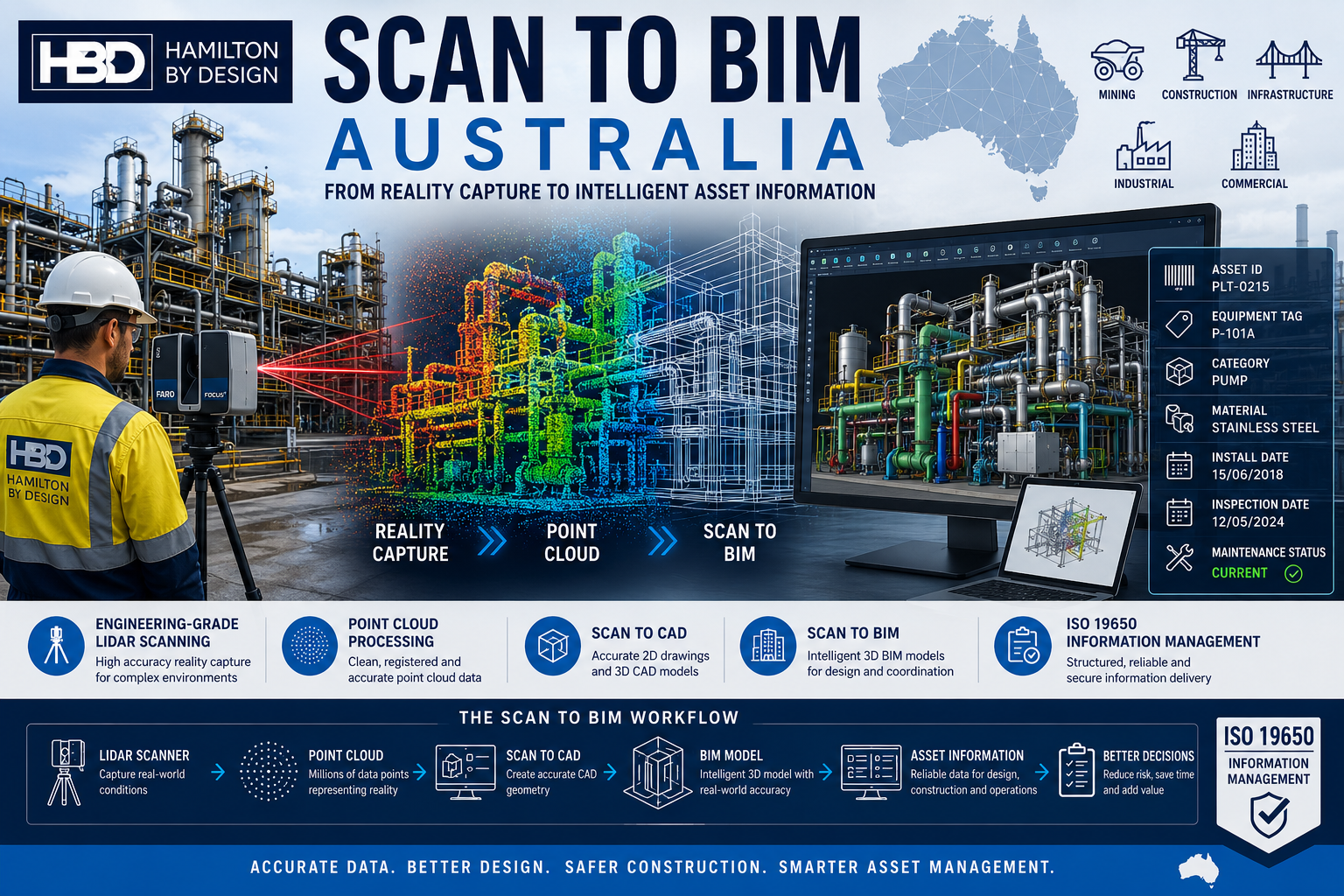
Engineering-Grade Reality Capture for Better Building Information
Across Australia, Scan to BIM is becoming an important part of how buildings, plants, infrastructure and industrial facilities are measured, documented and managed.
For existing assets, traditional drawings are often incomplete, outdated or missing. Scan to BIM helps solve this problem by using 3D laser scanning and point cloud data to create accurate digital building information models.
At Hamilton By Design, Scan to BIM is approached from an engineering and information-management perspective — not just as a modelling exercise.
What is Scan to BIM?
Scan to BIM is the process of capturing real-world site conditions using 3D laser scanning, LiDAR or reality-capture equipment, then converting that point cloud data into useful BIM or CAD information.
This may include:
- Existing building geometry
- Structural steel and framing
- Mechanical services and pipework
- Plant rooms and industrial equipment
- Access platforms, stairs and handrails
- As-built verification
- Clash checking and design coordination
The result is a more reliable digital record of the asset.
Why Scan to BIM Matters in Australia
Australian projects often involve brownfield sites, live facilities, mining infrastructure, commercial buildings, hospitals, schools, utilities and industrial plants. In these environments, guessing from old drawings creates risk.
Scan to BIM supports better decisions by providing:
- More accurate existing-condition information
- Reduced site rework
- Improved design coordination
- Safer planning before site works
- Better asset information for future maintenance
- Stronger alignment with ISO 19650 information-management principles
For a deeper academic discussion on the benefits, limitations and future direction of Scan to BIM, refer to this related article:
Scan to BIM
Scan to BIM and ISO 19650
Scan to BIM becomes more valuable when it is managed under a clear information-management framework.
ISO 19650 provides guidance on organising, naming, sharing and controlling information across the asset lifecycle. This is important because a 3D model is only useful if the information is structured, reliable and suitable for the project purpose.
Hamilton By Design has also written about this in more detail here:
ISO 19650, Scan to BIM and Information Management
Engineering-Led Scan to BIM
A good Scan to BIM workflow is not simply about creating a visually impressive model. It should support engineering, construction, safety and maintenance outcomes.
This means understanding:
- What level of detail is required
- What accuracy is suitable
- Which areas are critical for design
- How the model will be used
- What information should be included or excluded
- How the data will be controlled and updated
This is especially important for mining, infrastructure, manufacturing, commercial buildings and complex brownfield environments.
Conclusion
Scan to BIM in Australia is helping improve the way existing assets are captured, understood and managed. When combined with engineering experience and ISO 19650 information-management principles, it provides a practical foundation for better design, safer construction and more reliable asset information.
For Australian projects requiring 3D scanning, point cloud processing, Scan to CAD or Scan to BIM support, Hamilton By Design provides engineering-led reality capture services across a range of industrial and built environments.

Contact Us – Talk to Us