


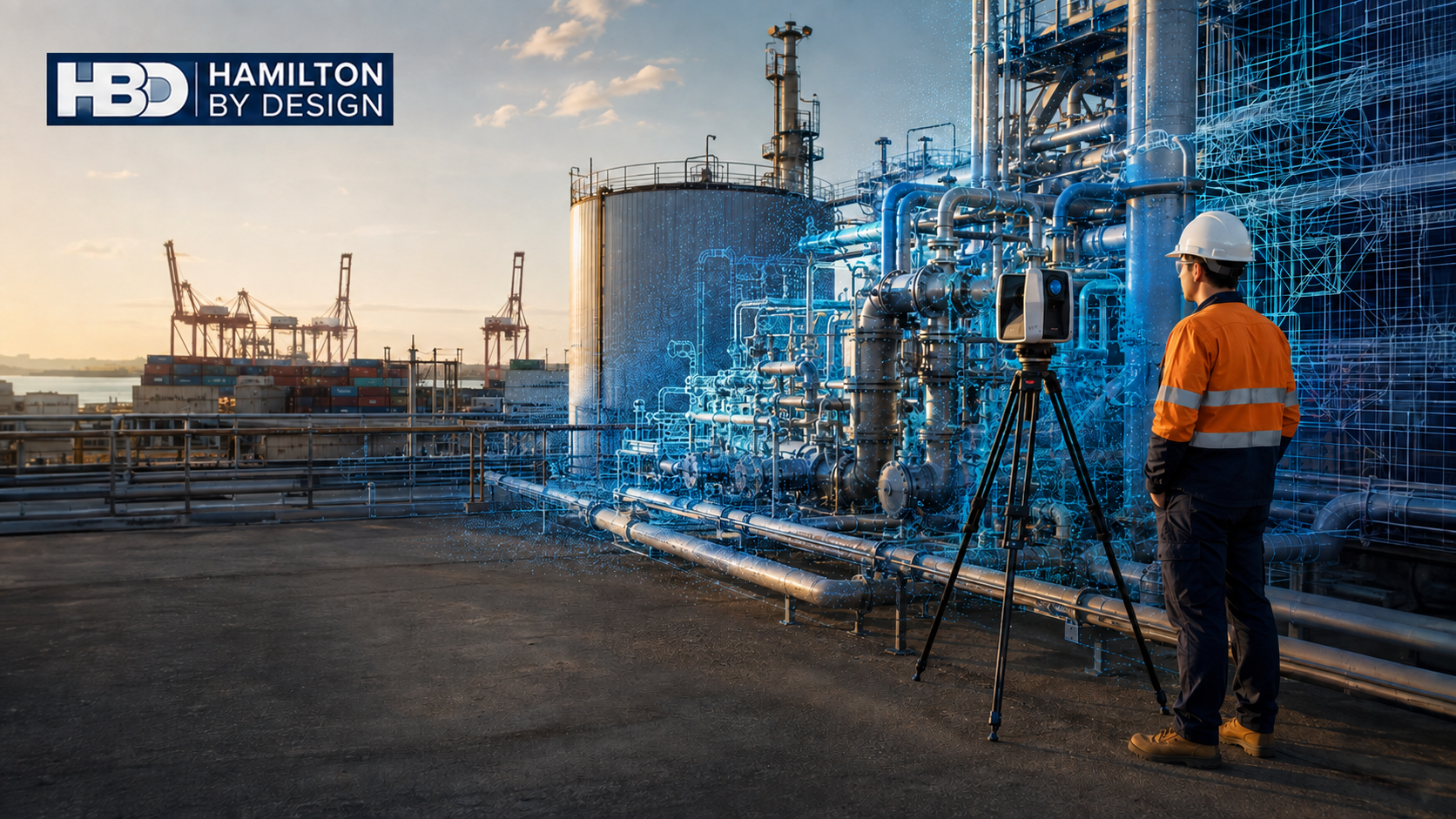
Industrial 3D Laser Scanning Botany for Port, Pipework and Brownfield Engineering

Botany, Matraville and Banksmeadow form one of Sydney’s most active industrial and logistics corridors. The area includes port terminals, tank farms, chemical facilities, processing plants, warehouses and freight operations. Many operate continuously, leaving little tolerance for incorrect measurements, installation clashes or unexpected shutdown work.
Hamilton By Design provides industrial 3D laser scanning in Botany to capture existing conditions and turn them into practical engineering information. Combining LiDAR scanning with mechanical engineering, CAD modelling and fabrication documentation helps project teams plan brownfield modifications confidently.
The objective is not simply to produce a point cloud. It is to establish a reliable dimensional foundation for design, coordination, fabrication, installation and future asset management.
Within this precinct, one modification may affect pipework, structural supports, access platforms, operating equipment and vehicle movements. Capturing these relationships in a coordinated dataset helps contractors work from the same dimensional reference and supports clearer communication between operations, maintenance, engineering and fabrication teams.
The Engineering Challenge Inside Operational Industrial Sites
Brownfield sites rarely match their original drawings. Pipework may have been rerouted, pumps replaced, platforms extended and supports modified over decades of maintenance. Some drawings may represent an earlier arrangement rather than what is installed today.
This becomes a significant risk when new pipework, equipment or steelwork must connect to existing assets. An error in a flange position, support elevation or clearance can produce a spool that does not fit, a structural clash or an extended shutdown.
Hamilton By Design’s brownfield industrial upgrade services connect existing-condition capture with engineering-led design. Critical interfaces can be checked before materials are ordered, reducing rework, delays and unplanned modifications.
Creating an Accurate Existing-Condition Baseline
Terrestrial LiDAR records millions of three-dimensional measurements as a registered point cloud showing the actual positions of plant, pipework, tanks, platforms, steelwork and surrounding infrastructure.
Hamilton By Design’s industrial 3D scanning services suit operational environments where tape measurements would be slow or incomplete. Multiple scan positions help capture congested areas around equipment and pipe racks.
The resulting point cloud can support:
- Existing-condition and as-built documentation
- Plant and equipment layouts
- Pipe routes and tie-in verification
- Structural and mechanical interface modelling
- Clearance and clash checking
- Shutdown and installation planning
- Fabrication and construction drawings
- Future modification and maintenance records
Laser scanning documents visible geometry. Internal conditions, material thickness and asset integrity require appropriate isolation, inspection or non-destructive testing.
Pipework Scanning and Tie-In Verification
Pipework is a valuable application for 3D laser scanning in Botany. Industrial networks can contain offsets, changing elevations, unusual supports and tightly packed services that manual measurements cannot fully describe.
Hamilton By Design combines reality capture with pipework drafting and 3D scanning to document routes, valves, pumps, flanges, supports and obstructions. The point cloud helps establish tie-ins, check flange orientation and develop new routes.
Deliverables may include general arrangements, pipework layouts, isometrics, spool drawings, support details and as-built records. Designing against captured conditions improves fit-up certainty and allows installation access to be reviewed early.
Tank, Terminal and Structural Interface Scanning
Port-related facilities contain storage tanks, transfer equipment, loading areas, bunds, pipe bridges and support structures. Modifications must often connect several disciplines within a restricted footprint.
LiDAR can document visible tank shells, roofs, nozzles, platforms, nearby pipework and supporting steelwork. The data can support nozzle records, equipment replacement, new supports and service coordination.
Hamilton By Design can provide structural engineering and drafting support for frames, platforms, access structures and mechanical interfaces. Assessment and certification requirements should be established for each project.
Mechanical Engineering for Botany and Matraville Industry
Accurate site data becomes more valuable within a mechanical design workflow. Hamilton By Design provides mechanical engineering consulting for plant modifications, equipment layouts, fabrication planning and brownfield integration.
Services may include:
- Equipment replacement and relocation layouts
- Pump and pipework modifications
- Machinery and production-line upgrades
- Conveyor and materials-handling modifications
- Access, maintenance and guarding improvements
- Equipment bases, frames and supports
- Constructability and installation reviews
- 3D CAD assemblies and clash checks
- General arrangement, fabrication and detail drawings
- Bills of materials and installation documentation
Hamilton By Design’s 3D CAD modelling and mechanical drafting workflow converts relevant point-cloud areas into engineering-ready models. Modelling only the required geometry avoids unnecessarily recreating an entire facility.
Support for Manufacturing, Food and Processing Facilities
Manufacturing and food-processing plants often need to modify equipment without interrupting production. Line extensions, replacement machines and conveyor changes must fit around existing services, hygiene zones and access routes.
Hamilton By Design’s manufacturing and production engineering services support equipment layouts, line upgrades, packaging systems, conveyors, utilities and fabrication documentation. Capturing the plant first identifies clearance problems early.
Engineering Support for Warehousing and Logistics
For logistics operations, scanning can establish warehouse, conveyor, platform, loading-area and equipment layouts. The data assists equipment relocation, structural coordination and clearance verification.
Hamilton By Design also supports material-handling engineering for conveyors, transfers, hoppers and bulk-product systems. Proposed systems can be coordinated with existing steelwork and services before fabrication.
From Site Scan to Fabrication Drawings
A project begins by reviewing the assets, accuracy, access, permits and deliverables. Scan positions are planned around operational restrictions. The resulting data is registered, cleaned and checked before modelling.
Relevant equipment, pipework and structures are developed into CAD models. Proposed modifications are checked against captured conditions and documented through arrangements, details, isometrics, spool drawings, DXF profiles or bills of materials.
Hamilton By Design’s Australian design drafting services provide a connected workflow from site measurement through to clear documentation for review, fabrication and installation.
Applicable Australian Standards
The applicable standards depend on the asset, loads, process duty, stored product, hazard classification and client requirements. Standards commonly considered may include AS/NZS 4024 for machinery safety, AS 1657 for fixed platforms and access systems, AS 4100 for steel structures, the AS/NZS 1170 series for structural actions, AS 4041 for pressure piping, AS 1210 for pressure vessels and AS 1940 for flammable and combustible liquids.
Scanning provides accurate dimensional information, but it does not by itself demonstrate structural capacity, material condition or regulatory compliance. These matters require an appropriate engineering assessment and, where necessary, inspection and certification.
Building a Reusable Digital Asset Record
Subject to agreed retention and security requirements, Hamilton By Design can maintain point clouds, pipe models, tank geometry, structural interfaces, tie-ins, drawings and modification history. This provides a reusable baseline for future upgrades.
For businesses requiring industrial scanning in Banksmeadow, mechanical engineering in Matraville, pipework scanning in Botany or brownfield engineering at Port Botany, the combination of reality capture and practical engineering delivers more value than site measurement alone.
Frequently Asked Questions
What can industrial 3D laser scanning capture?
LiDAR scanning can capture visible plant, pipework, tanks, valves, pumps, platforms, steelwork, equipment, floors and surrounding infrastructure. The required scan coverage should be agreed around the specific engineering and fabrication interfaces.
Can scanning be completed while a facility remains operational?
Often, yes. The work must be planned around site inductions, exclusion zones, permits, vehicle movements, hazardous-area requirements and operational restrictions. Some areas may require isolation or access during a shutdown.
What deliverables can Hamilton By Design provide?
Deliverables may include registered point clouds, RCP, RCS or E57 files, AutoCAD drawings, SolidWorks or Inventor models, general arrangements, pipework layouts, isometrics, fabrication drawings, bills of materials and as-built documentation.
Can the scan be used to design new pipework or equipment?
Yes. Relevant scan geometry can be brought into the CAD environment so new pipework, equipment and supports can be designed around actual site conditions. Proposed models can then be checked for clashes and installation access.
Does a point cloud confirm that existing equipment is structurally compliant?
No. A point cloud records visible geometry and position. Structural capacity, wall thickness, material condition and code compliance require separate engineering analysis, inspection information and design inputs.
Why use Hamilton By Design for a Botany industrial project?
Hamilton By Design combines engineering-grade scanning with practical mechanical engineering, CAD modelling and fabrication documentation. This connected approach helps turn accurate site data into buildable outcomes, supporting safer planning, reduced rework and greater confidence during brownfield upgrades and shutdowns.
If you are planning a pipework modification, terminal upgrade, equipment replacement or as-built documentation project, Hamilton By Design can provide engineering-led 3D laser scanning throughout Botany, Matraville, Banksmeadow and Port Botany.

Contact Us – Talk To Us
Our clients:

























More Engineering and 3D Scanning Services
Industrial 3D Scanning Services
Engineering-grade reality capture for manufacturing plants, processing facilities, infrastructure and brownfield industrial projects.
View page →Brownfield Industrial Upgrades
Reality capture, scan-to-CAD and engineering-led design for modifying operational plant with incomplete or outdated drawings.
View page →Brownfield Upgrades and Shutdowns
Engineering and 3D scanning support for shutdown-driven modifications, replacement equipment and restricted installation windows.
View page →Pipework Drafting and 3D Scanning
Pipe routing, tie-in details, isometrics, support layouts and fabrication documentation based on accurate site capture.
View page →Mechanical Engineering Consulting
Practical engineering for plant modifications, equipment upgrades, mechanical systems and fabrication-driven industrial projects.
View page →Australian Design Drafting Services
Mechanical, structural and pipework drafting for industrial, infrastructure, manufacturing and maintenance projects.
View page →3D CAD Modelling and Mechanical Drafting
Engineer-led CAD models, assemblies, general arrangements, fabrication drawings and bills of materials.
View page →Manufacturing and Production Engineering
Engineering support for production lines, processing equipment, conveyors, packaging systems and plant upgrades.
View page →Materials-Handling Engineering
Engineering for conveyors, chutes, hoppers, transfer equipment, bulk-product systems, wear and dust-control applications.
View page →Structural Engineering Services
Structural design and drafting support for plant interfaces, equipment frames, platforms and industrial steelwork.
View page →Scan to CAD with AI
Convert LiDAR point clouds into engineering-grade CAD geometry for plant layouts, modifications and fabrication documentation.
View page →Point Cloud to AutoCAD
Transform registered scan data into AutoCAD layouts, plant models, pipe routes and accurate as-built drawings.
View page →Reverse Engineering with 3D Scanning
Engineer-led scanning and modelling for undocumented, worn or obsolete industrial equipment and replacement assets.
View page →3D CAD Modelling Australia
Industrial and mechanical CAD modelling for equipment, plant systems, fabrication packages and engineering coordination.
View page →SolidWorks 3D Modelling Services
SolidWorks assemblies, manufacturing models, engineering drawings and fabrication-ready design documentation.
View page →FEA and Mechanical Assessment
Finite element analysis for structural stress, mechanical loading, equipment modifications and engineering design verification.
View page →