


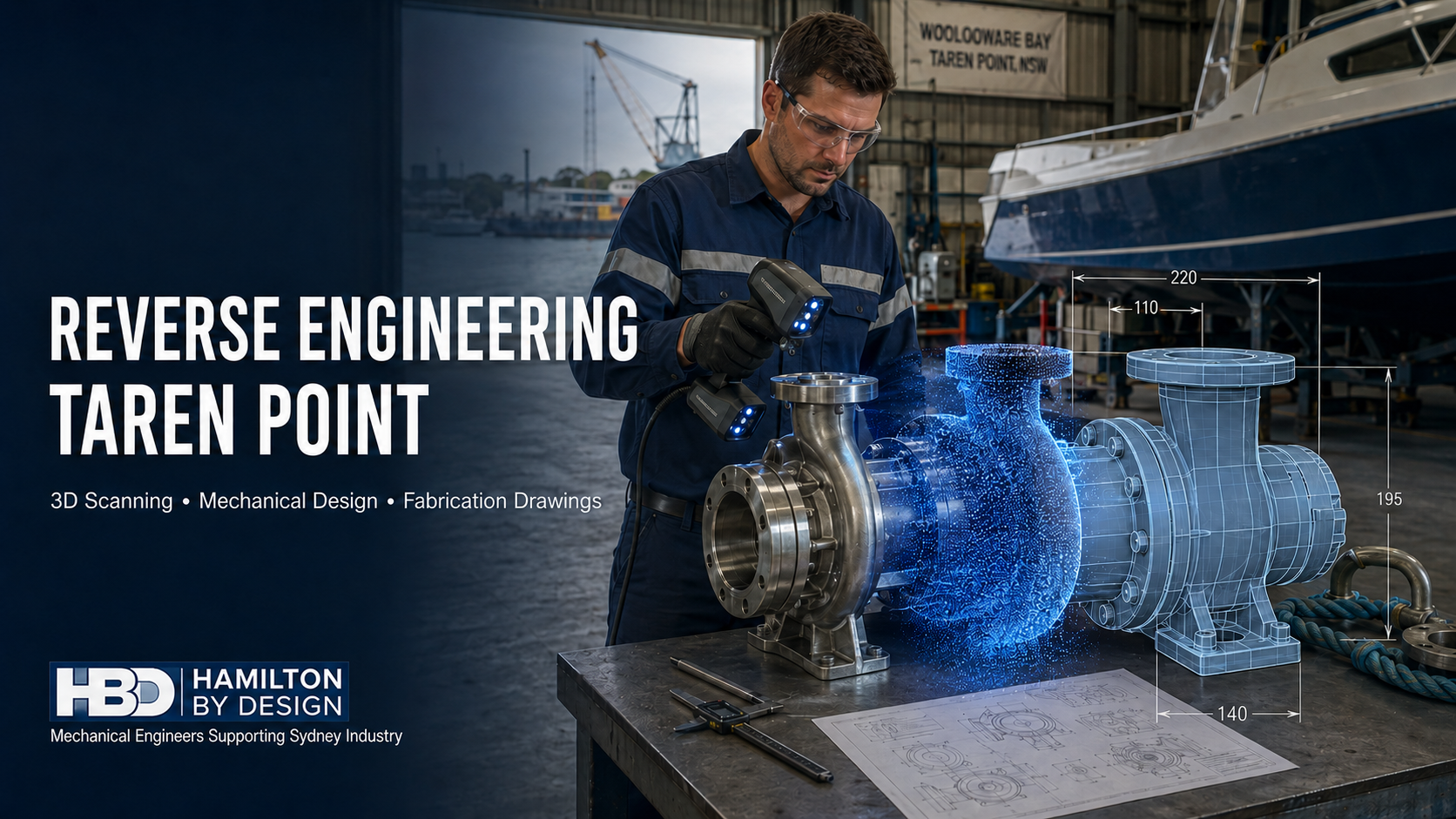
Reverse Engineering Taren Point: 3D Scanning, Mechanical Design and Fabrication Drawings

Taren Point is one of the Sutherland Shire’s most important industrial and employment areas. The precinct supports manufacturing, marine and automotive businesses, metal fabrication, specialist equipment suppliers, warehousing, building services and industrial maintenance. These operations depend on machinery and components that must remain serviceable, safe and capable of being modified as operating requirements change.
However, industrial assets do not always come with complete engineering records. Original drawings may be missing, manufacturers may no longer support older equipment, imported replacement parts may be unavailable, and years of maintenance can leave a machine significantly different from its original configuration. In marine environments, corrosion, wear, repairs and vessel modifications introduce further uncertainty.
Hamilton By Design provides reverse engineering in Taren Point to convert existing physical components and machinery into practical engineering information. This may include component scanning, dimensional measurement, 3D CAD modelling, mechanical design, fabrication drawings, inspection records and controlled digital asset information.
The service connects local Taren Point projects with Hamilton By Design’s broader Reverse Engineering and 3D Scanning Sydney capability. The objective is not merely to reproduce the visible shape of a component. It is to understand how the component functions, how it interfaces with surrounding equipment and what information a manufacturer, fabricator or asset owner needs to achieve a reliable outcome.
Why reverse engineering matters in Taren Point
Reverse engineering is the structured process of examining an existing component, assembly or machine and developing new technical information from the physical asset. It is particularly valuable when the original design information is unavailable, unreliable or no longer representative of the equipment in service.
Taren Point’s combination of manufacturing, fabrication, marine servicing and industrial support businesses creates several common applications. A production facility may need to replace a discontinued roller, shaft, housing or guard. A marine operator may require a new bracket or equipment support that must fit an existing vessel. A fabricator may receive a worn physical sample but no drawing. An automotive workshop may need a jig, mounting plate or custom interface for a specialist installation.
In each case, measurement is only the beginning. The engineering process must distinguish the intended geometry from wear, deformation, corrosion, previous repairs and manufacturing variation. If a worn shaft is copied exactly, the new component may reproduce the defect rather than restore the correct fit. If a corroded marine bracket is duplicated without reconsidering material, drainage and loading, the underlying failure mechanism may remain.
This is where engineering-led reverse engineering differs from simple geometric copying. Hamilton By Design can combine physical evidence, operating requirements, material information and the surrounding installation to develop a more useful digital model and drawing package.
Connecting Taren Point projects with Sydney-wide capability
Taren Point is part of a larger Greater Sydney industrial network. Components may be scanned locally, modelled remotely, manufactured elsewhere in Sydney and returned to the site or vessel for installation. A successful engineering workflow must therefore transfer accurate information between the client, engineer, fabricator, machine shop and installer.
Hamilton By Design’s 3D Scanning Sydney services support the capture of machinery, workshops, plant rooms, structures and surrounding installation conditions. Large-area scanning can be valuable when a component is only one part of a larger brownfield problem. For example, replacing a machine may also require confirmation of floor levels, access routes, service connections, maintenance clearances and structural interfaces.
The captured information can then be developed through Hamilton By Design’s CAD Services Sydney capability. Depending on the project, deliverables may include SolidWorks parts and assemblies, general-arrangement drawings, fabrication drawings, machining drawings, installation details and simplified coordination models. This Sydney-wide capability gives Taren Point clients access to an integrated scan-to-CAD workflow rather than a disconnected collection of measurements.
For projects requiring a wider documentation package, Hamilton By Design also provides Engineering Design and Drafting Services. These services help convert site information and engineering decisions into drawings that can be reviewed, priced, manufactured, installed and retained for future use.
Typical reverse engineering applications
Obsolete and unavailable components
Industrial equipment frequently remains operational beyond the commercial life of its individual parts. Manufacturers can discontinue product lines, suppliers can leave the market and overseas lead times can make an otherwise modest component a major operational problem.
Hamilton By Design can inspect the available sample, identify critical interfaces and recreate the part as a controlled CAD model. The new design can then be reviewed for an appropriate manufacturing process such as machining, fabrication, laser cutting, folding, casting, additive manufacture or a combination of processes.
Marine equipment and vessel modifications
Marine work presents distinctive challenges. Equipment spaces may be confined, original vessel information may be incomplete, and components may have experienced corrosion, vibration, impact or repeated modifications. Scanning can assist with the capture of brackets, rails, housings, deck equipment, machinery supports, steering interfaces and complex surrounding geometry.
For commercial vessels, the applicable regulatory and technical requirements must be established at the beginning of the project. Machinery involving propulsion, fuel, fluid, steering or ancillary systems may fall within the National Standard for Commercial Vessels. The reverse engineering deliverable must therefore suit the component’s function and regulatory context, rather than treating every marine item as an isolated object.
Machinery modifications and production upgrades
Manufacturing businesses often need to modify existing machinery to increase capacity, improve access, introduce new products or reduce a safety risk. These projects can be difficult when the machine has no reliable model or when its actual position differs from old drawings.
Component scanning and site-based reality capture can establish the existing condition before new equipment is designed. This supports clearance checking, guarding development, maintenance-access reviews and coordination with structures or services. Where the design requires analytical verification, Hamilton By Design’s FEA capabilities may assist with the assessment of stress, deflection or other defined loading conditions.
Fabrication drawings and manufacturing information
A scan or point cloud is not normally sufficient information for a fabricator. Manufacturing requires interpreted geometry, dimensions, materials, tolerances, weld information, surface finishes and revision status. Hamilton By Design can convert measured information into fabrication-ready documentation suited to the agreed scope.
Typical deliverables include:
- 3D component and assembly models;
- general-arrangement drawings;
- machining and fabrication drawings;
- cutting, folding and welded-assembly details;
- bills of materials;
- installation drawings;
- inspection records; and
- as-built revisions.
Drawing presentation may refer to AS 1100 technical-drawing principles, while steel design and fabrication may require consideration of AS 4100 and AS/NZS 1554.1. The exact standards depend on the component, material, loading, contractual requirements and intended application.
The reverse engineering process
An effective reverse engineering project begins with the operational problem, not the scanner. The required accuracy for a decorative cover is different from that required for a bearing fit, shaft, seal, bolted connection or aligned machinery interface.
Hamilton By Design’s typical process can include the following stages:
- Define the requirement. Establish what is being replaced or modified, why the work is required and how the final information will be used.
- Review the existing asset. Inspect condition, access, materials, interfaces, wear, corrosion and previous modifications.
- Plan the measurement method. Select component scanning, laser scanning, conventional measurement or a combination of methods.
- Capture the geometry. Record the component and, where necessary, the surrounding machinery, structure or vessel installation.
- Develop the CAD model. Reconstruct appropriate nominal geometry and design intent rather than automatically copying every surface defect.
- Check critical interfaces. Confirm fits, datums, clearances, fasteners, alignment and installation constraints.
- Prepare drawings. Add manufacturing information, materials, tolerances, notes and revision control.
- Review and verify. Compare the model with the physical evidence and record assumptions or limitations.
- Support manufacture and installation. Respond to technical queries and update information where agreed.
- Retain controlled records. Store the agreed models, drawings and inspection information for future maintenance or modification.
The process can be adapted for a single component or a larger machinery installation. It can also connect with Hamilton By Design’s broader structural engineering services where equipment supports, platforms or structural interfaces form part of the project.
Five common problems and how they can be addressed
1. Missing or inaccurate drawings
Old drawings may not reflect modifications made during installation or maintenance. Physical verification helps establish the actual condition before new work begins.
2. Worn, damaged or corroded samples
A damaged sample cannot always be copied directly. Engineering interpretation is needed to identify likely original geometry, appropriate tolerances and the cause of deterioration.
3. Difficult-to-measure geometry
Curved marine components, castings, moulded parts and confined machinery interfaces can be inefficient to capture using manual methods alone. Scanning can collect dense geometric information, while targeted measurements establish critical features.
4. New equipment that does not fit
Brownfield installations contain real-world deviations, obstructions and access limitations. Capturing surrounding conditions supports digital fit checking and reduces avoidable site rework.
5. Uncontrolled engineering information
Uncontrolled files can result in the wrong component being manufactured or an obsolete drawing being used. Drawing registers, approval status and revision control help maintain a traceable technical record.
Mechanical safety and risk management
Reverse engineering an operating machine is not only a dimensional exercise. A replacement or modification can alter guarding, access, stored energy, maintenance tasks, load paths or operator interaction. These changes should be reviewed through a structured safety-in-design and risk-management process.
Hamilton By Design can assist with hazard identification, machinery layouts, guarding concepts, maintenance access, isolation-point layouts and design risk registers. The AS/NZS 4024 machinery-safety series may be relevant to guarding and plant design. AS 1657 may apply to fixed platforms, walkways, stairs and ladders, while AS ISO 31000 provides broader risk-management principles.
The standards applicable to a particular project must be confirmed according to the plant, materials, intended use, legislation and client requirements. Engineering assistance does not remove the asset owner’s work health and safety obligations or replace specialist inspection, regulatory approval or certification where these are required.
Engineering data as a long-term asset
One of the greatest benefits of reverse engineering is the creation of information that can support future work. Subject to the agreed project and data-management arrangements, Hamilton By Design can retain component models, machinery scans, CAD assemblies, fabrication drawings and inspection records.
This information can help a client order another part, review a later modification, investigate a failure or brief a different manufacturer without beginning again from an undocumented physical sample. Controlled data can be particularly valuable to a small manufacturing or marine business where much of the asset knowledge would otherwise remain with one employee or contractor.
Hamilton By Design has provided practical engineering and digital-design support since 2001. More information about its approach and experience is available on the About Hamilton By Design page.
Frequently asked questions
What is reverse engineering?
Reverse engineering is the process of examining an existing physical component or machine and developing new technical information from it. The output may include measurements, a 3D CAD model, engineering analysis, fabrication drawings or inspection records.
Can Hamilton By Design reverse engineer a component without an original drawing?
Yes. Missing drawings are a common reason for reverse engineering. The available component can be measured or scanned, although its condition and the required accuracy must be assessed before the appropriate deliverables are agreed.
Is 3D scanning accurate enough for manufacturing?
It can be, provided the selected scanner, capture method and verification process suit the component and tolerances. Critical bores, threads, bearing fits and machined interfaces may require conventional metrology in addition to scanning.
Can a worn or broken component be reverse engineered?
Often, yes. The model should not automatically reproduce the damage. Adjacent parts, symmetry, remaining unworn surfaces, standard fits and the component’s function may help reconstruct its likely design intent.
Do you provide 3D scanning in Taren Point and the Sutherland Shire?
Hamilton By Design supports Taren Point through its broader Sydney scanning and engineering capability. The scope can include an individual component, industrial machinery, a workshop area or surrounding installation conditions.
Can you prepare fabrication and machining drawings?
Yes. Depending on the scope, Hamilton By Design can prepare general arrangements, machining drawings, welded-fabrication drawings, assemblies, bills of materials and installation details.
Can you assist with marine equipment?
Yes. Potential applications include equipment supports, brackets, rails, housings, machinery interfaces and vessel-refit geometry. Commercial-vessel requirements and any necessary survey or regulatory involvement must be established for the specific project.
Can the design be modified rather than copied exactly?
Yes. Once the existing geometry and function are understood, the component can potentially be adapted for different materials, manufacturing processes, interfaces or operational requirements. Any change should be assessed against the applicable loads, risks and standards.
What information should a client provide?
Useful information includes photographs, dimensions, operating conditions, material details, failure history, mating components, old drawings, required quantity, manufacturing preference and the reason the component is being replaced or modified.
Can Hamilton By Design retain the project data?
Subject to the agreed commercial, confidentiality and data-management arrangements, relevant scans, models, assemblies, drawings and inspection information can be retained as controlled engineering records.
Reverse engineering support for Taren Point
For Taren Point manufacturers, marine businesses, fabricators and industrial service providers, reverse engineering offers a practical route from an undocumented physical asset to reusable engineering information. It can reduce uncertainty, support local manufacture, improve installation planning and create a record that remains valuable after the immediate repair or modification is complete.
Hamilton By Design combines component scanning, Sydney-wide reality capture, mechanical engineering, CAD modelling and fabrication documentation to support this process. Whether the requirement involves one obsolete part or a coordinated machinery upgrade, the work begins by defining the operational problem, the required accuracy and the final engineering deliverables.
To understand the experience behind these services before discussing a reverse engineering, 3D scanning, mechanical design or fabrication-drawing project in Taren Point or elsewhere in Sydney, learn more about Hamilton By Design.
Applicable standards, verification requirements and regulatory approvals must be confirmed for each project according to the component, equipment, vessel, material, loading, contract and intended use.

Contact Us – Talk To Us
Our clients:
























