


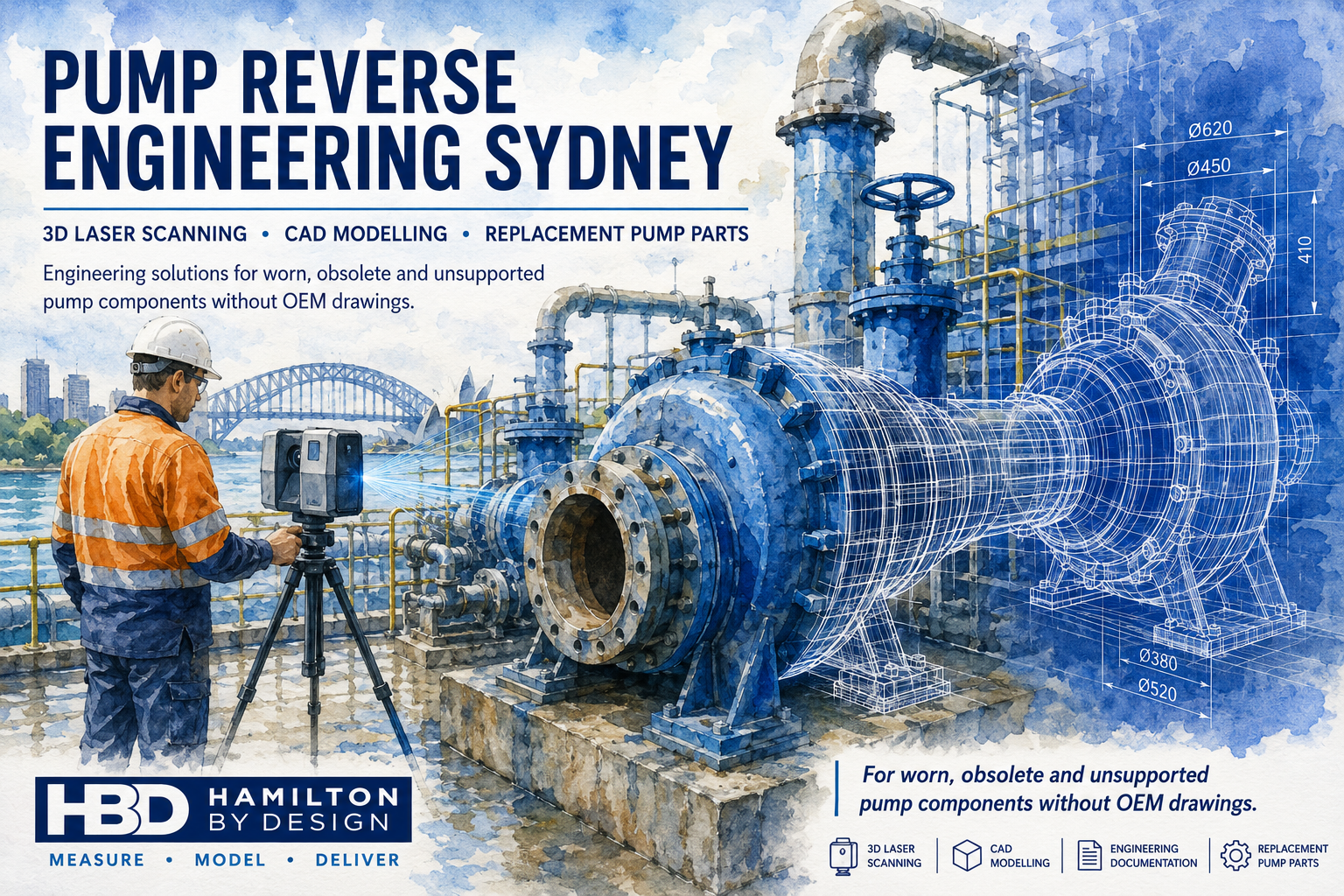
3D Laser Scanning, CAD Modelling and Engineering Documentation for Worn, Obsolete and Unsupported Pump Components
Hamilton By Design provides pump reverse engineering and replacement part documentation services for Sydney water infrastructure, wastewater facilities, pump stations and industrial plants.
When original drawings are missing, OEM support is no longer available, or a worn pump component needs to be replaced, we can assist by capturing the existing part, converting it into accurate 3D CAD data, and producing engineering documentation suitable for repair, replacement or future asset management.
Our work supports maintenance teams, project engineers, asset owners and plant operators who need reliable dimensional information before manufacturing, repairing or modifying critical pump components.
Reverse Engineering Pump Components When Drawings No Longer Exist
Many pumps used across Sydney’s water, wastewater and industrial infrastructure have been in service for decades. In many cases, the original manufacturer may no longer support the equipment, the drawings may be unavailable, or the component may have been modified over time.
This creates a major problem when a part fails.
Without accurate drawings, it can be difficult to manufacture a replacement component, verify fitment, assess wear, or plan a repair. Replacing the entire pump system may also be costly, disruptive and unnecessary.
Hamilton By Design helps solve this problem by using 3D laser scanning, precision measurement, CAD modelling and engineering drafting to recreate accurate digital models and drawings from existing physical components.
This process allows asset owners to extend the life of existing pump systems while creating useful engineering records for future maintenance.
Common Pump Problems We Help Solve
Pump components often become difficult to replace when the original design information is missing or outdated.
Hamilton By Design can assist when:
- OEM drawings are unavailable
- The original pump manufacturer no longer supports the equipment
- A replacement part has a long lead time
- A worn part needs to be measured before replacement
- A casing, housing or cover needs to be repaired or remanufactured
- A pump station requires accurate as-built information
- Existing parts have been modified on site over time
- Maintenance teams need drawings for future repairs
- A component needs to be checked before manufacture
- The cost of full pump replacement is too high
For many asset owners, reverse engineering provides a practical way to keep important equipment operating without relying on outdated or unavailable documentation.
Pump Reverse Engineering Services
Hamilton By Design provides engineering-led reverse engineering services for pump parts and pump station assets.
Our services include:
- 3D laser scanning of pump components
- Reverse engineering of worn or obsolete parts
- CAD modelling from existing physical samples
- Manufacturing drawings for replacement parts
- As-built documentation of pump station equipment
- Pump casing and housing documentation
- Wear component measurement and modelling
- CAD files for machining, fabrication or casting review
- Engineering verification of critical interfaces
- Digital records for asset management and future maintenance
We work with physical components, site measurements, point cloud data, old drawings, photographs and engineering markups to develop practical replacement part documentation.
Pump Components We Can Reverse Engineer
Hamilton By Design can assist with a wide range of pump components and related mechanical parts.
Typical components include:
- Pump casings
- Volutes
- Impellers
- Wear rings
- Shaft sleeves
- Bearing housings
- Seal housings
- Couplings
- Drive shafts
- Pump covers
- Diffusers
- Back plates
- Suction covers
- Discharge covers
- Custom castings
- Fabricated pump assemblies
- Mounting brackets
- Baseplates
- Pipework interfaces
- Flanges and adaptor components
Each component is assessed based on its condition, function, wear areas and critical fitment requirements.
3D Laser Scanning for Pump Stations and Pump Components
3D laser scanning is a useful tool when pump stations, pipework and existing equipment need to be accurately captured before repair, upgrade or replacement.
For pump station projects, scanning can help capture:
- Pump layouts
- Pipework routes
- Valve positions
- Flange locations
- Baseplates and plinths
- Access platforms
- Structural steel
- Existing clearances
- Tie-in points
- Confined or difficult-to-measure areas
This information can be used to create point clouds, CAD models, as-built drawings and engineering layouts.
For individual pump components, scanning can help capture complex geometry that may be difficult to measure manually. This is especially useful for worn casings, cast components, curved surfaces and irregular shapes.
Replacement Pump Parts Without OEM Drawings
One of the most common problems with older pump systems is the lack of reliable OEM documentation.
When drawings are missing, Hamilton By Design can create new engineering information from the existing part or assembly.
This may include:
- Measuring the existing component
- Capturing geometry using 3D scanning
- Identifying critical dimensions
- Modelling the part in CAD
- Comparing worn and unworn surfaces
- Producing manufacturing drawings
- Creating future maintenance records
This process can support the manufacture of replacement parts where the original design information is no longer available.
It can also help reduce downtime by giving maintenance and procurement teams accurate information to discuss with machinists, fabricators, foundries or specialist repair suppliers.
Reverse Engineering Worn Pump Casings and Components
Pump casings, housings and covers can be difficult to document because they often include complex cast geometry, internal profiles, worn faces and irregular surfaces.
Hamilton By Design can assist by scanning and modelling worn pump components to support repair, refurbishment or replacement.
This can be useful when:
- A pump casing has worn internal surfaces
- A cover needs to be replaced
- A housing has cracked or corroded
- Critical faces need to be machined
- Existing geometry needs to be captured before repair
- A casting needs to be documented for future manufacture
- The part must fit back into existing pipework and mounting locations
Reverse engineering does not simply mean copying a worn part. The process should consider which areas are critical, which surfaces are worn, and which dimensions need to be confirmed before manufacture.
Asset Life Extension for Sydney Water and Wastewater Infrastructure
Pump replacement can be expensive, especially when the existing unit is connected to fixed pipework, civil structures, electrical systems and access platforms.
In some cases, replacing a worn component may be more practical than replacing the complete asset.
Hamilton By Design supports asset life extension by helping create the engineering information required to repair, replace or document existing pump components.
This can benefit:
- Water infrastructure operators
- Wastewater treatment facilities
- Pump station owners
- Councils
- Industrial asset managers
- Maintenance contractors
- Mechanical engineers
- Fabricators and machine shops
By creating accurate CAD models and drawings, older equipment can be better understood, maintained and supported into the future.
Our Pump Reverse Engineering Process
Hamilton By Design uses a practical reverse engineering workflow suited to existing pump assets and brownfield infrastructure.
1. Review the Existing Problem
We start by understanding the component, the failure issue, the available information and the required outcome.
This may include reviewing old drawings, site photos, maintenance notes, failed components, spare parts or existing CAD data.
2. Capture the Existing Geometry
The component or pump station is measured using a combination of 3D laser scanning, manual measurement and engineering inspection.
For larger pump station environments, laser scanning can capture the surrounding pipework, equipment and structural context.
3. Identify Critical Interfaces
Critical interfaces are reviewed before modelling. These may include:
- Bearing fits
- Seal faces
- Shaft interfaces
- Bolt patterns
- Flange faces
- Machined surfaces
- Pipework connections
- Mounting points
- Alignment features
This step is important because not every surface on a worn part should be treated the same way.
4. Create the CAD Model
The captured geometry is converted into a usable CAD model.
Depending on the project, this may be a simplified model, an as-built model, a manufacturing model or a detailed reverse engineered component model.
5. Produce Drawings and Documentation
Engineering drawings can be produced to support manufacture, repair, procurement or future maintenance.
These drawings may include dimensions, tolerances, material notes, surface finish requirements, critical interfaces and general manufacturing notes.
6. Support Verification and Future Use
Once the replacement component is manufactured or repaired, the digital information can also be used for checking, future maintenance planning or asset documentation.
This helps reduce reliance on undocumented parts and creates a better long-term engineering record.
Deliverables Available
Depending on the project requirements, Hamilton By Design can provide a range of digital and drawing deliverables.
Typical deliverables include:
- Point cloud files
- 3D CAD models
- STEP files
- SAT files
- Parasolid files
- SolidWorks models
- Autodesk Inventor models
- 2D manufacturing drawings
- General arrangement drawings
- As-built pump station layouts
- Marked-up drawings
- Engineering verification models
- Reverse engineering documentation
Deliverables can be tailored to suit maintenance, fabrication, machining, procurement or engineering review requirements.
Where This Service Is Useful
Pump reverse engineering and replacement part documentation is useful across many Sydney industries and infrastructure environments.
Typical applications include:
- Water pump stations
- Wastewater pump stations
- Sewage treatment plants
- Water treatment plants
- Industrial process plants
- Manufacturing facilities
- Port infrastructure
- Mining support facilities
- Utilities infrastructure
- Brownfield mechanical upgrades
- Shutdown maintenance projects
- Asset refurbishment projects
Where old equipment remains operational but documentation is poor, reverse engineering can provide the missing technical information needed to make better decisions.

Why Use Hamilton By Design?
Hamilton By Design combines 3D scanning, CAD modelling and mechanical engineering experience to support practical reverse engineering outcomes.
Our approach is suited to real-world industrial environments where components may be worn, modified, corroded, difficult to access or poorly documented.
We understand that the goal is not just to create a model. The goal is to create useful engineering information that helps maintenance teams, fabricators, machinists and asset owners make better decisions.
Hamilton By Design can assist with:
- Site capture
- Component scanning
- Reverse engineering
- CAD modelling
- Manufacturing drawings
- As-built documentation
- Brownfield engineering support
- Pump station asset documentation
Supporting Pump Reverse Engineering Pages
For more specific information, you can also review the following related pages:
Need a Replacement Pump Component Without Drawings?
If you have a worn, obsolete or unsupported pump component and no reliable drawings, Hamilton By Design can help create the engineering information needed to support repair, replacement or future maintenance.
We can assist with 3D scanning, CAD modelling, reverse engineering and manufacturing documentation for pump components and pump station assets across Sydney.
Contact Hamilton By Design to discuss your pump reverse engineering or replacement part documentation requirements.
Call to Action:
Request Pump Reverse Engineering Support
Talk to Us – Contact Us
Our clients:

























FAQs — Pump Reverse Engineering & Replacement Parts Sydney
What is pump reverse engineering?
Pump reverse engineering is the process of measuring, scanning and modelling an existing pump component so new engineering drawings or CAD files can be created. This is useful when the original OEM drawings are missing, outdated or unavailable.
Can you reverse engineer a pump part if there are no drawings?
Yes. Hamilton By Design can work from the existing physical component, site measurements, 3D laser scan data, photographs, old drawings or maintenance notes to create usable CAD models and engineering documentation.
What pump components can be reverse engineered?
Common pump components include pump casings, volutes, impellers, wear rings, shaft sleeves, bearing housings, seal housings, couplings, drive shafts, covers, diffusers, back plates, baseplates, flanges and adaptor components.
How does 3D laser scanning help with pump replacement parts?
3D laser scanning captures the shape and geometry of existing pump components or pump station assets. This data can then be used to create CAD models, check dimensions, document wear areas and support the manufacture of replacement parts.
Can worn pump components still be scanned?
Yes. Worn components can be scanned, but the reverse engineering process needs to consider which areas are original geometry and which areas have been worn, corroded or damaged. Critical fits, machined faces and interfaces may require additional measurement and engineering judgement.
Can you reverse engineer obsolete pump components?
Yes. Reverse engineering is commonly used when pump components are obsolete, discontinued or no longer supported by the original manufacturer. It allows asset owners to create new drawings and CAD models for replacement, repair or future maintenance.
Do you provide manufacturing drawings for pump parts?
Yes. Hamilton By Design can provide 2D manufacturing drawings and 3D CAD models to support machining, fabrication, casting review, repair or procurement. Drawings can include critical dimensions, material notes, tolerances and general manufacturing information where required.
Is this service suitable for Sydney Water and wastewater infrastructure?
Yes. This service is suitable for water pump stations, wastewater pump stations, sewage treatment plants, water treatment plants and other Sydney infrastructure where older pump assets need to be repaired, replaced or documented.
Can reverse engineering help extend the life of an existing pump?
Yes. Reverse engineering can help extend asset life by allowing worn or unsupported components to be repaired, replaced or documented without needing to replace the entire pump system. This can reduce downtime, cost and disruption.
What files can be supplied after reverse engineering?
Typical deliverables may include 3D CAD models, STEP files, SAT files, Parasolid files, SolidWorks models, Autodesk Inventor models, 2D manufacturing drawings, as-built layouts, marked-up drawings and point cloud files where required.
Can you scan the whole pump station as well as the pump component?
Yes. Hamilton By Design can scan both individual pump components and larger pump station environments. This is useful when the replacement part must fit into existing pipework, baseplates, access platforms or surrounding equipment.
What is the difference between scanning a pump part and reverse engineering it?
Scanning captures the physical shape of the part. Reverse engineering goes further by converting that captured data into usable CAD models, drawings and engineering documentation that can support repair, replacement or future asset management.
Can you check if a replacement pump part will fit existing pipework?
Yes. By scanning the pump, pipework, flanges, baseplates and surrounding plant, Hamilton By Design can help verify key interfaces and clearances before a replacement part or modified component is manufactured.
Who uses pump reverse engineering services?
Typical users include water utilities, wastewater operators, councils, industrial plant owners, maintenance teams, mechanical engineers, asset managers, fabricators, machinists and contractors working with older pump systems.
When should I consider reverse engineering instead of buying a new pump?
Reverse engineering may be worth considering when the pump is still serviceable, the failed component can be replaced, OEM support is unavailable, full replacement would be expensive, or replacing the complete pump would require major pipework or civil modifications.