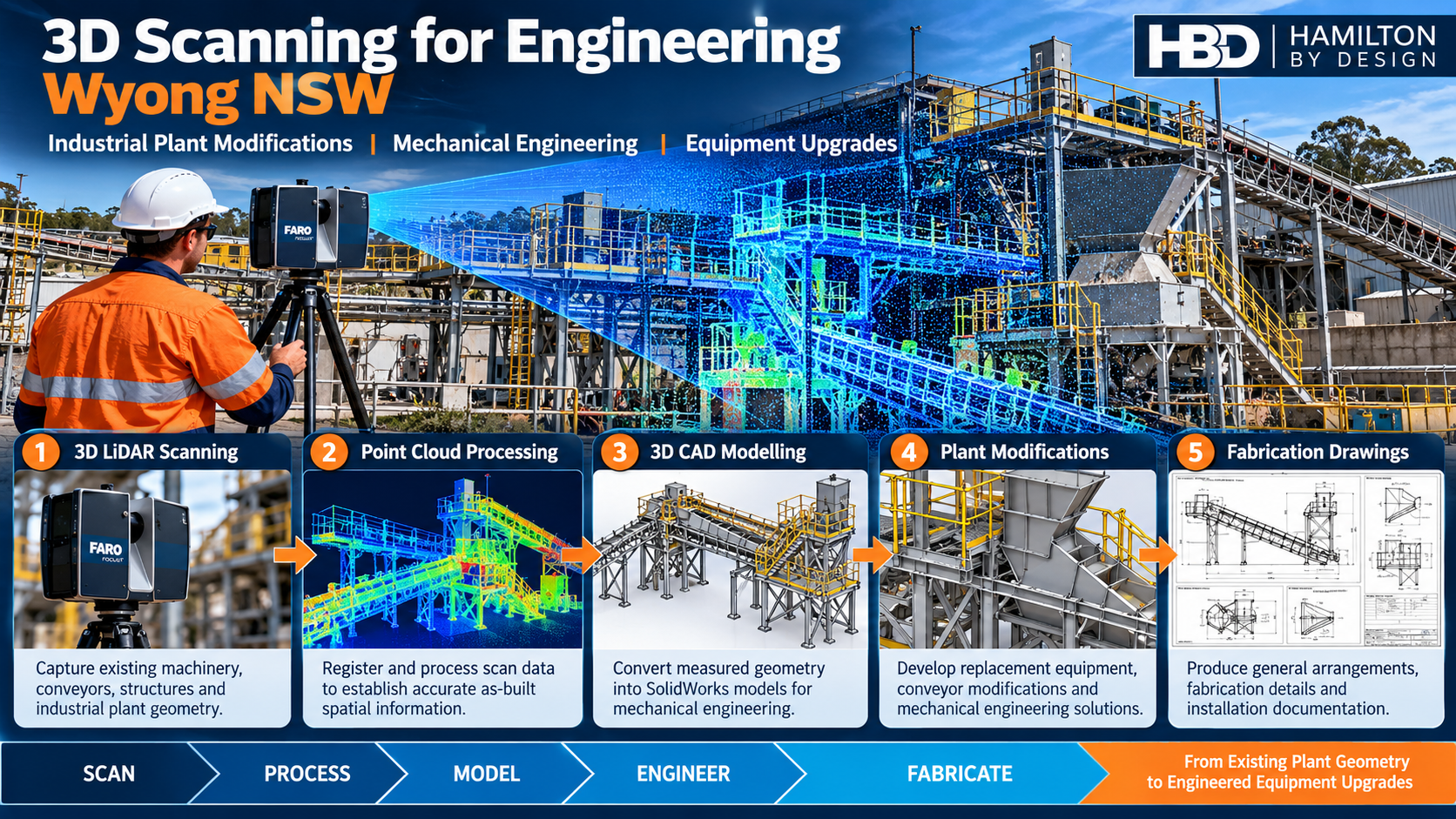
Hamilton By Design provides 3D scanning for engineering projects in Wyong, supporting manufacturers, industrial operators, maintenance teams and fabrication businesses across the NSW Central Coast.
Our services combine 3D LiDAR scanning, point cloud processing, mechanical engineering and 3D CAD modelling to help businesses understand existing equipment geometry before undertaking modifications, replacements or upgrades.
Whether you are modifying a conveyor, replacing worn equipment, installing new machinery or developing fabrication drawings, our approach helps reduce dimensional uncertainty and identify potential installation conflicts before work begins.
Unlike scanning-only providers, Hamilton By Design can support projects from initial site measurement through to mechanical design and fabrication documentation.
Why Use 3D Scanning for Engineering?
Industrial facilities often operate with equipment that has been modified over many years. Original drawings may be missing, outdated or inconsistent with the equipment currently installed.
Traditional measurements can be time-consuming, particularly around congested machinery, pipework, structural steel and elevated equipment.
3D scanning allows engineers to capture existing conditions and develop a digital reference for engineering decisions.
Common Engineering Applications
Industrial plant modifications: Capture existing equipment arrangements before modifications or upgrades.
Conveyor engineering: Measure conveyors, transfer points, support structures and surrounding equipment.
Reverse engineering: Reconstruct CAD models of existing mechanical components and assemblies.
Equipment replacement: Verify available space, mounting locations and connection points.
Pipework modifications: Capture existing pipework geometry to assist with routing and spool design.
Fabrication engineering: Develop models and drawings for replacement or modified components.
As-built verification: Compare installed equipment against design models and drawings.
Shutdown planning: Identify dimensional constraints before fabrication and installation activities.
Supporting Wyong’s Manufacturing and Industrial Businesses
Wyong and the surrounding Central Coast industrial areas contain manufacturing, warehousing, processing and engineering operations that depend on reliable mechanical equipment.
Hamilton By Design supports businesses in Wyong and nearby industrial locations including Tuggerah, North Wyong, Warnervale, Berkeley Vale and Somersby.
Our engineering scanning services are particularly relevant where existing plant must remain operational while modifications are designed and prepared.
Manufacturing Equipment Upgrades
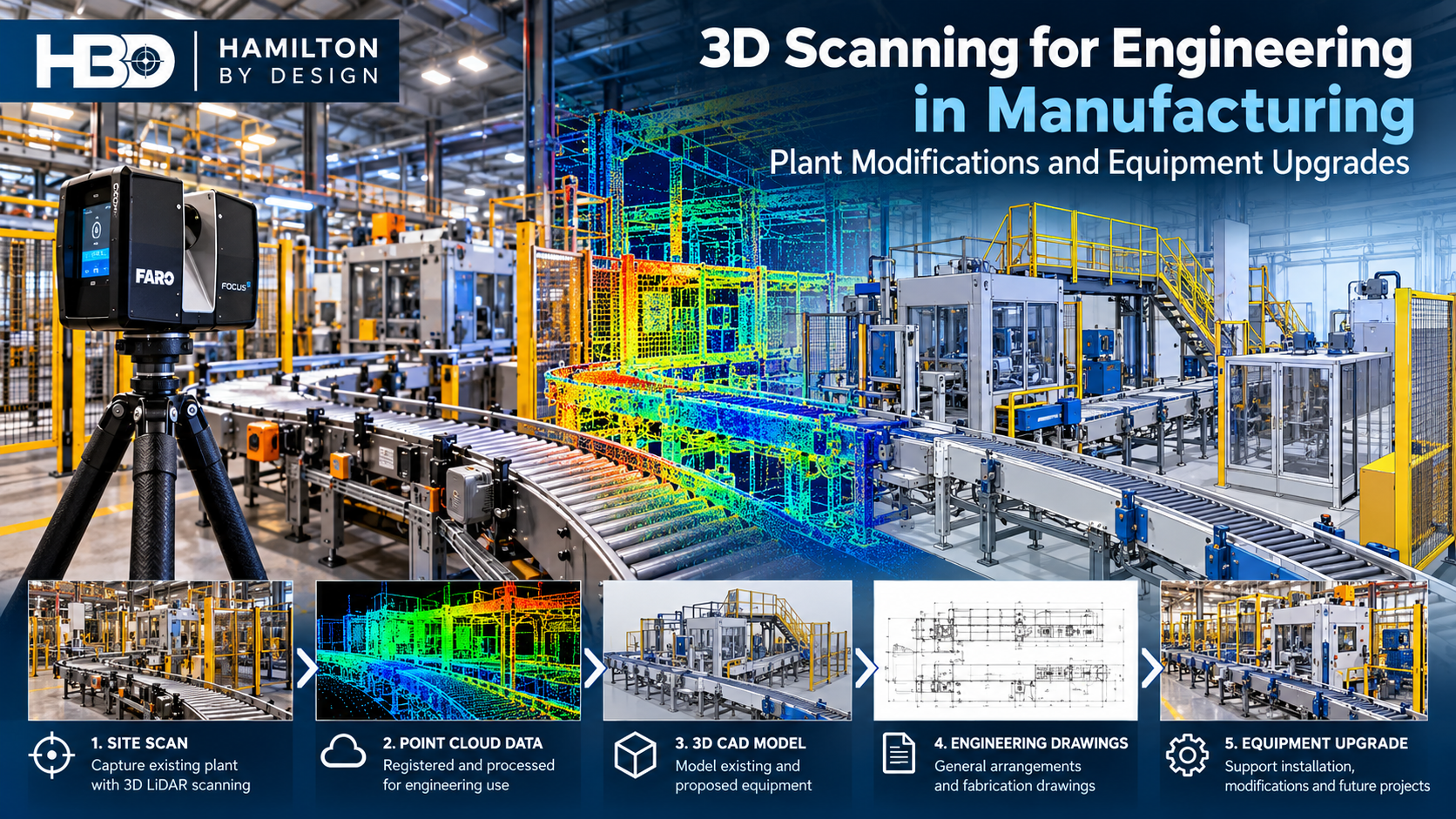
Manufacturing facilities frequently need to introduce new equipment into established production environments.
Existing conveyors, access platforms, structural steel, electrical services and pipework can create installation constraints.
3D scanning provides spatial information that can be used to develop and check equipment layouts before installation.
Conveyor and Materials Handling Modifications
Conveyor systems may require modifications to improve product flow, reduce wear, increase accessibility or accommodate replacement equipment.
We can capture existing conveyor arrangements and use the point cloud data to develop SolidWorks models of proposed modifications.
Typical projects include transfer chute upgrades, conveyor relocations, guarding modifications and mechanical support arrangements.
Reverse Engineering Existing Equipment
Many industrial facilities operate equipment for which original manufacturer drawings are no longer available.
Where appropriate, we combine LiDAR scanning with close-range 3D measurement techniques to develop CAD models of existing components.
These models can support replacement part development, engineering assessments and fabrication.
The selected measurement method depends on component size, access, surface condition and required accuracy.
From 3D Scanning to Mechanical Engineering
Hamilton By Design provides an integrated workflow that connects site measurement with engineering deliverables.
Stage 1 – Site Inspection and 3D Scanning
We review the project requirements and identify the equipment, structures and interfaces requiring measurement.
A 3D LiDAR scanner captures the existing arrangement, with supplementary measurements undertaken where greater dimensional accuracy is required.
Stage 2 – Point Cloud Registration and Processing
Individual scans are registered into a coordinated point cloud dataset.
The information is reviewed for coverage, alignment and suitability for the intended engineering application.
Stage 3 – 3D CAD Modelling
Using SolidWorks and other CAD tools, we develop models of the relevant existing equipment and proposed modifications.
The level of modelling detail is selected according to the engineering requirements rather than modelling unnecessary plant components.
Stage 4 – Mechanical Engineering and Design
We use the measured geometry to develop engineering solutions, review equipment arrangements and assess installation interfaces.
Where required, this can include mechanical design calculations, component selection and finite element analysis.
Stage 5 – Fabrication and Installation Documentation
Project deliverables may include:
3D SolidWorks models and assemblies
STEP and Parasolid files
General arrangement drawings
Fabrication and detail drawings
DXF files for manufacturing
Point cloud datasets
Installation reference models
Navisworks-compatible coordination models
Engineering Accuracy and Measurement Limitations
3D scanning accuracy depends on the selected equipment, measurement distance, environmental conditions, registration quality and access to the relevant surfaces.
For larger industrial LiDAR projects, registered point cloud datasets may typically achieve approximately ±5–10 mm under suitable conditions. This is not a guaranteed tolerance for every feature.
Components requiring tighter manufacturing tolerances may require close-range metrology scanning or supplementary dimensional measurements.
Hamilton By Design considers the intended engineering application when selecting the appropriate measurement approach.
A point cloud provides measured geometry, but engineering judgement is still required to determine whether that information is suitable for design and fabrication.
Why Choose Hamilton By Design?
Mechanical Engineering Knowledge
Hamilton By Design is led by a qualified mechanical engineer with practical fitting and industrial maintenance experience.
This combination helps connect dimensional measurement with the practical requirements of manufacturing, fabrication and installation.
Scanning and Engineering in One Service
Our services extend beyond the delivery of a point cloud. We can use the captured information to develop mechanical designs, equipment layouts and fabrication documentation.
Local Central Coast Support
Based in Wyong NSW, Hamilton By Design can support engineering projects across the Central Coast, Newcastle, Hunter Valley and greater Sydney.
Practical Industrial Experience
Our experience includes conveyors, chutes, materials handling systems, mechanical equipment, industrial plant and maintenance engineering applications.
Frequently Asked Questions
Can 3D scanning be used to design replacement equipment?
Yes. Scanning can capture the existing equipment arrangement and available installation space. The resulting geometry can be used to develop replacement equipment models, subject to verification of critical interfaces and tolerances.
Can you produce fabrication drawings from a 3D scan?
Yes. Hamilton By Design can develop CAD models and fabrication drawings using scanned geometry, supplementary measurements and mechanical engineering design information.
Do we need to shut down our manufacturing plant for scanning?
Not always. Many areas can be scanned while a facility remains operational, subject to site safety requirements, visibility and equipment movement. Some locations may require controlled access or shutdown arrangements.
Can you work with existing SolidWorks models?
Yes. Existing CAD models can be incorporated into the engineering workflow and compared with captured site geometry.
Do you service areas outside Wyong?
Yes. We support projects throughout the Central Coast, Newcastle, the Hunter Valley, Sydney and interstate.
Discuss Your Wyong Engineering Project
Planning a plant modification, machinery upgrade, conveyor replacement or reverse engineering project?
Hamilton By Design can help capture your existing equipment geometry and develop the engineering information needed to progress your project.
From 3D scanning to CAD modelling, mechanical engineering and fabrication drawings, we provide a practical approach to industrial equipment modifications.
Hamilton By Design supports manufacturers and industrial
facilities across Wyong and the Central Coast with 3D
laser scanning, mechanical engineering, CAD modelling,
reverse engineering and fabrication documentation.
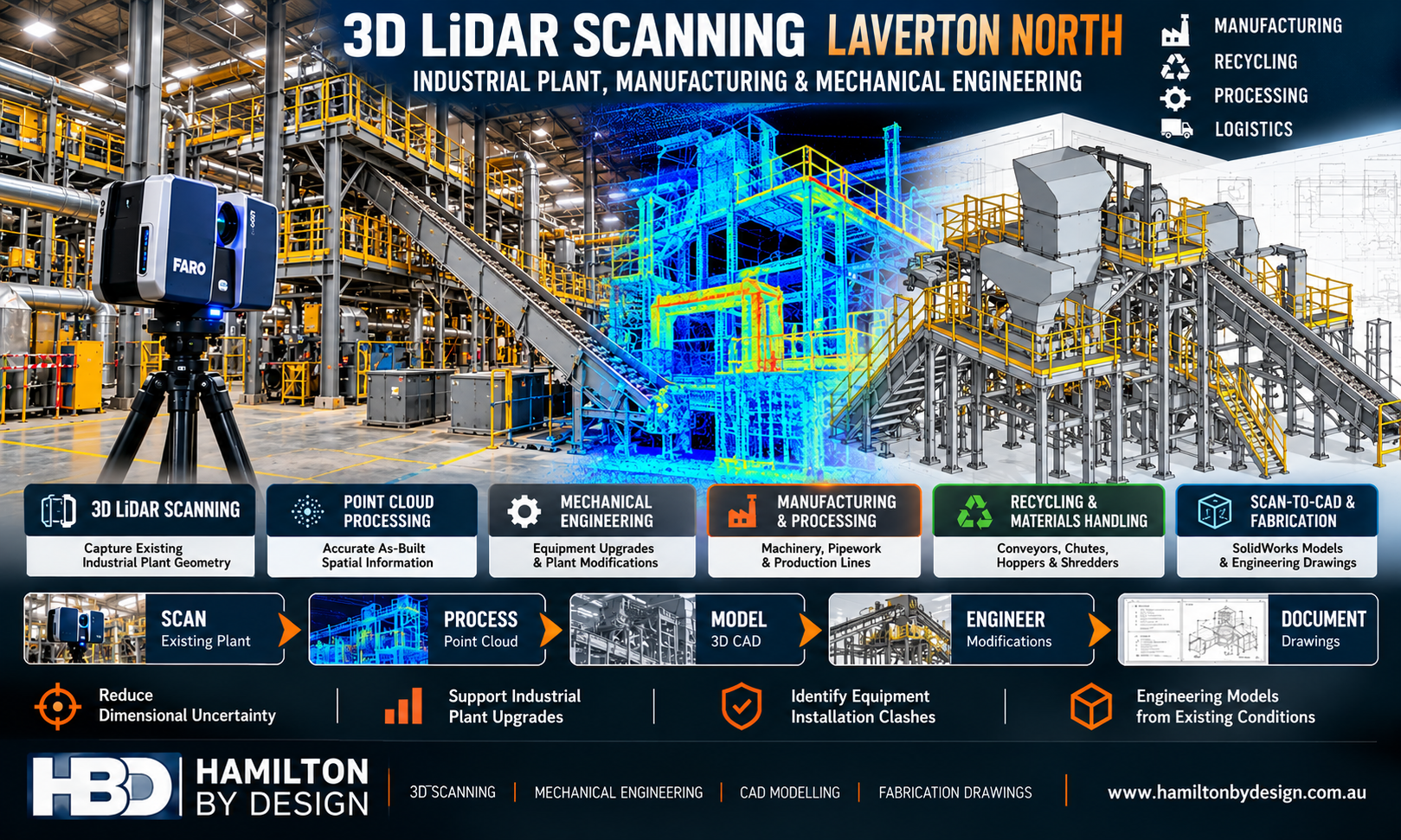
3D LiDAR Scanning for Industrial Facilities in Laverton North, Victoria
Industrial plant modifications often begin with a fundamental engineering challenge: understanding the exact geometry of existing equipment, structures, pipework and machinery before new designs are developed.
Hamilton By Design provides 3D LiDAR scanning services in Laverton North, Victoria, supporting heavy manufacturing, industrial processing, recycling facilities, logistics operations and mechanical engineering projects throughout Melbourne’s western industrial corridor.
Our approach combines 3D laser scanning, point cloud processing, mechanical engineering, 3D CAD modelling and fabrication drawings to help businesses plan equipment modifications with greater dimensional confidence.
Whether a facility is replacing a conveyor, installing processing equipment, modifying a production line or upgrading mechanical infrastructure, reliable existing-condition information is essential.
Rather than relying entirely on historical drawings, tape measurements or assumptions, 3D LiDAR scanning allows engineers to develop a detailed spatial record of the existing facility.
Our engineering workflow:
3D LiDAR Scanning → Point Cloud Registration → Mechanical Engineering → 3D CAD Modelling → Equipment Modifications → Fabrication Drawings
Supporting Laverton North’s Heavy Industrial and Manufacturing Sector
Laverton North is an established industrial area within Melbourne’s western manufacturing and logistics corridor.
Its industrial character makes 3D LiDAR scanning particularly relevant to businesses operating facilities containing complex machinery, conveyors, material handling systems, processing equipment and industrial infrastructure.
Hamilton By Design supports engineering applications across several industrial environments.
Industrial sector
Typical 3D LiDAR scanning applications
Heavy manufacturing
Machinery upgrades, production line modifications, equipment installation and factory layouts
Recycling and resource recovery
Conveyors, shredders, screening equipment, hoppers and processing plant modifications
Industrial processing
Pipework, pumps, mechanical equipment, access platforms and plant upgrades
Logistics and distribution
Warehouse equipment layouts, material handling systems and automation interfaces
Metal fabrication
Existing structure interfaces, machinery positioning and fabrication verification
Materials handling
Conveyor transfers, chutes, support structures and equipment replacements
Each facility presents different engineering constraints, including limited access, congested plant layouts, restricted shutdown windows and incomplete historical documentation.
3D scanning helps establish the existing geometry before detailed engineering begins.
3D LiDAR Scanning for Existing Industrial Plant and Equipment
Industrial facilities frequently undergo modifications throughout their operating lives.
Equipment may have been relocated, additional pipework installed, platforms modified or conveyor systems upgraded without corresponding updates to the original engineering drawings.
Over time, this creates uncertainty about the actual installed geometry.
3D LiDAR scanning provides a practical method of capturing existing plant conditions.
Using terrestrial laser scanning equipment, Hamilton By Design can capture spatial information relating to:
Industrial machinery and equipment footprints
Conveyors, transfer stations and processing systems
Pipework, pumps, valves and mechanical services
Steelwork, platforms, walkways and access arrangements
Building columns, walls, floors and roof interfaces
Existing installation clearances and equipment access zones
Multiple scan positions can be registered into a combined point cloud, providing a spatial reference for subsequent engineering work.
The resulting dataset can be used to establish existing conditions, develop CAD models, review equipment layouts and identify potential dimensional conflicts.
Why existing-condition verification matters
A small dimensional discrepancy can create significant problems when installing large mechanical equipment.
Incorrect assumptions about conveyor centreline positions, flange locations, structural interfaces or equipment clearances can result in fabrication changes, additional site work and installation delays.
3D scanning helps reduce these risks by allowing critical dimensions and interfaces to be assessed before fabrication.
Scanning accuracy and final modelling tolerances depend on the equipment, scanning conditions, registration quality, access and project requirements. Critical fabrication interfaces may require supplementary dimensional verification.
From 3D Point Clouds to Mechanical Engineering Design
Collecting point cloud data is only the first stage of an industrial engineering project.
The greater value comes from converting that information into usable engineering deliverables.
Hamilton By Design combines 3D scanning with mechanical engineering and CAD capabilities to support equipment modifications from initial site capture through to detailed design.
Stage 1 – Site scanning
Existing equipment, structures and installation areas are captured using 3D LiDAR scanning equipment.
Stage 2 – Point cloud registration
Individual scans are aligned and processed to establish a combined spatial dataset.
Stage 3 – Existing-condition modelling
Relevant equipment, structures and mechanical interfaces are reconstructed using CAD software.
Stage 4 – Mechanical engineering
Proposed equipment arrangements, modifications, installation clearances and mechanical interfaces are developed and reviewed.
Stage 5 – Engineering drawings
Depending on the project scope, deliverables may include:
General arrangement drawings
Equipment modification drawings
Fabrication and assembly drawings
Installation interface details
3D SolidWorks models
AutoCAD drawings and DXF files
STEP and Parasolid models
Registered point cloud datasets
This integrated approach allows industrial clients to work with a mechanical engineering provider rather than coordinating scanning and mechanical design as entirely separate activities.
Conveyor Systems, Transfer Chutes and Materials Handling Equipment
Conveyor systems are widely used in manufacturing, recycling, bulk materials handling and industrial processing.
Modifying an existing conveyor system can involve several interconnected engineering considerations.
These may include conveyor alignment, transfer geometry, supporting steelwork, access requirements, drive arrangements and equipment clearances.
Hamilton By Design uses 3D scanning and mechanical engineering to support projects involving:
Conveyor relocations and extensions
Transfer chute replacements and modifications
Hopper and discharge arrangements
Conveyor support interfaces
Belt transfer geometry
Wear liner arrangements
Maintenance access and guarding
Installation and fabrication drawings
Example: Existing conveyor modification
Consider a Laverton North recycling facility planning to replace an existing conveyor transfer chute.
The original drawings may not reflect modifications made during previous maintenance activities.
By scanning the existing conveyor arrangement, the engineering team can establish relevant equipment geometry, identify surrounding obstructions and develop a replacement chute design around verified site information.
The objective is to reduce uncertainty before fabrication and minimise avoidable modification work during installation.
3D LiDAR Scanning for Recycling and Waste Processing Facilities
Recycling and resource recovery facilities present particular engineering challenges because equipment often operates in abrasive, dusty and mechanically demanding environments.
Common equipment includes conveyors, shredders, screens, hoppers, feeders, bins and material transfer systems.
These systems may require modification because of equipment wear, changes in material characteristics, production requirements or maintenance access constraints.
Typical engineering applications
Conveyor and transfer chute upgrades
Capture existing equipment geometry before designing replacement chutes, liners or material transfer arrangements.
Shredder and screening equipment installation
Establish equipment footprints, supporting interfaces and surrounding clearances for replacement machinery.
Hopper and bin modifications
Develop existing-condition models to support changes to discharge geometry, access arrangements and mechanical components.
Maintenance access improvements
Assess existing machinery arrangements when developing platforms, walkways and guarding modifications.
Plant reconfiguration
Use registered point cloud data to evaluate proposed equipment positions within an established processing facility.
Importantly, 3D scanning establishes geometry; it does not independently determine material flow performance, structural adequacy or equipment capacity.
These matters require appropriate engineering assessment and, where necessary, additional analysis.
Manufacturing Equipment and Production Line Upgrades
Manufacturing facilities regularly introduce new equipment to improve production capacity, product quality, maintenance performance or operational efficiency.
However, installing new machinery within an existing factory can be challenging when floor space is limited and surrounding equipment must remain in place.
3D LiDAR scanning supports the engineering process by establishing the spatial relationships between existing machinery, structural elements and building services.
Applications include:
Machinery replacement and relocation
Production line extensions
Factory equipment layout planning
Mechanical service modifications
Equipment support and baseplate interfaces
Maintenance and installation clearance reviews
Clash assessment between new and existing equipment
Reducing installation uncertainty
A new machine may fit within the nominal available floor area but still conflict with existing pipework, access routes, maintenance zones or structural columns.
Combining point cloud information with proposed equipment CAD models allows these potential conflicts to be reviewed during design rather than discovered during installation.
This is particularly useful where shutdown time is limited or machinery must be installed around operating production systems.
Industrial Pipework, Pumps and Mechanical Services
Existing industrial pipework can be difficult to measure using conventional methods, particularly where services are elevated, congested or routed around machinery.
3D scanning can provide spatial information for pipework modifications and equipment connections.
Hamilton By Design supports engineering work involving:
Existing pipework route capture
Pump and equipment connection interfaces
Pipe support arrangements
Mechanical equipment replacement
Flange location and orientation assessment
Proposed pipe routing and spatial clash reviews
Mechanical arrangement and fabrication drawings
Point cloud information can help engineers develop proposed routing arrangements around existing equipment.
Where fabrication tolerances require greater precision than the registered scan data provides, critical connections should be independently verified before manufacture.
3D Scanning for Logistics and Distribution Facilities
Laverton North’s industrial environment also includes warehousing, transport and logistics operations.
These facilities may require modifications to material handling equipment, loading systems, automated machinery and building services.
3D LiDAR scanning can support:
Warehouse equipment layouts
Conveyor and sorting system installation
Automated material handling upgrades
Equipment clearance assessments
Loading and unloading infrastructure modifications
Building and mechanical service coordination
Existing-condition documentation for facility upgrades
For logistics operations, the principal benefit is establishing reliable spatial information before installing equipment into an operating facility.
Supporting Industrial Shutdowns and Equipment Installation
Industrial shutdowns often involve significant coordination between engineering, fabrication, maintenance and installation teams.
When equipment must be installed within a restricted timeframe, dimensional uncertainty can become a major project risk.
3D LiDAR scanning allows existing equipment interfaces and surrounding geometry to be captured before shutdown work begins, where safe access is available.
The resulting information can support:
Existing-condition verification
Proposed equipment layout development
Spatial clash identification
Fabrication drawing preparation
Installation sequence planning
Pre-installation engineering reviews
The objective is to identify dimensional and spatial problems before they affect the shutdown schedule.
While scanning cannot eliminate all installation risks, it can provide a more reliable basis for engineering decisions and fabrication planning.
Why Choose Hamilton By Design for 3D LiDAR Scanning in Laverton North?
Hamilton By Design combines practical mechanical engineering experience with 3D laser scanning and CAD modelling capabilities.
Our services extend beyond the collection of point cloud data.
Qualified mechanical engineering capability
Hamilton By Design is led by a qualified mechanical engineer with mechanical fitting trade experience and practical exposure to industrial equipment, fabrication, installation and maintenance environments.
Industrial site experience
Our experience includes mining, manufacturing, materials handling, mechanical equipment and industrial plant modifications.
Integrated scanning and CAD workflow
We use technologies including FARO laser scanning, SolidWorks and AutoCAD to support existing-condition capture and mechanical design.
Practical fabrication understanding
Engineering models and drawings are developed with consideration for equipment interfaces, fabrication requirements, installation constraints and maintenance access.
Industrial site access qualifications
Relevant qualifications and competencies include working at heights, confined space, rigging and industrial site supervision training, subject to project-specific access and safety requirements.
Flexible engineering deliverables
Projects can be scoped for scanning only, registered point clouds, existing-condition models, mechanical design or detailed fabrication drawings.
Frequently Asked Questions – 3D LiDAR Scanning Laverton North
Who provides 3D LiDAR scanning for industrial facilities in Laverton North?
Hamilton By Design provides 3D LiDAR scanning and mechanical engineering services for industrial projects in Laverton North and surrounding Melbourne industrial areas. Services include existing-condition scanning, point cloud processing, CAD modelling and engineering drawings.
Can 3D LiDAR scanning be used in operating manufacturing facilities?
Yes. 3D LiDAR scanning can be undertaken in many operating industrial environments, subject to site safety requirements, equipment movement, visibility and access restrictions. Some areas may require planned access or shutdown arrangements.
Can an existing conveyor system be converted into a SolidWorks model?
Yes. Point cloud data can be used as a spatial reference to reconstruct existing conveyor geometry and develop SolidWorks models. The required level of detail depends on the intended engineering use and available scan information.
Can 3D scanning help with recycling plant modifications?
Yes. Scanning can capture existing conveyors, hoppers, shredders, screening equipment and surrounding structures to support equipment replacement, layout modifications and mechanical engineering design.
What is the difference between 3D scanning and reverse engineering?
3D scanning captures the geometry of existing objects and environments. Reverse engineering interprets that information to reconstruct usable engineering geometry, components or assemblies. Additional measurements and engineering judgement may be necessary.
How accurate is industrial 3D LiDAR scanning?
Accuracy depends on the scanner, distance, site conditions, registration process and required deliverables. Registered industrial datasets may achieve millimetre-level accuracy under suitable conditions, but project-specific tolerances must be assessed and verified.
Can Hamilton By Design provide fabrication drawings after scanning?
Yes. Depending on the agreed scope, Hamilton By Design can use scan data to develop mechanical CAD models, general arrangement drawings, equipment modifications and fabrication drawings.
Is 3D LiDAR scanning useful when original plant drawings are unavailable?
Yes. One of the principal applications of industrial scanning is establishing existing geometry where historical drawings are missing, incomplete or no longer reflect the installed equipment.
Request a 3D LiDAR Scanning Quotation in Laverton North
Planning an industrial equipment upgrade, conveyor modification, recycling plant improvement or manufacturing facility expansion in Laverton North?
Hamilton By Design can assist with existing-condition scanning, point cloud processing, mechanical engineering, 3D CAD modelling and fabrication documentation.
Our approach is designed to help industrial clients establish reliable site information before committing to equipment modifications and fabrication.
Contact Hamilton By Design to discuss your Laverton North industrial scanning and engineering requirements.
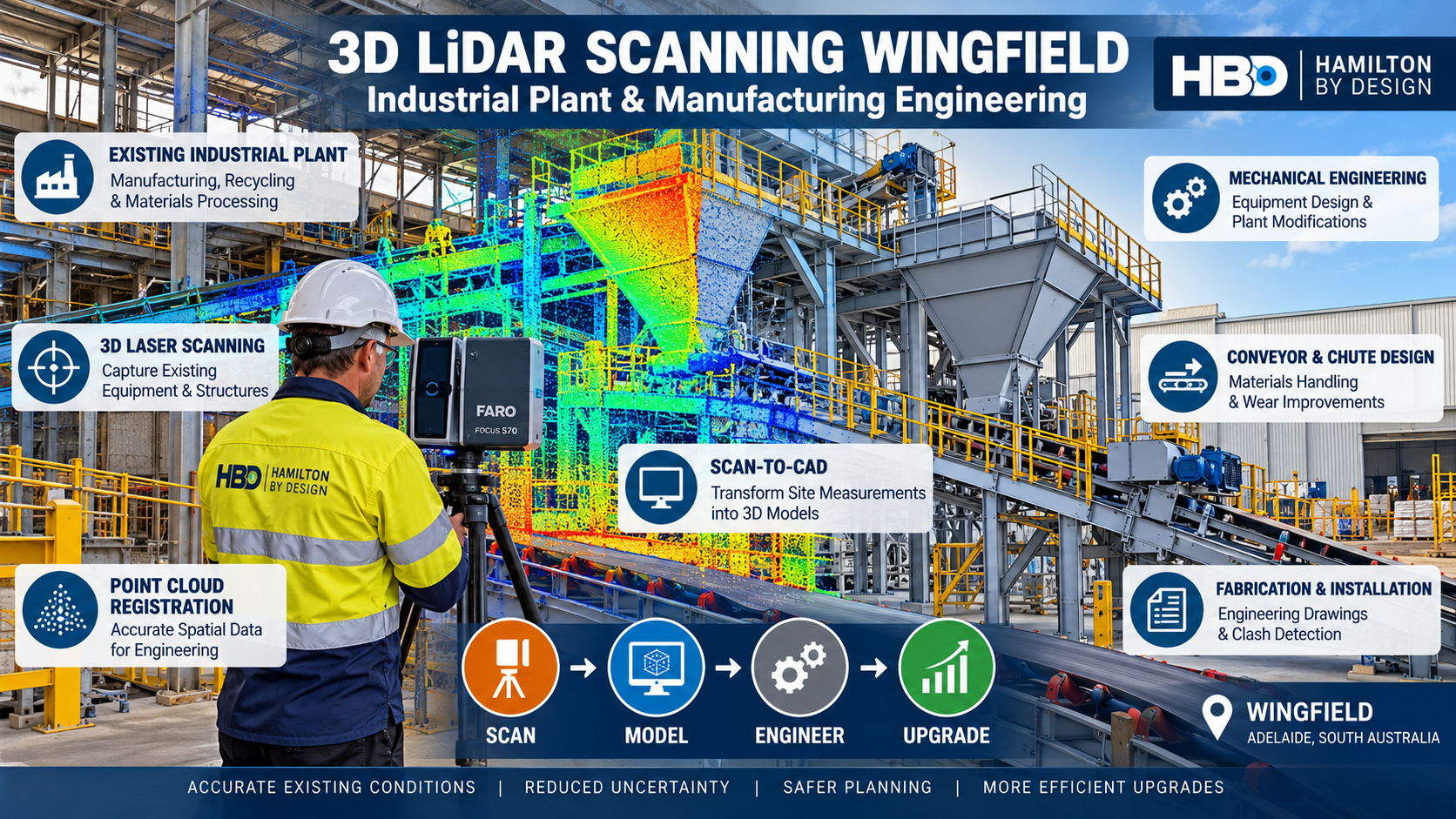
Supporting industrial plant modifications, manufacturing equipment upgrades, reverse engineering and as-built documentation across Wingfield, Adelaide and South Australia.
3D LiDAR Scanning Services in Wingfield, Adelaide
Wingfield is an established industrial precinct in Adelaide’s northern industrial corridor, supporting manufacturing, metal fabrication, recycling, transport, logistics and industrial maintenance operations.
Industrial facilities frequently undergo modifications to accommodate new equipment, improve production efficiency, replace ageing machinery and maintain operational reliability.
However, one of the challenges facing engineers, maintenance teams and fabrication contractors is the availability of accurate information about existing plant configurations.
Original engineering drawings may no longer represent the installed equipment. Machinery may have been relocated, structural modifications completed or pipework altered without corresponding updates to the facility’s documentation.
Hamilton By Design provides 3D LiDAR scanning, point cloud processing, scan-to-CAD modelling and mechanical engineering services to support industrial facilities in Wingfield and surrounding Adelaide manufacturing precincts.
Our approach combines physical measurement with practical mechanical engineering experience to support modifications to existing operational facilities.
Why 3D LiDAR Scanning Matters for Wingfield Industrial Facilities
Industrial modifications often require engineers to design new equipment within existing facilities where access, clearances and surrounding infrastructure create significant constraints.
Traditional measurement methods can be time-consuming when documenting complex machinery, elevated pipework, structural steelwork and congested production areas.
3D LiDAR scanning captures large quantities of spatial information, producing a three-dimensional point cloud representing the measured surfaces of the existing facility.
This information can be used to:
Document existing industrial plant and equipment configurations.
Identify potential clashes before fabrication or installation.
Support conveyor, chute and material handling modifications.
Establish equipment positions and available installation clearances.
Develop three-dimensional CAD models of existing machinery.
Support reverse engineering of components and assemblies.
Produce general arrangement drawings for engineering reviews.
Reduce uncertainty when planning plant upgrades and shutdown work.
The objective is not simply to collect measurements, but to convert reliable site information into engineering decisions.
Industrial Applications for 3D LiDAR Scanning in Wingfield
1. Manufacturing Plant Modifications
Manufacturing facilities regularly introduce new equipment, relocate production machinery and modify existing processing lines.
3D scanning provides spatial information that engineers can use when planning modifications around existing infrastructure.
Applications include production equipment layouts, machinery relocation, access improvements, pipework modifications and installation clearance assessments.
2. Conveyor Systems and Bulk Materials Handling
Industrial facilities handling raw materials, recycled products and manufactured goods often rely on conveyors, hoppers, transfer chutes and associated mechanical equipment.
Hamilton By Design can assist with scanning and modelling existing material handling systems to support:
Conveyor modifications and equipment replacement.
Transfer chute and hopper redesign.
Material flow improvements.
Wear liner replacement and arrangement.
Access and maintenance improvements.
Fabrication drawing development.
Where appropriate, mechanical design reviews can consider material flow behaviour, wear mechanisms, maintainability and installation constraints.
3. Recycling and Materials Processing Facilities
Wingfield supports recycling, resource recovery and industrial materials handling activities.
These operations may contain conveyors, screens, crushers, sorting equipment, hoppers, bins and other processing machinery.
3D LiDAR scanning can support plant modifications where existing equipment arrangements are difficult to document using conventional measurement techniques.
Potential applications include equipment replacement, structural clearance checks, new conveyor installations and preparation of as-built plant models.
4. Mechanical Equipment Reverse Engineering
Industrial equipment may remain operational long after original manufacturing drawings become unavailable.
Hamilton By Design provides reverse engineering support using 3D scanning, dimensional measurement and CAD modelling.
Applications include:
Replacement machinery components.
Existing mechanical assemblies.
Pump and equipment mounting arrangements.
Fabricated steel components.
Machine guarding and access systems.
Equipment interfaces and connection details.
For components requiring tighter dimensional tolerances, supplementary metrology and physical verification may be necessary.
5. Industrial Pipework and Equipment Layouts
Pipework modifications can be challenging when existing services are congested or original drawings are incomplete.
3D LiDAR scanning supports the documentation of pipework arrangements and surrounding equipment to assist with the development of proposed routes.
Applications include pipework replacement, spool arrangement planning, equipment connections and clearance assessment.
Detailed engineering, field verification and appropriate design checks remain necessary before fabrication and installation.
From 3D LiDAR Scanning to Mechanical Engineering
Hamilton By Design offers an integrated workflow connecting site measurement with engineering design.
Stage 1 – Site Inspection and Scanning
Review the project requirements, identify critical equipment interfaces and capture the existing facility using terrestrial 3D LiDAR scanning.
Stage 2 – Point Cloud Registration and Processing
Register individual scans into a coordinated point cloud dataset suitable for review and engineering modelling.
Stage 3 – Scan-to-CAD Modelling
Develop three-dimensional CAD models of the relevant equipment, structures or surrounding infrastructure using the registered point cloud.
Stage 4 – Mechanical Engineering and Design
Develop proposed modifications, review installation constraints and prepare engineering concepts or detailed models according to the agreed project scope.
Stage 5 – Engineering Drawings and Deliverables
Prepare relevant general arrangement drawings, mechanical details, fabrication information and digital models for review or downstream use.
This approach can reduce repeated site visits and improve coordination between engineering, fabrication and installation teams.
3D Scanning Accuracy and Engineering Verification
The accuracy of a 3D scanning project depends on several factors, including equipment capability, scanning geometry, environmental conditions, registration quality and the accessibility of measured surfaces.
For typical industrial scanning applications, Hamilton By Design uses project-specific measurement and verification procedures appropriate to the required deliverables.
A registered point cloud may provide sufficient information for general plant layouts and preliminary mechanical design. However, critical fabrication interfaces, bolt patterns, precision fits and machinery alignment requirements may require supplementary measurement.
A point cloud should not automatically be treated as a fabrication-tolerance dimensional inspection.
Measurement requirements and acceptance criteria should be agreed before commencing the work.
Supporting Industrial Engineering Across Adelaide
Although this page focuses on Wingfield, Hamilton By Design can support industrial projects throughout Adelaide and South Australia.
Relevant industrial areas include Wingfield, Regency Park, Gepps Cross, Dry Creek, Gillman, Port Adelaide, Kilburn, Cavan, Edinburgh and other manufacturing and logistics precincts.
Services can be delivered through site-based scanning, remote engineering development and coordination with local fabrication and installation contractors.
Why Choose Hamilton By Design?
Hamilton By Design combines 3D scanning capability with mechanical engineering and industrial plant experience.
Our services include:
Terrestrial 3D LiDAR scanning using FARO scanning equipment.
Point cloud registration and processing.
Scan-to-CAD modelling using SolidWorks and AutoCAD workflows.
Mechanical equipment and material handling design.
Reverse engineering and fabrication documentation.
Engineering support for operational plant modifications.
Digital deliverables suitable for coordination and design review.
Unlike a scanning-only service, Hamilton By Design can assist with the subsequent mechanical engineering and design activities, subject to the agreed scope.
Frequently Asked Questions
What is 3D LiDAR scanning used for in manufacturing?
3D LiDAR scanning captures the existing geometry of machinery, structures and industrial facilities. The resulting point cloud can support plant modifications, equipment relocation, as-built documentation and engineering design.
Can 3D scanning be completed while a factory is operating?
Scanning may be possible during normal operations, depending on access restrictions, moving machinery, visibility, site safety requirements and the project objectives. Moving equipment and obstructed surfaces can affect the completeness of the captured data.
Can a point cloud be converted into SolidWorks models?
Yes. Point cloud data can be used as a reference to develop SolidWorks models of existing equipment and structures. The level of detail depends on the intended engineering application.
Is 3D LiDAR scanning suitable for conveyor modifications?
Yes. Scanning can document existing conveyor positions, supporting structures, transfer points and surrounding equipment to assist with proposed modifications and clash assessments.
Can Hamilton By Design provide fabrication drawings?
Yes. Mechanical engineering and drafting services can include general arrangement drawings, component details and fabrication documentation, depending on the agreed scope and engineering verification requirements.
Do you provide 3D scanning services outside Wingfield?
Yes. Hamilton By Design supports projects across Adelaide, regional South Australia and interstate locations, subject to project requirements and mobilisation arrangements.
Related Engineering Services
For additional information about our engineering and scanning capabilities, visit:
Hamilton By Design supports manufacturing plants, fabrication
workshops, recycling facilities and industrial operations in
Wingfield, Adelaide and across Australia. Explore our related
3D LiDAR scanning, mechanical engineering, CAD modelling and
industrial plant modification services.
3D Laser Scanning Services
Engineering-grade LiDAR scanning for industrial facilities,
machinery, structural steelwork and existing plant.
Capture point cloud data to support as-built documentation,
equipment upgrades and mechanical engineering design.
Convert captured site geometry into practical engineering
information. Point clouds support equipment layouts,
clash detection, as-built verification, plant upgrades
and the development of three-dimensional CAD models.
Reduce fabrication and installation uncertainty by
capturing existing site conditions before manufacturing.
Support steelwork, pipe spools, platforms, machinery
modifications and mechanical component fit-up.
Support dimensional verification of fabricated
components and mechanical assemblies. Compare
measured geometry against design information to
identify potential installation and interface issues
before equipment reaches site.
Combine site measurement with three-dimensional CAD
modelling to support equipment design, reverse
engineering, plant modifications and fabrication
documentation for manufacturing and processing facilities.
Engineering-led 3D scanning for manufacturing,
mining and infrastructure projects. Develop
point cloud information into CAD models to
support mechanical design, equipment upgrades
and existing plant modifications.
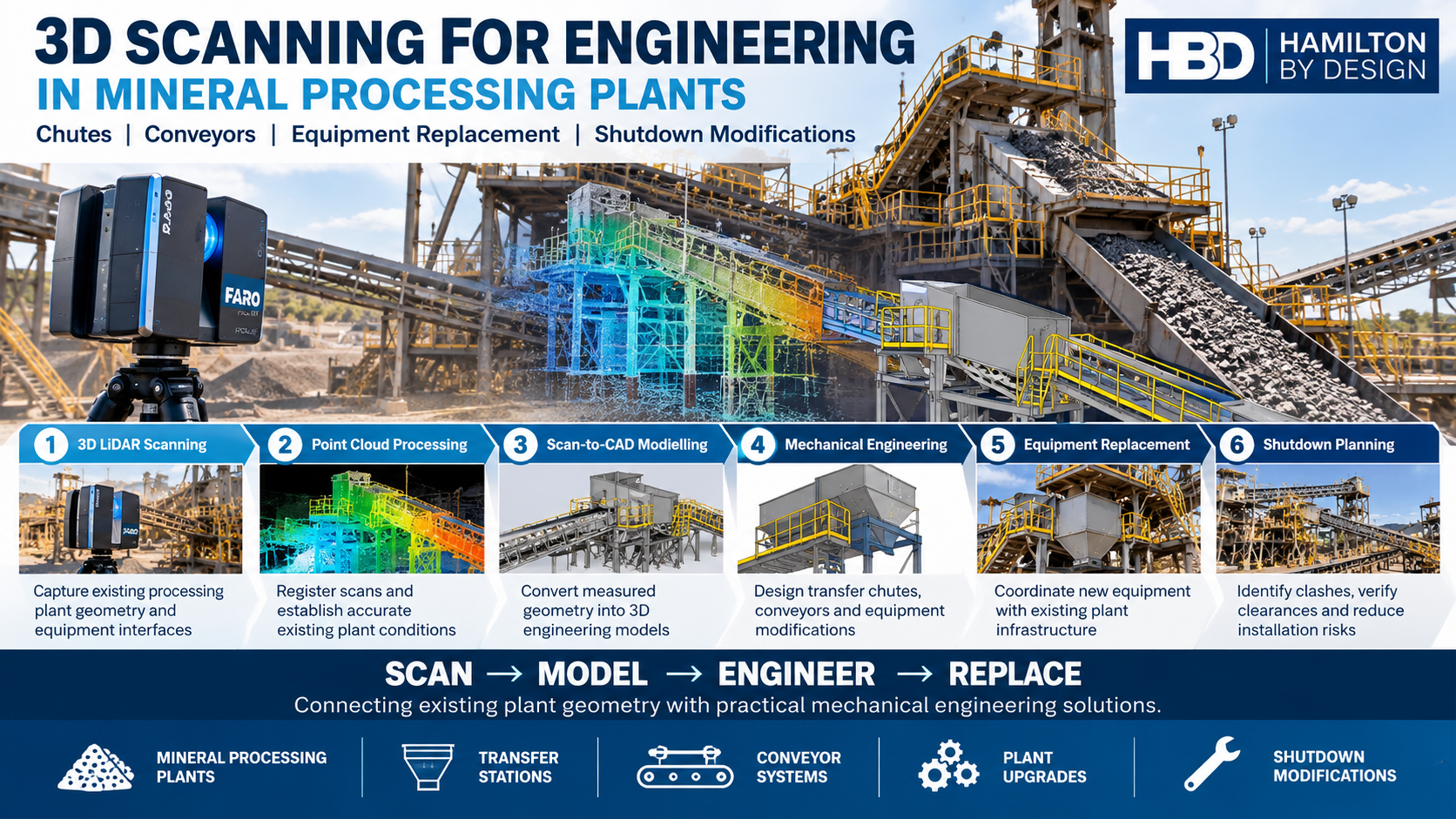
Mineral processing plants operate in demanding environments where equipment wear, structural constraints, material handling requirements and limited shutdown windows can make plant modifications challenging. Replacing a transfer chute, upgrading a conveyor or installing new processing equipment requires more than accurate dimensions. It requires an understanding of how existing equipment, supporting structures and mechanical systems interact.
3D scanning for engineering in mineral processing plants provides a practical way to capture existing plant conditions before mechanical design, equipment replacement and shutdown modifications begin.
At Hamilton By Design, we combine 3D LiDAR scanning, point cloud processing, 3D CAD modelling and mechanical engineering to support mineral processing plant upgrades across Australia.
Our approach connects existing plant geometry with engineering decisions, helping maintenance teams, project engineers and fabrication contractors plan modifications with greater confidence.
Why Accurate Existing Plant Geometry Matters
Mineral processing facilities are continually modified throughout their operating lives. Equipment may be repaired, relocated or replaced, while structural steelwork, platforms, pipework and access arrangements are progressively altered.
Unfortunately, existing engineering drawings do not always reflect these changes.
Common challenges include:
Transfer chutes that have been modified without updated fabrication drawings.
Conveyor structures with undocumented changes to supports and equipment interfaces.
Restricted access around crushers, screens, pumps and processing equipment.
Pipework and cable trays obstructing proposed replacement equipment.
Limited opportunities to measure equipment during production.
Replacement components that must fit within existing structural arrangements.
Shutdown schedules that leave little time for correcting dimensional errors.
3D LiDAR scanning helps establish a measurable record of existing plant geometry.
Rather than relying exclusively on historical drawings and manual measurements, engineers can reference registered point cloud data when developing replacement equipment and planning modifications.
1. How Is 3D Scanning Used for Engineering Modifications in Mineral Processing Plants?
3D scanning captures the visible surfaces of existing equipment, structures and surrounding plant infrastructure.
A terrestrial LiDAR scanner records millions of spatial measurements that can be registered into a coordinated three-dimensional point cloud.
This dataset can then be used to support mechanical engineering and plant modification activities.
Typical engineering applications
Plant Area
3D Scanning Application
Engineering Deliverable
Transfer stations
Capture chute geometry, supporting steelwork and conveyor interfaces
3D chute models and general arrangement drawings
Conveyor systems
Record existing frames, pulley positions and structural clearances
Conveyor modification models and drawings
Crushing circuits
Capture surrounding steelwork, access platforms and equipment interfaces
Equipment replacement layouts
Screening plants
Measure existing screens, support structures and surrounding services
Equipment installation and modification models
Pump installations
Capture pump bases, pipework and equipment connections
Pump skid and pipework arrangement drawings
Processing equipment
Identify spatial constraints around existing machinery
Equipment replacement and installation layouts
Shutdown modifications
Document existing conditions before shutdown works
Coordinated engineering models and installation planning information
The resulting point cloud becomes a geometric reference for engineering design.
However, scanning does not replace engineering calculations, equipment specifications or mechanical design verification. These activities remain essential when determining whether proposed modifications are suitable for their intended operating conditions.
2. How Can 3D LiDAR Scanning Improve Chute and Conveyor Replacement?
Transfer chutes and conveyor systems are among the most frequently modified components within mineral processing plants.
These systems experience abrasive wear, impact loading, material accumulation and changing operating requirements.
Replacing a worn transfer chute may appear straightforward, but the new design must integrate with existing equipment and surrounding structures.
Transfer chute engineering
3D LiDAR scanning can capture:
Existing chute inlet and outlet positions.
Conveyor discharge and receiving arrangements.
Structural steelwork and support connections.
Available space for chute removal and installation.
Maintenance access and surrounding obstructions.
Existing flange and equipment interface locations, where accessible.
Point cloud information can then be incorporated into SolidWorks or AutoCAD engineering workflows.
For example, a worn transfer chute may require replacement with a revised geometry intended to improve material flow or reduce maintenance requirements.
The existing plant geometry provides the spatial constraints for the new design.
Additional engineering considerations may include material trajectory, wear liner selection, impact zones, blockage risk, structural loads and maintenance accessibility.
The objective is not simply to reproduce the existing chute, but to develop a replacement that fits the available space and addresses the identified operational requirements.
Conveyor modifications and upgrades
Conveyor replacement projects may involve new pulleys, drive arrangements, transfer points, guarding, access platforms or supporting structures.
3D scanning helps engineers understand the relationship between existing components before modifications are developed.
Typical applications include conveyor frame modifications, drive station upgrades, transfer point changes and structural clearance assessments.
Critical mechanical interfaces still require suitable dimensional verification, particularly where fabrication tolerances are tighter than the achievable accuracy of the registered plant scan.
3. Why Is 3D Scanning Important When Planning Mineral Processing Plant Shutdowns?
Shutdown periods are expensive and operationally sensitive.
Engineering modifications often need to be completed within a limited installation window, with multiple contractors working in the same area.
Unexpected interference between replacement equipment and existing infrastructure can result in additional fabrication, rework and installation delays.
3D scanning supports shutdown preparation by providing engineering teams with a detailed record of accessible existing conditions.
Before the shutdown
Scanning can be undertaken during a planned site visit, subject to safe access and operating conditions.
The resulting dataset allows engineers to develop replacement equipment models, review spatial clearances and identify potential clashes before shutdown activities commence.
During engineering development
Replacement equipment can be modelled within the existing point cloud environment.
Engineers can review proposed installation arrangements against surrounding plant geometry, including structural steelwork, pipework, conveyors and access platforms.
Where appropriate, models can also be incorporated into Navisworks for coordination and clash reviews.
During installation
Pre-shutdown dimensional verification can reduce reliance on last-minute site measurements and help identify potential installation constraints earlier.
This does not eliminate installation risk. Final fit-up remains dependent on measurement quality, fabrication tolerances, site changes, lifting arrangements and construction verification.
Nevertheless, identifying geometric conflicts before mobilisation can improve shutdown readiness.
4. How Does Scan-to-CAD Support Equipment Replacement and Mechanical Engineering?
A point cloud contains spatial measurement data, but it is not automatically a complete engineering model.
Scan-to-CAD is the process of using measured geometry to develop CAD representations suitable for design and engineering activities.
At Hamilton By Design, point cloud information can be processed and referenced in mechanical design software to develop models of existing equipment and proposed modifications.
Typical scan-to-CAD workflow
Stage 1 – Site scanning
Capture the relevant plant area using terrestrial 3D LiDAR scanning, including accessible equipment, structural interfaces and surrounding obstructions.
Stage 2 – Point cloud registration
Register individual scans into a coordinated dataset and review registration quality and coverage.
Stage 3 – Existing condition modelling
Develop CAD representations of the relevant equipment, structures and interfaces.
Stage 4 – Mechanical engineering
Develop proposed replacement equipment or plant modifications using the captured geometry alongside applicable engineering requirements.
Stage 5 – Engineering drawings
Prepare general arrangement drawings, equipment layouts and, where included in the agreed scope, fabrication drawings.
Stage 6 – Design verification
Review critical dimensions, clearances and mechanical interfaces. Where necessary, undertake supplementary measurements or detailed metrology before fabrication.
Typical project deliverables
Deliverable
Engineering Purpose
Registered point cloud (.E57, .RCP)
Existing condition reference
3D CAD model
Equipment geometry and proposed modifications
STEP or Parasolid files
CAD exchange and fabrication coordination
General arrangement drawings
Overall equipment layout and installation interfaces
Fabrication drawings
Manufacture of replacement components
Navisworks-compatible model
Plant coordination and spatial clash review
Engineering calculations, where scoped
Assessment of loads, structural adequacy and mechanical design requirements
The required deliverables depend on the project scope, available information and level of engineering verification required.
5. Can 3D Laser Scanning Reduce Installation Risks When Upgrading Mineral Processing Equipment?
3D laser scanning can help reduce geometric uncertainty when upgrading or replacing mineral processing equipment.
This is particularly valuable when new equipment must fit into an established plant with limited space and incomplete documentation.
Consider a replacement transfer chute within an existing conveyor transfer station.
The proposed chute may need to accommodate fixed conveyor positions, existing support steelwork, maintenance platforms and surrounding services.
Without a coordinated record of the existing installation, designers may need to rely on several separate measurements and historical drawings.
A registered point cloud provides a more comprehensive spatial reference for evaluating the proposed arrangement.
Potential benefits include:
Earlier identification of equipment clashes.
Improved coordination between engineering and fabrication teams.
Reduced dependence on incomplete historical drawings.
Better understanding of maintenance and installation clearances.
Improved planning for shutdown equipment replacement.
Fewer avoidable dimensional assumptions during design development.
These benefits depend on the quality of the scan, accessibility of critical interfaces and the engineering verification undertaken.
For high-precision equipment connections, bearing locations, machined surfaces and bolted interfaces, additional measurements may be required.
6. Applications Across Mineral Processing Facilities
3D scanning and mechanical engineering can support a broad range of mineral processing operations.
Coal handling and preparation plants
Coal handling and preparation plants commonly contain extensive conveyor systems, transfer stations, screening equipment and structural platforms.
Potential applications include transfer chute replacement, conveyor modifications, wash plant equipment upgrades and shutdown coordination.
Gold and copper processing plants
Crushing, screening, grinding and flotation circuits often contain tightly integrated equipment, pipework and structural systems.
3D scanning can support equipment replacement planning, pump skid modifications, pipework routing and spatial coordination.
Mineral sands and other processing facilities
Mineral sands processing plants and other bulk materials facilities may require modifications to transfer systems, screening arrangements, hoppers, bins and mechanical handling equipment.
Capturing existing geometry helps engineers assess the available installation envelope before developing replacement components.
7. Engineering Accuracy and Dimensional Verification
Understanding the difference between scanning accuracy and engineering tolerance is essential.
A 3D laser scanner records visible surfaces, but the overall accuracy of a registered point cloud depends on several factors.
These include scanner performance, scan distance, registration quality, surface condition, environmental conditions and the selected coordinate reference system.
For many industrial plant surveys, registered datasets may provide an indicative geometric accuracy in the order of ±5–10 mm, depending on project conditions and survey methodology.
This should not be interpreted as a guaranteed tolerance for every measured feature.
Critical equipment interfaces may require higher-accuracy verification using appropriate measurement methods.
Examples include:
Machined flange faces.
Precision shaft and bearing positions.
Bolt hole centres.
Equipment mounting interfaces.
Close-tolerance fabrication connections.
Hamilton By Design can combine plant-scale scanning with targeted dimensional verification where the engineering scope requires it.
The appropriate measurement method should be selected according to the design tolerance and installation risk.
8. From Existing Plant Conditions to Engineered Equipment Replacement
A successful equipment replacement project requires more than a three-dimensional model.
The engineering process must consider the interaction between existing geometry, operational requirements, mechanical loads, material characteristics, maintenance access and fabrication constraints.
For mineral processing plant modifications, this may include:
Existing condition assessment: Understanding the actual arrangement of plant equipment and structures.
Mechanical design: Developing replacement equipment that addresses the intended operating requirements.
Structural and mechanical verification: Assessing relevant loads, connections, supports and equipment performance within the agreed scope.
Fabrication coordination: Producing suitable engineering information for manufacturing and assembly.
Installation planning: Reviewing access, clearances, lifting constraints and potential construction interfaces.
By connecting 3D scanning with mechanical engineering, project teams can move from measurement to a coordinated equipment replacement strategy.
9. Why Engage Hamilton By Design?
Hamilton By Design provides 3D scanning and mechanical engineering services for industrial and mineral processing applications.
Our capabilities include:
Terrestrial 3D LiDAR scanning and point cloud registration.
Scan-to-CAD and reverse engineering.
SolidWorks and AutoCAD mechanical modelling.
Transfer chute and conveyor modification design.
Mechanical equipment replacement layouts.
General arrangement and fabrication drawings.
Point cloud and model coordination using Navisworks.
Engineering support for plant upgrades and shutdown modifications.
Our workflow integrates site measurement, modelling and mechanical design, reducing the need to treat these as disconnected activities.
We support projects across New South Wales, Queensland, Victoria, Western Australia and other Australian industrial and mining regions, subject to project requirements and site access.
Frequently Asked Questions
What is 3D scanning used for in mineral processing plants?
3D scanning is used to capture existing plant geometry for equipment replacement, chute and conveyor modifications, engineering modelling and shutdown planning. It helps engineers understand the spatial relationships between existing machinery, structures and services.
Can 3D LiDAR scanning be used to design replacement transfer chutes?
Yes. LiDAR scanning can capture the surrounding plant geometry and accessible chute interfaces. Engineers can use this information to develop replacement chute models, subject to additional mechanical design, material flow assessment and critical dimensional verification.
Can mineral processing equipment be scanned while the plant is operating?
In some circumstances, yes. Scanning may be possible from approved safe locations without stopping the entire plant. However, moving equipment, vibration, dust, restricted visibility and site safety requirements may affect data quality and access. Shutdown access may still be required for concealed or critical interfaces.
Does 3D scanning replace existing engineering drawings?
3D scanning provides a measured record of visible existing conditions and can be used to update or develop engineering models and drawings. It does not automatically establish design intent, hidden details, material specifications or structural capacity.
How can 3D scanning support shutdown planning?
3D scanning allows replacement equipment to be developed and spatially reviewed against existing plant geometry before shutdown works commence. This can help identify potential clashes, installation restrictions and dimensional uncertainties earlier in the project.
What information is needed before scanning a mineral processing plant?
Typical project information includes the equipment or plant area to be scanned, proposed modifications, required deliverables, site access arrangements, target tolerances and project schedule. Existing drawings and equipment specifications are also useful where available.
What CAD files can be produced from a mineral processing plant scan?
Depending on the scope, deliverables may include registered point clouds, SolidWorks models, STEP files, Parasolid files, AutoCAD drawings, general arrangement drawings and fabrication documentation.
Planning a Mineral Processing Plant Modification?
Whether your project involves replacing a worn transfer chute, upgrading a conveyor, modifying a pump installation or preparing for a planned shutdown, understanding the existing plant geometry is an important first step.
Hamilton By Design provides 3D LiDAR scanning, scan-to-CAD modelling and mechanical engineering services to support mineral processing plant modifications and equipment replacement.
Discuss your next mineral processing plant upgrade with Hamilton By Design.
Visit www.hamiltonbydesign.com.au to discuss project requirements, site scanning and engineering deliverables.
Discover how 3D laser scanning and CAD modelling
support mineral processing plant upgrades, equipment
replacement and brownfield engineering modifications.
Engineering-led scanning for gold processing plants,
including conveyors, transfer chutes, pump installations,
equipment upgrades and shutdown modifications.
Capture existing conveyor systems, transfer stations
and supporting structures to assist with replacement
design, fabrication coordination and shutdown planning.
Convert registered point cloud data into engineering
CAD models for conveyor modifications, chute replacement,
equipment layouts and brownfield plant improvements.
Mechanical engineering and 3D scanning for copper
concentrators, crushing circuits, transfer systems,
pumps, pipework and equipment replacement projects.
Use engineering-grade LiDAR scanning to capture conveyor
geometry, structural interfaces and transfer stations
before developing replacement equipment and upgrades.
3D LiDAR Scanning | Mechanical Engineering | Construction Coordination | Scan to CAD | Refurbishment and Plant Upgrades
Accurate Existing-Condition Information Before Construction Begins
Construction projects frequently involve working around existing structures, mechanical equipment, pipework, services and building infrastructure.
Whether installing new equipment, modifying an industrial facility or refurbishing an existing building, one of the greatest engineering challenges is understanding what is actually present on site.
Original construction drawings may be incomplete, outdated or inconsistent with the installed arrangement. Equipment may have been relocated, pipework modified and structures altered over many years.
These uncertainties can lead to dimensional conflicts, fabrication errors, installation delays and expensive rework.
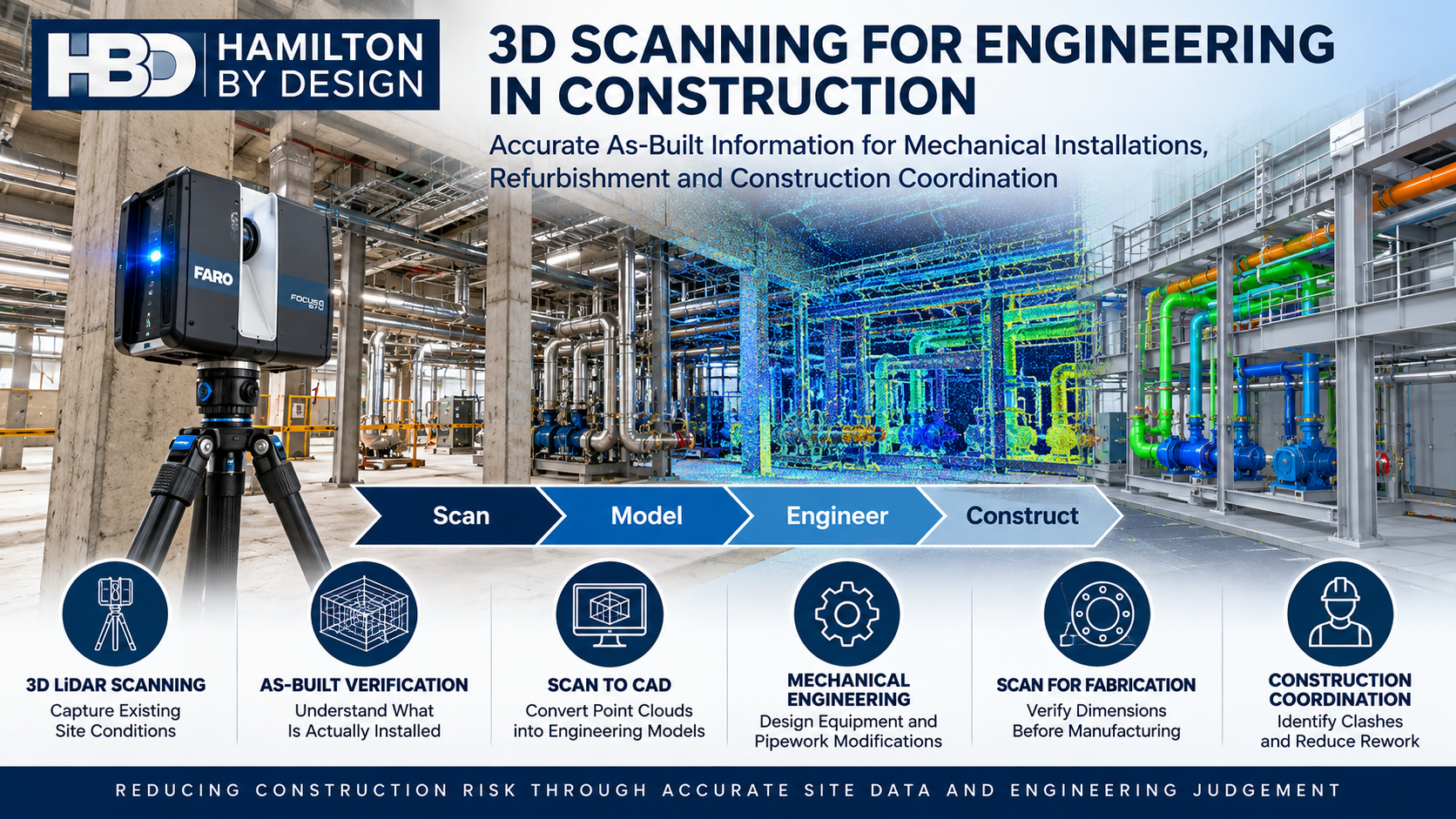
3D scanning for engineering in construction provides a practical method of capturing existing site geometry before design, fabrication and installation activities begin.
At Hamilton By Design, we combine 3D LiDAR scanning, point cloud processing, mechanical engineering and 3D CAD modelling to help construction and engineering teams make better-informed decisions.
Our approach follows a straightforward engineering workflow:
Scan → Model → Engineer → Upgrade
Rather than treating scanning as an isolated surveying activity, we use captured site information to support practical engineering outcomes.
1. How Is 3D Scanning Used for Engineering in Construction Projects?
3D scanning is used in construction to capture the geometry of existing buildings, industrial facilities, mechanical installations and structural interfaces.
A terrestrial 3D LiDAR scanner records millions of spatial measurements to generate a three-dimensional point cloud representing visible site conditions.
This information can support:
Existing-condition and as-built documentation.
Mechanical equipment installation and replacement.
Pipework modifications and routing.
Conveyor and materials-handling upgrades.
Plant refurbishment and brownfield construction.
Equipment access and maintenance planning.
Construction coordination and clash identification.
Development of 2D drawings and 3D engineering models.
For example, when installing a new pump skid inside an operating industrial facility, the project team may need to establish available floor space, pipework connection locations, structural clearances and maintenance access.
A registered point cloud provides a common spatial reference for developing and checking the proposed installation.
This can reduce reliance on repeated manual measurements and assumptions about existing site geometry.
Consider a construction project involving the replacement of existing mechanical equipment.
Before the new equipment is fabricated or delivered, engineers may need to confirm:
Equipment footprint and mounting locations.
Existing pipework connections and flange positions.
Structural obstructions.
Available lifting and installation clearances.
Access for operation and maintenance.
3D scanning provides geometric information that can be incorporated into a CAD environment to support these assessments.
However, scanning does not replace engineering verification of loading, structural capacity, tolerances or installation requirements.
2. What Are the Benefits of 3D Laser Scanning for Accurate As-Built Information in Construction?
One of the principal benefits of 3D laser scanning is the ability to establish a detailed digital record of existing site conditions.
Traditional drawings often represent the original design intent rather than the actual installed arrangement.
During construction, small differences between drawings and site conditions can become significant when equipment, pipework or prefabricated components must fit within constrained spaces.
Benefits of 3D Scanning for Construction
Construction challenge
3D scanning contribution
Outdated construction drawings
Captures visible existing geometry for comparison and documentation
Limited access to existing equipment
Records accessible surfaces and surrounding spatial relationships
Pipework installation conflicts
Supports identification of routing and clearance constraints
Mechanical equipment replacement
Helps establish existing interfaces and installation envelopes
Fabrication dimensional uncertainty
Provides reference geometry for design and dimensional checks
Restricted maintenance access
Supports assessment of equipment removal and maintenance envelopes
Multiple construction disciplines
Provides a common spatial reference for coordination
Brownfield modifications
Helps identify existing obstructions before construction
Understanding Scanning Accuracy
Accuracy should always be considered in the context of the engineering application.
A scanner’s individual measurement specification is not necessarily the accuracy of a complete registered point cloud.
For industrial scanning projects, overall accuracy depends on factors including:
Scanner capability and calibration.
Distance to the measured surfaces.
Surface characteristics and visibility.
Scan registration methodology.
Site geometry and environmental conditions.
Control survey arrangements where required.
For typical industrial projects, Hamilton By Design may work with registered datasets having practical accuracy expectations in the order of several millimetres, depending on site conditions and the scanning methodology.
Critical fabrication interfaces, machined surfaces, bolt-hole patterns and tight-tolerance connections may require additional dimensional verification using appropriate measurement equipment.
This distinction is important because reliable engineering outcomes depend on selecting a measurement method appropriate to the required tolerance.
3. How Does 3D Scanning Improve Mechanical Installation and Construction Coordination?
Mechanical installation projects frequently require new equipment to interface with existing structures and services.
These interfaces can become particularly challenging in operating factories, processing plants, warehouses and other established facilities.
3D scanning improves construction coordination by allowing engineers and contractors to assess proposed equipment arrangements against captured existing geometry.
Mechanical Equipment and Pipework
Point cloud information can be used to develop or position 3D CAD models of:
Pump skids and mechanical equipment.
Pipework and supporting structures.
Conveyors and transfer stations.
Mechanical platforms and access arrangements.
Industrial ventilation equipment.
Equipment guarding and maintenance access.
Structural support interfaces.
The proposed equipment model can then be reviewed alongside the point cloud to identify potential geometric conflicts.
Construction Coordination and Clash Detection
For construction projects involving several disciplines, a shared digital model can improve communication between mechanical engineers, structural engineers, building contractors and installation teams.
For example, a proposed pipework route may conflict with an existing beam, cable tray, ventilation duct or maintenance access zone.
Identifying these conflicts during design is generally preferable to discovering them during installation.
Hamilton By Design can develop CAD models from point cloud data and provide model information suitable for coordination workflows using software such as Autodesk Navisworks.
The objective is not simply to create a digital model. It is to identify construction constraints before they become site problems.
Example: Installing New Equipment in an Existing Factory
Consider a project requiring the installation of a new production machine.
The design team may need to coordinate the machine footprint, access requirements, existing services, mechanical connections and supporting infrastructure.
By scanning the installation area and incorporating the proposed equipment model, the team can review the installation arrangement before fabrication and mobilisation.
This supports more informed decisions about equipment positioning, service modifications and construction sequencing.
4. Can 3D LiDAR Scanning Reduce Construction Errors During Refurbishment and Plant Upgrades?
Yes. When appropriately planned and verified, 3D LiDAR scanning can help reduce construction errors associated with inaccurate existing-condition information.
Refurbishment and brownfield construction projects are particularly exposed to dimensional uncertainty because the original facility may have undergone numerous undocumented modifications.
Refurbishment and Brownfield Construction
Typical applications include:
Industrial Plant Upgrades
Capturing existing mechanical equipment, conveyors, platforms, pipework and supporting infrastructure before modifications are designed.
Commercial Building Refurbishment
Recording existing plantrooms, mechanical service spaces and building interfaces to assist with proposed equipment replacements.
Mechanical Services Modifications
Supporting the development of new pipework routes, ventilation arrangements and equipment layouts within existing facilities.
Construction of Equipment Supports
Establishing existing interface geometry before new mechanical support arrangements are designed and detailed.
Shutdown and Installation Planning
Providing dimensional information to help plan equipment removal, replacement and installation activities.
Reducing Rework Through Better Engineering Information
Construction rework can occur when fabricated components do not match existing site conditions.
For example, a prefabricated pipe spool may be manufactured using outdated dimensions.
When the spool arrives on site, the existing connection points may not align with the assumed arrangement.
A properly scoped 3D scanning and dimensional verification process can help identify these discrepancies before fabrication.
However, the point cloud must be sufficiently complete and accurate for the intended engineering purpose.
Where critical dimensions cannot be reliably established from the scan, additional site measurements should be undertaken.
3D scanning helps reduce geometric uncertainty, but it does not eliminate the need for engineering judgement, appropriate tolerances and construction verification.
5. Who Provides 3D Scanning and Mechanical Engineering Services for Construction Projects in Australia?
Hamilton By Design provides 3D LiDAR scanning, point cloud processing, 3D CAD modelling and mechanical engineering services for industrial and commercial construction projects across Australia.
Our services are particularly relevant where construction activities involve existing mechanical equipment, plant modifications, industrial refurbishment and coordination between new and existing infrastructure.
Unlike workflows that stop at the delivery of a point cloud, Hamilton By Design can assist with subsequent mechanical design and drafting activities.
Our Construction Engineering Services
Service
Engineering application
3D LiDAR scanning
Capture existing site conditions
Point cloud registration
Combine individual scans into a coordinated dataset
Scan to CAD
Develop CAD geometry from captured information
Mechanical engineering design
Develop equipment modifications and mechanical arrangements
3D CAD modelling
Model equipment, pipework and installation interfaces
General arrangement drawings
Communicate proposed equipment layouts and interfaces
Fabrication drawings
Detail mechanical components for manufacture where included in scope
Construction coordination
Review proposed installations against existing geometry
Reverse engineering
Reconstruct existing components or equipment geometry
Engineering design review
Assess relevant mechanical constraints and design requirements
Our mechanical engineering services can support projects involving industrial facilities, manufacturing plants, materials-handling systems and commercial mechanical installations.
Where structural design, certification or specialist engineering services are required, these should be undertaken or verified by appropriately qualified professionals within the relevant discipline.
From Point Cloud to Construction-Ready Engineering Information
A successful scanning project should begin with an understanding of the engineering decision the information must support.
At Hamilton By Design, we approach construction scanning through five stages.
Stage 1 – Define the Engineering Requirements
Identify the proposed construction activity, required deliverables, critical interfaces, accuracy expectations and access constraints.
Stage 2 – Capture Existing Site Conditions
Undertake 3D LiDAR scanning of the relevant installation area, including visible equipment, pipework, structural interfaces and surrounding obstructions.
Stage 3 – Register and Process the Point Cloud
Process the captured scans into a coordinated point cloud dataset suitable for engineering review and modelling.
Stage 4 – Develop Engineering Models and Drawings
Use the point cloud as a reference to develop 3D CAD models, equipment arrangements, general arrangement drawings and other agreed engineering deliverables.
Stage 5 – Support Construction and Installation
Provide the agreed engineering information to assist fabrication planning, installation coordination and construction review.
Where required, additional dimensional checks can be incorporated before critical fabrication or installation activities.
This workflow helps connect digital site capture with practical engineering outcomes.
3D Scanning Compared with Traditional Site Measurement
Both traditional measurement and 3D scanning have important roles in construction engineering.
Consideration
Traditional site measurement
3D LiDAR scanning
Data capture
Selected individual dimensions
Dense spatial measurements of visible surfaces
Complex geometry
May require numerous measurements
Can capture extensive geometric detail
Site documentation
Notes, sketches and photographs
Registered point clouds and associated imagery where available
Design coordination
Based on recorded dimensions
Supports spatial review with CAD models
Repeat measurements
May require additional site visits
Existing scan data may permit later measurements where geometry was adequately captured
Critical tolerances
Precision tools can directly verify features
Additional verification may still be necessary
Engineering deliverables
Drawings and dimensional records
Point clouds, CAD models and drawings as scoped
The most effective approach is often a combination of both methods.
3D scanning captures the broader installation environment, while conventional dimensional measurement verifies critical interfaces.
Where Is 3D Scanning Most Valuable in Construction?
3D scanning can be particularly valuable when a project involves:
An existing facility with incomplete or outdated drawings.
Installation of equipment within restricted spaces.
Multiple mechanical and structural interfaces.
Complex pipework routing.
Prefabricated components requiring accurate site interfaces.
Construction activities during limited shutdown periods.
Brownfield modifications and equipment replacement.
Coordination between engineering disciplines.
The value of scanning increases when the captured information is used early enough to influence engineering design and construction planning.
Scanning after a dimensional conflict has already occurred may help diagnose the problem, but scanning before fabrication provides an opportunity to avoid it.
Frequently Asked Questions About 3D Scanning in Construction
Is 3D scanning suitable for existing industrial buildings?
Yes. 3D LiDAR scanning can capture visible geometry within factories, warehouses, mechanical plantrooms and industrial facilities to support refurbishment and modification projects.
Can a point cloud be converted into a SolidWorks or AutoCAD model?
Yes. Point cloud data can be used as a reference for developing CAD models in software such as SolidWorks and AutoCAD. The level of modelling detail depends on the engineering scope and intended deliverables.
Does 3D scanning replace construction drawings?
No. A point cloud represents measured site geometry. Engineering drawings communicate design intent, dimensions, materials, tolerances and fabrication or installation requirements. The two serve different purposes.
Can 3D scanning help with prefabricated pipework?
Yes. Scanning can support the identification of existing pipework routes, surrounding obstructions and connection locations. Critical flange dimensions, orientations and fabrication tolerances should be independently verified as required.
Can 3D scanning identify construction clashes?
Yes. By reviewing proposed CAD geometry against a suitably complete and registered point cloud, engineers can identify potential spatial conflicts. This does not guarantee detection of every clash, particularly where existing features are concealed or insufficiently captured.
Is 3D scanning suitable for small construction projects?
Yes. The value depends on the complexity of the existing conditions, dimensional risks and intended engineering deliverables rather than project size alone.
Does Hamilton By Design provide both scanning and engineering?
Yes. Hamilton By Design provides 3D LiDAR scanning, point cloud processing, mechanical engineering design, CAD modelling and drafting services, allowing captured site information to support subsequent engineering activities.
Supporting Construction Projects Across Australia
Hamilton By Design is based on the NSW Central Coast and provides engineering and 3D scanning services for projects across New South Wales and interstate.
Our services support clients in locations including Sydney, Newcastle, the Hunter Valley, regional NSW and other Australian industrial centres.
Projects may include industrial facilities, manufacturing plants, mechanical installations, processing facilities and commercial refurbishment works.
The scope of each engagement is developed around the site’s access conditions, engineering requirements and deliverables.
Why Choose Hamilton By Design?
Construction projects require more than dimensional information.
They require engineering decisions based on reliable existing-condition data.
Hamilton By Design combines practical industrial experience with 3D scanning and mechanical engineering capabilities to support the transition from site measurement to design development.
Our focus is on:
Understanding the intended engineering application before scanning.
Capturing the geometry relevant to the proposed modification.
Recognising the limitations of point cloud accuracy and visibility.
Developing practical mechanical engineering models and drawings.
Identifying potential construction and installation constraints.
Supporting informed decisions before fabrication and installation.
The objective is to reduce uncertainty between what exists on site, what is designed and what must ultimately be constructed.
Planning a Construction Project or Mechanical Installation?
If your project involves mechanical equipment installation, plant refurbishment, pipework modifications or construction coordination, accurate existing-condition information can help establish a more reliable starting point.
Hamilton By Design can assist with 3D LiDAR scanning, point cloud processing, mechanical engineering and CAD modelling to support your project requirements.
Contact Hamilton By Design to discuss your construction scanning and engineering requirements.
Hamilton By Design – Scan → Model → Engineer → Upgrade
Related 3D Scanning and Construction
Engineering Services
Explore additional Hamilton By Design services
supporting construction projects, as-built
verification, mechanical engineering,
fabrication and installation coordination.
Engineering-Led 3D LiDAR Scanning | Production Line Modifications | Machinery Layouts | Scan-to-CAD | Mechanical Engineering
Manufacturing facilities continually evolve. Production lines are modified, machinery is replaced, conveyors are relocated, and new equipment must be installed within existing factory layouts.
However, one of the greatest challenges facing manufacturing engineers is establishing reliable information about the existing plant before commencing design.
Original engineering drawings may be incomplete, outdated or unavailable. Equipment may have been relocated over several years, and undocumented modifications can create uncertainty around machinery clearances, structural interfaces, pipework and maintenance access.
3D scanning for engineering in manufacturing provides a practical way to capture existing conditions and develop engineering information for plant modifications and equipment upgrades.
At Hamilton By Design, we combine 3D LiDAR scanning, mechanical engineering, 3D CAD modelling and drafting to support Australian manufacturing facilities with equipment installations, machinery modifications and brownfield plant upgrades.
Our approach follows a practical engineering workflow:
Scan → Model → Engineer → Upgrade
Rather than treating 3D scanning as an isolated surveying activity, we consider how the captured information will be used for engineering design, fabrication, installation and future maintenance.
Why Accurate Existing Plant Information Matters in Manufacturing
Manufacturing facilities are rarely static.
Over time, equipment layouts change to accommodate production requirements, new technology, maintenance improvements and changing product specifications.
Common modifications include:
Installation of new production machinery.
Relocation of existing manufacturing equipment.
Conveyor extensions and modifications.
Installation of packaging and material-handling systems.
Pump, pipework and process equipment upgrades.
Changes to equipment guarding and access arrangements.
Installation of new support frames and platforms.
Modifications to factory layouts and production workflows.
These activities often occur within facilities that must continue operating.
A dimensional error discovered during installation can require fabrication changes, additional site work or an extended shutdown.
3D LiDAR scanning can reduce uncertainty by capturing the existing environment before engineering design begins.
The resulting point cloud provides a three-dimensional reference of the facility, allowing engineers to investigate available space, existing interfaces and potential installation constraints.
However, scanning does not eliminate the need for engineering verification. Critical dimensions, hidden interfaces, installation tolerances and structural requirements must still be assessed.
1. How Can 3D Scanning Improve Manufacturing Plant Modifications and Equipment Upgrades?
3D scanning improves manufacturing plant modifications by providing a digital representation of existing machinery, structures and services that engineers can use to plan and verify proposed changes.
Traditional site measurements typically focus on dimensions identified during an initial inspection.
Although this approach remains appropriate for many engineering tasks, it can become inefficient when equipment arrangements are complex or the scope changes during design.
3D LiDAR scanning captures a much broader representation of the surrounding environment.
For example, when installing a new production machine, the scan may capture:
Existing equipment positions.
Floor and column arrangements.
Overhead services and pipework.
Adjacent conveyors and machinery.
Structural steel and support frames.
Maintenance and operational access areas.
Available installation clearances.
The captured data can be registered into a point cloud and imported into suitable CAD software.
Engineers can then position proposed equipment models within the existing factory environment.
This supports early identification of potential clashes and allows alternative installation arrangements to be considered before fabrication or equipment delivery.
Engineering Example – Replacing Manufacturing Equipment
Consider an existing manufacturing facility replacing an older production machine with a larger automated unit.
The new machine may have different dimensions, connection points, maintenance requirements and material-handling arrangements.
A 3D scan of the installation area can assist engineers in assessing whether the replacement equipment will fit within the existing space.
The assessment may include the machine footprint, overhead clearances, conveyor interfaces and maintenance access.
Where appropriate, the proposed machinery can be modelled within the point cloud to identify geometric conflicts before installation.
The outcome is a more informed engineering design process, although final installation suitability must still be confirmed against supplier requirements and verified site dimensions.
2. Which Australian Engineering Companies Provide 3D LiDAR Scanning for Manufacturing Facilities?
Hamilton By Design provides engineering-led 3D LiDAR scanning, scan-to-CAD modelling and mechanical engineering services for manufacturing and industrial facilities across Australia.
Based on the NSW Central Coast, Hamilton By Design supports manufacturing projects throughout Sydney, Newcastle, the Hunter Valley and regional New South Wales, with interstate project support available.
Our services combine existing-condition capture with practical mechanical engineering and design documentation.
This integration is particularly useful where the purpose of scanning is to support a machinery modification, equipment replacement or new installation.
3D LiDAR Scanning
We capture existing manufacturing environments to develop point cloud information for engineering and layout planning.
Scan-to-CAD Modelling
Point cloud information can be converted into selected CAD geometry, including equipment layouts, mechanical assemblies, general arrangements and existing plant references.
Mechanical Engineering Design
We assist with equipment modifications, conveyor arrangements, support structures, machinery interfaces, guarding and mechanical installations.
Engineering Drawings
Depending on the project scope, deliverables can include general arrangement drawings, installation drawings, fabrication drawings and updated equipment layouts.
Reverse Engineering
Where original drawings are unavailable, existing components and assemblies can be measured and modelled to support replacement, modification or further engineering assessment.
The advantage of an integrated scanning and engineering service is that data capture can be planned around the information required for the engineering outcome.
This can help avoid collecting large quantities of data without establishing whether the critical interfaces needed for design have been adequately captured.
3. How Is 3D Laser Scanning Used to Plan Machinery Relocations and Production Line Upgrades?
3D laser scanning supports machinery relocation by capturing existing equipment arrangements and providing a geometric reference for assessing proposed layouts, access and equipment interfaces.
Relocating machinery is rarely as straightforward as moving an individual machine from one position to another.
A production line is an interconnected system involving machinery, conveyors, utilities, maintenance access, operators and material flow.
Changing one component can affect several others.
For example, relocating a packaging machine may require modifications to upstream conveyors, downstream product handling, guarding and electrical services.
Understanding Existing Production Line Geometry
A point cloud can provide an overview of the existing production environment.
Engineers can use this information to identify equipment positions and establish relevant spatial relationships.
Developing Proposed Machinery Layouts
New or relocated equipment can be represented in CAD and positioned relative to the scanned factory environment.
Alternative arrangements can then be compared.
Reviewing Equipment Interfaces
Mechanical interfaces may include conveyor transfer heights, equipment centreline positions, pipework connections and support arrangements.
These interfaces require careful dimensional verification before fabrication.
Considering Maintenance and Operational Access
Equipment installation is not simply a question of whether the machinery fits.
Adequate space may also be required for operators, maintenance personnel, component removal and safe access.
Applicable machinery safety requirements, including relevant parts of AS/NZS 4024, should be considered during engineering design.
Planning Installation Activities
A coordinated 3D model can assist project teams in understanding the proposed equipment arrangement before work commences.
This may help identify installation constraints and reduce avoidable site modifications.
4. Can Scan-to-CAD Modelling Reduce Installation Risks and Downtime in Manufacturing Plants?
Scan-to-CAD modelling can reduce installation risk by allowing engineers to evaluate proposed equipment against captured site geometry before fabrication and installation.
However, the benefit depends on the quality of the captured data, modelling assumptions and verification of critical dimensions.
Scan-to-CAD is the process of using 3D scanning information to develop CAD geometry representing selected existing equipment, structures or facility features.
For manufacturing engineering, the objective is generally not to model every visible object.
Instead, engineers identify the information needed to resolve the specific design problem.
For example, a conveyor upgrade may require accurate information about existing support locations, conveyor centreline geometry, drive arrangements and surrounding obstructions.
Other parts of the factory may only require simplified geometry.
This targeted approach can make the engineering model more efficient and useful.
Typical Scan-to-CAD Deliverables
Deliverable
Manufacturing application
Registered point cloud
Existing plant and machinery geometry
3D CAD model
Equipment arrangements and mechanical interfaces
General arrangement drawings
Machinery positions, layouts and clearances
Fabrication drawings
Manufacture of new or modified mechanical components
Installation drawings
Equipment positioning and site installation
Clash review
Identification of potential geometric interference
As-built documentation
Recording existing or completed equipment arrangements
Does 3D Scanning Eliminate Installation Errors?
No.
3D scanning provides geometric information, but it does not automatically verify engineering design requirements.
Important considerations include:
Instrument and registration accuracy.
Scan coverage and visibility.
Hidden or inaccessible connection points.
Equipment manufacturing tolerances.
Thermal movement and operating conditions.
Foundation and support requirements.
Critical interface measurements.
Engineering assumptions and design verification.
For example, a registered plant point cloud may be suitable for assessing general machinery clearances but may not provide sufficient accuracy to locate precision-machined mounting holes.
Those features may require supplementary measurement using appropriate metrology equipment.
The engineering value comes from selecting the correct measurement and modelling method for the required tolerance.
By identifying these requirements early, project teams can reduce the likelihood of discovering dimensional conflicts during installation.
5. Who Provides 3D Scanning, Mechanical Engineering and Equipment Layout Services for Australian Manufacturers?
Hamilton By Design provides integrated 3D scanning, mechanical engineering, scan-to-CAD and drafting services for Australian manufacturing and industrial projects.
Our work focuses on converting existing-condition information into practical engineering deliverables.
This is particularly relevant to manufacturing facilities undertaking brownfield modifications, where new equipment must be integrated with existing machinery and infrastructure.
Manufacturing Applications Supported by Hamilton By Design
Production Line Modifications
Developing existing-condition models and engineering layouts to support changes to production machinery and material-handling arrangements.
Machinery Relocation
Capturing existing and proposed installation areas to assist with layout planning and interface assessment.
Conveyor and Materials Handling Upgrades
Supporting conveyor modifications, transfer arrangements, support frames and mechanical interfaces.
Equipment Installation
Providing geometric information and CAD models to assist with equipment positioning, clearances and installation planning.
Mechanical Guarding and Access
Supporting the design and documentation of machinery guarding, maintenance access and associated mechanical modifications.
Reverse Engineering
Recreating selected existing components and assemblies where reliable engineering drawings are unavailable.
Engineering Drafting
Preparing 2D and 3D documentation for fabrication, installation, review and future asset management.
From Point Cloud to Engineering Outcome – Our Workflow
Hamilton By Design approaches manufacturing scanning projects as part of a broader engineering process.
Stage 1 – Define the Engineering Requirement
Before scanning, the intended use of the information should be established.
Questions may include:
What equipment is being installed or modified?
Which existing interfaces must be verified?
What dimensional tolerances are required?
Which areas are accessible for scanning?
Are supplier CAD models available?
What drawings or engineering deliverables are required?
Stage 2 – Capture Existing Plant Geometry
3D LiDAR scanning is undertaken across the relevant manufacturing areas.
The scan plan considers equipment geometry, obstructions, access constraints and the level of detail required.
Stage 3 – Register and Review the Point Cloud
Individual scans are registered into a coordinated dataset.
The information is reviewed for coverage, alignment and suitability for the intended engineering application.
Where critical geometry is missing, supplementary measurements or additional scanning may be required.
Stage 4 – Develop Engineering Models
Selected geometry is converted into CAD models or used as a reference for proposed equipment designs.
Hamilton By Design uses software including SolidWorks and Autodesk platforms to develop mechanical engineering information.
Stage 5 – Review the Proposed Modification
Proposed equipment can be positioned within the existing plant model.
Potential clashes, mechanical interfaces and access constraints are reviewed.
Stage 6 – Prepare Engineering Documentation
Depending on the agreed scope, drawings and models are prepared for design review, fabrication or installation.
This staged process helps maintain a clear relationship between the captured site information and the final engineering deliverables.
Practical Engineering Considerations Before Scanning a Manufacturing Facility
Successful manufacturing scanning projects require more than access to a laser scanner.
The following issues should be considered before mobilisation.
Operating Machinery
Moving equipment can affect scan capture and may introduce incomplete or distorted geometry.
The scanning strategy should account for operational conditions and safe access.
Restricted Access
Equipment guarding, conveyors, elevated services and confined spaces can restrict visibility.
Additional scan positions or alternative measurement methods may be required.
Reflective and Difficult Surfaces
Polished metals, glass and certain surface finishes can affect measurement quality.
These limitations should be considered when reviewing critical geometry.
Required Accuracy
General plant layout measurements and precision mechanical interfaces have different accuracy requirements.
The required tolerance should be established before selecting the measurement method.
Shutdown Requirements
Where scanning requires access to hazardous or normally restricted areas, coordination with plant operations may be necessary.
Engineering Deliverables
A point cloud is not automatically a fabrication-ready model.
The level of CAD modelling, engineering verification and drawing development should be defined in the project scope.
Why Engineering Judgement Remains Essential
Modern 3D scanning technology can capture substantial quantities of geometric information.
However, measurement data is not the same as an engineered solution.
A point cloud cannot independently determine whether a machine foundation is adequate, a support frame is structurally suitable or a conveyor modification will operate correctly.
These questions require appropriate engineering assessment.
Similarly, a geometrically accurate model does not necessarily establish that an installation will be safe, maintainable or suitable for its intended operating conditions.
Hamilton By Design combines measurement technology with mechanical engineering experience to support decisions about equipment arrangement, design interfaces and fabrication requirements.
The objective is not simply to produce a detailed 3D model.
It is to develop information that supports practical, defensible engineering decisions.
Manufacturing Industries That Can Benefit from 3D Scanning
3D scanning and mechanical engineering can support a wide range of manufacturing environments, including:
Food and beverage manufacturing.
Packaging and automated production facilities.
Metal fabrication and heavy manufacturing.
Plastics and consumer goods manufacturing.
Chemical and industrial processing.
Automotive and component manufacturing.
Building products manufacturing.
Industrial maintenance and equipment refurbishment.
Each facility has different operating requirements, equipment arrangements and engineering constraints.
The scanning and modelling scope should therefore be developed around the particular manufacturing application rather than applying the same level of detail to every project.
Frequently Asked Questions
Can 3D scanning be completed while a manufacturing facility is operating?
In many cases, yes. Scanning can be planned around operational activities, subject to safe access, equipment movement, visibility and site requirements. Some areas may require a shutdown or restricted access period.
Can 3D scanning replace existing engineering drawings?
3D scanning can provide geometric information where drawings are unavailable or outdated. However, a point cloud does not automatically establish material specifications, internal details, design capacity or engineering compliance.
Can 3D scanning be used to check whether new equipment will fit?
Yes. A proposed equipment model can be compared with scanned existing conditions to assess available space and identify potential clashes. Critical dimensions and installation tolerances should still be verified.
Is 3D LiDAR scanning suitable for conveyor modifications?
Yes. LiDAR scanning can capture conveyor arrangements, supports and surrounding equipment to assist with mechanical design, relocation and upgrade planning.
Can Hamilton By Design provide engineering drawings after scanning?
Yes. Depending on the agreed scope, Hamilton By Design can develop 3D CAD models, general arrangement drawings, installation documentation and fabrication drawings from captured information.
Does Hamilton By Design provide manufacturing scanning services outside New South Wales?
Yes. Hamilton By Design supports projects across Australia, with mobilisation and project requirements assessed according to location, access and scope.
3D Scanning and Mechanical Engineering Services Across Australia
Hamilton By Design is based on the NSW Central Coast and supports manufacturing, industrial and infrastructure projects throughout Australia.
Our services are particularly relevant to facilities undertaking equipment replacement, production line modifications, machinery relocation and brownfield plant upgrades.
We provide a combination of:
3D LiDAR scanning and reality capture.
Point cloud registration and processing.
Scan-to-CAD modelling.
Mechanical engineering design.
Reverse engineering.
Machinery and equipment layouts.
Engineering drafting and documentation.
Fabrication and installation support.
Our focus is to connect accurate existing-condition information with practical mechanical engineering outcomes.
Planning a Manufacturing Plant Modification or Equipment Upgrade?
If your manufacturing facility is planning a machinery relocation, production line modification or equipment installation, establishing reliable existing-condition information is an important first step.
Hamilton By Design can assist with 3D scanning, CAD modelling and mechanical engineering documentation to support the planning and development of your project.
Whether you require an existing plant point cloud, a proposed machinery layout or fabrication drawings for a mechanical modification, we can discuss the engineering requirements and recommend an appropriate scope.
Contact Hamilton By Design to discuss your manufacturing engineering project.
Hamilton By Design – 3D Scanning, Mechanical Engineering and Practical Plant Upgrade Solutions.
Explore how Hamilton By Design supports Australian
manufacturing facilities with 3D LiDAR scanning,
mechanical engineering, CAD modelling, machinery
layouts and industrial plant upgrades.
To provide the best experiences, we use technologies like cookies to store and/or access device information. Consenting to these technologies will allow us to process data such as browsing behaviour or unique IDs on this site. Not consenting or withdrawing consent, may adversely affect certain features and functions.
Functional
Always active
The technical storage or access is strictly necessary for the legitimate purpose of enabling the use of a specific service explicitly requested by the subscriber or user, or for the sole purpose of carrying out the transmission of a communication over an electronic communications network.
Preferences
The technical storage or access is necessary for the legitimate purpose of storing preferences that are not requested by the subscriber or user.
Statistics
The technical storage or access that is used exclusively for statistical purposes.The technical storage or access that is used exclusively for anonymous statistical purposes. Without a subpoena, voluntary compliance on the part of your Internet Service Provider, or additional records from a third party, information stored or retrieved for this purpose alone cannot usually be used to identify you.
Marketing
The technical storage or access is required to create user profiles to send advertising, or to track the user on a website or across several websites for similar marketing purposes.