


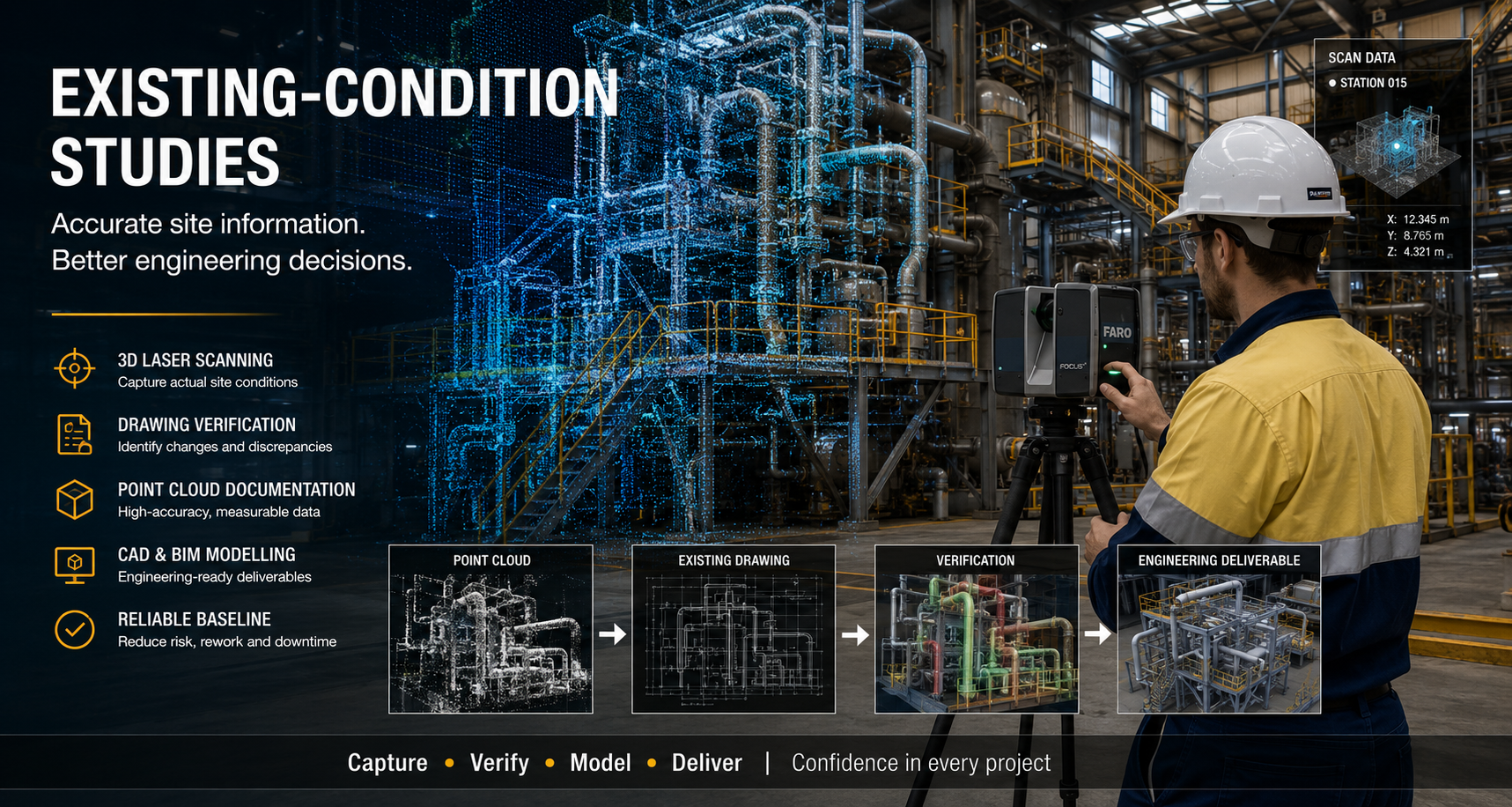
Existing-Condition Studies
Establish What Is Actually on Site Before Design Begins
Existing drawings may be outdated, incomplete, unavailable or inconsistent with what has actually been constructed.
Equipment may have been replaced, structures modified and services rerouted without the drawings being updated. Relying on this information can lead to fabrication errors, site clashes, installation delays and expensive redesign.
Hamilton By Design provides existing-condition studies to establish a reliable engineering baseline before plant upgrades, refurbishment, fabrication, equipment replacement or construction.
Our studies can combine engineering review, site inspection, 3D laser scanning, traditional measurement, point-cloud processing, drawing verification and CAD modelling.
Replace assumptions with verified site information.
Contact Hamilton By Design to discuss an existing-condition study.
What Is an Existing-Condition Study?
An existing-condition study documents the current geometry, arrangement and observable condition of a building, structure, machine or industrial facility.
It can establish:
- what is currently installed;
- whether existing drawings remain accurate;
- where equipment and structures are positioned;
- what modifications have occurred;
- what space is available for new work;
- where critical interfaces are located;
- what constraints may affect installation;
- whether further investigation is required.
The study may support:
- plant modifications;
- equipment replacement;
- feasibility studies;
- structural upgrades;
- shutdown planning;
- fabrication;
- reverse engineering;
- access-system design;
- building alterations;
- asset documentation.
Existing-condition studies form part of Hamilton By Design’s broader engineering services for existing industrial and commercial assets.
Why Existing Drawings Cannot Always Be Trusted
Many brownfield projects begin with drawings that do not fully represent the current site.
Common problems include:
- original drawings cannot be located;
- drawings only show the original construction;
- later modifications were not documented;
- equipment has been moved or replaced;
- structural members differ from the drawings;
- pipework and services have been rerouted;
- redline changes were never formally incorporated;
- dimensions conflict between drawings;
- drawings lack the detail required for fabrication.
Designing from inaccurate information can result in:
- components that do not fit;
- clashes with existing plant;
- incorrect connection points;
- insufficient maintenance clearances;
- installation delays;
- additional shutdown work;
- field modifications;
- increased project costs.
An existing-condition study helps identify these issues before detailed design or fabrication begins.
Who Uses Existing-Condition Studies?
The service may assist:
- asset owners;
- mining and processing companies;
- manufacturing facilities;
- mechanical and structural engineers;
- project managers;
- maintenance and reliability teams;
- architects and building designers;
- fabricators;
- installation contractors;
- construction companies;
- facility managers;
- government and infrastructure organisations.
The scope and deliverables can be tailored to the decision the client needs to make.
What Can Be Studied?
Industrial Plant and Equipment
Existing-condition studies can document:
- conveyors and transfer stations;
- chutes, hoppers and bins;
- crushers and screens;
- pumps, tanks and vessels;
- pipework and ducting;
- machinery and equipment;
- platforms and walkways;
- guards and access systems;
- equipment supports and foundations.
Buildings and Structures
The study may include:
- structural steelwork;
- columns, beams and bracing;
- concrete slabs and walls;
- roof structures;
- stairs and handrails;
- floor levels;
- building openings;
- plant rooms;
- service corridors.
Mechanical Interfaces
Critical interfaces may include:
- mounting points;
- bolt-hole positions;
- flanges;
- shaft and coupling locations;
- equipment supports;
- pipe and duct connections;
- equipment envelopes;
- maintenance clearances;
- removal and installation paths.
Where Are Existing-Condition Studies Used?
Hamilton By Design supports existing-condition studies across Australia, including projects in:
- mining and mineral processing;
- manufacturing;
- steelmaking and smelting;
- ports and bulk-material handling;
- food and beverage production;
- water and wastewater facilities;
- power generation;
- commercial buildings;
- warehouses;
- hospitals;
- rail and transport infrastructure.
Services are available in Sydney, the Central Coast, Newcastle, the Hunter Valley, Wollongong, Brisbane, Melbourne, Perth, Adelaide, Canberra, Darwin and regional Australia.
How Is an Existing-Condition Study Completed?
1. Define the Study Purpose
The first step is to establish what decision the information must support.
This may include:
- determining whether new equipment will fit;
- confirming whether drawings are accurate;
- locating critical interfaces;
- preparing for a shutdown;
- developing a replacement component;
- assessing installation access;
- supporting concept or detailed design.
The purpose determines the area to be captured, the required accuracy and the appropriate deliverables.
2. Review Existing Information
Available information may include:
- original drawings;
- as-built drawings;
- general arrangements;
- fabrication drawings;
- equipment manuals;
- photographs;
- maintenance records;
- previous surveys;
- CAD or BIM models.
Existing documents can provide useful context, but critical information should be verified before being used for new engineering work.
3. Plan and Complete the Site Investigation
The site investigation is planned around access, safety, line of sight, operating equipment, accuracy and project requirements.
Data capture may include:
- terrestrial LiDAR scanning;
- mobile scanning;
- site photographs;
- laser-distance measurements;
- tapes and verniers;
- digital levels;
- total-station or survey control;
- engineering observations.
Hamilton By Design’s engineering-grade 3D laser scanning services can capture complex plant, structures and equipment as measurable point-cloud data.
4. Process and Register the Point Cloud
Individual scans are aligned into a coordinated point cloud.
Processing may include:
- scan registration;
- data cleaning;
- alignment to site coordinates;
- survey-control integration;
- checking registration quality;
- dividing the dataset into project areas;
- preparing E57, RCP, RCS or LAS files.
The point cloud provides a three-dimensional record of visible site conditions.
5. Verify Critical Details
Critical dimensions may also be checked using traditional tools.
These checks can include:
- plate thicknesses;
- flange and shaft sizes;
- bolt and hole diameters;
- small mechanical features;
- concealed edges;
- fabrication interfaces.
Laser scanning and traditional measurements are complementary. The correct method depends on the feature being measured and the accuracy required.
6. Compare Drawings With the Site
Existing drawings or models can be compared against the captured information to identify:
- missing equipment;
- undocumented modifications;
- changed structural members;
- altered levels;
- displaced machinery;
- rerouted services;
- dimensional differences;
- potential clashes.
Where completed fabrication or construction needs to be compared with a design model, Hamilton By Design can also apply a digital quality assurance workflow.
7. Prepare Engineering-Ready Deliverables
Clients may require a registered point cloud, selected drawings, CAD models, dimensional comparisons or engineering observations.
The deliverables should match the project decision rather than modelling every visible item unnecessarily.
Tools That Support Existing-Condition Studies
3D LiDAR Scanning
LiDAR scanners capture dense three-dimensional measurements of visible surfaces, including plant, structural steel, pipework, equipment, buildings and surrounding constraints.
Point-Cloud Software
FARO SCENE, Autodesk ReCap and similar tools can be used to register, inspect and prepare point-cloud data for engineering applications.
SolidWorks and CAD Modelling
Hamilton By Design uses SolidWorks design and modelling services to develop mechanical models, assemblies, equipment layouts, interfaces and fabrication information.
AutoCAD and Inventor
AutoCAD and Inventor may be used to produce plans, elevations, sections, general arrangements, structural layouts and mechanical models.
Scan to BIM
For buildings and structured asset information, point-cloud data can be developed into a coordinated digital model through Hamilton By Design’s Scan to BIM Australia service.
Traditional Measurement
Laser-distance meters, tapes, verniers, digital levels and survey equipment may be used to verify selected dimensions that are too small, concealed or unsuitable for scanning alone.
Typical Deliverables
An existing-condition study may include:
- registered and colourised point clouds;
- E57, RCP, RCS, LAS or LAZ files;
- photographs and dimensional records;
- plans, elevations and sections;
- structural and equipment layouts;
- AutoCAD drawings;
- SolidWorks or Inventor models;
- STEP, SAT or Parasolid files;
- general arrangement drawings;
- drawing-to-site comparisons;
- clash or clearance reviews;
- critical-interface models;
- engineering observations;
- recommendations for further investigation.
A point cloud is not automatically a complete CAD or BIM model. Models are interpreted deliverables created from the selected geometry required by the project.
Existing-Condition Studies for Brownfield Projects
Brownfield projects must account for existing plant, structures, services and operating constraints.
An existing-condition study can establish:
- available installation space;
- equipment positions;
- structural support locations;
- pipe and duct interfaces;
- access and lifting constraints;
- maintenance clearances;
- removal paths;
- likely clashes.
This information can reduce site rework, fabrication changes and installation uncertainty.
Existing-Condition Studies Before Fabrication
Fabrication based on unreliable site dimensions can result in components that do not fit.
Existing-condition information may be used to verify:
- connection points;
- flange positions;
- support locations;
- equipment geometry;
- structural interfaces;
- surrounding obstructions;
- installation routes.
This can assist with replacement chutes, platforms, stairs, guards, pipe spools, ducting, machinery modifications and equipment supports.
Existing-Condition Studies for Reverse Engineering
Where drawings are missing or obsolete, existing-condition capture can support reverse engineering and 3D scanning.
The process may include:
- scanning the existing asset;
- measuring critical mechanical interfaces;
- developing a CAD model;
- identifying worn or damaged geometry;
- reviewing how the component functions;
- preparing replacement or improved design documentation.
Reverse engineering should be based on engineering interpretation rather than simply copying worn or modified geometry.
Existing-Condition Studies for Shutdown Planning
Shutdown projects provide limited time for removal, modification and installation.
Existing-condition information can help teams plan:
- lifting and removal paths;
- temporary access;
- work areas;
- installation sequencing;
- surrounding services;
- prefabrication;
- potential clashes.
Capturing the site beforehand allows design and planning work to continue away from the operating plant.
Benefits of an Existing-Condition Study
A properly scoped study can:
- reduce reliance on assumptions;
- identify inaccurate drawings;
- establish a shared project baseline;
- improve design coordination;
- reduce site remeasurement;
- reduce fabrication risk;
- identify clashes earlier;
- support remote engineering teams;
- improve shutdown planning;
- provide a lasting asset record.
The primary benefit is not simply obtaining a point cloud. It is making better engineering decisions from reliable information.
Important Limitations
An existing-condition study records what can reasonably be observed or measured within the agreed scope.
Unless specifically included, it may not establish:
- concealed structural details;
- internal corrosion;
- wall thickness;
- reinforcement arrangements;
- underground services;
- foundation depth;
- material grade;
- weld quality;
- structural capacity;
- remaining service life;
- legal property boundaries.
These matters may require non-destructive testing, materials testing, structural calculations, specialist surveying or further engineering assessment.
Why Hamilton By Design?
Hamilton By Design combines practical manufacturing experience, mechanical engineering, LiDAR scanning and CAD modelling.
Our capabilities include:
- engineer-led site capture;
- mechanical and structural design;
- SolidWorks and AutoCAD modelling;
- reverse engineering;
- point-cloud processing;
- fabrication documentation;
- shutdown support;
- engineering investigations.
This integrated approach allows site information to be captured with the final engineering purpose in mind.
We help determine what needs to be measured, how it should be documented and how the information can support the next project decision.
Request an Existing-Condition Study
Before committing to detailed design, fabrication or installation, establish what is actually present on site.
To help define the scope, provide:
- the site location;
- the asset or facility involved;
- the purpose of the study;
- available drawings or photographs;
- required deliverables;
- project timing;
- access and induction requirements;
- known accuracy requirements.
Contact Hamilton By Design to discuss your project.
Frequently Asked Questions
What is an existing-condition study?
An existing-condition study documents the current geometry, arrangement and observable condition of an existing building, structure, machine or industrial facility.
It provides a reliable baseline before design, modification, refurbishment or fabrication begins.
Is it the same as an as-built survey?
The services are related but not always identical.
An existing-condition study commonly supports planned work on an existing asset and may include engineering review, drawing verification and recommendations.
An as-built survey generally records the location or condition of completed or existing work.
Is an existing-condition study just laser scanning?
No. Laser scanning is one data-capture method.
The study may also include drawing review, engineering inspection, photographs, traditional measurements, CAD modelling, dimensional comparisons and engineering observations.
Can you verify existing drawings?
Yes. Available drawings or models can be compared with point-cloud data and selected site measurements.
The comparison may identify incorrect dimensions, missing components, modified structures, moved equipment and rerouted services.
What accuracy can be achieved?
Accuracy depends on the scanner, distance, surface conditions, site access, registration method, survey control and required deliverable.
The required accuracy should be defined before site capture begins.
Can operating plant be scanned?
In many cases, yes.
The ability to scan operating plant depends on safety requirements, moving machinery, heat, dust, vibration, access, visibility and hazardous-area restrictions.
Some areas may require a shutdown or controlled access.
Can LiDAR scan through walls or equipment?
No. Terrestrial LiDAR records visible surfaces within the scanner’s line of sight.
Multiple scan positions can reduce shadowed areas, but concealed conditions may require other inspection methods.
Can point-cloud data be used in SolidWorks?
Yes. Point-cloud information can be referenced when creating SolidWorks models.
The point cloud is not automatically converted into a fully detailed model. The required geometry must be interpreted and modelled according to the project purpose.
What file formats can be supplied?
Depending on the project, files may include E57, RCP, RCS, LAS, LAZ, DWG, DXF, STEP, SAT, Parasolid, SolidWorks, Inventor and PDF.
Do I need a complete model of the site?
Not necessarily.
Many projects only require selected equipment, structural interfaces, connection points, installation zones or simplified equipment envelopes.
Limiting the model to the required information can reduce cost and processing time.
Can the study identify wear or damage?
It may identify visible deformation, distortion, displacement, missing components, changed clearances or surface wear.
It does not automatically establish internal corrosion, material condition, structural capacity or remaining service life.
Can scans taken at different times be compared?
Yes. Repeat scanning may assist with monitoring movement, deformation, wear, material loss, construction progress or equipment displacement.
Consistent control and data-capture methods are important for meaningful comparison.
Can the study support a feasibility assessment?
Yes. Existing-condition information can help determine whether a proposed project is likely to fit, be accessible, be constructable and integrate with existing assets.
Can the study proceed without drawings?
Yes. Drawings are helpful but not essential.
Where no reliable documentation exists, the required geometry can be captured using scanning, photographs, measurements and CAD modelling.
What information is needed for a quotation?
Useful information includes the site location, photographs, available drawings, area to be studied, project objective, required deliverables, accuracy, access conditions, inductions and timing.
Do you provide scanning-only services?
Yes. Hamilton By Design can provide site scanning and registered point-cloud files without additional modelling.
CAD, drawings or engineering assessment can be added where required.
Do you provide services outside New South Wales?
Yes. Hamilton By Design provides engineering and LiDAR scanning services across Australia, including metropolitan, regional and remote locations.
What happens after the study?
The information may support feasibility work, concept design, detailed design, reverse engineering, fabrication, shutdown planning, installation or as-built documentation.
Hamilton By Design can continue supporting the project through subsequent engineering stages.

Contact Us – Talk To Us
Our clients:

























Related Services and Engineering Insights
Explore Existing-Condition Capture and Engineering Services
Learn how Hamilton By Design combines engineering-grade LiDAR scanning, point-cloud documentation, dimensional verification and CAD modelling to support brownfield upgrades, refurbishment, maintenance and engineering assessments.
3D Laser Scanning Services
Engineering-grade LiDAR scanning for documenting existing plant, machinery, structures, buildings and infrastructure before design, modification or refurbishment work begins.
Explore 3D laser scanningEngineering-Grade 3D Laser Scanning
Capture accurate, design-ready information for mining, industrial, infrastructure and brownfield projects where dependable existing geometry is essential.
View engineering-grade scanning3D LiDAR Scanning for Digital Quality Assurance
Compare constructed, manufactured or installed assets against design requirements to identify dimensional differences, misalignment and potential fit-up problems.
Explore digital verificationPoint Clouds for Brownfield Project Management
Understand why registered point-cloud data provides a measurable record of actual site conditions and a reliable basis for brownfield engineering decisions.
Read the brownfield guidePoint Cloud to Engineering Model
Convert existing-condition scan data into structured mechanical and structural models for mining upgrades, shutdown preparation and construction planning.
Explore engineering modellingReverse Engineering with 3D Scanning
Reconstruct existing machinery, fabricated equipment and legacy components when original drawings are missing, outdated or no longer representative of the asset.
Explore reverse engineering3D Scanning and Modelling for Mining
Combine reality capture and 3D modelling to document processing plants, verify surrounding interfaces and reduce assumptions during equipment upgrades.
View mining applicationsLiDAR Scanning for Mining Process Plants
Examine how LiDAR supports condition documentation, retrofit planning, wear investigations, safety reviews and digital engineering within operational process plants.
Explore process-plant scanningEngineering Analysis and Simulation
Use existing-condition verification and Scan-to-CAD geometry to support engineering assessments based on measured site information rather than assumed dimensions.
Explore engineering analysisIndustrial Plant 3D Laser Scanning
Capture machinery, structural steel, access systems, pipework and nearby obstructions before planning plant modifications, replacement equipment or new installations.
View industrial plant scanningEngineering-Led LiDAR and Mechanical Design
Integrate point-cloud capture with mechanical design for live plants, brownfield assets and shutdown-driven projects where constructability and accuracy are critical.
Explore the integrated serviceMechanical Engineering Consulting
Combine engineer-led reality capture with design, assessment and technical support for existing machinery, processing plant and industrial infrastructure.
Explore engineering consultingEngineering Services
Access mechanical design, digital capture, modelling and fabrication-support services for brownfield plant upgrades, retrofit projects and existing assets.
View engineering servicesEngineering-Led 3D Scanning in Sydney
Reality-capture services for design verification, fabrication, construction, as-built documentation and plant modifications throughout Sydney and New South Wales.
Explore Sydney scanning3D LiDAR Scanning in Perth
Existing-condition documentation, engineering studies, refurbishment planning and construction verification for Western Australian industrial and mining projects.
Explore Perth LiDAR scanningBrownfield Port Engineering
Support port and maritime upgrades by documenting existing structures, mechanical equipment and site constraints before developing modification or replacement designs.
Explore port engineering