


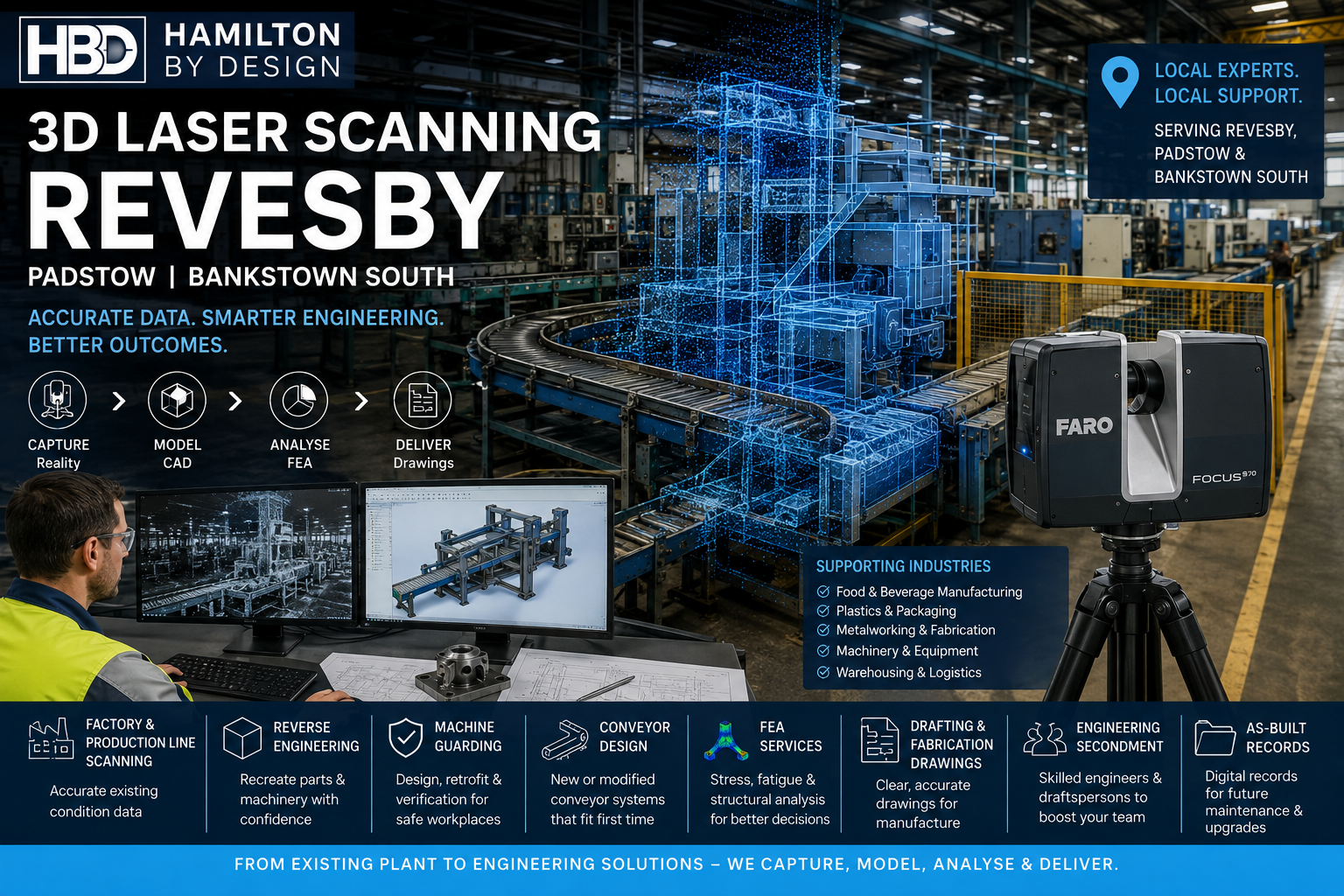

Revesby, Padstow and the southern Bankstown industrial area form a long-established manufacturing corridor supporting food production, plastics, metalworking, packaging, machinery, warehousing and production-line operations. In these facilities, engineering projects often begin with the same challenge: the machinery, conveyors and structures physically exist, but the available drawings do not always represent what is actually installed.
Hamilton By Design provides 3D laser scanning in Revesby to establish accurate existing-condition information before machinery is modified, relocated, reverse engineered or integrated into a wider plant upgrade.
Using 3D Laser Scanning Services, manufacturers can capture production machinery, conveyors, structures and surrounding interfaces as measurable point-cloud data. That information can then support reverse engineering, mechanical design, machine guarding, fabrication drawings, FEA and future as-built documentation.
The objective is not simply to create a 3D scan. It is to reduce uncertainty before engineering decisions are made.
Managing Engineering Risk in Existing Factories
Brownfield manufacturing projects carry a particular type of engineering risk.
Unlike a greenfield project, the designer is rarely working with an empty site. New equipment has to fit around existing machinery, structural steel, pipework, conveyors, guarding, access systems and production constraints.
Historical drawings may still be available, but they may not include decades of plant modifications.
A conveyor may have been moved.
A gearbox may have been replaced.
A machine frame may have been reinforced.
Guards may have been added.
Services may have been rerouted.
This means an apparently simple modification can become expensive if the project begins from incorrect existing-condition information.
Hamilton By Design can help manage this risk by establishing the physical arrangement before detailed design begins.
A practical sequence is:
capture reality → verify interfaces → engineer the modification → analyse where required → document for fabrication → retain the as-built record
This gives project teams a stronger information base than relying on drawings that may no longer match the factory.
Production-Line and Factory Scanning in Revesby
Production-line scanning is particularly useful where several pieces of equipment interact.
A typical scan can capture:
- production machinery;
- conveyors;
- transfer points;
- floors and walls;
- columns;
- structural steel;
- electrical cabinets;
- guarding;
- access platforms;
- pipework;
- neighbouring equipment.
Hamilton By Design’s 3D Laser Scanning Services can create a registered point cloud representing the actual plant condition.
This point cloud then becomes a measurable engineering reference.
Rather than sending engineers and draftspersons back to site repeatedly for individual dimensions, the project team can work from a broader digital record of the area.
This is especially valuable during factory upgrades where access may be restricted by production schedules.
Why Existing Drawings Are Not Always Enough
One of the largest risks in established manufacturing facilities is assuming that an old drawing is still correct.
Even a good original drawing may not include:
- modifications made by maintenance teams;
- locally fabricated replacement parts;
- revised conveyor supports;
- additional guards;
- new drives;
- altered access arrangements;
- production-line expansions;
- relocated equipment.
For this reason, existing drawings should often be considered valuable background information rather than unquestioned dimensional truth.
3D scanning provides an opportunity to compare the documentation with the actual plant.
Where discrepancies exist, they can be identified before new equipment is fabricated.
This can help reduce rework, installation delays and unexpected shutdown work.
Reverse Engineering Padstow and Revesby Machinery
Not all engineering problems involve the entire production line.
Sometimes the problem is a single component.
A machine may contain a bracket, housing, guard, chute, shaft support or fabricated assembly that is no longer available from the original manufacturer.
Where drawings or CAD files are missing, Hamilton By Design can use Reverse Engineer 3D Scanning to capture the existing geometry and reconstruct usable engineering information.
Typical reverse-engineering projects may involve:
- machine frames;
- bearing housings;
- fabricated brackets;
- conveyor components;
- equipment guards;
- chutes;
- covers;
- supports;
- obsolete replacement parts;
- machine interfaces.
The objective is generally to move from a physical component toward a practical CAD and drawing package that can support repair, redesign or manufacture.
From Scan Data to CAD
Raw point-cloud data is valuable, but many manufacturing projects require a further step.
The captured geometry can be used to develop CAD models representing machinery, conveyors, guards or fabricated structures.
Hamilton By Design’s Mechanical Engineering Services can combine site capture with mechanical design to develop practical modifications around the existing plant.
Depending on the project, the CAD model may include:
- equipment envelopes;
- conveyor centre lines;
- support structures;
- drive arrangements;
- machine guards;
- mounting plates;
- fabricated assemblies;
- replacement components.
This allows the proposed modification to be reviewed digitally before fabrication begins.
Conveyor Design and Production-Line Modifications
Conveyors are a common interface between existing and new equipment.
A production change may require:
- extending a conveyor;
- modifying its elevation;
- changing a transfer point;
- installing a new drive;
- rerouting product flow;
- introducing a new support structure;
- connecting a new machine.
The challenge is that the conveyor must fit the existing factory.
Scanning the surrounding plant allows the new geometry to be designed around actual installed conditions rather than assumed dimensions.
Hamilton By Design’s broader Mechanical Engineering Consulting capability can support plant modifications, conveyor systems and brownfield engineering projects where maintainability, access and installation constraints must be considered together.
Machine Guarding Revesby
Machine guarding should also be considered whenever production machinery is modified.
A new conveyor, drive, motor or machine configuration can affect the existing safeguarding arrangement.
Hamilton By Design provides Machine Guarding Engineering and Verification for industrial machinery and fixed plant.
3D scanning can assist by capturing the relationship between the machinery, guards, structures and operator access.
Potential guarding projects may involve:
- fixed guards;
- belt guards;
- pulley guards;
- coupling guards;
- rotating-shaft guards;
- mesh enclosures;
- perimeter guarding;
- access gates;
- retrofit modifications.
By designing the guarding within the same CAD environment as the machinery, the engineer can consider fit, access and maintenance requirements together.
FEA for Modified Machinery and Supports
Geometry is only one part of engineering risk.
Where a component or structure is being redesigned, it may also be necessary to understand how it behaves under load.
Hamilton By Design can incorporate finite element analysis into suitable mechanical engineering projects.
FEA may assist with evaluating:
- stress;
- displacement;
- stiffness;
- fatigue behaviour;
- buckling;
- load paths;
- modified plate thicknesses;
- reinforcement arrangements.
A typical workflow might be:
3D scan → CAD model → mechanical design → FEA → fabrication drawing
This can be particularly useful for conveyor supports, machine frames, brackets and reverse-engineered components where the project is not simply reproducing an existing part but modifying or improving it.
Hamilton By Design’s FEA Capabilities provide a natural extension of the scanning and mechanical design process.
Mechanical Drafting and Fabrication Drawings
A successful scan is not necessarily the final project deliverable.
Fabricators and installers need clear engineering information.
Hamilton By Design’s Mechanical Drafting Services Sydney can convert site and design information into documentation suitable for manufacturing and installation.
Deliverables may include:
- general arrangement drawings;
- fabrication drawings;
- assembly drawings;
- detail drawings;
- bills of materials;
- DXF cutting profiles;
- STEP files;
- DWG files;
- PDF drawing packages.
For a Revesby manufacturer, this means one engineering workflow can progress from scanning the existing plant through to producing practical workshop documentation.
Engineering Secondment for Manufacturing Projects
Not every client needs an external consultant to manage the complete project.
Many factories already have experienced plant engineers, maintenance teams and project managers. Their problem is often capacity rather than knowledge.
Hamilton By Design’s Engineering Secondment Services can provide additional technical resources during periods of high workload.
Secondment can support:
- shutdown preparation;
- plant upgrades;
- production-line modifications;
- engineering backlogs;
- CAD modelling;
- drafting;
- site verification;
- reverse-engineering programs;
- project engineering activities.
This can allow Hamilton By Design personnel to work alongside the client’s existing engineering team rather than operating as a separate project function.
For busy manufacturing facilities, that flexibility can be particularly useful when several plant changes need to be delivered within a limited shutdown or project window.
Creating a Digital As-Built Record
One of the longer-term advantages of 3D laser scanning is that the project data can remain useful after the immediate modification is complete.
Hamilton By Design can retain engineering data such as:
- registered production-line point clouds;
- machinery models;
- conveyor layouts;
- guarding models;
- fabrication drawings;
- CAD assemblies;
- STEP files;
- FEA records;
- updated as-built drawings.
This means a scan commissioned for one plant upgrade can potentially support later projects.
For example, a production line scanned in 2026 may later require another conveyor modification, new guarding or an additional piece of equipment.
Instead of beginning again with no reliable information, the project can start from an established digital record and then verify only what has changed.
This creates a gradual digital engineering history of the factory.
Supporting Revesby, Padstow and Bankstown Manufacturing
Hamilton By Design can support manufacturing and industrial businesses throughout Revesby, Padstow, Bankstown South and surrounding South-West Sydney industrial areas.
Projects may range from a single reverse-engineered component through to scanning an entire production area prior to a major upgrade.
The combination of 3D Laser Scanning, mechanical engineering, reverse engineering, machine guarding, drafting, FEA and engineering secondment means the service can be adapted to the actual engineering problem rather than treating scanning as an isolated deliverable.
The underlying objective is straightforward:
establish what really exists before deciding what needs to change.
Frequently Asked Questions
What can be captured during a factory scan?
A factory scan can include machinery, conveyors, structural steel, platforms, floors, walls, pipework, guards and other surrounding equipment required for the engineering project.
Can machinery be scanned while it remains installed?
In many cases, yes. Terrestrial laser scanning is well suited to capturing fixed machinery and production-line environments in situ.
Can 3D scanning help with conveyor modifications?
Yes. Existing conveyors and surrounding equipment can be captured so new conveyor geometry, supports and transfer arrangements can be designed against actual plant conditions.
Can Hamilton By Design reverse engineer a machine component?
Yes. Where suitable access and information are available, components can be scanned or measured and reconstructed into CAD models and manufacturing documentation.
Can machine guards be designed from scan data?
Yes. Existing machinery can be captured and guard geometry developed around actual equipment, access and structural interfaces.
Do you provide fabrication drawings?
Yes. Hamilton By Design’s Australian Design and Drafting Services can produce fabrication, assembly and mechanical drawings from site measurements, scan data and engineering models.
Can FEA be used on equipment developed from a scan?
Yes, where appropriate loads, materials and boundary conditions can be established. FEA can be used to assess stress, displacement, stiffness, fatigue and other structural behaviour.
Can Hamilton By Design support our internal engineering team?
Yes. Engineering Secondment Services can provide additional engineering and drafting capacity for projects, shutdowns and workload peaks.
Can scan data be retained for future projects?
Yes. Point clouds, machine models, conveyor layouts, guarding models and drawings can form part of a retained engineering and as-built record.
What should we provide before requesting a scan?
Photographs, existing drawings, approximate dimensions, details of the proposed modification and information about access or production constraints are all useful when establishing the initial scope.
3D Laser Scanning Revesby – Hamilton By Design
If your Revesby, Padstow or Bankstown manufacturing facility is planning a machinery modification, conveyor upgrade, reverse-engineering project or production-line change, Hamilton By Design can assist from initial reality capture through to mechanical engineering and fabrication documentation.
The combination of 3D scanning, reverse engineering, mechanical design, machine guarding, FEA, drafting and engineering secondment can help replace assumptions with verified engineering information and reduce the risk of discovering dimensional or interface problems after fabrication has already begun.
For established factories, that is often the real value of scanning: know what exists before changing what comes next.

Contact Us – Talk To Us
Our clients:

























Related Hamilton By Design Engineering Services
Mechanical Engineering Services
Plant upgrades, machinery modifications, equipment integration and practical mechanical engineering support.
View Service →3D Laser Scanning & Reality Capture
Accurate existing-condition data where drawings are missing, outdated or unreliable.
View Service →Reverse Engineering
Obsolete or undocumented equipment can be reconstructed, modified or reproduced.
View Service →Scan-to-CAD / Point Cloud to CAD
Point-cloud information can be converted into usable CAD models and engineering drawings.
View Service →CAD Design & 3D Modelling
Concepts, sketches or scan data can be developed into detailed manufacturable 3D models.
View Service →Finite Element Analysis – FEA
Stress, deflection, fatigue, buckling, vibration and structural performance can be assessed.
View Service →Machine Guarding Design & Verification
Machinery and conveyor guarding can be designed, modified or engineering-reviewed.
View Service →Manufacturing & Production Engineering
Production lines and machinery can be integrated, modified or upgraded with minimal disruption.
View Service →Secondment Engineering Services
Additional engineering capacity for shutdowns, projects, site work or temporary vacancies.
View Service →Mechanical Drafting
Workshop-ready drawings for manufacturing, installation or plant modification.
View Service →Australian Design Drafting Services
Mechanical, structural and industrial drafting support for engineering and fabrication projects.
View Service →Construction Vibration Monitoring
Independent vibration measurement and documentation near buildings and infrastructure.
View Service →Mechanical Engineering Services
Plant upgrades, machinery modifications, equipment integration and practical mechanical engineering support.
View Service →3D Laser Scanning & Reality Capture
Accurate existing-condition data where drawings are missing, outdated or unreliable.
View Service →Reverse Engineering
Obsolete or undocumented equipment can be reconstructed, modified or reproduced.
View Service →Scan-to-CAD / Point Cloud to CAD
Point-cloud information can be converted into usable CAD models and engineering drawings.
View Service →CAD Design & 3D Modelling
Concepts, sketches or scan data can be developed into detailed manufacturable 3D models.
View Service →Finite Element Analysis – FEA
Stress, deflection, fatigue, buckling, vibration and structural performance can be assessed.
View Service →Machine Guarding Design & Verification
Machinery and conveyor guarding can be designed, modified or engineering-reviewed.
View Service →Manufacturing & Production Engineering
Production lines and machinery can be integrated, modified or upgraded with minimal disruption.
View Service →Secondment Engineering Services
Additional engineering capacity for shutdowns, projects, site work or temporary vacancies.
View Service →Mechanical Drafting
Workshop-ready drawings for manufacturing, installation or plant modification.
View Service →Australian Design Drafting Services
Mechanical, structural and industrial drafting support for engineering and fabrication projects.
View Service →Construction Vibration Monitoring
Independent vibration measurement and documentation near buildings and infrastructure.
View Service →