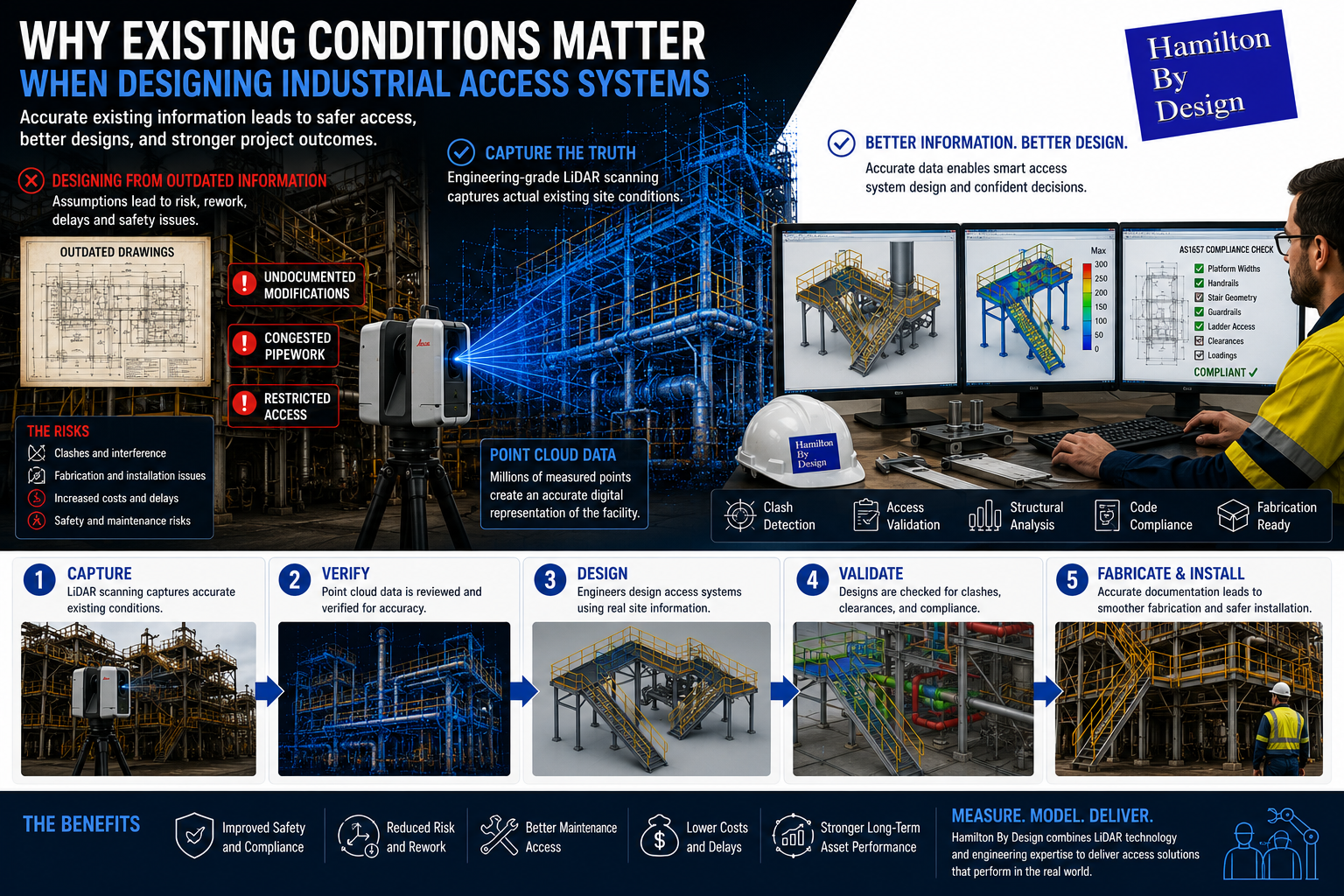
Industrial access systems are often viewed as secondary structures within a facility. Platforms, walkways, stairways, and ladders are frequently designed around existing equipment after primary process systems have already been established.
However, in industrial environments, access systems directly influence:
- Worker safety
- Maintenance efficiency
- Equipment accessibility
- Shutdown activities
- Project cost
- Long-term operational performance
When new access systems are designed using assumptions or outdated information, project teams can unknowingly introduce significant risk.
At Hamilton By Design, engineering decisions begin with understanding one important factor:
What actually exists on site today?
Existing condition capture provides measured information that supports safer, more efficient access system design.
Why Existing Conditions Matter
Industrial facilities rarely remain unchanged over their operational life.
Over time sites commonly experience:
- Equipment upgrades
- Structural modifications
- Additional pipework
- Maintenance repairs
- Temporary installations becoming permanent
- New process equipment
- Historical undocumented changes
As facilities evolve, original engineering documentation can gradually become disconnected from actual site conditions.
This creates challenges when developing:
- New platforms
- Walkways
- Stairways
- Ladders
- Handrails
- Maintenance access systems
Designing around incorrect information can create downstream issues during fabrication and installation.
Risks of Designing Around Assumptions
Even relatively small dimensional differences can create larger problems during construction activities.
Potential issues may include:
Restricted Maintenance Access
Poorly positioned access systems can create:
- Congested work areas
- Difficult equipment access
- Manual handling risks
- Longer maintenance durations
Structural Interference
Undocumented changes can result in:
- Platform clashes
- Pipework conflicts
- Equipment interference
- Structural rework
Installation Difficulties
Fabricated structures designed from inaccurate information may require:
- Site modification
- Additional labour
- Rework
- Schedule changes
Safety Risks
Poor access layouts can increase:
- Working at height exposure
- Congested access routes
- Maintenance hazards
- Human factors risks
Brownfield Facilities Create Additional Challenges
Brownfield environments are often significantly different from greenfield projects.
Typical challenges include:
- Congested plant layouts
- Existing structures
- Legacy equipment
- Historical modifications
- Limited clearances
- Restricted access areas
In many facilities, existing drawings may not accurately represent the current operating environment.
Designing access systems without verified information increases project uncertainty.
Existing Condition Capture Through Engineering-Grade LiDAR Scanning
Hamilton By Design supports industrial projects using engineering-grade 3D LiDAR scanning to capture actual site geometry.
Scanning may capture:
- Structural steel
- Existing platforms
- Walkways
- Pipework
- Equipment
- Access systems
- Buildings
- Operating environments
Rather than relying solely on manual measurements, engineers gain measurable spatial information.
Benefits can include:
- Existing condition verification
- Improved accuracy
- Reduced assumptions
- Reduced installation risk
- Improved project confidence
From Point Clouds to Access System Design
Once site information is captured, scan data can be converted into engineering information through Scan-to-CAD workflows.
This allows development of:
- Existing condition models
- Platform layouts
- Access systems
- Stairways
- Structural designs
- Fabrication drawings
Potential issues can be identified digitally before fabrication begins.
Improving Maintenance Access
Access systems should support how equipment is maintained, not simply how equipment is installed.
Maintenance activities commonly require:
- Equipment removal space
- Inspection access
- Safe movement paths
- Tool handling areas
- Shutdown activities
Considering these requirements early can improve:
- Safety performance
- Maintenance efficiency
- Downtime reduction
- Long-term asset performance
Supporting Engineering Compliance
Access system design frequently involves consideration of standards including:
- AS1657 – Fixed Platforms, Walkways, Stairways and Ladders
- AS3996 – Access Covers and Grates
- Structural loading requirements
- Site-specific standards
Compliance becomes more effective when based on accurate existing information.
How Hamilton By Design Supports Industrial Access Projects
Hamilton By Design supports industrial access projects through:
- Engineering-grade 3D LiDAR scanning
- Existing condition capture
- Scan-to-CAD workflows
- Mechanical and structural design
- Engineering analysis and simulation
- CAD modelling
- Fabrication documentation
The objective is not simply designing platforms.
The objective is creating access systems that support safety, maintenance activities, and operational performance.

Moving Beyond Assumptions
Industrial facilities evolve over time.
Successful access systems should be designed around what exists today rather than what historical drawings suggest exists.
Better existing condition information supports better engineering decisions.