


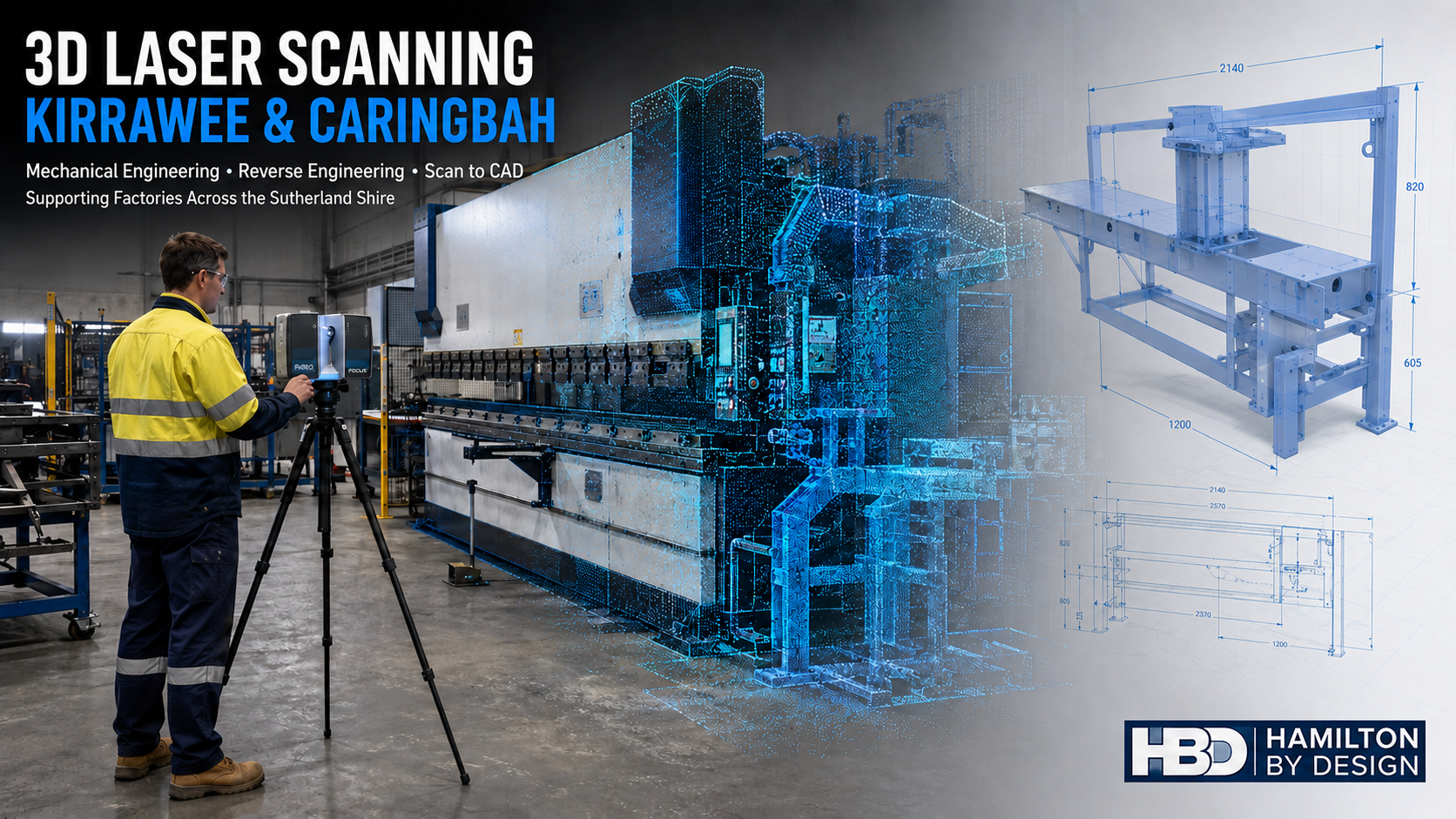
3D Laser Scanning Kirrawee and Caringbah: Engineering Support for Factories, Machinery and Fabrication

Kirrawee and nearby Caringbah form an important industrial area within the Sutherland Shire. The area supports established workshops, light manufacturing, sheet-metal production, steel fabrication, machinery servicing, warehousing and specialist trade businesses. Many of these operations depend on machinery and factory infrastructure that have been progressively modified over many years.
As industrial facilities evolve, a common problem arises: the physical factory no longer agrees with its original drawings. Machinery may have been relocated, guards altered, platforms added, pipework redirected or replacement components manufactured without the engineering records being updated. In other cases, drawings may never have existed.
Hamilton By Design provides engineering-led 3D laser scanning for engineering, reverse engineering, mechanical design and drafting services for industrial clients in Kirrawee, Caringbah and throughout Sydney.
The objective is not simply to produce a point cloud or a visually impressive model. The purpose is to establish reliable engineering information that can support practical decisions about machinery modifications, replacement parts, factory layouts, guarding, fabrication and installation.
Understanding the Kirrawee and Caringbah industrial environment
Kirrawee’s industrial character is primarily associated with established workshops and smaller industrial properties. Operations include steel and stainless-steel fabrication, sheet-metal production, laser cutting, welding, equipment repair and custom manufacturing.
Caringbah has a larger and more concentrated industrial area containing manufacturing, fabrication, plastics processing, building-product production, warehousing, distribution and machinery-related businesses. Together, the two areas create a diverse industrial market in which accurate engineering information can offer significant operational value.
The industrial buildings in these areas are often occupied by businesses that must make efficient use of relatively constrained sites. A factory may contain several generations of machinery, storage systems, work areas, extraction equipment, forklifts and pedestrian routes within the same building.
This creates engineering challenges that cannot always be resolved using isolated measurements. A modification to one machine can affect access, production flow, maintenance clearances, guarding, structures, services and adjoining equipment.
A comprehensive digital record allows these relationships to be studied before fabrication or installation begins.
Why conventional factory measurements can be insufficient
Tape measures, hand sketches and photographs continue to have a legitimate role in engineering. However, they can become inefficient when the asset is large, geometrically complex or difficult to access.
Traditional measurements generally capture only the dimensions that the person attending the site expects to need. If an additional dimension becomes important later, another site visit may be required. Manual methods can also struggle to document warped surfaces, irregular fabrications, inaccessible machinery interfaces and the spatial relationship between multiple assets.
By comparison, 3D laser scanning for engineering projects captures a dense digital record of the visible environment. The resulting point cloud may contain millions of measured points representing machinery, structures, floors, walls, access systems, services and surrounding obstructions.
The point cloud can then be used as a measurable reference during engineering design. It can support:
- Existing-condition documentation
- Factory and workshop layouts
- Machinery modification
- Reverse engineering
- Guarding design
- Fabrication detailing
- Equipment relocation
- Clearance assessment
- Clash detection
- Installation planning
The appropriate scanning and modelling scope depends on the client’s intended engineering outcome. Scanning an entire factory is not always necessary, while scanning only a small component may be inadequate where surrounding interfaces influence the design.
From factory scanning to usable engineering information
A point cloud is valuable, but it is not automatically a fabrication-ready engineering model. The data must be interpreted and developed according to the requirements of the project.
Hamilton By Design’s typical workflow begins by clarifying what the client needs to manufacture, modify, assess or document. The scanning plan can then concentrate on the geometry, reference points and interfaces needed to support that outcome.
After the site data has been captured, the individual scans are registered into a coordinated point cloud. The information can be reviewed for coverage and then imported into an engineering modelling environment.
Depending on the project, the resulting deliverables may include:
- Registered factory point clouds
- Existing-condition machinery models
- Simplified spatial-envelope models
- SolidWorks parts and assemblies
- General arrangement drawings
- Mechanical fabrication drawings
- Guarding models
- Structural interface information
- Clash-detection reports
- Equipment-location plans
- Installation reference dimensions
Where building information modelling is required, Hamilton By Design can also provide Scan to BIM services for suitable industrial and built-environment applications.
The level of model detail should be selected according to its intended use. A model required for factory-layout planning may not need every bolt represented. Conversely, a component being reproduced by machining may require detailed measurement of functional surfaces, hole patterns, fits and tolerances.
Reverse engineering machinery and obsolete components
Many Kirrawee and Caringbah businesses operate machinery that remains mechanically useful despite its age. Problems arise when a critical component is damaged, worn or no longer commercially available.
Original equipment manufacturers may have ceased trading, discontinued the model or withdrawn support. Even where an original drawing exists, the installed component may have been modified or may have worn significantly during service.
Hamilton By Design uses reverse engineering of industrial equipment through 3D scanning to convert existing physical assets into usable design information.
A reverse-engineering project may involve:
- Inspecting the component and understanding its function.
- Identifying critical interfaces and operating requirements.
- Scanning or measuring the available component.
- Distinguishing original geometry from wear or damage.
- Developing a controlled CAD model.
- Reviewing materials, manufacturing processes and tolerances.
- Preparing drawings for manufacture.
- Comparing the replacement component with adjoining machinery.
The process requires engineering judgement. A scan accurately records the component’s current condition, but it does not independently identify the original design intent. Wear, distortion, corrosion, repairs and previous modifications must be considered before a replacement design is finalised.
This approach can be applied to brackets, guards, housings, shafts, machine frames, chutes, covers, fabricated assemblies and other industrial components. Similar methods are used for more specialised work such as reverse engineering worn pump casings.
Machinery modifications and production improvements
Factory machinery is regularly modified to accommodate new products, increase capacity, improve reliability or address production bottlenecks. However, modifications undertaken without adequate documentation can introduce fitment problems, maintenance difficulties or new safety hazards.
Hamilton By Design offers mechanical engineering services for plant and production problems, including the investigation of existing machinery and the development of practical design options.
Potential projects in Kirrawee and Caringbah may include:
- Modifying a machine frame or equipment support
- Redesigning a feed or discharge arrangement
- Adding access for maintenance
- Reconfiguring a production cell
- Developing a new bracket, fixture or adaptor
- Relocating machinery within a restricted workshop
- Improving product flow between operations
- Creating a replacement for an obsolete assembly
- Adding guarding around an exposed hazard
- Coordinating a new machine with existing services
Scanning allows the proposed design to be assessed within the actual factory environment. This can reduce the risk of discovering during installation that a guard cannot open, a component cannot be removed for maintenance or a structural member conflicts with existing machinery.
Mechanical drafting for local manufacturing
Accurate drafting connects engineering intent with manufacturing activity. For fabricators and manufacturers, a clear drawing should communicate geometry, materials, dimensions, tolerances, weld requirements, finishes and assembly relationships without unnecessary ambiguity.
Hamilton By Design provides mechanical drafting and broader engineering services across Sydney for industrial and manufacturing projects.
Drafting deliverables may include:
- General arrangement drawings
- Component detail drawings
- Fabricated assembly drawings
- Sheet-metal drawings
- Cut and folded guard panels
- Weldment drawings
- Parts lists and bills of materials
- Installation drawings
- Existing-condition drawings
- Drawing revisions
- Exploded assembly views
- Interface and clearance drawings
Where appropriate, drawings can be prepared with reference to the AS 1100 technical drawing framework. Fabricated steelwork may also require consideration of AS 4100 and the relevant parts of AS/NZS 1554. The applicable standard depends on the type of structure, material, welding category, service conditions and contractual requirements.
Engineering drawings must also reflect the capabilities of the selected manufacturer. A design that can be modelled in CAD is not necessarily economical to cut, fold, weld, machine or assemble. Early collaboration between the designer, client and fabricator can improve manufacturability and reduce unnecessary production cost.
Machine guarding and industrial safety
Machinery in fabrication and manufacturing environments can expose workers to rotating shafts, belts, pulleys, cutting tools, press mechanisms, shear points, crushing zones and unexpected movement.
Guarding should not be considered merely as a sheet-metal enclosure placed around a hazard. Effective guarding must account for how the machine is operated, cleaned, adjusted, inspected and maintained.
Hamilton By Design can assist with:
- Existing-condition machinery scanning
- Identification and documentation of mechanical hazards
- Fixed guarding concepts
- Interlocked-guard mechanical arrangements
- Guard frames, panels and supports
- Maintenance-access requirements
- Walkways, platforms, stairs and ladders
- Safe-clearance assessment
- Fabrication drawings
- Design-risk reviews
- Updating machinery and guarding models after installation
The AS/NZS 4024 Safety of Machinery series may be relevant to machinery risk assessment, risk reduction, guard design, safety distances and control-system considerations. AS 1657 may apply where fixed platforms, walkways, stairways or ladders are required.
The design process should follow the hierarchy of controls. Where reasonably practicable, a hazard should be eliminated through design before reliance is placed on guarding, procedures, signage or personal protective equipment.
Electrical interlocks, emergency-stop functions and safety-related control systems require input and validation from appropriately competent electrical or control-system specialists. Mechanical guarding design should be coordinated with that work rather than developed independently.
Factory layouts, logistics and materials handling
The efficient movement of materials is an important consideration in both manufacturing and warehousing. Poorly arranged workshops can create unnecessary handling, production delays and interaction between pedestrians, forklifts and machinery.
Factory scanning allows the existing facility to be analysed as an integrated system. Machinery, racking, columns, access doors, loading areas, workstations and traffic routes can be represented within a coordinated model.
Hamilton By Design can use this information to support:
- Machinery-layout development
- Equipment-relocation planning
- Forklift and pedestrian-route assessment
- Materials-handling modifications
- Conveyor and transfer-point design
- Maintenance-clearance studies
- Storage-frame and stillage design
- Installation-access planning
- Equipment clash detection
- Future factory-expansion concepts
For more complex existing-condition projects, Hamilton By Design also undertakes engineering studies and assessments before the client commits to detailed design or fabrication.
This staged approach is particularly useful where several solutions are technically possible. An early engineering study can compare options, identify missing information and establish the risks that must be resolved during detailed design.
Managing point clouds, CAD models and engineering records
Engineering data remains useful well beyond the original project. A factory point cloud captured for one machinery modification may later assist with another layout, access or maintenance project.
Subject to the agreed project scope and data-management arrangements, Hamilton By Design can help clients organise and retain:
- Factory point clouds
- Machinery CAD models
- Component geometry
- Guarding models
- Fabrication drawings
- General arrangements
- Revision histories
- Site photographs
- Engineering calculations
- Design assumptions and limitations
Data retention should be deliberate rather than informal. File naming, revision control, access permissions and approved formats should be established so that future users can identify which information is current.
A digital model should not be assumed to remain accurate indefinitely. If machinery is relocated or modified after the scan, the dataset may require revision before it is used for a new project.
Engineering support across the Sutherland Shire
Hamilton By Design supports engineering and 3D scanning projects throughout Sydney, including the Sutherland Shire. Relevant industrial areas include Kirrawee, Caringbah, Taren Point and surrounding southern Sydney locations.
For businesses farther north within the same industrial corridor, Hamilton By Design also provides reverse engineering and 3D scanning support in Taren Point.
The company’s engineer-led approach connects reality capture with mechanical design, drafting and practical manufacturing knowledge. Clients can engage Hamilton By Design for a defined scanning task or for a broader project progressing from the initial site investigation through CAD modelling, engineering assessment and fabrication documentation.
Frequently asked questions
What is 3D laser scanning?
3D laser scanning is a measurement process that records the visible surfaces of an object or environment as a dense collection of spatial points. These points form a point cloud that can be measured, viewed and used as a reference for engineering modelling.
Does a point cloud automatically become a CAD model?
No. A point cloud is measured reference data. Engineering judgement and modelling work are required to convert the relevant geometry into structured CAD parts, assemblies, drawings or BIM elements.
Can Hamilton By Design scan an operating factory?
In many cases, yes. The scanning plan must consider site access, moving machinery, workers, vehicles, reflective surfaces and other operating conditions. Some areas may need to be isolated or scanned during a planned production pause.
Can 3D scanning reproduce an obsolete component?
Scanning can provide the geometric basis for reverse engineering, but the complete process must also consider wear, tolerances, materials, loading, function and manufacturing requirements. The worn component should not simply be copied without engineering review.
What accuracy can be achieved?
Achievable accuracy depends on the scanner, range, surface condition, target geometry, site environment, registration method and required deliverable. The required tolerance should be discussed before scanning so the appropriate method can be selected.
Can scanning help with machine guarding?
Yes. Scanning can document the existing machinery and surrounding clearances before guard frames, panels, doors and access systems are modelled. A project-specific risk assessment is still required.
Which Australian Standards may apply?
Depending on the project, relevant standards may include the AS/NZS 4024 Safety of Machinery series, AS 1100 for engineering drawings, AS 1657 for fixed access, AS 4100 for steel structures and applicable parts of AS/NZS 1554 for welding. Standards must be selected for the specific design rather than applied as a generic list.
Can the scan be used to check a proposed machine layout?
Yes. Proposed equipment can be modelled within the scanned factory environment to review position, access, clearances, maintenance space and potential clashes before installation.
Can Hamilton By Design retain the engineering data?
Point clouds, CAD models, drawings and associated project information may be retained under an agreed data-management arrangement. Ownership, access, confidentiality, file formats and retention periods should be confirmed as part of the project scope.
Does Hamilton By Design provide services outside Kirrawee and Caringbah?
Yes. Hamilton By Design provides mechanical engineering and 3D scanning services across Sydney and supports industrial projects throughout New South Wales and Australia.
Discuss a Kirrawee or Caringbah engineering project
Whether the requirement involves a factory point cloud, an obsolete component, a machine modification, new guarding or manufacturing drawings, the first step is to define the engineering decision that the captured information must support.
Hamilton By Design can inspect the existing conditions, establish an appropriate scanning and modelling scope, and convert the physical factory or machinery into practical engineering information.
For 3D laser scanning, reverse engineering, mechanical drafting and factory-engineering support in Kirrawee, Caringbah or the wider Sutherland Shire, contact Hamilton By Design to discuss the project requirements.

Contact Us – Talk To Us
Our clients:
























