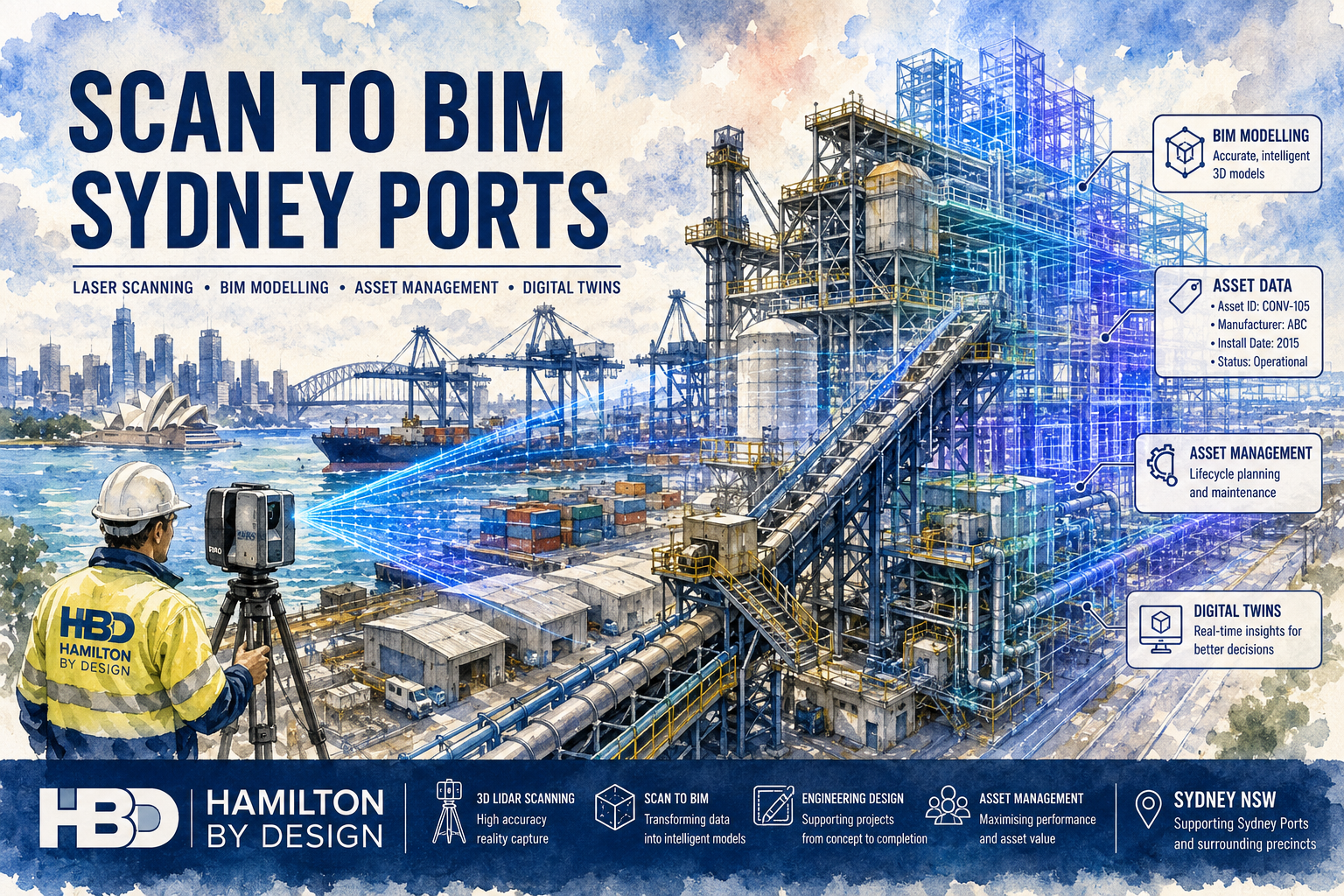
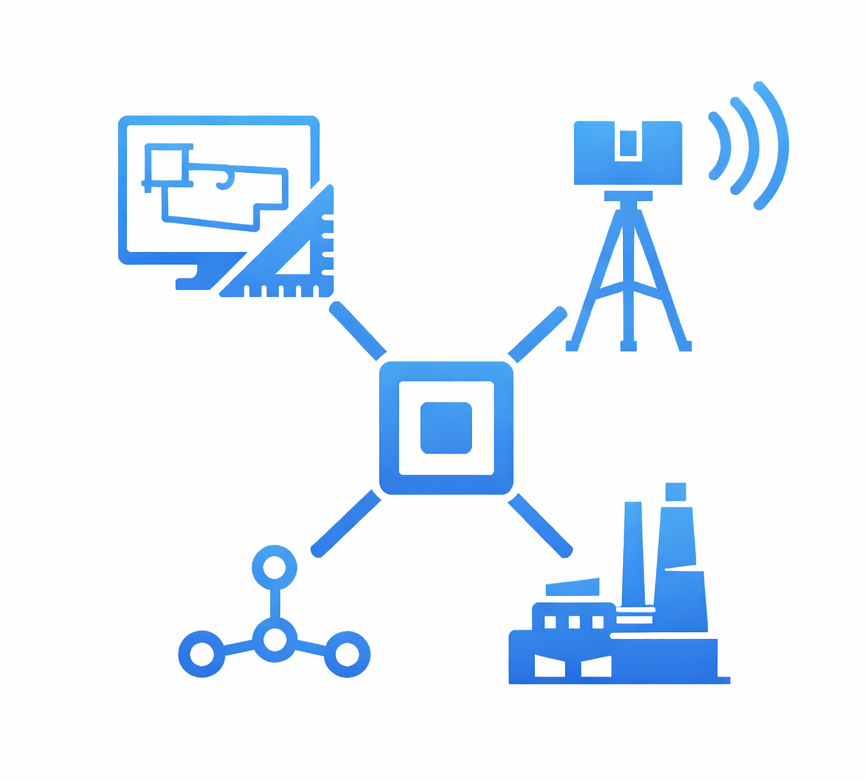
Hamilton By Design provides engineering-grade Scan to BIM services for Sydney ports, converting laser scan data into accurate Building Information Models (BIM) for asset management, maintenance planning, engineering upgrades and infrastructure development. Using advanced terrestrial laser scanning technology and BIM workflows, we capture existing port facilities and transform them into intelligent digital models that support decision-making throughout the asset lifecycle.
Sydney’s port infrastructure is constantly evolving. Facilities are upgraded, conveyors are modified, buildings are expanded and marine assets are maintained to meet increasing operational demands. Unfortunately, many port facilities rely on outdated drawings or incomplete documentation. Scan to BIM provides an accurate and reliable digital representation of existing conditions, allowing engineers, asset managers and project teams to work from current site data rather than assumptions.
Our services are available throughout Sydney and surrounding port precincts, including container terminals, bulk handling facilities, wharves, warehouses, workshops and industrial infrastructure.
What is Scan to BIM?
Scan to BIM is the process of capturing an existing facility using 3D laser scanning and converting the resulting point cloud data into an intelligent BIM model.
Unlike traditional CAD drawings, BIM models contain both geometric information and asset data. This allows the model to become a valuable asset management tool rather than simply a visual representation of the facility.
The process typically begins with laser scanning and reality capture. Millions of measurement points are collected from the site and registered into a highly accurate point cloud. Engineers and BIM specialists then use this data to develop structured digital models that represent buildings, structures, mechanical equipment and infrastructure assets.
The resulting BIM model can be used for:
- Asset management
- Maintenance planning
- Shutdown preparation
- Facility upgrades
- Expansion projects
- Engineering design
- Digital twin development
- Lifecycle management
Why Sydney Ports Require Scan to BIM
Port facilities are among the most complex industrial environments in Australia.
Many Sydney port assets have undergone multiple upgrades over decades of operation. As a result, original drawings may no longer reflect current conditions.
Common challenges include:
- Missing as-built documentation
- Outdated drawings
- Unrecorded modifications
- Congested plant layouts
- Limited shutdown windows
- Complex structural arrangements
- Legacy infrastructure
Scan to BIM helps eliminate these challenges by providing a current and accurate digital representation of the facility.
Engineering teams can design with confidence, knowing that the model reflects actual site conditions rather than historical assumptions.
Sydney Port Infrastructure Commonly Modelled
Marine Infrastructure
We regularly capture and model:
- Wharves
- Berths
- Jetties
- Fender systems
- Mooring facilities
- Access structures
- Marine loading equipment
Bulk Materials Handling Facilities
Bulk handling operations often include:
- Conveyors
- Transfer towers
- Chutes
- Hoppers
- Ship loaders
- Storage facilities
- Dust collection systems
These assets can be accurately modelled to support maintenance and upgrade projects.
Buildings and Facilities
Scan to BIM is commonly used for:
- Warehouses
- Workshops
- Administration buildings
- Control rooms
- Maintenance facilities
- Operational centres
Structural Infrastructure
Port facilities contain extensive structural assets including:
- Steel platforms
- Walkways
- Handrails
- Access stairs
- Pipe supports
- Equipment support structures
These can be modelled to support engineering design and compliance requirements.
Utilities and Services
Models may also include:
- Fire services
- Water systems
- Drainage infrastructure
- Electrical services
- Communications systems
- Compressed air systems
Our Scan to BIM Process
1. Site Inspection and Planning
Every project begins with a detailed review of:
- Site access requirements
- Asset priorities
- Safety procedures
- Shutdown requirements
- Deliverable expectations
A scanning strategy is developed to ensure complete coverage of the facility.
2. 3D Laser Scanning
Using professional laser scanning equipment, millions of measurements are collected across the facility.
Typical equipment includes:
- FARO Focus S70
- FARO Orbis Mobile Scanner
These systems capture highly detailed spatial information suitable for engineering and BIM applications.
3. Point Cloud Registration
Individual scans are registered into a unified dataset using specialised software.
Common software platforms include:
- FARO SCENE
- Autodesk ReCap
The registered point cloud becomes the foundation for all subsequent modelling work.
4. BIM Development
The point cloud is imported into BIM software where intelligent models are created.
Platforms commonly used include:
- Autodesk Revit
- Navisworks
- AutoCAD
- SolidWorks
- Autodesk Inventor
Models can be developed to suit the required Level of Development (LOD) and project objectives.
5. Asset Information Integration
Additional asset information can be incorporated into the BIM model including:
- Asset identification numbers
- Equipment tags
- Maintenance schedules
- Manufacturer information
- Inspection records
- Operational data
This transforms the model into a valuable asset management resource.
6. Final Delivery
The completed BIM model is delivered along with supporting files and documentation.
Benefits of Scan to BIM for Sydney Ports
Improved Asset Management
Accurate BIM models provide a centralised source of asset information, improving maintenance and operational planning.
Reduced Project Risk
Engineers can design against verified site conditions, reducing clashes and costly rework.
Better Shutdown Planning
Maintenance activities can be planned using accurate digital representations of equipment and infrastructure.
Faster Engineering Design
Consultants and project teams can begin design work immediately without extensive site re-measurement.
Enhanced Collaboration
BIM models provide a common platform for engineers, contractors, asset managers and operations personnel.
Future Digital Twin Development
Scan to BIM forms the foundation for digital twin initiatives and advanced asset management systems.
Typical Deliverables
Clients typically receive a combination of the following deliverables.
Point Cloud Data
- E57 files
- RCP files
- RCS files
- LAS files
BIM Models
- Autodesk Revit (RVT)
- IFC models
- Navisworks models
- Federated BIM models
Engineering Documentation
- General Arrangement Drawings
- Floor Plans
- Sections
- Elevations
- Equipment layouts
Asset Information
- Equipment schedules
- Asset registers
- Model metadata
- Asset management datasets
Industries We Support
Our Scan to BIM services support a wide range of industrial sectors including:
- Ports and marine infrastructure
- Bulk materials handling
- Manufacturing
- Logistics facilities
- Mining infrastructure
- Water treatment facilities
- Utilities
- Industrial processing plants
Why Choose Hamilton By Design?
Hamilton By Design combines engineering expertise with advanced reality capture technology to deliver practical BIM solutions for industrial environments.
Unlike survey-only providers, our team understands how the captured data will ultimately be used by engineers, maintenance teams and asset managers. This engineering-focused approach ensures the final BIM model delivers real value beyond simple visualisation.
Our experience across ports, mining operations, manufacturing facilities, utilities and infrastructure projects enables us to deliver accurate models that support maintenance, design, compliance and long-term asset management objectives.
Whether your project involves a single warehouse, a bulk materials handling facility, a marine structure or an entire port precinct, our Scan to BIM services provide the digital foundation needed for informed engineering and asset management decisions.
Need Scan to BIM Services for Sydney Ports?
Hamilton By Design provides engineering-grade laser scanning, point cloud processing, BIM modelling and asset management deliverables for port infrastructure projects throughout Sydney.
Our team can assist with brownfield upgrades, shutdown planning, asset management programs, digital twin development and engineering design projects using accurate reality capture data and intelligent BIM workflows. Contact Hamilton By Design to discuss your Sydney port Scan to BIM requirements.
Talk to Us – Contact Us
Our clients: