Reverse Engineering Kirrawee: 3D Scanning, CAD Modelling and Fabrication Drawings for Local Industry

Kirrawee has an established industrial character shaped by fabrication workshops, specialist manufacturers, machinery businesses, automotive operations, construction suppliers and small industrial warehouses. Although the suburb is not a heavy-industrial centre, it contains a valuable concentration of businesses that manufacture, modify, repair and maintain physical equipment.
These operations regularly encounter a practical engineering problem: an important component, machine or fabricated assembly must be repaired or reproduced, but its original drawings are missing, incomplete or no longer accurate.
In other situations, drawings may exist but fail to reflect years of wear, modifications and workshop repairs. A replacement component manufactured directly from the old drawing may therefore reproduce the original geometry without fitting the equipment as it exists today.
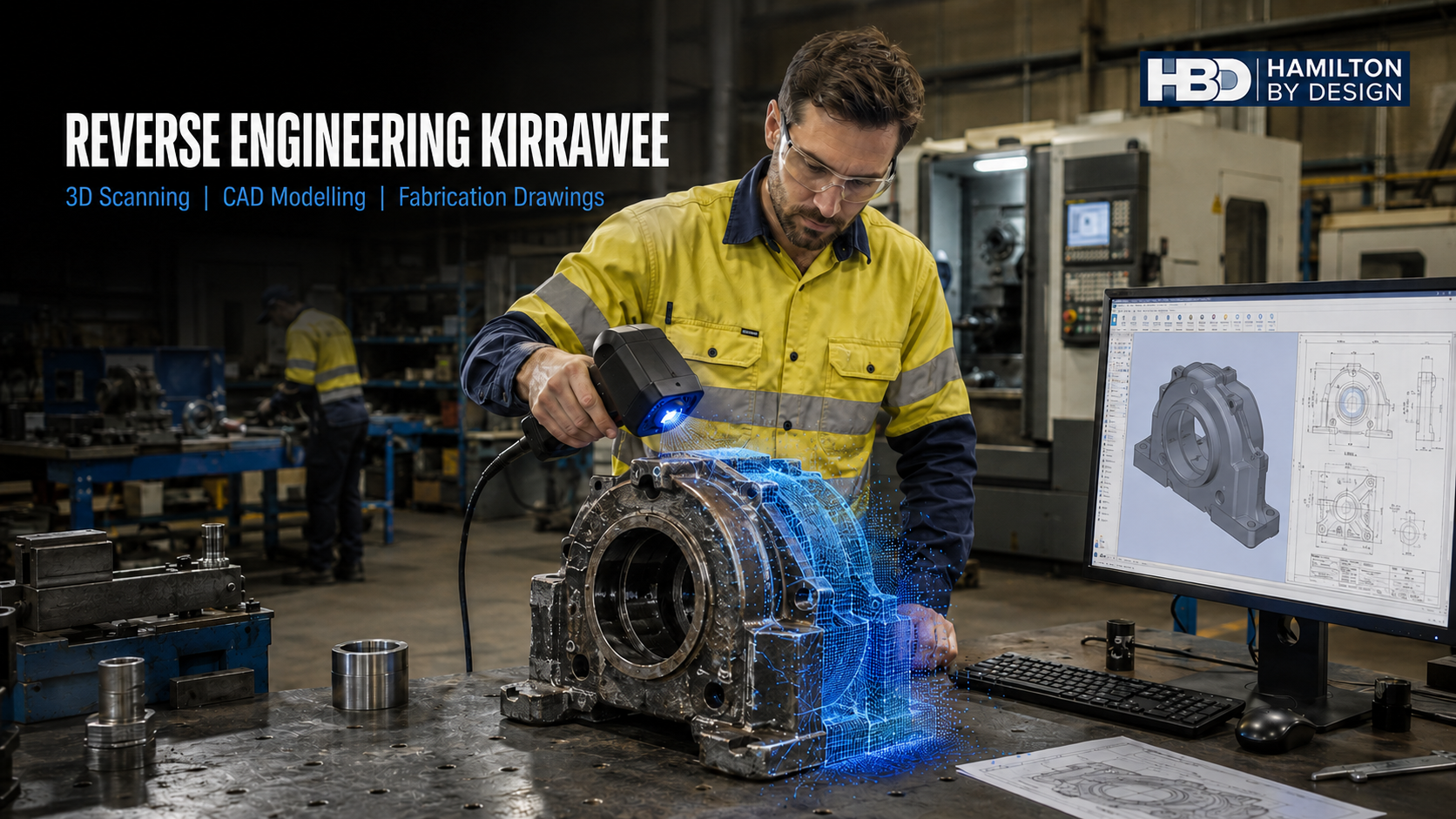
Hamilton By Design provides reverse engineering in Kirrawee, combining detailed measurement, 3D scanning, mechanical engineering, CAD modelling and fabrication drawing services. This integrated process helps local manufacturers, workshop owners, fabricators, maintenance contractors and equipment operators convert physical assets into useful digital engineering information.
For larger machinery, workshop layouts and surrounding buildings, Hamilton By Design can provide 3D laser scanning in Kirrawee and Caringbah. For smaller parts and complex components, close-range scanning can capture detailed surface geometry before the information is converted into a practical CAD model.
The objective is not simply to produce a visually accurate model. It is to understand what the component does, identify its critical interfaces and create information that can support manufacturing, inspection, modification and future maintenance.
What Is Reverse Engineering?
Reverse engineering is the process of examining an existing physical product, component or assembly to determine its geometry, function, material characteristics and relationship with surrounding equipment.
In a manufacturing context, the process may be used to:
- Reproduce an obsolete replacement part
- Replace a component for which drawings are unavailable
- Convert a physical item into a 3D CAD model
- Document a machine that has been modified over time
- Develop fabrication drawings from an existing assembly
- Investigate premature wear or failure
- Improve an existing component
- Create a dimensional baseline for future inspections
- Establish manufacturing information for a local supplier
- Capture engineering knowledge before it is lost
A straightforward component may only require conventional measurement and a machining drawing. More complex objects may require a combination of detailed 3D scanning, physical inspection, material investigation, engineering calculations and manual verification of critical dimensions.
Hamilton By Design’s broader approach to reverse engineering industrial equipment using 3D scanning is especially useful for castings, housings, curved fabrications, guards, ducts, machine frames and other components that cannot be described adequately using a small number of manual measurements.
Why Reverse Engineering Matters to Kirrawee Businesses
Kirrawee’s industrial precinct includes CNC machining, metal fabrication, sheet-metal work, specialist tool manufacture, steel supply, equipment servicing and construction-related operations.
Companies in these sectors often work with machinery that has remained in service for many years. The equipment may still perform its intended function, but replacement parts can become increasingly difficult to obtain.
The original manufacturer may have:
- Discontinued the machine
- Withdrawn support for an older model
- Lost or archived the relevant drawings
- Changed ownership
- Moved production overseas
- Introduced an expensive minimum order
- Imposed an unacceptable delivery period
- Supplied a replacement that no longer matches the modified machine
These problems can create a disproportionate operational risk. A relatively small shaft, bracket, housing, guard, coupling or support may prevent an otherwise serviceable machine from operating.
Reverse engineering provides another pathway. Instead of treating the absence of OEM information as the end of the equipment’s useful life, the existing component can become the starting point for a new engineering record.
This approach can help Kirrawee businesses extend asset life, improve supply-chain independence and support local manufacturing. It can also create a controlled digital record so that the same investigative work does not have to be repeated the next time the component is required.
Kirrawee’s Industrial and Manufacturing Profile
The broader Sutherland–Kirrawee area has strong connections to construction, trade supply, light manufacturing, automotive services and professional technical services. Kirrawee also benefits from access to the Princes Highway, Sydney Airport, Port Botany, southern Sydney and the Illawarra.
Local operations include:
- CNC turning and milling
- Component and tool manufacturing
- Sheet-metal cutting and folding
- Aluminium and stainless-steel fabrication
- Structural and miscellaneous steel fabrication
- Machinery servicing and modification
- Automotive equipment and vehicle-related services
- Building-product manufacture
- Warehousing and trade supply
- Small-batch production
- Specialist installation work
- Equipment repair and refurbishment
These businesses may both use and supply reverse-engineering services.
A machine shop, for example, may have the equipment needed to manufacture a replacement part but require a verified CAD model or machining drawing before production can begin. A fabricator may be capable of producing a platform, guard or support frame but need accurate information about the existing site. An asset owner may understand the operational problem but require engineering assistance to convert a damaged component into a suitable manufacturing package.
Hamilton By Design can help connect these stages through mechanical engineering consulting, scanning, modelling and documented engineering information.
The Five Major Problems Reverse Engineering Can Address
1. Missing or Unreliable Drawings
Many industrial assets do not have a complete drawing history. Original documents may have been lost during a company acquisition, workshop relocation or change of maintenance contractor.
Even where drawings remain available, they may not represent the current machine. Equipment is often altered during breakdowns, production changes and safety upgrades. Replacement components made from the original drawing may consequently fail to match the present arrangement.
Reverse engineering establishes a new dimensional record based on the actual asset.
2. Obsolete or Unavailable Components
A machine does not necessarily become technically unsuitable when its manufacturer stops supplying parts. In some circumstances, a locally manufactured replacement can extend its useful operating life.
This decision requires more than copying the visible shape. The component’s loading, interfaces, fits, material, manufacturing process, surface finish and likely failure mechanisms may all need consideration.
3. Complex Geometry
Castings, curved housings, fabricated transitions, ducts, guards and worn surfaces can be difficult to measure with rulers, tapes and callipers alone.
Three-dimensional scanning captures a dense surface record that can be inspected from different directions. Sections can be taken through the scan, symmetry can be evaluated, and complex geometry can be reconstructed in CAD.
4. Fabrication and Installation Errors
A new component may be dimensionally correct in isolation but still fail to fit the available space. Nearby steelwork, services, guards, floors and access restrictions can all affect installation.
Hamilton By Design’s 3D scanning for fabrication in Sydney can capture both the component and its surrounding installation envelope. The proposed design can then be reviewed against existing conditions before material is cut.
5. Loss of Engineering Knowledge
In many workshops, essential knowledge is held by a small number of experienced employees. They may know which parts have been altered, which dimensions are critical and how an assembly must be installed.
If this knowledge is not documented, it can be lost when people retire, change roles or leave the business.
A controlled CAD model, drawing package and dimensional record help convert individual knowledge into an enduring business asset.
What Can Be Reverse Engineered?
Hamilton By Design can investigate a wide range of mechanical and fabricated items, including:
- Machine components
- Shafts and couplings
- Bearing housings
- Pump components
- Brackets and mounting plates
- Guards and access covers
- Chutes, hoppers and transitions
- Ductwork
- Frames and skids
- Equipment supports
- Sheet-metal enclosures
- Wear plates and liners
- Pipework interfaces
- Flanges and nozzles
- Special-purpose tools
- Fabricated assemblies
- Obsolete replacement parts
- Workshop machinery layouts
The appropriate capture method depends on the size, shape, material, surface condition and required manufacturing tolerance.
A complete workshop or large machine may be suited to terrestrial LiDAR scanning. A smaller casting or mechanical component may require close-range scanning. Precision features such as bearing seats, seal surfaces, threads and accurately machined bores should normally be verified using suitable contact-measurement or metrology equipment.
From Physical Component to CAD Model
A scan is not automatically a manufacturing model.
Raw scan data usually represents millions of measured surface points. It may include dirt, wear, corrosion, reflective noise, nearby equipment and areas hidden from the scanner. Engineering interpretation is needed to convert this information into deliberate design geometry.
The process generally includes the following stages.
Initial Scope Review
The first step is to understand why the component is being reverse engineered.
Questions may include:
- Is an exact replacement required?
- Has the original component worn or deformed?
- What features connect with other equipment?
- Which dimensions determine fit and function?
- Is the proposed component safety-critical?
- What loads does it experience?
- What material was originally used?
- Does the client want a model, drawing or complete engineering review?
- Will one component or a production batch be manufactured?
This review determines the required level of detail and the most appropriate measurement method.
Physical Inspection and Data Capture
The component is photographed, measured and scanned as appropriate. Associated equipment may also need to be captured to establish mounting points, clearances and operating relationships.
Hamilton By Design provides 3D laser scanning for engineering projects where larger areas or complex existing conditions must be documented.
Point-Cloud or Mesh Processing
The scan data is aligned, checked and cleaned. Unwanted background information is removed, and the relevant surfaces are prepared for engineering interpretation.
The quality of this stage matters. Poorly aligned scan data can create false geometry and misleading measurements.
CAD Reconstruction
A practical CAD model is developed from the measured information. Depending on the component, this may involve:
- Identifying axes and centre planes
- Reconstructing nominal radii
- Restoring symmetry
- Establishing machined features
- Defining plate thicknesses
- Rebuilding sheet-metal geometry
- Modelling weldments
- Creating assemblies
- Separating deliberate geometry from wear
- Defining replaceable subcomponents
Hamilton By Design uses SolidWorks for engineering modelling and drafting where parametric, editable models are required.
Verification
Critical dimensions are checked against the physical component and its mating parts. Any assumptions, inaccessible areas or uncertain features should be documented.
Verification is particularly important where a part contains precision fits or performs a safety-related function.
Drawing and Manufacturing Information
The CAD model can then support:
- Machining drawings
- Fabrication drawings
- Assembly drawings
- General arrangements
- DXF cutting profiles
- Sheet-metal flat patterns
- Bills of materials
- Weld details
- STEP or Parasolid files
- Inspection dimensions
- As-built records
Hamilton By Design’s Australian design and drafting services can support the conversion of engineering geometry into controlled information suitable for review and manufacture.
Reproducing Worn or Damaged Parts
One of the most important reverse-engineering decisions is whether to copy the measured part exactly.
A worn component represents its present condition, not necessarily its original design. Copying every measured surface may reproduce defects such as:
- Elongated holes
- Uneven wear
- Distorted plates
- Bent shafts
- Damaged sealing surfaces
- Weld shrinkage
- Corrosion loss
- Previous repair material
- Misalignment
- Heat-related deformation
Engineering judgement is required to identify the likely nominal geometry.
Where possible, this may involve comparing opposite sides, evaluating symmetry, examining mating components, reviewing standard bearing or seal sizes and consulting maintenance personnel.
The final model should clearly distinguish measured information from reconstructed or assumed geometry. This traceability is important because it allows the client and manufacturer to understand the basis of the design.
Mechanical Engineering Support
Reverse engineering can lead directly into a wider mechanical engineering project.
Once the existing component has been documented, Hamilton By Design may assist with:
- Functional assessment
- Design improvement
- Material review
- Design for manufacture
- Assembly and maintenance access
- Component strengthening
- Guarding integration
- Load-path review
- Connection detailing
- Finite element analysis where appropriate
- Prototype development
- Fabrication support
- Installation planning
Hamilton By Design provides broader mechanical engineering services in Sydney for manufacturing, industrial and equipment-related projects.
Where a modification affects a building or primary structural system, appropriately qualified structural engineering input may also be required. Hamilton By Design can provide mechanical design and drafting information and coordinate with the client’s structural engineer where necessary.
Mechanical Drafting and Fabrication Drawings
A sound model is only useful when the required information is communicated clearly.
Mechanical drafting can provide the bridge between the engineering investigation and the workshop. Depending on the project, the drawing package may include:
- Overall and detail dimensions
- Tolerances and fits
- Material specifications
- Weld symbols
- Surface-finish requirements
- Machining notes
- Fastener information
- Assembly relationships
- Critical inspection points
- Revision information
- Drawing status
- Parts lists
- Cutting profiles
The AS 1100 technical-drawing series may provide the general foundation for drawing presentation. Other standards may apply depending on the component, manufacturing process and client requirements.
For welded steelwork, AS/NZS 1554.1 and AS/NZS 5131 may be relevant. Mechanical equipment steelwork may require consideration of AS 3990. Access platforms, walkways and stairs may involve AS 1657. The applicable standard should always be confirmed against the actual duty and project scope.
Machinery Safety and Guarding
Reverse engineering should not reproduce an unsafe condition without review.
Older machinery may contain exposed drives, belts, chains, shafts, cutting tools, pinch points or accessible moving parts. Existing guards may have been removed, damaged or modified to make maintenance easier.
Hamilton By Design can assist with:
- Capturing existing machinery
- Identifying guarding interfaces
- Developing fixed-guard layouts
- Designing removable covers
- Reviewing maintenance access
- Documenting doors and panels
- Checking operator clearances
- Preparing fabrication drawings
- Recording residual design risks
- Coordinating mechanical guarding with control-system specialists
The AS/NZS 4024 series is an important reference for machinery safety. SafeWork NSW guidance also emphasises suitable guarding, safe isolation, prevention of unexpected restart and consultation with the people who operate and maintain the machine.
Scanning can make guarding design more reliable because mounting points, surrounding equipment and access constraints are captured before the guard is fabricated.
However, a physical guard is only one part of machine safety. Electrical controls, interlocks, safety functions, isolation, operating procedures and worker training may require specialist input beyond the mechanical scope.
Supporting Workshop and Logistics Improvements
Reverse-engineering projects often reveal wider opportunities to improve a workshop or production area.
A scan can document not only the component but also:
- Machine positions
- Operator work areas
- Maintenance clearances
- Forklift routes
- Pedestrian access
- Loading areas
- Storage locations
- Overhead obstructions
- Crane or hoist coverage
- Equipment-removal paths
- Service connections
- Emergency access
Hamilton By Design can use this information to support machinery relocation, workshop layout development, lifting studies, fabricated transport frames and installation sequencing.
AS 4991 may apply to purpose-designed lifting devices. The AS 1418 and AS 2550 series may be relevant to cranes and their safe use. AS 1657 may apply to fixed access systems, while AS/NZS 4024 may apply where people interact with machinery.
The relevant requirements depend on the equipment, site and intended operation.
Risk Management and Design Documentation
Reverse engineering does not eliminate risk by itself. It provides better information from which risks can be identified, assessed and controlled.
Hamilton By Design can assist with engineering inputs to:
- Design risk assessments
- Plant hazard reviews
- Machinery-modification assessments
- Fabrication risk reviews
- Installation planning
- Maintenance-access reviews
- Lifting assessments
- Inspection and verification plans
- Management-of-change records
- Residual-risk registers
AS ISO 31000 provides general risk-management principles. Machinery projects may also require reference to the AS/NZS 4024 series, WHS legislation, applicable codes of practice and the client’s internal engineering standards.
The client or person conducting a business or undertaking retains responsibility for workplace risk management. Hamilton By Design’s role is to contribute accurate site information, mechanical engineering analysis and documented design information within the agreed scope.
Engineering Data as a Long-Term Asset
A major benefit of reverse engineering is the creation of reusable data.
Depending on the project agreement, Hamilton By Design can retain or manage:
- Machinery scans
- Component scans
- Registered point clouds
- Native CAD models
- STEP and Parasolid files
- Replacement-part drawings
- Fabrication drawings
- Dimensional records
- Revision histories
- As-built documentation
- Inspection information
This information can help the client avoid repeating site measurements and investigative work. It can also support future procurement, maintenance planning, design modifications and supplier changes.
The value is therefore greater than the immediate replacement component. The project can establish a controlled engineering record that supports the asset over the remainder of its operating life.
Why an Engineering-Led Approach Matters
Many technologies can produce a 3D image of an object. Fewer processes produce dependable engineering information.
Engineering-led reverse engineering considers:
- What the component is intended to do
- Which features are functionally important
- Which surfaces are worn
- Where tolerances are required
- How the component will be manufactured
- How it will be assembled
- Whether it can be inspected
- How it affects machinery safety
- Whether the replacement will fit the existing equipment
- What assumptions must be recorded
Hamilton By Design combines practical industry experience with scanning, CAD modelling, mechanical design and fabrication-aware drafting.
This approach supports the broader Hamilton By Design workflow of scan, model, engineer and upgrade.
Reverse Engineering Across Kirrawee and Southern Sydney
Hamilton By Design can support projects throughout Kirrawee, Sutherland, Caringbah, Taren Point, Miranda, Gymea, Heathcote, Menai, Cronulla and surrounding areas.
The reverse engineering services available in Taren Point are particularly relevant to businesses operating across the wider Sutherland Shire industrial market.
For organisations with facilities elsewhere in the metropolitan area, Hamilton By Design also provides engineering-led 3D scanning across Sydney and broader engineering and 3D scanning services throughout NSW.
Frequently Asked Questions
What is reverse engineering?
Reverse engineering is the process of examining an existing physical component, machine or assembly and converting the measured information into usable engineering data. The resulting information may include a CAD model, machining drawing, fabrication drawing, dimensional record or complete replacement-part package.
Can Hamilton By Design reverse engineer a component without drawings?
Yes. A physical component can be measured and scanned even when the original drawings are unavailable. The required process depends on its size, geometry, condition, function and manufacturing tolerance.
Can a worn component be used to create a new part?
Often, yes. However, the worn surface should not necessarily be copied directly. Hamilton By Design can evaluate symmetry, mating parts, standard component sizes and functional interfaces to estimate the intended nominal geometry. Important assumptions should be recorded for client review.
Is 3D scanning accurate enough to manufacture a replacement component?
It depends on the component and required tolerance. Scanning can be highly effective for overall geometry, curved surfaces, castings and fabricated assemblies. Precision features such as bearing seats, threads, shafts and seal surfaces should normally be checked with appropriate contact-measurement or metrology equipment.
What is the difference between a point cloud, mesh and CAD model?
A point cloud is a collection of measured points representing visible surfaces. A mesh joins surface information into interconnected triangles. A CAD model reconstructs deliberate engineering geometry such as planes, cylinders, holes, features and sheet-metal components. Manufacturing generally requires an appropriate CAD model or drawing rather than raw scan data alone.
Can Hamilton By Design produce fabrication drawings?
Yes. Depending on the agreed scope, Hamilton By Design can prepare general arrangements, fabrication drawings, machining drawings, assembly drawings, DXF profiles, sheet-metal flat patterns and bills of materials.
Can the model be supplied to a Kirrawee machine shop?
Yes. Deliverables may include STEP, Parasolid, DXF, DWG, SolidWorks and PDF files. The appropriate format should be agreed with the selected manufacturer before the drawing package is finalised.
Can reverse engineering improve the original component?
Yes. Once the original geometry and function are understood, the component may be reviewed for material changes, improved strength, reduced weight, easier manufacture, better maintenance access or improved safety. Any design change should be properly assessed rather than treated as a simple copy.
Can Hamilton By Design scan a complete workshop or machine?
Yes. Terrestrial 3D laser scanning can capture complete machinery, building geometry, nearby services, access routes and installation constraints. This is useful when a replacement assembly must fit within an existing operating area.
Can 3D scanning help prevent fabrication errors?
Yes. Proposed CAD geometry can be compared with the captured site condition before manufacture. This can identify clashes, incorrect connection positions, access restrictions and installation problems earlier in the project.
Can Hamilton By Design assist with machine guarding?
Hamilton By Design can assist with mechanical guard surveys, layouts, CAD models and fabrication drawings. The design may be reviewed against relevant parts of AS/NZS 4024. Electrical interlocks, safety-control systems and functional-safety validation may require appropriately qualified electrical or control-system specialists.
Which Australian Standards may apply?
Applicable standards depend on the component and project. Common references may include the AS 1100 technical-drawing series, AS/NZS 4024 for machinery safety, AS 3990 for mechanical equipment steelwork, AS 1657 for fixed access systems, AS 4991 for lifting devices, AS/NZS 1554.1 for welding and AS/NZS 5131 for structural steelwork fabrication and erection.
Can Hamilton By Design retain the scan and CAD information?
Data retention can be included in the project scope. Machinery scans, CAD files, dimensional records, drawings and revision histories can provide a valuable baseline for future maintenance, procurement and modification work.
Does reverse engineering breach the original manufacturer’s intellectual property?
Reverse engineering can raise intellectual-property, licence or contractual issues, particularly where a component is protected by patents, copyright, confidentiality agreements or other restrictions. The asset owner should confirm that it has the legal right to reproduce or modify the component. Technical feasibility does not automatically establish a legal right to manufacture it.
How does a reverse-engineering project begin?
The project normally begins with photographs, available drawings, approximate component dimensions, the reason for replacement and a description of the equipment’s operation. Hamilton By Design can then recommend the appropriate inspection, scanning, modelling and engineering scope.
Discuss a Reverse Engineering Project in Kirrawee
A missing drawing or discontinued component does not always mean that an otherwise useful machine must be replaced.
Hamilton By Design can assist Kirrawee and Sutherland Shire businesses with machinery scanning, close-range component capture, CAD modelling, mechanical drafting, fabrication drawings and engineering review.
Whether the requirement involves one obsolete component, a modified machine, a new guard or a complete workshop upgrade, the process can begin by documenting what physically exists.
Visit Hamilton By Design to discuss reverse engineering, 3D scanning or mechanical drafting support for a Kirrawee project.

Contact Us – Talk To Us
Our clients: