Industrial 3D Laser Scanning Silverwater | Scan-to-CAD & Reverse Engineering

Blue 3D LiDAR scanner icon on a tripod with scanning waves

Silverwater and Auburn form one of Sydneyโ€™s established industrial corridors, supporting manufacturing, food and process operations, machinery, fabrication, warehousing, logistics and distribution facilities. Many of these sites have evolved progressively over years or decades, with machinery replaced, production lines altered, pipework rerouted, platforms added and buildings adapted to suit changing operational requirements.

For engineers and maintenance teams, this creates a common problem: the drawings available for an industrial facility may no longer accurately represent what exists on site.

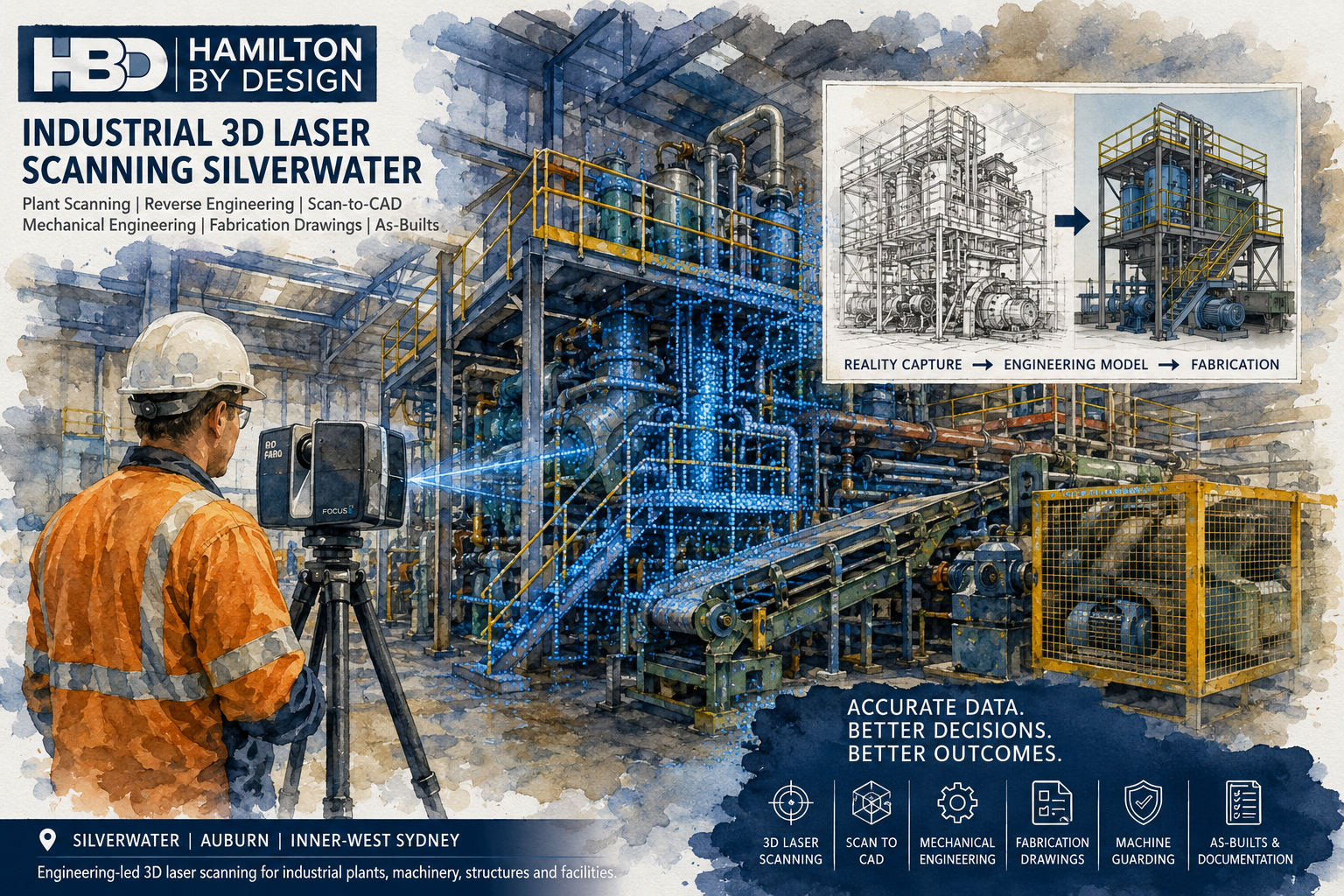
Hamilton By Design provides industrial 3D laser scanning in Silverwater and Auburn to capture existing plant conditions and convert that information into practical engineering data. Through 3D laser scanning for industrial plants, point-cloud processing, mechanical engineering, Scan-to-CAD modelling and fabrication documentation, we can help businesses reduce uncertainty before modifying existing equipment or installing new plant.

The objective is not simply to create a point cloud. It is to capture the existing plant accurately enough to support better engineering decisions.

The Biggest Problem: Existing Drawings Do Not Always Match Existing Plant

One of the greatest challenges in a mature industrial facility is determining exactly what has been built.

A factory may have original construction drawings and equipment drawings, but years of maintenance and production changes can mean those documents no longer represent the current arrangement.

Changes might include:

  • machinery relocated from its original position;
  • new conveyors or processing equipment installed;
  • additional structural steel or platforms;
  • pipework and ducting rerouted around new equipment;
  • guarding modified during maintenance;
  • services added without corresponding drawing revisions; or
  • obsolete equipment replaced with machinery of different dimensions.

When a new project begins, engineers may therefore be designing against information that is incomplete or incorrect.

For brownfield work, Hamilton By Design can use engineering-grade 3D laser scanning to establish the actual geometry of the plant before detailed engineering begins.

This can substantially reduce the risk of discovering dimensional problems only after fabrication or during installation.

What Is Industrial 3D Laser Scanning?

3D laser scanning uses LiDAR technology to capture millions of spatial measurements from the surrounding environment. These measurements form a three-dimensional point cloud representing the visible geometry of the facility.

Within an industrial plant, this can include:

  • machinery;
  • conveyors;
  • structural steel;
  • columns and beams;
  • access platforms;
  • stairs and handrails;
  • tanks and vessels;
  • pipework;
  • ducting;
  • floor levels;
  • walls and roof structures;
  • electrical and mechanical services; and
  • surrounding equipment that may affect a proposed installation.

Unlike taking individual tape or laser measurements, a terrestrial scan captures the relationship between many different objects at the same time.

This becomes particularly useful when working inside congested manufacturing facilities where a proposed machine, conveyor or fabricated assembly must pass through several existing interfaces.

Hamilton By Design provides 3D laser scanning for engineering projects where the scan data is collected with the intended engineering outcome in mind.

Plant Modifications in Silverwater and Auburn

Plant modifications are one of the strongest applications for industrial scanning.

Consider a manufacturer preparing to install a replacement production machine.

The machine itself may have accurate manufacturer drawings. However, the surrounding factory could contain columns, cable trays, pipework, existing machinery, guarding, walkways and building structures that are not accurately documented.

The critical question becomes:

Will the new equipment actually fit?

A 3D scan can establish the existing environment before the new installation is finalised. Proposed equipment can then be incorporated into a 3D engineering model to assess position, access and interfaces.

Hamilton By Design can support this process through mechanical engineering services, combining existing-condition capture with practical mechanical design.

This approach can be applied to:

  • machinery replacements;
  • production-line modifications;
  • conveyor extensions;
  • equipment relocations;
  • process plant upgrades;
  • access modifications;
  • platforms and support steel;
  • pipework changes; and
  • shutdown projects.

Reverse Engineering Auburn Industrial Equipment

Industrial businesses also regularly operate machinery for which usable CAD models or manufacturing drawings are no longer available.

The original equipment manufacturer may no longer exist, replacement parts may have long lead times, or the machine may have been modified significantly during its service life.

In these situations, Hamilton By Design can provide reverse engineering using 3D scanning.

Reverse engineering is more than copying geometry.

The process may involve capturing an existing component or assembly, establishing its important dimensions and interfaces, interpreting how the component functions and developing engineering CAD suitable for its intended purpose.

Applications can include:

  • obsolete machinery;
  • replacement components;
  • fabricated assemblies;
  • guards and covers;
  • chutes and hoppers;
  • structural frames;
  • machine bases;
  • equipment interfaces; and
  • existing plant where original drawings are unavailable.

For Auburn and Silverwater manufacturers, this provides a practical pathway between an existing physical asset and a new engineering model.

Scan-to-CAD Silverwater

A point cloud is an extremely useful record, but many engineering and fabrication projects ultimately require CAD.

Hamilton By Design can convert selected scan information into usable engineering geometry through its 3D CAD modelling and mechanical drafting services.

The amount of modelling required depends on the project.

It is not always necessary to model an entire factory.

For example, if a new machine is being installed, the relevant CAD model might only require:

  • floor and foundation geometry;
  • nearby columns;
  • existing machinery;
  • overhead obstructions;
  • pipework affecting the installation;
  • maintenance access;
  • surrounding structural steel; and
  • critical connection points.

This targeted Scan-to-CAD approach can provide the engineering team with the information required without unnecessarily modelling unrelated areas of the facility.

Potential deliverables can include:

  • SolidWorks models;
  • STEP or SAT models;
  • AutoCAD DWG files;
  • DXF profiles;
  • general arrangement drawings;
  • equipment layouts;
  • fabrication drawings;
  • as-built drawings; and
  • point-cloud datasets such as E57, RCP or RCS.

Mechanical Drafting and Fabrication Drawings

The real value of industrial scanning often becomes apparent when captured site data is carried through into fabrication.

Once the existing plant geometry is understood, Hamilton By Design can develop the proposed modification using mechanical drafting and 3D CAD.

Depending on the scope, documentation may include:

  • general arrangement drawings;
  • assembly drawings;
  • individual part drawings;
  • fabrication details;
  • bills of materials;
  • cutting lists;
  • DXF plate profiles;
  • installation information; and
  • CAD exchange files for fabrication.

This creates a relatively direct engineering workflow:

Existing plant โ†’ 3D scan โ†’ point cloud โ†’ engineering model โ†’ fabrication drawings โ†’ manufacture โ†’ installation

The benefit is that the fabricated equipment can be designed around measured site conditions rather than assumptions derived from outdated information.

Machine Guarding and Existing Machinery

Silverwater and Auburn contain numerous operating manufacturing and processing facilities where older machinery may also require modifications to guarding, access or maintenance arrangements.

Guarding design can be difficult where machinery has irregular geometry or where available space is constrained by surrounding equipment.

3D scanning can capture the machinery and its immediate environment, giving engineers a reliable geometric reference before developing new guarding.

Hamilton By Design provides machine guarding engineering and verification that can complement the scanning and mechanical-design workflow.

Scanning may assist with establishing:

  • machine geometry;
  • existing guarding arrangements;
  • surrounding access constraints;
  • conveyor interfaces;
  • structural attachment locations; and
  • space available for new guarding.

The resulting information can then support development of practical guarding arrangements that consider fabrication, installation, operation and maintenance.

As-Built Documentation for Mature Industrial Facilities

Not every scanning project relates to a new machine.

Some businesses simply need to establish what they currently own.

Where a plant has undergone numerous undocumented modifications, 3D scanning can provide a detailed existing-condition dataset from which updated as-built information can be generated.

This may be valuable for:

  • future capital projects;
  • maintenance planning;
  • shutdown preparation;
  • asset management;
  • equipment relocation;
  • engineering studies;
  • facility layouts; and
  • tender documentation.

An accurate point cloud can also allow engineers to return to the captured environment digitally to obtain additional measurements without automatically requiring another site visit.

Reducing Shutdown and Installation Risk

Industrial shutdowns can involve significant production pressures.

A dimensional problem discovered during installation may result in fabricated components being modified on site, additional welding or cutting, delayed crane operations or interference with other shutdown activities.

3D scanning cannot eliminate every project risk, but it can reduce one important source of uncertainty: the geometry of the existing plant.

Hamilton By Designโ€™s approach to engineering-led industrial 3D laser scanning connects reality capture with the engineering work that follows.

Instead of treating scanning as an isolated survey, the scan can become the geometric foundation for design, drafting, fabrication and installation planning.

Why Use an Engineering-Led Scanning Service?

The question when planning a scan should not only be:

โ€œWhat can we scan?โ€

A more useful question is:

โ€œWhat engineering decision will this scan help us make?โ€

If the final requirement is a replacement component, fabrication assembly, plant layout or equipment modification, understanding that outcome before scanning can influence what should be captured and at what level of detail.

Hamilton By Design combines industrial scanning with mechanical engineering, reverse engineering and CAD documentation so that reality capture forms part of a wider project workflow.

For businesses in Silverwater and Auburn, that can mean one engineering pathway from the existing plant through to fabrication-ready documentation.

Industrial 3D Laser Scanning Silverwater and Auburn

Whether the requirement is to install new machinery, reverse engineer existing equipment, document an industrial facility or produce fabrication drawings for a brownfield modification, accurate existing-condition information provides a stronger starting point.

Hamilton By Design can assist with:

  • 3D laser scanning Silverwater
  • industrial plant scanning Auburn
  • reverse engineering Auburn
  • mechanical engineering Silverwater
  • Scan-to-CAD Silverwater
  • plant modifications;
  • equipment layouts;
  • machine guarding;
  • mechanical drafting;
  • fabrication drawings; and
  • industrial as-built documentation.

For projects where the existing drawings cannot be trusted, engineering-grade 3D scanning provides a practical way to replace assumptions with measured information.

Frequently Asked Questions

What is industrial 3D laser scanning?

Industrial 3D laser scanning uses LiDAR equipment to capture millions of measurements from machinery, buildings, structures and surrounding plant. These measurements create a three-dimensional point cloud that can be used for measurement, engineering design, Scan-to-CAD and as-built documentation.

Can Hamilton By Design scan an operating factory in Silverwater?

Yes. Industrial scanning can often be undertaken within operating manufacturing and processing environments, subject to site access, safety requirements and the specific project scope. The scanning strategy can be developed around the equipment and areas relevant to the engineering project.

Can 3D scanning help when our existing drawings are inaccurate?

Yes. This is one of the principal applications of industrial scanning. The point cloud records the visible existing condition of the plant, allowing engineering work to be based on measured geometry rather than relying exclusively on historical drawings.

Can you reverse engineer machinery in Auburn from a 3D scan?

Yes, depending on the equipment, component size and required accuracy. Hamilton By Design can combine 3D scanning with reverse engineering and CAD modelling to develop usable engineering information for obsolete machinery, replacement components and modified equipment.

What is Scan-to-CAD?

Scan-to-CAD is the process of using point-cloud data as the geometric basis for creating CAD models or drawings. Depending on the project, this could include SolidWorks models, equipment layouts, AutoCAD drawings, fabrication drawings or as-built documentation.

Do you need to model the entire factory?

No. The required level of modelling should suit the engineering problem. For many plant modifications, only the machinery, structures and interfaces surrounding the proposed work need to be converted into CAD.

Can scanning be used before installing new machinery?

Yes. Existing machinery, columns, structures, services and access constraints can be captured and compared with the proposed equipment layout. This can help identify potential spatial conflicts before equipment arrives on site.

Can Hamilton By Design produce fabrication drawings after scanning?

Yes. Where included in the engineering scope, scan information can be developed into mechanical CAD models, general arrangements, assemblies, detail drawings, BOMs and DXF profiles suitable for fabrication.

Can 3D scanning assist with machine guarding?

Yes. Scanning can establish the geometry of existing machinery and the surrounding environment before new guarding is designed. This is particularly useful where existing machinery has complex geometry or limited available space.

What files can be supplied following industrial scanning?

Depending on project requirements, deliverables can include point-cloud formats such as E57, RCP or RCS together with CAD outputs including DWG, DXF, STEP, SAT, Parasolid, SolidWorks models and PDF engineering drawings.

Who uses industrial 3D laser scanning in Silverwater and Auburn?

Typical users include manufacturers, food and process facilities, machinery builders, engineering contractors, maintenance teams, fabricators, project engineers, facility managers and businesses undertaking brownfield plant modifications.

How do I discuss a Silverwater or Auburn scanning project?

The best starting point is to provide Hamilton By Design with a brief description of the equipment or facility, the problem being solved, photographs where available and an indication of the required engineering deliverable. From there, the scanning and engineering scope can be developed around the project outcome.


Hamilton By Design logo displayed on a blue tilted rectangle with a grey gradient background

Contact Us – Talk To Us

Name
Would you like us to arrange a phone consultation for you?
Address

Our clients:


Mechanical Engineering Services

Plant upgrades, machinery modifications, equipment integration and practical mechanical engineering support.

View Service โ†’

3D Laser Scanning & Reality Capture

Accurate existing-condition data where drawings are missing, outdated or unreliable.

View Service โ†’

Reverse Engineering

Obsolete or undocumented equipment can be reconstructed, modified or reproduced.

View Service โ†’

Scan-to-CAD / Point Cloud to CAD

Point-cloud information can be converted into usable CAD models and engineering drawings.

View Service โ†’

CAD Design & 3D Modelling

Concepts, sketches or scan data can be developed into detailed manufacturable 3D models.

View Service โ†’

Finite Element Analysis โ€“ FEA

Stress, deflection, fatigue, buckling, vibration and structural performance can be assessed.

View Service โ†’

Machine Guarding Design & Verification

Machinery and conveyor guarding can be designed, modified or engineering-reviewed.

View Service โ†’

Manufacturing & Production Engineering

Production lines and machinery can be integrated, modified or upgraded with minimal disruption.

View Service โ†’

Secondment Engineering Services

Additional engineering capacity for shutdowns, projects, site work or temporary vacancies.

View Service โ†’

Mechanical Drafting

Workshop-ready drawings for manufacturing, installation or plant modification.

View Service โ†’

Australian Design Drafting Services

Mechanical, structural and industrial drafting support for engineering and fabrication projects.

View Service โ†’

Construction Vibration Monitoring

Independent vibration measurement and documentation near buildings and infrastructure.

View Service โ†’

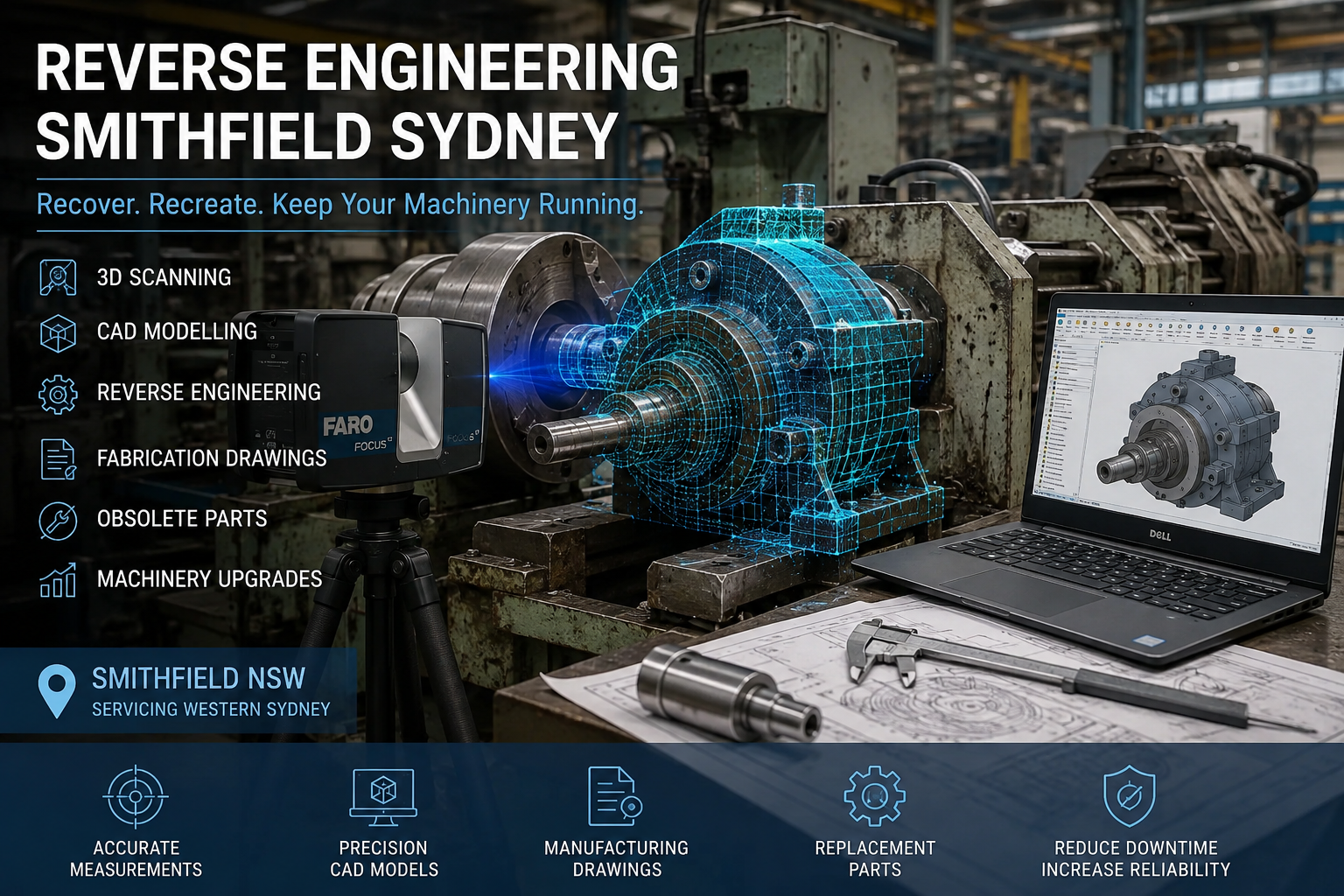
Reverse Engineering Smithfield Sydney | 3D Scanning & Machinery

Reverse engineering Smithfield Sydney with 3D scanning, CAD modelling, fabrication drawings and obsolete machinery part replacement.

Recovering the Engineering Knowledge Locked Inside Existing Machinery

Blue 3D LiDAR scanner icon on a tripod with scanning waves

Manufacturing plants in Smithfield NSW often contain machinery that has remained productive for decades. Over that time, equipment may have been repaired, modified, relocated, upgraded or adapted to suit changing production requirements.

The machinery may still perform its job reliably, but the engineering information behind it can gradually disappear.

Original drawings may no longer exist. CAD models may never have been created. Manufacturers may have ceased trading, replacement components may have become obsolete, and previous modifications may only be understood by experienced maintenance personnel.

For manufacturers operating in Smithfield, this creates a significant engineering and maintenance problem:

How do you repair, reproduce or modify an important machine when nobody has an accurate record of what is actually installed?

Hamilton By Design provides reverse engineering, 3D scanning, CAD modelling and mechanical engineering services in Smithfield and Western Sydney, helping manufacturers recover this information and convert existing machinery into practical digital engineering records.

For broader projects throughout Sydney, our Reverse Engineering 3D Scanning Sydney service supports the recreation and verification of machinery and components where reliable original information is unavailable.


The Biggest Problem: The Machine Exists, but the Engineering Information Does Not

Many established factories are effectively operating two assets.

The first is the physical machine.

The second is the knowledge required to maintain it.

While the machine may remain on the factory floor, the supporting engineering knowledge can be much easier to lose.

A production machine may have undergone numerous modifications during its working life. Guards may have been replaced. Shafts may have been remanufactured. Frames may have been strengthened. Motors, gearboxes and bearings may have changed. Locally manufactured components may have replaced original OEM parts.

Unfortunately, the drawings are not always updated as these modifications occur.

Eventually, the drawing in the filing cabinet can describe a machine that no longer exists.

This is particularly significant when a critical component fails and the maintenance team discovers:

  • the original manufacturer no longer supports the equipment;
  • replacement parts are unavailable;
  • the existing drawings are incomplete or inaccurate;
  • nobody has a CAD model;
  • the failed component has already suffered significant wear;
  • previous modifications were never documented; or
  • the person who understood the machine is no longer available.

At this point, the challenge is no longer simply finding a replacement part.

It is recovering the engineering information required to create one.


Reverse Engineering Existing Machinery in Smithfield

Smithfield forms part of the broader Smithfieldโ€“Wetherill Park industrial precinct, an established Western Sydney manufacturing and employment area containing a substantial concentration of industrial businesses.

For machinery owners in this environment, reverse engineering can provide a practical method of documenting equipment that otherwise exists only as a physical asset.

The process can be applied to:

  • production machinery;
  • packaging equipment;
  • conveyors;
  • rollers and shafts;
  • bearing housings;
  • machine frames;
  • fabricated assemblies;
  • guards and covers;
  • hoppers and chutes;
  • brackets and mounting systems;
  • obsolete replacement components;
  • processing equipment; and
  • custom-built machinery.

The objective is not necessarily to copy every surface exactly.

Good reverse engineering requires an understanding of design intent.

A worn component should not automatically be recreated with the same wear. A distorted fabricated frame may not represent its original design geometry. A shaft journal may measure undersize because it has operated for thousands of hours.

The engineering process must therefore distinguish between what currently exists and what the component was intended to be.


3D Scanning Smithfield Machinery and Factory Equipment

Different equipment requires different measurement approaches.

Large machines, production lines and surrounding factory environments can be captured using terrestrial laser scanning. This creates a measurable three-dimensional record of the existing installation, including surrounding structures and equipment where those interfaces are relevant.

Hamilton By Design’s broader Industrial 3D Scanning Services support manufacturing facilities, plant modifications, machinery installations and reverse-engineering projects where reliable existing-condition information is required.

For smaller components or detailed surfaces, high-resolution handheld 3D scanning may be more suitable.

Traditional measurement remains important as well.

Vernier calipers, micrometers, bore gauges and other dimensional measurement techniques may be used alongside scan data where critical machined features, fits or tolerances need to be established.

The appropriate combination depends on the component, its size, surface condition and the intended engineering outcome.


From Physical Machinery to Usable CAD

Capturing a point cloud or mesh is only the beginning.

The real value comes from converting measured information into engineering geometry that can be reused.

A typical Smithfield reverse-engineering project may involve:

1. Understanding the Requirement

Before scanning begins, Hamilton By Design can establish why the machinery or component is being captured.

The objective may be to reproduce a failed part, modify a machine, design new guarding, relocate equipment or simply create a permanent engineering record before one is urgently required.

2. Reviewing Existing Information

Old drawings, sketches, manuals, photographs, CAD files, spare parts and maintenance records can provide useful supporting information.

Where the accuracy of historical drawings is uncertain, they can be compared against the physical machine rather than assumed to be correct.

3. Capturing Existing Geometry

The machine, component and relevant interfaces are measured using scanning and conventional dimensional techniques appropriate to the required outcome.

For projects extending into complete facilities or production areas, Hamilton By Design also provides 3D Scanning Services in Sydney for engineering-grade existing-condition capture.

4. Reconstructing Design Intent

Scan information can then be interpreted to establish features such as:

  • nominal diameters;
  • hole centres;
  • mounting patterns;
  • machined surfaces;
  • interfaces;
  • datums;
  • symmetry;
  • clearances; and
  • assembly relationships.

This stage is particularly important where the existing component contains wear, deformation or previous repair work.

5. Developing CAD Models and Drawings

The reconstructed geometry can then be developed into practical engineering deliverables such as:

  • SolidWorks models;
  • Inventor models;
  • STEP or Parasolid files;
  • fabrication drawings;
  • machining drawings;
  • general arrangement drawings;
  • assembly drawings;
  • DXF cutting profiles; and
  • bills of materials where required.

The purpose is to move from physical machinery to reusable engineering information.


Creating a Digital Spare-Part Library Before Machinery Fails

One of the most useful applications of reverse engineering is to undertake the work before a breakdown occurs.

A Smithfield manufacturer may have several production machines containing critical components that are becoming increasingly difficult to source.

Rather than waiting until one fails, selected components can be progressively scanned, modelled and documented.

Over time, the business can establish a digital library of critical replacement parts.

The retained information could include:

  • machinery scans;
  • component geometry;
  • registered point clouds;
  • CAD models;
  • replacement-part drawings;
  • machining drawings;
  • factory layouts;
  • equipment interfaces;
  • as-built information; and
  • modification records.

This changes the engineering response to future maintenance.

Instead of starting with a failed component and an urgent measurement exercise, the engineering information required to obtain quotations, machine a new part or investigate a redesign may already exist.


Supporting Machinery Upgrades and Plant Modifications

Reverse engineering can also assist when an existing machine is being changed rather than simply repaired.

A new motor, gearbox, conveyor, guarding system or fabricated assembly must often fit around equipment that was installed years earlier.

For these projects, capturing only the individual component may not be sufficient.

The surrounding plant can also be measured to understand:

  • mounting positions;
  • structural interfaces;
  • access clearances;
  • neighbouring machinery;
  • maintenance envelopes;
  • service routes; and
  • available installation space.

Hamilton By Design’s 3D Laser Scanning for Industrial Plants Sydney capability can support these larger brownfield modification projects by providing engineering teams with a measured representation of actual site conditions.

The principle is straightforward:

design the modification around the machinery that is actually there, rather than around assumptions about what should be there.


Dimensional Verification of Replacement Components

Reverse engineering does not necessarily finish when a replacement component has been manufactured.

Where fit or dimensional accuracy is important, the new component or fabrication can also be checked against the developed engineering geometry.

Hamilton By Design’s 3D LiDAR Scanning and Digital Quality Assurance workflows can support dimensional verification where fabricated or installed geometry needs to be compared with design information.

This can be particularly valuable when site installation opportunities are limited and incorrect fit-up could result in production delays or additional shutdown work.


Mechanical Engineering Support for Smithfield Manufacturers

The advantage of an engineering-led reverse-engineering workflow is that the project does not have to stop at scanning.

Depending on the requirement, captured information may support:

  • replacement-part development;
  • mechanical design;
  • machinery modifications;
  • fabrication drawings;
  • machine guarding;
  • plant layouts;
  • installation planning;
  • equipment relocation;
  • dimensional verification;
  • as-built documentation; and
  • engineering assessment.

This provides a practical connection between the existing physical asset and the drawings and CAD information required to maintain or modify it.


Retaining Engineering Knowledge for the Future

For established manufacturing facilities, machinery knowledge can have considerable operational value.

A machine may continue working for another ten or twenty years, but the people, suppliers and documentation surrounding it may change several times during that period.

Reverse engineering provides an opportunity to capture that knowledge while the equipment is still accessible and operational.

The long-term objective is therefore broader than producing a drawing for one replacement part.

It is about establishing a reliable engineering record of the asset.

Measure it. Understand it. Document it. Retain the information. Reuse it when the plant needs it again.

For manufacturers, maintenance teams and engineering managers in Smithfield NSW, Hamilton By Design can assist with reverse engineering, machinery scanning, CAD modelling, mechanical design, fabrication drawings and factory existing-condition documentation.


Frequently Asked Questions

Can you reverse engineer machinery when no drawings are available?

Yes. Existing machinery or components can be measured using appropriate 3D scanning and conventional dimensional measurement techniques. The resulting information can then be interpreted and reconstructed into CAD models and engineering drawings suitable for the intended application.

Can you 3D scan machinery without dismantling the entire machine?

Often, yes. Terrestrial laser scanning can capture installed machinery together with its surrounding environment. However, hidden surfaces and internal features cannot be measured if they are not visible, so some components may require separate measurement or partial disassembly depending on the required deliverable.

Can Hamilton By Design reproduce an obsolete machinery part?

Hamilton By Design can reverse engineer the existing component and develop CAD models, manufacturing geometry and drawings from which a suitable manufacturer can produce a replacement. The required scope depends on the component, material, tolerances, loading and whether the replacement is intended to be like-for-like or modified.

What happens if the original component is badly worn?

Wear needs to be considered when reconstructing design intent. Simply copying a worn surface could reproduce the defect. Available mating components, symmetry, nominal engineering dimensions, historical drawings and conventional measurements can assist in establishing the intended geometry.

Can old machinery drawings be checked against the actual equipment?

Yes. Existing drawings or CAD information can be compared with measured site conditions to identify differences caused by previous modifications, repairs, installation tolerances or outdated documentation.

Can you scan an entire factory in Smithfield?

Yes. Larger industrial areas, production lines, machinery installations, structures and plant interfaces can be captured using terrestrial LiDAR scanning where required. The resulting point-cloud information can support layouts, equipment upgrades, relocation projects and future engineering work.

Can scan data be converted into SolidWorks or Inventor models?

Yes. Depending on the project, captured geometry can be reconstructed into usable mechanical CAD models and supplied in native or neutral formats appropriate to the required engineering workflow.

Can you produce fabrication and machining drawings?

Yes. Reverse-engineered geometry can be developed into fabrication drawings, detail drawings, assembly information and DXF profiles where these form part of the agreed project scope.

Is reverse engineering useful before a machine fails?

Yes. In many cases this is the preferred time to capture critical machinery. Developing CAD models and replacement-part information while the machine is operational can reduce the amount of engineering work that has to be undertaken during an unplanned breakdown.

Can we build a digital library of obsolete or critical spare parts?

Yes. Critical machinery and components can be progressively captured and documented to create a retained digital engineering record containing scans, CAD models, drawings and relevant dimensional information for future maintenance or manufacturing requirements.

Do you provide mechanical engineering as well as 3D scanning?

Yes. Hamilton By Design combines reality capture with mechanical design, CAD modelling, drafting and fabrication documentation, allowing scan information to be developed into practical engineering deliverables rather than remaining solely as point-cloud data.

What areas do you service around Smithfield?

Hamilton By Design can support projects throughout Smithfield and the surrounding Western Sydney industrial areas, including Wetherill Park, Fairfield, Yennora, Pemulwuy, Greystanes, Guildford and the broader Sydney region.

How do we start a Smithfield reverse-engineering project?

The most useful starting information is normally a brief description of the machine or component, photographs, approximate dimensions, the reason for reverse engineering and any existing drawings or documentation available. From this information, Hamilton By Design can determine an appropriate measurement, scanning and engineering workflow.


Hamilton By Design logo displayed on a blue tilted rectangle with a grey gradient background

Contact Us – Talk To Us

Name
Would you like us to arrange a phone consultation for you?
Address

Our clients:


3D Laser Scanning Wetherill Park | Reverse Engineering & Mechanical Design

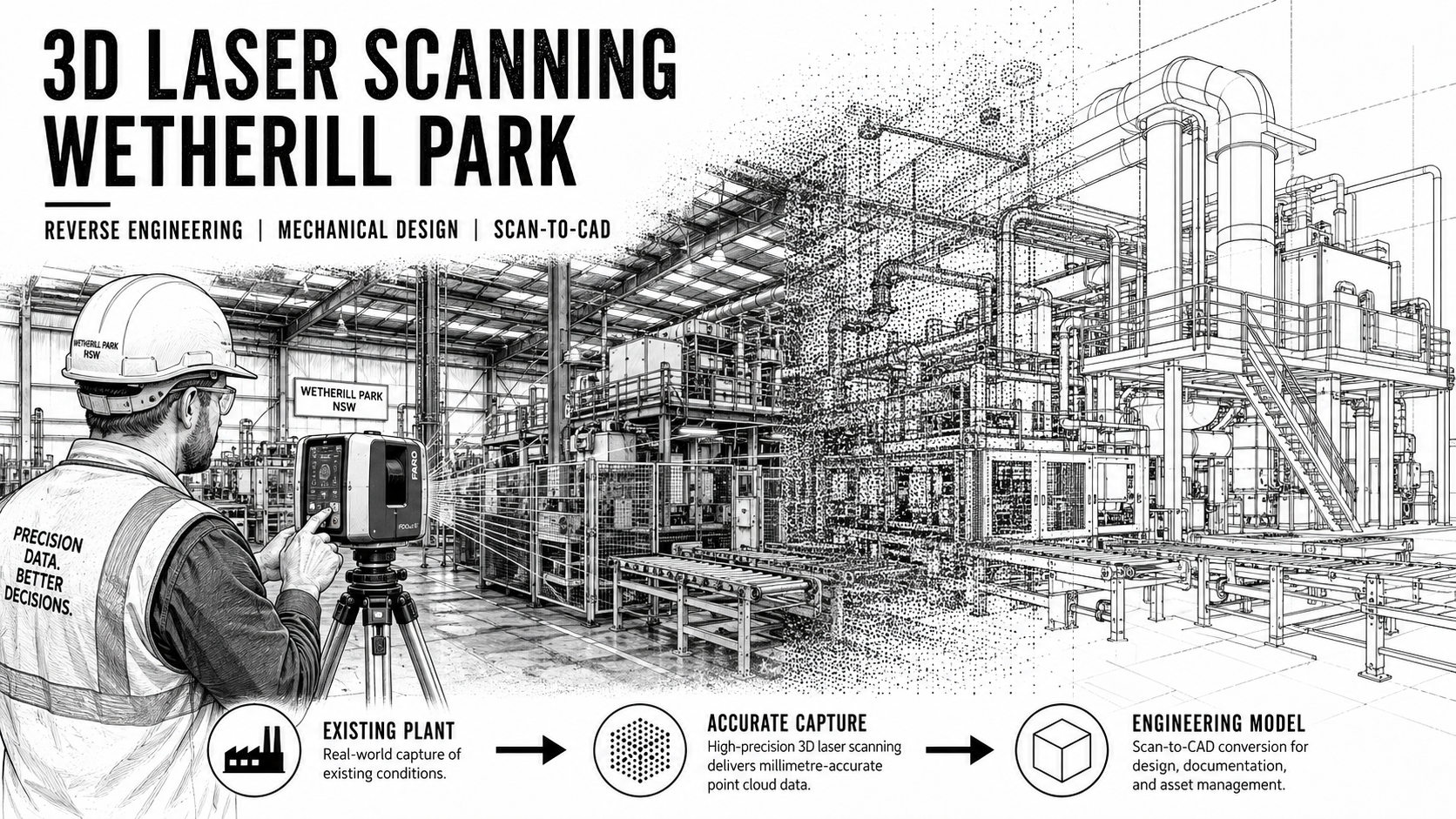
Black-and-white illustration of 3D laser scanning in a Wetherill Park factory, showing an engineer scanning industrial machinery as the plant transitions from existing conditions to point-cloud data and a CAD engineering model.

3D Laser Scanning Wetherill Park | Reverse Engineering & Mechanical Engineering

Wetherill Park is one of Sydneyโ€™s most significant industrial and manufacturing precincts, with a substantial concentration of factories, processing facilities, machinery, warehouses, fabrication businesses and industrial equipment.

For businesses operating within this environment, one of the recurring engineering challenges is obtaining accurate information about existing machinery, structures and plant layouts before modifications, upgrades or replacement equipment can be designed.

Hamilton By Design provides 3D laser scanning, reverse engineering, mechanical engineering and CAD design services in Wetherill Park, helping manufacturers and industrial operators capture existing conditions and convert them into practical engineering information.

Using terrestrial 3D laser scanning together with engineering-grade CAD modelling, existing machinery and factory environments can be documented without relying entirely on old drawings, manual measurements or incomplete site information.

3D Laser Scanning for Wetherill Park Factories and Industrial Facilities

Many manufacturing facilities evolve over decades.

Machinery is relocated, conveyors are modified, production lines are extended, guarding is replaced and new equipment is installed around existing infrastructure.

Unfortunately, engineering drawings do not always evolve at the same rate.

The result can be a substantial difference between the drawings held by the business and the equipment that actually exists on the factory floor.

Hamilton By Design can undertake 3D laser scanning of Wetherill Park industrial facilities to establish an accurate digital record of existing conditions.

Scanning can be applied to:

  • Manufacturing machinery
  • Production lines
  • Conveyors
  • Food-processing equipment
  • Packaging machinery
  • Structural steel
  • Platforms and access structures
  • Pipework
  • Tanks and vessels
  • Factory layouts
  • Equipment interfaces
  • Machine guarding
  • Existing fabrication
  • Plant rooms
  • Warehouses containing production equipment

The resulting point cloud provides a measurable three-dimensional representation of the facility that can subsequently be used for engineering, drafting and design.

Why 3D Laser Scanning Is Useful in Existing Manufacturing Plants

Traditional site measurement remains valuable, but complex machinery and industrial plants can contain thousands of dimensions.

Trying to manually measure every structural member, equipment interface, conveyor elevation, pipe location and obstruction can be time-consuming and may still leave critical information undocumented.

3D laser scanning changes the process by capturing a much larger proportion of the existing environment during the site visit.

This can be particularly valuable when a project involves fitting new equipment into an established Wetherill Park factory.

Instead of designing new machinery against an assumed arrangement, engineers can work within a digital representation of the existing plant.

This allows equipment interfaces, clearances and potential clashes to be considered considerably earlier in the design process.

Reverse Engineering Wetherill Park

Wetherill Park contains a large amount of machinery that has been operating for many years.

In some cases, the original manufacturer may no longer exist. In others, drawings may have been lost, or machinery may have been modified several times since it was originally installed.

Hamilton By Design provides reverse engineering services in Wetherill Park for machinery, components and industrial equipment where accurate engineering information needs to be recreated.

A typical reverse-engineering workflow may involve:

  1. 3D scanning or dimensional measurement of the existing equipment.
  2. Processing and registering the captured point-cloud data.
  3. Identifying important mechanical interfaces and geometry.
  4. Reconstructing components or assemblies as 3D CAD models.
  5. Producing manufacturing or fabrication drawings where required.
  6. Retaining the digital information for future modifications or replacement components.

Depending upon the project, CAD deliverables may include SolidWorks models, STEP files, SAT files, DWG drawings, DXF profiles and fabrication drawings.

Reverse Engineering Obsolete Machinery and Components

Obsolete components are a common problem in long-established manufacturing facilities.

A machine may still perform an important production function while replacement parts become increasingly difficult to source.

When suitable engineering assessment is undertaken, 3D scanning and reverse engineering can assist with recreating the geometry of existing components.

Examples may include:

  • Machine frames
  • Covers and guards
  • Brackets
  • Chutes
  • Hoppers
  • Conveyor components
  • Fabricated assemblies
  • Equipment supports
  • Transition pieces
  • Ducting
  • Existing mechanical interfaces

The objective is not simply to reproduce a shape.

For industrial applications, the geometry normally needs to be understood in the context of how the component fits, functions and interfaces with surrounding equipment.

This is where combining scanning with mechanical engineering and CAD modelling becomes particularly valuable.

Mechanical Engineering Wetherill Park

Hamilton By Design can provide mechanical engineering support for Wetherill Park manufacturing and industrial facilities, particularly where new equipment needs to be integrated into existing plant.

Projects may include:

  • Plant modifications
  • Machinery upgrades
  • Conveyor modifications
  • Equipment layouts
  • Machine guarding
  • Access platforms
  • Chutes and hoppers
  • Equipment support structures
  • Fabricated machinery
  • Existing-condition verification
  • Replacement components
  • Production-line changes
  • Installation planning

The combination of field measurement, laser scanning and CAD design can allow engineering work to progress from the actual physical installation rather than relying solely on historic drawings.

Factory Scanning Wetherill Park

A factory scan can capture considerably more than an individual machine.

For modification and expansion projects, Hamilton By Design can scan sections of a complete production environment to establish the relationship between:

  • Machinery
  • Building columns
  • Structural steel
  • Conveyors
  • Services
  • Pipework
  • Platforms
  • Walkways
  • Floor levels
  • Walls
  • Existing access routes
  • Adjacent production equipment

This can create a useful digital reference for future engineering projects.

For businesses operating continuously, it may also reduce the number of occasions on which engineering personnel need to return to the production area simply to obtain additional dimensions.

Scan-to-CAD for Existing Machinery and Plant

A point cloud is extremely useful as a measurement reference, but many engineering projects ultimately require CAD geometry.

Hamilton By Design can convert selected areas of captured scan data into practical engineering models.

Depending upon the project requirements, this may involve developing:

  • Simplified plant models
  • Detailed machinery models
  • Structural geometry
  • Equipment envelopes
  • Conveyor arrangements
  • Existing fabrication
  • Mechanical interfaces
  • General arrangement drawings
  • Sections and elevations
  • Fabrication drawings

The amount of modelling required can be tailored to the intended purpose.

For example, a complete detailed model may not be necessary when the primary objective is simply to establish whether new machinery will fit within an existing production area.

Machinery Layouts and Plant Modifications

One of the strongest applications for 3D laser scanning in Wetherill Park manufacturing facilities is machinery layout planning.

Before modifying an existing plant, designers need to understand more than the dimensions of the proposed equipment.

They also need to consider the environment around it.

This may include:

  • Operator access
  • Maintenance clearances
  • Existing conveyors
  • Electrical equipment
  • Pipework
  • Structural columns
  • Access platforms
  • Production flow
  • Forklift routes
  • Existing guarding
  • Building limitations

Capturing these conditions before detailed design can provide a much stronger basis for planning plant modifications.

Conveyor Scanning and Engineering

Conveyors frequently form the connection between different pieces of manufacturing equipment.

Even relatively small changes to conveyor geometry can affect multiple parts of a production line.

Hamilton By Design can scan existing conveyor systems to establish:

  • Conveyor centre lines
  • Elevations
  • Support locations
  • Pulley positions
  • Transfer interfaces
  • Existing guarding
  • Adjacent machinery
  • Structural constraints
  • Access requirements

This information can then assist with conveyor modifications, replacement sections or integration with new machinery.

Machine Guarding Design

Existing machinery may require new or modified guarding as production equipment changes.

Because guarding needs to work around the physical geometry of the machine, accurate existing-condition information is important.

3D scanning can assist with capturing:

  • Machine frames
  • Moving components
  • Existing guards
  • Conveyor interfaces
  • Operator positions
  • Access points
  • Maintenance zones
  • Nearby equipment

Hamilton By Design can use this information as part of the development of machine guarding and associated fabrication drawings.

Engineering requirements should be assessed against the applicable machinery-safety standards and the particular operating environment.

Fabrication Drawings from Existing Equipment

Once existing machinery or fabricated equipment has been captured and modelled, Hamilton By Design can develop drawings suitable for further engineering, modification or fabrication.

Depending on the scope, documentation may include:

  • General arrangement drawings
  • Assembly drawings
  • Detail drawings
  • Fabrication drawings
  • Bills of materials
  • DXF profiles for profile cutting
  • Sections
  • Elevations
  • Installation drawings

This is particularly useful where existing equipment needs to be modified but reliable fabrication drawings are no longer available.

Creating a Digital Engineering Record of Your Wetherill Park Plant

One of the longer-term advantages of laser scanning is the ability to retain engineering information after the immediate project has been completed.

Subject to the agreed project scope and document-management arrangements, project information may include:

  • Registered point clouds
  • FARO SCENE project data
  • CAD models
  • SolidWorks assemblies
  • Machinery layouts
  • Fabrication drawings
  • Equipment-interface information
  • As-built drawings
  • Revision history
  • Scan-to-CAD models

This creates the potential for engineering information collected during one project to become useful again during future plant modifications.

Instead of beginning every engineering project from zero, an existing digital record may provide a valuable starting point.

A Developing Digital Record of Existing Plant

For larger manufacturing sites, individual scanning projects can potentially contribute to a progressively more complete digital representation of the facility.

For example, the first project may involve scanning a conveyor modification.

A later project may capture adjacent processing machinery.

Another project may involve a packaging line or structural modification.

Provided the information is appropriately controlled and retained, these individual engineering datasets can gradually provide greater knowledge of the existing plant.

This can be particularly useful for facilities that undergo frequent production changes.

Typical Wetherill Park Projects Hamilton By Design Can Assist With

Hamilton By Design can assist Wetherill Park manufacturers with projects such as:

  • 3D laser scanning before machinery installation
  • Reverse engineering existing machinery
  • Recreating obsolete components
  • Factory layout scanning
  • Production-line modifications
  • Conveyor upgrades
  • Machine guarding design
  • Scan-to-CAD modelling
  • Mechanical equipment design
  • Fabrication drawing development
  • Existing-condition surveys
  • Equipment-interface verification
  • As-built documentation
  • Structural and mechanical interface capture
  • Shutdown engineering preparation

Engineering-Grade Deliverables

The required deliverables depend upon how the captured information will ultimately be used.

Available project outputs may include:

Point-cloud data

Registered three-dimensional scan information suitable for measurement, coordination and further modelling.

3D CAD models

Models developed from selected scanned equipment or structures using engineering CAD software such as SolidWorks.

General arrangement drawings

Plans, elevations and sections communicating the overall equipment or plant arrangement.

Fabrication drawings

Detailed documentation for components or fabricated assemblies where included within the engineering scope.

DXF profiles

Two-dimensional profiles suitable for further manufacturing preparation or profile-cutting workflows.

STEP and SAT models

Neutral CAD formats suitable for transferring geometry between different engineering software packages.

Why Wetherill Park Is an Important Industrial Engineering Location

Wetherill Park represents exactly the type of established manufacturing environment where reality capture can provide substantial practical value.

Industrial facilities within the precinct commonly contain combinations of machinery, fabrication, processing equipment, conveyors, production lines and building infrastructure that have changed progressively over time.

For these businesses, the engineering problem is often not designing something new in isolation.

The challenge is designing something new that must fit accurately into an existing operating facility.

That is where 3D scanning, reverse engineering and mechanical design work particularly well together.

3D Laser Scanning Wetherill Park

If your business is planning a machinery upgrade, factory modification, conveyor project, reverse-engineering project or new equipment installation in Wetherill Park, Hamilton By Design can assist with capturing and documenting the existing plant.

Our approach combines:

Existing-condition capture โ†’ point-cloud processing โ†’ engineering assessment โ†’ CAD modelling โ†’ mechanical design โ†’ fabrication documentation.

The objective is to provide engineers, manufacturers and project teams with reliable information about what actually exists before new work begins.

Frequently Asked Questions

Can you 3D scan machinery in Wetherill Park?

Yes. Hamilton By Design can undertake terrestrial 3D laser scanning of machinery, production equipment, conveyors, structural steel and factory environments in Wetherill Park.

Can 3D scanning be used for reverse engineering?

Yes. Scan data can provide geometric information for reverse-engineering projects. The appropriate modelling and engineering process depends on the complexity, condition and function of the component or machinery.

Can you create SolidWorks models from the scan?

Yes. Selected equipment and structures can be recreated as SolidWorks or other suitable CAD geometry depending upon the required level of detail.

Can you scan an entire factory?

Yes. The appropriate scanning strategy depends upon the size of the facility and the engineering purpose of the survey. Complete facilities or selected production areas can be captured.

Can you produce fabrication drawings?

Yes. Where included within the project scope, CAD models can be developed into general arrangement, assembly, detail and fabrication drawings.

Can you provide DXF files for profile cutting?

Yes. Suitable components can be documented as DXF profiles where required for downstream manufacturing or profile-cutting processes.

Can you scan conveyors and production lines?

Yes. Conveyor systems, production lines and their surrounding equipment can be scanned to establish existing geometry, interfaces and spatial constraints.

Can the scan information be retained for future engineering projects?

Yes. Subject to the agreed project and information-management arrangements, point clouds, CAD models, drawings and revision information can be retained to provide a useful reference for future modifications.

Talk to Hamilton By Design About a Wetherill Park Project

If you are planning a factory modification, machinery upgrade, reverse-engineering project or equipment installation in Wetherill Park, Hamilton By Design can help establish an accurate picture of the existing plant before detailed engineering begins.

From a single machine through to a larger production area, 3D laser scanning can provide the foundation for more informed mechanical design, CAD modelling and fabrication documentation.


Hamilton By Design logo displayed on a blue tilted rectangle with a grey gradient background

Contact Us – Talk To Us

Name
Would you like us to arrange a phone consultation for you?
Address

Our clients:


3D Laser Scanning | Reverse Engineering | Mechanical Engineering | Scan-to-CAD | SolidWorks | Mechanical Drafting | Structural Drafting | Brown Field Upgrades

Sydney Marine Facility As-Built Surveys | 3D LiDAR Scanning & Engineering

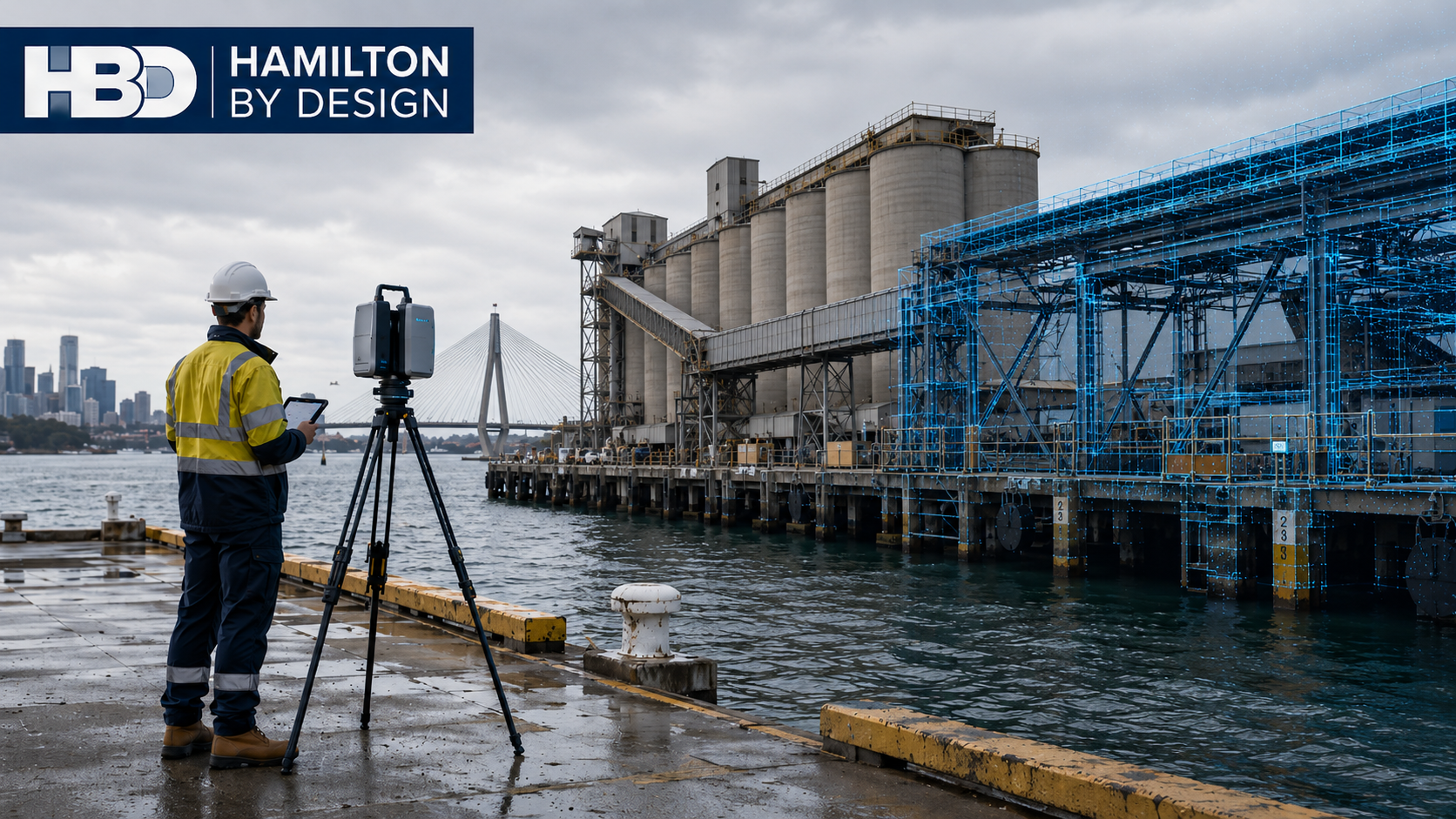
Sydney marine facility as-built survey using terrestrial laser scanning beside dry-bulk silos, conveyors and wharf infrastructure near the ANZAC Bridge.

Sydney Marine Facility As-Built Surveys โ€“ Accurate Existing-Condition Data for Brownfield Engineering

Sydneyโ€™s marine infrastructure operates in a demanding environment. Wharves, berths, terminals, conveyors, ship-loading systems, pipework, access platforms, structural steel and mechanical equipment may remain in service for decades while undergoing continuous maintenance, modification and upgrading.

One of the greatest challenges for engineers working on these existing facilities is therefore remarkably simple:

Do the drawings accurately represent what is actually there?

In many brownfield marine facilities, the answer may be no.

Original construction drawings can become outdated as equipment is replaced, platforms are modified, services are rerouted, structural members are strengthened and maintenance modifications accumulate over the life of the facility. Different contractors may also produce separate drawing packages, leaving project teams with incomplete or conflicting information.

For engineering projects around Sydneyโ€™s ports, terminals and waterfront industrial facilities, accurate as-built information can therefore become an important foundation for safe, practical and buildable design.

Hamilton By Design provides Sydney Port Engineering Services combining engineering experience with modern reality-capture technology to help establish reliable existing-condition information before brownfield design work begins.

The Problem with Existing Marine Facility Drawings

Engineering drawings represent the design intent at a particular point in time.

Marine infrastructure, however, does not remain unchanged.

A facility that has operated for 10, 20 or 30 years may have undergone numerous modifications including:

  • replacement mechanical equipment;
  • additional structural steel;
  • modified walkways and access platforms;
  • new guards and safety systems;
  • conveyor modifications;
  • altered pipework;
  • electrical and hydraulic services;
  • temporary modifications that became permanent;
  • corrosion repairs and strengthening works;
  • changes completed during shutdowns; and
  • equipment installed by different contractors.

Each individual modification may be relatively small, but collectively they can create a significant difference between the drawing archive and the physical facility.

This becomes particularly important when engineers are designing new equipment that must fit precisely around existing structures.

A few incorrect dimensions can potentially affect an entire fabrication package.

Establishing What Is Actually There

Traditional site measurement remains useful, particularly for individual components and straightforward geometry. However, measuring complex marine infrastructure using tapes, laser distance meters and individual survey points can become difficult when hundreds or thousands of dimensions are required.

Terrestrial LiDAR provides another approach.

Hamilton By Design’s 3D LiDAR scanning and 3D modelling services in Sydney can capture dense spatial information representing visible surfaces throughout an existing facility.

Multiple scanner positions can be registered together to create a coordinated three-dimensional point cloud.

Instead of recording only selected dimensions, the project team can retain a detailed digital record of the accessible existing environment at the time of scanning.

This becomes particularly valuable where design decisions may need to be revisited after the site visit.

Reality Capture for Brownfield Marine Projects

Marine facilities can contain extremely congested areas.

Structural steel, conveyors, chutes, mechanical equipment, pipework, cable trays, hydraulic systems, walkways and handrails may all occupy a relatively small volume.

Understanding these relationships from conventional two-dimensional drawings can be difficult.

Engineering-grade reality capture in Sydney provides a three-dimensional reference that allows designers to examine existing conditions from multiple viewpoints.

The point cloud can assist engineers in understanding:

  • equipment position;
  • structural interfaces;
  • available clearances;
  • access constraints;
  • floor and platform levels;
  • pipe routes;
  • surrounding obstructions;
  • connection locations; and
  • potential installation pathways.

The objective is not simply to create an impressive three-dimensional image.

The real value comes from using measured spatial information to support engineering decisions.

From Point Cloud to Engineering CAD

A point cloud is fundamentally a measurement dataset.

For many engineering projects, it needs to be converted into a form that designers, engineers and fabricators can use efficiently.

Through Point Cloud to CAD Services in Sydney, relevant existing geometry can be reconstructed into CAD models and engineering drawings.

Importantly, not every object within the scan necessarily needs to be modelled.

The appropriate level of modelling should depend on the purpose of the project.

For example, a conveyor modification might require accurate modelling of:

  • existing conveyor structure;
  • pulley positions;
  • transfer chute interfaces;
  • walkways;
  • surrounding structural steel;
  • equipment supports; and
  • potential clash zones.

Modelling unrelated objects elsewhere in the facility may provide little engineering benefit.

A fit-for-purpose approach can therefore keep the model focused on the information required for the engineering task.

Reducing Brownfield Design Uncertainty

One of the largest risks in brownfield engineering is designing new equipment around assumed existing conditions.

An engineering drawing may indicate that two columns are parallel.

The actual structure may have moved slightly.

A nominal platform level may differ from its measured position.

Pipework may have been rerouted.

A conveyor guard may have been added.

A structural brace may occupy the same location proposed for a new component.

This is where combining site capture with practical mechanical engineering services in Sydney becomes particularly useful.

Rather than separating measurement completely from engineering, the capture strategy can be developed around the downstream design problem.

Critical interfaces can be deliberately captured so the resulting dataset supports the decisions that engineers will later need to make.

Supporting Fabrication and Installation

For marine infrastructure projects, fabrication may occur many kilometres away from the operating facility.

Structural steel, platforms, chutes, guards, brackets, pipe supports and mechanical assemblies may be manufactured in a workshop before being transported to site.

Once fabrication begins, dimensional errors become increasingly expensive to correct.

If existing geometry has been incorrectly documented, the problem may only become apparent when the fabricated component reaches site.

The consequences can include:

  • cutting and reworking fabricated steel;
  • modifying holes or mounting plates;
  • additional welding;
  • redesign;
  • additional crane or access requirements;
  • installation delays;
  • extended shutdown work; and
  • additional engineering and fabrication costs.

For this reason, 3D laser scanning for industrial plants in Sydney can also be highly relevant to marine terminals where mechanical plant, materials-handling equipment and structural systems interact.

The aim is straightforward: obtain better information before committing to fabrication.

Reverse Engineering Existing Marine Equipment

Another challenge arises when the equipment itself has incomplete documentation.

Older marine plant may have been modified repeatedly, while original manufacturing drawings may no longer be available.

This can occur with:

  • chutes;
  • guards;
  • covers;
  • hoppers;
  • housings;
  • platforms;
  • mechanical frames;
  • conveyor components; and
  • specialised maintenance equipment.

In these situations, reverse engineering using 3D scanning can establish the geometry of an existing component or assembly as the starting point for replacement, redesign or modification.

The scan is not necessarily the finished engineering deliverable.

Engineering judgement is still required to determine design intent, material requirements, manufacturing methods, tolerances, interfaces and suitable drawing detail.

Marine Infrastructure Is Particularly Suited to Retrofit Scanning

Marine terminals are fundamentally brownfield environments.

The challenge is often not designing something completely new. It is introducing something new into an operating facility that already contains decades of infrastructure.

This makes LiDAR scanning for industrial retrofit engineering particularly applicable to wharf and port projects.

Typical applications may include:

  • conveyor replacement;
  • transfer chute upgrades;
  • walkway modifications;
  • machine guarding;
  • equipment replacement;
  • pipework alterations;
  • structural strengthening;
  • access improvements;
  • maintenance-platform design;
  • services coordination; and
  • installation planning.

In each case, accurate understanding of the existing environment reduces the number of assumptions entering the design process.

Access and Operational Constraints

Marine facilities also present practical surveying challenges.

Some equipment may be elevated, positioned close to water, located around active conveyors or accessible only during controlled operational windows.

Terrestrial laser scanning can capture substantial amounts of visible geometry from each scanner position, reducing the need to physically measure every individual element.

However, LiDAR is a line-of-sight technology.

Objects hidden behind equipment, cladding or structural members cannot automatically be captured from a single scanner position.

A good survey therefore requires planning.

Multiple scan positions may be needed to minimise occlusion, while critical interfaces should be identified before scanning begins.

In some cases, conventional measurement, survey control or supplementary inspection may still be required.

The objective should always be a dataset appropriate for the engineering decisions that depend upon it.

Typical As-Built Deliverables

The final deliverable should be selected according to the project rather than treating every scan as identical.

Depending on requirements, a Sydney marine facility as-built survey may support production of:

  • registered point-cloud data;
  • E57, RCP, RCS or other project-compatible point-cloud formats;
  • AutoCAD drawings;
  • 2D plans and elevations;
  • SolidWorks or other 3D CAD models;
  • structural and mechanical layouts;
  • existing-condition models;
  • equipment-interface geometry;
  • fabrication drawings;
  • clash-review models; and
  • engineering documentation.

The important question is not simply, โ€œWhat can be produced from the scanner?โ€

The more useful question is:

โ€œWhat information does the engineering team need to make the next project decision confidently?โ€

That should determine the survey and modelling strategy.

Creating a Reliable Engineering Baseline

For many Sydney marine projects, the greatest value of an as-built survey is the creation of a defensible engineering baseline.

Instead of beginning a brownfield project with assumptions based on ageing drawings, engineers can begin with measured information representing accessible existing conditions.

The workflow becomes:

Capture the existing facility โ†’ register and review the point cloud โ†’ identify critical interfaces โ†’ develop engineering geometry โ†’ design the modification โ†’ review clashes โ†’ produce drawings โ†’ fabricate โ†’ install.

This does not remove every risk associated with brownfield construction.

It does, however, address one of the most fundamental sources of uncertainty:

not knowing accurately what is already there.

For Sydney wharves, terminals and marine facilities, establishing that information early can support better design decisions, more reliable fabrication and more efficient site installation.

Frequently Asked Questions

What is a marine facility as-built survey?

A marine facility as-built survey records the existing physical configuration of infrastructure such as wharves, terminals, conveyors, structural steel, equipment, platforms, pipework and related assets.

The information can then be used to support engineering, modification, fabrication, maintenance and asset documentation.

Why aren’t the existing drawings sufficient?

Existing drawings remain valuable, but they may not include every modification made during the operating life of a facility.

An as-built survey allows engineers to compare documented information with current physical conditions rather than assuming the drawings remain completely accurate.

Can LiDAR scan an entire wharf or marine facility?

Large areas can be captured using multiple terrestrial scanner positions. The practical extent depends on site access, visibility, required accuracy and the purpose of the survey.

A scan plan should therefore be developed around the required engineering outcomes.

Can terrestrial LiDAR scan underwater?

No. Conventional terrestrial LiDAR is principally used for visible above-water surfaces.

Submerged infrastructure generally requires other techniques such as hydrographic, sonar or specialist underwater survey methods.

These can be complementary to terrestrial scanning where both above-water and below-water information is required.

Can point-cloud information be converted into CAD?

Yes. Relevant scan geometry can be reconstructed into 2D drawings or 3D CAD models.

The appropriate level of detail should be determined by the project requirements rather than automatically attempting to model every scanned object.

Can scanning help with fabrication?

Yes. Accurate capture of existing interfaces can assist designers producing components that need to fit existing structures and equipment.

This can be particularly valuable for brownfield steelwork, chutes, guards, platforms, pipe supports and mechanical equipment modifications.

Can 3D scanning identify clashes before installation?

Point clouds and derived CAD geometry can be incorporated into design coordination and clash-review workflows.

Proposed equipment can therefore be examined relative to captured existing infrastructure before fabrication or installation.

When should a marine facility be scanned?

Ideally, existing-condition capture occurs early in the engineering process and before detailed design or fabrication begins.

Scanning may also be valuable before shutdowns, major equipment replacements, structural modifications or refurbishment projects.

What parts of a marine facility are suitable for scanning?

Typical applications include wharves, berths, conveyors, transfer stations, chutes, platforms, structural steel, plant rooms, pipework, access systems, mechanical equipment and equipment interfaces.

What is the main advantage of an engineering-led as-built survey?

The benefit is not simply collecting more spatial data.

An engineering-led approach focuses the survey on the dimensions, interfaces, clearances and surrounding geometry that will influence the downstream design.

For brownfield marine projects, that can turn a point cloud from a visual record into a practical engineering resource.

Sydney Marine Facility As-Built Survey Support

Where existing drawings are incomplete, outdated or uncertain, obtaining reliable existing-condition information before commencing detailed engineering can significantly improve the quality of the design process.

Hamilton By Design can support marine, port and industrial projects across Sydney with terrestrial LiDAR scanning, point-cloud processing, 3D CAD modelling, mechanical engineering, reverse engineering and engineering drafting.

The objective is simple:

Establish what is actually there before designing what needs to go there.


Hamilton By Design logo displayed on a blue tilted rectangle with a grey gradient background

Contact Us – Talk To Us

Name
Would you like us to arrange a phone consultation for you?
Address

Our clients:


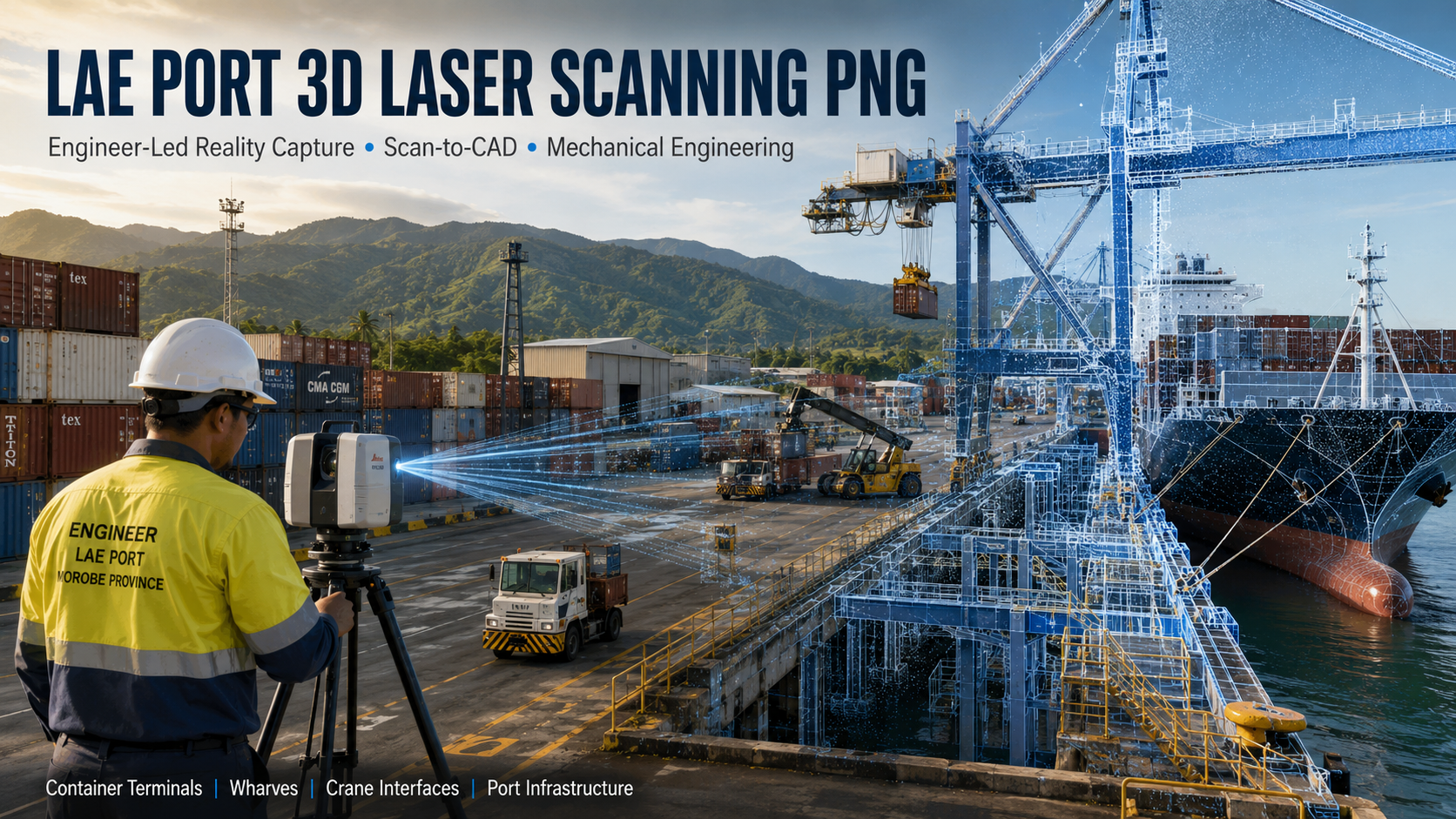
Lae Port 3D Laser Scanning PNG | Port Engineering & Scan-to-CAD

The Port of Lae and Lae Tidal Basin are critical pieces of transport and logistics infrastructure for Papua New Guinea, supporting containers, general cargo, mining supply chains and bulk-material movements throughout Morobe Province and beyond.

As container-terminal infrastructure develops, one of the major engineering challenges is ensuring that new cranes, equipment, structural steelwork, access systems and cargo-handling assets integrate correctly with the infrastructure already operating on site.

Hamilton By Design provides an engineer-led approach to Lae Port 3D laser scanning PNG, combining high-accuracy reality capture with mechanical engineering, CAD modelling, structural drafting, reverse engineering and fabrication-ready documentation.

Rather than treating laser scanning as an isolated surveying exercise, our approach creates an engineering workflow from:

Site Capture โ†’ Point Cloud โ†’ CAD Model โ†’ Engineering โ†’ Verification โ†’ Fabrication

Our 3D laser scanning services are suited to complex brownfield environments where reliable existing-condition information is essential before new infrastructure is designed, fabricated or installed.

Why 3D Laser Scanning Matters at an Operating Container Terminal

Port infrastructure rarely remains exactly as originally documented.

Wharves are repaired and extended. Structural steel is modified. Platforms and services are added. Equipment is replaced. Crane interfaces evolve, and new cargo-handling systems need to be installed around assets that may have been operating for decades.

As a result, historic drawings may no longer accurately represent what exists on site.

Engineering-grade LiDAR scanning provides a way to establish a new dimensional baseline.

A terrestrial laser scanner captures millions of three-dimensional points describing the actual position of structures, machinery, pipework, platforms, buildings and surrounding infrastructure.

This information can then be registered into a coordinated point cloud that engineering teams can use to measure and model the existing facility.

For brownfield projects, this can reduce reliance on repeated tape measurements, photographs, hand sketches and assumptions.

Hamilton By Design’s engineering-grade 3D laser scanning workflow is focused on producing data that can support actual engineering decisions rather than visualisation alone.

Container Terminal and Crane Interface Scanning

One of the strongest applications for 3D laser scanning at Lae is the integration of new container-terminal equipment with existing infrastructure.

This could include:

  • ship-to-shore crane interfaces
  • crane rails and supporting structures
  • machinery platforms
  • structural frames
  • cable and service routes
  • access stairs and walkways
  • maintenance areas
  • wharf structures
  • container-handling equipment
  • existing foundations and connection points.

Before new equipment is fabricated or shipped to Papua New Guinea, the existing infrastructure can be captured and converted into usable engineering geometry.

Vendor equipment models can then be positioned within the scanned environment to assess interfaces and potential clashes.

This provides engineers with the ability to ask practical questions before installation begins:

Will the equipment fit?

Are the existing connection points where the drawings say they are?

Is there enough maintenance access?

Will new steelwork interfere with existing services?

Can the equipment be installed without major site modification?

These are exactly the types of issues where accurate existing-condition data can reduce risk.

Point Cloud to CAD for Lae Port Infrastructure

Capturing the site is only the first stage.

Hamilton By Design can convert selected portions of the point cloud into engineering CAD models suitable for design development, equipment layouts and fabrication documentation.

Our Point Cloud to CAD services provide a pathway from LiDAR data into practical engineering deliverables.

Depending on the project, these can include:

  • SolidWorks models
  • AutoCAD drawings
  • Inventor-compatible geometry
  • general arrangement drawings
  • sections and elevations
  • structural models
  • equipment layouts
  • fabrication drawings
  • STEP or SAT geometry
  • registered point-cloud deliverables.

Not every object visible in a scan needs to be modelled.

For engineering work, it is often more efficient to model the geometry that influences the project: structural interfaces, machinery, connection points, access zones and potential clashes.

This keeps the model useful rather than unnecessarily complicated.

Mechanical Engineering for Port Assets

Hamilton By Design can take the project beyond scanning by applying mechanical engineering to the captured site information.

Typical port engineering opportunities can include:

Equipment Support Structures

Existing infrastructure can be scanned before new support frames, brackets or machinery bases are designed.

Machinery Modifications

Mechanical components can be redesigned or modified to suit the actual installed geometry.

Maintenance Access

Platforms, ladders, stairs, walkways and handrails can be developed around existing machinery and structural constraints.

Guards and Safety Improvements

Machine guarding and access-control structures can be designed around equipment captured directly from site.

Materials Handling Equipment

Conveyors, transfer points, chutes and associated structural interfaces can be developed using verified existing-condition data.

Equipment Replacement

Obsolete or undocumented machinery components can be reconstructed through scanning, measurement and engineering assessment.

Our reverse engineering 3D scanning capability is particularly useful where original manufacturing drawings no longer exist or where the installed asset has changed significantly during its service life.

Wharves, Structural Steel and Brownfield Port Infrastructure

Wharf areas can contain dense combinations of structural steel, concrete, services, lifting equipment, access structures and mechanical systems.

This makes conventional measurement difficult.

Laser scanning allows large areas to be documented while maintaining the spatial relationship between different assets.

For example, a proposed structural modification may require the engineering team to understand:

  • column locations
  • beam elevations
  • connection geometry
  • platform heights
  • nearby machinery
  • service penetrations
  • access restrictions
  • maintenance clearances.

The scan becomes a common dimensional reference that can be reviewed by engineering, fabrication and construction teams.

Hamilton By Design applies similar workflows to Australian port environments through services such as mechanical engineering for the Port of Newcastle, where site capture can feed directly into CAD development and fabrication documentation.

Scan-to-CAD for Equipment Upgrades

The real value of 3D scanning becomes clearer when new equipment needs to be fitted into an existing operating facility.

Consider a new container-terminal system being manufactured outside PNG.

A traditional workflow might rely on old drawings and a limited site survey. Problems may only become apparent after fabricated equipment reaches Lae.

A scan-to-CAD workflow changes that process.

Hamilton By Design can:

  1. capture the existing installation;
  2. register the scan data;
  3. create CAD geometry around critical interfaces;
  4. import the proposed equipment model;
  5. check clearances and clashes;
  6. identify structural or mechanical modifications;
  7. develop revised engineering;
  8. produce fabrication drawings.

This approach is similar to our Scan to CAD Port of Brisbane services, where LiDAR data can be converted into practical engineering information for existing port assets.

The objective is straightforward:

find problems digitally before they become fabrication or installation problems on site.

Structural Steel, Platforms and Maintenance Access

Port infrastructure often requires ongoing modification as equipment and operating practices change.

Hamilton By Design can assist with the development of:

  • structural equipment frames
  • machinery platforms
  • access platforms
  • stairs
  • ladders
  • handrails
  • maintenance walkways
  • guards
  • equipment supports
  • connection details.

Laser scanning is particularly valuable because these structures must often fit around existing machinery.

Instead of designing from an idealised drawing, the engineer can develop the modification around the actual asset.

Reverse Engineering Port Equipment

Ports frequently operate mechanical equipment for long periods.

Some components may no longer have reliable drawings, while others may have been repaired or modified several times.

Reverse engineering can provide a pathway to replacement or improvement.

Hamilton By Design can combine:

  • 3D scanning
  • physical measurement
  • dimensional verification
  • CAD modelling
  • engineering assessment
  • material consideration
  • fabrication documentation.

Rather than simply copying an old component, the objective is to understand how the part functions and how the replacement must interface with surrounding equipment.

Our broader reverse engineering for mining and industrial equipment experience applies particularly well to ports supporting mining and heavy-industry supply chains.

Australian Standards and Engineering for PNG Projects

Projects at Lae Port are located in Papua New Guinea, so applicable PNG legislation, project specifications, PNG Ports Corporation requirements and client engineering standards must be established for each project.

Where nominated as part of the project engineering basis, Hamilton By Design can also work with relevant Australian Standards.

Depending on the scope, these may include:

AS 4100 โ€“ Steel Structures
For structural steelwork and equipment support structures.

AS/NZS 1170 series โ€“ Structural Design Actions
For structural actions and engineering load combinations where applicable to the project design basis.

AS 1657 โ€“ Fixed Platforms, Walkways, Stairways and Ladders
For industrial access systems around machinery and port infrastructure.

AS/NZS 4024 series โ€“ Safety of Machinery
For machinery safety, guarding and materials-handling systems.

AS 4991 โ€“ Lifting Devices
For appropriate below-the-hook lifting devices and maintenance lifting arrangements.

AS 2550 series โ€“ Cranes, Hoists and Winches โ€“ Safe Use
Potentially relevant where engineering interfaces with crane and lifting operations.

AS/NZS 1554 series
For welding of structural steelwork where applicable.

Engineering requirements should always be confirmed against the specific asset, duty, client specification and PNG regulatory requirements before design begins.

Engineering Before Fabrication

The principal advantage of combining scanning with engineering is the opportunity to resolve problems earlier.

A point cloud provides dimensional evidence.

A CAD model makes that information easier to design around.

Engineering turns the captured geometry into a practical solution.

Fabrication drawings then allow the solution to be manufactured.

This is why Hamilton By Design focuses on an integrated engineering approach rather than treating 3D scanning as the final deliverable.

Our broader Scan to BIM and point-cloud modelling services can also support warehouse, building and infrastructure documentation where the project requires more extensive digital asset information.

Lae Port 3D Laser Scanning PNG

For developing port infrastructure, accurate existing-condition information can make the difference between a modification that fits first time and one that requires extensive site rework.

Hamilton By Design can support Port of Lae projects involving container terminals, wharves, structural steelwork, warehouses, mechanical equipment and materials-handling infrastructure.

Our engineer-led workflow combines:

3D laser scanning + point clouds + CAD modelling + mechanical engineering + reverse engineering + fabrication documentation.

For brownfield port upgrades, the goal is not simply to scan what exists.

It is to understand what exists well enough to design what comes next.

Frequently Asked Questions

Can Hamilton By Design provide 3D laser scanning at Lae Port?

Hamilton By Design can support engineering-grade 3D laser scanning for port and industrial infrastructure projects subject to project requirements, site access, mobilisation arrangements and client approvals.

What port assets can be scanned?

Typical assets include wharves, structural steel, cranes and crane interfaces, cargo-handling equipment, warehouses, conveyors, pipework, machinery, platforms, stairs, handrails and surrounding infrastructure.

Can you convert the point cloud into CAD?

Yes. Selected scan data can be converted into engineering CAD geometry, drawings and models suitable for equipment integration, mechanical design, structural detailing and fabrication planning.

Can HBD work with equipment models supplied by another manufacturer?

Yes. Vendor CAD models can be coordinated with the captured existing-condition environment to assess positioning, clearances, access and potential clashes.

Can scanning help before a shutdown?

Yes. Capturing existing geometry before a shutdown can allow a substantial amount of measurement, modelling, clash checking and fabrication planning to occur before the shutdown begins.

Can you reverse engineer existing port equipment?

Where appropriate, HBD can combine scanning, measurement, engineering assessment and CAD modelling to develop replacement or modified components for undocumented or obsolete equipment.

Does HBD only provide the point cloud?

No. Point-cloud delivery can form part of the scope, but HBD’s key advantage is the ability to continue through CAD modelling, mechanical engineering, reverse engineering and fabrication-ready drafting.

Are Australian Standards applicable in Papua New Guinea?

Australian Standards should not automatically be assumed to govern a PNG project. Applicable PNG legislation, project specifications, client requirements and asset-owner standards must first be identified. Relevant Australian Standards can then be incorporated where they form part of the agreed engineering basis.

Why use engineer-led 3D laser scanning for Lae Port?

Because the scan can be captured with the eventual engineering problem in mind. Critical interfaces, access areas, structural connections and surrounding equipment can be captured so the resulting data supports real design, fabrication and installation decisions.

What is the main advantage for brownfield port upgrades?

The principal advantage is the ability to design against the actual installed condition rather than relying solely on historic drawings. This can help identify clashes and fit-up issues before equipment is fabricated, transported to Papua New Guinea or installed on site.


Hamilton By Design logo displayed on a blue tilted rectangle with a grey gradient background

Contact Us – Talk To Us

Name
Would you like us to arrange a phone consultation for you?
Address

Our clients:


Mining Engineering Services Cobar NSW | 3D Scanning & CAD

Mining engineering services in Cobar NSW showing 3D laser scanning, point cloud capture, scan-to-CAD modelling and brownfield plant equipment design.

Mining Engineering Services Cobar NSW โ€“ 3D Scanning, CAD Modelling & Brownfield Engineering

Mining and mineral processing operations around Cobar operate in environments where new equipment frequently needs to be installed within existing infrastructure. Conveyors, processing equipment, pipework, structural steel, access platforms and mechanical systems may have been modified many times throughout the operating life of a plant.

The challenge is straightforward: new equipment needs to fit existing infrastructure accurately.

Hamilton By Design provides mining engineering support for Cobar and western New South Wales, combining engineering-grade 3D laser scanning, LiDAR reality capture, mechanical engineering, CAD modelling, reverse engineering and fabrication detailing to support brownfield mining and mineral-processing projects.

Our approach starts by capturing the plant as it exists today rather than assuming historical drawings perfectly represent site conditions.

For projects where accurate existing-condition information is critical, our engineering-grade 3D laser scanning services can provide the dimensional foundation for mechanical design, plant modifications and equipment installation.

Mining Engineering for Cobar’s Brownfield Infrastructure

Mining plants rarely remain exactly as originally constructed.

Over years of operation, equipment can be replaced, structures strengthened, platforms modified, pipework rerouted and conveyors altered. Drawings may not have been updated following every modification.

When another plant upgrade is required, these differences can create significant engineering challenges.

A few millimetres or centimetres in the wrong location can affect:

  • equipment installation;
  • conveyor alignment;
  • structural connections;
  • pipework interfaces;
  • maintenance clearances;
  • access platforms;
  • chute geometry;
  • bolt-hole locations;
  • guarding; and
  • shutdown schedules.

Hamilton By Design provides mechanical engineering for mining infrastructure where existing plant conditions must be incorporated into the engineering process.

Rather than separating measurement from engineering, we can use captured site geometry directly within the design environment.

This creates a practical workflow:

Scan โ†’ Model โ†’ Design โ†’ Verify โ†’ Detail โ†’ Fabricate โ†’ Install

The objective is simple: improve confidence that what is fabricated will fit when it arrives on site.

3D Laser Scanning for Mining and Processing Plants

Traditional site measurement remains useful, but complicated processing plants can contain thousands of relevant dimensions.

Steel columns, conveyor stringers, pipework, handrails, existing equipment, cable trays and structural members can make manual measurement difficult and time-consuming.

Engineering-grade terrestrial LiDAR provides another option.

Multiple scanner positions are used to capture the visible geometry of the area. The scans are registered together to produce a three-dimensional point cloud representing the existing plant.

This information can then support:

  • existing-condition verification;
  • equipment replacement;
  • conveyor modifications;
  • chute replacement;
  • structural modifications;
  • pipework routing;
  • maintenance access;
  • shutdown planning; and
  • fabrication verification.

The important step is what happens after the scan.

A point cloud provides a detailed representation of the existing environment, but an engineering project often requires usable CAD geometry. Our approach to converting point clouds into engineering models for mining infrastructure allows selected plant geometry to be reconstructed within an engineering CAD environment.

Scan-to-CAD for Brownfield Plant Modifications

Not every object captured during scanning needs to be modelled.

The level of modelling should be driven by the project.

For an equipment replacement project, the important geometry may include the floor, supporting steelwork, surrounding equipment, connection points, pipework and access routes.

For a conveyor modification, the model may instead concentrate on head and tail pulleys, stringers, drives, supports, transfer points, platforms and surrounding structures.

This targeted scan-to-CAD approach helps avoid spending engineering time modelling objects that have no bearing on the proposed modification.

The resulting model gives the design team a three-dimensional reference against which new equipment can be developed.

Equipment Installation and Interface Verification

One of the biggest risks in brownfield engineering is the interface between new equipment and old infrastructure.

A supplier may provide an accurate model of a new machine, but that model does not guarantee the surrounding plant matches the original drawings.

Existing foundations may differ.

Steelwork may have been modified.

Pipework may occupy a different position.

A maintenance platform may have been extended.

A previously undocumented support may pass directly through the proposed installation envelope.

Hamilton By Design’s broader engineering services combine reality capture with engineering and modelling to help identify these conditions before fabrication or installation.

New equipment can be positioned within the captured existing-condition model so clearances and interfaces can be reviewed digitally.

Potential clashes can therefore be identified while changes remain relatively inexpensive to make.

Mechanical Engineering for Plant Upgrades

Once reliable existing-condition information has been established, mechanical engineering can proceed with significantly greater confidence.

Hamilton By Design can support projects involving:

  • conveyors;
  • transfer stations;
  • chutes and hoppers;
  • crushers and screens;
  • pumps;
  • pipework;
  • equipment supports;
  • machinery guarding;
  • maintenance platforms;
  • stairs and walkways;
  • lifting arrangements;
  • equipment replacement; and
  • plant modifications.

Our mechanical engineering consulting services are particularly suited to industrial and mining projects where practical plant experience, CAD modelling and existing-condition verification need to work together.

For smaller and regional mining operations, this can also provide a flexible alternative to building a large internal engineering team for individual brownfield projects.

Conveyors, Chutes and Materials Handling

Zinc, lead, copper and gold processing facilities rely on materials-handling equipment to move ore and processed material between different stages of the plant.

Conveyors and transfer points are therefore common areas for modification and maintenance.

Hamilton By Design supports bulk materials handling and mining infrastructure including conveyors, transfer points, chutes and related plant modifications.

3D scanning can be particularly valuable around transfer stations because these locations are often congested.

A scan can capture the relationship between:

  • conveyor centre lines;
  • pulleys;
  • discharge trajectories;
  • chute interfaces;
  • structural steelwork;
  • platforms;
  • maintenance access;
  • pipework; and
  • neighbouring equipment.

The resulting geometry can provide the basis for replacement chute designs, new equipment arrangements and modifications to existing systems.

Engineering for Planned Shutdowns

Shutdown work creates a different engineering challenge.

There may be only a limited window available to remove existing equipment and install the replacement. Discovering a dimensional problem after shutdown work begins can therefore have consequences far beyond the cost of modifying a component.

Pre-shutdown scanning allows much of the dimensional investigation to occur while the plant remains available for measurement.

Hamilton By Design provides 3D scanning for mining shutdown projects to support engineering preparation, equipment replacement, structural verification and plant-layout assessment.

Where appropriate, proposed equipment can be incorporated into the existing-condition model before fabrication.

This does not eliminate every project risk, but it can significantly improve the information available to engineers, fabricators and construction teams before shutdown activities commence.

Engineering-Grade 3D Scanning for Plant Upgrades

The value of reality capture increases when it forms part of the engineering workflow rather than being treated simply as a surveying exercise.

Hamilton By Design combines engineering-grade 3D scanning for mining plant upgrades with mechanical design and CAD modelling.

Depending on the project, deliverables may include:

  • registered point clouds;
  • existing-condition CAD models;
  • equipment interface models;
  • SolidWorks models;
  • Inventor models;
  • AutoCAD drawings;
  • general arrangements;
  • fabrication drawings;
  • DXF files;
  • STEP or SAT geometry;
  • PDF drawings; and
  • clash or clearance reviews.

The required deliverables should be established according to what the fabricator, engineering team and site installation team actually need.

Australian Standards and Mining Engineering

Australian Standards applicable to a project depend on the equipment, structure and scope being designed.

Standards that may be relevant to brownfield mining and mineral-processing projects include:

AS/NZS 4024 โ€“ Safety of Machinery

The AS/NZS 4024 series may apply to machinery safety, guarding, risk reduction and interaction between personnel and mechanical equipment.

It is particularly relevant when designing or modifying conveyors, rotating equipment and machinery guarding.

AS/NZS 4024.3610 and AS/NZS 4024.3611 โ€“ Conveyor Safety

Conveyor-specific requirements may need to be considered for bulk-material handling systems, guarding and access around conveyors.

AS 1657 โ€“ Platforms, Walkways, Stairways and Ladders

Maintenance access is an important consideration within mineral-processing plants.

AS 1657 may apply to the design or modification of fixed platforms, walkways, stairs and ladders associated with equipment access.

AS 4100 โ€“ Steel Structures

Where mechanical equipment requires structural steel supports, platforms, frames or modifications to existing structural steelwork, AS 4100 may form part of the engineering requirements.

AS 4991 โ€“ Lifting Devices

Projects involving specialised lifting devices, lifting beams or fabricated lifting equipment may require consideration of AS 4991.

AS 4041 and AS 1210

Pressure piping and pressure equipment may require assessment against standards such as AS 4041 and AS 1210 where applicable.

The standards required for each project should be determined from the actual scope, equipment, operating conditions and client requirements.

Importantly, 3D laser scanning does not itself make equipment compliant with these standards. The purpose of scanning is to provide accurate existing-condition information from which engineering decisions and designs can be developed.

Supporting Regional Mining Operations Around Cobar NSW

Cobar’s mining industry involves hard-rock underground mining and mineral-processing infrastructure where plant reliability and efficient use of existing assets remain important.

For brownfield sites, replacing the entire plant is rarely practical.

Instead, engineering teams are commonly required to make new equipment work within existing constraints.

That is where the combination of 3D scanning and mechanical engineering becomes particularly valuable.

Hamilton By Design can travel to regional mine sites to capture the required area, process the scan data and continue the engineering and CAD development away from site.

This can reduce repeated measurement trips and provide engineers with a digital reference that can continue to be reviewed throughout the project.

From Existing Plant to Installation-Ready Engineering

For mining projects around Cobar, the challenge is often not designing a piece of equipment in isolation.

The challenge is making it fit.

The existing conveyor is already there.

The steelwork is already there.

The pipework is already there.

Production needs to continue.

And when shutdown arrives, the replacement equipment needs to go into position as efficiently as possible.

Hamilton By Design brings together 3D laser scanning, scan-to-CAD modelling, mechanical engineering, reverse engineering, materials-handling design and fabrication detailing to help bridge the gap between the existing plant and the proposed modification.

Capture what exists. Design around reality. Verify the interfaces before fabrication.

Frequently Asked Questions

What mining engineering services does Hamilton By Design provide in Cobar?

Hamilton By Design can provide engineering-grade 3D laser scanning, LiDAR reality capture, scan-to-CAD modelling, mechanical engineering, reverse engineering, conveyor and chute design, plant-layout modelling, equipment interface verification and fabrication detailing for mining and mineral-processing projects.

Why use 3D laser scanning for a brownfield mining project?

Brownfield plants often differ from historical drawings because of modifications made throughout their operating life. 3D scanning captures current site geometry and provides designers with a more reliable basis for equipment modifications and installation planning.

Can you convert a point cloud into a SolidWorks or Inventor model?

Yes. Relevant geometry from the registered point cloud can be reconstructed into engineering CAD models. The amount of modelling depends on the project requirements rather than attempting to model every object captured by the scanner.

Can scanning help with new equipment installation?

Yes. A model of the proposed equipment can be positioned relative to the captured existing plant. This allows engineers to review clearances, support locations, connections and potential clashes before fabrication and installation.

Can Hamilton By Design assist with conveyor and transfer-station projects?

Yes. Services can include scanning existing conveyors and transfer stations, CAD modelling, chute and transfer-point development, conveyor modifications, structural interfaces, access arrangements and fabrication detailing.

Is 3D scanning useful before a mine shutdown?

Yes. Capturing critical plant geometry before a shutdown allows more engineering and dimensional verification to occur beforehand. This can help reduce reliance on field measurement once the shutdown has commenced.

What Australian Standards may apply?

Depending on the project, relevant standards may include AS/NZS 4024 for machinery safety, conveyor-specific standards within the AS/NZS 4024 series, AS 1657 for access systems, AS 4100 for steel structures, AS 4991 for lifting devices, AS 4041 for pressure piping and AS 1210 for pressure equipment. The applicable standards should always be determined for the individual project.

Do you service underground mines as well as processing plants?

Yes. The engineering scope can extend to underground and surface infrastructure where 3D scanning, mechanical design, equipment interfaces, CAD modelling or existing-condition verification are required.

What files can be supplied after scanning and modelling?

Depending on scope and client requirements, deliverables can include registered point clouds and formats suitable for engineering workflows, together with CAD models, DWG or DXF drawings, STEP/SAT geometry, SolidWorks or Inventor models, general arrangements, fabrication drawings and PDFs.

Why combine 3D scanning and mechanical engineering?

Combining the two services allows the captured plant geometry to become part of the engineering design process. Instead of simply providing measurements, the existing-condition data can be used to develop, position and verify new equipment within the actual brownfield environment.

Mining Engineering Services Cobar NSW

If you are planning a plant upgrade, equipment replacement, conveyor modification, transfer-station project, shutdown or brownfield installation in the Cobar mining region, Hamilton By Design can provide a practical pathway from site capture through to engineering-ready CAD information.

For zinc, lead, copper, gold and other hard-rock mineral-processing applications, our focus is on helping engineering and maintenance teams understand what is actually on site before new equipment is fabricated.

3D scanning. CAD modelling. Mechanical engineering. Brownfield interface verification.


Hamilton By Design logo displayed on a blue tilted rectangle with a grey gradient background

Contact Us – Talk To Us

Name
Would you like us to arrange a phone consultation for you?
Address

Our clients: