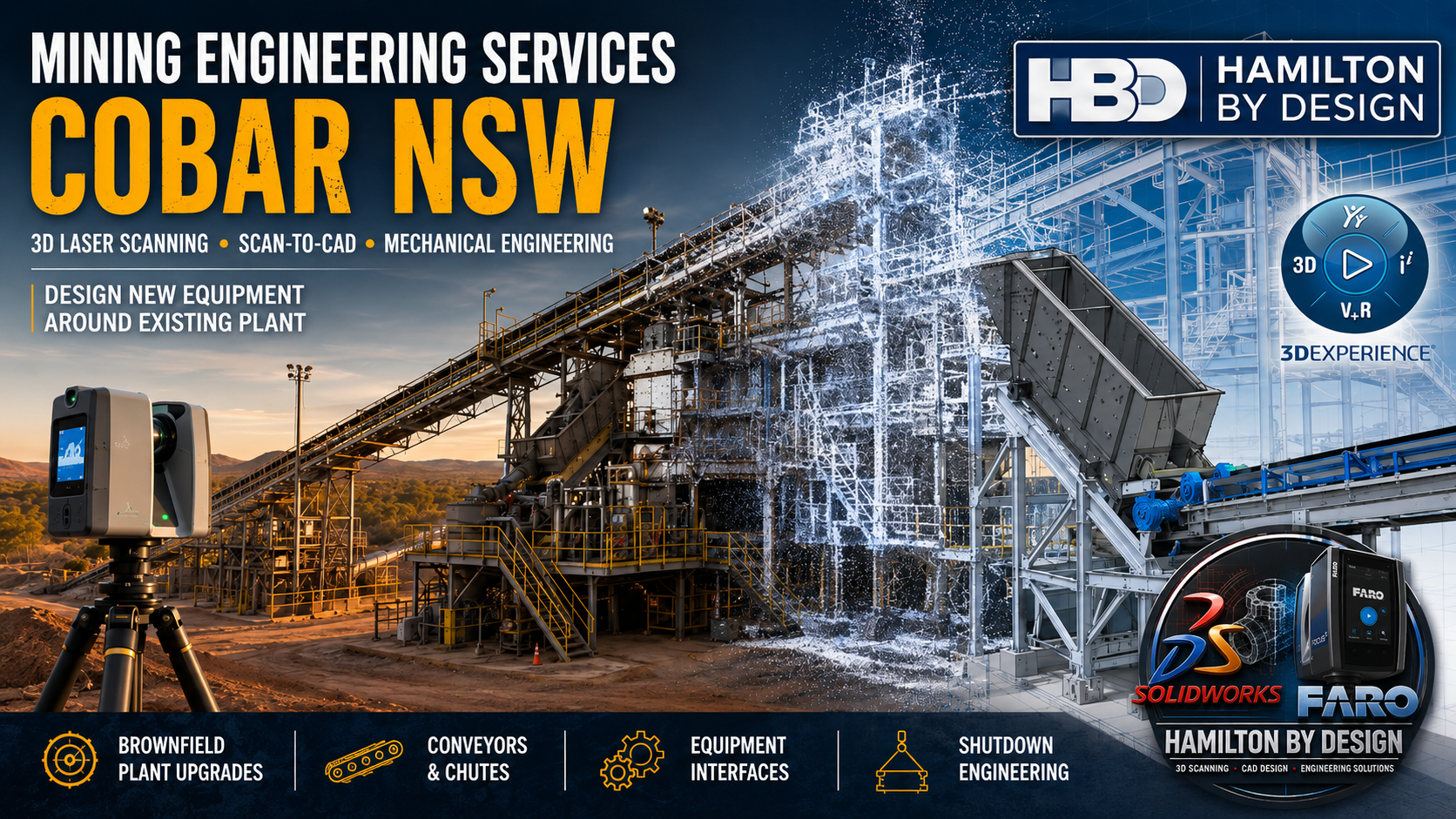
Mining Engineering Services Cobar NSW – 3D Scanning, CAD Modelling & Brownfield Engineering
Mining and mineral processing operations around Cobar operate in environments where new equipment frequently needs to be installed within existing infrastructure. Conveyors, processing equipment, pipework, structural steel, access platforms and mechanical systems may have been modified many times throughout the operating life of a plant.
The challenge is straightforward: new equipment needs to fit existing infrastructure accurately.
Hamilton By Design provides mining engineering support for Cobar and western New South Wales, combining engineering-grade 3D laser scanning, LiDAR reality capture, mechanical engineering, CAD modelling, reverse engineering and fabrication detailing to support brownfield mining and mineral-processing projects.
Our approach starts by capturing the plant as it exists today rather than assuming historical drawings perfectly represent site conditions.
For projects where accurate existing-condition information is critical, our engineering-grade 3D laser scanning services can provide the dimensional foundation for mechanical design, plant modifications and equipment installation.
Mining Engineering for Cobar’s Brownfield Infrastructure
Mining plants rarely remain exactly as originally constructed.
Over years of operation, equipment can be replaced, structures strengthened, platforms modified, pipework rerouted and conveyors altered. Drawings may not have been updated following every modification.
When another plant upgrade is required, these differences can create significant engineering challenges.
A few millimetres or centimetres in the wrong location can affect:
- equipment installation;
- conveyor alignment;
- structural connections;
- pipework interfaces;
- maintenance clearances;
- access platforms;
- chute geometry;
- bolt-hole locations;
- guarding; and
- shutdown schedules.
Hamilton By Design provides mechanical engineering for mining infrastructure where existing plant conditions must be incorporated into the engineering process.
Rather than separating measurement from engineering, we can use captured site geometry directly within the design environment.
This creates a practical workflow:
Scan → Model → Design → Verify → Detail → Fabricate → Install
The objective is simple: improve confidence that what is fabricated will fit when it arrives on site.
3D Laser Scanning for Mining and Processing Plants
Traditional site measurement remains useful, but complicated processing plants can contain thousands of relevant dimensions.
Steel columns, conveyor stringers, pipework, handrails, existing equipment, cable trays and structural members can make manual measurement difficult and time-consuming.
Engineering-grade terrestrial LiDAR provides another option.
Multiple scanner positions are used to capture the visible geometry of the area. The scans are registered together to produce a three-dimensional point cloud representing the existing plant.
This information can then support:
- existing-condition verification;
- equipment replacement;
- conveyor modifications;
- chute replacement;
- structural modifications;
- pipework routing;
- maintenance access;
- shutdown planning; and
- fabrication verification.
The important step is what happens after the scan.
A point cloud provides a detailed representation of the existing environment, but an engineering project often requires usable CAD geometry. Our approach to converting point clouds into engineering models for mining infrastructure allows selected plant geometry to be reconstructed within an engineering CAD environment.
Scan-to-CAD for Brownfield Plant Modifications
Not every object captured during scanning needs to be modelled.
The level of modelling should be driven by the project.
For an equipment replacement project, the important geometry may include the floor, supporting steelwork, surrounding equipment, connection points, pipework and access routes.
For a conveyor modification, the model may instead concentrate on head and tail pulleys, stringers, drives, supports, transfer points, platforms and surrounding structures.
This targeted scan-to-CAD approach helps avoid spending engineering time modelling objects that have no bearing on the proposed modification.
The resulting model gives the design team a three-dimensional reference against which new equipment can be developed.
Equipment Installation and Interface Verification
One of the biggest risks in brownfield engineering is the interface between new equipment and old infrastructure.
A supplier may provide an accurate model of a new machine, but that model does not guarantee the surrounding plant matches the original drawings.
Existing foundations may differ.
Steelwork may have been modified.
Pipework may occupy a different position.
A maintenance platform may have been extended.
A previously undocumented support may pass directly through the proposed installation envelope.
Hamilton By Design’s broader engineering services combine reality capture with engineering and modelling to help identify these conditions before fabrication or installation.
New equipment can be positioned within the captured existing-condition model so clearances and interfaces can be reviewed digitally.
Potential clashes can therefore be identified while changes remain relatively inexpensive to make.
Mechanical Engineering for Plant Upgrades
Once reliable existing-condition information has been established, mechanical engineering can proceed with significantly greater confidence.
Hamilton By Design can support projects involving:
- conveyors;
- transfer stations;
- chutes and hoppers;
- crushers and screens;
- pumps;
- pipework;
- equipment supports;
- machinery guarding;
- maintenance platforms;
- stairs and walkways;
- lifting arrangements;
- equipment replacement; and
- plant modifications.
Our mechanical engineering consulting services are particularly suited to industrial and mining projects where practical plant experience, CAD modelling and existing-condition verification need to work together.
For smaller and regional mining operations, this can also provide a flexible alternative to building a large internal engineering team for individual brownfield projects.
Conveyors, Chutes and Materials Handling
Zinc, lead, copper and gold processing facilities rely on materials-handling equipment to move ore and processed material between different stages of the plant.
Conveyors and transfer points are therefore common areas for modification and maintenance.
Hamilton By Design supports bulk materials handling and mining infrastructure including conveyors, transfer points, chutes and related plant modifications.
3D scanning can be particularly valuable around transfer stations because these locations are often congested.
A scan can capture the relationship between:
- conveyor centre lines;
- pulleys;
- discharge trajectories;
- chute interfaces;
- structural steelwork;
- platforms;
- maintenance access;
- pipework; and
- neighbouring equipment.
The resulting geometry can provide the basis for replacement chute designs, new equipment arrangements and modifications to existing systems.
Engineering for Planned Shutdowns
Shutdown work creates a different engineering challenge.
There may be only a limited window available to remove existing equipment and install the replacement. Discovering a dimensional problem after shutdown work begins can therefore have consequences far beyond the cost of modifying a component.
Pre-shutdown scanning allows much of the dimensional investigation to occur while the plant remains available for measurement.
Hamilton By Design provides 3D scanning for mining shutdown projects to support engineering preparation, equipment replacement, structural verification and plant-layout assessment.
Where appropriate, proposed equipment can be incorporated into the existing-condition model before fabrication.
This does not eliminate every project risk, but it can significantly improve the information available to engineers, fabricators and construction teams before shutdown activities commence.
Engineering-Grade 3D Scanning for Plant Upgrades
The value of reality capture increases when it forms part of the engineering workflow rather than being treated simply as a surveying exercise.
Hamilton By Design combines engineering-grade 3D scanning for mining plant upgrades with mechanical design and CAD modelling.
Depending on the project, deliverables may include:
- registered point clouds;
- existing-condition CAD models;
- equipment interface models;
- SolidWorks models;
- Inventor models;
- AutoCAD drawings;
- general arrangements;
- fabrication drawings;
- DXF files;
- STEP or SAT geometry;
- PDF drawings; and
- clash or clearance reviews.
The required deliverables should be established according to what the fabricator, engineering team and site installation team actually need.
Australian Standards and Mining Engineering
Australian Standards applicable to a project depend on the equipment, structure and scope being designed.
Standards that may be relevant to brownfield mining and mineral-processing projects include:
AS/NZS 4024 – Safety of Machinery
The AS/NZS 4024 series may apply to machinery safety, guarding, risk reduction and interaction between personnel and mechanical equipment.
It is particularly relevant when designing or modifying conveyors, rotating equipment and machinery guarding.
AS/NZS 4024.3610 and AS/NZS 4024.3611 – Conveyor Safety
Conveyor-specific requirements may need to be considered for bulk-material handling systems, guarding and access around conveyors.
AS 1657 – Platforms, Walkways, Stairways and Ladders
Maintenance access is an important consideration within mineral-processing plants.
AS 1657 may apply to the design or modification of fixed platforms, walkways, stairs and ladders associated with equipment access.
AS 4100 – Steel Structures
Where mechanical equipment requires structural steel supports, platforms, frames or modifications to existing structural steelwork, AS 4100 may form part of the engineering requirements.
AS 4991 – Lifting Devices
Projects involving specialised lifting devices, lifting beams or fabricated lifting equipment may require consideration of AS 4991.
AS 4041 and AS 1210
Pressure piping and pressure equipment may require assessment against standards such as AS 4041 and AS 1210 where applicable.
The standards required for each project should be determined from the actual scope, equipment, operating conditions and client requirements.
Importantly, 3D laser scanning does not itself make equipment compliant with these standards. The purpose of scanning is to provide accurate existing-condition information from which engineering decisions and designs can be developed.
Supporting Regional Mining Operations Around Cobar NSW
Cobar’s mining industry involves hard-rock underground mining and mineral-processing infrastructure where plant reliability and efficient use of existing assets remain important.
For brownfield sites, replacing the entire plant is rarely practical.
Instead, engineering teams are commonly required to make new equipment work within existing constraints.
That is where the combination of 3D scanning and mechanical engineering becomes particularly valuable.
Hamilton By Design can travel to regional mine sites to capture the required area, process the scan data and continue the engineering and CAD development away from site.
This can reduce repeated measurement trips and provide engineers with a digital reference that can continue to be reviewed throughout the project.
From Existing Plant to Installation-Ready Engineering
For mining projects around Cobar, the challenge is often not designing a piece of equipment in isolation.
The challenge is making it fit.
The existing conveyor is already there.
The steelwork is already there.
The pipework is already there.
Production needs to continue.
And when shutdown arrives, the replacement equipment needs to go into position as efficiently as possible.
Hamilton By Design brings together 3D laser scanning, scan-to-CAD modelling, mechanical engineering, reverse engineering, materials-handling design and fabrication detailing to help bridge the gap between the existing plant and the proposed modification.
Capture what exists. Design around reality. Verify the interfaces before fabrication.
Frequently Asked Questions
What mining engineering services does Hamilton By Design provide in Cobar?
Hamilton By Design can provide engineering-grade 3D laser scanning, LiDAR reality capture, scan-to-CAD modelling, mechanical engineering, reverse engineering, conveyor and chute design, plant-layout modelling, equipment interface verification and fabrication detailing for mining and mineral-processing projects.
Why use 3D laser scanning for a brownfield mining project?
Brownfield plants often differ from historical drawings because of modifications made throughout their operating life. 3D scanning captures current site geometry and provides designers with a more reliable basis for equipment modifications and installation planning.
Can you convert a point cloud into a SolidWorks or Inventor model?
Yes. Relevant geometry from the registered point cloud can be reconstructed into engineering CAD models. The amount of modelling depends on the project requirements rather than attempting to model every object captured by the scanner.
Can scanning help with new equipment installation?
Yes. A model of the proposed equipment can be positioned relative to the captured existing plant. This allows engineers to review clearances, support locations, connections and potential clashes before fabrication and installation.
Can Hamilton By Design assist with conveyor and transfer-station projects?
Yes. Services can include scanning existing conveyors and transfer stations, CAD modelling, chute and transfer-point development, conveyor modifications, structural interfaces, access arrangements and fabrication detailing.
Is 3D scanning useful before a mine shutdown?
Yes. Capturing critical plant geometry before a shutdown allows more engineering and dimensional verification to occur beforehand. This can help reduce reliance on field measurement once the shutdown has commenced.
What Australian Standards may apply?
Depending on the project, relevant standards may include AS/NZS 4024 for machinery safety, conveyor-specific standards within the AS/NZS 4024 series, AS 1657 for access systems, AS 4100 for steel structures, AS 4991 for lifting devices, AS 4041 for pressure piping and AS 1210 for pressure equipment. The applicable standards should always be determined for the individual project.
Do you service underground mines as well as processing plants?
Yes. The engineering scope can extend to underground and surface infrastructure where 3D scanning, mechanical design, equipment interfaces, CAD modelling or existing-condition verification are required.
What files can be supplied after scanning and modelling?
Depending on scope and client requirements, deliverables can include registered point clouds and formats suitable for engineering workflows, together with CAD models, DWG or DXF drawings, STEP/SAT geometry, SolidWorks or Inventor models, general arrangements, fabrication drawings and PDFs.
Why combine 3D scanning and mechanical engineering?
Combining the two services allows the captured plant geometry to become part of the engineering design process. Instead of simply providing measurements, the existing-condition data can be used to develop, position and verify new equipment within the actual brownfield environment.
Mining Engineering Services Cobar NSW
If you are planning a plant upgrade, equipment replacement, conveyor modification, transfer-station project, shutdown or brownfield installation in the Cobar mining region, Hamilton By Design can provide a practical pathway from site capture through to engineering-ready CAD information.
For zinc, lead, copper, gold and other hard-rock mineral-processing applications, our focus is on helping engineering and maintenance teams understand what is actually on site before new equipment is fabricated.
3D scanning. CAD modelling. Mechanical engineering. Brownfield interface verification.

Contact Us – Talk To Us
Our clients: