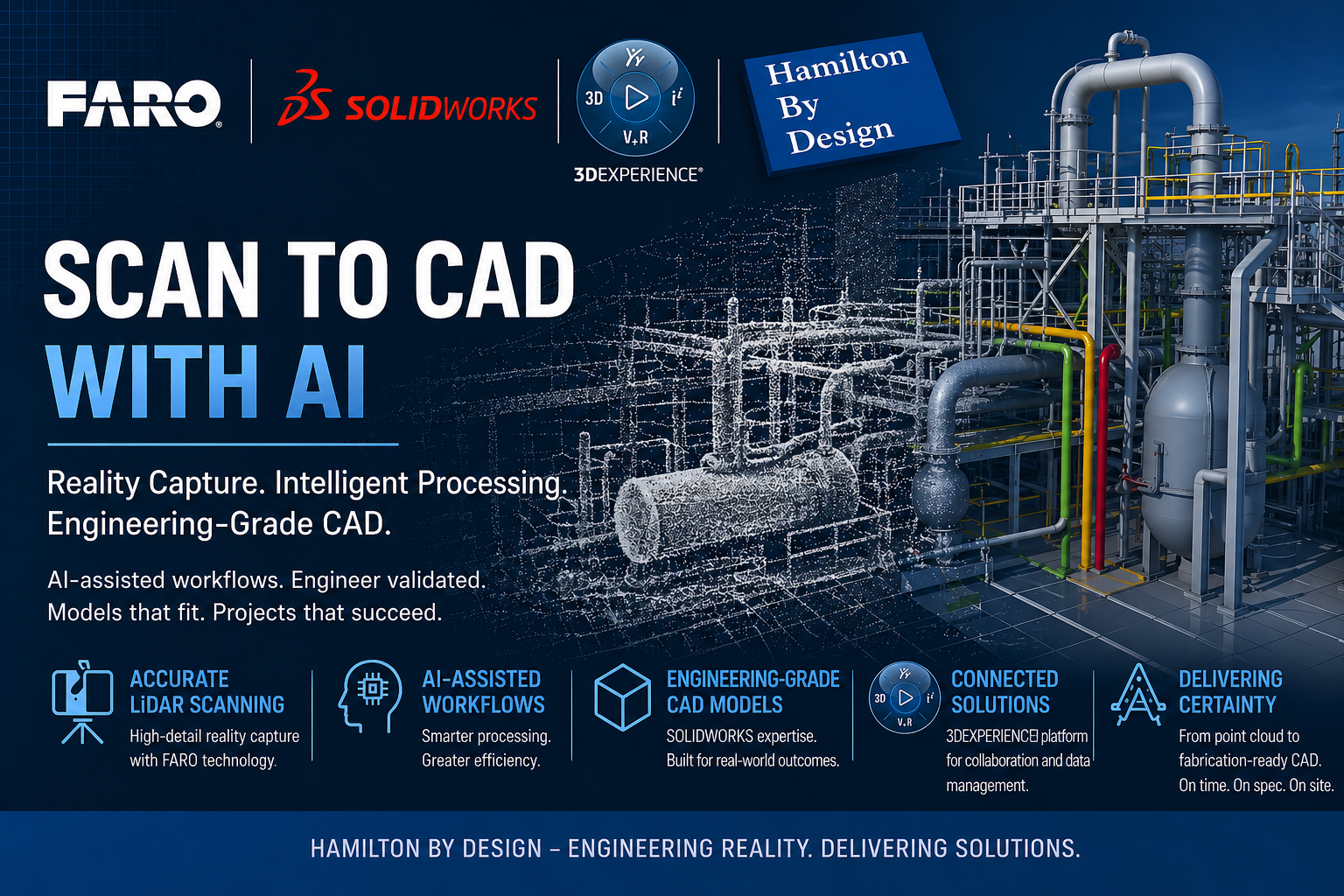
From Reality Capture to Fabrication-Ready CAD — Powered by AI, Delivered by Engineers
At Hamilton By Design, we provide engineering-grade scan-to-CAD services supported by AI-assisted workflows, transforming high-density LiDAR point cloud data into accurate, structured, and fabrication-ready CAD models. Our services are specifically tailored to the requirements of mining, industrial, and brownfield environments, where accuracy, reliability, and constructability are critical.
The rapid emergence of artificial intelligence (AI) within the reality capture and digital engineering domain has introduced significant efficiencies in data processing and geometric extraction. However, while AI enhances the speed and scalability of scan-to-CAD workflows, it does not replace the need for engineering judgement, validation, and accountability.
This distinction is fundamental:
AI can extract geometry.
Engineers deliver models that perform in the real world.
What is Scan to CAD with AI?
Scan-to-CAD with AI refers to the integrated process of capturing real-world conditions using LiDAR technology, processing point cloud data, and converting that data into structured CAD models with the assistance of AI-driven tools. This process typically involves multiple stages, including data acquisition, registration, feature extraction, modelling, and validation.
The inclusion of AI within this workflow primarily supports:
- Automated scan alignment and registration
- Noise filtering and data optimisation
- Feature recognition, including pipes, structural members, and planar surfaces
- Preliminary geometric fitting and segmentation
These capabilities significantly reduce manual processing time and improve workflow efficiency. However, the outputs generated by AI are not inherently engineering-ready and require interpretation, refinement, and validation by experienced engineers.
Scan-to-CAD with AI is therefore best understood not as a fully automated solution, but as a hybrid workflow combining advanced computational tools with professional engineering expertise.
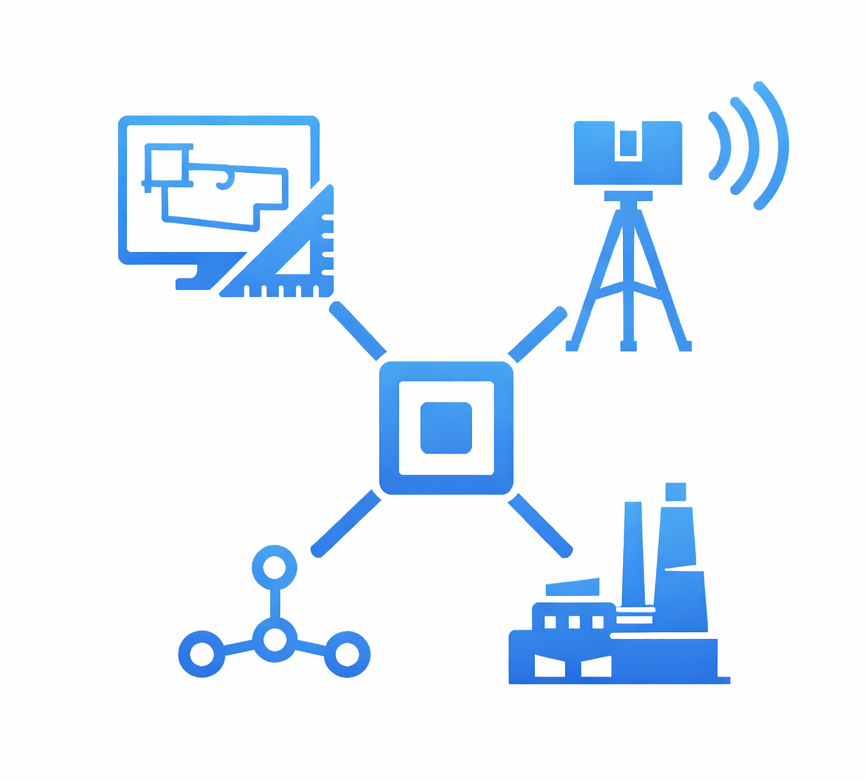
Engineering-Led Scan-to-CAD Workflow
1. Reality Capture (LiDAR Scanning)
The process begins with high-resolution LiDAR scanning of the physical environment. Using professional-grade equipment such as the FARO Focus S70, spatial data is captured with millimetre-level accuracy.
This data forms a comprehensive point cloud representation of the asset, including structural elements, mechanical systems, and surrounding constraints. In industrial and mining environments, particular attention is given to access limitations, line-of-sight constraints, and operational considerations during data capture.
2. Registration and Data Processing
Following acquisition, individual scans are registered into a unified coordinate system using software such as FARO SCENE. This stage involves aligning multiple scan positions, removing redundant data, and filtering noise.
AI-assisted algorithms are increasingly utilised to:
- Perform targetless registration through pattern recognition
- Identify and eliminate outliers
- Optimise point cloud density
While these tools improve efficiency, quality assurance remains essential. Verification of alignment accuracy and data completeness is critical, particularly for engineering applications where dimensional accuracy directly impacts downstream design and fabrication.
3. AI-Assisted Feature Recognition and Segmentation
Advanced software platforms, including the FARO As-Built Software Suite and Autodesk ReCap Pro, utilise AI-driven methods to identify geometric features within point cloud data.
These tools can detect:
- Cylindrical elements such as pipework
- Planar surfaces including floors, walls, and steel members
- Repetitive structural features
This stage represents one of the most significant contributions of AI to the scan-to-CAD process. However, it is important to recognise that AI-based detection is inherently probabilistic. It identifies patterns based on geometric similarity, rather than understanding functional or design intent.
As such, outputs must be interpreted and validated by engineers, particularly in complex or congested environments.
4. CAD Modelling and Engineering Development
The transition from point cloud data to structured CAD geometry is the defining stage of the scan-to-CAD process. While AI can assist in generating initial geometry, the development of engineering-grade models requires detailed manual intervention.
At this stage, engineers:
- Convert point cloud data into parametric CAD models (e.g., STEP, Parasolid, DWG)
- Resolve ambiguities arising from occlusions or incomplete data
- Apply engineering judgement to determine appropriate modelling assumptions
- Incorporate tolerances, clearances, and constructability considerations
In brownfield environments, where assets may have undergone years of modification, wear, or deformation, this stage is particularly critical. The ability to distinguish between design intent and as-built condition is essential for producing reliable models.
5. Validation and Clash Detection
Following model development, validation is conducted through direct comparison between the CAD model and the original point cloud data. This process ensures that the model accurately reflects real-world conditions.
Validation activities include:
- Overlay comparison of CAD geometry against point cloud data
- Clearance and clash detection analysis
- Dimensional verification against critical interfaces
AI-supported tools can assist in identifying deviations and potential conflicts. However, final validation decisions remain the responsibility of the engineering team.
6. Engineering Deliverables
The final outputs are structured to support design, fabrication, and construction workflows. Typical deliverables include:
- 3D CAD models (STEP, Parasolid, SolidWorks)
- 2D engineering drawings (general arrangements, sections, fabrication details)
- Registered point cloud datasets (.E57, .RCP)
- Digital model access via platforms such as the 3DEXPERIENCE platform
These deliverables are produced with consideration for downstream use, ensuring compatibility with fabrication, procurement, and construction processes.
The Role of AI in Scan-to-CAD
AI provides measurable benefits within specific stages of the scan-to-CAD workflow. These include:
Areas of Strength
- Automated scan registration and alignment
- Noise reduction and data optimisation
- Feature detection and segmentation
- Preliminary geometry extraction
These capabilities contribute to improved efficiency and reduced processing time.
Limitations of AI
Despite its advantages, AI remains limited in several critical areas:
- Lack of understanding of engineering intent
- Inability to reliably interpret incomplete or obstructed data
- Difficulty handling irregular or degraded geometries
- Limited capability in producing fabrication-ready outputs
AI operates based on pattern recognition rather than contextual understanding. As such, it cannot independently determine design requirements, functional constraints, or constructability considerations.
The Importance of Engineering Oversight
The integration of AI into scan-to-CAD workflows does not eliminate the need for engineering expertise. Instead, it shifts the role of the engineer from manual modeller to technical authority.
Engineering oversight ensures:
- Accuracy of geometric interpretation
- Appropriateness of modelling assumptions
- Compliance with design and fabrication requirements
- Accountability for final deliverables
This distinction is particularly important in high-risk environments such as mining and heavy industry, where errors can result in significant cost, safety, and operational impacts.
Applications in Industrial and Mining Environments
Scan-to-CAD with AI is widely applied across a range of industrial scenarios, including:
- Brownfield plant upgrades and expansions
- Conveyor and bulk handling system modifications
- Pipework and structural retrofits
- Pump station and process plant redesign
- Shutdown planning and execution
- Digital twin development
In these contexts, the ability to accurately capture and model existing conditions is essential for reducing risk and ensuring successful project outcomes.
The Future of Scan-to-CAD
The continued development of AI technologies is expected to further enhance the efficiency of scan-to-CAD workflows. Improvements in machine learning models will likely result in more accurate feature recognition and faster geometry extraction.
However, the role of engineering expertise will remain central. The complexity of real-world environments, combined with the need for accountability and precision, ensures that human judgement will continue to play a critical role.
The future of scan-to-CAD is therefore not characterised by full automation, but by the integration of AI as a tool that augments engineering capability.
Work With Hamilton By Design
At Hamilton By Design, we combine advanced LiDAR scanning, AI-assisted workflows, and engineering expertise to deliver reliable, high-quality scan-to-CAD solutions.
Our approach ensures that models are not only accurate representations of existing conditions, but also fit-for-purpose for design, fabrication, and construction.
If your project requires dependable as-built data, fabrication-ready CAD models, and reduced project risk, we invite you to engage with our team.

Contact Us – Talk to US
Our clients