


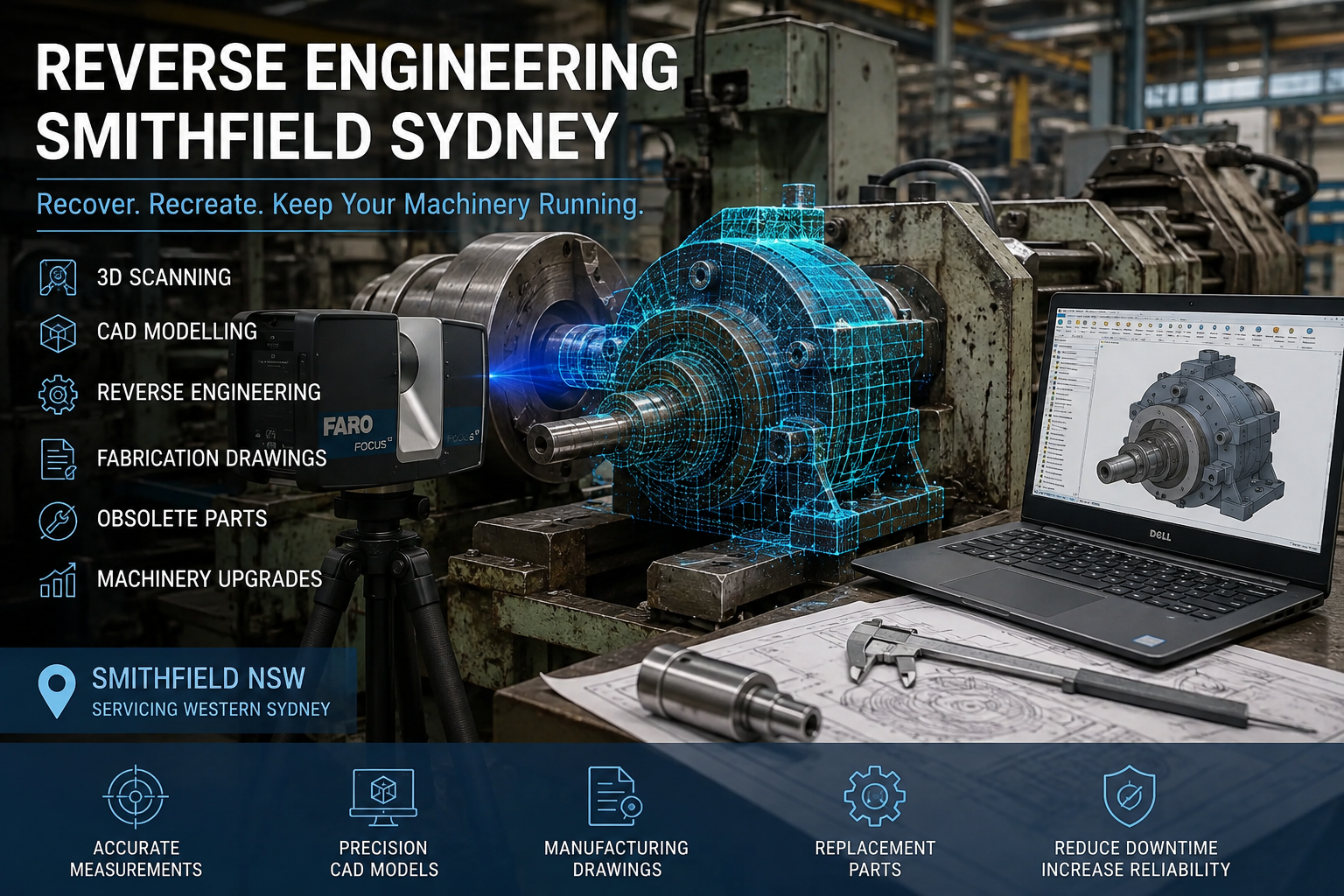
Recovering the Engineering Knowledge Locked Inside Existing Machinery

Manufacturing plants in Smithfield NSW often contain machinery that has remained productive for decades. Over that time, equipment may have been repaired, modified, relocated, upgraded or adapted to suit changing production requirements.
The machinery may still perform its job reliably, but the engineering information behind it can gradually disappear.
Original drawings may no longer exist. CAD models may never have been created. Manufacturers may have ceased trading, replacement components may have become obsolete, and previous modifications may only be understood by experienced maintenance personnel.
For manufacturers operating in Smithfield, this creates a significant engineering and maintenance problem:
How do you repair, reproduce or modify an important machine when nobody has an accurate record of what is actually installed?
Hamilton By Design provides reverse engineering, 3D scanning, CAD modelling and mechanical engineering services in Smithfield and Western Sydney, helping manufacturers recover this information and convert existing machinery into practical digital engineering records.
For broader projects throughout Sydney, our Reverse Engineering 3D Scanning Sydney service supports the recreation and verification of machinery and components where reliable original information is unavailable.
The Biggest Problem: The Machine Exists, but the Engineering Information Does Not
Many established factories are effectively operating two assets.
The first is the physical machine.
The second is the knowledge required to maintain it.
While the machine may remain on the factory floor, the supporting engineering knowledge can be much easier to lose.
A production machine may have undergone numerous modifications during its working life. Guards may have been replaced. Shafts may have been remanufactured. Frames may have been strengthened. Motors, gearboxes and bearings may have changed. Locally manufactured components may have replaced original OEM parts.
Unfortunately, the drawings are not always updated as these modifications occur.
Eventually, the drawing in the filing cabinet can describe a machine that no longer exists.
This is particularly significant when a critical component fails and the maintenance team discovers:
- the original manufacturer no longer supports the equipment;
- replacement parts are unavailable;
- the existing drawings are incomplete or inaccurate;
- nobody has a CAD model;
- the failed component has already suffered significant wear;
- previous modifications were never documented; or
- the person who understood the machine is no longer available.
At this point, the challenge is no longer simply finding a replacement part.
It is recovering the engineering information required to create one.
Reverse Engineering Existing Machinery in Smithfield
Smithfield forms part of the broader Smithfield–Wetherill Park industrial precinct, an established Western Sydney manufacturing and employment area containing a substantial concentration of industrial businesses.
For machinery owners in this environment, reverse engineering can provide a practical method of documenting equipment that otherwise exists only as a physical asset.
The process can be applied to:
- production machinery;
- packaging equipment;
- conveyors;
- rollers and shafts;
- bearing housings;
- machine frames;
- fabricated assemblies;
- guards and covers;
- hoppers and chutes;
- brackets and mounting systems;
- obsolete replacement components;
- processing equipment; and
- custom-built machinery.
The objective is not necessarily to copy every surface exactly.
Good reverse engineering requires an understanding of design intent.
A worn component should not automatically be recreated with the same wear. A distorted fabricated frame may not represent its original design geometry. A shaft journal may measure undersize because it has operated for thousands of hours.
The engineering process must therefore distinguish between what currently exists and what the component was intended to be.
3D Scanning Smithfield Machinery and Factory Equipment
Different equipment requires different measurement approaches.
Large machines, production lines and surrounding factory environments can be captured using terrestrial laser scanning. This creates a measurable three-dimensional record of the existing installation, including surrounding structures and equipment where those interfaces are relevant.
Hamilton By Design’s broader Industrial 3D Scanning Services support manufacturing facilities, plant modifications, machinery installations and reverse-engineering projects where reliable existing-condition information is required.
For smaller components or detailed surfaces, high-resolution handheld 3D scanning may be more suitable.
Traditional measurement remains important as well.
Vernier calipers, micrometers, bore gauges and other dimensional measurement techniques may be used alongside scan data where critical machined features, fits or tolerances need to be established.
The appropriate combination depends on the component, its size, surface condition and the intended engineering outcome.
From Physical Machinery to Usable CAD
Capturing a point cloud or mesh is only the beginning.
The real value comes from converting measured information into engineering geometry that can be reused.
A typical Smithfield reverse-engineering project may involve:
1. Understanding the Requirement
Before scanning begins, Hamilton By Design can establish why the machinery or component is being captured.
The objective may be to reproduce a failed part, modify a machine, design new guarding, relocate equipment or simply create a permanent engineering record before one is urgently required.
2. Reviewing Existing Information
Old drawings, sketches, manuals, photographs, CAD files, spare parts and maintenance records can provide useful supporting information.
Where the accuracy of historical drawings is uncertain, they can be compared against the physical machine rather than assumed to be correct.
3. Capturing Existing Geometry
The machine, component and relevant interfaces are measured using scanning and conventional dimensional techniques appropriate to the required outcome.
For projects extending into complete facilities or production areas, Hamilton By Design also provides 3D Scanning Services in Sydney for engineering-grade existing-condition capture.
4. Reconstructing Design Intent
Scan information can then be interpreted to establish features such as:
- nominal diameters;
- hole centres;
- mounting patterns;
- machined surfaces;
- interfaces;
- datums;
- symmetry;
- clearances; and
- assembly relationships.
This stage is particularly important where the existing component contains wear, deformation or previous repair work.
5. Developing CAD Models and Drawings
The reconstructed geometry can then be developed into practical engineering deliverables such as:
- SolidWorks models;
- Inventor models;
- STEP or Parasolid files;
- fabrication drawings;
- machining drawings;
- general arrangement drawings;
- assembly drawings;
- DXF cutting profiles; and
- bills of materials where required.
The purpose is to move from physical machinery to reusable engineering information.
Creating a Digital Spare-Part Library Before Machinery Fails
One of the most useful applications of reverse engineering is to undertake the work before a breakdown occurs.
A Smithfield manufacturer may have several production machines containing critical components that are becoming increasingly difficult to source.
Rather than waiting until one fails, selected components can be progressively scanned, modelled and documented.
Over time, the business can establish a digital library of critical replacement parts.
The retained information could include:
- machinery scans;
- component geometry;
- registered point clouds;
- CAD models;
- replacement-part drawings;
- machining drawings;
- factory layouts;
- equipment interfaces;
- as-built information; and
- modification records.
This changes the engineering response to future maintenance.
Instead of starting with a failed component and an urgent measurement exercise, the engineering information required to obtain quotations, machine a new part or investigate a redesign may already exist.
Supporting Machinery Upgrades and Plant Modifications
Reverse engineering can also assist when an existing machine is being changed rather than simply repaired.
A new motor, gearbox, conveyor, guarding system or fabricated assembly must often fit around equipment that was installed years earlier.
For these projects, capturing only the individual component may not be sufficient.
The surrounding plant can also be measured to understand:
- mounting positions;
- structural interfaces;
- access clearances;
- neighbouring machinery;
- maintenance envelopes;
- service routes; and
- available installation space.
Hamilton By Design’s 3D Laser Scanning for Industrial Plants Sydney capability can support these larger brownfield modification projects by providing engineering teams with a measured representation of actual site conditions.
The principle is straightforward:
design the modification around the machinery that is actually there, rather than around assumptions about what should be there.
Dimensional Verification of Replacement Components
Reverse engineering does not necessarily finish when a replacement component has been manufactured.
Where fit or dimensional accuracy is important, the new component or fabrication can also be checked against the developed engineering geometry.
Hamilton By Design’s 3D LiDAR Scanning and Digital Quality Assurance workflows can support dimensional verification where fabricated or installed geometry needs to be compared with design information.
This can be particularly valuable when site installation opportunities are limited and incorrect fit-up could result in production delays or additional shutdown work.
Mechanical Engineering Support for Smithfield Manufacturers
The advantage of an engineering-led reverse-engineering workflow is that the project does not have to stop at scanning.
Depending on the requirement, captured information may support:
- replacement-part development;
- mechanical design;
- machinery modifications;
- fabrication drawings;
- machine guarding;
- plant layouts;
- installation planning;
- equipment relocation;
- dimensional verification;
- as-built documentation; and
- engineering assessment.
This provides a practical connection between the existing physical asset and the drawings and CAD information required to maintain or modify it.
Retaining Engineering Knowledge for the Future
For established manufacturing facilities, machinery knowledge can have considerable operational value.
A machine may continue working for another ten or twenty years, but the people, suppliers and documentation surrounding it may change several times during that period.
Reverse engineering provides an opportunity to capture that knowledge while the equipment is still accessible and operational.
The long-term objective is therefore broader than producing a drawing for one replacement part.
It is about establishing a reliable engineering record of the asset.
Measure it. Understand it. Document it. Retain the information. Reuse it when the plant needs it again.
For manufacturers, maintenance teams and engineering managers in Smithfield NSW, Hamilton By Design can assist with reverse engineering, machinery scanning, CAD modelling, mechanical design, fabrication drawings and factory existing-condition documentation.
Frequently Asked Questions
Can you reverse engineer machinery when no drawings are available?
Yes. Existing machinery or components can be measured using appropriate 3D scanning and conventional dimensional measurement techniques. The resulting information can then be interpreted and reconstructed into CAD models and engineering drawings suitable for the intended application.
Can you 3D scan machinery without dismantling the entire machine?
Often, yes. Terrestrial laser scanning can capture installed machinery together with its surrounding environment. However, hidden surfaces and internal features cannot be measured if they are not visible, so some components may require separate measurement or partial disassembly depending on the required deliverable.
Can Hamilton By Design reproduce an obsolete machinery part?
Hamilton By Design can reverse engineer the existing component and develop CAD models, manufacturing geometry and drawings from which a suitable manufacturer can produce a replacement. The required scope depends on the component, material, tolerances, loading and whether the replacement is intended to be like-for-like or modified.
What happens if the original component is badly worn?
Wear needs to be considered when reconstructing design intent. Simply copying a worn surface could reproduce the defect. Available mating components, symmetry, nominal engineering dimensions, historical drawings and conventional measurements can assist in establishing the intended geometry.
Can old machinery drawings be checked against the actual equipment?
Yes. Existing drawings or CAD information can be compared with measured site conditions to identify differences caused by previous modifications, repairs, installation tolerances or outdated documentation.
Can you scan an entire factory in Smithfield?
Yes. Larger industrial areas, production lines, machinery installations, structures and plant interfaces can be captured using terrestrial LiDAR scanning where required. The resulting point-cloud information can support layouts, equipment upgrades, relocation projects and future engineering work.
Can scan data be converted into SolidWorks or Inventor models?
Yes. Depending on the project, captured geometry can be reconstructed into usable mechanical CAD models and supplied in native or neutral formats appropriate to the required engineering workflow.
Can you produce fabrication and machining drawings?
Yes. Reverse-engineered geometry can be developed into fabrication drawings, detail drawings, assembly information and DXF profiles where these form part of the agreed project scope.
Is reverse engineering useful before a machine fails?
Yes. In many cases this is the preferred time to capture critical machinery. Developing CAD models and replacement-part information while the machine is operational can reduce the amount of engineering work that has to be undertaken during an unplanned breakdown.
Can we build a digital library of obsolete or critical spare parts?
Yes. Critical machinery and components can be progressively captured and documented to create a retained digital engineering record containing scans, CAD models, drawings and relevant dimensional information for future maintenance or manufacturing requirements.
Do you provide mechanical engineering as well as 3D scanning?
Yes. Hamilton By Design combines reality capture with mechanical design, CAD modelling, drafting and fabrication documentation, allowing scan information to be developed into practical engineering deliverables rather than remaining solely as point-cloud data.
What areas do you service around Smithfield?
Hamilton By Design can support projects throughout Smithfield and the surrounding Western Sydney industrial areas, including Wetherill Park, Fairfield, Yennora, Pemulwuy, Greystanes, Guildford and the broader Sydney region.
How do we start a Smithfield reverse-engineering project?
The most useful starting information is normally a brief description of the machine or component, photographs, approximate dimensions, the reason for reverse engineering and any existing drawings or documentation available. From this information, Hamilton By Design can determine an appropriate measurement, scanning and engineering workflow.

Contact Us – Talk To Us
Our clients:
























