Why Information Management Matters More Than the 3D Model
For many organisations, the discussion around Building Information Modelling (BIM) begins with software. Questions are often focused on whether a project requires Revit, Navisworks, AutoCAD or a particular modelling platform. However, the international BIM standard ISO 19650-1:2018 takes a very different view.
The standard makes it clear that BIM is not fundamentally about creating 3D models. Instead, BIM is an information management process that enables better decision-making throughout the lifecycle of an asset. ISO 19650 establishes a framework for creating, exchanging, approving, storing and maintaining information associated with buildings, infrastructure and industrial facilities.
This distinction is particularly important for Scan to BIM projects where the focus can easily become the creation of a highly detailed model while overlooking the long-term value of the information contained within it.
What is ISO 19650?
ISO 19650 is an international standard that provides concepts and principles for managing information using BIM across the entire lifecycle of a built asset. The framework applies to projects of all sizes and complexities and covers everything from planning and design through construction, operation, maintenance and eventual decommissioning.
The standard promotes:
- Structured information management
- Collaborative workflows
- Defined responsibilities
- Common Data Environments (CDE)
- Information requirements
- Lifecycle asset management
- Consistent information exchange
At its core, ISO 19650 seeks to ensure that the right people have access to the right information at the right time.
The Relationship Between Scan to BIM and ISO 19650
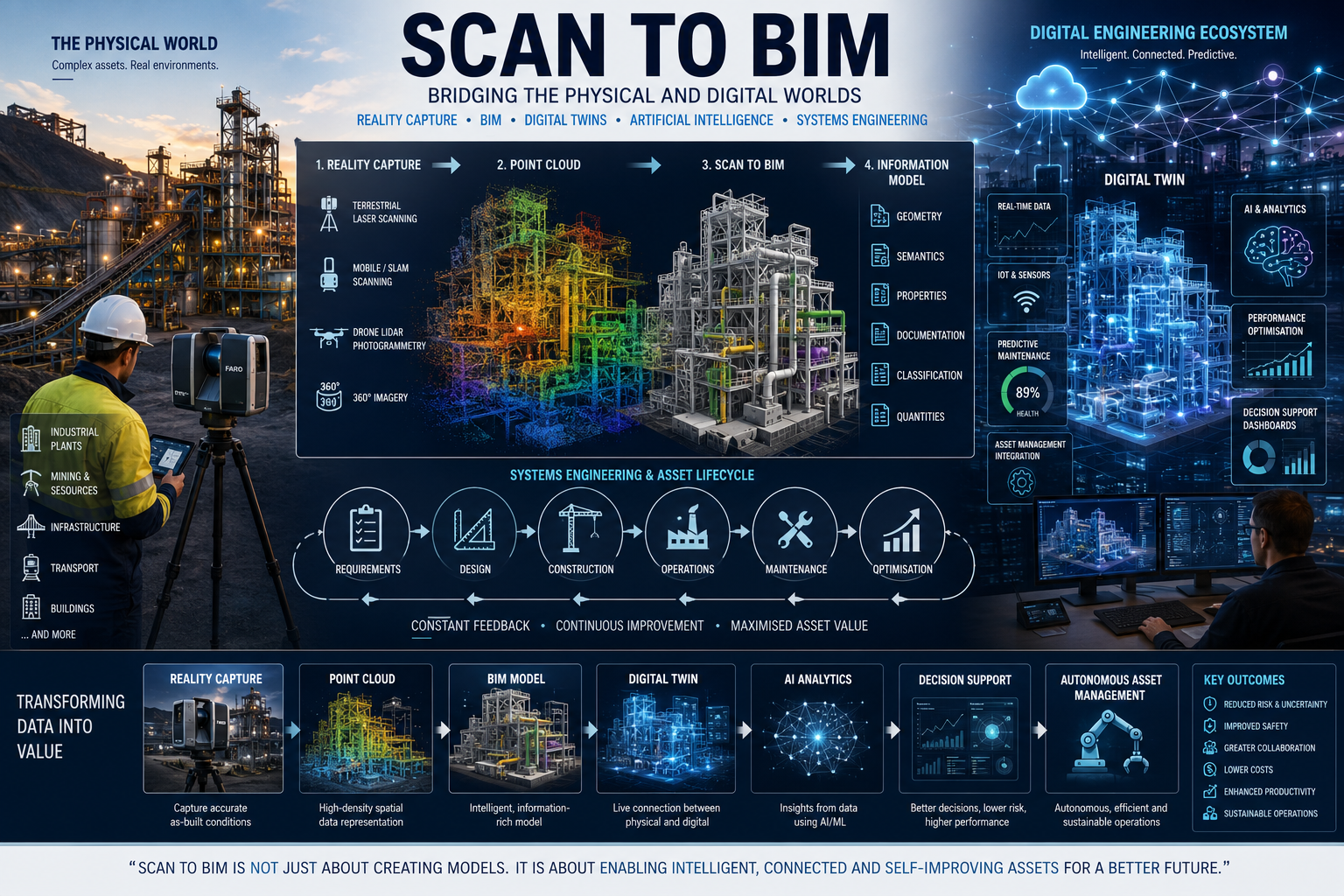
Traditional Scan to BIM projects often follow a simple workflow:
Site Scan → Point Cloud → BIM Model
While this approach creates an accurate digital representation of an asset, ISO 19650 encourages organisations to think beyond geometry.
A more mature digital engineering workflow looks like:
Site Scan → Point Cloud → BIM Model → Asset Information → Digital Twin → Operational Decision Support
The BIM model becomes a container for information rather than simply a 3D representation.
For example, a pump within a processing plant may contain:
- Manufacturer details
- Asset numbers
- Maintenance schedules
- Design duty points
- Inspection records
- Risk classifications
- Spare parts information
In many cases, this information becomes more valuable than the geometry itself.
Why This Matters in Mining and Industrial Facilities
Mining operations, processing plants, smelters, ports and manufacturing facilities often contain decades of undocumented modifications.
Common challenges include:
- Missing drawings
- Outdated documentation
- Unknown equipment changes
- Inconsistent asset registers
- Limited visibility of operational risks
Engineering-grade LiDAR scanning and Scan to BIM services provide an opportunity to create a digital representation of existing assets. However, ISO 19650 demonstrates that the greatest value occurs when that information is structured, governed and maintained throughout the asset lifecycle.
This enables organisations to support:
- Brownfield expansions
- Shutdown planning
- Hazard identification
- Asset management programs
- Reliability engineering
- Capital project delivery
- Digital Twin initiatives
The Importance of a Common Data Environment (CDE)
One of the most important concepts introduced by ISO 19650 is the Common Data Environment (CDE).
A CDE acts as a single source of truth for project and asset information.
Rather than storing information across multiple disconnected systems, a CDE enables:
- Controlled document management
- Revision tracking
- Approval workflows
- Model coordination
- Information sharing
The objective is simple:
Everyone works from the same information.
This reduces duplication, confusion and project risk while improving collaboration across engineering, operations and maintenance teams.
Information Requirements Drive Success
Another key principle of ISO 19650 is that information requirements should be defined before modelling begins.
The standard encourages organisations to ask:
What information do we need to operate and maintain this asset?
rather than:
What level of model detail do we want?
This subtle shift can dramatically improve project outcomes.
For example, an asset owner may require:
- Equipment metadata
- Safety-critical element identification
- Maintenance records
- Inspection history
- Asset hierarchy structures
Capturing this information during a Scan to BIM project ensures that the resulting model supports operational objectives rather than becoming a static 3D deliverable.
Scan to BIM and Digital Twins
The future direction of Scan to BIM is closely linked to Digital Twin technology.
A Digital Twin extends BIM by integrating:
- Real-time operational data
- IoT sensors
- Maintenance systems
- Asset management platforms
- Artificial intelligence
- Predictive analytics
The BIM model becomes the foundation upon which a Digital Twin is built.
Without structured information management practices such as those promoted by ISO 19650, Digital Twin initiatives often struggle to deliver long-term value.
Systems Engineering and Lifecycle Thinking
At Hamilton By Design, we view Scan to BIM through a systems engineering lens.
The purpose of digital engineering is not simply to create models.
It is to support better lifecycle decisions.
This aligns closely with ISO 19650 principles including:
- Requirements management
- Information governance
- Configuration control
- Traceability
- Asset lifecycle management
For mining, industrial and infrastructure projects, the ability to manage information consistently throughout the lifecycle of an asset can significantly improve safety, reduce risk and support more informed decision-making.
The Future of Engineering is Information-Centric
Historically, engineering was drawing-centric.
Then it became model-centric.
The future is increasingly information-centric.
As Artificial Intelligence, Digital Twins, reality capture and asset management systems continue to evolve, organisations will place greater emphasis on information quality, governance and lifecycle management.
Scan to BIM will remain a critical bridge between the physical world and the digital world, but its long-term value will be determined not by the quality of the model alone, but by the quality of the information that supports it.
Learn More
For additional commentary on digital engineering, systems engineering, Scan to BIM and the future of engineering practice, visit:

Talk to Us – Contact Us
Our clients: