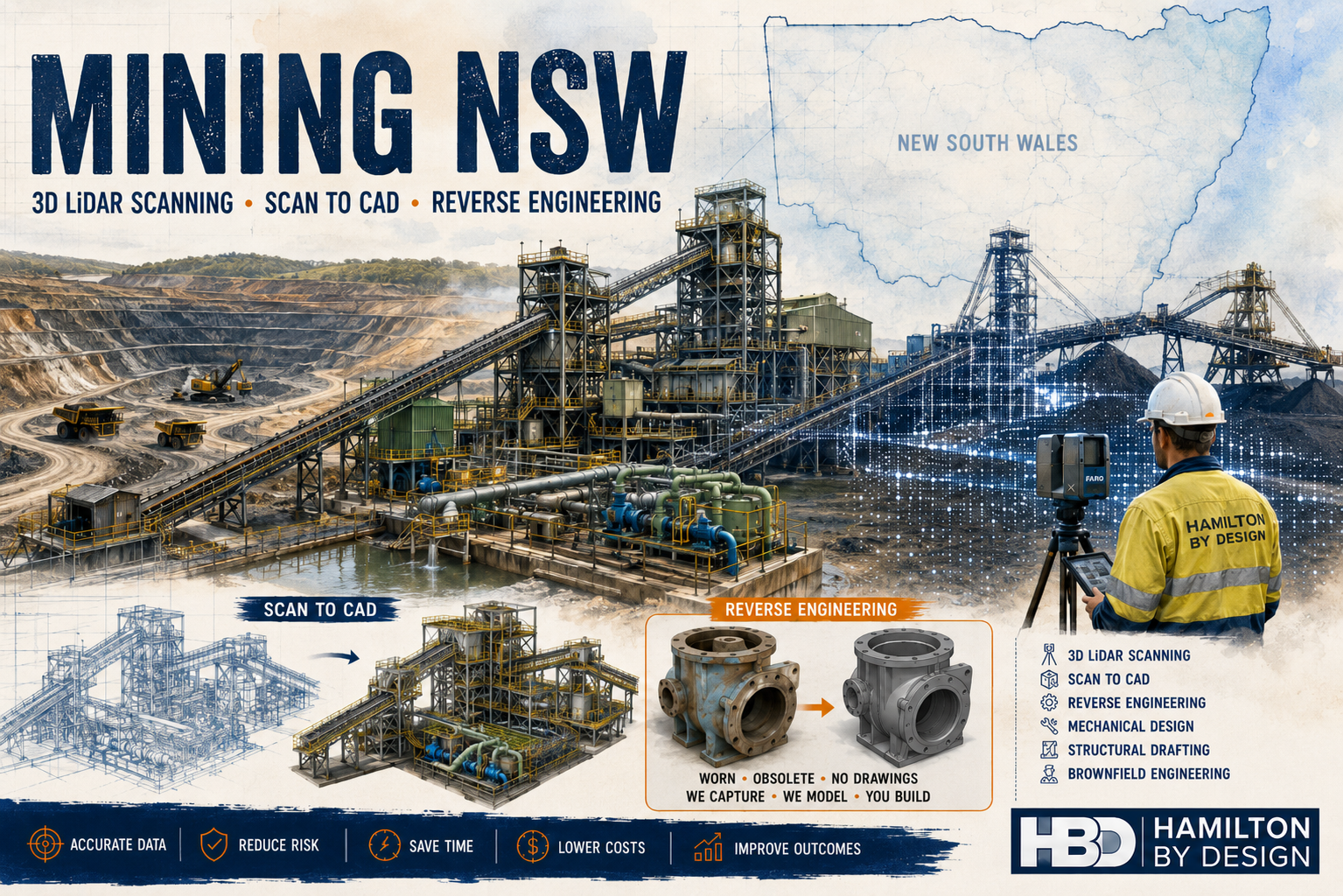
Mining in NSW is changing, but it is not disappearing.

Across New South Wales, mining remains a major part of the industrial economy. Coal mining continues across established regions such as the Hunter Valley, Gunnedah Basin, Western Coalfields and Southern Coalfields. At the same time, NSW is also becoming increasingly important for critical minerals, gold, copper, silver, cobalt, scandium, rare earths and other resources required for energy, infrastructure, defence, manufacturing and advanced technology.
For mine operators, engineering teams, maintenance planners and project managers, the challenge is practical: how do you keep existing mining assets operating safely, efficiently and accurately when the plant has changed over time, OEM drawings are missing, and shutdown windows are short?
Hamilton By Design supports mining operations across NSW with engineer-led engineering-grade 3D laser scanning, engineering-grade Scan to CAD services, reverse engineering, mechanical design, structural drafting and brownfield engineering support.
We help mining teams capture real site conditions, convert point cloud data into usable CAD models, reverse engineer obsolete components and reduce the risk of costly site clashes during maintenance, shutdowns and upgrades.
Hamilton By Design also provides broader engineering-led digital engineering services for mining, industrial, infrastructure and brownfield plant projects across NSW and Australia.
Engineering Support for Mining NSW
NSW mining is not one single industry. It includes open cut coal mines, underground coal mines, metalliferous mines, mineral processing plants, CHPPs, conveyors, stockyards, pump stations, workshops, rail load-out facilities, port-linked coal handling assets and brownfield industrial infrastructure.
That means mining engineering support needs to be practical, site-aware and flexible.
Hamilton By Design works with mining and heavy industrial operators that need accurate information about existing assets. This is especially important where original drawings are outdated, missing, incomplete or controlled by an OEM that will not provide usable CAD data.
Our focus is on helping mining clients answer questions such as:
- What is actually installed on site?
- Will the new equipment fit?
- Can we create a CAD model from the existing plant?
- Can we reverse engineer this worn or obsolete part?
- Can we reduce shutdown risk before people arrive on site?
- Can we check access, clearances and installation clashes before fabrication?
- Can we produce practical drawings for repair, manufacture or modification?
Mining projects often fail or become expensive when design teams are forced to work from assumptions. Hamilton By Design helps replace assumptions with accurate site data, CAD models and engineering documentation.
For regional mining and industrial support, see our page on Hunter Valley mining engineering and 3D laser scanning.
Why Mining NSW Needs Accurate As-Built Information
Many NSW mining sites have been operating for decades. Over that time, conveyors are modified, chutes are changed, platforms are added, pipework is rerouted, guards are replaced, pumps are upgraded and equipment is repaired during shutdowns.
The problem is that the drawings do not always keep up.
A drawing may show what was originally designed, but not what was installed. It may not include later changes. It may be a scanned PDF, a vendor sketch or an old 2D drawing with limited detail. In some cases, the site may have no drawing at all.
This creates major risk for brownfield mining work.
When the existing plant is not accurately known, new equipment can clash with steelwork, pipework, guards, conveyors, cable trays, platforms or access ways. Fabricated items may arrive on site and fail to fit. Shutdown crews may lose time modifying parts that should have been checked before the job started.
Hamilton By Design helps reduce this risk by capturing existing mine infrastructure using 3D LiDAR scanning and converting the scan data into usable engineering information.
For surface mining projects in the Hunter Valley, see our page on Surface Mine 3D LiDAR Scanning Hunter Valley NSW.
3D LiDAR Scanning for NSW Mining Sites
3D LiDAR scanning captures the real geometry of existing mining assets. Instead of relying only on manual measurements, a scanner records millions of points across the site, creating a point cloud that can be used for design review, modelling, clash checking and documentation.
This is valuable for mining assets such as:
- Conveyors
- Transfer towers
- Chutes
- Crushers
- Screens
- Hoppers
- Bins
- Pump stations
- Pipework
- Platforms
- Stairs and handrails
- Structural steel
- CHPP areas
- Rail load-out structures
- Maintenance workshops
- Brownfield tie-in zones
The main benefit is confidence. Engineers, designers and fabricators can work from real site data rather than guessing what is installed.
LiDAR scanning is especially useful before shutdowns. A short site capture can provide the basis for CAD modelling, interface checks and design planning before the shutdown begins. This helps reduce the risk of fit-up problems when time is limited.
For broader plant upgrade work, see our page on 3D laser scanning for mining plant upgrades.
For mining, coal handling, port and industrial sites around Newcastle, see 3D laser scanning Newcastle NSW.
Scan to CAD for NSW Mining Operations
A point cloud is useful, but most engineering teams need CAD.
Scan to CAD is the process of converting 3D scan data into usable CAD models, drawings and design references. This may include SolidWorks models, Inventor models, AutoCAD drawings, Navisworks coordination models, STEP files, SAT files, DWG files, DXF files or 2D general arrangement drawings.
For NSW mining operations, Scan to CAD can support:
- Brownfield upgrades
- Conveyor modifications
- Chute replacement
- Pump station upgrades
- Structural access changes
- Guarding improvements
- Pipework modifications
- Shutdown planning
- Fabrication design
- Clash detection
- Long-term as-built records
The level of detail should match the job. Not every project needs a full fabrication-ready model. Some projects only need an envelope model for clash checking. Other projects need detailed mechanical or structural modelling for fabrication and installation.
For mining teams that need point cloud data converted into usable CAD models, see our page on Surface Mine Scan to CAD Hunter Valley NSW.
Hamilton By Design can also support mining and mineral processing projects with SolidWorks 3D modelling for mining and mineral processing.
Reverse Engineering for Mining Replacement Parts
One of the biggest problems in mining maintenance is not simply that the drawings are old. The bigger problem is often that the OEM will not provide drawings, replacement parts are expensive, or lead times are too long.
When a mine has a worn, obsolete or damaged component, reverse engineering can help create the information needed to repair, replace or locally manufacture the part.
Hamilton By Design can assist with reverse engineering for mining components such as:
- Shafts
- Bushes
- Housings
- Guards
- Wear plates
- Brackets
- Pump components
- Conveyor parts
- Chute components
- Fabricated assemblies
- Machined parts
- Obsolete OEM parts
- Modified plant components
Reverse engineering may include 3D scanning, manual measurement, CAD modelling, material review, fit-up checks and production of drawings for discussion with fabricators, machinists or maintenance teams.
For open cut mining machinery and replacement part support, see our page on Open Cut Mine Machinery Reverse Engineering Muswellbrook NSW.
For broader asset-life and replacement-part support, see reverse engineering for mining and industrial equipment.
Hamilton By Design also provides reverse engineering using 3D scanning where physical parts, plant areas or worn components need to be measured and converted into CAD data.
CHPP 3D Scanning and Brownfield Plant Support
Coal Handling and Preparation Plants are some of the most complex mining assets in NSW.
A CHPP may include conveyors, screens, crushers, cyclones, tanks, pumps, pipework, chutes, transfer points, access platforms, structural steel and confined maintenance areas. These facilities often operate in wet, abrasive and corrosive environments.
Process water, coal fines, slurry, magnetite, wash-down water and poor drainage can all contribute to corrosion, wear and deterioration. Over time, this can make existing drawings less reliable and make upgrades harder to plan.
3D scanning helps CHPP teams capture the real condition and geometry of existing plant areas before modifications are designed. This is useful for shutdown planning, structural review, pipework changes, chute replacement, conveyor modifications and access improvements.
For coal handling and preparation plant support in Singleton and the Hunter region, see our page on CHPP 3D Scanning Services Singleton NSW.
For broader coal handling plant support, see CHPP engineering and 3D scanning.
Mechanical and Structural Drafting for Mining Projects
Mining projects often need more than a scan or a CAD model. They also need drawings that can be reviewed, priced, fabricated, installed and maintained.
Hamilton By Design can support mining and plant projects with mechanical drafting for mining and plant projects, including general arrangements, component drawings, fabrication details, equipment layouts and plant modification drawings.
For platforms, stairs, handrails, gantries, access structures, transfer towers and structural steel around mine infrastructure, Hamilton By Design also provides structural drafting for mining access structures.
This is important for brownfield mining work because scanning alone does not solve the full problem. The value comes from turning site data into engineering outputs that can be used by maintenance teams, fabricators, installers and project engineers.
Scan to BIM and Digital Asset Documentation for Mining
Some mining and industrial projects require structured building or asset models rather than simple CAD files. This may be useful for larger facilities, long-term asset records, infrastructure planning, site coordination or digital engineering workflows.
Hamilton By Design can support Scan to BIM for mining and industrial facilities where scan data needs to be converted into more structured digital models.
For regional projects around Newcastle, the Hunter Valley, Maitland, Singleton, Muswellbrook, Cessnock, Tomago and the Central Coast, see Scan to BIM Newcastle and Hunter.
Mining Regions in NSW We Can Support
Hamilton By Design can support mining and heavy industrial projects across NSW, including:
- Hunter Valley
- Newcastle
- Singleton
- Muswellbrook
- Maitland
- Cessnock
- Gunnedah
- Boggabri
- Narrabri
- Mudgee
- Ulan
- Lithgow
- Orange
- Parkes
- Dubbo
- Cobar
- Broken Hill
- Wollongong
- Southern Coalfields
- Central West NSW
- Western NSW
- Regional NSW mining and industrial sites
Mining Assets We Help Document and Model
Hamilton By Design can assist with scanning, modelling and drafting for a wide range of mining assets, including:
Fixed Plant
- Conveyors
- Crushers
- Screens
- Feeders
- Hoppers
- Chutes
- Transfer towers
- Bins
- Skids
- Pump stations
- Process equipment
Structural and Access Systems
- Platforms
- Stairs
- Ladders
- Handrails
- Walkways
- Gantries
- Support frames
- Maintenance access structures
Mechanical and Fabricated Components
- Guards
- Brackets
- Wear liners
- Drive components
- Shafts
- Bushes
- Housings
- Covers
- Replacement parts
- Obsolete OEM components
Brownfield Interfaces
- Tie-in points
- Existing steelwork
- Pipework routes
- Conveyor interfaces
- Equipment footprints
- Installation clearances
- Access and maintenance envelopes
Common Mining Problems We Help Solve
No Reliable Drawings
Many mining sites have drawings that no longer match the plant. LiDAR scanning and Scan to CAD help create updated engineering references.
OEM Drawings Are Unavailable
When OEM drawings cannot be supplied, reverse engineering can help create practical CAD models and drawings for review, repair or manufacture.
Shutdown Time Is Limited
Accurate scanning before shutdown helps reduce site measuring time and allows design issues to be reviewed before crews arrive.
New Equipment May Not Fit
Brownfield upgrades often fail because existing structures, pipework or conveyors are not where the drawings say they are. Scan data helps identify clashes earlier.
Corrosion and Wear Have Changed the Plant
Mining environments can be abrasive and corrosive. Existing assets may have worn, bent, cracked or deteriorated, making old drawings unreliable.
Replacement Parts Have Long Lead Times
Reverse engineering can support local repair or manufacture when replacement parts are expensive, delayed or no longer available.
Tools Used for Mining Engineering Support
Hamilton By Design uses practical engineering and design tools to support mining projects, including:
- FARO 3D laser scanning
- Point cloud registration
- E57, RCP, RCS and LAS point cloud workflows
- SolidWorks
- Autodesk Inventor
- AutoCAD
- Navisworks
- STEP, SAT, DWG and DXF outputs
- Mechanical design
- Structural drafting
- Reverse engineering
- Scan to CAD
- Site measurement and verification
The goal is not just to collect scan data. The goal is to produce usable information that helps mining teams make decisions, design modifications and reduce project risk.
Why Use Hamilton By Design for Mining NSW?
Hamilton By Design is engineer-led. That means we understand that mining clients do not only need a point cloud. They need information that can be used for design, fabrication, installation and maintenance decisions.
We can support projects from site capture through to CAD modelling, reverse engineering and drafting.
Our mining support is suited to:
- Maintenance teams
- Shutdown planners
- Project engineers
- Mechanical engineers
- Structural engineers
- Fabricators
- Drafting teams
- Asset owners
- Processing plant operators
- Brownfield upgrade teams
Whether the problem is a missing drawing, a worn component, a plant clash, a shutdown risk or an outdated CAD model, Hamilton By Design can help turn existing site conditions into usable engineering data.
To learn more about Hamilton By Design’s industrial, mining and mechanical background, see Hamilton By Design mining and industrial experience.
Mining NSW Services
Hamilton By Design can support Mining NSW projects with:
- 3D LiDAR scanning
- Laser scanning
- Scan to CAD
- Point cloud processing
- As-built modelling
- Reverse engineering
- Replacement part modelling
- Mechanical drafting
- Structural drafting
- Brownfield engineering support
- Conveyor and chute modelling
- Pump component reverse engineering
- Shutdown measurement support
- CAD modelling from existing assets
- Fabrication drawing support

Talk to Hamilton By Design About Mining NSW
If your NSW mining site is working from outdated drawings, missing OEM information or uncertain site measurements, Hamilton By Design can help.
We support mining and heavy industrial clients with practical 3D scanning, Scan to CAD, reverse engineering and drafting services that reduce design risk before fabrication, shutdown or installation.
Contact Hamilton By Design to discuss your Mining NSW project.
Whether you need to scan a CHPP, model a conveyor area, reverse engineer a replacement part, update an as-built CAD model or check a brownfield installation before shutdown, Hamilton By Design can help turn real site conditions into reliable engineering information.
Talk to Us – Contact Us
Our clients: