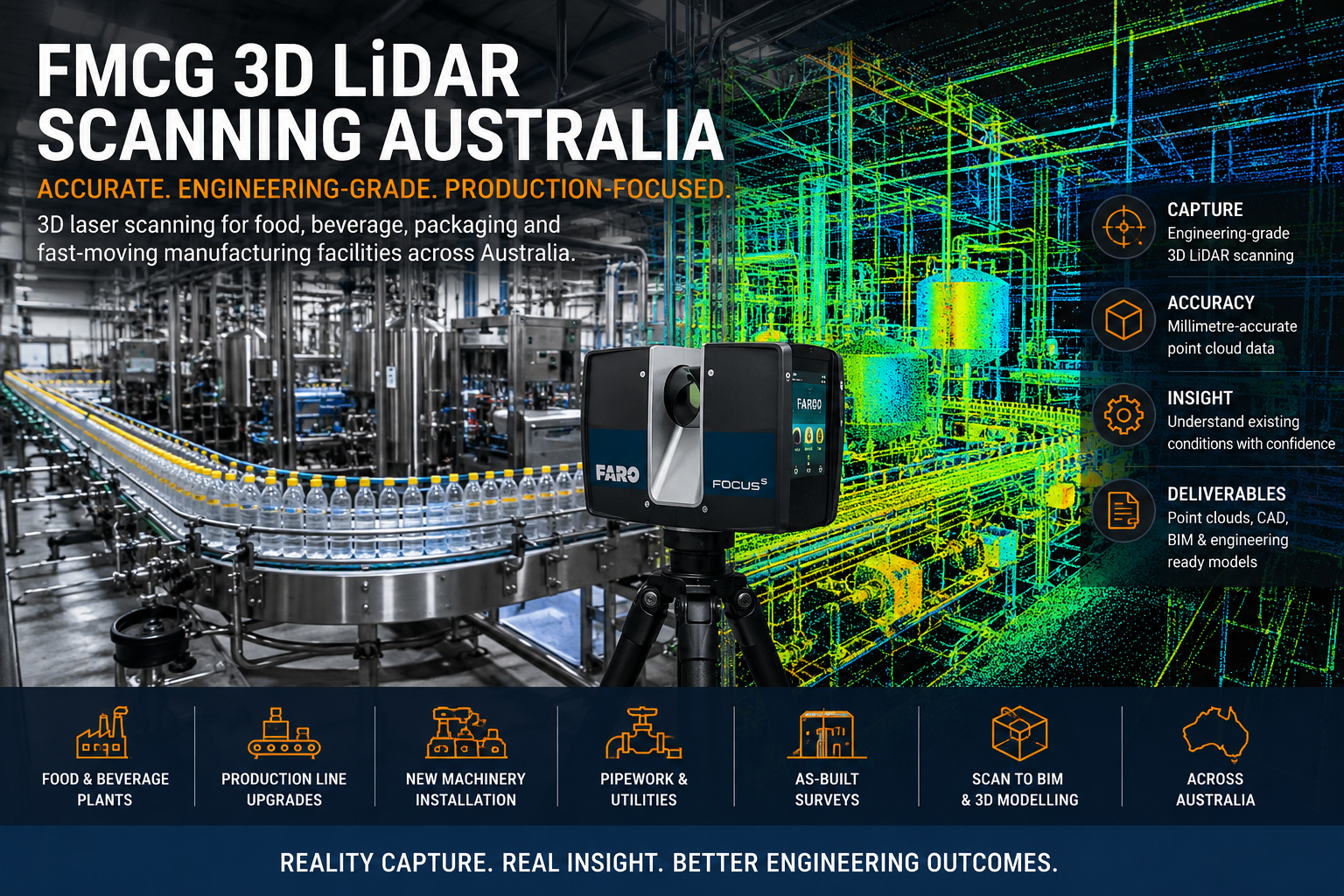
FMCG 3D LiDAR Scanning Australia
Engineering-Grade 3D Laser Scanning for Food, Beverage, Packaging and Fast-Moving Manufacturing Facilities
Fast-moving consumer goods manufacturing is built around production.
Food, beverage, packaging and consumer-product facilities depend on machinery, conveyors, pipework, utilities, structural steel and automated systems operating together in increasingly congested production environments.
The challenge is that these facilities rarely remain exactly as they were originally designed.
Production lines change. New machinery is installed. Conveyors are extended. Pipework is rerouted. Packaging systems are replaced. Platforms are modified. Automation is introduced. Utilities are relocated.
Over time, the physical factory can become significantly different from the drawings available to the engineering team.
Hamilton By Design provides FMCG 3D LiDAR scanning services across Australia, capturing accurate existing factory conditions to support production-line upgrades, machinery installation, plant modifications, engineering design and as-built documentation.
Our approach combines engineering-grade reality capture with mechanical engineering, 3D CAD modelling and drafting so the captured data can be used to solve practical industrial problems.
For projects requiring the captured factory to be developed into coordinated BIM or digital models, see our Factory Scan to BIM Australia service.
The Biggest Problem: The Factory Changes Faster Than the Drawings
One of the biggest engineering problems within an FMCG facility is not necessarily the machinery itself.
It is knowing exactly what is already there.
Food, beverage and consumer-goods factories can undergo numerous modifications during their operating life.
Individual projects may alter:
- production machinery;
- conveyors;
- packaging lines;
- pipework;
- valves;
- pumps;
- ducting;
- structural steel;
- access platforms;
- guarding;
- cable trays;
- electrical services;
- compressed-air systems;
- process utilities;
- equipment foundations; and
- maintenance access.
Those changes are not always incorporated into the original drawings.
The result is a familiar brownfield engineering problem:
Tomorrow’s production equipment may be designed using yesterday’s factory information.
In an FMCG environment, this becomes particularly important because installation work may need to occur during tightly controlled shutdown periods.
If a new machine, conveyor, platform, pipe spool or structural component does not fit when it arrives on site, the problem can quickly become more than an engineering inconvenience.
It can affect production.
3D LiDAR scanning helps reduce this uncertainty by creating a measurable digital record of the facility as it exists today.
What Is FMCG 3D LiDAR Scanning?
3D LiDAR scanning uses laser measurements to capture the geometry of an existing factory, production line or industrial environment.
Multiple scanner positions can be combined to create a registered 3D point cloud representing the physical facility.
The point cloud can capture the spatial relationship between:
- machinery;
- conveyors;
- pipework;
- platforms;
- structures;
- services;
- equipment;
- access areas; and
- surrounding building geometry.
Hamilton By Design’s 3D Laser Scanning for Engineering Projects service is focused on using captured site information as an engineering resource rather than simply producing a visual scan.
Depending on the project, the resulting information can support:
- 3D CAD modelling;
- Scan to BIM;
- equipment layout design;
- general arrangement drawings;
- existing-condition documentation;
- clash assessment;
- mechanical design;
- fabrication planning; and
- installation engineering.
Why 3D Scan an FMCG Factory?
Traditional site measurement can work well when only a small number of dimensions are required.
The difficulty arises when a project has to interact with an entire production environment.
A single equipment installation may need to account for:
- floor levels;
- surrounding machinery;
- access clearances;
- structural columns;
- overhead steelwork;
- pipework;
- cable trays;
- conveyors;
- maintenance access;
- operator access;
- hygiene zones; and
- installation pathways.
Rather than attempting to predict every dimension that may be required later, 3D laser scanning captures a broader representation of the existing environment.
This provides engineers with a digital reference that can be reviewed after the site visit.
For broader manufacturing and industrial projects, Hamilton By Design also provides 3D Laser Scanning for Industrial Plants, combining plant capture with point-cloud-to-CAD, Scan to BIM and engineering applications.
3D Scanning for Food Manufacturing Plants
Food manufacturing facilities can contain complex combinations of processing machinery, conveyors, pipework, tanks, vessels, platforms and building services.
A proposed upgrade may need to integrate into an operating environment where space is already heavily utilised.
3D LiDAR scanning can support projects involving:
- process-line modifications;
- new production equipment;
- conveyor changes;
- packaging-line upgrades;
- pipework modifications;
- plant-room alterations;
- new platforms and access;
- utility changes; and
- factory redevelopment.
Existing-condition capture can be particularly valuable where the original drawings are incomplete or numerous plant changes have occurred over time.
Hamilton By Design already supports food, beverage and manufacturing businesses through its broader Mechanical Engineering Services on the Central Coast, including plant upgrades, component replacement and 3D LiDAR scanning.
3D Laser Scanning for Beverage Plants
Beverage-production facilities often combine process equipment with extensive pipework, tanks, conveyors, filling machinery and packaging systems.
A relatively small modification can therefore involve several engineering interfaces.
Typical applications may include:
- bottling-line modifications;
- filling equipment;
- tank installations;
- process pipework;
- conveyor rerouting;
- packaging equipment;
- palletising systems;
- structural platforms;
- access modifications; and
- service coordination.
Capturing the surrounding environment before design begins provides a more reliable basis for positioning new equipment and identifying potential conflicts.
Packaging-Line 3D Scanning
Packaging lines can involve closely integrated machinery operating within limited floor space.
Equipment may include:
- fillers;
- cappers;
- labellers;
- wrappers;
- case packers;
- carton systems;
- conveyors;
- inspection equipment;
- palletisers; and
- robotic handling systems.
When one piece of machinery is replaced, the new equipment may still have to connect with the existing upstream and downstream production systems.
3D scanning can capture those interfaces so the engineering team can assess the available space before the replacement equipment is installed.
Production-Line Modifications
Production lines evolve.
New products may require different machinery.
Higher throughput may require new conveying systems.
Manual operations may be automated.
Existing machines may need to move.
The surrounding factory does not necessarily move with them.
This means a production-line modification may have to fit between existing machinery, structural columns, platforms, services and access areas.
An engineering-grade point cloud can provide the design team with an accurate reference for developing the revised production layout.
For projects where a full digital representation of the factory is required, our Factory Scan to BIM Australia service can convert existing-condition capture into practical BIM and CAD information for factory upgrades.
New Machinery and Equipment Installation
Installing new equipment into an existing FMCG factory is fundamentally different from placing machinery in an empty building.
The proposed machine may need to fit around:
- existing production equipment;
- conveyors;
- structural steel;
- services;
- access routes;
- maintenance zones;
- existing foundations;
- floor penetrations;
- overhead obstructions; and
- operator working areas.
3D scanning before detailed design can help establish these interfaces.
The proposed equipment can then be modelled within the captured environment.
This can assist the engineering team in answering practical questions such as:
Will the machine fit?
Can it be installed?
Can it be maintained once installed?
Will existing equipment obstruct access?
Do surrounding services need to move?
Will the new conveyor align with the existing production line?
Brownfield Engineering for FMCG Facilities
Most existing FMCG upgrade projects are brownfield projects.
The new engineering has to work around what already exists.
This may include equipment installed decades earlier, later modifications, undocumented steelwork, relocated services and machinery that cannot easily be moved.
Hamilton By Design’s broader Engineering Services combine reality capture with mechanical engineering, modelling and drafting for brownfield and retrofit projects.
The advantage of integrating scanning with engineering is that the scanning strategy can be developed around what the project team actually needs to design.
The purpose is not simply to capture everything.
The purpose is to capture the information required to make better engineering decisions.
FMCG Factory As-Built Surveys
Accurate as-built documentation can be difficult to maintain in a continuously evolving production facility.
Drawings may show what was originally installed rather than what exists today.
A LiDAR-based as-built survey can create a new spatial reference for the factory.
This may be useful where:
- drawings are unavailable;
- existing drawings are outdated;
- equipment has moved;
- pipework has changed;
- platforms have been added;
- production systems have been modified;
- multiple contractors have changed the facility; or
- future upgrades are being planned.
For larger digital documentation projects, Hamilton By Design’s national Scan to BIM Australia services provide a pathway from measured reality to structured digital models.
Scan Before the Shutdown
Production shutdowns can represent one of the most expensive periods of an FMCG engineering project.
The installation window may be fixed while numerous contractors and activities compete for access.
Where practical, scanning before the shutdown allows engineering work to begin while the plant is still operating.
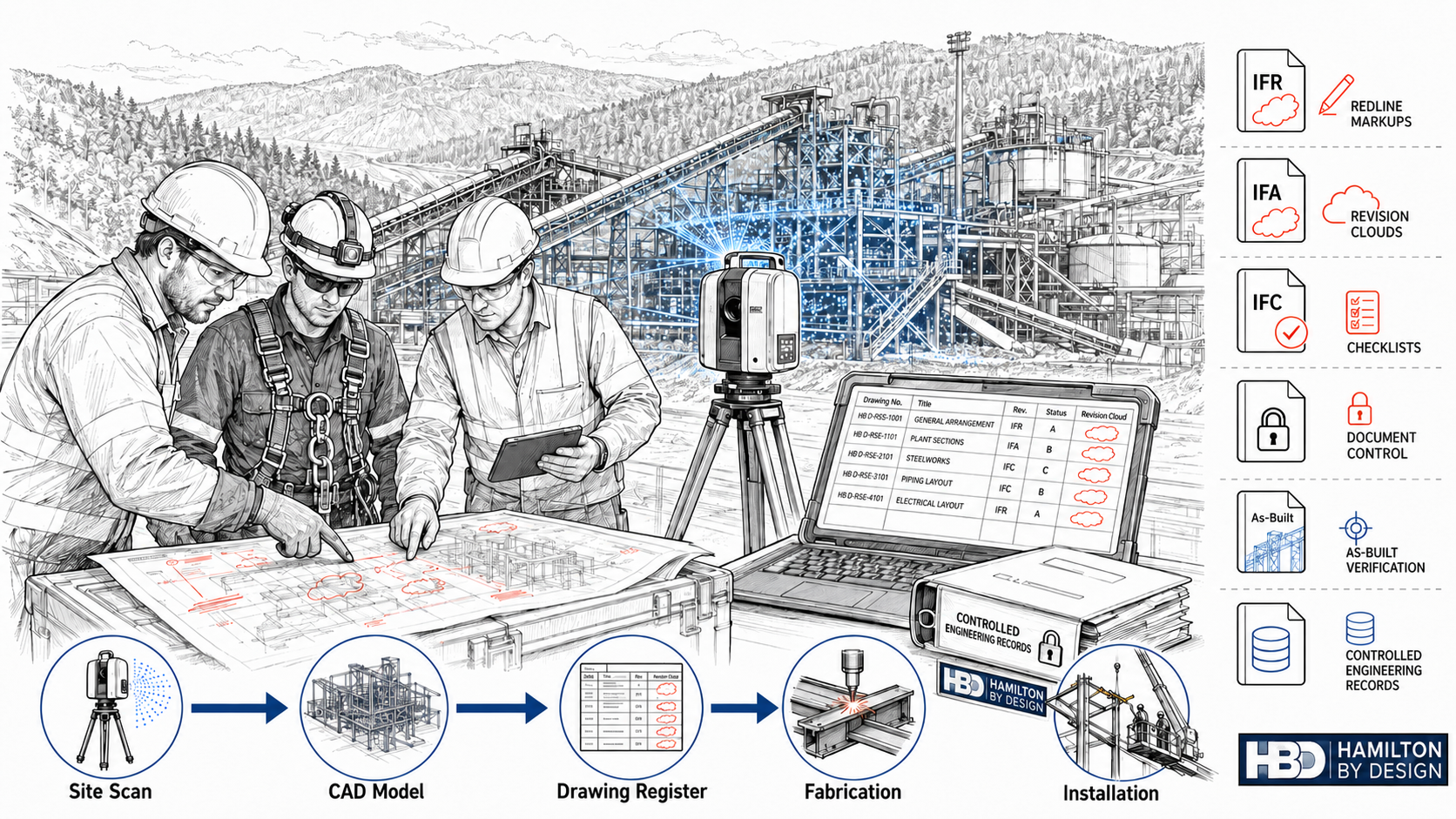
A typical workflow can become:
3D Site Scanning
↓
Point-Cloud Registration
↓
Existing-Condition Review
↓
3D CAD Modelling
↓
Engineering Design
↓
Fabrication Planning
↓
Shutdown Installation
The more engineering that can be completed before the shutdown begins, the less work needs to be resolved while production is offline.
Hamilton By Design’s 3D Laser Scanning for Engineering service is specifically focused on using accurate existing-condition data to support brownfield upgrades, shutdown engineering and fabrication planning.
Conveyor and Materials-Handling 3D Scanning
Conveyors are common throughout FMCG production and packaging systems.
They may connect several machines across a production line and frequently pass beneath or around existing structures and services.
3D scanning can capture:
- conveyor centre lines;
- conveyor elevations;
- support frames;
- transfer locations;
- machinery interfaces;
- surrounding structures;
- access areas;
- guarding;
- platforms; and
- overhead restrictions.
This information can support conveyor extensions, production-line changes and new machinery integration.
Pipework, Utilities and Factory Services
Food, beverage and FMCG plants can contain extensive networks of mechanical and electrical services.
Depending on the facility, these may include:
- process pipework;
- compressed air;
- water;
- steam;
- cleaning systems;
- drainage;
- electrical services;
- cable trays;
- ventilation;
- ducting; and
- equipment utilities.
These services often occupy congested spaces above, below and around production equipment.
3D laser scanning provides a way to capture their spatial relationship to the surrounding factory.
The resulting point cloud can then support routing studies, plant modifications and equipment connections.
Structural Steel, Platforms and Access
New equipment does not exist independently of the surrounding structure.
Manufacturing facilities may contain:
- structural columns;
- beams;
- roof trusses;
- equipment support structures;
- platforms;
- stairs;
- handrails;
- equipment frames;
- walkways; and
- mezzanines.
Capturing this geometry provides engineers with a reference when developing equipment layouts or assessing structural interfaces.
From FMCG Point Cloud to CAD and BIM
The registered point cloud is only the starting point.
Depending on the project requirement, captured factory information can be converted into engineering geometry.
This may include:
- SolidWorks models;
- AutoCAD drawings;
- BIM models;
- equipment layouts;
- mechanical arrangements;
- structural interfaces;
- sections and elevations;
- general arrangement drawings;
- fabrication reference geometry; and
- existing-condition models.
Hamilton By Design’s Scan to BIM Sydney service demonstrates the broader workflow of combining LiDAR scanning with BIM to establish accurate digital representations for design, maintenance and asset-management applications.
Engineer-Led FMCG 3D Scanning
A factory can be scanned in many different ways.
The most appropriate scanning strategy depends on what the project needs to achieve.
An engineering-led approach considers questions such as:
- What is being modified?
- Which interfaces are critical?
- What equipment is being replaced?
- Which dimensions will matter during installation?
- Does the surrounding structure need to be modelled?
- What CAD system will be used?
- Does fabrication need to occur before the shutdown?
- Which areas are difficult to access?
- What level of modelling is actually required?
Hamilton By Design combines 3D scanning with mechanical engineering and design experience so the scanning scope can be developed around the downstream engineering requirement.
FMCG 3D LiDAR Scanning Across Australia
Hamilton By Design provides FMCG, factory and industrial 3D laser scanning services for projects across Australia.
We can support projects in:
- Sydney;
- Newcastle;
- Central Coast NSW;
- Wollongong;
- Brisbane;
- Gold Coast;
- Melbourne;
- Adelaide;
- Perth;
- Darwin;
- regional NSW;
- regional Queensland;
- regional Victoria;
- regional South Australia;
- regional Western Australia; and
- other industrial locations throughout Australia.
For broader national reality-capture requirements, see our 3D Laser Scanning services.
FMCG Industries We Can Support
3D LiDAR scanning can support a wide range of fast-moving manufacturing environments, including:
- food manufacturing;
- beverage production;
- dairy processing;
- bakeries;
- bottling plants;
- breweries;
- confectionery;
- frozen-food production;
- meat processing;
- packaging plants;
- consumer-product manufacturing;
- personal-care manufacturing;
- household-product manufacturing;
- warehousing;
- logistics;
- automated production;
- palletising facilities; and
- general manufacturing.
The common requirement is an existing production environment where new engineering must fit around the real facility.
Typical FMCG 3D Scanning Deliverables
Project deliverables can be tailored to suit the downstream engineering workflow and may include:
- registered 3D point clouds;
- E57 files;
- RCP/RCS datasets;
- LAS files;
- 3D CAD models;
- BIM models;
- SolidWorks models;
- STEP files;
- SAT files;
- AutoCAD DWG files;
- DXF files;
- general arrangement drawings;
- sections;
- elevations;
- equipment layouts;
- existing-condition plans; and
- engineering documentation.
Not every project requires every deliverable.
The appropriate output should be determined by what the engineering team needs to achieve.
Frequently Asked Questions
What is FMCG 3D LiDAR scanning?
FMCG 3D LiDAR scanning uses laser-based reality capture to document the existing geometry of food, beverage, packaging and consumer-goods manufacturing facilities. The resulting point cloud can support engineering, CAD, BIM and plant-upgrade projects.
Can you scan an operating food or manufacturing factory?
Many facilities can be scanned while normal operations continue, subject to site safety requirements, access restrictions and the nature of the production process.
Can production machinery be included in the scan?
Yes. Machinery, conveyors, structural steel, platforms, services, pipework and surrounding building geometry can be captured according to the requirements of the project.
Can scanning help before installing new machinery?
Yes. Capturing the surrounding environment before equipment installation allows the proposed machinery and its interfaces to be evaluated against existing factory geometry.
Can you scan conveyor systems?
Yes. Conveyor geometry, supports, interfaces, transfers, surrounding structures and associated equipment can be included in the scan.
What happens if our factory drawings are outdated?
This is one of the main reasons to consider reality capture. 3D scanning records the existing physical condition rather than relying entirely on legacy drawings.
Can FMCG scan data be used for Scan to BIM?
Yes. Where required, point-cloud information can be developed into BIM or CAD models. See our Factory Scan to BIM Australia service for more information.
Can the scan data be used in SolidWorks?
Point-cloud information can be used as reference data for developing appropriate engineering geometry for SolidWorks workflows.
Do you provide FMCG 3D scanning outside Sydney?
Yes. Hamilton By Design supports 3D laser scanning and engineering projects throughout Australia.
Planning an FMCG Factory Upgrade?
A successful factory modification starts with understanding what is already there.
Before designing a new production line, installing machinery, modifying conveyors or fabricating equipment around old drawings, capture the existing facility accurately.
Hamilton By Design provides FMCG 3D LiDAR scanning, Factory Scan to BIM, mechanical engineering, 3D modelling and drafting services across Australia.
Our goal is to provide engineering teams with a reliable digital starting point for brownfield projects where fit, access, interfaces and shutdown duration matter.
Capture the existing factory. Understand the interfaces. Engineer the upgrade around reality.

Contact Us – Talk To Us
Our clients: