


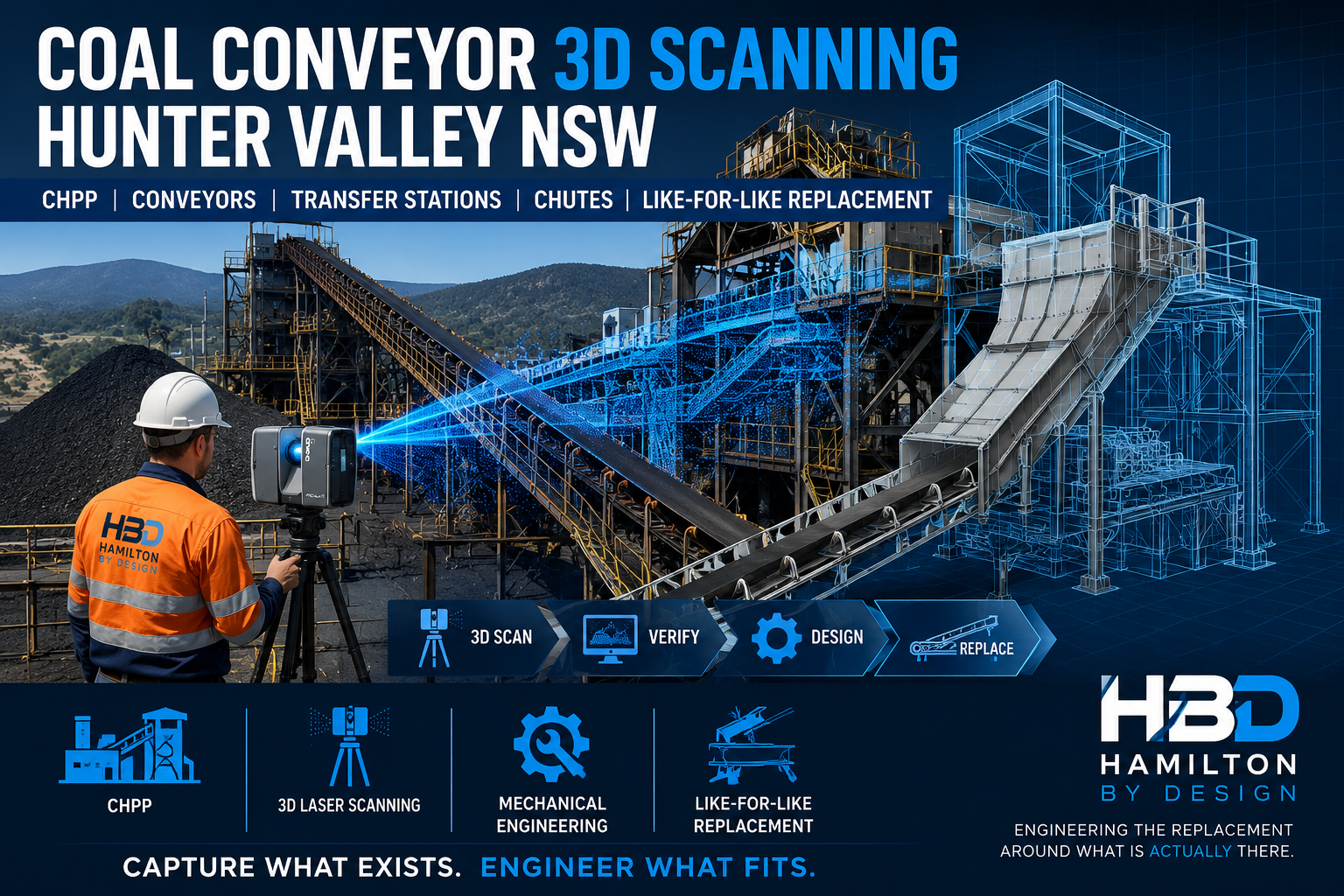

Coal Handling and Preparation Plants across the Hunter Valley operate in demanding conditions. Conveyors run continuously, transfer chutes are exposed to abrasive coal and fines, structures are modified during successive shutdowns, and plant layouts can gradually move away from the drawings originally used to construct them.
For maintenance and project teams, this creates a practical problem: how do you design a replacement component with confidence when the existing plant is no longer exactly as drawn?
Hamilton By Design provides Coal Conveyor 3D Scanning Hunter Valley services combining engineering-grade LiDAR scanning, mechanical engineering, reverse engineering and 3D CAD modelling. Our approach allows conveyor systems, transfer stations, chutes and associated CHPP equipment to be captured as they actually exist before replacement or modification work begins.
For broader regional capability, see our Hunter Valley Mining Engineering & 3D Laser Scanning Services.
Why Existing CHPP Information Can Become Unreliable
A coal wash plant can remain operational for decades. During that time, equipment may be repaired, reinforced, replaced or modified during short maintenance windows.
A transfer station that looks unchanged externally may have undergone numerous alterations, including:
- new wear liners;
- additional support steel;
- replacement conveyor components;
- modified skirts;
- altered chute geometry;
- relocated guards;
- new platforms and handrails;
- additional pipework;
- electrical cable routes;
- revised maintenance access; and
- temporary modifications that eventually became permanent.
Consequently, legacy drawings may remain useful as historical information but may no longer provide sufficient dimensional certainty for a replacement project.
Hamilton By Design’s CHPP Engineering & 3D Scanning services combine existing-condition capture with mechanical and digital engineering to support brownfield upgrades.
Instead of assuming that the original drawing represents the plant, we can measure the installed asset and develop the engineering around the actual condition.
Coal Conveyor 3D Scanning Hunter Valley
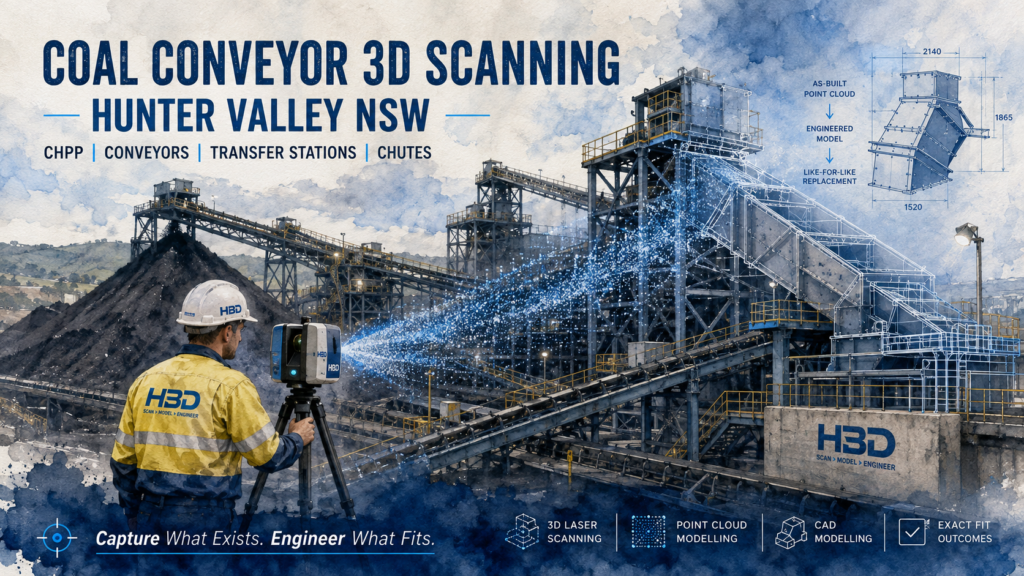
Engineering-grade 3D laser scanning allows large sections of conveyor and CHPP infrastructure to be captured efficiently as a dense three-dimensional point cloud.
The scan can record the spatial relationship between conveyor steelwork, transfer chutes, platforms, walkways, structures, pipework, equipment and surrounding services.
Hamilton By Design provides dedicated 3D Laser Scanning services for mining, processing and industrial facilities throughout Australia.
For Hunter Valley coal operations, typical scanning targets can include:
- conveyor head and tail stations;
- transfer towers;
- conveyor galleries;
- chutes and hoppers;
- bins;
- screen structures;
- feeders;
- drive arrangements;
- pulley locations;
- platforms and access systems;
- maintenance areas;
- guarding;
- surrounding structural steel;
- pipework and services; and
- equipment interfaces.
The objective is not simply to produce a point cloud.
The real value comes from using that captured information as the basis for engineering decisions.
From Point Cloud to Practical Engineering
Once site capture has been completed, selected areas of the point cloud can be converted into usable engineering geometry.
Hamilton By Design’s Surface Mine Scan-to-CAD Hunter Valley NSW service is particularly useful where project teams need CAD information suitable for modifications, replacement equipment or shutdown planning.
Depending on the project, deliverables may include:
- registered point clouds;
- E57, RCP, RCS or LAS files;
- SolidWorks models;
- Inventor models;
- AutoCAD geometry;
- STEP or SAT files;
- existing-condition models;
- general arrangement drawings;
- sections and elevations;
- interface models; and
- fabrication drawings.
The modelling effort can also be targeted.
There is often no need to model an entire CHPP in fabrication-level detail when the project concerns one chute or one conveyor transfer.
The relevant interfaces can instead be modelled accurately around the area being modified.
Like-for-Like Replacement Engineering for Coal Wash Plants
Like-for-like replacement is particularly valuable in established CHPP facilities.
A component may have reached the end of its service life while its basic function remains satisfactory. In these situations, replacing the equipment with something substantially different may introduce unnecessary project risk, cost and shutdown complexity.
Hamilton By Design can assist with like-for-like and fit-for-purpose replacement engineering by capturing the installed component, establishing its interfaces and recreating the required geometry in CAD.
This can apply to:
- conveyor structures;
- transfer chutes;
- hoppers;
- wear plates;
- guards;
- platforms;
- support frames;
- transitions;
- covers;
- fabricated mechanical components; and
- obsolete equipment.
However, “like-for-like” should not simply mean copying a component without engineering review.
The replacement should still be assessed against the project’s design requirements, site standards, current operating conditions and applicable Australian Standards.
Hamilton By Design provides broader Mechanical Engineering Consulting covering brownfield plant upgrades, bulk-material-handling systems, conveyors, chutes, feeders, guarding and maintenance-access improvements.
Transfer Chutes – Where Small Errors Become Big Problems
Transfer stations are among the most challenging parts of coal handling systems.
The material leaves one conveyor and must be controlled as it passes through a chute before being presented correctly onto the receiving belt.
Poor geometry can contribute to:
- belt mis-tracking;
- uneven loading;
- excessive wear;
- dust generation;
- material buildup;
- blockage;
- spillage;
- accelerated liner wear; and
- increased maintenance requirements.
The problem becomes more difficult in an existing CHPP where the transfer chute must fit between structures that may have changed since the original plant was constructed.
Hamilton By Design’s Chute Design & Materials-Handling Engineering combines scanning, mechanical engineering and fabrication-aware modelling for existing bulk-material-handling installations.
Rather than designing a chute in isolation, the surrounding plant can be incorporated into the model.
This helps establish available envelope, flange locations, belt positions, maintenance clearances and installation constraints before fabrication begins.
Reducing Shutdown Risk Through Reality Capture
Shutdown work is expensive because the installation window is limited.
Discovering during a shutdown that a chute flange is incorrectly positioned, a support beam has moved, or a replacement assembly clashes with existing services can consume valuable production time.
Engineering-led scanning enables more of this uncertainty to be addressed beforehand.
Hamilton By Design also provides Engineering-Led 3D Scanning for CHPP & Coal Wash Plant Shutdowns, supporting the capture of conveyors, transfer stations, bins, structural steel, foundations, tie-in locations and maintenance clearances.
A typical workflow may be:
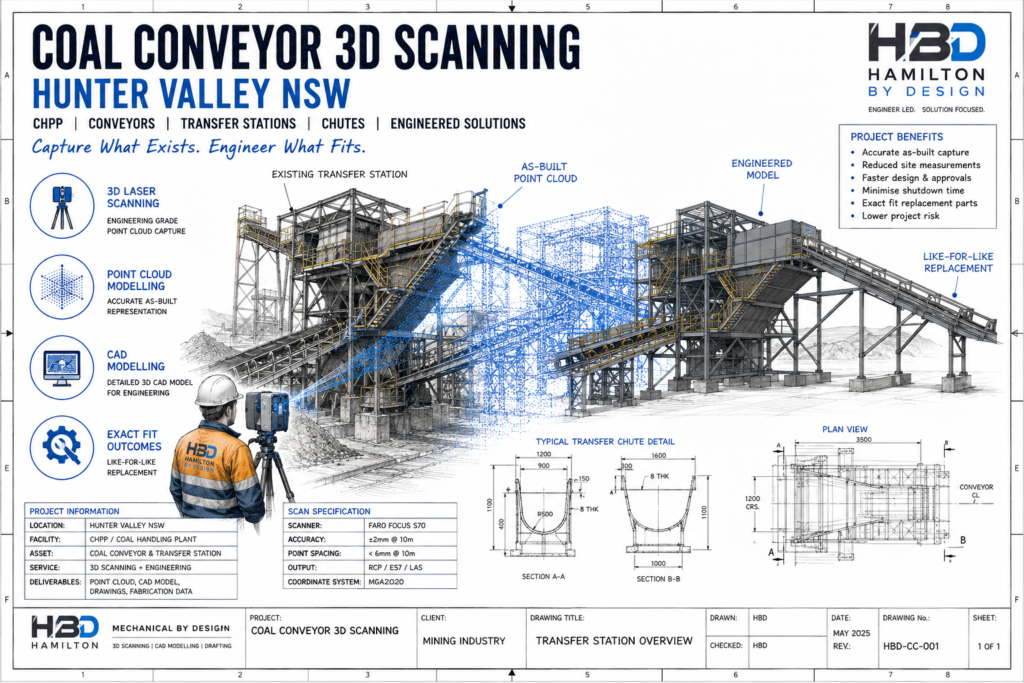
3D scan existing plant → register point cloud → model critical interfaces → develop replacement → overlay proposed design → check clashes → produce fabrication drawings → manufacture → install during shutdown
The objective is straightforward:
measure once, engineer accurately and maximise the amount of work completed before the shutdown begins.
Reverse Engineering Obsolete CHPP Components
Mining equipment often remains in service much longer than the availability of its original components.
Manufacturers may no longer exist, drawings may be unavailable or replacement equipment may have different mounting arrangements.
3D scanning and reverse engineering can provide a pathway forward.
Existing components can be captured before removal and converted into 3D CAD geometry. Critical dimensions, mounting arrangements and surrounding constraints can then be identified.
Hamilton By Design’s engineering-focused 3D Laser Scanning for Engineering Projects supports conversion of point-cloud data into usable models for structural steel, platforms, chutes, piping, ducting and mechanical equipment.
For replacement projects, the goal is not necessarily to reproduce every feature of the original component.
The objective may instead be to retain the interfaces that matter while improving wear life, fabrication, access or maintainability.
Australian Standards and Engineering Requirements
CHPP modifications should be developed against the standards applicable to the particular equipment and scope.
Depending on the project, these may include:
AS/NZS 4024 series – Safety of Machinery
Relevant to machinery safety, risk reduction, conveyor systems and guarding.
AS/NZS 4024.3610 – Conveyors
Provides general requirements associated with conveyor safety.
AS/NZS 4024.3611 – Belt Conveyors for Bulk Material Handling
Particularly relevant to belt conveyor systems used for coal and bulk materials.
AS 1657 – Fixed Platforms, Walkways, Stairways and Ladders
Important where conveyor modifications involve maintenance access, stairs, platforms or walkways.
AS 4100 – Steel Structures
May apply to structural steel forming part of conveyor and transfer-station modifications.
AS/NZS 1170 series – Structural Design Actions
Relevant where structural loading forms part of the design assessment.
AS/NZS 1554 series – Structural Steel Welding
Applicable to relevant fabricated and welded steelwork.
Other standards and mine-specific engineering requirements may also apply depending on the equipment being modified.
The applicable design basis should therefore be established for each project rather than assuming one generic standard covers an entire CHPP.
Supporting Hunter Valley Coal Operations
Hamilton By Design supports mining and processing projects throughout NSW, including the Hunter Valley, Singleton, Muswellbrook, Newcastle and surrounding mining regions.
Our broader Mining NSW engineering and 3D scanning capability connects reality capture with mechanical engineering, reverse engineering and CAD documentation for brownfield mining facilities.
The approach is particularly suited to smaller and clearly defined engineering scopes where an operation needs experienced technical support without engaging a large multidisciplinary consultancy for every plant modification.
Projects can range from scanning one transfer station through to capturing larger sections of a CHPP for an upcoming shutdown or plant-upgrade program.
Engineer-Led Scanning – Not Scanning for Scanning’s Sake
A point cloud is extremely useful, but only when it captures the information required by the engineering project.
Because Hamilton By Design approaches reality capture from an engineering perspective, scanning can be planned around questions such as:
- What is being replaced?
- Which interfaces control fit?
- What areas require detailed modelling?
- What can be fabricated before shutdown?
- Where could the new equipment clash?
- Which areas require maintenance access?
- What information does the fabricator actually need?
This changes the conversation from simply “we need a scan” to:
“What engineering information do we need to make this replacement fit?”
For coal conveyor and CHPP projects throughout the Hunter Valley, that distinction can make reality capture significantly more useful.
Frequently Asked Questions
What is Coal Conveyor 3D Scanning?
Coal conveyor 3D scanning uses terrestrial laser scanning or LiDAR technology to capture the existing geometry of conveyors, transfer stations, structures, chutes and surrounding plant. The resulting point cloud provides accurate spatial information for engineering, modelling and replacement projects.
Can Hamilton By Design scan an operating CHPP?
Scanning methodology depends on the site’s safety requirements, access arrangements and operating conditions. Where access is permitted, substantial areas of plant can often be captured without physically contacting the equipment.
Can you design directly from the point cloud?
Yes. Point clouds can be imported into engineering workflows and used as the reference for CAD modelling, equipment layouts, replacement design and clash checking.
Do you provide like-for-like replacement engineering?
Yes. Hamilton By Design can support like-for-like and fit-for-purpose replacement of existing mechanical and fabricated CHPP components. The existing asset can be scanned, modelled and assessed before replacement drawings are developed.
Can you reverse engineer a chute if the original drawings are missing?
Yes. Existing chute geometry and surrounding interfaces can be captured using 3D scanning and converted into CAD. The replacement can then reproduce the necessary interfaces or incorporate appropriate improvements.
Can you help redesign a transfer chute that is spilling coal?
Yes. Transfer chute projects can involve existing-condition capture, chute geometry review, materials-handling engineering, wear-liner considerations, maintenance access and fabrication detailing. The appropriate solution depends on the cause of the spillage and operating conditions.
What files can Hamilton By Design provide?
Depending on project requirements, deliverables can include registered point clouds, E57, RCP, RCS and LAS data, SolidWorks or Inventor models, STEP/SAT geometry, AutoCAD files, general arrangements and fabrication drawings.
Why scan before a CHPP shutdown?
Pre-shutdown scanning allows plant conditions and replacement interfaces to be captured while engineering and fabrication work can still be completed ahead of the outage. This can help identify clashes and dimensional problems before installation crews are working against the shutdown clock.
Does 3D scanning replace engineering inspection?
No. 3D scanning provides dimensional and spatial information. Engineering assessment, condition inspection, calculations and verification remain separate activities where required.
What Australian Standards apply to coal conveyors?
Applicable standards depend on the project, but commonly relevant requirements may include the AS/NZS 4024 machinery-safety series, AS/NZS 4024.3610 and AS/NZS 4024.3611 for conveyors, AS 1657 for access systems, AS 4100 for structural steel and relevant welding and structural-action standards.
Coal Conveyor 3D Scanning Hunter Valley – Talk to Hamilton By Design
Conveyor and transfer-station modifications become more difficult when the existing plant no longer matches the drawings.
Hamilton By Design combines 3D laser scanning, Scan-to-CAD, reverse engineering and mechanical design to establish what is actually installed before replacement components are designed and fabricated.
For Hunter Valley CHPP operators, maintenance teams, project engineers and contractors, this provides a practical pathway from:
Existing plant → accurate 3D capture → engineering model → replacement design → fabrication → shutdown installation.
Whether the requirement involves a worn chute, conveyor modification, transfer-station upgrade, obsolete component or like-for-like replacement, Hamilton By Design can provide engineering-led support based on the real condition of the plant.
Hamilton By Design – Engineering the replacement around what is actually there.

Contact Us – Talk To Us
Our clients:
























