

Planning a chute replacement, pipework modification or equipment upgrade starts with understanding the plant that is already there. Hamilton By Design offers 3D LiDAR scanning for projects at Peak Mine and across the Cobar region, helping engineering and maintenance teams capture existing conditions before design and fabrication begin.
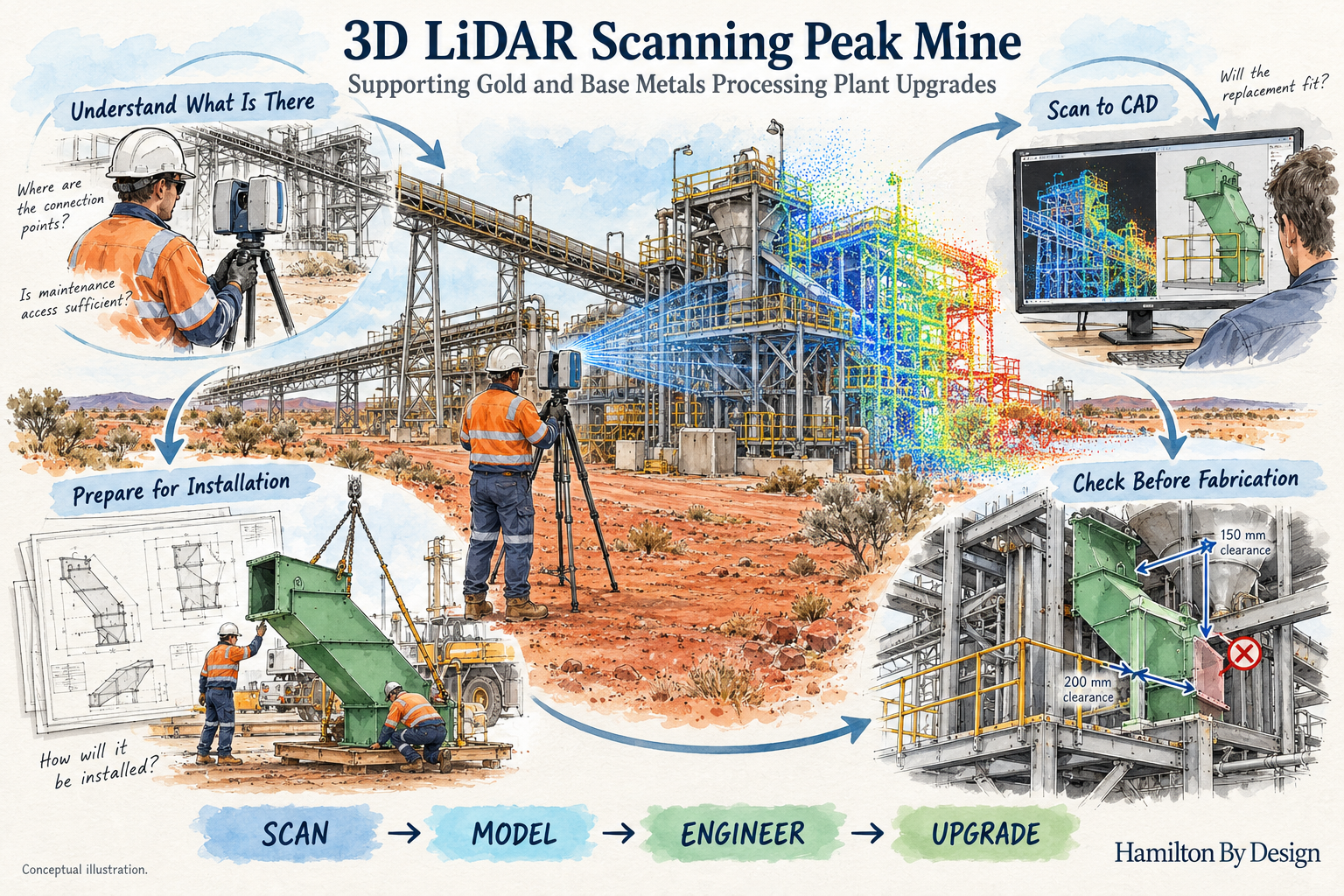
Our workflow connects site measurements with practical engineering deliverables:
Scan → Model → Engineer → Upgrade
Supporting Processing Plant Projects in the Cobar Region
Aurelia Metals’ Peak operation near Cobar includes underground mining areas and a gold and base metals processing plant handling lead-zinc-gold and copper-gold ores.
For modifications within an established processing plant, the challenge is often fitting new equipment around existing infrastructure. Older drawings may not reflect previous alterations, while congested areas can make manual measurements difficult.
3D LiDAR scanning captures visible plant geometry as a point cloud, providing a spatial reference for planning modifications, checking clearances and developing engineering models.
Hamilton By Design can support proposed Peak Mine projects with scanning, scan-to-CAD modelling, mechanical design and fabrication documentation.
Capture Existing Conditions Before Design
A registered point cloud allows designers to review the relationship between equipment, supporting steelwork, pipework and access routes.
Depending on the project scope and site access, scanning can capture:
- Conveyors, transfer points and chute arrangements.
- Accessible bins, hoppers and equipment exteriors.
- Pipework, pump installations and service corridors.
- Platforms, walkways, stairs and surrounding steelwork.
- Equipment foundations and visible connection locations.
- Available space for installation and maintenance access.
This information helps establish the constraints that influence a replacement component or plant modification.
Chute Replacement and Conveyor Modifications
A replacement chute needs to suit both the material handling duty and the available installation space.
Scanning can help establish the relationship between conveyor discharge points, receiving equipment, support steelwork and surrounding services. These measurements provide a basis for developing chute geometry and reviewing how the proposed assembly will be installed.
Hamilton By Design can assist with:
- Existing chute and transfer point modelling.
- Replacement chute layouts.
- Flange and interface positioning.
- Liner arrangements and maintenance access.
- General arrangement and fabrication drawings.
- Installation clearance reviews.
Material flow performance, wear protection and supporting loads require engineering assessment alongside the captured geometry.
Pipework, Pumps and Equipment Fit-Up
Pipe routes and equipment installations often pass through areas with limited clearance. A point cloud helps designers assess proposed arrangements against the surrounding plant before components are fabricated.
Typical applications include pump skid replacements, pipe spool layouts, service rerouting, equipment relocations and maintenance access improvements.
Critical interfaces—such as flange faces, bolt patterns and equipment connection points—can require supplementary measurements or closer inspection. We identify these requirements when defining the scanning and design scope.
From Point Clouds to Engineering Models and Drawings
The most useful deliverable depends on what the project team needs to decide or build.
| Deliverable | Project application |
|---|---|
| Registered point cloud | Reviewing existing plant conditions |
| 3D CAD model | Developing equipment layouts and modifications |
| Combined point cloud and design review | Checking clearances and potential clashes |
| General arrangement drawings | Communicating position, dimensions and interfaces |
| Fabrication drawings | Documenting approved components for manufacture |
| Installation views | Supporting assembly and shutdown planning |
Deliverable formats can include E57, RCP, STEP, DXF and PDF, as agreed for the project.
Plan Fabrication and Shutdown Work Earlier
Discovering an interference during installation can lead to site modifications, additional labour and delays.
By comparing proposed designs with captured site conditions, project teams can identify potential problems earlier and make better-informed decisions about fabrication, transport, lifting and assembly.
Scanning also helps teams review areas remotely, reducing the need for repeat measurement visits where the captured coverage is sufficient.
Site scanning is planned around inductions, permits, operating conditions and access restrictions. Equipment movement, obstructions and inaccessible surfaces affect what can be captured, so coverage and measurement requirements are agreed before mobilisation.
Discuss 3D LiDAR Scanning for Your Peak Mine Project
If you are planning a processing plant modification at Peak Mine or elsewhere in the Cobar region, Hamilton By Design can help establish the existing geometry and develop the models and drawings needed to progress the work.
Send through available drawings, photographs and a brief description of the proposed modification. We can define the scanning area, identify critical interfaces and prepare a scope suited to your project.
Contact Hamilton By Design to discuss 3D LiDAR scanning, mechanical design and scan-to-CAD support for your next plant upgrade.
Hamilton By Design is an independent engineering service provider. References to Peak Mine and Aurelia Metals identify the location and project context and do not imply an existing engagement or endorsement.
Contact Us – Talk To Us
Our clients: