


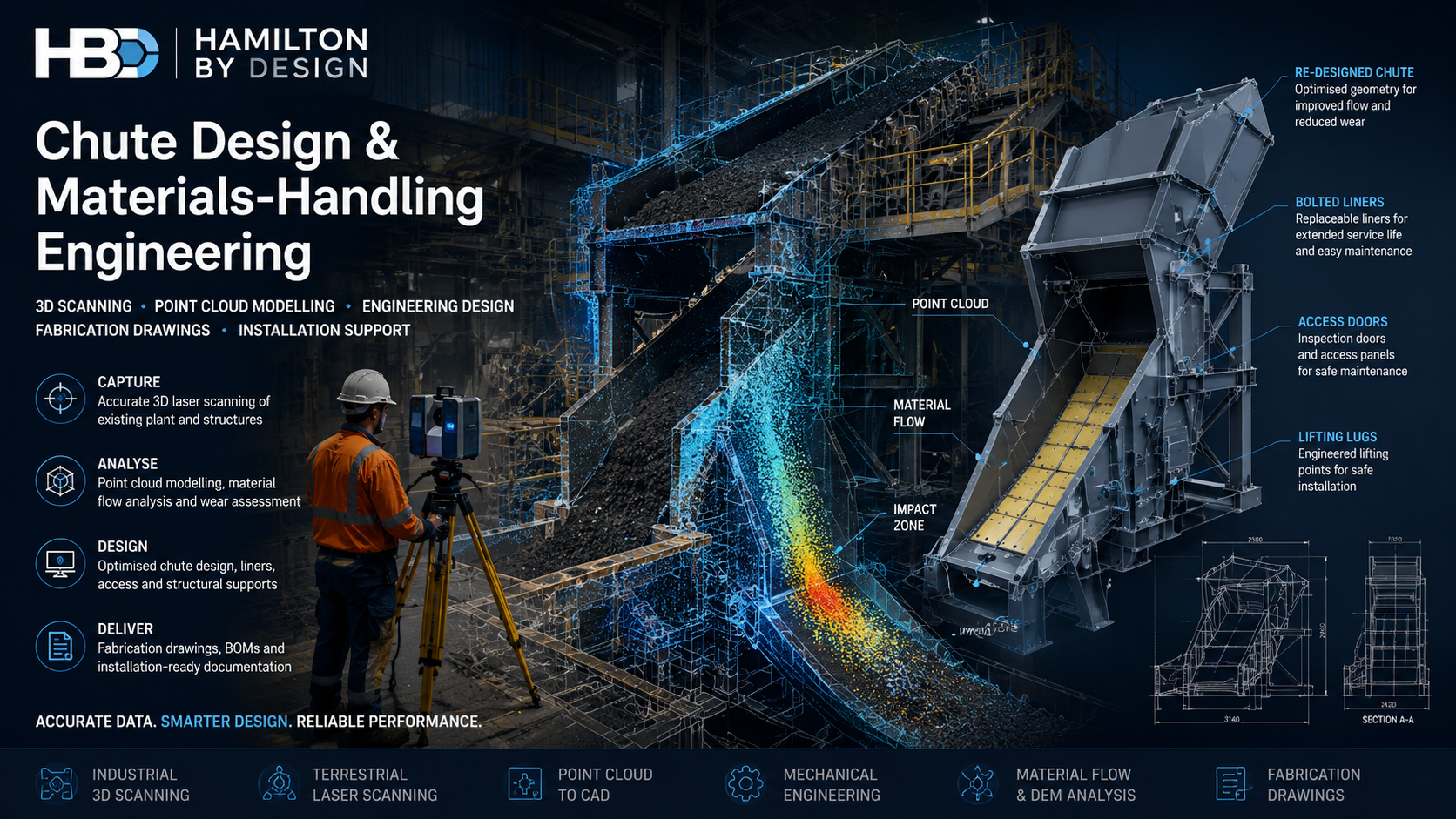
Chute Design and Materials-Handling Engineering
Hamilton By Design provides chute design and materials-handling engineering services for mining, mineral processing, manufacturing, ports, quarries and heavy industrial facilities across Australia.
Our approach combines mechanical engineering, industrial 3D scanning, terrestrial laser scanning, point-cloud modelling and fabrication-ready CAD documentation. This allows existing transfer stations and bulk-material-handling systems to be accurately captured, assessed and redesigned with a focus on fit, reliability, maintainability and practical installation.
Chutes are often treated as relatively simple fabricated structures. In practice, they can be some of the most troublesome components within a conveyor or processing system. Poorly performing chutes can cause blockages, excessive wear, dust, spillage, belt damage, product degradation and repeated shutdown work.
Hamilton By Design supports brownfield and upgrade projects where existing drawings may be incomplete, outdated or unavailable. By combining engineering-grade site capture with mechanical design, we can develop solutions around the actual condition of the plant rather than relying solely on historical information or manual measurements.
Chute Design Services for Existing Industrial Plant
A successful chute design must do more than contain material.
It must guide bulk material through the transfer point while managing impact, velocity, wear, dust, access, structural loading and maintenance requirements.
Hamilton By Design can assist with the design, modification and documentation of:
- conveyor transfer chutes;
- feed chutes;
- discharge chutes;
- loading chutes;
- diverter chutes;
- crusher feed arrangements;
- hoppers and bins;
- skirt systems;
- impact zones;
- wear-liner systems;
- removable chute sections;
- access doors and inspection panels;
- structural support frames;
- maintenance platforms;
- lifting arrangements for removable components.
Each project is reviewed in the context of the surrounding plant. This may include conveyors, pulleys, support steelwork, pipework, electrical services, platforms, walkways, equipment foundations and restricted removal paths.
The objective is to create a design that performs its intended function while also fitting the available space and supporting safe fabrication, installation and maintenance.
Common Chute and Transfer-Point Problems
Many chute-design projects begin with an operational problem rather than a new installation.
The existing chute may have operated for years but now struggles with higher throughput, changed material characteristics, increased moisture, worn liners or modified upstream equipment.
Common problems include:
- material blockages and hang-up;
- excessive impact at transfer points;
- accelerated liner and plate wear;
- dust generation;
- uncontrolled spillage;
- off-centre loading onto the receiving belt;
- belt tracking problems;
- product degradation;
- inadequate throughput;
- excessive noise or vibration;
- poor access for inspection and maintenance;
- difficult liner replacement;
- structural cracking or local distortion;
- insufficient clearance around existing plant;
- fabrication and fit-up problems during shutdowns.
A chute replacement can also fail when the design is based on incorrect legacy drawings. Even small errors in connection points, steelwork locations or conveyor geometry can create major installation problems.
This is where industrial 3D scanning and point-cloud modelling provide significant value.
Industrial 3D Scanning for Chute Design
Hamilton By Design can use terrestrial laser scanning to capture the existing transfer station and surrounding plant before design work begins.
A terrestrial laser scanner records millions of measured points across visible surfaces. These points form a three-dimensional point cloud that can be reviewed, measured and used as the basis for CAD modelling.
For chute and materials-handling projects, scanning may capture:
- existing chute geometry;
- conveyor frames;
- pulley positions;
- belt lines;
- head and tail arrangements;
- discharge locations;
- structural steel;
- columns and beams;
- platforms and access structures;
- pipework and ductwork;
- electrical trays and services;
- equipment foundations;
- bolt locations;
- fabrication interfaces;
- connection points;
- surrounding obstructions;
- available installation and removal paths.
Unlike a limited series of manual measurements, a point cloud records the wider environment around the chute. This is important because design constraints are often located outside the immediate equipment boundary.
For example, a replacement chute may fit between the conveyors but clash with an existing platform brace, pipe, cable tray or handrail during installation.
Capturing the complete work area helps reduce this risk.
Terrestrial Laser Scanning for Brownfield Engineering
Brownfield engineering involves modifying plant that is already operating.
These projects can be more complex than greenfield design because the new equipment must integrate with existing assets that may have been altered over time.
Historical drawings may not reflect:
- previous repairs;
- undocumented modifications;
- worn or deformed components;
- changed steelwork;
- relocated services;
- non-standard fabrication;
- actual site clearances.
Terrestrial laser scanning provides a reliable record of the visible site condition at the time of scanning.
Hamilton By Design can register the collected scan data and produce engineering point-cloud formats such as E57, RCP or RCS. The relevant plant geometry can then be modelled in CAD to support design development.
The new chute or modification can be reviewed against the point cloud to check clearances, interfaces and potential clashes before fabrication.
This workflow is particularly valuable where site access is limited, the plant is remote or the available shutdown period is short.
Our Chute Design Workflow
The exact workflow depends on the project, but a typical chute-design assignment may include the following stages.
1. Define the Operational Problem
Before developing a design, it is important to understand what is happening within the existing system.
Relevant information may include:
- material type;
- bulk density;
- particle-size range;
- moisture content;
- abrasiveness;
- stickiness;
- operating temperature;
- belt speed;
- belt width;
- design throughput;
- current throughput;
- feed direction;
- discharge trajectory;
- blockage history;
- wear patterns;
- liner replacement frequency;
- dust and spillage locations;
- previous modifications;
- shutdown constraints.
Photographs, videos, maintenance records and operator feedback can provide valuable information about how the chute performs during operation.
2. Site Inspection and 3D Scanning
Where required, Hamilton By Design can attend site to inspect and scan the transfer station.
The scan area is selected to include the chute, conveyors, structural supports and surrounding constraints.
Traditional measurements and photographs may also be collected to verify critical details that are difficult to capture directly.
3. Point-Cloud Registration and Processing
The individual scans are registered into a coordinated point-cloud dataset.
The registered data can then be cleaned, reviewed and prepared for use in engineering and CAD software.
The deliverable may include the registered point cloud as well as extracted measurements, sections or modelled geometry.
4. Existing-Condition CAD Modelling
The relevant plant is modelled to the level of detail required by the project.
This may include:
- existing chute shell;
- support frames;
- conveyor centre lines;
- pulleys;
- steelwork;
- platforms;
- pipework;
- connection flanges;
- bolt patterns;
- surrounding services.
The purpose of the existing-condition model is not necessarily to recreate every site feature. It is to capture the geometry that affects the proposed design, fabrication and installation.
5. Chute Geometry Development
The revised chute arrangement is developed around the process requirements and available space.
The design may consider:
- material entry direction;
- discharge location;
- transfer height;
- material trajectory;
- impact zones;
- changes in velocity;
- cross-sectional area;
- potential restrictions;
- wear surfaces;
- belt loading position;
- access for inspection;
- removal of liners;
- fabrication sequence;
- installation clearances.
Concept options may be prepared where more than one arrangement is practical.
6. Material-Flow Assessment
Depending on the complexity of the project, material-flow assessment may involve engineering calculations, trajectory review or discrete element modelling.
Discrete element modelling, commonly called DEM, can assist in reviewing:
- material flow through the chute;
- impact locations;
- velocity changes;
- dead zones;
- build-up areas;
- potential blockages;
- liner wear patterns;
- loading onto the receiving conveyor;
- interaction between particles and chute surfaces.
DEM is a useful engineering tool, but it should be supported by appropriate input data and practical knowledge of the plant.
Material properties, operating conditions and calibration assumptions can significantly affect the results.
7. Wear and Liner Design
Wear is often one of the main drivers behind chute replacement or redesign.
Hamilton By Design can assist with the arrangement and documentation of:
- replaceable wear liners;
- bolted liners;
- ceramic or composite liner zones;
- hardened steel liners;
- sacrificial wear plates;
- impact plates;
- inspection panels;
- access covers.
The design should consider both expected wear and the practical requirements for replacing worn components.
A liner system that performs well but cannot be safely accessed may create additional maintenance problems.
8. Structural and Mechanical Review
The chute shell, supports, brackets and connections may need to resist:
- self-weight;
- contained material;
- impact loads;
- dynamic effects;
- blockage loads;
- maintenance loads;
- liner weight;
- lifting and removal forces;
- loads transferred from connected equipment.
Structural calculations and verification can be included where required by the agreed scope.
The applicable standards and design criteria should be confirmed for each project.
9. Clash and Installation Review
The proposed design can be compared with the point cloud and existing-condition model to identify potential clashes.
The review may consider:
- fabrication interfaces;
- bolt access;
- welding access;
- crane access;
- removal paths;
- installation sequence;
- temporary supports;
- platform and handrail interference;
- pipework and cable-tray clearances.
This stage is particularly important for shutdown work where there may be little time available for site modifications.
10. Fabrication Documentation
Once the design is approved, Hamilton By Design can prepare fabrication and installation documentation.
Deliverables may include:
- general arrangement drawings;
- fabrication drawings;
- plate details;
- folded plate drawings;
- liner drawings;
- support-frame drawings;
- sections and elevations;
- bills of materials;
- installation reference dimensions;
- STEP, SAT or Parasolid models;
- SolidWorks or Inventor files;
- DWG or DXF files.
The final documentation should clearly communicate how the chute is to be manufactured, assembled and installed.
AS 4991 and Chute Lifting Arrangements
AS 4991 relates to lifting devices and may be relevant where purpose-designed lifting equipment or lifting attachments are included within the project.
Examples may include:
- lifting beams;
- lifting frames;
- removable chute assemblies;
- engineered lifting lugs;
- spreader arrangements;
- purpose-designed lifting attachments.
AS 4991 is not generally the principal standard for the overall flow or mechanical design of a chute.
Its application should be considered separately where lifting devices are required for installation, removal or maintenance.
Lifting points and devices may require dedicated calculations, material specifications, welding requirements, inspection, testing, marking and certification.
The exact requirements depend on the intended use, load, lifting method, frequency of operation and site requirements.
Engineering Software and Tools
Hamilton By Design can use a range of engineering and design tools depending on the project scope.
These may include:
- FARO terrestrial laser scanners;
- FARO SCENE;
- Autodesk ReCap;
- CloudCompare;
- Navisworks;
- SolidWorks;
- SolidWorks Simulation;
- Autodesk Inventor;
- AutoCAD;
- ANSYS;
- Rocky DEM;
- point-cloud formats including E57, RCP, RCS and LAS;
- CAD exchange formats including STEP, SAT and Parasolid.
The selection of software depends on the client’s existing systems, required deliverables and level of analysis.
Applications Across Mining and Industry
Chute design and materials-handling engineering services can support a wide range of facilities, including:
- coal handling and preparation plants;
- mines and mineral-processing plants;
- crushing and screening facilities;
- ports and ship-loading terminals;
- quarries;
- cement plants;
- steelworks;
- smelters;
- recycling facilities;
- grain-handling plants;
- bulk-storage facilities;
- food and manufacturing plants;
- water and wastewater facilities.
The same principles apply across these industries: understand the material, capture the existing plant accurately, develop a practical design and verify that the new equipment can be fabricated and installed.
Why Combine Chute Design with 3D Scanning?
Separating site measurement from engineering design can create gaps in information.
The scanning team may not know which dimensions are important to the design, while the design team may discover missing information after the site visit.
Hamilton By Design offers an engineer-led approach where the site-capture requirements are considered in the context of the final engineering outcome.
This can provide several advantages:
- fewer return visits to site;
- improved understanding of the existing plant;
- more reliable fabrication interfaces;
- better clash detection;
- clearer installation planning;
- reduced reliance on outdated drawings;
- improved communication with fabricators and contractors;
- lower risk during shutdown work.
The result is a more connected workflow from the existing plant condition through to the proposed design and final documentation.
Chute Design Services Across Australia
Hamilton By Design can support chute and materials-handling projects across Australia.
Service areas include:
- Central Coast;
- Newcastle;
- Hunter Valley;
- Sydney;
- regional New South Wales;
- Brisbane;
- regional Queensland;
- Melbourne;
- regional Victoria;
- Perth;
- regional Western Australia;
- Adelaide;
- Darwin;
- remote mining and industrial locations.
Projects can be structured around a combination of site scanning, remote engineering, point-cloud processing, CAD modelling and fabrication documentation.
Where clients already have scan data, Hamilton By Design may also be able to work from supplied E57, RCP, RCS or other point-cloud formats.
Information Required to Start a Chute Design Project
To assess a chute-design or transfer-station project, it is helpful to provide:
- site location;
- description of the current problem;
- photographs or videos;
- existing drawings;
- conveyor information;
- belt width and speed;
- material properties;
- operating throughput;
- maximum design throughput;
- available shutdown window;
- known wear or blockage areas;
- required deliverables;
- point-cloud data, where available;
- relevant site and client standards.
Where information is incomplete, a site inspection and engineering-grade 3D scan can be used to establish the existing condition.
Speak with Hamilton By Design
Hamilton By Design provides integrated chute design, industrial 3D scanning and mechanical engineering services for brownfield and existing-plant projects.
Whether the project involves a worn transfer chute, recurring blockage, poor belt loading, excessive dust, limited maintenance access or a replacement that must fit within a short shutdown, our approach focuses on practical engineering and accurate site information.
Contact Hamilton By Design to discuss your chute design, transfer-station upgrade or materials-handling engineering requirements.
Contact Us – Talk To Us
Our clients:
























