Engineering-Led 3D Scanning for Better Fabrication, Fit-Up and Installation
Fabrication problems are often discovered too late.
A steel frame does not fit around existing pipework.
A replacement chute fouls on a handrail.
A platform clashes with existing equipment.
A pipe spool is fabricated from an old drawing that no longer matches site.
A shutdown window is lost because the new component does not fit first time.
Hamilton By Design provides engineering-led 3D scanning for fabrication projects across Australia. Using LiDAR scanning, point cloud data and CAD modelling, we help fabricators, engineers, project managers and asset owners verify existing site conditions before fabrication begins.
The aim is simple: reduce rework, reduce site clashes and give fabrication teams better information before steel, pipework, guards, platforms or mechanical components are manufactured.
What Is 3D Scanning for Fabrication?
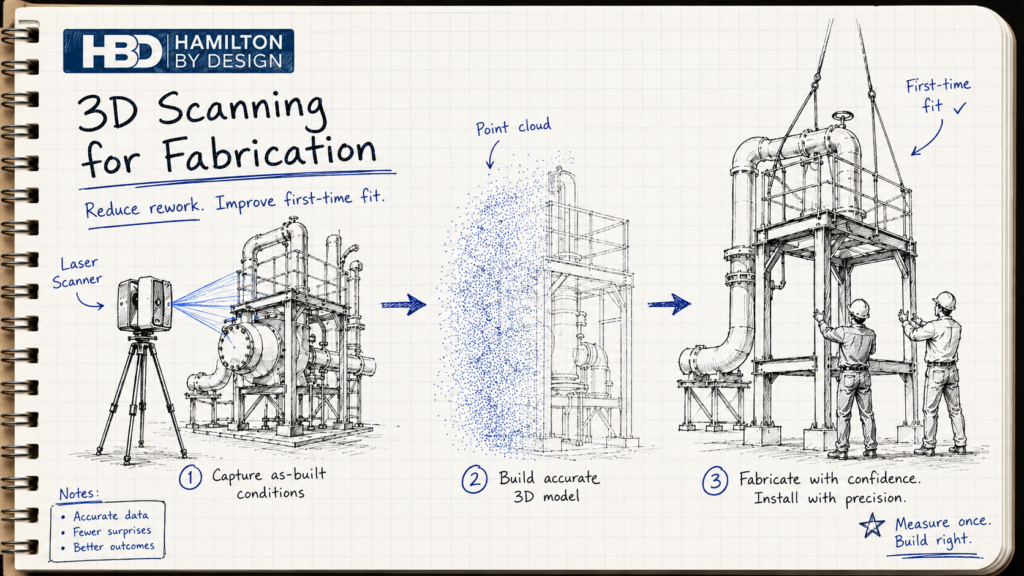
3D scanning for fabrication is the process of capturing accurate site geometry using laser scanning or LiDAR scanning equipment, then converting that information into useful engineering data.
Depending on the project, this may include:
- Registered point cloud files
- E57, RCP, RCS or LAS scan data
- 3D CAD models
- STEP, SAT or Parasolid files
- SolidWorks or Inventor models
- AutoCAD DWG drawings
- General arrangement drawings
- Fabrication drawing support
- Clash review geometry
- As-built documentation
- Site fit-up verification
This is especially useful when existing drawings are missing, incomplete, outdated or not trusted.
Why Fabrication Projects Need Accurate Site Data
Many fabrication projects start with old drawings, rough sketches, site photos or hand measurements. This can be enough for simple work, but it becomes risky when the fabricated item must fit into an existing plant, structure or operating site.
Common problems include:
- Existing drawings do not match the real site
- Site measurements are incomplete
- Pipework, steelwork or equipment has been modified over time
- Access is limited
- Shutdown windows are short
- Components are fabricated before site clashes are checked
- Fabricators are asked to “make it fit” during installation
- The cost of rework increases as the project moves from design to site
3D scanning helps identify these issues earlier, when they are cheaper and easier to correct.
Different Styles of Fabrication Supported by 3D Scanning
3D scanning can support many different styles of fabrication. The value is highest when fabricated components must connect to, fit around or replace existing site assets.
1. Structural Steel Fabrication
Used for platforms, access stairs, walkways, ladders, handrails, pipe supports, equipment frames, support structures and access modifications.
3D scanning helps confirm:
- Existing steel locations
- Beam and column positions
- Connection points
- Head clearance
- Access envelope
- Clash risks
- Bolt-up locations
- Existing site constraints
Typical industries:
- Mining
- Ports
- Water and wastewater
- Manufacturing
- Industrial plants
- Food processing
- Power generation
- Smelters
- Processing plants
2. Mechanical Fabrication
Used for guards, brackets, frames, covers, supports, hoppers, chutes, access panels, machine bases, skids and fabricated mechanical assemblies.
3D scanning helps confirm:
- Equipment location
- Existing machine geometry
- Clearance around moving parts
- Guarding interfaces
- Maintenance access
- Replacement component fit
- Connection points
- Site installation envelope
Typical industries:
- Mining
- Quarrying
- FMCG
- Manufacturing
- Materials handling
- Packaging
- Food production
- Water treatment
- Power stations
3. Pipework and Spool Fabrication
Used for process pipework, pump station pipework, cooling water pipework, compressed air systems, hydraulic lines, slurry pipework, dust extraction ducting and service pipe routes.
3D scanning helps confirm:
- Existing pipe locations
- Flange positions
- Pump and valve locations
- Pipe support positions
- Nozzle orientations
- Clash risks
- Spool lengths
- Tie-in locations
- Access for installation
Typical industries:
- Water treatment
- Wastewater treatment
- Mining
- Mineral processing
- Oil and gas
- Chemical processing
- Power generation
- Manufacturing
- Marine and port facilities
4. Chute, Hopper and Materials Handling Fabrication
Used for transfer chutes, hoppers, bins, skirts, deflectors, liners, conveyors, guarding and access steelwork around materials handling systems.
3D scanning helps confirm:
- Conveyor geometry
- Existing chute location
- Transfer point constraints
- Belt centreline
- Skirt locations
- Access clearance
- Structural support positions
- Maintenance access
- Installation envelope
Typical industries:
- Coal handling
- Mining
- Quarrying
- Ports
- Bulk materials handling
- Cement
- Grain handling
- Mineral processing
- Recycling
5. Sheet Metal and Guard Fabrication
Used for guards, covers, machine guarding, stainless steel panels, mild steel covers, aluminium panels, polycarbonate guards and protective enclosures.
3D scanning helps confirm:
- Machine envelope
- Access points
- Fixing locations
- Handrail and support locations
- Door swing clearance
- Operator access
- Maintenance access
- Guard interfaces
Typical industries:
- Manufacturing
- FMCG
- Packaging
- Food processing
- Conveyor systems
- Ports
- Water infrastructure
- Industrial facilities
6. Platework Fabrication
Used for bins, tanks, sumps, wear plates, liners, chute plates, base plates, stiffeners, covers and fabricated plate assemblies.
3D scanning helps confirm:
- Existing plate geometry
- Wear areas
- Mounting locations
- Field weld areas
- Bolt patterns
- Surrounding steelwork
- Replacement component fit
Typical industries:
- Mining
- Smelters
- Quarries
- Ports
- Mineral processing
- Heavy industry
- Water treatment
- Wastewater treatment
7. Tank, Vessel and Duct Fabrication
Used for tanks, ductwork, access platforms, replacement nozzles, support frames, dust extraction systems, ventilation ducting and industrial enclosures.
3D scanning helps confirm:
- Tank diameter
- Nozzle locations
- Duct routes
- Existing steelwork
- Access restrictions
- Connection points
- Equipment clashes
- Support locations
Typical industries:
- Water and wastewater
- Manufacturing
- Food processing
- Mining
- Power generation
- Chemical processing
- Dust extraction
- HVAC and mechanical services
8. Marine, Port and Ship Repair Fabrication
Used for ship repair, wharf infrastructure, access platforms, marine pipework, brackets, guards, ladders, handrails, replacement steelwork and equipment supports.
3D scanning helps confirm:
- Existing steel geometry
- Corroded or damaged structures
- Wharf interfaces
- Vessel geometry
- Access constraints
- Bolt and weld locations
- Site installation envelope
Typical industries:
- Ports
- Marine repair
- Shipyards
- Defence support
- Bulk handling terminals
- Offshore support
- Wharf maintenance
- Industrial waterfront assets
Different Types of Scanners Used for Fabrication Projects
The best scanner depends on the project size, required accuracy, access conditions and deliverables.
Terrestrial Laser Scanners
Terrestrial laser scanners are tripod-mounted scanners used to capture accurate point cloud data of buildings, plants, structures, workshops and industrial sites.
Best used for:
- Plant rooms
- Pump stations
- Structural steel
- Platforms
- Conveyors
- Chutes
- Pipework
- Industrial sites
- Large fabrication fit-up areas
Typical advantage:
- Good accuracy
- Good site coverage
- Suitable for engineering and fabrication workflows
- Reliable for brownfield sites
Common output formats:
- E57
- RCP
- RCS
- LAS
- Point cloud registrations
- CAD reference models
Mobile LiDAR Scanners
Mobile LiDAR scanners are handheld, backpack, vehicle-mounted or walking scanners that capture geometry while moving through a site.
Best used for:
- Large areas
- Fast site capture
- Long corridors
- Repetitive industrial areas
- Multi-level facilities
- Early feasibility scanning
- Asset capture
Typical advantage:
- Faster than tripod scanning
- Good for broad site context
- Useful where access time is limited
- Helpful for large industrial environments
Potential limitation:
- May not be as accurate as high-quality tripod scanning for fine fabrication details unless used carefully and checked against project requirements.
Structured Light Scanners
Structured light scanners are short-range scanners used to capture smaller components with high detail.
Best used for:
- Reverse engineering parts
- Castings
- machined components
- pump parts
- brackets
- impellers
- housings
- worn components
- small fabricated items
Typical advantage:
- High detail
- Useful for small components
- Good for reverse engineering
- Suitable for CAD modelling of existing parts
Potential limitation:
- Not ideal for large site capture or full plant scanning.
Handheld 3D Scanners
Handheld scanners are portable scanners used to capture smaller to medium-sized objects, parts and assemblies.
Best used for:
- Reverse engineering
- Replacement parts
- Guards
- brackets
- components
- fabricated assemblies
- equipment details
Typical advantage:
- Portable
- Useful in workshops
- Good for component-level scanning
- Can support reverse engineering workflows
Potential limitation:
- Accuracy and scan quality depend on scanner type, surface finish, operator method and project requirements.
Photogrammetry
Photogrammetry uses overlapping photographs to create 3D information. It can be useful for visual records, large objects and site context.
Best used for:
- Visual site records
- Large outdoor assets
- Stockpiles
- civil areas
- roofs
- terrain
- early concept reviews
Typical advantage:
- Good visual record
- Can cover large areas
- Useful for context
Potential limitation:
- Usually not the first choice for fabrication-critical fit-up unless combined with other measurement methods.
Total Station and Survey Control
A total station is not usually considered a scanner, but it can support 3D scanning by providing control points and survey references.
Best used for:
- Control networks
- Long-distance checks
- Grid references
- Datum control
- structural set-out
- scan registration support
Typical advantage:
- Helps control accuracy across larger sites
- Useful when scan data must align with plant coordinates or construction set-out
Applications by Fabricated Component and Industry
| Fabricated Component | Typical Application | Industries |
|---|---|---|
| Structural platforms | Access around equipment, tanks, conveyors and plant areas | Mining, water, ports, manufacturing, power |
| Stairs and walkways | Safe access to plant, maintenance areas and elevated equipment | Mining, industrial, utilities, processing plants |
| Handrails and ladders | Access compliance and fall protection | Ports, water, mining, industrial sites |
| Pipe spools | Replacement pipework, pump station upgrades, process piping | Water, wastewater, mining, chemical, oil and gas |
| Pipe supports | Support for new or modified pipe runs | Industrial plants, process plants, power, mining |
| Chutes and hoppers | Material transfer, storage and flow control | Mining, quarrying, ports, bulk handling |
| Conveyor guards | Machine guarding and safety upgrades | Mining, FMCG, manufacturing, ports |
| Machine guards | Protection around moving equipment | Manufacturing, food, packaging, industrial plants |
| Equipment frames | Support frames, skids and machine bases | Manufacturing, mechanical services, processing |
| Access covers | Covers for pits, sumps, tanks, plant openings and machinery | Water, ports, industrial, utilities |
| Replacement brackets | Site-specific supports and mechanical brackets | All industrial sectors |
| Tank modifications | Nozzles, platforms, ladders, access and support steel | Water, chemical, food, mining |
| Ductwork | Dust extraction, ventilation and process air systems | Manufacturing, mining, FMCG, power |
| Marine steelwork | Ship repair, wharf access, brackets and replacement steel | Ports, marine, defence support |
| Pump station steelwork | Platforms, pipe supports, guards and access modifications | Water, wastewater, councils, utilities |
| Shutdown replacement parts | Fabricated parts prepared before shutdown installation | Mining, ports, smelters, power, processing |
Cost of Catching a Fabrication Fit-Up Issue
A fabrication fit-up issue becomes more expensive the later it is discovered.
The actual cost depends on the size of the job, site location, material type, access, shutdown timing and whether cranes, scaffold, EWP access or specialist trades are required. However, the cost pattern is usually consistent.
A clash found during design is usually cheap to fix.
A clash found during fabrication is more expensive.
A clash found during site fit-up can become very expensive.
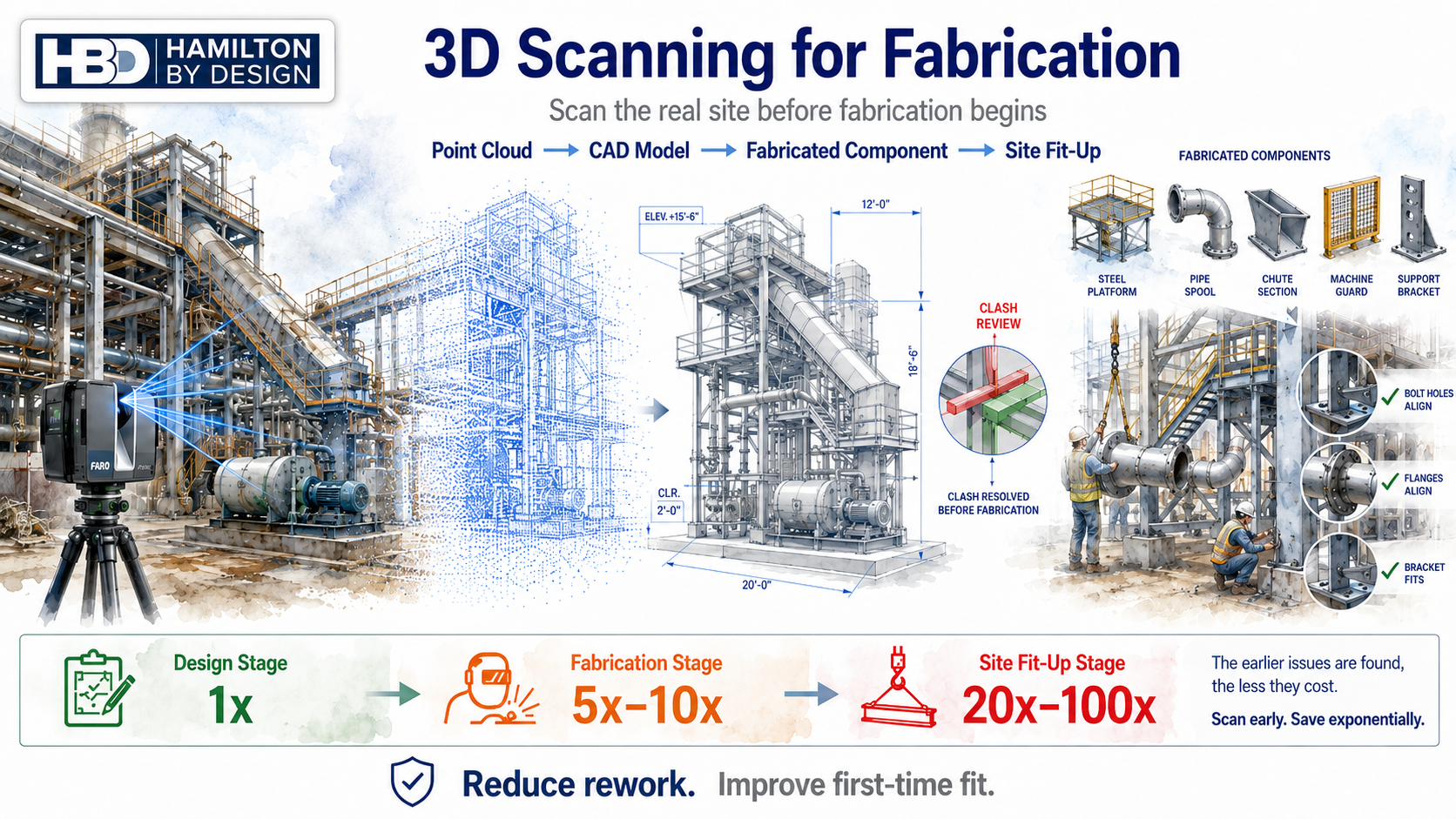
Cost Escalation Comparison
| Stage Issue Is Found | Typical Problem | Likely Action Required | Relative Cost | Example Cost Impact |
|---|---|---|---|---|
| Design stage | Clash found in point cloud or CAD model before fabrication | Update model, revise drawing, adjust connection, change plate or bracket before manufacture | 1x | Low-cost drafting or engineering change |
| Fabrication stage | Fabricated item does not match updated information or has a workshop fit-up issue | Rework steel, cut and re-weld, remake a bracket, change holes, update drawings | 5x to 10x | Workshop rework, lost fabrication time, material waste |
| Site fit-up stage | Component does not fit during installation | Site cutting, welding, crane delays, shutdown delay, hot work permits, EWP/scaffold, emergency redesign | 20x to 100x | Delayed installation, extra trades, site rework, production downtime |
Simple Example
A clash identified in the design stage may take two hours to fix in CAD.
That same issue found after fabrication may require:
- cutting
- welding
- grinding
- repainting
- galvanising repair
- new holes
- revised drawings
- workshop delay
If the issue is found during site installation, the cost can increase again because the project may now involve:
- shutdown time
- site labour
- crane or EWP delays
- scaffold
- hot work permits
- safety controls
- production delays
- emergency engineering decisions
- transport back to workshop
- remanufacture
- client frustration
This is why 3D scanning is often most valuable before fabrication starts.
Example Fit-Up Risk Scenarios
Pipe Spool Does Not Fit
Without scanning, a pipe spool may be fabricated from old drawings. On site, the flange angle, pipe route or pump location may have changed.
3D scanning can capture the actual flange locations and surrounding equipment before the spool is detailed.
Platform Clashes with Existing Pipework
A new access platform may look correct on a drawing, but existing pipework, cable trays, valves or supports may occupy the same space.
3D scanning allows the platform to be designed around real site geometry.
Guard Cannot Be Installed
A fabricated guard may be correct in isolation but may clash with handrails, brackets, frames, doors or access points.
3D scanning helps confirm the fixing points and installation envelope.
Chute Replacement Does Not Match Existing Structure
A chute may be fabricated to suit an old arrangement, but the conveyor, transfer point or supporting steel may have changed.
3D scanning helps confirm the existing steelwork, belt centreline, chute location and access constraints.
When 3D Scanning Should Be Used Before Fabrication
3D scanning is worth considering when:
- Existing drawings are missing
- Existing drawings are not trusted
- The site has been modified over time
- Fabricated components must fit into a brownfield plant
- Shutdown time is limited
- Rework would be expensive
- Access is difficult
- The component is large, heavy or hard to modify on site
- Multiple trades or contractors are working in the same area
- There is limited tolerance for site clashes
- The job involves pipework, steelwork, platforms, guards, chutes or mechanical supports
Typical 3D Scanning for Fabrication Workflow
1. Scope Review
We review the fabrication problem, site area, drawings, sketches, photos and available project information.
2. Site Scanning
The site is captured using suitable 3D scanning equipment. This may include tripod laser scanning, mobile LiDAR scanning or component-level scanning depending on the project.
3. Point Cloud Registration
The scan data is registered and prepared for engineering use.
4. CAD Modelling or Clash Review
The point cloud can be used to create CAD models, check proposed designs, verify clearances or support fabrication drawing development.
5. Fabrication Support
The information can be used by engineers, designers, fabricators and project managers to reduce site fit-up risk.
6. Installation Review
The scan data and CAD model can support installation planning, access review and future as-built documentation.
Typical Deliverables
Depending on the project scope, deliverables may include:
- Registered point cloud files
- E57, RCP, RCS or LAS files
- ReCap files
- 3D CAD models
- STEP, SAT or Parasolid files
- SolidWorks models
- Inventor models
- AutoCAD DWG drawings
- 2D plans, sections and elevations
- General arrangement drawings
- Fabrication drawing support
- Clash review geometry
- As-built documentation
- Site measurement reports
- Installation clearance checks
The level of detail can be adjusted to suit the project. Not every project needs a fully detailed model. In many cases, a fit-for-purpose model around the fabrication interface is more useful and cost-effective.
Industries We Support
Hamilton By Design supports 3D scanning for fabrication across a range of industrial and engineering sectors, including:
- Mining
- Coal handling
- Mineral processing
- Ports
- Marine repair
- Water treatment
- Wastewater treatment
- Pump stations
- Manufacturing
- FMCG
- Food processing
- Packaging
- Power generation
- Smelters
- Quarries
- Industrial maintenance
- Brownfield plant upgrades
- Shutdown projects
- Engineering consultancies
- Fabrication workshops
Why Use Hamilton By Design?
Hamilton By Design is not just a scanning provider. We bring mechanical engineering, drafting, fabrication and site experience into the scanning process.
This means the scan data is captured and used with fabrication outcomes in mind.
We understand:
- fabrication tolerances
- site fit-up problems
- mechanical interfaces
- structural steel constraints
- pipework tie-ins
- shutdown pressure
- workshop rework
- brownfield plant risk
- CAD modelling requirements
- practical installation issues
The result is scan data that is useful for design, fabrication and installation.
Frequently Asked Questions
Can 3D scanning replace site measurements?
In many cases, 3D scanning can reduce the need for repeated manual site measurements. However, critical dimensions may still need to be checked depending on tolerance, access and fabrication requirements.
Is 3D scanning accurate enough for fabrication?
For many fabrication support projects, terrestrial laser scanning can provide suitable accuracy for site verification, clash checking and CAD modelling. The required accuracy should always be matched to the fabrication task.
Do I need a full 3D model?
Not always. Some projects only need a registered point cloud and a few key interface checks. Other projects may require detailed CAD models, fabrication drawings or clash review geometry.
Can scanning help if we only have old drawings?
Yes. This is one of the strongest uses of 3D scanning. The scan can be used to compare the real site against old drawings and identify differences before fabrication begins.
Can you scan a site before a shutdown?
Yes. Pre-shutdown scanning is often valuable because it allows fabricated parts to be checked before the shutdown window starts.
What files can be provided?
Typical deliverables include E57, RCP, RCS, LAS, STEP, SAT, Parasolid, SolidWorks, Inventor and AutoCAD DWG files depending on the project scope.
Can 3D scanning help fabricators quote a job?
Yes. Scan data can help fabricators better understand site constraints, access, connection points and the complexity of installation.
Is this useful for Perth, Brisbane, Sydney and regional projects?
Yes. 3D scanning is particularly useful where fabrication is completed off site and then transported to site for installation. This includes city, industrial, mining, port and regional projects.
Call to Action
If you are planning fabricated steelwork, pipework, guards, platforms, chutes, hoppers or mechanical components for an existing site, 3D scanning can help reduce fit-up risk before fabrication begins.
Hamilton By Design can provide site scanning, point cloud registration, CAD modelling and fabrication drawing support for industrial and engineering projects across Australia.
Contact Hamilton By Design to discuss 3D scanning for fabrication, scan-to-CAD modelling and site fit-up verification.

Talk to Us – Contact Us
Our clients: