


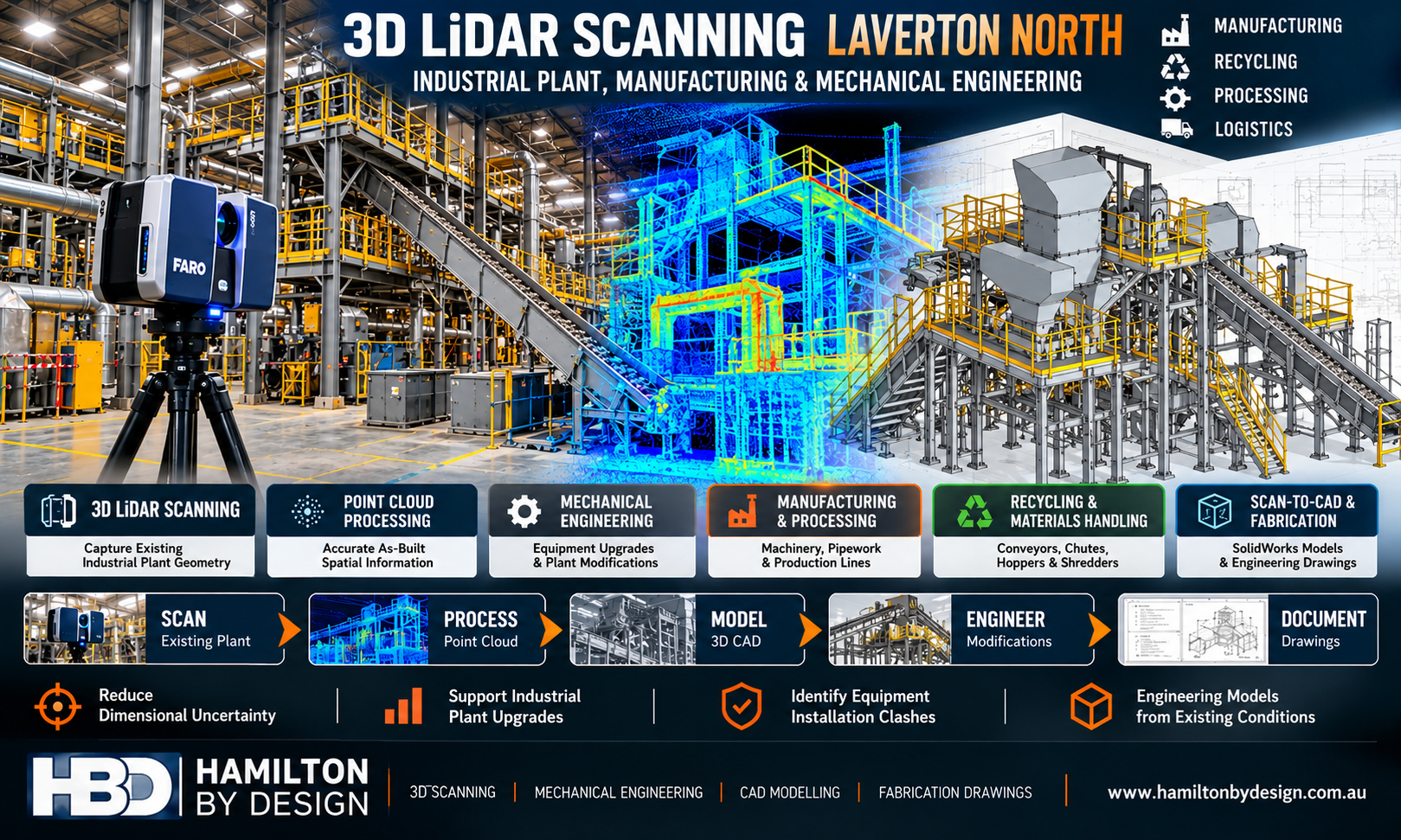
3D LiDAR Scanning for Industrial Facilities in Laverton North, Victoria

Industrial plant modifications often begin with a fundamental engineering challenge: understanding the exact geometry of existing equipment, structures, pipework and machinery before new designs are developed.
Hamilton By Design provides 3D LiDAR scanning services in Laverton North, Victoria, supporting heavy manufacturing, industrial processing, recycling facilities, logistics operations and mechanical engineering projects throughout Melbourne’s western industrial corridor.
Our approach combines 3D laser scanning, point cloud processing, mechanical engineering, 3D CAD modelling and fabrication drawings to help businesses plan equipment modifications with greater dimensional confidence.
Whether a facility is replacing a conveyor, installing processing equipment, modifying a production line or upgrading mechanical infrastructure, reliable existing-condition information is essential.
Rather than relying entirely on historical drawings, tape measurements or assumptions, 3D LiDAR scanning allows engineers to develop a detailed spatial record of the existing facility.
Our engineering workflow:
3D LiDAR Scanning → Point Cloud Registration → Mechanical Engineering → 3D CAD Modelling → Equipment Modifications → Fabrication Drawings
Supporting Laverton North’s Heavy Industrial and Manufacturing Sector
Laverton North is an established industrial area within Melbourne’s western manufacturing and logistics corridor.
Its industrial character makes 3D LiDAR scanning particularly relevant to businesses operating facilities containing complex machinery, conveyors, material handling systems, processing equipment and industrial infrastructure.
Hamilton By Design supports engineering applications across several industrial environments.
| Industrial sector | Typical 3D LiDAR scanning applications |
|---|---|
| Heavy manufacturing | Machinery upgrades, production line modifications, equipment installation and factory layouts |
| Recycling and resource recovery | Conveyors, shredders, screening equipment, hoppers and processing plant modifications |
| Industrial processing | Pipework, pumps, mechanical equipment, access platforms and plant upgrades |
| Logistics and distribution | Warehouse equipment layouts, material handling systems and automation interfaces |
| Metal fabrication | Existing structure interfaces, machinery positioning and fabrication verification |
| Materials handling | Conveyor transfers, chutes, support structures and equipment replacements |
Each facility presents different engineering constraints, including limited access, congested plant layouts, restricted shutdown windows and incomplete historical documentation.
3D scanning helps establish the existing geometry before detailed engineering begins.
3D LiDAR Scanning for Existing Industrial Plant and Equipment
Industrial facilities frequently undergo modifications throughout their operating lives.
Equipment may have been relocated, additional pipework installed, platforms modified or conveyor systems upgraded without corresponding updates to the original engineering drawings.
Over time, this creates uncertainty about the actual installed geometry.
3D LiDAR scanning provides a practical method of capturing existing plant conditions.
Using terrestrial laser scanning equipment, Hamilton By Design can capture spatial information relating to:
- Industrial machinery and equipment footprints
- Conveyors, transfer stations and processing systems
- Pipework, pumps, valves and mechanical services
- Steelwork, platforms, walkways and access arrangements
- Building columns, walls, floors and roof interfaces
- Existing installation clearances and equipment access zones
Multiple scan positions can be registered into a combined point cloud, providing a spatial reference for subsequent engineering work.
The resulting dataset can be used to establish existing conditions, develop CAD models, review equipment layouts and identify potential dimensional conflicts.
Why existing-condition verification matters
A small dimensional discrepancy can create significant problems when installing large mechanical equipment.
Incorrect assumptions about conveyor centreline positions, flange locations, structural interfaces or equipment clearances can result in fabrication changes, additional site work and installation delays.
3D scanning helps reduce these risks by allowing critical dimensions and interfaces to be assessed before fabrication.
Scanning accuracy and final modelling tolerances depend on the equipment, scanning conditions, registration quality, access and project requirements. Critical fabrication interfaces may require supplementary dimensional verification.
From 3D Point Clouds to Mechanical Engineering Design
Collecting point cloud data is only the first stage of an industrial engineering project.
The greater value comes from converting that information into usable engineering deliverables.
Hamilton By Design combines 3D scanning with mechanical engineering and CAD capabilities to support equipment modifications from initial site capture through to detailed design.
Stage 1 – Site scanning
Existing equipment, structures and installation areas are captured using 3D LiDAR scanning equipment.
Stage 2 – Point cloud registration
Individual scans are aligned and processed to establish a combined spatial dataset.
Stage 3 – Existing-condition modelling
Relevant equipment, structures and mechanical interfaces are reconstructed using CAD software.
Stage 4 – Mechanical engineering
Proposed equipment arrangements, modifications, installation clearances and mechanical interfaces are developed and reviewed.
Stage 5 – Engineering drawings
Depending on the project scope, deliverables may include:
- General arrangement drawings
- Equipment modification drawings
- Fabrication and assembly drawings
- Installation interface details
- 3D SolidWorks models
- AutoCAD drawings and DXF files
- STEP and Parasolid models
- Registered point cloud datasets
This integrated approach allows industrial clients to work with a mechanical engineering provider rather than coordinating scanning and mechanical design as entirely separate activities.
Conveyor Systems, Transfer Chutes and Materials Handling Equipment
Conveyor systems are widely used in manufacturing, recycling, bulk materials handling and industrial processing.
Modifying an existing conveyor system can involve several interconnected engineering considerations.
These may include conveyor alignment, transfer geometry, supporting steelwork, access requirements, drive arrangements and equipment clearances.
Hamilton By Design uses 3D scanning and mechanical engineering to support projects involving:
- Conveyor relocations and extensions
- Transfer chute replacements and modifications
- Hopper and discharge arrangements
- Conveyor support interfaces
- Belt transfer geometry
- Wear liner arrangements
- Maintenance access and guarding
- Installation and fabrication drawings
Example: Existing conveyor modification
Consider a Laverton North recycling facility planning to replace an existing conveyor transfer chute.
The original drawings may not reflect modifications made during previous maintenance activities.
By scanning the existing conveyor arrangement, the engineering team can establish relevant equipment geometry, identify surrounding obstructions and develop a replacement chute design around verified site information.
The objective is to reduce uncertainty before fabrication and minimise avoidable modification work during installation.
3D LiDAR Scanning for Recycling and Waste Processing Facilities
Recycling and resource recovery facilities present particular engineering challenges because equipment often operates in abrasive, dusty and mechanically demanding environments.
Common equipment includes conveyors, shredders, screens, hoppers, feeders, bins and material transfer systems.
These systems may require modification because of equipment wear, changes in material characteristics, production requirements or maintenance access constraints.
Typical engineering applications
Conveyor and transfer chute upgrades
Capture existing equipment geometry before designing replacement chutes, liners or material transfer arrangements.
Shredder and screening equipment installation
Establish equipment footprints, supporting interfaces and surrounding clearances for replacement machinery.
Hopper and bin modifications
Develop existing-condition models to support changes to discharge geometry, access arrangements and mechanical components.
Maintenance access improvements
Assess existing machinery arrangements when developing platforms, walkways and guarding modifications.
Plant reconfiguration
Use registered point cloud data to evaluate proposed equipment positions within an established processing facility.
Importantly, 3D scanning establishes geometry; it does not independently determine material flow performance, structural adequacy or equipment capacity.
These matters require appropriate engineering assessment and, where necessary, additional analysis.
Manufacturing Equipment and Production Line Upgrades
Manufacturing facilities regularly introduce new equipment to improve production capacity, product quality, maintenance performance or operational efficiency.
However, installing new machinery within an existing factory can be challenging when floor space is limited and surrounding equipment must remain in place.
3D LiDAR scanning supports the engineering process by establishing the spatial relationships between existing machinery, structural elements and building services.
Applications include:
- Machinery replacement and relocation
- Production line extensions
- Factory equipment layout planning
- Mechanical service modifications
- Equipment support and baseplate interfaces
- Maintenance and installation clearance reviews
- Clash assessment between new and existing equipment
Reducing installation uncertainty
A new machine may fit within the nominal available floor area but still conflict with existing pipework, access routes, maintenance zones or structural columns.
Combining point cloud information with proposed equipment CAD models allows these potential conflicts to be reviewed during design rather than discovered during installation.
This is particularly useful where shutdown time is limited or machinery must be installed around operating production systems.
Industrial Pipework, Pumps and Mechanical Services
Existing industrial pipework can be difficult to measure using conventional methods, particularly where services are elevated, congested or routed around machinery.
3D scanning can provide spatial information for pipework modifications and equipment connections.
Hamilton By Design supports engineering work involving:
- Existing pipework route capture
- Pump and equipment connection interfaces
- Pipe support arrangements
- Mechanical equipment replacement
- Flange location and orientation assessment
- Proposed pipe routing and spatial clash reviews
- Mechanical arrangement and fabrication drawings
Point cloud information can help engineers develop proposed routing arrangements around existing equipment.
Where fabrication tolerances require greater precision than the registered scan data provides, critical connections should be independently verified before manufacture.
3D Scanning for Logistics and Distribution Facilities
Laverton North’s industrial environment also includes warehousing, transport and logistics operations.
These facilities may require modifications to material handling equipment, loading systems, automated machinery and building services.
3D LiDAR scanning can support:
- Warehouse equipment layouts
- Conveyor and sorting system installation
- Automated material handling upgrades
- Equipment clearance assessments
- Loading and unloading infrastructure modifications
- Building and mechanical service coordination
- Existing-condition documentation for facility upgrades
For logistics operations, the principal benefit is establishing reliable spatial information before installing equipment into an operating facility.
Supporting Industrial Shutdowns and Equipment Installation
Industrial shutdowns often involve significant coordination between engineering, fabrication, maintenance and installation teams.
When equipment must be installed within a restricted timeframe, dimensional uncertainty can become a major project risk.
3D LiDAR scanning allows existing equipment interfaces and surrounding geometry to be captured before shutdown work begins, where safe access is available.
The resulting information can support:
- Existing-condition verification
- Proposed equipment layout development
- Spatial clash identification
- Fabrication drawing preparation
- Installation sequence planning
- Pre-installation engineering reviews
The objective is to identify dimensional and spatial problems before they affect the shutdown schedule.
While scanning cannot eliminate all installation risks, it can provide a more reliable basis for engineering decisions and fabrication planning.
Why Choose Hamilton By Design for 3D LiDAR Scanning in Laverton North?
Hamilton By Design combines practical mechanical engineering experience with 3D laser scanning and CAD modelling capabilities.
Our services extend beyond the collection of point cloud data.
Qualified mechanical engineering capability
Hamilton By Design is led by a qualified mechanical engineer with mechanical fitting trade experience and practical exposure to industrial equipment, fabrication, installation and maintenance environments.
Industrial site experience
Our experience includes mining, manufacturing, materials handling, mechanical equipment and industrial plant modifications.
Integrated scanning and CAD workflow
We use technologies including FARO laser scanning, SolidWorks and AutoCAD to support existing-condition capture and mechanical design.
Practical fabrication understanding
Engineering models and drawings are developed with consideration for equipment interfaces, fabrication requirements, installation constraints and maintenance access.
Industrial site access qualifications
Relevant qualifications and competencies include working at heights, confined space, rigging and industrial site supervision training, subject to project-specific access and safety requirements.
Flexible engineering deliverables
Projects can be scoped for scanning only, registered point clouds, existing-condition models, mechanical design or detailed fabrication drawings.
Frequently Asked Questions – 3D LiDAR Scanning Laverton North
Who provides 3D LiDAR scanning for industrial facilities in Laverton North?
Hamilton By Design provides 3D LiDAR scanning and mechanical engineering services for industrial projects in Laverton North and surrounding Melbourne industrial areas. Services include existing-condition scanning, point cloud processing, CAD modelling and engineering drawings.
Can 3D LiDAR scanning be used in operating manufacturing facilities?
Yes. 3D LiDAR scanning can be undertaken in many operating industrial environments, subject to site safety requirements, equipment movement, visibility and access restrictions. Some areas may require planned access or shutdown arrangements.
Can an existing conveyor system be converted into a SolidWorks model?
Yes. Point cloud data can be used as a spatial reference to reconstruct existing conveyor geometry and develop SolidWorks models. The required level of detail depends on the intended engineering use and available scan information.
Can 3D scanning help with recycling plant modifications?
Yes. Scanning can capture existing conveyors, hoppers, shredders, screening equipment and surrounding structures to support equipment replacement, layout modifications and mechanical engineering design.
What is the difference between 3D scanning and reverse engineering?
3D scanning captures the geometry of existing objects and environments. Reverse engineering interprets that information to reconstruct usable engineering geometry, components or assemblies. Additional measurements and engineering judgement may be necessary.
How accurate is industrial 3D LiDAR scanning?
Accuracy depends on the scanner, distance, site conditions, registration process and required deliverables. Registered industrial datasets may achieve millimetre-level accuracy under suitable conditions, but project-specific tolerances must be assessed and verified.
Can Hamilton By Design provide fabrication drawings after scanning?
Yes. Depending on the agreed scope, Hamilton By Design can use scan data to develop mechanical CAD models, general arrangement drawings, equipment modifications and fabrication drawings.
Is 3D LiDAR scanning useful when original plant drawings are unavailable?
Yes. One of the principal applications of industrial scanning is establishing existing geometry where historical drawings are missing, incomplete or no longer reflect the installed equipment.
Request a 3D LiDAR Scanning Quotation in Laverton North
Planning an industrial equipment upgrade, conveyor modification, recycling plant improvement or manufacturing facility expansion in Laverton North?
Hamilton By Design can assist with existing-condition scanning, point cloud processing, mechanical engineering, 3D CAD modelling and fabrication documentation.
Our approach is designed to help industrial clients establish reliable site information before committing to equipment modifications and fabrication.
Contact Hamilton By Design to discuss your Laverton North industrial scanning and engineering requirements.

Contact Us – Talk To Us
Our clients:

























3D LiDAR Scanning | Scan-to-CAD | Mechanical Engineering | SolidWorks Modelling | Industrial Equipment Design | Fabrication Drawings