

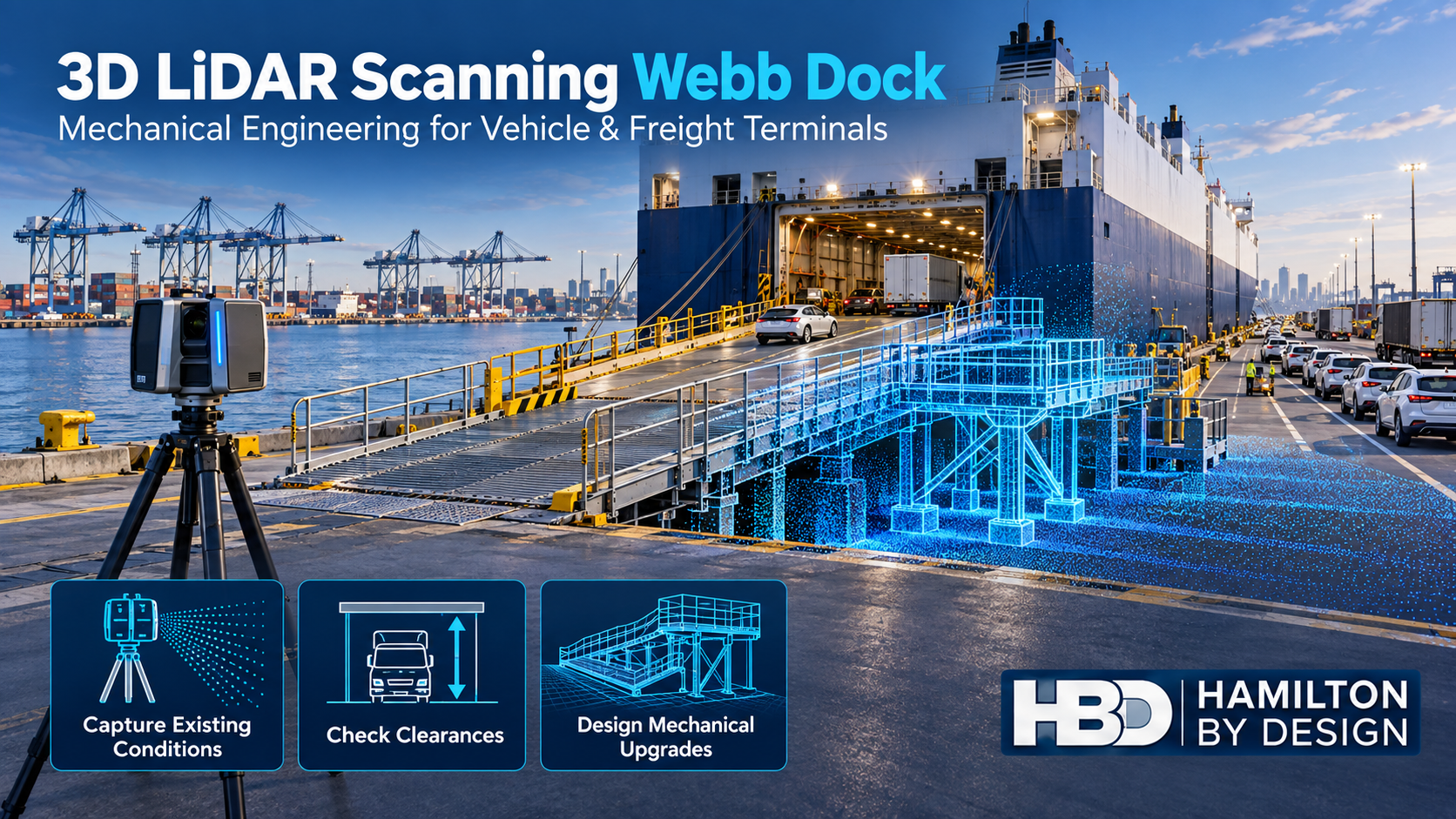

Hamilton By Design provides 3D LiDAR scanning and mechanical engineering support for Webb Dock projects, helping terminal operators, maintenance teams, contractors and fabricators plan modifications around existing infrastructure.
Located near the Yarra River entrance in Port Melbourne, Webb Dock supports container handling, automotive trade, roll-on/roll-off operations and Bass Strait freight. This combination creates engineering challenges involving vehicle movements, loading interfaces, mechanical equipment and restricted installation areas.
Our focus is the relationship between the equipment being modified and the terminal around it. By connecting site scanning with CAD modelling, mechanical design and fabrication documentation, we help project teams understand what is already installed before committing to new work.
Understanding the Interfaces That Keep Freight Moving
A terminal upgrade rarely involves an isolated piece of equipment. A replacement platform may sit beside a vehicle route. A new guard may affect maintenance access. A pipework modification may pass through an area used by trucks, trailers or mobile equipment.
These interfaces need to be understood early.
For Webb Dock projects, useful existing-condition information may include:
- Accessible geometry around fixed ramp landings and loading areas.
- Equipment bases, mounting positions and adjoining steelwork.
- Gates, canopies and overhead obstructions.
- Pipework, cable trays and other visible services.
- Platforms, stairs, handrails and maintenance access.
- Space around machinery for component removal.
- Fixed infrastructure beside vehicle and freight routes.
Capturing the relevant area as a coordinated point cloud allows designers to review these relationships together, rather than relying on separate measurements and photographs.
3D LiDAR Scanning for Webb Dock Infrastructure
3D LiDAR scanning records visible surfaces as a point cloud. Multiple scan positions are registered together to create a measurable representation of the captured area.
For terminal modifications, the scan should be planned around the engineering question. A broad layout study needs different coverage and verification from a replacement component that must fit an existing mounting arrangement.
Hamilton By Design can scope scanning around:
- The equipment or infrastructure being modified.
- Critical connections and installation interfaces.
- Surrounding obstructions and access restrictions.
- Required CAD models and drawings.
- Areas needing additional direct measurement.
- Site access and operating conditions.
This approach helps ensure the captured information supports the next stage of the project.
Ro/Ro Ramp and Loading-Area Interfaces
Roll-on/roll-off operations bring vehicle movement and loading infrastructure into close contact. Modifications around these areas need a clear understanding of the accessible fixed geometry and the equipment involved.
Scanning can support the documentation of fixed landing areas, nearby steelwork, equipment supports, platforms and services. That information can provide a basis for planning brackets, guards, access arrangements or other mechanical modifications.
Where a project involves moving ramps or variable operating positions, a scan records the arrangement present during capture. Other positions and operating requirements must be established separately.
The engineering scope should therefore identify which geometry is fixed, which components move and which interfaces require further checking before design or fabrication.
Vehicle Clearances and Terminal Layout Changes
New equipment can affect the space available for vehicles and freight handling.
A canopy extension, relocated service, equipment enclosure or new platform may introduce an obstruction that is difficult to recognise from individual drawings.
A coordinated model of existing conditions can help project teams assess:
- Available height beneath fixed structures.
- Clearances beside equipment and services.
- Proposed equipment footprints.
- Relationships between pedestrian access and vehicle routes.
- Space required for maintenance and equipment removal.
- Potential clashes between proposed work and existing infrastructure.
LiDAR provides the existing geometry for these studies. Vehicle dimensions, swept paths, operating allowances and traffic requirements need to be supplied or assessed as part of the wider project.
Mechanical Engineering for Terminal Equipment Upgrades
Hamilton By Design connects scanning with practical mechanical design.
Depending on the project scope, we can support:
- Equipment supports and mounting arrangements.
- Machinery guarding and protective enclosures.
- Maintenance platforms and access arrangements.
- Pipework modifications and mechanical skids.
- Brackets, frames and fabricated assemblies.
- Replacement mechanical components.
- Equipment relocation and installation layouts.
- Fabrication drawings and assembly documentation.
The design process considers how the proposed equipment connects to the existing facility, how it will be installed and how maintenance teams will access it.
Where specialist structural, civil, electrical or marine input is required, the relevant interfaces can be identified and coordinated with the project team.
Maintenance Access Before Fabrication
Equipment may fit within the available space while still being difficult to maintain.
For example, a replacement guard could obstruct a lifting path. A new support could prevent a motor from being removed. A platform might provide access to one component while restricting access to another.
Scanning and CAD modelling allow these issues to be considered before fabrication.
A maintenance review can examine:
- Component removal directions.
- Access to fasteners and service points.
- Space for tools and lifting equipment.
- Platform and guarding arrangements.
- Nearby services that could obstruct maintenance.
- The installation sequence for replacement equipment.
Reviewing these relationships early helps the project team resolve conflicts while changes are still straightforward to make.
Reverse Engineering Existing Components
An existing terminal component may need replacement even when usable drawings are unavailable.
Hamilton By Design can combine scanning, direct measurement and mechanical assessment to develop CAD models and manufacturing documentation for suitable components.
Examples include guards, brackets, housings, covers, mounting plates and fabricated assemblies.
The method depends on the component’s size, condition and function. Worn surfaces may not represent the intended design, and critical holes, fits or machined features may require detailed measurement beyond a general site LiDAR scan.
The aim is to establish the information needed for the replacement to function and fit correctly.
Planning Scanning Around Terminal Operations
Webb Dock scanning should be coordinated with the relevant terminal operator and site contact.
Before mobilisation, the project scope can establish:
- Permitted work areas and access windows.
- Induction and escort requirements.
- Vehicle and mobile-equipment movements.
- Suitable scanner positions.
- Areas requiring isolation or controlled access.
- Equipment positions needed during capture.
Moving vehicles, freight and machinery can obscure surfaces or introduce unwanted points into the dataset. Scan positioning and timing therefore matter, particularly around busy loading areas.
Some areas may be captured during agreed operating windows. Others may require equipment isolation or temporary access controls.
From Point Cloud to Engineering Deliverables
The final deliverables should match the decisions the project team needs to make.
Depending on scope, Hamilton By Design can provide:
- Registered point clouds in agreed formats.
- Existing-condition CAD models.
- General arrangement drawings.
- Equipment and installation layouts.
- Sections through critical interfaces.
- Mechanical component models.
- Fabrication and assembly drawings.
- Models for coordination with other project disciplines.
A project may need only a defined equipment area modelled in detail. Agreeing on that boundary early helps keep scanning, modelling and drafting focused on the required outcome.
Frequently Asked Questions
What can 3D LiDAR scanning capture at Webb Dock?
LiDAR can capture visible geometry such as equipment, steelwork, platforms, buildings, services and accessible fixed loading infrastructure. Coverage depends on access, sightlines and site conditions. Concealed features require another method of investigation.
Can you provide mechanical engineering as well as scanning?
Yes. Hamilton By Design can support a project from existing-condition capture through to CAD modelling, mechanical design and fabrication documentation. The engineering scope is agreed around the equipment, interfaces and deliverables required.
Can scanning help with Ro/Ro ramp modifications?
Yes, scanning can document accessible fixed geometry around ramp and landing interfaces. Moving positions, operating loads and vessel-related requirements need additional information and assessment within the appropriate engineering scope.
Can you check whether new equipment will obstruct vehicle movements?
We can capture and model fixed infrastructure to support clearance and layout reviews. The assessment also needs the relevant vehicle dimensions, movement paths and operating allowances. A static scan alone does not establish every clearance required during operation.
How accurate is a Webb Dock LiDAR scan?
Accuracy depends on the required outcome, scan arrangement, surface conditions, registration and verification method. We agree on the measurement requirements before capture. Critical fabrication interfaces may need supplementary direct measurements or a more detailed scanning method.
Can scanning be completed while the terminal is operating?
Some areas may be accessible during operations, subject to site approval and appropriate controls. Other areas may require isolation, restricted vehicle movements or a planned access window. The capture plan is developed with the site contact.
Can you work from existing drawings and scan data?
Yes. Existing drawings can help define the project and intended arrangement, while scan data helps establish the current visible geometry. Supplied point clouds are reviewed for coverage, registration quality and suitability before being used for design.
Can you produce replacement-part drawings?
Yes, for suitable components. We first establish the component’s function, condition, interfaces and measurement requirements. Wear, material selection, manufacturing tolerances and critical fits may need further assessment.
Does LiDAR scanning establish the condition or capacity of an asset?
LiDAR records visible surface geometry. It can support an engineering investigation, but determining material condition, remaining thickness, load capacity or serviceability may require inspections, testing and calculations.
What information do you need to prepare a quote?
Please provide the site area, photographs or drawings, the proposed modification, required deliverables and preferred timeframe. Details about access restrictions, operating windows and critical dimensions also help us prepare a suitable scope.
Discuss Your Webb Dock Project
If you are planning a mechanical upgrade, replacement component, equipment relocation or as-built scanning project at Webb Dock, contact Hamilton By Design.
Share the area involved, the problem you need to solve and the models or drawings required. We can then develop a scanning and engineering scope that supports your project from site capture through to design and fabrication.
Contact Us – Talk To Us
Our clients:













Related Scanning and Mechanical Engineering Services
3D Laser Scanning
Capture visible equipment, steelwork, services and access areas as a coordinated point cloud to support terminal layouts, existing-condition documentation and upgrade planning.
Explore 3D laser scanningMechanical Engineering Consulting
Connect site information with mechanical design for equipment modifications, guarding, supports and maintenance access, with consideration for installation and ongoing operation.
Explore mechanical engineering consultingPoint Cloud to AutoCAD
Convert captured site geometry into useful CAD information for layouts, sections and equipment interfaces when planning modifications around existing terminal infrastructure.
Explore point cloud to AutoCADReverse Engineering and 3D Scanning
Develop usable engineering information from existing components where drawings are unavailable. Support replacement guards, brackets, housings and fabricated assemblies.
Explore reverse engineering3D Scanning for Fabrication
Document existing connection points and surrounding obstructions before platforms, pipework, guards or equipment supports are fabricated for installation.
Explore scanning for fabricationAustralian Design Drafting Services
Prepare engineering layouts and detailed drawings that communicate equipment arrangements, mechanical interfaces and fabrication requirements to project teams.
Explore design and drafting servicesFEA and Mechanical Assessment
Assess the mechanical behaviour of components and assemblies under defined loading conditions to support decisions about equipment modifications and replacement designs.
Explore FEA and mechanical assessment3D Laser Scanning for Engineering Projects
Plan capture around the engineering purpose, required deliverables and critical interfaces so scan data supports design development, retrofit planning and installation.
Explore scanning for engineering projects