


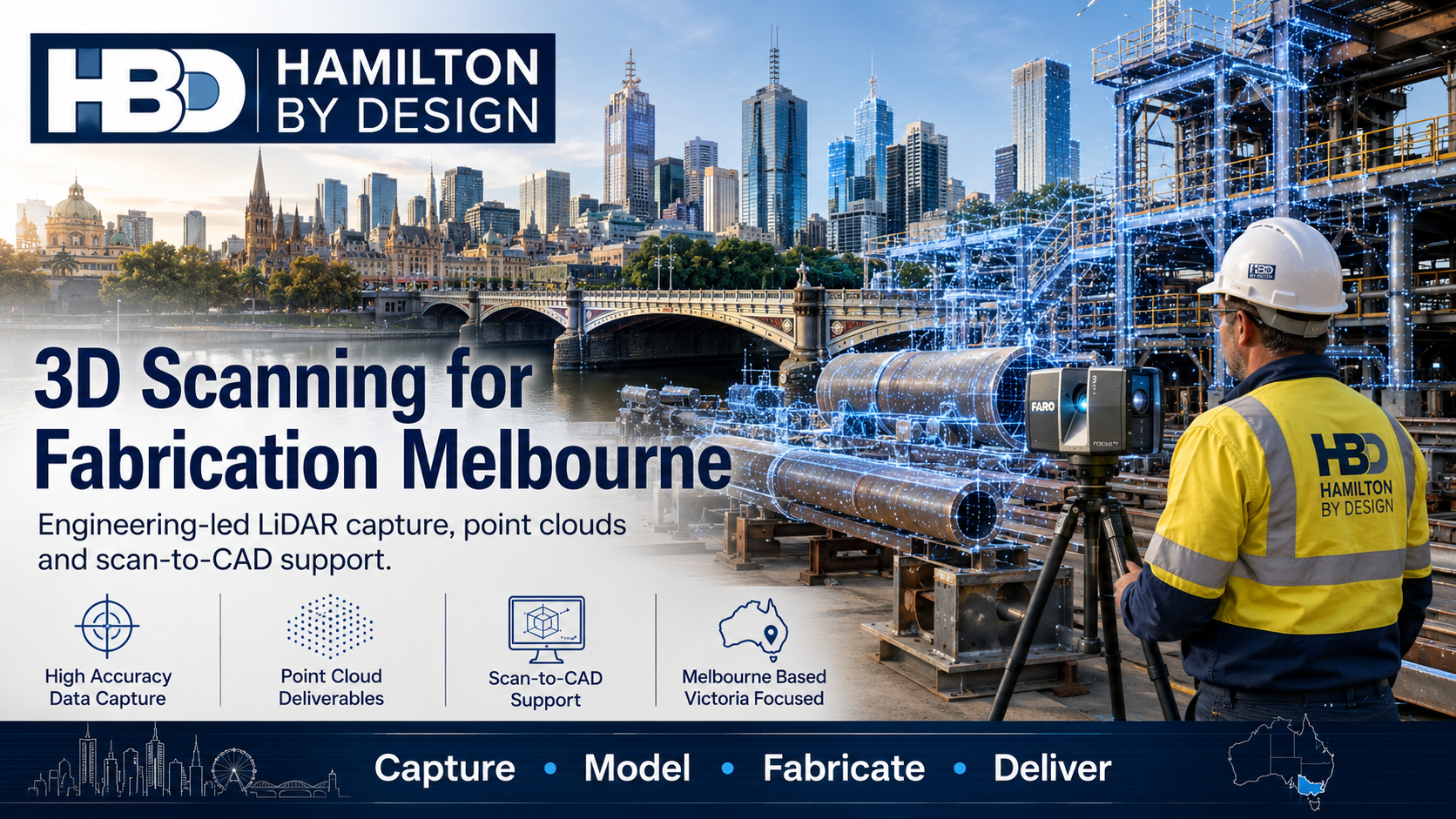
Engineering-Led 3D Scanning for Fabrication, Fit-Up and Site Verification in Melbourne VIC
Fabrication problems are expensive when they are discovered late.
A pipe spool does not line up on site.
A fabricated platform clashes with existing steelwork.
A replacement chute does not fit into the available plant envelope.
A guard is fabricated from old measurements and needs rework during installation.
A shutdown window is lost because the fabricated item does not fit first time.
Hamilton By Design provides 3D scanning for fabrication in Melbourne and Victoria, helping fabricators, engineers, project managers and asset owners capture accurate site information before fabrication begins.
Using LiDAR scanning, point cloud data and CAD modelling, we help turn existing site conditions into useful engineering information for fabrication, design review, fit-up checking and installation planning.
This Melbourne page supports our national parent service page for 3D Scanning for Fabrication.
Why Melbourne Fabrication Projects Benefit from 3D Scanning

Melbourne fabrication projects often support manufacturing, food and beverage, water infrastructure, industrial plants, commercial buildings, ports, transport assets, process facilities and brownfield upgrades.
Many of these projects involve existing assets where the original drawings may be missing, incomplete, outdated or no longer trusted.
This creates risk when new fabricated components need to connect to existing:
- Structural steel
- Pipework
- Platforms
- Chutes
- Conveyors
- Pump stations
- Tanks
- Ductwork
- Guards
- Mechanical equipment
- Access systems
- Site services
- Plant rooms
- Building structure
- Existing workshop or factory layouts
3D scanning helps reduce this risk by capturing the real site geometry before fabrication starts.
Instead of relying only on tape measurements, photographs or old drawings, the fabrication team can work from a registered point cloud, CAD model, scan-to-CAD geometry or engineering drawing based on the actual site.
Common Fabrication Problems 3D Scanning Helps Avoid
3D scanning is useful when fabricated components must fit into an existing Melbourne site with limited access, limited shutdown time or tight installation constraints.
Common issues include:
- Existing drawings not matching the site
- Missing or unreliable dimensions
- Pipework that has been modified over time
- Steelwork that is out of square
- Limited crane, EWP or forklift access
- Tight clearances around existing plant
- Handrails, platforms or services blocking installation
- Bolt holes or flange locations not lining up
- Shutdown work being delayed by site rework
- Fabricators being forced to “make it fit” during installation
- Building services clashing with new fabricated items
- Access limitations in older industrial buildings
The earlier these problems are found, the easier they are to fix.
Finding a fit-up issue during design is usually far cheaper than finding it after fabrication, and far less disruptive than finding it during site installation.
Melbourne Industries We Support
Hamilton By Design can support fabrication scanning across Melbourne, Greater Melbourne, Port Melbourne, Dandenong, Clayton, Laverton, Truganina, Derrimut, Tullamarine, Campbellfield, Broadmeadows, Geelong, Ballarat and regional Victoria.
Typical industries include:
- Industrial manufacturing
- Food and beverage processing
- Water and wastewater infrastructure
- Ports and marine facilities
- Transport and rail support
- Bulk materials handling
- Fabrication workshops
- Mechanical maintenance
- Commercial building services
- Pump stations
- Process plants
- Structural steel upgrades
- Brownfield plant modifications
- Warehousing and logistics facilities
- Factory upgrades
- Regional Victorian industrial projects
This service is especially useful where Melbourne-based fabrication work is being completed for operating plants, regional Victorian sites, shutdown works, infrastructure upgrades or industrial maintenance projects.
Fabrication Types Supported by 3D Scanning
Structural Steel Fabrication
3D scanning can support platforms, access stairs, handrails, walkways, ladders, support frames, equipment platforms and structural modifications.
The scan data can help confirm:
- Existing beam and column locations
- Connection points
- Site clearances
- Platform interfaces
- Handrail locations
- Headroom and access restrictions
- Clash risks
- Installation envelope
This is useful for brownfield sites where new steelwork must connect to existing structures.
Pipework and Spool Fabrication
Pipework fabrication is one of the areas where 3D scanning can provide significant value.
A point cloud can help confirm:
- Pipe routes
- Flange locations
- Valve positions
- Pump nozzles
- Pipe support locations
- Tie-in points
- Existing obstructions
- Installation access
- Spool fit-up requirements
This can reduce the risk of pipe spools being fabricated from outdated drawings, incomplete measurements or assumptions made from photos.
Chutes, Hoppers and Materials Handling
For manufacturing plants, ports, bulk materials handling sites and process facilities, 3D scanning can support chute, hopper and conveyor-related fabrication.
This may include:
- Transfer chutes
- Skirts
- Deflectors
- Wear liners
- Conveyor guards
- Access platforms
- Maintenance covers
- Bin and hopper modifications
- Structural support frames
Scanning helps identify the real position of surrounding steelwork, conveyors, walkways, access points and equipment before fabrication starts.
Mechanical Guards and Access Covers
Machine guards, conveyor guards, pump guards and access covers often need to fit around existing equipment.
3D scanning can help confirm:
- Fixing locations
- Existing handrails
- Machine envelope
- Operator access
- Maintenance access
- Door swing clearance
- Existing guard interfaces
- Polycarbonate or mesh panel layout
This is useful where a guard must be fabricated to suit an existing machine, conveyor, pump station or plant area.
Platework Fabrication
3D scanning can support platework used for:
- Wear plates
- Base plates
- Covers
- Liners
- Hoppers
- Bins
- Sumps
- Chute plates
- Fabricated brackets
- Replacement steel sections
Point cloud data can be used to check surrounding geometry and help reduce field fitting.
Tank, Duct and Vessel Fabrication
For tanks, ducts and vessels, scanning can help capture existing geometry and surrounding constraints.
This may include:
- Tank diameter checks
- Nozzle locations
- Duct routes
- Access platforms
- Existing supports
- Tie-in points
- Clash zones
- Replacement duct sections
- Dust extraction modifications
This is valuable where new fabricated sections need to connect to older infrastructure.
Typical 3D Scanning Deliverables for Fabrication
Depending on the project scope, deliverables may include:
- Registered point cloud files
- E57, RCP, RCS or LAS files
- Autodesk ReCap files
- 3D CAD models
- STEP, SAT or Parasolid files
- SolidWorks or Inventor models
- AutoCAD DWG drawings
- General arrangement drawings
- 2D plans, sections and elevations
- Fabrication drawing support
- Clash review geometry
- As-built documentation
- Site fit-up verification models
The level of detail can be adjusted to suit the project.
Some projects only require a point cloud for design reference. Others require CAD modelling, fabrication drawings, clash checking or reverse engineering support.
Scan-to-CAD for Melbourne Fabrication Projects
For fabrication work, the scan itself is only part of the process.
The real value comes from converting the point cloud into information that engineers, designers and fabricators can use.
Hamilton By Design can support:
- Point cloud registration
- Site condition review
- Scan-to-CAD modelling
- SolidWorks modelling
- Inventor modelling
- AutoCAD drafting
- Fabrication drawing support
- Clash checking
- Fit-up review
- Design verification
- As-built documentation
This helps bridge the gap between site capture and fabrication.
Melbourne Fabrication Scanning Workflow
A typical workflow may include:
1. Scope Review
We review the fabrication problem, site area, access requirements, deliverables and required level of detail.
2. Site Scan
The existing site, plant area, workshop or asset is scanned using LiDAR or laser scanning equipment.
3. Point Cloud Registration
The scan data is registered into a point cloud that can be used for measurement, modelling and review.
4. CAD Modelling or Drawing Support
Depending on the scope, the point cloud can be converted into CAD geometry, reference models, sections, layouts or fabrication drawing information.
5. Fit-Up and Clash Review
The proposed fabricated item can be checked against the existing site geometry before manufacture or installation.
6. Fabrication Support
The final information can be used by fabricators, engineers, project managers or installation teams to reduce uncertainty before site work begins.
Why Use an Engineering-Led Scanning Service?
Not all 3D scanning is the same.
For fabrication projects, the scan data needs to be interpreted with an understanding of engineering, fabrication, fit-up and installation.
Hamilton By Design combines 3D scanning with mechanical engineering, drafting, CAD modelling and fabrication support.
This helps ensure the scan data is not just visually impressive, but useful for real project decisions.
An engineering-led approach can help identify:
- What needs to be captured
- What accuracy is suitable
- Which areas are critical for fit-up
- What should be modelled
- What can remain as point cloud reference
- Where fabrication risk is highest
- Which deliverables are useful for the fabricator
The goal is practical: better information before fabrication starts.
Melbourne and Victorian Project Applications
3D scanning for fabrication can support:
- Melbourne fabrication workshops
- Dandenong and Clayton industrial sites
- Laverton, Truganina and Derrimut logistics facilities
- Port Melbourne and port infrastructure
- Campbellfield and Broadmeadows manufacturing sites
- Tullamarine industrial facilities
- Food and beverage processing plants
- Water and wastewater pump stations
- Commercial plant room modifications
- Mechanical equipment replacement
- Conveyor and chute replacement projects
- Structural access upgrades
- Brownfield process plant upgrades
- Regional Victorian fabrication verification
- Shutdown and maintenance support
- 3D Scanning for Fabrication
- 3D Laser Scanning
- 3D Scanning Melbourne
- Scan to CAD
- Reverse Engineering
- Mechanical Engineering Consulting
- Contact Hamilton By Design

Talk to Us – Contact Us
Need a fabricated component to fit an existing Melbourne or Victorian site?
Hamilton By Design can assist with 3D scanning, point cloud capture, CAD modelling, fabrication drawing support and site fit-up verification.
Our clients

























Contact Hamilton By Design to discuss your Melbourne fabrication scanning project.
FAQs – 3D Scanning for Fabrication Melbourne
What is 3D scanning for fabrication?
3D scanning for fabrication is the process of capturing existing site geometry using laser scanning or LiDAR scanning, then using the data to support fabrication, CAD modelling, fit-up checks and installation planning.
Why is 3D scanning useful before fabrication?
It helps reduce the risk of fabricating components from outdated drawings, incomplete measurements or incorrect assumptions. This can reduce rework, site clashes and installation delays.
Can 3D scanning help with pipe spool fabrication?
Yes. 3D scanning can help capture flange positions, pipe routes, pump nozzles, valve locations, pipe supports and tie-in points so pipe spools can be designed with better site information.
Can you scan Melbourne industrial sites for fabrication work?
Yes. Hamilton By Design can support fabrication scanning for Melbourne industrial sites, workshops, plant rooms, pump stations, manufacturing plants, ports, water infrastructure and brownfield upgrade projects.
What files can be provided after scanning?
Depending on the project, deliverables may include E57, RCP, RCS, LAS, DWG, STEP, SAT, Parasolid, SolidWorks, Inventor or AutoCAD files.
Do we always need a full CAD model?
No. Some projects only need a registered point cloud for reference. Other projects may need CAD modelling, fabrication drawings, clash review or fit-up verification.
Is 3D scanning useful for shutdown projects?
Yes. 3D scanning can help reduce uncertainty before shutdown work begins by capturing the existing site geometry and allowing fabricated components to be checked before installation.
Can 3D scanning support structural steel fabrication?
Yes. 3D scanning can support platforms, handrails, walkways, support frames, stairs, ladders and structural modifications where new steelwork needs to connect to existing structures.
Can scan data be used by fabricators and designers?
Yes. The scan data can be used as a point cloud reference, converted into CAD models, used for clash checking or developed into drawings depending on the project scope.
Why choose Hamilton By Design for fabrication scanning in Melbourne?
Hamilton By Design combines 3D scanning with mechanical engineering, CAD modelling, drafting and fabrication support. This helps ensure the captured information is useful for real fabrication and installation decisions, not just visual documentation.