Stop Reacting โ€” Start Engineering

Hamilton By Design logo displayed on a blue tilted rectangle with a grey gradient background

How Smart Mechanical Strategies Extend CHPP Life

Every coal wash plant in Australia tells the same story: constant throughput pressure, harsh operating conditions, and the never-ending battle against wear, corrosion, and unplanned downtime. The reality is simple โ€” if you donโ€™t engineer for reliability, youโ€™ll spend your time repairing failure.

At Hamilton By Design, we specialise in mechanical engineering, 3D scanning, and digital modelling for coal handling and preparation plants (CHPPs). Our goal is to help site teams transition from reactive maintenance to a precision, data-driven strategy that keeps production steady and predictable.
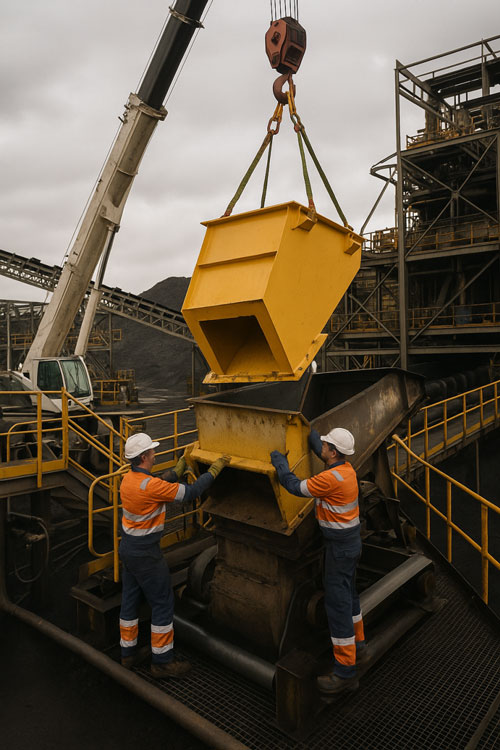
Workers guiding a crane-lifted yellow chute into position at a coal handling and preparation plant, with conveyor infrastructure and safety equipment visible on site

Design for Reliability โ€” Not Reaction

Reliability begins with smart mechanical design. Poor geometry, limited access, and undersized components lead to fatigue and repeated downtime. Instead, modern CHPP maintenance programs start by engineering for fit, lift, and life:

  • Fit: Design components that align with the existing structure โ€” every bolt, flange, and mating face verified digitally before fabrication.
  • Lift: Incorporate certified lifting points that comply with AS 4991 Lifting Devices, and ensure clear access paths for cranes or chain blocks.
  • Life: Select wear materials suited to the physics of the process โ€” quenched and tempered steel for impact, rubber or ceramic for abrasion, and UHMWPE for slurry lines.

Itโ€™s not just about parts; itโ€™s about engineering foresight. A well-designed plant component is safer to install, easier to inspect, and lasts longer between shutdowns.


Scan What You See โ€” Not What You Think You Have

Over time, every wash plant drifts from its original drawings. Field welds, retrofits, and corrosion mean that โ€œas-builtโ€ and โ€œas-existsโ€ are rarely the same thing.

Thatโ€™s where LiDAR scanning transforms maintenance. Using sub-millimetre accuracy, 3D laser scans capture your plant exactly as it stands โ€” every pipe spool, every chute, every bolt hole.

With this data, our engineers can:

  • Overlay new models directly into your point cloud to confirm fit-up before fabrication.
  • Identify alignment errors, corrosion zones, and clearance conflicts before shutdowns.
  • Generate true digital twins that allow for predictive maintenance and simulation.

LiDAR scanning isnโ€™t just a measurement tool; itโ€™s an insurance policy against rework and lost production.
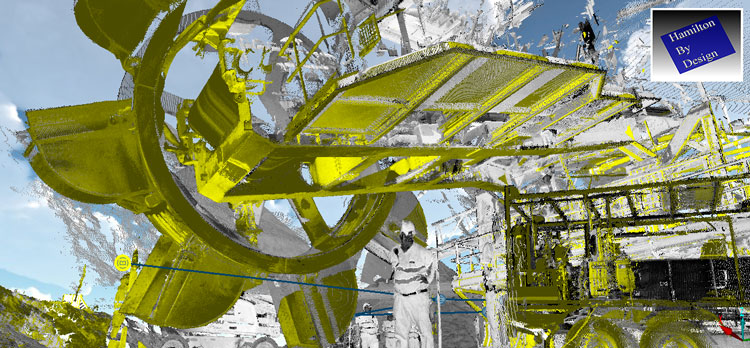
3D LiDAR point cloud of a CHPP plant showing detailed structural geometry, equipment, platforms, and personnel captured during an industrial site scan for engineering and upgrade planning.

Corrosion: The Hidden Killer in Every CHPP

Coal and water donโ€™t just move material โ€” they create acidic environments that eat through untreated or aging steel. In sumps, launders, and under conveyors, corrosion silently compromises strength until a structure is no longer safe to walk on.

Regular inspections are the first line of defence. At Hamilton By Design, we recommend combining:

  • Daily visual checks by operators for surface rust and coating damage.
  • Thickness testing during shutdowns to track wall loss on chutes and pipes.
  • 3D scan comparisons every 6โ€“12 months to quantify deformation and corrosion in critical structures.

With modern tools, you can see corrosion coming long before it becomes a failure.


From Data to Decision: Predictive Maintenance in Action

A coal wash plant produces a river of data โ€” motor loads, vibration levels, pump pressures, liner thickness, and flow rates. The key is turning that data into insight.

By integrating scanning results, maintenance records, and sensor data, plant teams can identify trends that point to future breakdowns. For example:

  • Vibration trending can reveal bearing fatigue weeks before failure.
  • Load monitoring can detect screen blinding or misalignment.
  • Scan data overlays can show sagging supports or displaced chutes.

When you understand what your plant is telling you, you move from reacting to problems to predicting and preventing them.
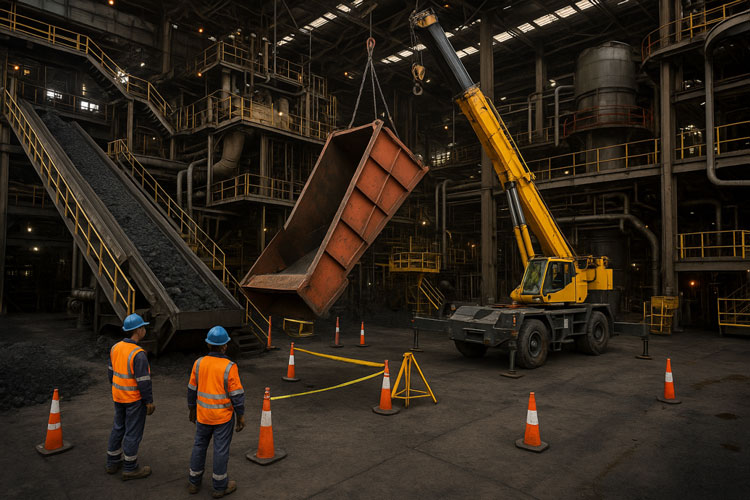

Industrial shutdown scene showing workers monitoring a mobile crane lifting a large steel chute inside a coal processing plant, with safety cones and exclusion zones in place

Shutdowns: Planned, Precise, and Productive

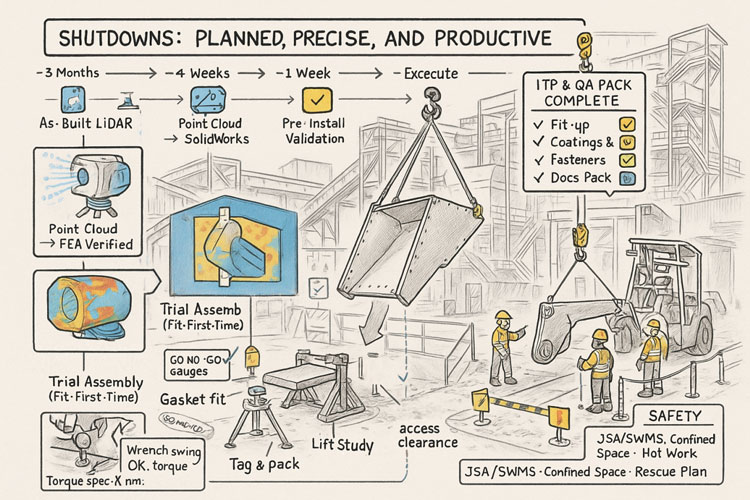
Every shutdown costs money โ€” the real goal is to make every hour count. The best shutdowns start months ahead with validated design data and prefabrication QA.

Before you cut steel or mobilise cranes, every component should be digitally proven to fit. Trial assemblies, lifting studies, and bolt access checks prevent costly surprises once youโ€™re on the clock.

At Hamilton By Design, our process combines:

  • LiDAR scanning to confirm as-built geometry.
  • SolidWorks modelling and FEA for mechanical verification.
  • Pre-installation validation to ensure bolt holes, flanges, and lift paths align on day one.

Thatโ€™s how you replace chutes, spools, and launders in a fraction of the usual time โ€” safely, and with confidence.

Hand-drawn infographic showing the shutdown workflow from LiDAR scanning and FEA verification through SolidWorks modelling, pre-install validation, trial assembly, lift study, and execution, including ITP and QA checks, safety steps, and onsite installation activities

The Payoff: Reliability You Can Measure

The plants that invest in engineering-led maintenance see results that are tangible and repeatable:

Improvement AreaTypical Gain
Reduced unplanned downtime30โ€“40%
Increased liner lifespan25โ€“50%
Shorter shutdown duration10โ€“20%
Fewer fit-up issues and rework60โ€“80%
Improved safety performance20โ€“30%

Reliability isnโ€™t luck โ€” itโ€™s engineered.


Hamilton By Design logo displayed on a blue tilted rectangle with a grey gradient background

Your Next Step: A Confidential Mechanical Assessment

Whether your plant is in the Bowen Basin, Hunter Valley, or Central West NSW, our team can deliver a confidential mechanical and scanning assessment of your wash plant.

Weโ€™ll benchmark your current maintenance strategy, identify high-risk areas, and provide a clear roadmap toward predictive, engineered reliability.

๐Ÿ“ฉ For a confidential assessment of your current wash plant, contact:
info@hamiltonbydesign.com.au

Stop reacting. Start engineering. Build reliability that lasts.

Name
Would you like us to arrange a phone consultation for you?
Address

Our clients:

Mechanical Engineering | Structural Engineering

Mechanical Drafting | Structural Drafting
3D CAD Modelling | 3D Scanning

Chute Design

Chute Design in the Mining Industry

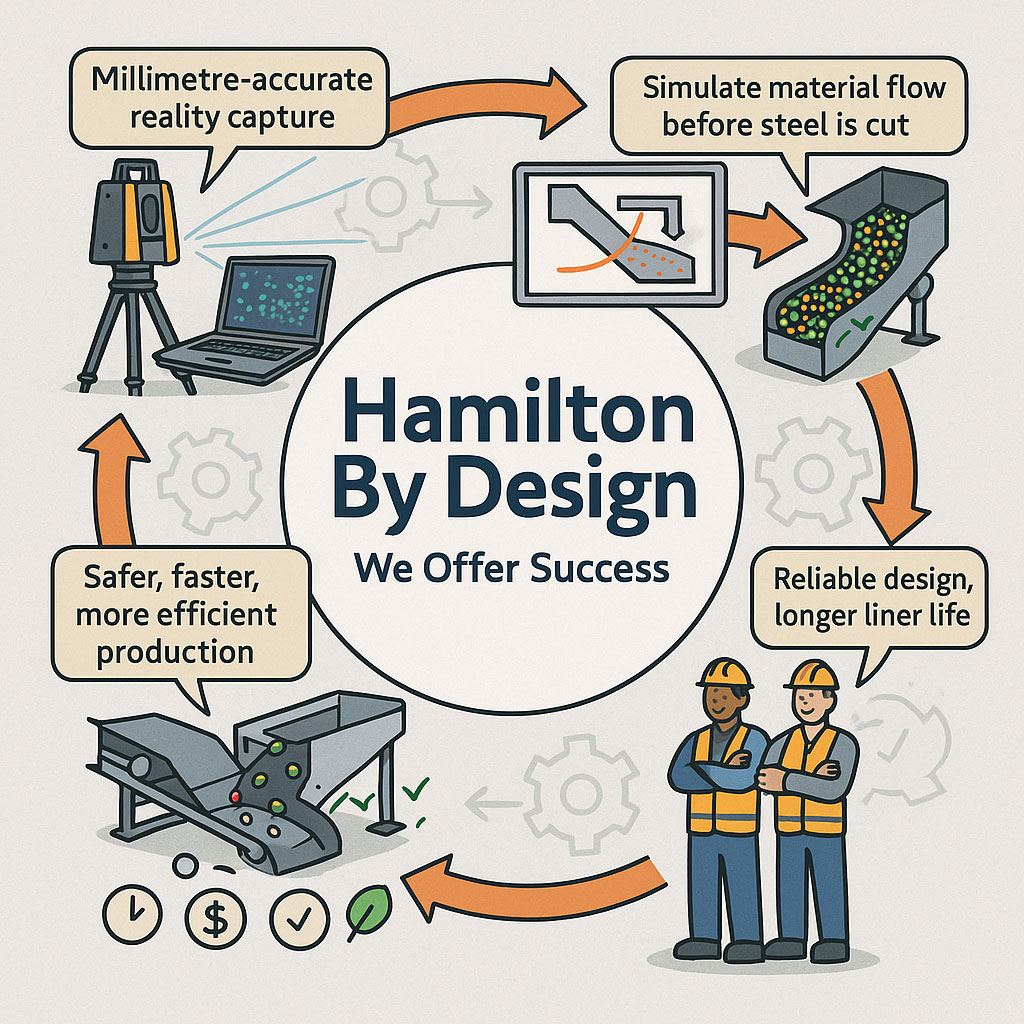
Infographic showing Hamilton By Designโ€™s engineering workflow, including millimetre-accurate LiDAR reality capture, material-flow simulation, optimised chute designs, and safer, more efficient production outcomes. Two workers in PPE highlight reliable design and longer liner life, with icons representing time, cost and quality benefits.

Getting Coal, Hard Rock, and ROM Material Flow Right

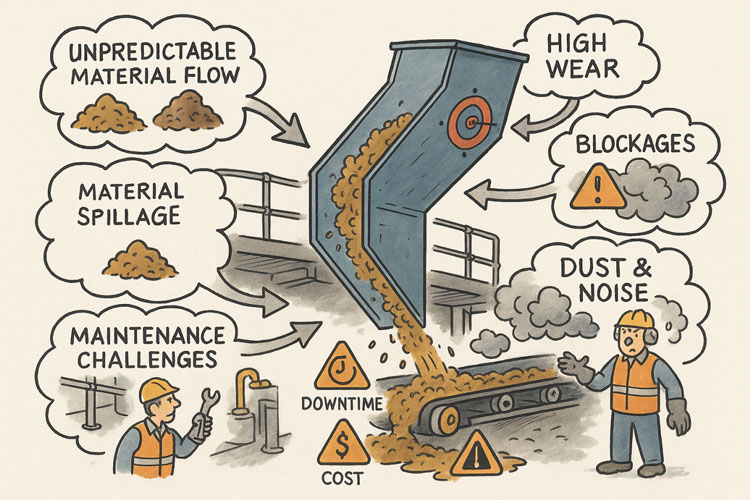
Chute design is one of the most critical yet challenging aspects of mining and mineral processing. Whether you are handling coal, hard rock ore, or raw ROM material, chutes and transfer stations are the unsung workhorses of every operation. When designed well, they guide material smoothly, minimise wear, and keep conveyors running. When designed poorly, they cause blockages, spillage, excessive dust, and expensive downtime.

Modern chute design has moved far beyond rules of thumb and back-of-the-envelope sketches. Today, successful projects rely on accurate as-built data, particle trajectory analysis, and advanced Discrete Element Method (DEM) simulation to predict, visualise, and optimise material flow before steel is cut. In this article, we explore why these tools have become essential, how they work together, and where software can โ€” and cannot โ€” replace engineering judgement.


Illustration showing common problems with poorly designed material-handling chutes. A chute discharges material onto a conveyor while issues are highlighted around it: unpredictable material flow, material spillage, maintenance challenges, high wear, blockages, and dust and noise. Warning icons for downtime and cost appear on the conveyor, and workers are shown dealing with the resulting hazards and maintenance tasks.

The Challenge of Chute Design

Coal and hard rock have very different flow behaviours. Coal tends to be softer, generate more dust, and be prone to degradation, while hard rock is more abrasive and can damage chutes if impact angles are not controlled. ROM material adds another level of complexity โ€” oversize lumps, fines, and moisture variation can cause hang-ups or uneven flow.

Chute design must balance several competing objectives:

  • Control the trajectory of incoming material to reduce impact and wear
  • Prevent blockages by maintaining flowability, even with wet or sticky ore
  • Manage dust and noise to meet environmental and workplace health requirements
  • Fit within existing plant space with minimal modification to conveyors and structures
  • Be maintainable โ€” liners must be accessible and replaceable without excessive downtime

Meeting all these goals without accurate data and simulation is like trying to design in the dark.


Illustrated graphic showing a tripod-mounted 3D laser scanner capturing millimetre-accurate as-built data in an industrial plant with conveyors and walkways. Speech bubbles highlight issues such as โ€œOutdated drawings donโ€™t tell the full storyโ€ and โ€œModifications rarely get documented.โ€ The scan data is shown being visualised on a laptop, with notes describing full coverage of conveyors, walkways, and services. Benefits listed along the bottom include faster data collection, fewer site revisits, safer shutdowns, accurate starting point for design simulation, and safer outcomes that ensure designs fit first time.

Capturing the Truth with 3D Scanning

The first step in any successful chute project is to understand the as-built environment. In many operations, drawings are outdated, modifications have been made over the years, and the real plant geometry may differ from what is on paper. Manual measurement is slow, risky, and often incomplete.

This is where 3D laser scanning changes the game. Using tripod-mounted or mobile LiDAR scanners, engineers can capture the entire transfer station, conveyors, surrounding steelwork, and services in a matter of hours. The result is a dense point cloud with millimetre accuracy that reflects the true state of the plant.

From here, the point cloud is cleaned and converted into a 3D model. This ensures the new chute design will not clash with existing structures, and that all clearances are known. It also allows maintenance teams to plan safe access for liner change-outs and other work, as the scanned model can be navigated virtually to check reach and access envelopes.


Understanding Particle Trajectory

Once the physical environment is known, the next challenge is to understand the particle trajectory โ€” the path that material takes as it leaves the head pulley or previous transfer point.

Trajectory depends on belt speed, material characteristics, and discharge angle. For coal, fine particles may spread wider than the coarse fraction, while for ROM ore, large lumps may follow a ballistic path that needs to be controlled to prevent impact damage.

Accurately modelling trajectory ensures that the material enters the chute in the right location and direction. This minimises impact forces, reducing wear on liners and avoiding the โ€œsplashโ€ that creates spillage and dust. It also prevents the material from hitting obstructions or dead zones that could lead to build-up and blockages.

Modern software can plot the trajectory curve for different loading conditions, providing a starting point for chute geometry. This is a critical step โ€” if the trajectory is wrong, the chute design will be fighting against the natural path of the material.


The Power of DEM Simulation

While trajectory gives a first approximation, real-world flow is far more complex. This is where Discrete Element Method (DEM) simulation comes into play. DEM models represent bulk material as thousands (or millions) of individual particles, each following the laws of motion and interacting with one another.

When a DEM simulation is run on a chute design:

  • You can visualise material flow in 3D, watching how particles accelerate, collide, and settle
  • Impact zones become clear, showing where liners will wear fastest
  • Areas of turbulence, dust generation, or segregation are identified
  • Build-up points and potential blockages are predicted

This allows engineers to experiment with chute geometry before fabrication. Angles can be changed, ledges removed, and flow-aiding features like hood and spoon profiles or rock-boxes optimised to achieve smooth, controlled flow.

For coal, DEM can help ensure material lands gently on the receiving belt, reducing degradation and dust. For hard rock, it can ensure that the energy of impact is directed onto replaceable wear liners rather than structural plate. For ROM ore, it can help prevent oversize lumps from wedging in critical locations.


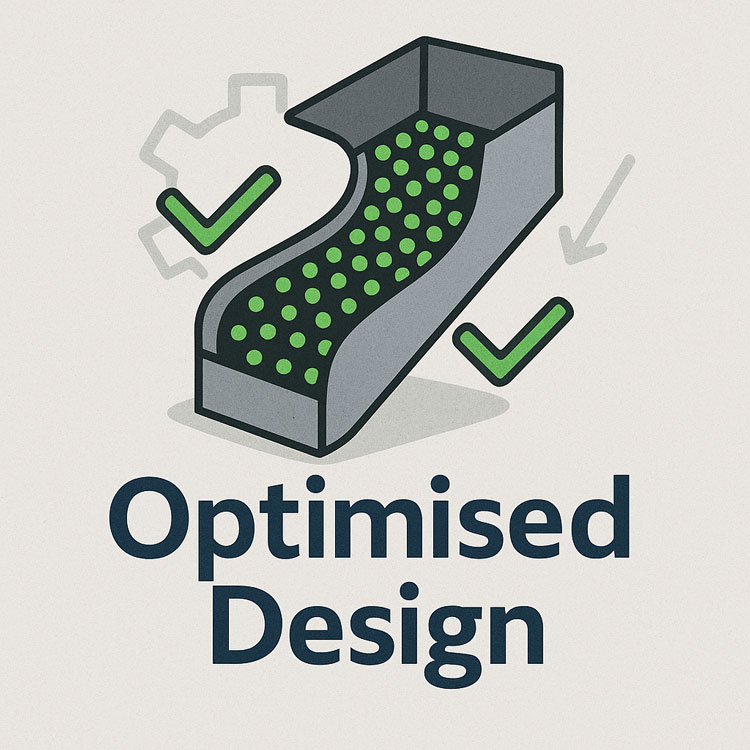
Illustration of an optimised chute design showing material flow represented by green particles, with check marks and gear icons indicating improved efficiency and engineered performance.

๐Ÿ–ฅ Strengths and Limitations of Software

Modern DEM packages are powerful, but they are not magic. Software such as EDEM, Rocky DEM, or Altairโ€™s tools can simulate a wide range of materials and geometries, but they rely on good input data and skilled interpretation.

Key strengths include:

  • Ability to model complex, 3D geometries and particle interactions
  • High visualisation power for communicating designs to stakeholders
  • Capability to run multiple scenarios (different feed rates, moisture contents, ore types) quickly

However, there are limitations:

  • Material calibration is critical. If the particle shape, friction, and cohesion parameters are wrong, the results will not match reality.
  • Computational cost can be high โ€” detailed simulations of large chutes with millions of particles may take hours or days to run.
  • Engineering judgement is still needed. Software will not tell you the โ€œbestโ€ design โ€” it will only show how a proposed design behaves under given conditions.

Thatโ€™s why DEM is best used as part of a holistic workflow that includes field data, trajectory analysis, and experienced design review.


From Model to Real-World Results

When the simulation results are validated and optimised, the design can be finalised. The point cloud model ensures the chute will fit in the available space, and the DEM results give confidence that it will perform as intended.

This means fabrication can proceed with fewer changes and less risk. During shutdown, installation goes smoothly, because clashes have already been resolved in the digital model. Once commissioned, the chute delivers predictable flow, less spillage, and longer liner life.


Why It Matters More Than Ever

Todayโ€™s mining operations face tighter production schedules, stricter environmental compliance, and increasing cost pressures. Downtime is expensive, and the margin for error is shrinking.

By combining 3D scanning, trajectory modelling, and DEM simulation, operations can move from reactive problem-solving to proactive improvement. Instead of waiting for blockages or failures, they can design out the problems before they occur, saving both time and money.


Partnering for Success

At Hamilton by Design, we specialise in turning raw site data into actionable insights. Our team uses advanced 3D scanning to capture your transfer stations with precision, builds accurate point clouds and CAD models, and runs calibrated DEM simulations to ensure your new chute design performs from day one.

Whether youโ€™re working with coal, hard rock, or ROM ore, we help you deliver designs that fit first time, reduce maintenance headaches, and keep production running.

Contact us today to see how our integrated scanning and simulation workflow can make your next chute project safer, faster, and more reliable.

Mechanical Engineering | Structural Engineering

Mechanical Drafting | Structural Drafting
3D Laser Scanning | 3D CAD Modelling | 3D Scanning

Chute Design

SolidWorks Contractors in Australia

Hamilton By Design โ€“ Blog

Consulting Engineers

About Us โ€“ Hamilton By Design

Hamilton By Design | 3D Scanning | Sydney | Perth | Brisbane | Mount Isa | Lidar Scanning

Contact us

Maximising Uptime at Transfer Points: How Hamilton By Design Optimises Chutes, Hoppers, and Conveyors for the Mining Industry

In the mining industry, system uptime isnโ€™t just a goalโ€”itโ€™s a necessity. Transfer points such as chutes, hoppers, and conveyors are often the most failure-prone components in processing plants, especially in high-wear environments like HPGR (High Pressure Grinding Rolls) circuits. Abrasive ores, heavy impact, fines accumulation, and moisture can all combine to reduce flow efficiency, damage components, and drive up maintenance costs.

At Hamilton By Design, we help mining clients minimise downtime and extend the life of their material handling systems by applying advanced 3D scanning, DEM simulation, smart material selection, and modular design strategies. This ensures that transfer points operate at peak efficiencyโ€”day in, day out.

Hereโ€™s how we do it:

Optimised Flow with DEM-Based Chute & Hopper Design

Flow blockages and misaligned velocities are among the biggest contributors to transfer point failure in the mining industry. Thatโ€™s why we use Discrete Element Method (DEM) simulations to model bulk material flow through chutes, hoppers, and transfer transitions.

Through DEM, we can simulate how different oresโ€”ranging from dry coarse rock to sticky finesโ€”move, compact, and impact structures. This allows us to tailor chute geometry, outlet angles, and flow paths in advance, helping:

  • Prevent material buildup or arching inside hoppers and chutes
  • Align material velocity with the conveyor belt speed using hood & spoon or trumpet-shaped designs
  • Reduce wear by managing trajectory and impact points

Optimised flow equals fewer shutdowns, longer equipment life, and better plant throughput.

Wear-Resistant Liners & Material Engineering

Not all wear is the sameโ€”and neither are the materials we use to combat it. By studying the abrasion and impact zones in your chute and hopper systems, we strategically apply wear liners suited to each application.

Our engineering team selects from:

  • AR (Abrasion-Resistant) steels for high-wear areas
  • Ceramic liners in fines-rich or ultra-abrasive streams
  • Rubber liners to absorb shock and reduce noise

This approach reduces liner replacement frequency, improves operational safety, and lowers the risk of unplanned shutdowns at key transfer points.

3. Dust and Spillage Control: Cleaner, Safer Operation

Dust and spillage around conveyors and transfer chutes can lead to extensive cleanup time, increased maintenance, and health hazards. At Hamilton By Design, we treat this as a core design challenge.

We design chutes and hoppers with:

  • Tight flange seals at interface points
  • Enclosed transitions that contain dust at the source
  • Controlled discharge points to reduce turbulent material drops

This reduces environmental risk and contributes to more consistent plant performanceโ€”especially in confined or enclosed processing facilities in the mining industry.

4. Modular & Accessible Designs for Faster Maintenance

When liners or components need replacement, every minute counts. That’s why our chute and hopper systems are built with modular sectionsโ€”each engineered for fast removal and reinstallation.

Key maintenance-driven design features include:

  • Bolt-on panels or slide-in liner segments
  • Accessible inspection doors for safe visual checks
  • Lightweight modular components for easy handling

These details reduce labour time, enhance safety, and keep your plant online longerโ€”especially critical in HPGR zones where throughput is non-stop.

5. Precision 3D Scanning & 3D Modelling for Retrofit Accuracy

One of the most powerful tools we use is 3D scanning. In retrofit or brownfield projects, physical measurements can be inaccurate or outdated. We solve this by conducting detailed laser scans that generate accurate point cloud dataโ€”a precise digital twin of your plant environment.

That data is then transformed into clean 3D CAD models, which we use to:

  • Design retrofits that precisely match existing structure
  • Identify interferences or fit-up clashes before fabrication
  • Reduce install time by ensuring right-first-time fits

This scan-to-CAD workflow dramatically reduces rework and error margins during installation, saving time and cost during shutdown windows.

Real-World Application: HPGR & Minerals Transfer Systems

In HPGR-based circuits, transfer points between crushers, screens, and conveyors experience high rates of wear, dust generation, and blockagesโ€”particularly where moisture-rich fines are present.

Hereโ€™s how Hamilton By Designโ€™s methodology addresses these pain points:

  • DEM-based flow modelling ensures the HPGR discharge flows cleanly into chutes and onto conveyors without buildup.
  • Hood/spoon geometries help track material to belt velocityโ€”minimising belt wear and reducing misalignment.
  • Strategic liner selection extends life in critical wear zones under extreme abrasion.
  • Modular chute designs allow for fast liner swap-outs without major disassembly.
  • 3D scanning & CAD design ensures new chute sections fit seamlessly into existing HPGR and conveyor frameworks.

By designing smarter transfer systems with these technologies, we enable operators to reduce downtime, increase liner life, and protect critical assets in high-throughput mining applications.

Uptime Benefits at a Glance

Performance AreaImpact on Mining Operations
Smooth bulk material flowFewer clogs, improved throughput, longer operating cycles
Velocity-matched dischargeLower conveyor belt wear and downtime
Robust wear protectionLonger life, fewer liner replacements
Modular designFaster maintenance turnarounds during scheduled shutdowns
3D scanning & CAD integrationPrecise fit, reduced installation time, fewer errors during retrofit

Final Word: Engineering That Keeps the Mining Industry Moving

At Hamilton By Design, we combine mechanical engineering expertise with 3D modelling, material flow simulation, and smart fabrication practices to deliver high-performance chute, hopper, and transfer point systems tailored for the mining industry.

Whether youโ€™re dealing with a problematic HPGR discharge, spillage issues, or planning a brownfield upgrade, our integrated design process delivers results that improve reliability, extend service life, and protect uptime where it matters most.

Looking to retrofit or upgrade transfer systems at your site?
Letโ€™s talk. We bring together 3D scanning, DEM modelling, practical engineering, and proven reliability to deliver systems that workโ€”from concept through to install.

Reach out at contact@hamiltonbydesign.com.au

#3DScanning #MiningIndustry #Chutes #Hoppers #TransferPoints #3DModelling #MechanicalEngineering #HPGR #PlantUptime #HamiltonByDesign

Structural Drafting | Mechanical Drafting | 3D Laser Scanning

Mechanical Engineering

Conveyor Drives in Underground Coal Mines

Operation, Design Challenges, and the Role of Direct Drive Units
In the highly demanding and regulated world of underground coal mining, the reliable and efficient transport of coal from the mining face to the surface is critical. Among the many systems involved in this process, conveyor drives play a pivotal role. These systems are tasked with powering conveyor belts that haul coal over long distances through often confined and hazardous environments. A vital part of this setup includes the use of direct drive units (DDUs), particularly in low-profile applications such as underground operations.

This document explores the functionality of conveyor drives in underground coal mines, the unique challenges faced in their operation, the complexities design engineers encounter in their development, and the concept of the phase “outbye”โ€”a term widely used in underground mining to describe the direction and location of operations.


Conveyor Drives in Underground Coal Mining

A conveyor drive is a mechanical system that powers conveyor belts used to transport materials, in this case, coal. In underground mines, these conveyor belts often run for several kilometers, extending from the coal face (the area where coal is actively being cut and mined) to the shaft or drift that brings the coal to the surface.

The drive systems can be located at several points along the belt:

  • Head drive: Located at the discharge end of the conveyor.
  • Tail drive: Located at the loading end.
  • Mid-belt drives: Installed partway along long conveyors to help manage torque and reduce belt tension.

In the context of underground coal mines, the term “conveyor drive” is generally associated with the head or tail drive unit, which powers the movement of the belt.


Role of Direct Drive Units (DDUs)

Direct Drive Units are electric motors directly coupled to the drive shaft of the conveyor pulley, eliminating the need for intermediary gearboxes or belt drives. These units are especially advantageous in underground mining due to their compact design, reliability, and reduced maintenance.

Benefits of DDUs in Underground Coal Mines

  1. Compact Size: Ideal for low-profile mining applications where vertical space is restricted.
  2. Energy Efficiency: With fewer mechanical components, DDUs offer less friction and mechanical losses.
  3. Lower Maintenance: No gearboxes or belt couplings to service.
  4. Increased Reliability: Fewer parts mean fewer failure points.
  5. Improved Safety: The enclosed design minimizes exposure to moving parts and flammable materials.

Australian Mining, Hamilton By Design, Mechanical Engineering

Operational Challenges of Conveyor Drives Underground

Underground coal mining presents a set of challenges not commonly encountered in surface operations. Conveyor drives, as the lifeblood of coal transportation, are central to these operational difficulties.

1. Space Constraints

Underground roadways are typically narrow and low, especially in coal seams with minimal thickness. This limitation forces the use of low-profile conveyor systems, which in turn limits the size and configuration of the drive units.

2. Dust and Moisture Exposure

Coal dust is highly abrasive and, in certain concentrations, explosive. Moisture from groundwater or the mining process further complicates the reliability of drive components. Ensuring DDUs are properly sealed and rated for these harsh conditions is critical.

3. Heat and Ventilation

Electric motors generate heat, which must be dissipated. However, underground mines have limited ventilation. Overheating can be a major issue, requiring cooling systems or specialized motor enclosures.

4. Explosion-Proof Requirements

Due to the potential presence of methane gas and coal dust, all electrical equipment, including conveyor drives, must comply with stringent explosion-proof standards (e.g., IECEx or ATEX ratings).

5. Long Haul Distances

Modern coal faces can be several kilometers from the shaft bottom. Transporting coal over long distances places mechanical stress on conveyor belts and drive units, increasing the risk of failure if not properly engineered.

6. Maintenance Access

Accessing conveyor drives for inspection or maintenance can be difficult in tight underground environments. Failures that require replacement or repair can cause significant production delays.

7. Load Variability

The volume of coal being hauled can vary significantly during a shift, which places variable demands on the drive system. The control systems must be able to accommodate fluctuating loads without mechanical strain.


Hamilton By Design promotional graphic featuring industrial machinery imagesโ€”including a rotating mill, preventive maintenance gears, and a coal conveyorโ€”alongside the Hamilton By Design logo and the text โ€˜Mechanical Engineers โ€“ www.hamiltonbydesign.com.auโ€™.โ€

Engineering and Design Challenges

Design engineers are tasked with creating conveyor drive systems that are not only robust and efficient but also compact and compliant with mining regulations. Some of the key design challenges include:

1. System Integration in Confined Spaces

Engineering a system that fits into limited space while delivering the necessary power is a fundamental challenge. Direct drive units help address this by eliminating gearboxes, but the motor itself must still be sized correctly.

2. Material Selection

Materials used must be corrosion-resistant, non-sparking, and capable of withstanding vibration, dust ingress, and moisture. This often limits design options and increases costs.

3. Thermal Management

Ensuring that the drive units do not overheat requires careful thermal modeling and the use of heat-resistant components. In some cases, passive or active cooling systems are integrated.

4. Compliance with Standards

Designs must adhere to a host of mining and electrical standards for flameproof and intrinsically safe equipment. Certification processes can be lengthy and expensive.

5. Modularity and Transportability

Since access to underground sites is limited, equipment must be modular or transportable in pieces small enough to be moved through shafts or drifts. Assembling and commissioning underground adds another layer of complexity.

6. System Control and Monitoring

Advanced drives require smart control systems that can adjust to load demands, monitor for faults, and integrate with mine-wide automation systems. Designing these systems requires interdisciplinary expertise.

7. Redundancy and Reliability Engineering

System failure underground can halt production and pose safety risks. Engineers must design for redundancy and easy switch-over between drive systems when necessary.


Understanding the Term โ€œOutbyeโ€

In underground mining terminology, directionality is essential for communication and logistics. The terms โ€œinbyeโ€ and โ€œoutbyeโ€ are commonly used to describe relative directions underground.

What Does โ€œOutbyeโ€ Mean?

  • Outbye refers to the direction away from the coal face and toward the surface or the mine entrance.
  • Conversely, inbye means toward the coal face.

For example:

  • If a miner is walking from the coal face toward the conveyor belt transfer station, they are walking outbye.
  • If a service vehicle is heading toward the longwall face, it is moving inbye.

Relevance of โ€œOutbyeโ€ in Conveyor Systems

In conveyor operations:

  • The coal face is the inbye starting point.
  • The belt head drive and transfer points to the main conveyor system are located outbye.
  • Maintenance and service activities often take place outbye to avoid interfering with production at the face.

Understanding this term is critical for coordinating activities underground, as directions are often communicated using inbye and outbye references rather than compass points or distances.


Digital engineering graphic featuring a central robotic arm icon surrounded by futuristic interface elements, cloud and AI symbols, and motion-blurred technology backgrounds. The SolidWorks logo appears on the left and the Hamilton By Design logo on the right, representing advanced 3D modelling and digital engineering capabilities.

Innovations and Future Trends

The mining industry continues to evolve, and conveyor drive systems are no exception. Some of the emerging trends and technologies include:

1. Variable Speed Drives (VSDs)

VSDs allow precise control over motor speed and torque, improving efficiency and reducing mechanical stress. They are increasingly paired with direct drive units to optimize performance.

2. Condition Monitoring

Sensors embedded in motors and drive systems can provide real-time feedback on vibration, temperature, and load. Predictive maintenance models reduce downtime.

3. Permanent Magnet Motors

These motors offer higher efficiency and torque density compared to traditional induction motors, making them well-suited for space-constrained environments.

4. Automation and Remote Control

Fully integrated systems that allow operators to monitor and control conveyor drives from surface control rooms are becoming standard.

5. Modular, Plug-and-Play Designs

Future drive units are being designed with ease of installation and replacement in mind, enabling faster deployment and lower maintenance impact.


Conclusion

Conveyor drive systems in underground coal mining are vital to the continuous flow of material and, by extension, the productivity of the entire mining operation. The adoption of direct drive units is helping to meet the unique demands of underground environments by providing compact, reliable, and efficient power transmission solutions.

However, these systems are not without their challenges. From the operational constraints of underground environments to the rigorous demands placed on design engineers, the development and maintenance of these systems require specialized knowledge, innovative thinking, and strict adherence to safety standards.

Moreover, understanding mining-specific terminology such as “outbye” provides important context for the deployment and maintenance of conveyor systems. As technology continues to advance, we can expect to see more intelligent, adaptive, and efficient conveyor drive systems that are better suited to the evolving demands of underground coal mining.

#CoalMining #EngineeringSolutions #MechanicalEngineering #ConveyorSystems #MiningIndustry #UndergroundMining #AustralianEngineering #HamiltonByDesign

Hamilton By Design | Mechanical Drafting | Structural Drafting | 3-D Lidar Scanning

Mechanical Engineering Challenges for Conveyor Reliability

Challenges for Conveyor Reliability

The challenges Mechanical Engineers have when it comes to maintaining the reliability of conveyor systems for transporting bulk materials, particularly particles ranging from 1mm to 100mm, presents mechanical engineers with a host of challenges. Reliability maintenance aims to ensure that these systems operate consistently and efficiently over their operational lifespan, minimizing downtime and optimizing productivity. Here are some key challenges faced by mechanical engineers in this regard:


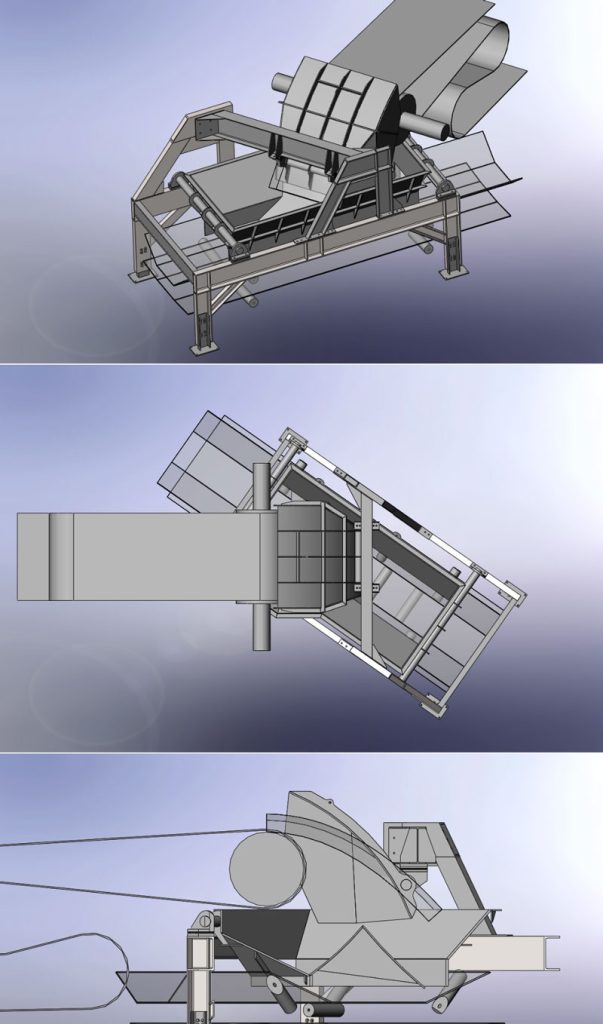
Three-view SolidWorks model of an industrial conveyor transfer system, showing an isometric view, top view, and side view. The assembly includes a transfer chute, conveyor belt sections, support frame, rollers, and structural steel components

1. Component Wear and Failure: The continuous operation of conveyor systems subjects various components such as belts, rollers, bearings, and drive mechanisms to wear and potential failure. The abrasive nature of bulk materials can accelerate this process, leading to shortened component lifespan and increased risk of unexpected breakdowns. Mechanical engineers must implement proactive maintenance strategies, including regular inspections, lubrication, and component replacement, to mitigate wear-related issues and enhance system reliability.

2. Material Contamination and Blockages: Bulk materials containing particles of diverse sizes can lead to material contamination and blockages within conveyor systems if not properly managed. Fine particles may accumulate in chutes, transfer points, or on conveyor surfaces, causing flow disruptions and increased friction. Engineers need to design systems with effective cleaning mechanisms, such as scrapers, brushes, and air blowers, to prevent material buildup and maintain uninterrupted material flow.

3. Misalignment and Tracking Issues: Misalignment of conveyor belts and tracking problems can result in uneven material distribution, increased friction, and premature wear on system components. Mechanical engineers must ensure proper belt tensioning and alignment during installation and implement monitoring systems to detect and correct any deviations from the desired trajectory. Advanced tracking technologies, such as automated belt positioners and laser alignment tools, can aid in maintaining optimal conveyor performance.

4. Environmental Factors: Harsh environmental conditions, including temperature variations, moisture, dust, and corrosive substances, pose significant challenges to conveyor system reliability. Exposure to such elements can accelerate component degradation and compromise system integrity. Engineers must select durable materials, coatings, and sealing solutions resistant to environmental hazards and implement preventive measures, such as regular cleaning and protective enclosures, to safeguard conveyor systems from adverse effects.

5. Safety and Regulatory Compliance: Compliance with safety regulations and industry standards is essential for ensuring the reliability and safe operation of conveyor systems. Mechanical engineers must stay abreast of regulatory requirements and design systems that meet or exceed applicable standards for material handling equipment. Regular safety inspections, training programs for personnel, and implementation of safety protocols are crucial aspects of reliability maintenance in conveyor systems.

At Hamilton By Design, our team have the experience in addressing these challenges requires a comprehensive approach that combines sound engineering principles, advanced technologies, and proactive maintenance practices. By implementing robust reliability maintenance programs, mechanical engineers can maximize the uptime and longevity of conveyor systems for transporting bulk materials, thereby optimizing operational efficiency and minimizing costly disruptions.


Our Clients


Mechanical Engineering | Structural Engineering

Mechanical Drafting | Structural Drafting

3D CAD Modelling | 3D Scanning

Hamilton By Design

Name
Would you like us to arrange a phone consultation for you?
Address