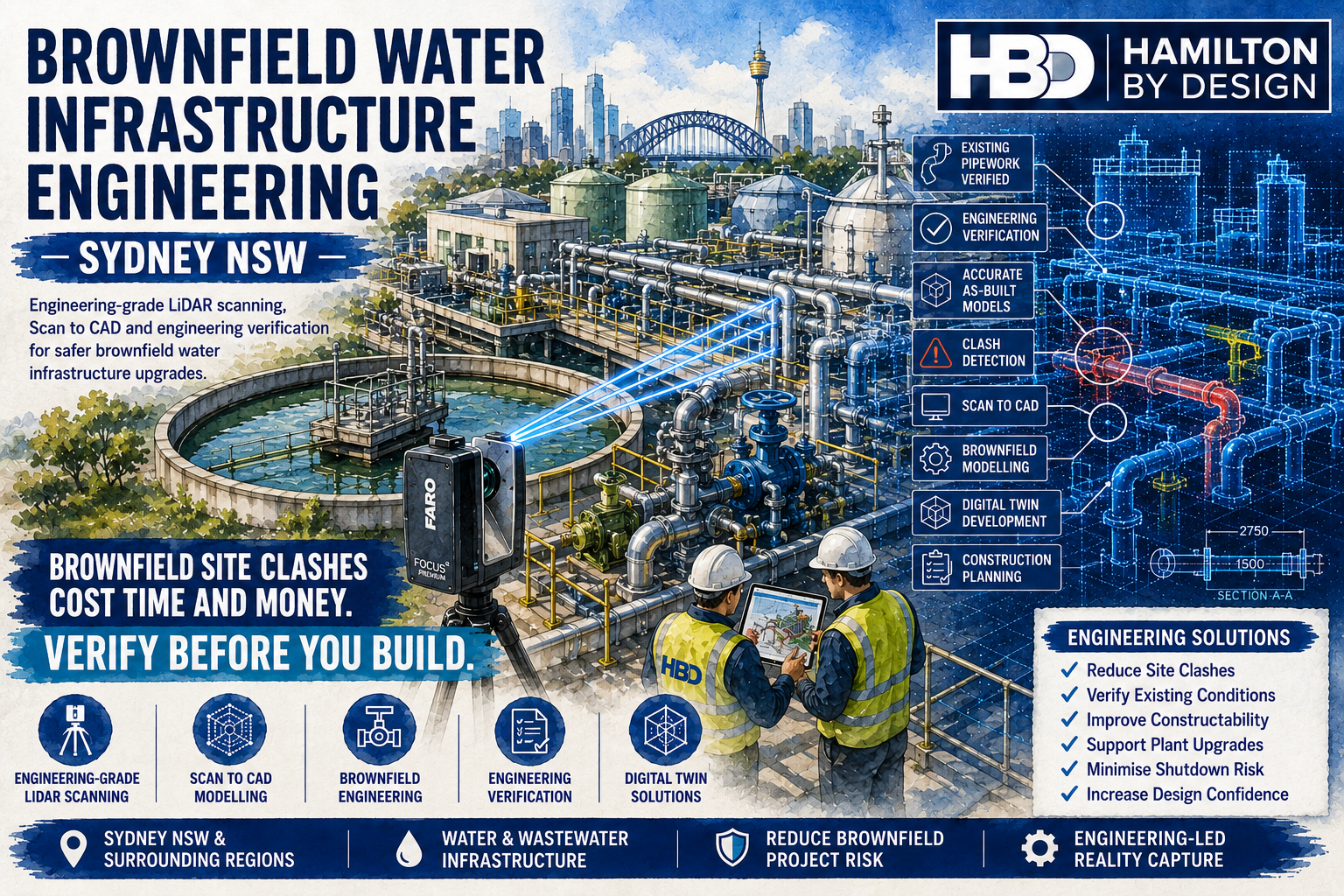
Brownfield Water Infrastructure Engineering in Sydney NSW โ€“ Reduce Risk Before Construction Begins

Engineering-grade LiDAR scanning of Sydney brownfield water infrastructure, capturing existing pipework, tanks, pumps and structural assets to support engineering verification, Scan to CAD and digital twin development.

Sydney’s water infrastructure is constantly evolving. Ageing water treatment plants, wastewater treatment facilities, pumping stations, reservoirs and transfer pipelines require ongoing upgrades to meet increasing demand, improve reliability and comply with changing environmental regulations.

Unlike greenfield projects where engineers begin with an empty site, brownfield projects involve modifying existing operational infrastructure. Every new pipe, pump, platform or structural support must integrate seamlessly with equipment that may have been installed decades ago.

The greatest challenge with brownfield engineering is simple:

Existing infrastructure rarely matches the available drawings.

Over many years, maintenance activities, emergency repairs, plant expansions and operational improvements alter facilities in ways that are often never fully documented. As a result, engineering teams frequently encounter unknown pipework, relocated equipment, modified structural steel and outdated as-built drawings.

These discrepancies create one of the biggest risks in industrial engineering:

Brownfield modifications causing costly site clashes.

Hamilton By Design provides Brownfield Water Infrastructure Engineering Services throughout Sydney NSW, combining engineering-grade LiDAR scanning, Scan to CAD, mechanical engineering and engineering verification to reduce project risk before construction begins.


Why Brownfield Projects Are More Complex Than Greenfield Projects

A greenfield project starts with a clean site.

Engineers control every dimension, every structural member and every equipment location.

Brownfield projects are completely different.

Existing facilities already contain:

  • Operating equipment
  • Underground services
  • Congested pipework
  • Electrical infrastructure
  • Instrumentation
  • Structural steel
  • Maintenance platforms
  • Access walkways
  • Cable trays
  • Temporary modifications
  • Legacy equipment

Every new design must fit around existing infrastructure while maintaining safe operation.

That is why accurate existing-condition data is essential.


The Hidden Cost of Site Clashes

A site clash occurs when newly designed equipment conflicts with existing infrastructure.

Typical clashes include:

  • Pipework intersecting structural steel
  • Pumps fouling maintenance platforms
  • Valves becoming inaccessible
  • Cable trays blocking pipe routing
  • Pipe supports interfering with existing equipment
  • Motors conflicting with overhead beams
  • Access ladders blocking maintenance paths
  • Concrete foundations overlapping underground services

Many of these issues are only discovered during construction.

By that stage:

  • fabrication is complete
  • contractors are mobilised
  • shutdowns have commenced
  • installation crews are waiting

The result is expensive redesign, fabrication changes and extended project durations.


Engineering-Grade LiDAR Scanning Eliminates Guesswork

Hamilton By Design uses professional terrestrial LiDAR scanning to accurately capture existing water infrastructure.

Rather than relying on tape measures or outdated drawings, millions of survey points are recorded across the entire facility.

This captures:

  • Pumps
  • Pipework
  • Valves
  • Tanks
  • Structural steel
  • Pipe bridges
  • Clarifiers
  • Digesters
  • Access platforms
  • Stairways
  • Handrails
  • Electrical equipment
  • Cable trays
  • Instrumentation
  • Concrete structures

The resulting point cloud becomes the single source of truth for engineering design.


Accurate Existing Conditions Lead to Better Engineering

Reliable engineering begins with reliable information.

Accurate point cloud data enables engineers to:

  • Verify dimensions
  • Confirm pipe routing
  • Check equipment locations
  • Validate maintenance access
  • Measure structural geometry
  • Review installation clearances
  • Detect clashes before construction
  • Plan shutdown activities

Instead of making assumptions, engineers work from the actual plant.


Supporting Water Infrastructure Projects Across Sydney

Hamilton By Design supports a wide range of brownfield water infrastructure projects.

These include:

Water Treatment Plant Upgrades

Treatment plants require continual investment to maintain water quality and increase capacity.

LiDAR scanning provides accurate existing-condition data before detailed engineering begins.


Wastewater Treatment Plant Modifications

Wastewater facilities often involve highly congested process pipework.

Accurate point clouds reduce installation risk during process upgrades.


Pump Station Engineering

Pump replacements frequently require:

  • new baseplates
  • pipework modifications
  • motor upgrades
  • structural changes

Scanning ensures replacement equipment integrates correctly.


Reservoir Infrastructure

Reservoir facilities require accurate engineering for:

  • inlet pipework
  • outlet manifolds
  • valve chambers
  • overflow systems
  • maintenance platforms

Reality capture improves design certainty.


Transfer Pipeline Connections

Tie-ins to existing pipelines require precise dimensional verification.

LiDAR scanning allows engineers to accurately model connection points before fabrication.


Scan to CAD Services

Point clouds are valuable, but engineering projects generally require CAD models.

Hamilton By Design converts point cloud data into:

  • Intelligent 3D models
  • General Arrangement drawings
  • Pipework models
  • Structural steel models
  • Equipment layouts
  • Sections
  • Elevations
  • Fabrication drawings
  • As-built documentation

These deliverables integrate with:

  • SOLIDWORKS
  • Autodesk Inventor
  • AutoCAD
  • Navisworks
  • Autodesk ReCap

Engineering Verification Before Construction

Engineering verification is one of the most valuable outcomes of reality capture.

Before fabrication begins, proposed designs can be compared against existing infrastructure.

Verification includes:

  • Equipment fit
  • Pipe routing
  • Structural interfaces
  • Maintenance access
  • Installation clearances
  • Lifting paths
  • Serviceability
  • Constructability

Resolving these issues during design significantly reduces project risk.


Supporting Digital Twin Development

Many Sydney water authorities are developing digital twins to improve long-term asset management.

LiDAR scanning provides the accurate geometric foundation required for these systems.

Digital twins assist with:

  • Asset management
  • Maintenance planning
  • Shutdown coordination
  • Future upgrades
  • Operator training
  • Lifecycle management
  • Engineering studies
  • Capital planning

Because the model reflects actual site conditions, future projects begin with reliable information.


Reducing Shutdown Risk

Brownfield water infrastructure projects often occur during tightly controlled shutdowns.

Unexpected site clashes can quickly extend shutdown durations.

LiDAR scanning helps engineers:

  • Detect clashes early
  • Validate fabrication
  • Optimise installation sequences
  • Improve access planning
  • Confirm equipment clearances

Many construction problems are therefore resolved before anyone arrives on site.


Typical Brownfield Engineering Workflow

Hamilton By Design follows an engineering-led workflow designed specifically for operational infrastructure.

1. Project Definition

Understand project objectives, operational constraints and shutdown requirements.

2. Engineering LiDAR Scanning

Capture existing infrastructure using terrestrial laser scanning.

3. Point Cloud Registration

Register scans into one accurate engineering dataset.

4. Quality Assurance

Verify scan completeness and registration accuracy.

5. Scan to CAD

Develop engineering-ready models from the point cloud.

6. Engineering Design

Complete mechanical, structural and pipework design using verified site information.

7. Engineering Verification

Compare proposed modifications against existing infrastructure before fabrication.

8. Construction Support

Provide engineering assistance during installation if required.


Why Choose Hamilton By Design?

Hamilton By Design combines practical engineering knowledge with advanced reality capture technology.

Our capabilities include:

  • Engineering-grade LiDAR scanning
  • Brownfield engineering support
  • Mechanical engineering
  • Reverse engineering
  • Scan to CAD
  • Engineering drafting
  • Structural modelling
  • Pipework modelling
  • As-built documentation
  • Digital twin development
  • Engineering verification
  • Construction support

Unlike traditional survey-only providers, we understand how engineering models will be used throughout the project lifecycle.

Our reality capture services are designed to produce information engineers can immediately use for design, verification and construction planning.


Supporting Sydney’s Essential Water Infrastructure

Sydney’s water infrastructure supports millions of residents, businesses and industries every day. As assets continue to age, brownfield engineering projects will become increasingly important to maintain reliable services and improve operational performance.

Successful brownfield engineering depends on one critical factor:

Accurate existing-condition information.

Without reliable data, unknown infrastructure creates unnecessary engineering risk, costly site clashes and expensive construction delays.

Hamilton By Design provides engineering-grade LiDAR scanning, Scan to CAD modelling and engineering verification services that replace uncertainty with confidence. By accurately capturing existing water infrastructure before design begins, we help engineering consultants, utilities and contractors reduce project risk, improve constructability and deliver successful brownfield upgrades.

Whether your project involves a water treatment plant, wastewater treatment facility, pumping station, reservoir or pipeline connection, our engineering-led approach ensures every design decision is based on the facility as it exists todayโ€”not outdated drawings or assumptions.

Talk to Us – Contact Us

Name
Would you like us to arrange a phone consultation for you?
Address

Our clients:
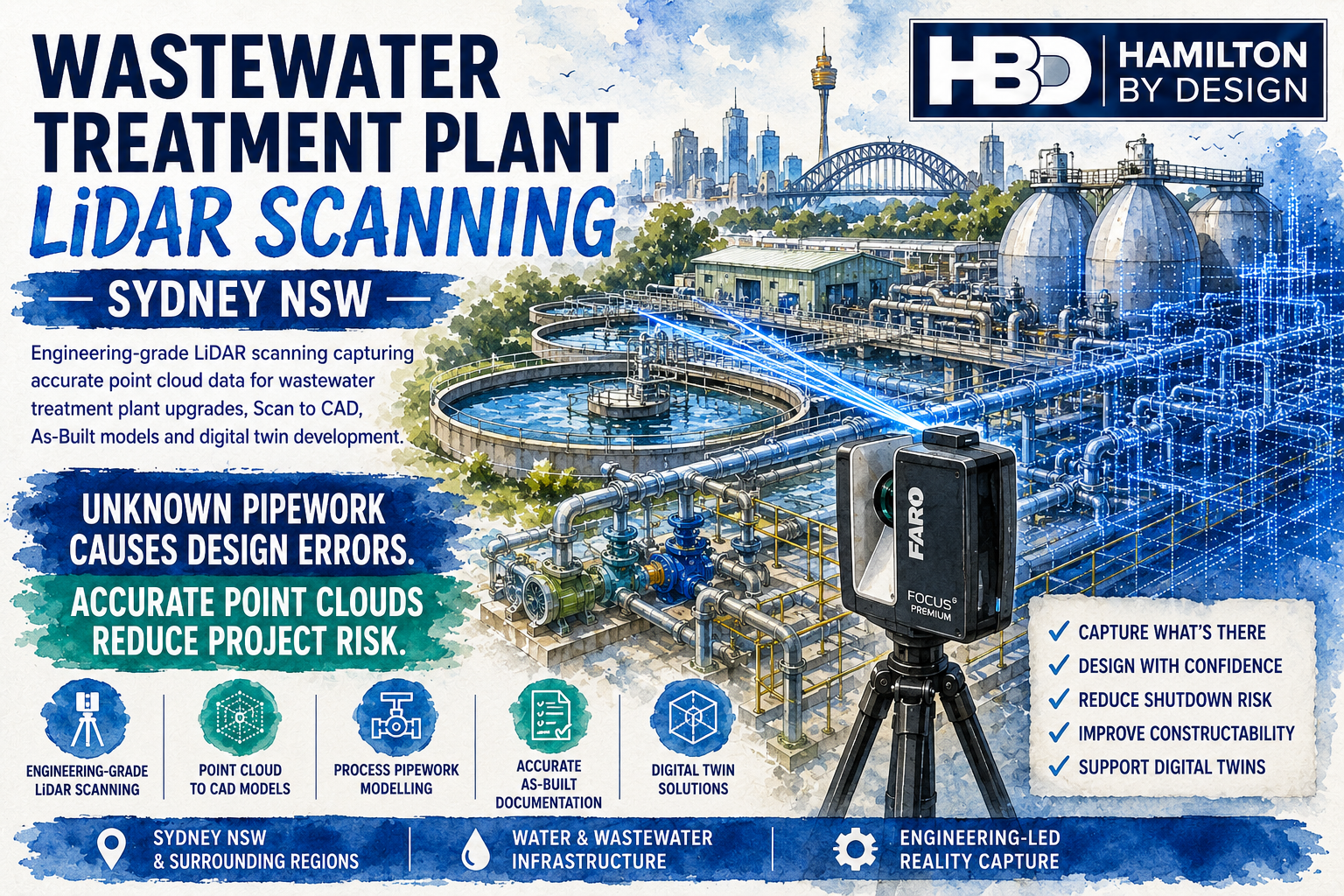


Wastewater Treatment Plant LiDAR Scanning in Sydney NSW โ€“ Engineering Accuracy for Complex Brownfield Upgrades

Engineering-grade LiDAR scanning at a Sydney wastewater treatment plant, capturing process pipework, tanks, pumps and equipment to create accurate point cloud data for As-Built models, Scan to CAD and digital twin development.

Wastewater treatment plants are among the most complex industrial facilities in Australia. They contain thousands of interconnected assets, including pumps, tanks, pipework, valves, digesters, blowers, electrical equipment, structural steel and process instrumentation. Many of Sydney’s wastewater treatment plants have evolved over decades, with continual upgrades, maintenance activities and emergency repairs altering the original plant layout.

Unfortunately, the engineering documentation often fails to keep pace with these changes.

One of the most common challenges facing engineers working on wastewater treatment plants is not knowing the exact location of existing pipework and equipment. Drawings may be outdated, undocumented modifications may have occurred during previous shutdowns, and temporary installations may have become permanent. When engineering teams rely on inaccurate information, the result is design errors, construction delays, costly rework and extended shutdowns.

Hamilton By Design provides engineering-grade Wastewater Treatment Plant LiDAR Scanning Services throughout Sydney NSW, delivering accurate point cloud data and reality capture that forms the foundation for reliable engineering design, Scan to CAD workflows, digital twins and future plant upgrades.


The Challenge of Existing Wastewater Infrastructure

Unlike greenfield projects where everything is designed from a clean slate, wastewater treatment plants present a true brownfield engineering environment.

Facilities are continually modified to improve capacity, meet environmental regulations and replace ageing assets. These modifications may include:

  • Replacement pumps
  • New process pipework
  • Chemical dosing systems
  • Additional valves
  • Electrical upgrades
  • Instrumentation changes
  • Structural steel modifications
  • Access platforms
  • Pipe bridges
  • Temporary bypass systems
  • Maintenance repairs

While these improvements keep the plant operating efficiently, they also create a significant challenge.

The original drawings rarely represent the current plant configuration.

Engineers designing future upgrades often discover that equipment is not where the drawings indicate, pipework has been rerouted and structural elements have changed considerably since construction.


Why Unknown Pipework Creates Expensive Problems

Pipework is the backbone of every wastewater treatment plant.

Unknown pipe locations can create serious engineering issues including:

  • Pipe clashes during installation
  • Incorrect spool fabrication
  • Valve interference
  • Equipment access restrictions
  • Foundation conflicts
  • Structural clashes
  • Maintenance clearance problems
  • Shutdown delays
  • Additional site welding
  • Emergency redesign

Even a small discrepancy in pipe alignment can require extensive fabrication changes during installation.

These problems become significantly more expensive once contractors are mobilised and the plant is offline.


Engineering LiDAR Scanning Removes Uncertainty

Hamilton By Design uses high-resolution terrestrial LiDAR scanners to accurately capture the entire wastewater treatment facility.

Rather than collecting isolated survey points, LiDAR scanning records millions of highly accurate measurements across every visible surface.

This includes:

  • Process pipework
  • Pumps
  • Blowers
  • Clarifiers
  • Digesters
  • Tanks
  • Screens
  • Conveyors
  • Valves
  • Structural steel
  • Pipe supports
  • Access platforms
  • Handrails
  • Stairways
  • Electrical switchrooms
  • Cable trays
  • Instrumentation
  • Concrete structures

The result is a highly detailed point cloud representing the facility exactly as it exists today.


Engineering Applications

Plant Upgrades

As treatment capacity increases, plants require continual expansion.

LiDAR scanning provides engineers with accurate existing-condition data before detailed design begins.


Pump Replacements

Pump replacement projects benefit from accurate verification of:

  • Baseplate locations
  • Pipe flange alignment
  • Maintenance clearances
  • Motor access
  • Lifting paths

Replacement equipment can be designed around actual site conditions rather than outdated drawings.


Pipework Modifications

New process improvements frequently require:

  • Additional pipelines
  • Larger pipe diameters
  • Bypass systems
  • New isolation valves
  • Flow measurement equipment
  • Chemical dosing lines

Point cloud data ensures new pipework integrates correctly with existing infrastructure.


Structural Modifications

Engineering upgrades often require:

  • New maintenance platforms
  • Pipe supports
  • Equipment frames
  • Walkways
  • Ladders
  • Access stairs

LiDAR scanning accurately captures existing structural steel for seamless integration.


Electrical and Instrumentation

Reality capture also supports:

  • Cable tray routing
  • MCC upgrades
  • Instrument relocation
  • Electrical design
  • Control system upgrades

Designers can verify available space before construction begins.


Accurate Point Cloud Data for Engineering Design

The value of LiDAR scanning extends well beyond visualisation.

Accurate point cloud data enables engineers to:

  • Measure existing equipment
  • Verify pipe routing
  • Confirm elevations
  • Check structural geometry
  • Review maintenance access
  • Identify clashes
  • Plan installations
  • Validate design assumptions

Because measurements can be taken directly from the point cloud, engineers spend less time returning to site and more time designing solutions.


Scan to CAD Services

Hamilton By Design transforms point cloud data into engineering-ready deliverables.

Typical outputs include:

  • Intelligent 3D CAD models
  • General Arrangement drawings
  • Equipment layouts
  • Pipework models
  • Structural steel models
  • Plant sections
  • Elevations
  • Fabrication drawings
  • Asset registers
  • As-built documentation

These deliverables integrate with modern engineering software including SOLIDWORKS, Autodesk Inventor, AutoCAD, Navisworks and ReCap.


Supporting Digital Twin Development

Water utilities across Australia are increasingly adopting digital twin technology.

LiDAR scanning provides the accurate geometric foundation for these digital assets.

Digital twins support:

  • Asset management
  • Maintenance planning
  • Capital works
  • Lifecycle management
  • Operator training
  • Shutdown planning
  • Future engineering design
  • Regulatory compliance

Instead of relying on historical drawings, digital twins represent the facility exactly as it exists.


Reducing Shutdown Risk

Wastewater treatment plants typically operate continuously, making shutdown windows extremely valuable.

Every hour of delay increases project costs.

Engineering-grade LiDAR scanning reduces shutdown risk by allowing designers to:

  • Verify equipment locations
  • Perform clash detection
  • Optimise installation sequences
  • Confirm maintenance access
  • Validate fabrication before delivery

Many construction issues can therefore be resolved during design rather than during installation.


Supporting Brownfield Engineering Projects

Brownfield engineering demands accurate information.

Hamilton By Design supports projects including:

  • Plant expansions
  • Process upgrades
  • Mechanical replacements
  • Structural modifications
  • Pipework redesign
  • Electrical upgrades
  • Asset verification
  • Condition assessments

Accurate reality capture significantly improves engineering confidence throughout the project lifecycle.


Typical Workflow

Our wastewater treatment plant scanning workflow includes:

1. Project Planning

Review project objectives, operational constraints and shutdown requirements.

2. Site LiDAR Scanning

Capture all required plant areas using engineering-grade terrestrial laser scanning.

3. Point Cloud Registration

Register individual scans into one accurate coordinate system.

4. Quality Assurance

Verify scan accuracy, completeness and registration quality.

5. Engineering Modelling

Develop CAD models, layouts and engineering documentation from the point cloud.

6. Design Integration

Use verified existing conditions for mechanical, structural and process design.

7. Construction Verification

Review proposed modifications against existing infrastructure before fabrication.


Why Choose Hamilton By Design?

Hamilton By Design combines engineering expertise with advanced reality capture technology.

Our capabilities include:

  • Engineering-grade terrestrial LiDAR scanning
  • Wastewater infrastructure surveying
  • Scan to CAD
  • Reverse engineering
  • Mechanical engineering
  • Structural engineering support
  • Engineering drafting
  • As-built documentation
  • Digital twin development
  • Brownfield engineering
  • Shutdown planning support

Because our team understands industrial engineering, we capture the information designers actually requireโ€”not simply visual data.


Supporting Sydney’s Wastewater Infrastructure

Sydney’s wastewater treatment plants are critical to protecting public health, supporting population growth and maintaining environmental compliance. As these facilities continue to modernise, reliable engineering information becomes essential for successful upgrades.

Unknown pipework and undocumented equipment locations should never compromise engineering design.

Engineering-grade LiDAR scanning provides accurate point cloud data that replaces uncertainty with confidence. By capturing every visible asset in its true position, Hamilton By Design helps engineers reduce design errors, improve constructability and minimise costly site modifications.

Whether your project involves replacing pumps, upgrading treatment processes, modifying pipework or developing a digital twin, our engineering-led LiDAR scanning services deliver the accurate existing-condition data required for successful project outcomes.

If you’re planning a wastewater treatment plant upgrade in Sydney NSW, Hamilton By Design can provide the engineering-grade reality capture, Scan to CAD modelling and As-Built documentation needed to ensure your design is based on the facility as it exists todayโ€”not as it was drawn years ago.

Talk to Us – Contact Us

Name
Would you like us to arrange a phone consultation for you?
Address

Our clients:

Talk to Us – Contact Us

Name
Would you like us to arrange a phone consultation for you?
Address

Our clients:


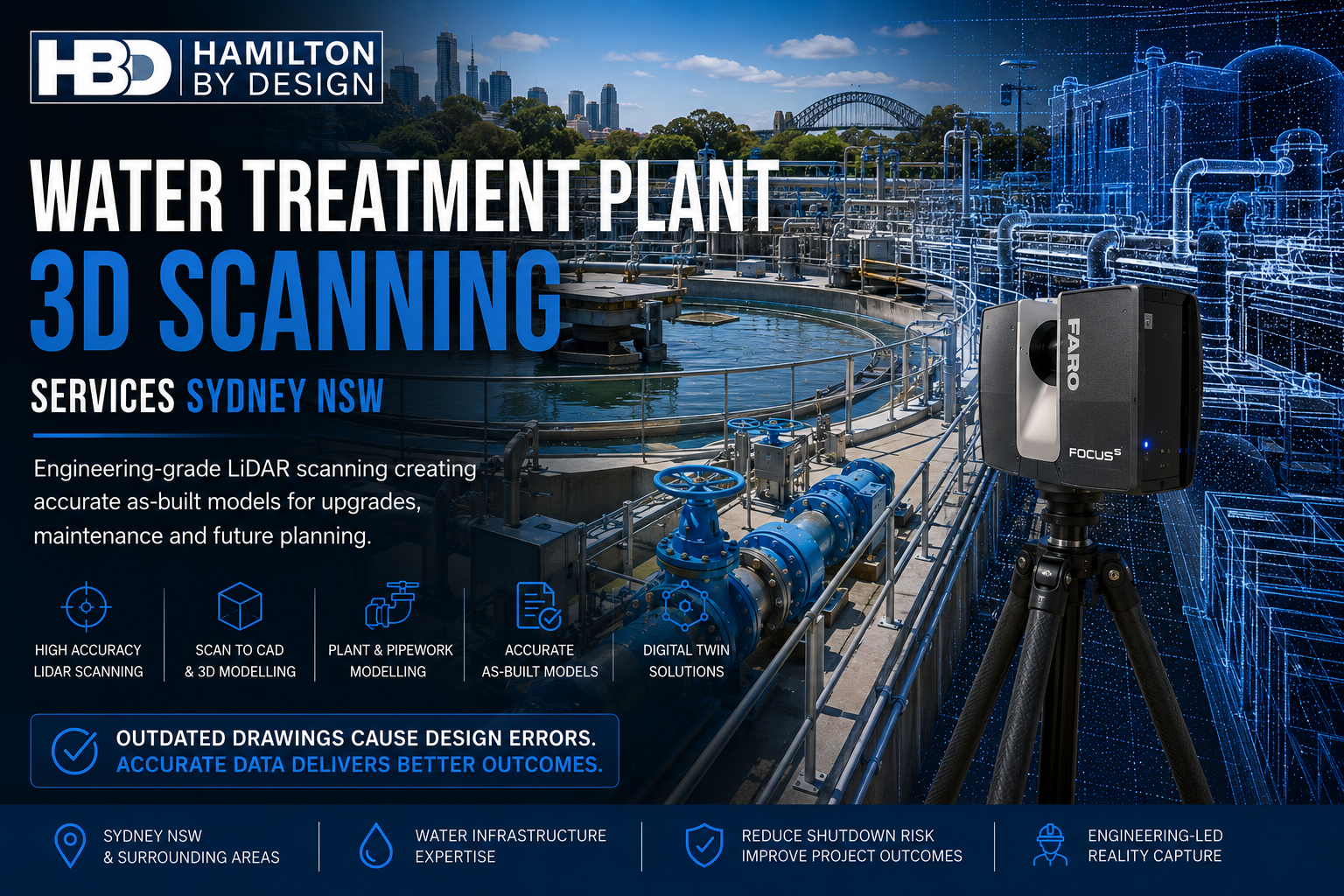
Water Treatment Plant 3D Scanning Services in Sydney NSW โ€“ Accurate As-Built Data for Smarter Engineering

Engineering-grade LiDAR scanning at a Sydney water treatment plant, capturing tanks, pipework and process infrastructure to create accurate As-Built models for plant upgrades, Scan to CAD and digital twin development.

Water treatment plants are among Australia’s most critical infrastructure assets. They operate continuously to deliver safe, reliable drinking water to millions of people while meeting stringent regulatory and environmental requirements. As Sydney continues to invest in expanding and modernising its water infrastructure, engineering teams are increasingly faced with a common challenge:

The existing as-built drawings no longer reflect what is actually installed on site.

Over decades of operation, treatment plants undergo numerous modifications. Pumps are replaced, pipework is rerouted, valves are upgraded, electrical equipment is relocated, and structural steel is modified to suit operational requirements. Unfortunately, these changes are not always captured in the engineering documentation.

When engineers begin designing upgrades using outdated drawings, errors quickly emerge. Pipework clashes with existing infrastructure, replacement equipment fails to fit, structural supports require redesign, and shutdown schedules are extended while unexpected site modifications are completed.

Hamilton By Design provides engineering-grade Water Treatment Plant 3D Scanning Services throughout Sydney NSW, using terrestrial LiDAR scanning to create highly accurate digital representations of existing facilities. By replacing outdated drawings with reliable reality capture, engineering teams can design with confidence, reduce project risk and improve construction outcomes.


The Problem with Outdated As-Built Drawings

Many of Sydney’s water treatment facilities have been operating for several decades. During this time, numerous maintenance activities and capital upgrades have altered the original plant configuration.

Typical undocumented changes include:

  • Replacement pumps with different footprints
  • Pipework rerouted around new equipment
  • Additional valves and instrumentation
  • Modified pipe supports
  • Structural strengthening
  • New cable trays
  • Electrical switchboard upgrades
  • Temporary modifications that became permanent
  • Altered maintenance platforms
  • Relocated access ladders

Although each modification may have been appropriate at the time, the cumulative effect is that original drawings often no longer represent actual site conditions.

Engineering projects based on these outdated documents carry significant risk.


Why Accurate Existing Conditions Matter

Every brownfield engineering project begins with one critical question:

What is actually installed today?

Without accurate existing information, designers are forced to rely on assumptions or undertake extensive manual site measurements.

Both approaches introduce unnecessary risk.

Common design issues include:

  • Pipework that does not align during installation
  • Pump discharge flanges requiring on-site modification
  • Structural steel interfering with new equipment
  • Insufficient maintenance access
  • Cable trays clashing with pipe supports
  • Valve actuators becoming inaccessible
  • Equipment foundations requiring redesign
  • Lifting clearances being overlooked

These problems typically become apparent during construction, when the cost of correcting them is significantly higher.


Engineering LiDAR Scanning Removes Uncertainty

Hamilton By Design uses professional terrestrial LiDAR scanners to capture millions of highly accurate measurement points throughout a water treatment facility.

Rather than recording selected dimensions using conventional survey methods, laser scanning captures the complete geometry of the plant.

Typical assets captured include:

  • Process pipework
  • Pumps
  • Motors
  • Valves
  • Tanks
  • Clarifiers
  • Filters
  • Chemical dosing systems
  • Structural steel
  • Pipe bridges
  • Walkways
  • Stairways
  • Handrails
  • Electrical switchrooms
  • MCC rooms
  • Cable trays
  • Instrumentation
  • Concrete structures

The result is a comprehensive point cloud representing the true existing condition of the facility.

Engineers can measure any feature directly from the scan throughout the design process without repeatedly returning to site.


Supporting Water Treatment Plant Upgrades

Sydney’s treatment plants require continual investment to maintain reliability, increase capacity and improve operational efficiency.

LiDAR scanning supports projects such as:

Pump Replacements

Replacement pumps frequently differ from the original equipment.

Accurate scanning ensures:

  • baseplates align correctly
  • suction and discharge pipework matches
  • maintenance clearances are maintained
  • lifting access is preserved

Pipework Modifications

Process improvements often require:

  • larger diameter pipework
  • bypass systems
  • additional isolation valves
  • flow meters
  • chemical dosing lines

Accurate point clouds allow new spool pieces to be designed around existing infrastructure before fabrication begins.


Structural Modifications

New equipment installations commonly require:

  • equipment platforms
  • maintenance walkways
  • lifting beams
  • pipe supports
  • access ladders
  • handrails

Scanning captures every structural member to ensure new steel integrates correctly.


Electrical and Instrumentation Upgrades

Electrical upgrades benefit significantly from reality capture.

Designers can accurately model:

  • cable trays
  • conduits
  • MCC rooms
  • switchboards
  • instrument locations
  • communication systems

This improves installation planning while reducing field modifications.


Creating Accurate As-Built Models

One of the greatest advantages of engineering-grade LiDAR scanning is the ability to create reliable as-built models.

These models provide:

  • current equipment locations
  • verified pipe routing
  • structural layouts
  • equipment dimensions
  • maintenance clearances
  • plant configuration

Unlike historic drawings, as-built models reflect the facility exactly as it exists today.

They become the foundation for future engineering projects.


Scan to CAD for Engineering Design

Point clouds are extremely valuable, but engineering projects often require intelligent CAD models.

Hamilton By Design converts point cloud data into engineering deliverables including:

  • 3D CAD models
  • General Arrangement drawings
  • Equipment layouts
  • Pipe routing models
  • Structural steel models
  • Plant sections
  • Elevations
  • Fabrication drawings
  • As-built documentation

These models integrate directly into engineering workflows using software such as Autodesk, SOLIDWORKS and Navisworks.


Supporting Digital Twin Development

Many water authorities are now investing in digital twins to improve long-term asset management.

LiDAR scanning forms the foundation of these digital assets.

A digital twin can support:

  • maintenance planning
  • shutdown coordination
  • asset lifecycle management
  • operator training
  • future upgrades
  • capital works planning
  • condition assessments
  • engineering analysis

Rather than relying on outdated information, the digital twin represents actual plant conditions.


Reducing Shutdown Risk

Water treatment plants often operate continuously, making shutdown planning critical.

Unexpected design errors during shutdowns can result in:

  • extended outages
  • contractor delays
  • increased labour costs
  • emergency fabrication
  • delayed commissioning

Accurate 3D scanning identifies potential issues before work begins.

Engineers can perform visual clash detection, verify clearances and optimise installation sequences during the design stage.

This significantly reduces project risk.


Brownfield Engineering Expertise

Unlike greenfield facilities, brownfield projects require engineers to work around existing assets.

Hamilton By Design specialises in engineering support for brownfield infrastructure, including:

  • water treatment plants
  • wastewater treatment plants
  • pumping stations
  • reservoirs
  • chemical dosing facilities
  • filtration plants
  • process buildings

Engineering-grade reality capture provides confidence that new infrastructure will integrate successfully with existing operations.


Typical Project Workflow

Our engineering workflow has been developed specifically for operational infrastructure.

1. Project Planning

Review plant access requirements, shutdown windows and engineering objectives.

2. Site LiDAR Scanning

Capture complete facility geometry using terrestrial laser scanning.

3. Scan Registration

Combine individual scans into one accurate point cloud.

4. Quality Assurance

Verify registration accuracy and confirm complete site coverage.

5. Engineering Modelling

Develop CAD models, equipment layouts and engineering documentation.

6. Design Integration

Use accurate as-built information to complete mechanical, structural and process designs.

7. Construction Verification

Verify proposed upgrades against existing infrastructure before fabrication.


Why Choose Hamilton By Design?

Hamilton By Design provides more than laser scanning.

We combine engineering expertise with advanced reality capture technologies to deliver practical engineering solutions.

Our capabilities include:

  • Engineering-grade terrestrial LiDAR scanning
  • Mechanical engineering design
  • Scan to CAD services
  • Reverse engineering
  • Pipework modelling
  • Structural steel modelling
  • Engineering drafting
  • Digital twin development
  • As-built verification
  • Brownfield engineering support
  • Shutdown engineering planning

Because our engineers understand industrial facilities, we capture the information that designers actually needโ€”not just visually impressive point clouds.


Supporting Sydney’s Water Infrastructure

Sydney’s water treatment plants play a vital role in supplying safe drinking water to millions of residents and businesses. As these facilities continue to expand, modernise and replace ageing assets, engineering accuracy becomes increasingly important.

Outdated as-built drawings should never be the reason a project experiences delays, redesigns or costly construction changes.

Engineering-grade LiDAR scanning provides reliable existing-condition data that supports smarter engineering decisions, reduces construction risk and improves project outcomes.

Whether your project involves replacing pumps, modifying pipework, upgrading process equipment or creating a digital twin, Hamilton By Design delivers accurate 3D scanning, engineering modelling and Scan to CAD services throughout Sydney NSW.

By capturing the plant exactly as it exists today, we help ensure tomorrow’s upgrades fit correctly the first time.

Talk to Us – Contact Us

Name
Would you like us to arrange a phone consultation for you?
Address

Our clients:
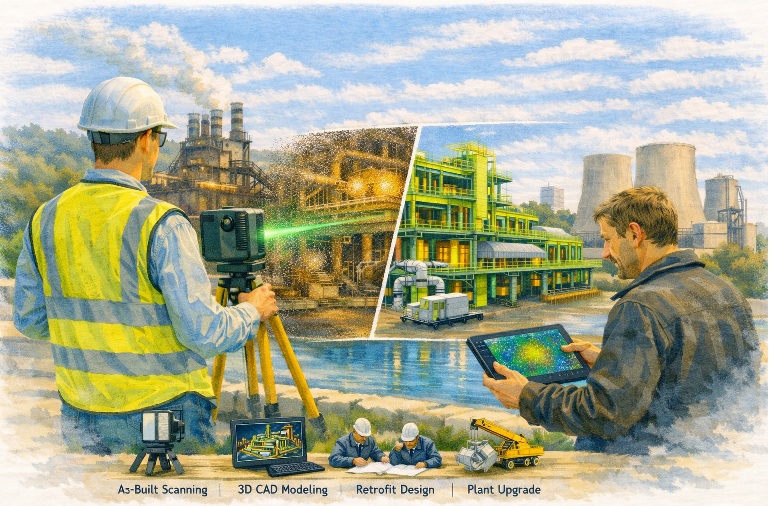


Industrial LiDAR Scanning & Retrofit Engineering โ€“ Pittsburgh, Pennsylvania

Industrial facility captured using 3D laser scanning for brownfield plant upgrade

Engineering Certainty in Legacy Industrial Facilities

Pittsburgh is not a new-build engineering market.

It is a modification market.

Steel mills, manufacturing plants, utilities and infrastructure in the Pittsburgh region have evolved over decades โ€” often across multiple owners, upgrades and undocumented changes. As a result, existing drawings rarely represent real conditions.

Hamilton By Design supports engineering and project teams by capturing accurate as-built data before modification work begins.

Rather than designing around assumptions, projects are developed from measured reality.


Engineer performing industrial LiDAR scan of a processing plant for retrofit design

Why Retrofit Projects in Pittsburgh Require LiDAR Scanning

Legacy facilities typically contain:

  • undocumented plant changes
  • relocated equipment
  • structural distortion over time
  • incomplete or missing drawings
  • congested services and pipework

When upgrades are designed from outdated information, installation conflicts occur and shutdown durations increase.

High-accuracy LiDAR scanning captures millions of measurement points and creates a true digital representation of the operating facility, reducing rework and unexpected site conflicts.


Typical Pittsburgh Projects We Support

Steel & Heavy Manufacturing

  • equipment replacement
  • access platforms and walkways
  • structural refurbishment
  • plant safety upgrades

Utilities & Processing Facilities

  • pipe routing modifications
  • pump and tank replacement
  • tie-in engineering
  • maintenance shutdown planning

Industrial Infrastructure & Brownfield Sites

  • facility upgrades
  • expansion works
  • mechanical retrofits
  • reverse engineering of existing equipment

Hamilton By Design combines engineering knowledge with reality capture to reduce fabrication and installation risk on operating assets.


Our Engineering-Led Workflow

(See full process: Industrial Retrofit LiDAR Scanning)

1 โ€” Site Capture

We collect high-density scan data without interrupting operations.

2 โ€” Digital As-Built Model

Point clouds are converted into coordinated engineering models.

3 โ€” Retrofit Design

Designs are developed directly from actual geometry.

4 โ€” Fabrication & Installation Confidence

Projects install correctly the first time, reducing shutdown risk.

Engineering-grade scanning enables clash detection, brownfield integration and efficient shutdown planning.


What Problems This Solves

For retrofit projects the largest risk is dimensional uncertainty.

Our workflow removes:
  • field modification work
  • fabrication rework
  • installation clashes
  • extended shutdown durations

Hamilton By Design focuses on reducing engineering and fabrication risk on existing industrial assets using accurate scan data and mechanical design integration.


Engineering-Led, Not Survey-Led

Many providers deliver point clouds.

We deliver engineering decisions.

One team is responsible from measurement through to design support โ€” ensuring the data collected is practical and usable for real construction outcomes.


Supporting Pittsburghโ€™s Ongoing Industrial Evolution

Regions like Pittsburgh continue to modernise existing infrastructure rather than replace it. Successful upgrades depend on understanding what is already built.

LiDAR scanning provides the digital foundation for safe modification, accurate fabrication and predictable installation.


Hamilton By Design logo displayed on a blue tilted rectangle with a grey gradient background

3D LiDAR scanning and 3D modelling service button โ€” laser scanner capturing a point cloud for engineering and CAD modelling
Mechanical engineering services

Talk to Hamilton By Design

If your project involves modifying an existing facility, engage scanning before design begins.

Design from reality โ€” not assumption.


Name
Would you like us to arrange a phone consultation for you?
Address

3D CAD Modelling Australia service banner for Hamilton By Design
Australian Drafting logo featuring bold white text reading "Australian Drafting" centred on a blue rounded rectangle background.
Engineering Governance title graphic featuring bold white text reading "Engineering Governance" centred on a blue rounded rectangle background.
Mechanical, Structural & Pipework Drafting service banner by Hamilton By Design featuring white text on a blue background.
Mechanical engineering services
Blue rounded button with the text โ€œSolidWorks Designโ€ in white.
Finite Element Analysis (FEA) engineering simulation button
3D LiDAR Scanning Darwin for engineering surveys, laser scanning, reality capture and point cloud modelling services
3D LiDAR Scanning Australia engineering services for laser scanning, reality capture, scan-to-CAD, Scan-to-BIM and as-built documentation across Australia
3D LiDAR scanning services on the Central Coast providing engineering-grade laser scanning, point cloud capture, scan-to-CAD modelling and industrial reality capture for infrastructure and industrial projects.
3D LiDAR Scanning Perth for engineering surveys, laser scanning, reality capture and point cloud modelling services
3D LiDAR Scanning Sydney for engineering surveys, laser scanning, reality capture and point cloud modelling services
3D LiDAR Scanning Brisbane for engineering surveys, laser scanning, reality capture and point cloud modelling services
3D LiDAR Scanning Canberra for engineering surveys, laser scanning, reality capture and point cloud modelling services
3D LiDAR Scanning Newcastle for engineering surveys, laser scanning, reality capture and point cloud modelling services
3D LiDAR Scanning Adelaide for engineering surveys, laser scanning, reality capture and point cloud modelling services

LiDAR Scanning for Industrial Retrofit Engineering

Industrial facility captured using 3D laser scanning for brownfield plant upgrade

LiDAR Scanning for Industrial Retrofit Engineering | Brownfield Plant As-Built Capture

Steel Mills, Manufacturing Plants & Legacy Facility Upgrades

Across industrial regions such as Pittsburgh, Carnegie and Norristown, engineering teams are not scanning sites for mapping โ€” they are scanning them because they are about to change something critical.

Brownfield facilities rarely match drawings.
Plant modifications fail when decisions are made from assumptions rather than measurements.

Hamilton By Design provides engineering-grade LiDAR scanning and modelling specifically for retrofit engineering โ€” capturing existing assets so upgrades install correctly the first time.


Engineer performing industrial LiDAR scan of a processing plant for retrofit design

Why Industrial Facilities Require Scanning Before Design

In heavy industry the problem is rarely design capability โ€” it is uncertainty of the existing plant.

Old facilities typically contain:

  • undocumented structural alterations
  • relocated services and pipework
  • equipment installed over decades
  • distorted steelwork
  • unavailable or unreliable drawings

When upgrades are designed from historical drawings, fabrication errors and shutdown overruns occur.

Our process replaces assumption with measured reality.

We capture what actually exists โ€” then design from truth.

Hamilton By Design combines mechanical engineering with LiDAR capture to reduce fabrication and installation risk on operating assets.


Typical Projects Supported

Brownfield Industrial Plants

  • plant expansions
  • conveyor modifications
  • structural replacement
  • maintenance shutdown preparation

Steel Mills & Heavy Manufacturing

  • equipment replacement
  • platform and access upgrades
  • retrofit guarding & compliance
  • mechanical component redesign

Utilities & Processing Facilities

  • pipe routing development
  • pump and tank replacement
  • asset life-extension upgrades
  • tie-in engineering

These projects require accurate as-built conditions before design โ€” not survey grade positioning, but engineering-grade dimensional certainty.


Our Retrofit Engineering Workflow

1. Field Capture โ€” Engineering LiDAR Scanning

We capture operating facilities without interrupting production and obtain full spatial reality of structures, equipment and services.

2. Digital As-Built Model

Point cloud data is converted into coordinated 3D engineering models for decision-making and clash prevention.

3. Mechanical & Structural Design

Designs are developed directly from measured geometry rather than historic drawings.

4. Fabrication-Ready Deliverables

We provide models and drawings suitable for fabrication and installation.

This approach allows components to fit existing plant conditions on installation rather than being adjusted in the field.


What This Solves

Industrial retrofit projects fail due to dimensional unknowns โ€” not poor engineering.

LiDAR-driven design removes:

  • shutdown delays
  • rework fabrication
  • on-site modifications
  • installation conflicts
  • access clashes

Hamilton By Design supports manufacturing, processing and heavy industry with accurate as-built data and coordinated models for upgrades, maintenance and asset life-extension projects.


Engineering-Led Scanning โ€” Not Just Surveying

Many scanning providers supply point clouds.

We provide engineering decisions.

The difference is accountability โ€” one team responsible from measurement to design.

One team accountable from scan to fabrication.


When to Engage Us

Engage scanning early when a project involves:

  • replacing equipment
  • modifying structure
  • adding services
  • shutdown installation
  • upgrading legacy facilities

If fabrication depends on existing conditions, scanning should precede design โ€” not follow it.


Hamilton By Design logo displayed on a blue tilted rectangle with a grey gradient background

Talk to Hamilton By Design

Hamilton By Design delivers engineering-grade LiDAR scanning and retrofit design support for operating industrial assets worldwide.

Reduce installation risk.
Design from measured reality.

Name
Would you like us to arrange a phone consultation for you?
Address
Name
Would you like us to arrange a phone consultation for you?
Address

3D CAD Modelling Australia service banner for Hamilton By Design
3D LiDAR scanning and 3D modelling service button โ€” laser scanner capturing a point cloud for engineering and CAD modelling
Mechanical engineering services
Finite Element Analysis (FEA) engineering simulation button
Mechanical engineering services

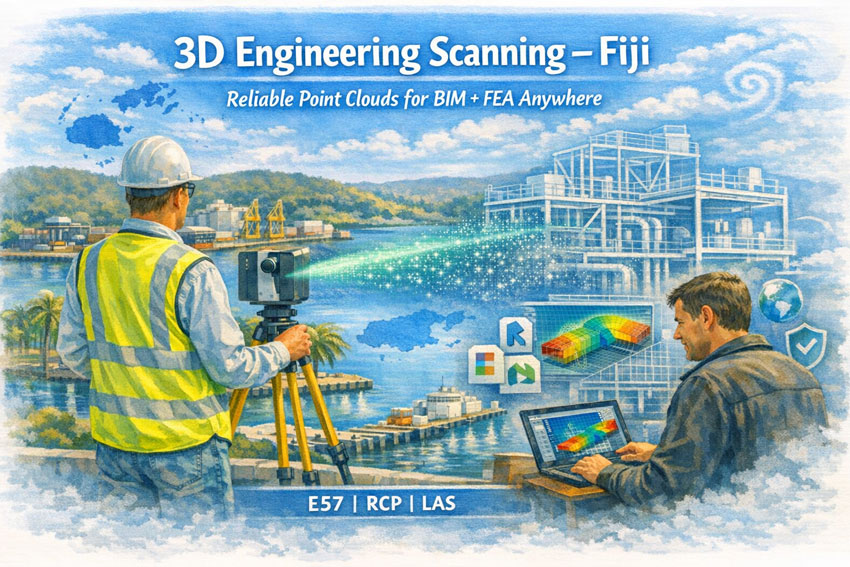
3D Engineering Scanning in Fiji โ€“ Reliable Point Clouds for Global Engineering

Engineer performing 3D laser scanning in Fiji with point cloud transforming into BIM model and FEA analysis beside a tropical port.

3D Engineering Scanning Fiji โ€“ Point Clouds for Design & FEA | Hamilton By Design

Hamilton By Design provides professional 3D laser scanning services across Fiji, delivering high-accuracy point clouds that allow designers, engineers, and asset owners anywhere in the world to work with real, measured dataโ€”without stepping foot on site.

Our focus is simple:
capture the truth of your asset once, and let every engineering discipline design from the same digital backbone.


Engineering-Grade Data You Can Design From

In Fiji, many industrial, marine, and commercial assets have:

  • incomplete or outdated drawings
  • decades of informal modifications
  • mixed construction standards
  • corrosion and cyclone damage history

Traditional measurement methods struggle in this environment. Our 3D scanning service produces a survey-accurate digital replica that can be used for:

  • 3D modelling in Revit, Plant3D, Tekla, SolidWorks
  • structural analysis and FEA studies
  • clash detection for new equipment
  • fabrication of steel and pipework
  • condition assessments and deformation checks

We deliver neutral, open formats so your teamโ€”anywhere in Australia, New Zealand, Fiji, or globallyโ€”can immediately begin engineering work.


What We Deliver

Core Outputs

  • Registered point clouds (E57 / RCP / LAS)
  • Colourised, engineering-accurate datasets
  • Site coordinate systems or project datum
  • Mesh models for Navisworks / visualisation
  • 2D plans, elevations, and sections

Optional Engineering Deliverables

  • Scan-to-BIM models (LOD 200โ€“350)
  • Steel and pipe geometry extraction
  • Tie-in coordinates for brownfields projects
  • Deformation and roundness reports
  • Clash and constructability reviews

Every dataset is processed in Australia under formal QA procedures so it can be relied upon for detailed design, certification, and FEA modelling.


Designed for Fiji Conditions

Scanning in Fiji requires more than equipmentโ€”it requires experience in Pacific environments.

We plan projects around:

  • tropical heat and humidity
  • sudden rain events
  • reflective stainless and bright sunlight
  • inter-island logistics
  • remote power and access constraints
  • cyclone season scheduling

Our workflows are built so field capture is efficient and robust, while processing and modelling are completed by our Australian engineering team.


Industries We Support in Fiji

  • Ports and wharves โ€“ Suva, Lautoka, Levuka
  • Power generation and utilities
  • Sugar and food processing plants
  • Water and wastewater infrastructure
  • Resorts and commercial buildings
  • Bridges and civil structures
  • Post-cyclone assessments
  • Mining and materials handling

A Digital Backbone for Global Teams

A quality scan is the backbone of every downstream task.
If the backbone is wrong, every model, drawing, and FEA result is compromised.

Our aim is to give your project a foundation that:

  • removes re-measure risk
  • allows off-site fabrication
  • supports remote engineering teams
  • shortens shutdowns
  • improves safety and constructability

Designers and engineers in any location can open our data and begin work immediatelyโ€”confident it represents the real world.

3D LiDAR scanning and 3D modelling service button โ€” laser scanner capturing a point cloud for engineering and CAD modelling
Mechanical engineering services

Hamilton By Design logo displayed on a blue tilted rectangle with a grey gradient background

Why Choose Hamilton By Design

  • Engineer-led scanning team
  • Australian processing and QA
  • experience in PNG and Pacific brownfields
  • deliverables tailored to your software
  • practical understanding of fabrication and FEA requirements

We donโ€™t just capture pointsโ€”we deliver usable engineering information.


Talk to Us About Your Fiji Project

Whether you need a single building, a wharf, or a full processing plant captured, we can mobilise quickly and provide data your global team can trust.

Hamilton By Design
Engineering certainty through 3D scanning.

Name
Would you like us to arrange a phone consultation for you?
Address

3D CAD Modelling Australia service banner for Hamilton By Design
Finite Element Analysis (FEA) engineering simulation button
Mechanical engineering services