Mechanical Engineering | 3D Scanning | 3D Modelling
Tag: mechanical design
Mechanical design services focused on safe, compliant, and buildable engineering solutions.
This tag covers mechanical design activities including concept development, detailed design, reverse engineering, and design for manufacture and maintenance (DFM/DFMA), supported by engineering-led LiDAR scanning, CAD modelling, and standards-aligned documentation for industrial, mining, commercial, and residential applications.
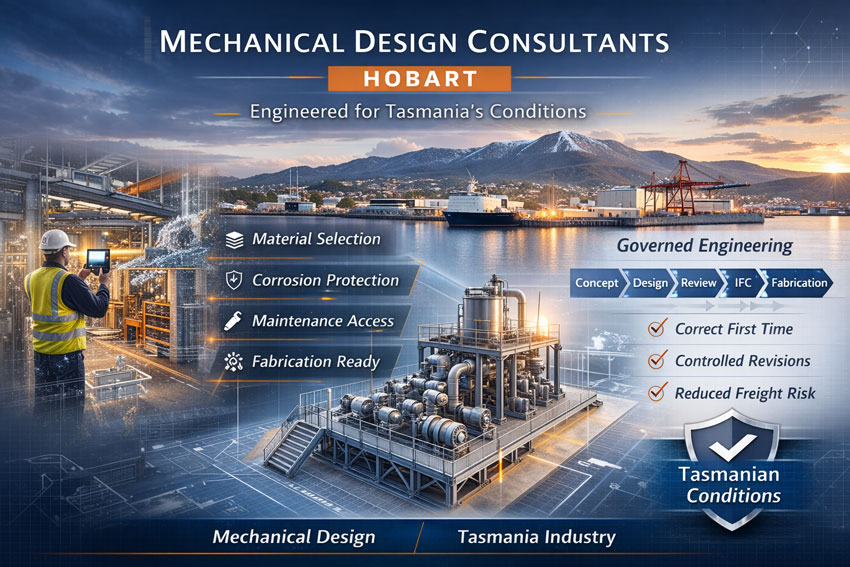
Hobart is unlike mainland capital cities. Its maritime environment, cooler climate and geographic isolation create unique engineering challenges. Mechanical design in Hobart requires practical thinking, accurate documentation and a strong understanding of local conditions.
Hamilton By Design provides mechanical design consulting services to Hobart and broader Tasmania. We deliver governed, fabrication-ready engineering solutions built for real site conditions.
What Makes Mechanical Design in Hobart Unique
Maritime Environment Hobart’s proximity to the Southern Ocean and the Port creates exposure to salt-laden air and high corrosion environments. Mechanical systems must consider material selection, protective coatings, long-term durability and maintainability in marine conditions.
Cool Climate and Variable Weather Tasmania’s cooler temperatures and moisture exposure affect thermal expansion, outdoor equipment performance and environmental protection requirements. Mechanical design must account for weather sealing, drainage and long-term asset performance.
Geographic Isolation Tasmania’s separation from the mainland increases freight costs and lead times. Rework is expensive and delays are amplified. Mechanical design must be correct the first time, with controlled revisions and clear fabrication documentation.
Unique Mechanical Design Projects in Hobart
Food and Beverage Processing Tasmania’s premium produce industry requires hygienic mechanical systems, stainless fabrication, conveyor design and washdown-compatible plant layouts.
Aquaculture and Marine Infrastructure Mechanical systems must withstand marine exposure while integrating with wharf structures, pumps, processing systems and coastal facilities.
Renewable and Energy Infrastructure Tasmania’s hydro and renewable energy assets require mechanical upgrades, maintenance platforms and brownfield integration within existing operational environments.
Industrial and Port Upgrades Materials handling systems, structural interfaces and mechanical modifications must work within live facilities while minimising disruption.
Our Mechanical Design Approach
Hamilton By Design integrates practical engineering with structured governance. We deliver:
Mechanical 2D and 3D modelling Brownfield site verification and measurement Fabrication-ready workshop drawings Revision-controlled issue states Clear approval pathways Maintainability-focused design
Mechanical design is not just geometry. It is accountability, constructability and lifecycle thinking.
Brownfield Engineering in Hobart
Many Hobart facilities operate within existing structures. Upgrades must work within tight spatial constraints and operational environments.
Clear documentation reduces risk and protects project budgets.
Why Engineering Governance Matters in Tasmania
When freight and remanufacture costs are high, mistakes become expensive quickly. Controlled documentation and disciplined revision management are essential.
Governed mechanical design ensures:
Correct drawing revision at fabrication Traceable design decisions Structured document control Reduced rework risk Clear communication between stakeholders
Supporting Hobart Industry
Hobart’s industrial sector is innovative and export-focused. From marine and aquaculture to food production and renewable infrastructure, mechanical design must reflect Tasmania’s environment and long-term asset strategy.
Hamilton By Design supports Hobart projects from concept through to detailed design and fabrication documentation, delivering practical engineering solutions built for site reality.
Mechanical Design Consultants Hobart – Let’s Discuss Your Project
If your Hobart-based project requires structured mechanical design support and disciplined documentation control, Hamilton By Design is ready to assist.
We provide engineering clarity, reduced risk and fabrication-ready outcomes for Tasmania industry.
Hamilton By Design delivers 3D engineering services in Melbourne that enable designers and engineers to develop solutions based on measured reality, not assumptions.
By combining engineering-grade laser scanning, point cloud modelling, and coordinated 3D CAD environments, we support better decision-making across construction, infrastructure, industrial, and asset-upgrade projects throughout Melbourne and Victoria.
Why 3D Engineering Changes Design Outcomes
Traditional design workflows often rely on:
Incomplete as-built drawings
Historical documentation of unknown accuracy
Assumptions about alignment, levels, and clearances
A 3D engineering model replaces uncertainty with verified spatial data.
When designers work inside a coordinated 3D environment, they gain:
Full visibility of existing conditions
Early identification of constraints
Clear understanding of interfaces
Confidence that the proposed design can actually be built
This is especially critical for brownfield sites, upgrades, and staged construction works common across Melbourne.
3D Models Enable Better Scope-Driven Design
Every engineering project is governed by scope — what is changing, what remains, and what must interface correctly.
A 3D model allows designers to:
Test multiple design options against real constraints
Validate that scope assumptions are correct
Adjust layouts before drawings are issued
Reduce downstream RFIs and site rework
Instead of designing to drawings, teams design to reality.
Laser Scanning as the Foundation of 3D Engineering
Accurate 3D engineering begins with accurate capture.
Our Melbourne workflows are built on professional LiDAR scanning that produces dense, structured point cloud data suitable for engineering use.
A 3D engineering model allows designers to answer critical questions early:
Will it fit?
Can it be installed?
Does it clash with existing services?
Is the assumed geometry actually correcting?
Can this be built safely and efficiently?
By resolving these questions digitally, engineering teams reduce uncertainty and improve outcomes across the entire project lifecycle.
Why Hamilton By Design in Melbourne
Engineering-led scanning and modelling
3D models built from verified site data
Strong integration between capture, CAD, and engineering review
Experience with brownfield, retrofit, and complex sites
Models that support real design decisions — not just visuals
We don’t just create 3D models. We create engineering environments that designers can trust.
Discuss Your 3D Engineering Requirements in Melbourne
If your project requires accurate information to support design decisions, Hamilton By Design can assist with 3D engineering in Melbourne from initial capture through to coordinated model delivery.
Contact us to discuss your scope and design requirements.
Melbourne has long been recognised as one of Australia’s most advanced engineering and manufacturing centres, and inner-city hubs such as South Yarra sit at the intersection of design, industry, infrastructure, and innovation. As projects become more complex and timelines more compressed, engineering teams are increasingly seeking partners who can reduce uncertainty, improve accuracy, and provide reliable technical insight from day one.
This is where Hamilton By Design delivers genuine value.
Hamilton By Design operates as an engineer-led consultancy focused on precision, constructability, and real-world outcomes. Rather than working from assumptions or incomplete information, the business is built around capturing existing conditions accurately and transforming that data into practical engineering deliverables that support confident decision-making.
Moving Beyond Assumptions in Modern Engineering
Many engineering challenges in metropolitan Melbourne are not greenfield projects. They involve existing buildings, operating facilities, constrained spaces, legacy assets, or staged upgrades that must integrate seamlessly with what is already in place. In these environments, relying on outdated drawings or manual measurements introduces risk — misalignment, clashes, rework, and delays that can quickly erode budgets and schedules.
Hamilton By Design addresses this challenge by placing reality capture and engineering validation at the front end of projects. This ensures that every downstream decision is based on what truly exists on site, not what is assumed to exist.
For engineering teams working in and around South Yarra — whether supporting manufacturing, infrastructure, plant upgrades, or specialist facilities — this approach significantly reduces technical risk and increases confidence across all stakeholders.
LiDAR Scanning as a Foundation for Accuracy
A key capability that differentiates Hamilton By Design is its use of engineering-grade LiDAR scanning. Unlike traditional surveys that capture selective points, LiDAR scanning records millions of measurements across an entire environment, producing a high-resolution digital representation of buildings, plant, structures, and surrounding context.
This data becomes a reliable reference point for engineers, designers, fabricators, and project managers alike.
LiDAR scanning enables:
Accurate capture of complex geometries and tight spaces
Clear identification of spatial constraints and interfaces
Early detection of clashes and access issues
Reduced need for repeat site visits
Improved coordination between disciplines
By converting physical assets into precise digital data, Hamilton By Design helps teams eliminate ambiguity and work from a single source of truth.
From Scan Data to Engineering Outcomes
Importantly, Hamilton By Design does not operate as a scanning-only service. The real value lies in how scan data is interpreted, validated, and converted into engineering outputs that directly support delivery.
Scan information is used to develop structured models, layouts, and documentation that reflect real-world conditions. This supports engineering activities such as:
Mechanical and structural modifications
Plant upgrades and equipment integration
Space planning and layout optimisation
Fabrication and installation planning
Asset documentation and as-built records
Because the work is led by experienced engineers, the focus is always on what needs to be built, installed, or modified, not just on creating visually impressive models.
Supporting Engineering Teams and Decision-Makers
In a business and engineering environment like South Yarra — where projects are often time-sensitive and commercially driven — external engineering support must be reliable, efficient, and technically sound.
Hamilton By Design integrates smoothly with internal teams, consultants, and contractors, providing additional technical depth without adding unnecessary complexity. The consultancy model is deliberately structured to support decision-makers who need clarity, not noise.
This means:
Clear communication of constraints and risks
Practical recommendations grounded in real site data
Deliverables aligned with fabrication and construction needs
Engineering documentation that supports approval and execution
The result is fewer surprises downstream and a smoother path from concept through to implementation.
Engineering for Brownfield and Live Environments
One of the most challenging aspects of modern engineering is working within live or brownfield environments — facilities that cannot simply shut down for measurement, redesign, or rework. In these settings, accuracy and planning are critical.
Hamilton By Design’s LiDAR-driven workflows are particularly well suited to these conditions. Rapid data capture minimises disruption on site, while the detailed digital record allows engineering work to continue remotely with confidence.
This approach supports safer planning, better coordination, and reduced exposure to operational risk — outcomes that are highly valued by engineering leaders and project managers alike.
A Practical, Engineer-Led Philosophy
At its core, Hamilton By Design operates on a simple but powerful principle: engineering should be grounded in reality. By combining high-accuracy site data with deep engineering experience, the consultancy helps organisations make informed decisions, avoid costly mistakes, and deliver projects that work the first time.
For organisations operating in South Yarra and the broader Melbourne region, this means access to an engineering partner who understands both the technical and commercial pressures of modern project delivery.
Engineering Certainty in a Complex World
As engineering projects continue to increase in complexity, the margin for error continues to shrink. Those who invest early in accurate data and sound engineering judgement gain a clear advantage — fewer delays, lower risk, and better outcomes.
Hamilton By Design provides that advantage by bridging the gap between the physical site and the engineering office. Through precise LiDAR scanning, practical engineering insight, and a strong focus on constructability, the consultancy supports confident, efficient, and reliable project delivery across Melbourne’s most demanding environments.
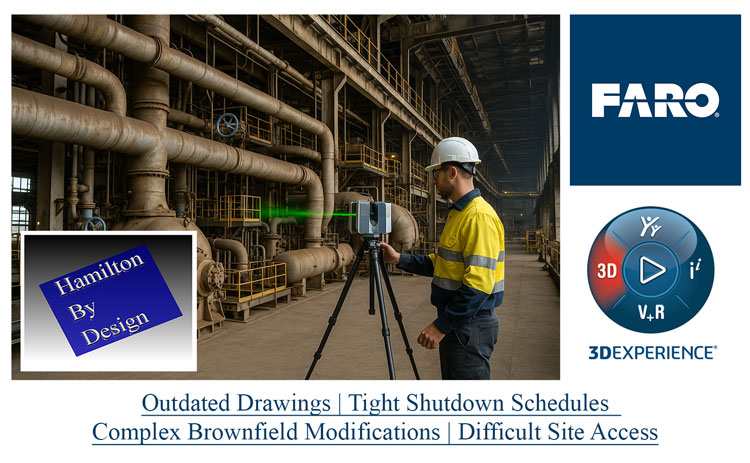
Few regions in Australia represent heavy industry quite like Newcastle and the Hunter Valley. From the coal mines at Bengalla and Mount Thorley, to the power stations at Bayswater and Eraring, to the Port of Newcastle’s massive shiploaders and conveyors, this region has powered Australia for generations.
But with age, complexity, and constant upgrades come challenges:
Outdated drawings
Tight shutdown schedules
Complex brownfield modifications
Difficult site access
That’s where 3D scanning and LiDAR modelling are transforming how industrial projects are designed, verified, and delivered — ensuring every bolt, beam, and bracket fits perfectly the first time.
At Hamilton By Design, we bring together field experience, digital precision, and local knowledge to help the Hunter’s industries design, maintain, and modernise with confidence.
What Is 3D Scanning — and Why It Matters in Industry
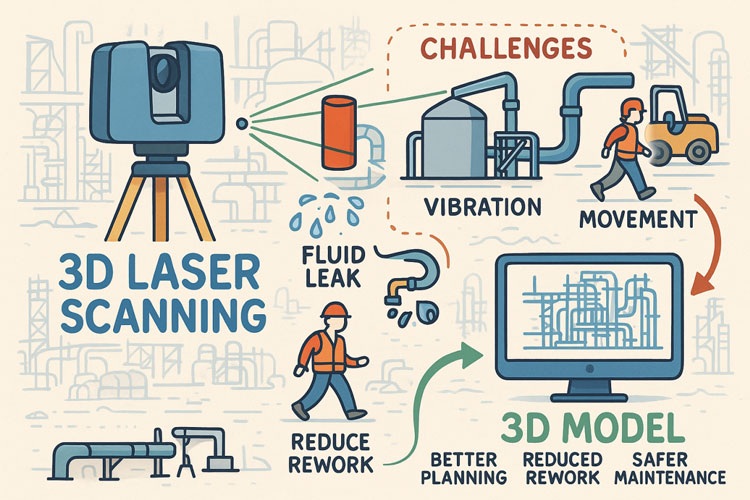
3D laser scanning, also known as LiDAR (Light Detection and Ranging), captures millions of data points across an industrial site to create a precise digital representation — known as a point cloud.
This point cloud forms the foundation of a digital twin of your plant or asset — an exact, measurable 3D environment that engineers can design within using SolidWorks, AutoCAD, or Navisworks.
The result? Every measurement is accurate, every clash is detected before fabrication, and every installation happens exactly as planned.
Why Newcastle and the Hunter Valley Need Scanning More Than Ever
The Hunter is an engineering powerhouse — but much of its infrastructure was built decades ago. Many coal handling plants, power stations, and smelters are now in a constant cycle of refurbishment, retrofit, and compliance upgrade.
The challenges are familiar:
Old 2D drawings don’t reflect today’s reality.
Assets have been modified repeatedly over decades.
Shutdown windows are shrinking.
Every error adds cost and delays production.
By scanning before you design, you remove uncertainty. You don’t guess clearances — you know them. You don’t estimate tie-in points — you model them. You don’t hope it fits — you prove it digitally.
That’s the power of 3D scanning in today’s industrial environment.
Where Scanning Adds Value Across the Hunter’s Industries
⚙️ Power Generation
The Bayswater, Eraring, and Vales Point Power Stations are engineering icons. Upgrades to cooling systems, ducts, platforms, and access structures require millimetre accuracy. 3D scanning ensures:
Every retrofit aligns with existing steelwork and pipework.
Structural interferences are caught before fabrication.
Shutdown work can be completed on time — without rework.
Whether it’s a fan casing replacement or a duct reroute, laser scanning removes the guesswork from aging assets.
⛏️ Coal Handling and CHPP Facilities
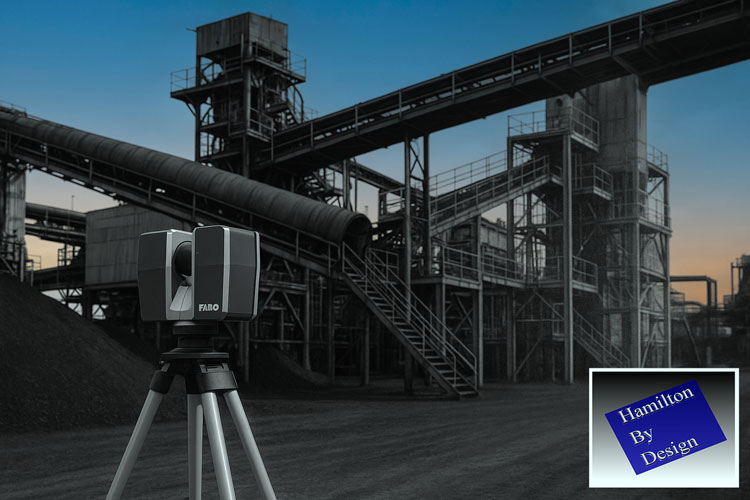
The Hunter Valley’s CHPP network — Mount Thorley Warkworth, Ravensworth, Bengalla, Hunter Valley Operations — all depend on reliable mechanical systems. These plants evolve continuously: diverter chutes, screen replacements, conveyors, and wash plant modifications.
Scanning delivers:
Accurate as-built geometry for plant upgrades.
Clash detection between new and existing equipment.
Shutdown planning certainty — no unexpected fit-up issues.
Integration of SolidWorks models directly into point clouds for visual verification.
For CHPP managers and maintenance engineers, 3D scanning is now as essential as the plant itself.
⚓ Port of Newcastle and Coal Export Terminals
Newcastle’s port is the lifeline of the Hunter’s economy. Facilities such as Port Waratah Coal Services (PWCS), Newcastle Coal Infrastructure Group (NCIG), and Carrington Terminal handle massive volumes of coal every hour.
The complexity of these sites — shiploaders, conveyors, gantries, and stacker-reclaimers — demands accuracy during maintenance and upgrade works. 3D scanning supports:
Shiploader upgrades and boom extensions.
Conveyor and transfer tower alignment checks.
Wharf structure condition monitoring.
Integration with mechanical and electrical systems.
By scanning before modification, downtime is reduced, safety improves, and project teams gain total confidence in every fit-up.
🏭 Aluminium and Heavy Manufacturing
At Tomago Aluminium Smelter, precision is everything. The scale of the site — from potlines to switchyards — makes manual measurement impractical and unsafe.
Laser scanning captures geometry accurately across large areas, enabling:
Retrofit planning without full shutdowns.
Clearance checks for cranes, ducts, and potline infrastructure.
Digital twins for long-term maintenance and asset management.
Beyond Tomago, manufacturers in Waratah, Beresfield, and Thornton use scanning to validate jigs, fixtures, and workshop layouts — ensuring local fabrication accuracy that matches site requirements.
🔋 Emerging Energy and Infrastructure
As the Hunter region transitions toward renewable and low-emission industries, scanning plays a critical role in planning new infrastructure around existing sites. This includes:
Hydrogen and gas pipeline tie-ins.
Solar and battery installations near existing grid connections.
Conversion of existing power plant structures for new technology.
Accurate point-cloud data ensures new energy meets old infrastructure safely and efficiently.
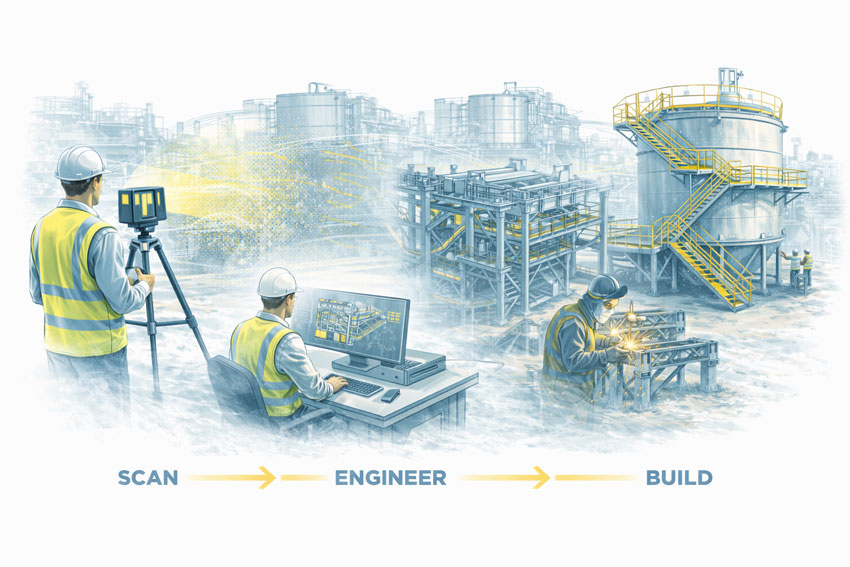
From Field to Fabrication: The Hamilton By Design Process
At Hamilton By Design, our 3D scanning workflow is built around practical, industrial needs:
Site Scan & Data Capture Using high-precision LiDAR scanners, we safely capture full site geometry in hours, not weeks. Scans are performed during operation or short shutdowns, without interrupting production.
Point Cloud Registration & Processing Multiple scans are aligned to create a unified, accurate model of your facility. The result is a true “digital twin” of your asset, complete with millimetre accuracy.
SolidWorks Modelling & Integration Our design team converts scan data into fully functional 3D models — chutes, pipework, platforms, or structural frames — ready for fabrication.
Clash Detection & Design Validation Every new design is tested within the digital twin, ensuring it fits the first time.
Fabrication Drawings & e-Drawings Detailed 2D and 3D deliverables are provided for fabricators, site crews, and certifiers — ensuring seamless communication between design and construction.
Why Local Expertise Matters
Many engineering firms offer scanning — but few understand what it takes to work on a live plant in the Hunter Valley.
Hamilton By Design combines trade experience, mechanical design, and regional understanding. We’ve worked with the same assets, fabricators, and contractors who keep the region’s power, port, and manufacturing industries running.
We design for real fabrication conditions — using Australian Standards, local materials, and practical build methods. That means fewer redesigns, faster turnarounds, and safer installations.
Safety and Access: Scanning Without Shutdowns
Traditional site measurement often means working at heights, in confined spaces, or around operating equipment. 3D scanning eliminates those risks.
Our scanners capture data safely from the ground — even in restricted or hazardous areas. This not only improves safety but also allows projects to continue without halting production.
For large plants like Eraring or PWCS, scanning entire structures during live operation is now standard practice — enabling ongoing maintenance and long-term asset integrity planning.
Case Example: Port Upgrade Without Rework
A local contractor approached Hamilton By Design for a conveyor and tower modification project at the Port of Newcastle. Existing drawings were decades old, and the structure had been modified repeatedly.
We performed a 3D scan of the tower and adjacent conveyors, capturing the as-built geometry in one day. The resulting model revealed several misalignments between the planned chute and existing supports. By correcting these in SolidWorks before fabrication, the contractor avoided at least 48 hours of site rework and kept the shutdown on schedule.
That’s measurable ROI — precision that pays for itself.
The ROI of 3D Scanning in Heavy Industry
A single hour of lost production at a CHPP or power station can cost $20,000 to $50,000. A single day’s delay can exceed $500,000 in lost revenue and labour costs.
3D scanning reduces that risk by eliminating rework and ensuring every component fits right the first time. Typical return on investment (ROI):
Scanning cost: <1% of total project value.
Rework savings: 3–10% of total cost.
Downtime reduction: 1–3 days saved per shutdown.
When accuracy drives reliability, 3D scanning isn’t an expense — it’s insurance.
Supporting the Hunter’s Future
Newcastle and the Hunter Valley are evolving — from coal and power to renewables, advanced manufacturing, and logistics. But one thing hasn’t changed: the region’s foundation in engineering, precision, and hard work.
Hamilton By Design supports that legacy with the next generation of technology — scanning, digital modelling, and mechanical design that keep the region’s assets efficient, safe, and ready for the future.
We’re not an offshore CAD vendor. We’re local engineers who’ve worked in the field, understand your equipment, and speak the same language as your crews.
Let’s Build the Future of Hunter Industry – Accurately
Every project starts with one question: “Do we have accurate site data?”
With Hamilton By Design, the answer is always yes.
We deliver: ✅ 3D laser scanning and LiDAR modelling ✅ Point-cloud to SolidWorks integration ✅ Reverse engineering and FEA validation ✅ Fabrication drawings tailored for local workshops ✅ On-site consultation with practical engineering insight
Whether you’re upgrading a conveyor at Bayswater, fabricating platforms for Tomago, or retrofitting process piping at Kooragang, we ensure your next project fits perfectly — before steel is cut.
👉 Get your industrial site scanned and modelled before your next shutdown. Visit www.hamiltonbydesign.com.au or contact us to request a capability statement today.
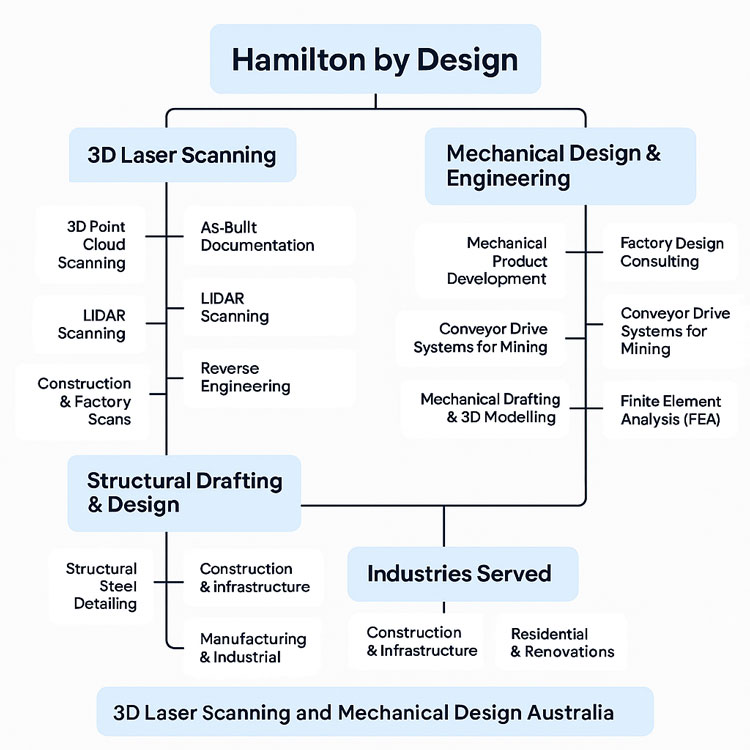
When it comes to precision engineering, structural drafting, and mechanical design services, Hamilton by Design leads the way. We provide advanced 3D laser scanning solutions across Perth, Sydney, Brisbane, Melbourne, and the Hunter Valley — giving clients accurate data for smarter decisions and efficient project delivery.
3D Laser Scanning Across Australia
Our 3D laser scanning services capture exact measurements of your site, plant, or equipment to create detailed 3D point clouds and as-built documentation. This reduces rework, saves time, and improves project planning.
We offer:
3D Laser Scanning Perth & Fremantle – Industrial plant surveys, mining site scanning, and reverse engineering.
3D Laser Scanning Sydney & Melbourne – Building surveys, renovation planning, and structural inspections.
3D Laser Scanning Brisbane & Hunter Valley – Factory layouts, conveyor drive design, and structural scanning.
3D Laser Scanning for Engineering & Mining – Point cloud scanning, clash detection, and 3D modelling.
Our team uses the latest 3D scanning and LiDAR technology to produce millimetre-accurate results that engineers, architects, and builders can trust.
Structural Drafting & Design Services
Hamilton by Design provides structural drafting services across Australia, including:
Structural Design and Drafting – For residential, commercial, and industrial projects.
Steel Detailing & Shop Drawings – Produced to Australian drafting standards.
Structural Scanning Services Brisbane & Sydney – Helping engineers assess existing structures for upgrades or repairs.
Our experienced structural design engineers work closely with builders, architects, and civil engineers in Hamilton and beyond to deliver reliable, build-ready plans.
To provide the best experiences, we use technologies like cookies to store and/or access device information. Consenting to these technologies will allow us to process data such as browsing behaviour or unique IDs on this site. Not consenting or withdrawing consent, may adversely affect certain features and functions.
Functional
Always active
The technical storage or access is strictly necessary for the legitimate purpose of enabling the use of a specific service explicitly requested by the subscriber or user, or for the sole purpose of carrying out the transmission of a communication over an electronic communications network.
Preferences
The technical storage or access is necessary for the legitimate purpose of storing preferences that are not requested by the subscriber or user.
Statistics
The technical storage or access that is used exclusively for statistical purposes.The technical storage or access that is used exclusively for anonymous statistical purposes. Without a subpoena, voluntary compliance on the part of your Internet Service Provider, or additional records from a third party, information stored or retrieved for this purpose alone cannot usually be used to identify you.
Marketing
The technical storage or access is required to create user profiles to send advertising, or to track the user on a website or across several websites for similar marketing purposes.