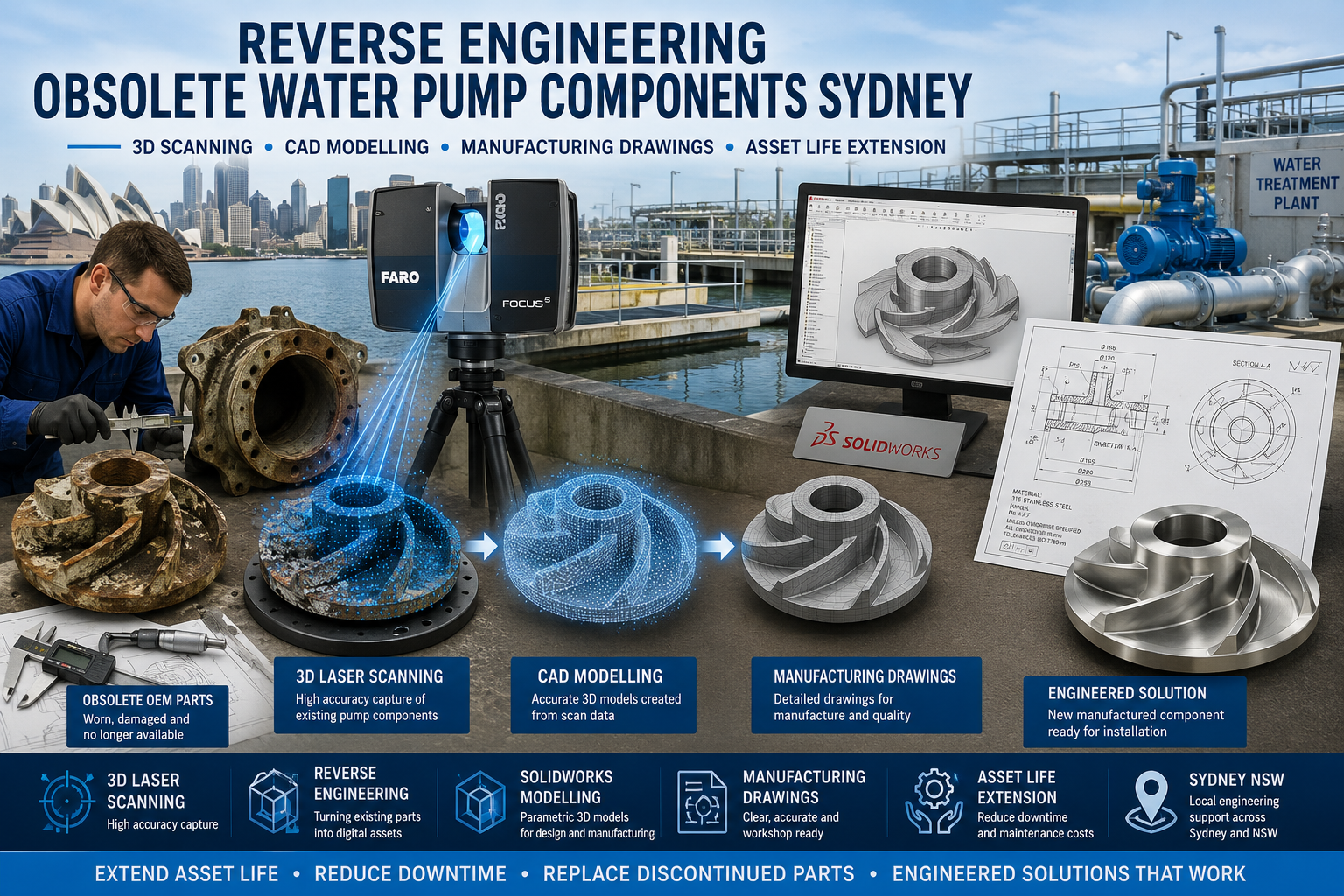
Reverse Engineering Obsolete Water Pump Components Sydney

Reverse engineering obsolete water pump components in Sydney using 3D laser scanning, SolidWorks CAD modelling and manufacturing drawings to replace discontinued OEM pump parts for water infrastructure and industrial facilities.

Reverse Engineering Obsolete Water Pump Components Sydney
Hamilton By Design provides reverse engineering services for obsolete water pump components in Sydney NSW, helping water utilities, maintenance teams, manufacturers, asset owners and engineering contractors replace discontinued OEM pump parts when drawings, models or supplier support are no longer available. We inspect, measure, scan and model existing pump components to create accurate CAD files, manufacturing drawings and engineering documentation suitable for repair, replacement, refurbishment or local manufacture.

Reverse Engineering for Obsolete Pump Components in Sydney NSW

Water pump assets often remain in service for decades. Over time, OEM parts can become unavailable, lead times can increase, suppliers may discontinue product lines, and replacement costs can become difficult to justify. For councils, water treatment plants, pumping stations, industrial facilities and infrastructure operators, this can create serious maintenance and operational risks.

Hamilton By Design supports Sydney-based clients by reverse engineering worn, damaged or obsolete water pump components so they can be reproduced, repaired or improved. This includes pump casings, impellers, shafts, sleeves, bushes, bearing housings, covers, flanges, couplings, wear rings, brackets and other mechanical pump components.

Our work combines practical trade experience, mechanical engineering knowledge, 3D scanning, CAD modelling and detailed drafting. The result is clear, usable documentation that can support fabrication, machining, casting, repair, procurement and asset maintenance.

Who We Help

We provide reverse engineering and engineering drafting services for clients across Sydney NSW and surrounding regions, including:

Water treatment plants
Wastewater facilities
Council pumping stations
Industrial water systems
Utilities and infrastructure operators
Manufacturing plants
Mining and mineral processing facilities
Ports and marine infrastructure
Mechanical contractors
Maintenance teams
Fabricators and machine shops
Pump repair workshops
Asset owners with discontinued OEM equipment

We also support projects in Newcastle, the Hunter Valley, Brisbane, Perth, Melbourne, regional NSW and across Australia where pump components or mechanical assets need to be measured, modelled and documented.

Why Reverse Engineer Obsolete Water Pump Components?

Reverse engineering is useful when an existing component is required but original design information is missing or unreliable. Many older water pump assets were installed years ago, and drawings may no longer exist, may be incomplete, or may not reflect changes made during maintenance.

Reverse engineering can help when:

OEM parts are discontinued
OEM lead times are too long
Replacement parts are too expensive
The original drawings are missing
The part has been modified over time
A casting pattern is no longer available
A pump needs to remain operational
A local manufacturing option is required
The component needs to be improved or strengthened
A damaged part needs to be reproduced urgently

For water infrastructure, downtime can be costly. Reverse engineering allows asset owners to extend the life of critical pump equipment while maintaining control over documentation, repair options and future spare parts.

Typical Pump Components We Reverse Engineer

Hamilton By Design can reverse engineer a wide range of pump and rotating equipment components, including:

Impellers
Pump casings
Bearing housings
Shafts
Shaft sleeves
Wear rings
Bushes
Couplings
Drive components
Flanges
Covers and guards
Mounting brackets
Split casings
Casting components
Machined components
Replacement OEM-style parts
Obsolete water pump components
Custom repair components

Where required, we can also document finished machining details, keyways, fits, tolerances, material notes, surface finish requirements and general arrangement information.

Technical Capability

Our reverse engineering workflow combines physical inspection, 3D measurement, laser scanning and CAD modelling. Depending on the component and project requirements, we can use:

FARO 3D laser scanning
FARO SCENE point cloud processing
Autodesk ReCap RCP and RCS workflows
E57 point cloud export
SolidWorks 3D modelling
Autodesk Inventor modelling
AutoCAD 2D drafting
STEP, SAT and Parasolid file creation
DWG and PDF manufacturing drawings
Engineering review and practical design input

For complex geometry such as cast pump casings or impellers, 3D scanning helps capture the external shape of the component. For machined features, manual measurement and engineering judgement are often required to define functional dimensions, tolerances and fits.

The goal is not just to copy the damaged part. The goal is to understand how the part functions, what surfaces are critical, what features are worn, and what information is required to manufacture or repair the part correctly.

Standards and Engineering Considerations

Depending on the project, documentation may reference relevant Australian Standards, client specifications, machining standards or general engineering practices. Reverse engineering pump components may involve consideration of:

Material selection
Corrosion resistance
Machining allowances
Casting allowances
Fits and tolerances
Surface finish
Weld repair requirements
Fastener details
Bearing and bush fits
Shaft alignment
Clearances
Operating environment
Maintenance access
Asset life extension
Fabrication and machining practicality

For water and wastewater applications, material selection is important. Stainless steel, duplex stainless, cast iron, bronze, polymer composites and engineered coatings may all be considered depending on the service environment and client requirements.

Our Reverse Engineering Process

1. Initial Review

We begin by reviewing the component, photos, existing drawings, site information and the reason the part needs to be reverse engineered. This helps determine whether the outcome should be a like-for-like replacement, a repair drawing, a manufacturing drawing, a 3D model, or an upgraded engineering solution.

2. Site Inspection or Component Measurement

The component can be measured on site in Sydney or inspected at a workshop. For larger pump assemblies or installed equipment, site scanning may be used to capture the surrounding equipment, pipework, access restrictions and interface points.

3. 3D Scanning and Manual Measurement

Where suitable, we use 3D scanning to capture the component geometry. Manual measurement is then used to confirm critical features such as bores, shaft diameters, bolt patterns, keyways, bearing fits, flange faces and machined surfaces.

4. Point Cloud Processing

Scan data is processed into usable formats such as E57, RCP or RCS. The point cloud can then be used as the reference geometry for CAD modelling, comparison and documentation.

5. CAD Modelling

The component is modelled in SolidWorks, Inventor or another suitable CAD platform. For cast or organic shapes, the model may include a practical representation of the geometry suitable for manufacturing, machining, fabrication or pattern development.

6. Engineering Review

We review the model for function, fit, interfaces and manufacturing practicality. Where a component is worn or damaged, engineering judgement may be required to identify original design intent rather than simply copying worn geometry.

7. Drawing and Documentation

Manufacturing drawings are produced showing the required dimensions, notes, tolerances, materials and machining information. Drawings can be supplied as PDF and DWG files, with 3D models supplied in SolidWorks, STEP, SAT or Parasolid formats.

8. Client Review and Final Issue

The drawing package is issued for client review. Where required, changes can be made based on additional photos, site checks, workshop feedback or manufacturing requirements.

Deliverables

Depending on the scope of work, clients may receive:

3D scan files
E57 point cloud files
RCP or RCS files
SolidWorks 3D models
Inventor 3D models
STEP files
SAT files
Parasolid files
DWG drawings
DXF profiles
PDF manufacturing drawings
General arrangement drawings
Machining drawings
Casting reference models
Inspection notes
Reverse engineering report
Critical dimension summaries
Material and finish notes
Assembly interface documentation

Not every project requires every deliverable. For some clients, a simple manufacturing drawing is sufficient. For others, a full 3D model, scan file, assembly drawing and engineering report may be required.

Why Choose Hamilton By Design?

Hamilton By Design brings together hands-on trade experience, mechanical design capability and engineering drafting expertise. Our background includes fitting and turning, CNC machining, fabrication, 3D CAD modelling, site measurement, mechanical engineering and industrial asset documentation.

We understand that reverse engineering is not only a drafting task. It requires practical knowledge of how parts are made, how they fit, how they wear and how they are repaired. This is especially important for pump components where worn surfaces, damaged castings, corrosion and missing information can affect the final outcome.

Our experience includes work across water, mining, ports, manufacturing, infrastructure, industrial plants and utilities. We use modern 3D scanning and CAD tools while applying practical engineering judgement to deliver documentation that fabricators, machinists and asset owners can actually use.

Hamilton By Design also provides related engineering and digital measurement services, including:

Scan to CAD Services
Scan to BIM Services
Mechanical Engineering Services
Reverse Engineering Services
3D LiDAR Scanning
Engineering Drafting
Structural Drafting
SolidWorks Modelling
As-Built Documentation
Industrial Site Measurement

Suggested internal links:

Reverse Engineering Services: /reverse-engineering/
Scan to CAD Services: /scan-to-cad/
Scan to BIM Services: /scan-to-bim/
Mechanical Engineering Services: /mechanical-engineering-services/
3D LiDAR Scanning: /3d-lidar-scanning/
Engineering Drafting Sydney: /engineering-services-sydney/

Frequently Asked Questions

Can you reverse engineer obsolete water pump parts without drawings?

Yes. We can measure, scan and model existing pump components even when original drawings are unavailable. Where parts are worn or damaged, we use engineering judgement to help determine the likely original geometry.

Do you provide reverse engineering services in Sydney NSW?

Yes. Hamilton By Design provides reverse engineering services across Sydney NSW, including water plants, industrial sites, workshops, pumping stations and infrastructure facilities.

What pump components can you reverse engineer?

We can reverse engineer pump casings, impellers, shafts, bushes, sleeves, covers, bearing housings, wear rings, brackets, flanges, couplings and other mechanical pump components.

Can you help replace discontinued OEM pump parts?

Yes. We can create CAD models and manufacturing drawings for discontinued OEM-style parts where original parts are no longer available or have long lead times.

Do you provide manufacturing drawings?

Yes. We can provide PDF and DWG drawings with dimensions, notes, materials, tolerances and machining details suitable for review by fabricators, machinists or repair workshops.

Can you scan large pump assemblies on site?

Yes. Larger pump assemblies, installed equipment and surrounding pipework can be scanned on site where required. This is useful when interface points, access constraints or as-built conditions need to be captured.

What file formats can you supply?

Typical file formats include E57, RCP, RCS, DWG, DXF, PDF, SolidWorks, STEP, SAT and Parasolid files.

Can you improve a component instead of copying it exactly?

Yes. Where required, we can review the component and suggest practical improvements relating to material, machining, fit, access, maintenance or durability. Any design changes should be reviewed and approved before manufacture.

Is reverse engineering suitable for urgent pump repairs?

Yes. Reverse engineering can be useful when a critical pump part has failed and OEM lead times are too long. The timeframe depends on the complexity of the part and the level of documentation required.

Do you work with pump repair workshops and machine shops?

Yes. We regularly support workshops, fabricators, machinists, maintenance contractors and asset owners with practical CAD models and drawings for repair, replacement and manufacturing work.

Hamilton By Design logo displayed on a blue tilted rectangle with a grey gradient background

Reverse Engineering Obsolete Water Pump Components in Sydney

Hamilton By Design helps Sydney water, wastewater, industrial and infrastructure clients extend the life of ageing pump assets by reverse engineering obsolete and discontinued components. We combine 3D scanning, manual measurement, CAD modelling, engineering drafting and practical mechanical experience to produce usable documentation for repair, replacement and manufacture.

If your water pump component is no longer available, has a long OEM lead time or needs to be reproduced from an existing part, Hamilton By Design can help create the CAD files, drawings and engineering documentation required to move the project forward.

Talk to Us – Contact Us

Name
Would you like us to arrange a phone consultation for you?
Address

Our clients:


Scan to CAD Perth

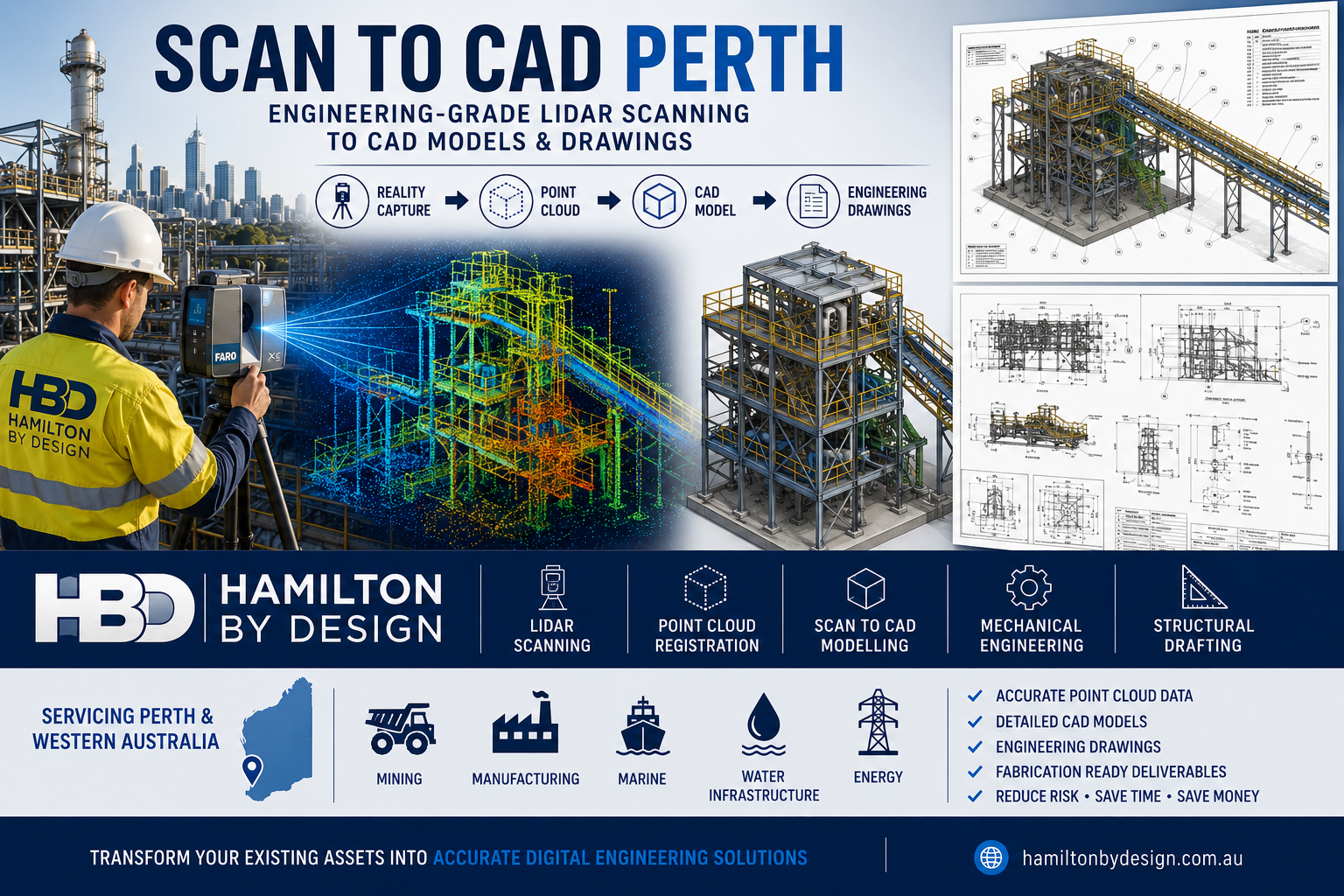
Scan to CAD Perth workflow by Hamilton By Design showing engineering-grade LiDAR scanning of an industrial processing facility in Perth, Western Australia. The image illustrates the complete reality capture process from laser scanning and point cloud registration through to 3D CAD modelling, engineering drawings, mechanical engineering and structural drafting. Featured are a field engineer operating a FARO laser scanner, a coloured point cloud model, a detailed industrial plant CAD model, fabrication drawings and industries including mining, manufacturing, marine, water infrastructure and energy.

Engineering-Grade Point Cloud to CAD Services

Scan to CAD Perth

Blue 3D LiDAR scanner icon on a tripod with scanning waves

When existing facilities, equipment, structures, and process plants need to be modified, expanded, or documented, accurate information is critical. Unfortunately, many sites across Perth and Western Australia rely on outdated drawings, incomplete documentation, or site measurements that do not reflect what has actually been built.

Hamilton By Design provides professional Scan to CAD Perth services, combining engineering-grade LiDAR scanning with experienced mechanical and structural drafting to create accurate CAD models and drawings from real-world assets.

Rather than relying on tape measures or assumptions, we capture the existing environment using advanced 3D laser scanning technology and convert the resulting point cloud data into usable engineering deliverables.


What is Scan to CAD?

Scan to CAD is the process of converting physical assets into accurate digital engineering models and drawings.

The workflow typically includes:

  1. Site scanning using LiDAR technology
  2. Registration of the point cloud data
  3. Creation of CAD models
  4. Production of engineering drawings
  5. Verification against captured site conditions

The result is a highly accurate digital representation of the existing asset that can be used for engineering, maintenance, fabrication, and future upgrades.


Why Use Scan to CAD?

Many projects fail because existing site information is incorrect.

Common challenges include:

  • Missing drawings
  • Outdated drawings
  • Unrecorded modifications
  • Unknown equipment locations
  • Limited shutdown windows
  • Expensive site revisits
  • Fabrication errors
  • Installation clashes

Scan to CAD helps eliminate these issues by providing a reliable digital record of the actual site conditions.


Our Scan to CAD Workflow

1. Site Capture

Hamilton By Design uses engineering-grade LiDAR scanning equipment to capture millions of measurement points across the site.

Applications include:

  • Mining facilities
  • Processing plants
  • Structural steel installations
  • Pipework systems
  • Conveyor systems
  • Water treatment facilities
  • Manufacturing plants
  • Marine facilities

2. Point Cloud Registration

Individual scans are combined into a single registered dataset.

This process creates a coordinated point cloud representing the complete facility.

Deliverable formats can include:

  • E57
  • RCP
  • RCS
  • LAS

3. CAD Modelling

The point cloud is imported into engineering software where accurate models are developed.

Software used includes:

  • SOLIDWORKS
  • AutoCAD
  • Autodesk Inventor
  • Navisworks

Models may include:

  • Structural steel
  • Pipework
  • Mechanical equipment
  • Platforms and access systems
  • Buildings and facilities
  • Process infrastructure

4. Engineering Drawings

Once modelling is complete, the information can be converted into detailed engineering documentation.

Typical deliverables include:

  • General Arrangement Drawings
  • Fabrication Drawings
  • As-Built Drawings
  • Layout Drawings
  • Structural Steel Drawings
  • Mechanical Drawings
  • Pipework Drawings

Industries We Support in Perth

Hamilton By Design supports clients throughout Perth and Western Australia including:

Mining

  • Iron Ore
  • Gold
  • Lithium
  • Nickel
  • Mineral Processing

Manufacturing

  • Food Processing
  • Packaging Facilities
  • Industrial Production

Energy

  • Power Generation
  • Renewable Energy Facilities
  • Oil and Gas Infrastructure

Water Infrastructure

  • Water Treatment Plants
  • Pump Stations
  • Wastewater Facilities

Marine and Ports

  • Ship Repair Facilities
  • Port Infrastructure
  • Bulk Handling Equipment

Benefits of Scan to CAD

Reduce Site Visits

Capture everything during a single visit and continue working remotely.

Improve Design Accuracy

Design directly from measured site conditions.

Reduce Fabrication Risk

Accurate models help reduce costly fabrication errors.

Improve Safety

Less time measuring equipment in operational environments.

Support Future Projects

Create a digital record that can be reused for future upgrades.


Typical Scan to CAD Deliverables

Hamilton By Design can provide:

  • Point Cloud Files
  • AutoCAD Drawings
  • SOLIDWORKS Models
  • Inventor Models
  • STEP Files
  • SAT Files
  • DWG Files
  • DXF Files
  • Structural Steel Models
  • Mechanical Equipment Models
  • Pipework Models
  • Fabrication Drawings

Why Hamilton By Design?

Hamilton By Design combines reality capture technology with practical engineering experience.

Our team understands:

  • Mechanical Engineering
  • Structural Steel Design
  • Fabrication Workflows
  • Mining Infrastructure
  • Process Plants
  • Site Installation Requirements

This means we do more than simply collect scan data. We transform site information into practical engineering deliverables that support project execution.


Perth Service Area

We provide Scan to CAD services across:

  • Perth CBD
  • Kwinana
  • Henderson
  • Welshpool
  • Canning Vale
  • Malaga
  • Osborne Park
  • Rockingham
  • Fremantle
  • Bunbury
  • Geraldton
  • Kalgoorlie
  • Port Hedland
  • Karratha
  • Pilbara Region

  • 3D Laser Scanning Perth
  • LiDAR Scanning Perth
  • Mechanical Engineering Perth
  • Reverse Engineering Perth
  • Structural Drafting Perth
  • Point Cloud to CAD Modelling
  • As-Built Documentation
  • Industrial Reality Capture

Frequently Asked Questions

What is Scan to CAD?

Scan to CAD is the process of converting laser scan data into CAD models and engineering drawings.

What industries use Scan to CAD?

Mining, manufacturing, energy, water, marine, construction, and industrial facilities commonly use Scan to CAD workflows.

What file formats can be delivered?

DWG, DXF, STEP, SAT, Parasolid, E57, RCP, RCS, and PDF.

Can Scan to CAD be used for structural steel?

Yes. Existing structures can be scanned and converted into detailed structural steel models and fabrication drawings.

Can Scan to CAD be used for pipework?

Yes. Pipework systems can be modelled directly from point cloud data to support modifications and upgrades.

Do you provide services outside Perth?

Yes. Hamilton By Design supports projects throughout Western Australia and across Australia.


Our Clients


Contact Hamilton By Design

If you require accurate site information for design, fabrication, maintenance, or asset management, Hamilton By Design can help.

Our engineering-led Scan to CAD Perth services transform real-world assets into accurate digital engineering deliverables, helping projects move forward with confidence.

Hamilton By Design โ€“ Engineering, LiDAR Scanning, CAD Modelling and Drafting Services Across Perth and Western Australia.

Hamilton By Design logo displayed on a blue tilted rectangle with a grey gradient background
Name
Would you like us to arrange a phone consultation for you?
Address

Where are we in Perth

https://www.hamiltonbydesign.com.au/perth-wa
3D CAD Modelling Australia service banner for Hamilton By Design
Australian Drafting logo featuring bold white text reading "Australian Drafting" centred on a blue rounded rectangle background.
Engineering Governance title graphic featuring bold white text reading "Engineering Governance" centred on a blue rounded rectangle background.
Mechanical, Structural & Pipework Drafting service banner by Hamilton By Design featuring white text on a blue background.
Mechanical engineering services
Blue rounded button with the text โ€œSolidWorks Designโ€ in white.
Finite Element Analysis (FEA) engineering simulation button
3D LiDAR Scanning Darwin for engineering surveys, laser scanning, reality capture and point cloud modelling services
3D LiDAR Scanning Australia engineering services for laser scanning, reality capture, scan-to-CAD, Scan-to-BIM and as-built documentation across Australia
3D LiDAR scanning services on the Central Coast providing engineering-grade laser scanning, point cloud capture, scan-to-CAD modelling and industrial reality capture for infrastructure and industrial projects.
3D LiDAR Scanning Perth for engineering surveys, laser scanning, reality capture and point cloud modelling services
3D LiDAR Scanning Sydney for engineering surveys, laser scanning, reality capture and point cloud modelling services
3D LiDAR Scanning Brisbane for engineering surveys, laser scanning, reality capture and point cloud modelling services
3D LiDAR Scanning Canberra for engineering surveys, laser scanning, reality capture and point cloud modelling services
3D LiDAR Scanning Newcastle for engineering surveys, laser scanning, reality capture and point cloud modelling services
3D LiDAR Scanning Adelaide for engineering surveys, laser scanning, reality capture and point cloud modelling services

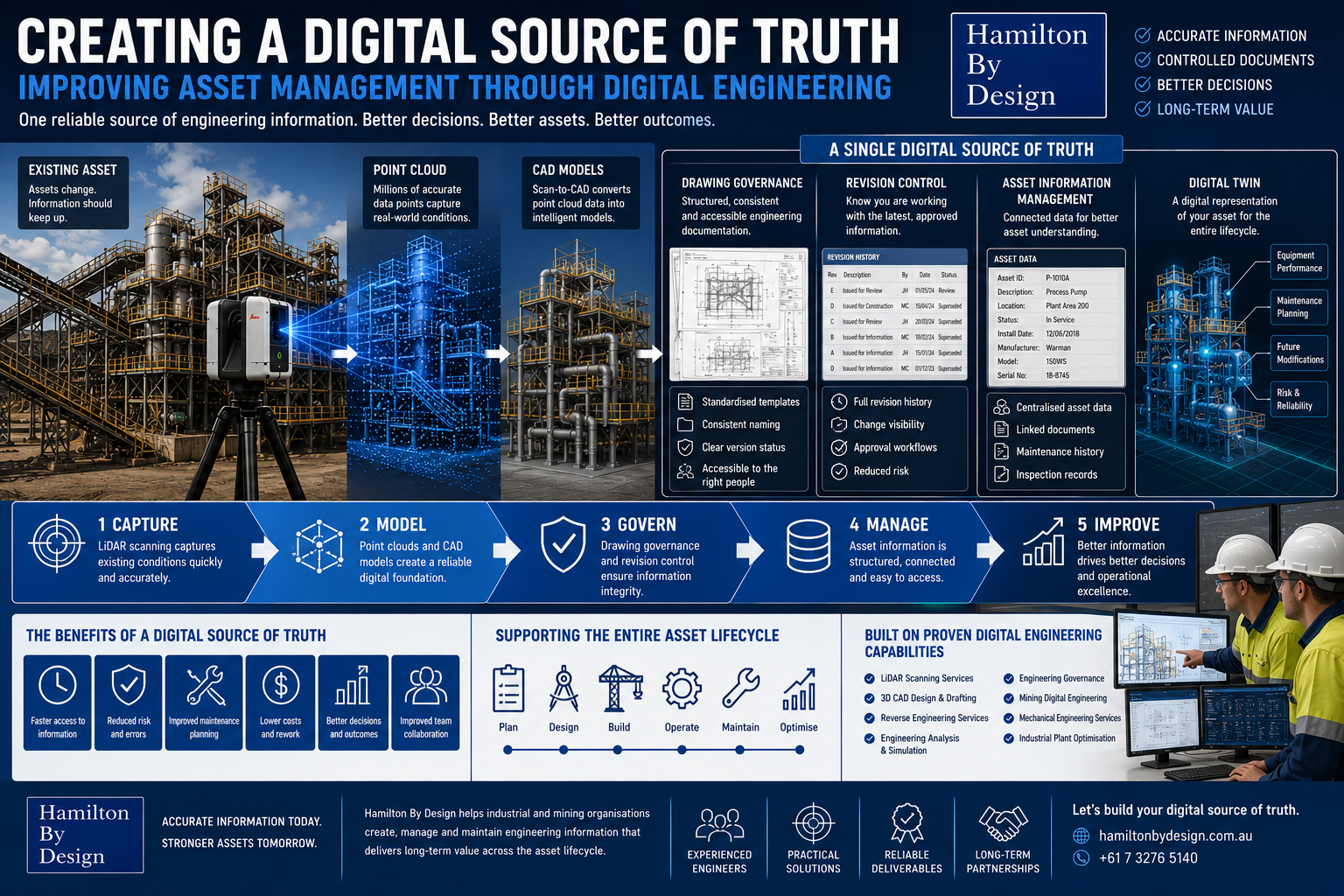
Creating a Digital Source of Truth: Improving Asset Management Through Digital Engineering

Engineering-grade LiDAR scanning and digital engineering workflow showing how a digital source of truth improves long-term asset management.

Industrial assets change over time. Equipment is upgraded, drawings are revised, platforms are modified, components are replaced, and maintenance activities gradually reshape the plant.

When engineering information is spread across old drawings, uncontrolled PDFs, manual mark-ups, spreadsheets, and individual folders, asset management becomes harder than it needs to be.

A digital source of truth helps bring engineering information together so teams can make decisions using reliable, current, and controlled data.

At Hamilton By Design, we support digital engineering asset management by combining LiDAR scanning, CAD modelling, drawing governance, revision control, and digital engineering workflows.

What is a Digital Source of Truth?

A digital source of truth is a controlled location where accurate engineering information can be stored, managed, accessed, and updated.

It may include:

  • Engineering drawings
  • CAD models
  • Point cloud data
  • Asset information
  • Revision history
  • Inspection records
  • Fabrication documentation
  • Engineering reports

The goal is simple:

One reliable place for engineering information.

Why Asset Information Management Matters

Poorly controlled information can create:

  • Outdated drawings
  • Duplicate files
  • Missing revisions
  • Conflicting information
  • Fabrication errors
  • Shutdown delays
  • Maintenance confusion

Good asset information management improves:

  • Decision making
  • Project planning
  • Maintenance efficiency
  • Drawing control
  • Long-term asset performance

Digital Engineering Workflows

Hamilton By Design can support workflows such as:

  • Engineering-grade LiDAR scanning
  • Existing condition capture
  • Point cloud generation
  • Scan-to-CAD conversion
  • CAD modelling
  • Engineering drawings
  • Revision-controlled documentation
  • Digital asset records

This turns real-world site information into usable engineering data.

Drawing Governance and Revision Control

Drawing governance helps ensure the right people are using the right information.

This includes:

  • Controlled drawing revisions
  • Clear document naming
  • Updated engineering records
  • Managed mark-ups
  • Approval workflows
  • Accessible project information
3D CAD Modelling Australia service banner for Hamilton By Design

Without revision control, teams may unknowingly use superseded drawings.

Digital Twins and Long-Term Asset Management

A digital twin does not need to start as a complex system. For many industrial sites, it begins with accurate geometry, controlled drawings, and reliable asset records.

Digital engineering can support:

  • Plant upgrades
  • Maintenance planning
  • Shutdown preparation
  • Reverse engineering
  • Engineering analysis
  • Future modifications

Long-Term Operational Efficiency

A digital source of truth can reduce:

  • Time spent searching for drawings
  • Rework caused by outdated information
  • Repeated site measurements
  • Fabrication errors
  • Project uncertainty

It can improve:

  • Maintenance planning
  • Engineering confidence
  • Asset visibility
  • Operational efficiency
  • Project delivery

How Hamilton By Design Supports This

Hamilton By Design supports digital engineering asset management through:

  • 3D CAD Design & Drafting
  • Engineering Governance
  • LiDAR Scanning Services
  • Industrial Plant Optimisation
  • Engineering Analysis & Simulation
  • Mining Digital Engineering
  • Mechanical Engineering Services
  • Reverse Engineering Services

The objective is not just to create drawings or models.

The objective is to create engineering information that remains useful throughout the asset lifecycle.

3D LiDAR scanning and 3D modelling service button โ€” laser scanner capturing a point cloud for engineering and CAD modelling
Mechanical engineering services

Conclusion

Industrial asset management depends on reliable information.

A digital source of truth helps organisations move from scattered documents and outdated drawings toward controlled, current, and usable engineering data.

Better information supports better asset decisions.

Hamilton By Design logo displayed on a blue tilted rectangle with a grey gradient background

Our Clients:
Name
Would you like us to arrange a phone consultation for you?
Address
3D CAD Modelling Australia service banner for Hamilton By Design
Australian Drafting logo featuring bold white text reading "Australian Drafting" centred on a blue rounded rectangle background.
Engineering Governance title graphic featuring bold white text reading "Engineering Governance" centred on a blue rounded rectangle background.
Mechanical, Structural & Pipework Drafting service banner by Hamilton By Design featuring white text on a blue background.
Mechanical engineering services
Blue rounded button with the text โ€œSolidWorks Designโ€ in white.
Finite Element Analysis (FEA) engineering simulation button
3D LiDAR Scanning Darwin for engineering surveys, laser scanning, reality capture and point cloud modelling services
3D LiDAR Scanning Australia engineering services for laser scanning, reality capture, scan-to-CAD, Scan-to-BIM and as-built documentation across Australia
3D LiDAR scanning services on the Central Coast providing engineering-grade laser scanning, point cloud capture, scan-to-CAD modelling and industrial reality capture for infrastructure and industrial projects.
3D LiDAR Scanning Perth for engineering surveys, laser scanning, reality capture and point cloud modelling services
3D LiDAR Scanning Sydney for engineering surveys, laser scanning, reality capture and point cloud modelling services
3D LiDAR Scanning Brisbane for engineering surveys, laser scanning, reality capture and point cloud modelling services
3D LiDAR Scanning Canberra for engineering surveys, laser scanning, reality capture and point cloud modelling services
3D LiDAR Scanning Newcastle for engineering surveys, laser scanning, reality capture and point cloud modelling services
3D LiDAR Scanning Adelaide for engineering surveys, laser scanning, reality capture and point cloud modelling services

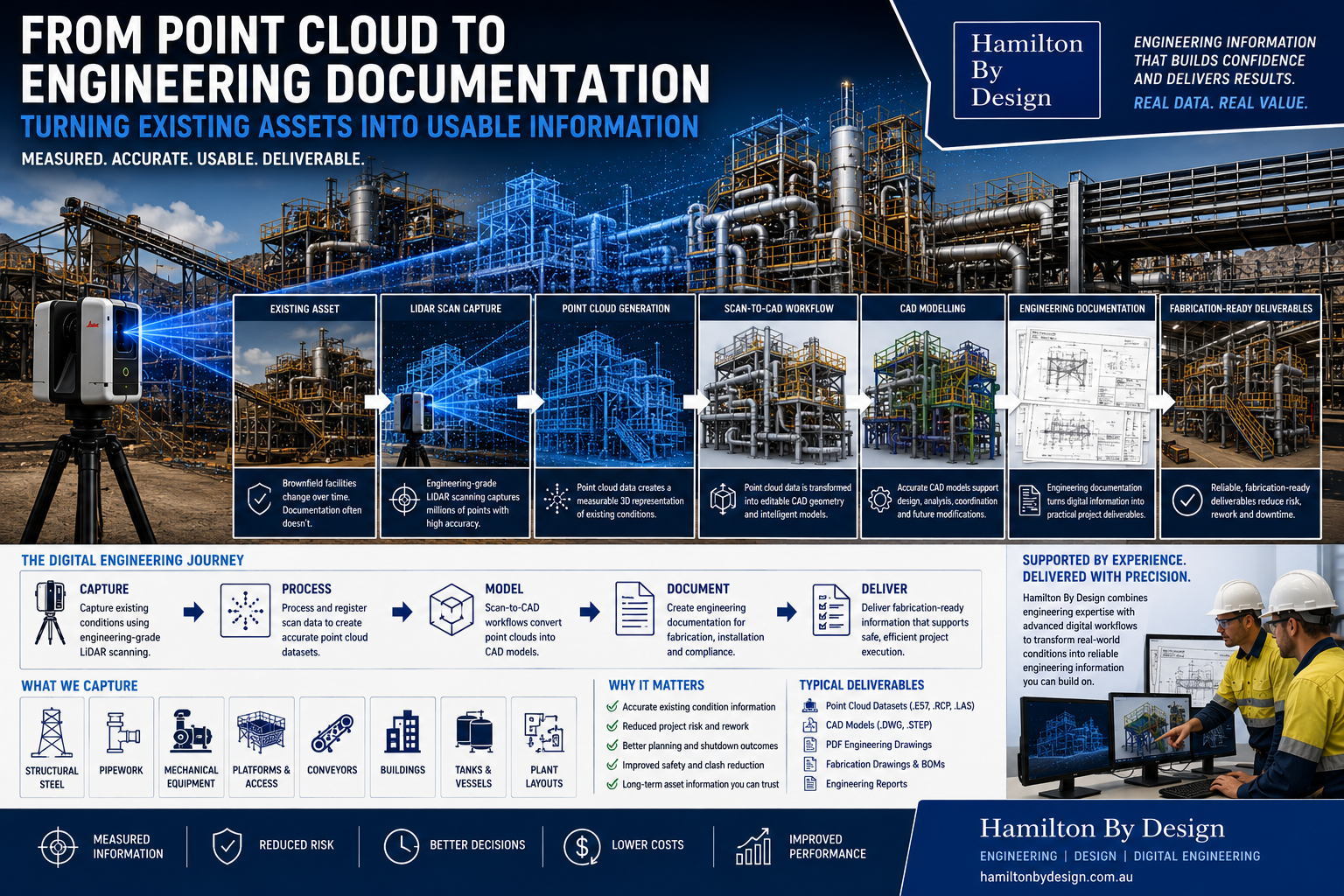
From Point Cloud to Engineering Documentation: Turning Existing Assets into Usable Information

Engineering-grade LiDAR scanning and digital engineering workflow showing point cloud data transformed into CAD models and fabrication-ready engineering documentation.

Industrial facilities are constantly changing. Equipment is upgraded, structures are modified, process lines evolve, and maintenance-driven changes gradually reshape plant layouts over time.

Unfortunately, engineering documentation does not always evolve at the same pace.

Many facilities eventually reach a point where the question becomes:

“What actually exists on site today?”

When drawings become outdated or documentation is missing, engineering teams can face increased project risk, fabrication challenges, and costly rework.

Modern digital engineering workflows now allow physical assets to be transformed into accurate engineering information through engineering-grade LiDAR scanning, point cloud generation, and Scan-to-CAD workflows.

At Hamilton By Design, we support industrial and mining projects by converting real-world conditions into practical engineering deliverables that support design, fabrication, and long-term asset management.

Why Existing Information Matters

Engineering decisions rely on information.

Drawings and documentation support:

  • Plant upgrades
  • Maintenance activities
  • Shutdown planning
  • Equipment replacement
  • Fabrication projects
  • Asset management
  • Future modifications

When information becomes inaccurate, project uncertainty increases.

Potential impacts may include:

  • Installation clashes
  • Fabrication errors
  • Rework
  • Delays
  • Safety risks
  • Increased project cost

Reliable engineering information begins with understanding existing conditions.

Engineering-Grade LiDAR Scanning

The first step involves capturing the physical environment.

Hamilton By Design uses engineering-grade 3D LiDAR scanning to record:

  • Structural steel
  • Pipework
  • Mechanical equipment
  • Platforms and access systems
  • Buildings
  • Conveyors
  • Processing equipment
  • Existing plant layouts

Unlike manual measurements, LiDAR scanning captures millions of measured points from real operating environments.

Benefits can include:

  • Existing condition verification
  • Reduced assumptions
  • Improved accuracy
  • Faster information capture
  • Reduced project risk

Point Cloud Generation

Following site capture, scan information is processed into a point cloud dataset.

Point clouds provide a measurable digital representation of existing assets.

Typical outputs may include:

  • .E57 files
  • .RCP files
  • .LAS files
  • Registration reports

Point cloud datasets provide:

  • Spatial information
  • Existing geometry
  • Equipment relationships
  • Measured dimensions
  • Existing plant layouts

This information forms the foundation for engineering workflows.

Scan-to-CAD Workflows

Point cloud information becomes significantly more valuable when converted into editable engineering data.

Scan-to-CAD workflows allow engineers to transform captured geometry into:

  • Mechanical models
  • Structural models
  • Equipment layouts
  • Existing condition models
  • Plant modifications
  • Engineering assemblies

Rather than working from assumptions, engineers can work from measured information.

CAD Modelling

CAD models transform captured information into usable engineering assets.

Benefits may include:

  • Editable geometry
  • Future design flexibility
  • Improved project coordination
  • Better visualisation
  • Long-term asset information

Typical CAD outputs can include:

  • Solid models
  • Assembly models
  • Layout models
  • Mechanical drawings
  • Structural models

Digital models become valuable engineering assets beyond a single project.

Engineering Documentation

Models alone do not build equipment.

Engineering documentation converts digital information into practical project deliverables.

Documentation may include:

  • General arrangement drawings
  • Detail drawings
  • Fabrication drawings
  • Bills of materials
  • Assembly documentation
  • Engineering reports

Engineering documentation creates information that fabrication and construction teams can use confidently.

Fabrication-Ready Deliverables

The final objective is delivering usable engineering information.

Hamilton By Design deliverables may include:

  • Point cloud datasets
  • CAD models
  • PDF drawings
  • DWG files
  • STEP files
  • Fabrication documentation
  • Engineering reports

The focus is moving beyond visual models toward deliverables that support real-world implementation.

How Hamilton By Design Supports Digital Engineering

Hamilton By Design combines practical engineering knowledge and digital workflows including:

  • Engineering-grade 3D LiDAR scanning
  • Existing condition capture
  • Point cloud generation
  • Scan-to-CAD workflows
  • CAD modelling
  • Engineering documentation
  • Fabrication-ready deliverables

Our objective is creating accurate engineering information that reduces project uncertainty and supports better outcomes.

Turning Existing Assets into Usable Information

Existing assets contain valuable engineering information.

The challenge is transforming that information into something practical and usable.

3D LiDAR scanning and 3D modelling service button โ€” laser scanner capturing a point cloud for engineering and CAD modelling
Mechanical engineering services

Digital engineering workflows allow organisations to move from:

Physical Asset โ†’ Point Cloud โ†’ CAD Model โ†’ Engineering Documentation โ†’ Fabrication

When accurate information supports engineering decisions, project confidence improves.

Measured information creates better engineering outcomes than assumptions.

Hamilton By Design logo displayed on a blue tilted rectangle with a grey gradient background

Our Clients:

Name
Would you like us to arrange a phone consultation for you?
Address
Finite Element Analysis (FEA) engineering simulation button
Mechanical engineering services

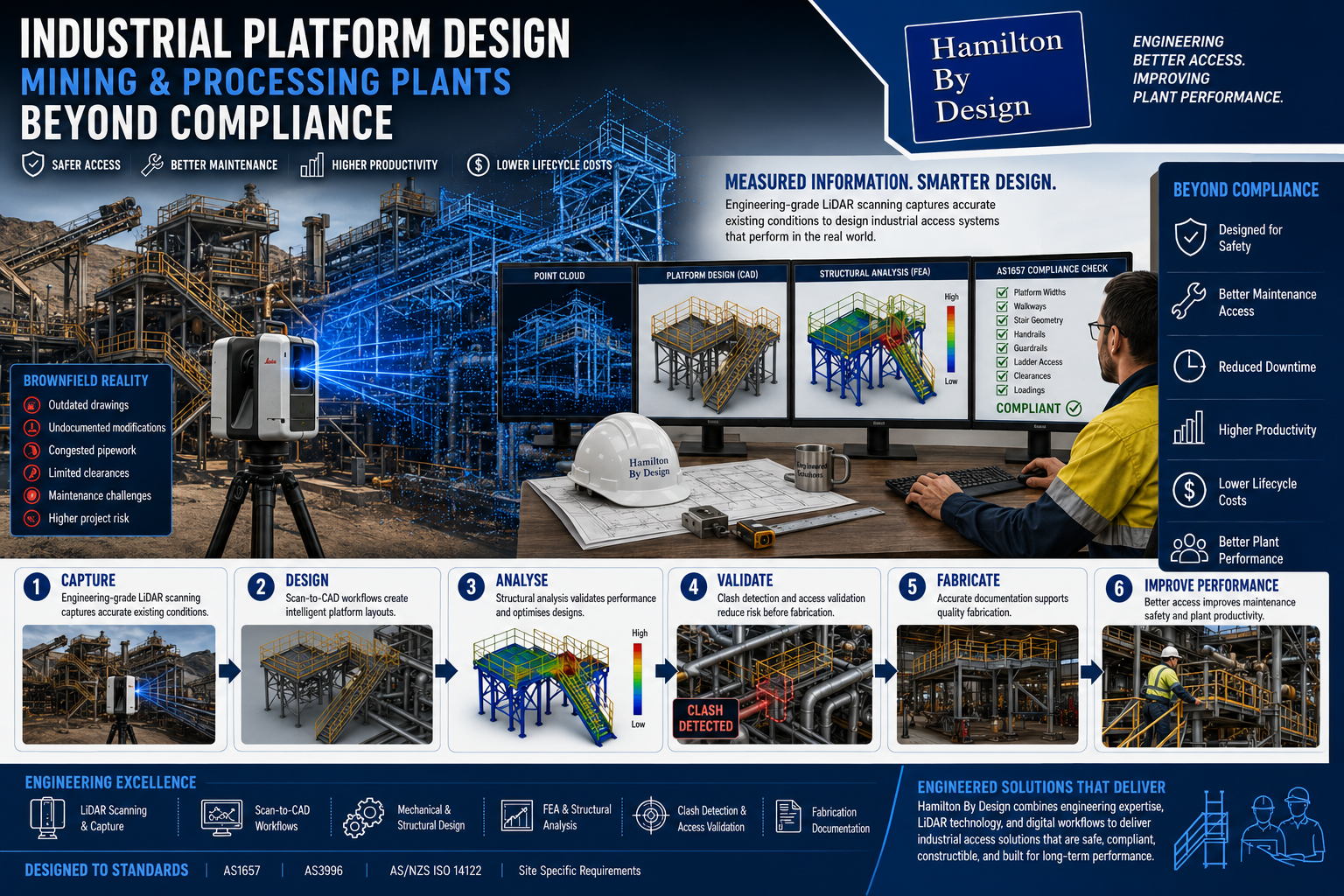
Industrial Platform Design for Mining and Processing Plants: Beyond Compliance

Engineering-grade Scan-to-CAD reverse engineering workflow converting existing industrial equipment into CAD models and fabrication-ready drawings.

Industrial platforms are commonly viewed as supporting structures that simply provide access to equipment and operating areas. In many projects the design process focuses heavily on meeting minimum standards and compliance requirements.

While compliance is essential, successful platform design extends beyond satisfying engineering checklists.

Mining and processing facilities rely on platforms every day for:

  • Maintenance activities
  • Equipment inspections
  • Shutdown work
  • Operational access
  • Plant monitoring
  • Emergency access
  • Equipment removal and installation

Poor platform design can create safety concerns, maintenance challenges, and operational inefficiencies that remain throughout the life of the asset.

At Hamilton By Design, we view platform design as an engineering solution supporting productivity, maintenance, and long-term operational performance rather than simply meeting minimum requirements.

Why Industrial Platform Design Matters

Platforms directly affect how personnel interact with equipment and infrastructure.

Well-designed systems can improve:

  • Worker safety
  • Maintenance access
  • Equipment accessibility
  • Shutdown performance
  • Plant productivity
  • Long-term operating costs

Poor platform layouts may create:

  • Congested access areas
  • Restricted maintenance access
  • Increased manual handling risks
  • Difficult equipment removal
  • Longer shutdown durations
  • Increased project costs

Platform design influences how effectively a facility operates every day.

Compliance is the Starting Point

Mining and processing facilities frequently consider standards including:

  • AS1657 โ€“ Fixed Platforms, Walkways, Stairways and Ladders
  • AS3996 โ€“ Access Covers and Grates
  • Structural loading requirements
  • Site-specific engineering requirements

Standards establish minimum requirements for:

  • Platform dimensions
  • Walkway widths
  • Guardrails
  • Handrails
  • Stair geometry
  • Ladder systems
  • Access openings

Compliance is important, but meeting minimum requirements alone does not guarantee an efficient design.

3D CAD Modelling Australia service banner for Hamilton By Design

Maintenance Access Often Drives Better Outcomes

Maintenance teams commonly interact with platforms more frequently than operations personnel.

Platform design should consider:

  • Equipment removal paths
  • Tool access requirements
  • Safe working zones
  • Inspection locations
  • Clearance requirements
  • Shutdown activities
  • Future maintenance needs

Questions often worth asking include:

  • Can pumps or motors be removed safely?
  • Can maintenance teams work comfortably?
  • Is lifting equipment accessible?
  • Can personnel safely carry tools and equipment?
  • Is there room for future upgrades?

Designing around maintenance activities often improves long-term outcomes.

Human Factors Matter

Platform systems should be designed around how people actually move and work.

Human considerations can include:

  • Visibility
  • Reach distances
  • Working posture
  • Congestion
  • Manual handling requirements
  • Access frequency
  • Emergency escape routes

Designs that ignore human interaction can create unnecessary operational difficulties.

Brownfield Environments Create Additional Challenges

Most mining and processing facilities are not greenfield sites.

Brownfield facilities commonly include:

  • Existing structural steel
  • Pipework congestion
  • Historical modifications
  • Equipment additions
  • Limited clearances
  • Legacy infrastructure

Existing drawings may no longer represent current operating conditions.

Designing new platforms around assumptions can increase:

  • Fabrication risk
  • Site rework
  • Installation delays
  • Shutdown costs

Engineering-Grade LiDAR Scanning for Existing Condition Capture

Hamilton By Design supports platform projects through engineering-grade 3D LiDAR scanning.

Scanning may capture:

  • Structural steel
  • Existing platforms
  • Pipework
  • Equipment
  • Access systems
  • Buildings
  • Existing clearances

Measured information supports engineering decisions using actual site conditions rather than assumptions.

From Point Clouds to Platform Design

Captured information can be processed into engineering workflows through Scan-to-CAD systems.

This supports:

  • Existing condition modelling
  • Platform layouts
  • Structural design
  • Clash detection
  • Access validation
  • Fabrication drawings

Potential problems can often be identified digitally before fabrication begins.

Engineering Analysis and Validation

Platform systems frequently require engineering validation beyond simple geometry.

Hamilton By Design may support projects through:

  • Structural assessment
  • Finite Element Analysis (FEA)
  • Load validation
  • Design optimisation
  • Fabrication documentation

The objective is delivering practical designs that perform in operating environments.

How Hamilton By Design Supports Industrial Platform Projects

Hamilton By Design combines practical engineering experience and digital engineering workflows including:

  • Engineering-grade 3D LiDAR scanning
  • Existing condition capture
  • Scan-to-CAD workflows
  • Mechanical and structural design
  • Engineering analysis and simulation
  • CAD modelling
  • Fabrication documentation
3D LiDAR scanning and 3D modelling service button โ€” laser scanner capturing a point cloud for engineering and CAD modelling
Mechanical engineering services

Beyond Compliance

Industrial platform design should support more than standards compliance.

Successful designs support:

  • Safer workplaces
  • Better maintenance access
  • Reduced downtime
  • Improved operational efficiency
  • Lower lifecycle costs
  • Long-term asset performance

Standards establish minimum requirements.

Engineering adds value beyond them.

Better platform design supports better plant performance.

Hamilton By Design logo displayed on a blue tilted rectangle with a grey gradient background

Our Clients:

Name
Would you like us to arrange a phone consultation for you?
Address
3D CAD Modelling Australia service banner for Hamilton By Design
Australian Drafting logo featuring bold white text reading "Australian Drafting" centred on a blue rounded rectangle background.
Engineering Governance title graphic featuring bold white text reading "Engineering Governance" centred on a blue rounded rectangle background.
Mechanical, Structural & Pipework Drafting service banner by Hamilton By Design featuring white text on a blue background.
Mechanical engineering services
Blue rounded button with the text โ€œSolidWorks Designโ€ in white.
Finite Element Analysis (FEA) engineering simulation button
3D LiDAR Scanning Darwin for engineering surveys, laser scanning, reality capture and point cloud modelling services
3D LiDAR Scanning Australia engineering services for laser scanning, reality capture, scan-to-CAD, Scan-to-BIM and as-built documentation across Australia
3D LiDAR scanning services on the Central Coast providing engineering-grade laser scanning, point cloud capture, scan-to-CAD modelling and industrial reality capture for infrastructure and industrial projects.
3D LiDAR Scanning Perth for engineering surveys, laser scanning, reality capture and point cloud modelling services
3D LiDAR Scanning Sydney for engineering surveys, laser scanning, reality capture and point cloud modelling services
3D LiDAR Scanning Brisbane for engineering surveys, laser scanning, reality capture and point cloud modelling services
3D LiDAR Scanning Canberra for engineering surveys, laser scanning, reality capture and point cloud modelling services
3D LiDAR Scanning Newcastle for engineering surveys, laser scanning, reality capture and point cloud modelling services
3D LiDAR Scanning Adelaide for engineering surveys, laser scanning, reality capture and point cloud modelling services

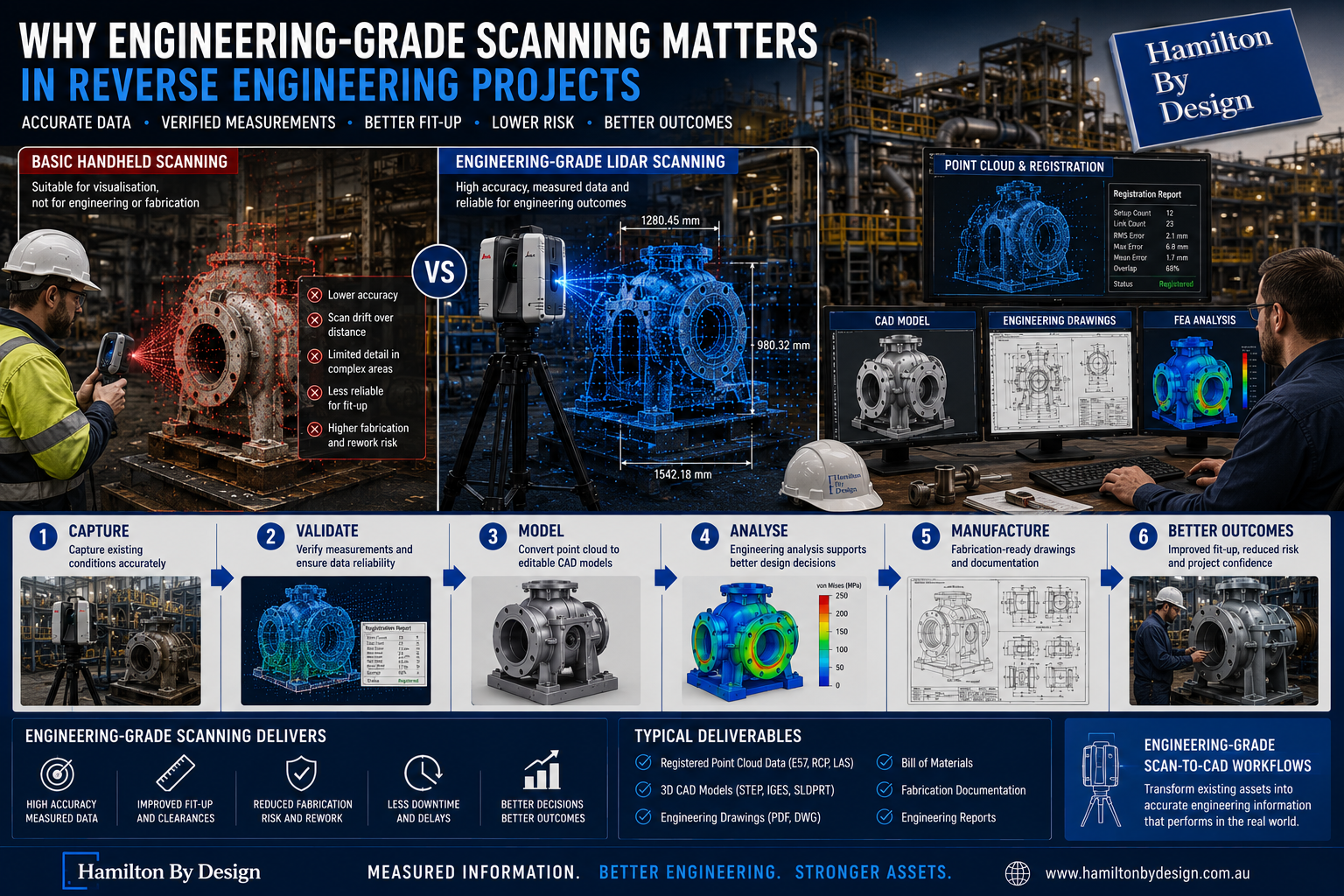
Why Engineering-Grade Scanning Matters in Reverse Engineering Projects

Engineering-grade LiDAR scanning workflow comparing basic scanning and reverse engineering processes for industrial equipment.

Reverse engineering projects often begin with a simple challenge:

“We have the component, but we do not have the engineering information.”

Mining and industrial operations frequently rely on equipment that has been modified, repaired, or operating for many years beyond original installation. Drawings may no longer exist, replacement parts may be difficult to source, and physical components may have changed from their original design.

In these situations, reverse engineering allows existing equipment to be captured and converted into usable engineering information.

However, not all scanning methods deliver the same outcome.

At Hamilton By Design, we use engineering-grade scanning workflows to support reverse engineering projects where accuracy, fit-up, and fabrication outcomes matter.

The objective is not simply creating a visual model.

The objective is creating reliable engineering information.

Why Scanning Accuracy Matters

Reverse engineering projects frequently involve components where small dimensional variations can create significant downstream impacts.

Examples may include:

  • Pump assemblies
  • Conveyor systems
  • Transfer chutes
  • Shafts and couplings
  • Structural components
  • Wear liners
  • Mechanical assemblies

Minor dimensional errors can potentially create:

  • Misalignment
  • Installation difficulties
  • Increased wear
  • Rework
  • Downtime
  • Manufacturing delays

A model that looks correct visually may not necessarily be suitable for fabrication or engineering analysis.

For engineering projects, measured information is critical.

Handheld Scanning vs Terrestrial Scanning

Different scanning technologies are suited to different applications.

3D CAD Modelling Australia service banner for Hamilton By Design

Handheld Scanning Systems

Handheld systems may provide advantages including:

  • Rapid scanning
  • Mobility
  • Convenience
  • Fast visualisation

These systems are commonly used for:

  • Demonstrations
  • General visual models
  • Consumer products
  • Smaller objects
  • Architectural walkthroughs

However, challenges may include:

  • Drift over larger areas
  • Reduced positional control
  • Limited accuracy over extended environments
  • Difficulty in complex industrial sites

Engineering-Grade Terrestrial Scanning

Engineering-grade terrestrial LiDAR systems are typically designed for:

  • Existing condition capture
  • Industrial facilities
  • Brownfield environments
  • Structural information
  • Mechanical equipment
  • Engineering workflows

Potential benefits include:

  • High positional accuracy
  • Measured spatial relationships
  • Existing condition verification
  • Repeatable information capture
  • Better support for engineering decisions

The goal is producing information suitable for engineering use rather than visualisation alone.

Measurement Validation

Engineering workflows often require verification rather than assumptions.

Validation processes may include:

  • Dimensional checks
  • Registration reports
  • Measurement verification
  • Control point assessment
  • Existing condition review

Measurement validation helps ensure information can support:

  • Design development
  • Engineering analysis
  • Manufacturing
  • Construction activities

Confidence in the information improves confidence in the outcome.

Mechanical Fit-Up Requirements

Reverse engineering projects frequently involve equipment that must physically integrate with existing systems.

Examples may include:

  • Conveyor modifications
  • Pump replacements
  • Structural upgrades
  • Access platforms
  • Mechanical assemblies
  • Wear components

Poor fit-up can create:

  • Site rework
  • Delays
  • Fabrication changes
  • Additional labour
  • Installation difficulties

Engineering-grade capture helps reduce uncertainty before fabrication begins.

Brownfield Environments Create Additional Challenges

Brownfield facilities rarely match original documentation.

Industrial sites commonly include:

  • Historical modifications
  • Congested layouts
  • Existing pipework
  • Structural changes
  • Equipment additions
  • Limited access areas

These environments create challenges for reverse engineering because:

  • Drawings may be outdated
  • Components may differ from original designs
  • Existing clearances may be limited

Engineering-grade scanning provides measurable information from the actual operating environment.

Reducing Fabrication Risk

Fabrication errors can become expensive when discovered during installation.

Typical causes of fabrication risk may include:

  • Missing dimensions
  • Incorrect assumptions
  • Clash issues
  • Existing condition inaccuracies
  • Poor fit-up

Engineering-grade scanning can support:

  • Existing condition verification
  • Improved design development
  • Clash detection
  • Better fabrication planning
  • Reduced site modifications

Identifying problems digitally generally costs less than discovering them during installation.

How Hamilton By Design Supports Reverse Engineering Projects

Hamilton By Design combines engineering experience with digital engineering workflows including:

  • Engineering-grade 3D LiDAR scanning
  • Existing condition capture
  • Scan-to-CAD workflows
  • CAD modelling
  • Engineering drawings
  • Engineering analysis and simulation
  • Fabrication documentation
  • Mechanical engineering services

Our workflows naturally support broader engineering services including:

  • 3D CAD Design & Drafting
  • Engineering Analysis & Simulation
  • Mining Mechanical Engineering
  • Engineering Documentation & Digital Engineering
  • Industrial Plant Optimisation
  • LiDAR Scanning Services
3D LiDAR scanning and 3D modelling service button โ€” laser scanner capturing a point cloud for engineering and CAD modelling
Mechanical engineering services

Moving Beyond Visual Models

Reverse engineering projects require more than attractive 3D models.

They require engineering information that supports:

  • Manufacturing
  • Installation
  • Reliability
  • Maintenance
  • Long-term asset management

Engineering-grade scanning helps transform physical assets into measurable engineering information that reduces risk and improves confidence in project outcomes.

Better information supports better engineering decisions.

Hamilton By Design logo displayed on a blue tilted rectangle with a grey gradient background

Our Clients:

Name
Would you like us to arrange a phone consultation for you?
Address
3D CAD Modelling Australia service banner for Hamilton By Design
Australian Drafting logo featuring bold white text reading "Australian Drafting" centred on a blue rounded rectangle background.
Engineering Governance title graphic featuring bold white text reading "Engineering Governance" centred on a blue rounded rectangle background.
Mechanical, Structural & Pipework Drafting service banner by Hamilton By Design featuring white text on a blue background.
Mechanical engineering services
Blue rounded button with the text โ€œSolidWorks Designโ€ in white.
Finite Element Analysis (FEA) engineering simulation button
3D LiDAR Scanning Darwin for engineering surveys, laser scanning, reality capture and point cloud modelling services
3D LiDAR Scanning Australia engineering services for laser scanning, reality capture, scan-to-CAD, Scan-to-BIM and as-built documentation across Australia
3D LiDAR scanning services on the Central Coast providing engineering-grade laser scanning, point cloud capture, scan-to-CAD modelling and industrial reality capture for infrastructure and industrial projects.
3D LiDAR Scanning Perth for engineering surveys, laser scanning, reality capture and point cloud modelling services
3D LiDAR Scanning Sydney for engineering surveys, laser scanning, reality capture and point cloud modelling services
3D LiDAR Scanning Brisbane for engineering surveys, laser scanning, reality capture and point cloud modelling services
3D LiDAR Scanning Canberra for engineering surveys, laser scanning, reality capture and point cloud modelling services
3D LiDAR Scanning Newcastle for engineering surveys, laser scanning, reality capture and point cloud modelling services
3D LiDAR Scanning Adelaide for engineering surveys, laser scanning, reality capture and point cloud modelling services