3D Scanning Engineering in Ballarat

3D Scanning Engineering in Ballarat

Ballarat is one of Victoriaโ€™s most enduring engineering cities. Shaped by gold-rush mining, rail infrastructure, manufacturing, and education, it has a depth of engineering capability that few regional centres can match. Today, Ballarat faces a familiar challenge โ€” upgrading ageing infrastructure and heritage assets while supporting population growth, modern industry, and future resilience.

In this environment, assumptions are risky. Accurate as-built information, practical engineering, and buildable documentation are essential.

Hamilton By Design supports Ballarat projects with engineering-led 3D LiDAR laser scanning, mechanical and structural engineering, 3D modelling, FEA, and easy-to-build fabrication drawings with engineering approval, helping clients move confidently from concept to construction.


Engineering in Ballarat: Heritage, Industry, and the Future

Engineering work in Ballarat rarely starts with a blank sheet. Projects typically involve:

  • Historic and heritage-listed buildings
  • Existing industrial and manufacturing facilities
  • Rail and transport-related infrastructure
  • Brownfield sites with limited or outdated drawings

At the same time, Ballarat must adapt to future pressures such as climate resilience, workforce transition, and infrastructure renewal. This makes accurate digital capture and conservative engineering judgement more important than ever.


3D Laser Scanning for Ballarat Projects

High-accuracy 3D LiDAR laser scanning forms the foundation of successful engineering projects in Ballarat.

Hamilton By Design scans:

  • Heritage buildings and complex structures
  • Industrial plant and manufacturing facilities
  • Rail-adjacent infrastructure and workshops
  • Buildings and assets with unknown or undocumented modifications

3D scanning captures the true as-built condition โ€” including deflection, settlement, misalignment, and historic alterations โ€” without relying on assumptions or invasive measurement.

This approach supports:

  • Safer and faster design development
  • Reduced risk when working within heritage constraints
  • Better coordination between disciplines
  • Fewer surprises during construction

Learn more about our scanning services:
3D Laser Scanning


3D Modelling Built from Real Site Data

From the point cloud, Hamilton By Design develops accurate 3D CAD models that reflect what actually exists on site.

Our 3D modelling services support:

  • Brownfield upgrades and refurbishments
  • Integration of new services into old structures
  • Clash detection and constructability reviews
  • Digital asset records for long-term planning

In Ballarat, where heritage and modern infrastructure coexist, modelling from real data significantly reduces risk and supports sensitive, well-planned design.

Explore our modelling capability:
3D CAD Modelling


FEA for Existing and Modified Assets

Many Ballarat projects involve extending the life of existing assets or modifying structures designed to older standards. Finite Element Analysis (FEA) provides confidence that these changes are safe, compliant, and fit for purpose.

Hamilton By Design applies FEA to:

  • Assess structural capacity and load paths
  • Check deflection, fatigue, and buckling
  • Verify upgrades to heritage and industrial steelwork
  • Support strengthening and compliance decisions

By analysing as-built geometry, FEA results better reflect real behaviour โ€” critical when working with ageing or historically modified structures.

Learn more about our analysis services:
FEA Capabilities


Easy-to-Build Fabrication Drawings with Engineering Approval

Clear, practical documentation is essential for Ballarat projects, where builders and fabricators often work within tight constraints and around existing assets.

Hamilton By Design delivers easy-to-build fabrication and installation drawings, including:

  • General arrangement drawings
  • Fabrication and workshop details
  • Installation and staging layouts
  • As-built documentation

Drawings are produced directly from scanned data and validated 3D models and can be issued with engineering approval, giving contractors confidence that what is built will fit, function, and comply.

View our drafting services:
Drafting Services


Hamilton By Design logo displayed on a blue tilted rectangle with a grey gradient background

Why Hamilton By Design in Ballarat?

Hamilton By Design provides a single-source, engineering-led digital workflow โ€” from site capture through to modelling, analysis, and construction documentation.

For Ballarat clients, this means:

  • Fewer assumptions on heritage and brownfield sites
  • Reduced construction and rework risk
  • Designs that respect existing structures and future needs
  • Fabrication-ready drawings backed by engineering sign-off

Whether you are upgrading heritage buildings, modifying industrial facilities, or planning future-ready infrastructure, Hamilton By Design delivers accurate, practical, and build-ready engineering solutions tailored to Ballaratโ€™s unique challenges.

If youโ€™re planning a project in Ballarat, weโ€™re ready to help โ€” starting with accurate data and carrying it through to approved, buildable outcomes.

Our clients

Name
Would you like us to arrange a phone consultation for you?
Address

3D Lidar Scanning Bundabergโ€™s Industrial Evolution

Bundabergโ€™s Industrial Evolution: How 3D LiDAR Scanning, Engineering & Digital Modelling Are Modernising Regional Projects

Bundaberg may be famous for rum, ginger beer and turtles โ€” but beneath its relaxed coastal reputation is a rapidly evolving industrial, agricultural and manufacturing hub powering a huge portion of Queenslandโ€™s regional economy. With major sugar operations, large-scale food processing, port development, aviation facilities, marine engineering and rural infrastructure all expanding, Bundaberg is quietly becoming one of the most diverse engineering environments in regional Australia.

At Hamilton By Design, weโ€™re proud to support Bundabergโ€™s growth by providing 3D LiDAR laser scanning, mechanical and structural engineering, 3D modelling and drafting services tailored to the unique challenges of the region. Whether youโ€™re upgrading a processing plant, modernising an agricultural facility, documenting flood-impacted infrastructure or developing marine and port assets, we offer end-to-end digital engineering capability that reduces risk, improves accuracy and streamlines project delivery.

This article explores what makes Bundaberg such a unique place for engineering โ€” and how todayโ€™s digital tools are helping its industries design, maintain and build with confidence.


Why Bundabergโ€™s Industry Mix Demands High-Accuracy Digital Engineering

Bundaberg has one of the most diverse economies of any coastal regional city in Queensland. It is shaped by four major forces:

1. Agriculture & Food Production

Bundaberg is a national leader in:

  • sugarcane
  • macadamias
  • citrus
  • sweet potatoes
  • ginger
  • processed beverages

The presence of both Bundaberg Rum and Bundaberg Brewed Drinks means the region hosts advanced processing plants, bottling systems, conveyors, tanks, pipework and automated equipment โ€” all of which require ongoing upgrades, inspections and engineering documentation.

2. Marine & Port Infrastructure

Port of Bundaberg supports:

  • bulk exports
  • marine servicing
  • vessel maintenance
  • fisheries and aquaculture supply chains

Port and marina expansions increasingly rely on accurate as-built data, coastal engineering, and detailed modelling of structural and mechanical systems.

3. Manufacturing & Fabrication

Bundaberg has a strong fabrication sector serving:

  • agriculture
  • food processing
  • marine
  • regional construction
  • heavy machinery maintenance

These workshops benefit enormously from precise laser scans and digital models to ensure steelwork fits the first time.

4. Floodplain & Civil Infrastructure

Sitting on the Burnett River, Bundaberg has unique hydrological challenges. Flood-impacted suburbs, bridges, drainage systems, pump stations and terrain require:

  • accurate ground modelling
  • as-built condition assessments
  • structural verification
  • digital documentation for upgrades and mitigation works

These factors make Bundaberg an ideal candidate for modern engineering supported by 3D LiDAR technology.


3D LiDAR Laser Scanning โ€” Eliminating Guesswork in Bundaberg Projects

Bundabergโ€™s blend of agriculture, coastal assets, manufacturing and flood-prone areas means traditional tape-measure surveys often fall short. Complex geometry, ageing infrastructure, tight retrofits and undocumented changes can easily lead to costly errors.

Hamilton By Design uses engineering-grade 3D LiDAR laser scanning to capture entire sites with millimetre-level precision.

Our scans document:

  • processing equipment
  • structural steel and platforms
  • tanks, pipework and conveyors
  • marine facilities, wharfs, slipways
  • fabrication workshops
  • terrain and civil structures
  • legacy infrastructure needing refurbishment

This creates a complete digital โ€œas-builtโ€ environment, ready for modelling and engineering.

Learn more about our process here: 3D Laser Scanning

For Bundaberg clients, the benefits are significant:

  • reduced shutdown time
  • fewer site visits
  • more accurate fabrication
  • confident planning and design
  • safer working conditions

The result is a faster, more predictable project with fewer surprises.


3D Modelling & Drafting โ€” From Scanned Reality to Build-Ready Designs

After scanning, Hamilton By Design converts the point cloud into detailed 3D CAD models using SolidWorks and similar engineering platforms.

This allows us to deliver:

  • mechanical and structural models
  • general arrangement drawings
  • detailed fabrication drawings
  • pipe and tank layouts
  • conveyor, chutes and materials-handling upgrades
  • clash detection and interference reviews
  • BOMs and digital documentation

Bundabergโ€™s agricultural processing plants, beverage facilities, marine workshops and industrial sites often undergo staged upgrades โ€” meaning existing equipment stays in place while new equipment is added. Accurate 3D models prevent conflicts and ensure everything fits perfectly when fabricated.


Engineering Services Supporting Bundabergโ€™s Growth

Bundabergโ€™s infrastructure is a mix of new development, legacy equipment and rural-industrial installations โ€” each requiring professional engineering.

Hamilton By Design provides a full mechanical and structural capability including:

  • structural integrity assessments
  • platform, walkway and support-structure design
  • vibration, load and deflection assessments
  • mechanical upgrade design for processing plants
  • pipework and flow optimisation
  • fatigue and stress analysis (FEA)
  • pressure vessel and tank engineering
  • fabrication-ready documentation

Whether the project involves a food-processing plant, a marine facility, agricultural machinery, a port upgrade or civil asset rework, our engineering solutions deliver certainty and compliance.


Bundaberg Use Cases โ€” Where Our Services Create the Most Impact

1. Sugar Mills & Beverage Production Facilities

Bundabergโ€™s sugarcane and beverage industries use large, complex mechanical systems. LiDAR scanning helps document aging infrastructure, fit new equipment, optimise flow, and reduce downtime.

2. Marine Engineering & Port Upgrades

Scanning captures accurate geometry of:

  • wharfs
  • slipways
  • hulls
  • coastal structures
  • mechanical support frames

Models support efficient repairs, upgrades or new marine installations.

3. Agricultural Processing & Packing Plants

From conveyors to tanks to packing lines, scanning ensures accurate upgrades and tight fabrication tolerances โ€” essential for continuous agricultural operations.

4. Fabrication & Engineering Workshops

Bundaberg has many local fabricators who benefit from:

  • dimensionally accurate models
  • verified tie-in points
  • reduced rework
  • precise steel fabrication

5. Flood-Resilience & Civil Projects

Terrain scanning, structural assessment and digital modelling help modernise drainage, bridges, culverts and pump facilities โ€” especially after flood events.


Our End-to-End Workflow โ€” One Team, One Source of Accountability

Bundaberg clients often face delays when scanning, drafting and engineering are handled by separate contractors. Hamilton By Design provides a single-source solution:
  1. 3D LiDAR scanning
  2. Point cloud registration & accuracy verification
  3. 3D modelling of existing and new assets
  4. Mechanical & structural engineering
  5. Fabrication-ready drawings
  6. Digital QA and final documentation

This unified approach reduces handover errors and ensures every step flows smoothly.


Hamilton By Design logo displayed on a blue tilted rectangle with a grey gradient background

Bundabergโ€™s Future Is Digital โ€” And Hamilton By Design Is Ready

As Bundaberg continues expanding its port, upgrading processing plants, improving civil infrastructure and developing new agricultural and manufacturing capacity, digital engineering will play a major role in keeping projects safe, efficient and profitable.

Hamilton By Design is here to support that growth with:

  • precision 3D LiDAR scanning
  • comprehensive mechanical and structural engineering
  • reliable 3D CAD modelling
  • fabrication-ready drafting
  • digital QA and project documentation

Whether youโ€™re improving a plant, designing new equipment, documenting flood impacts or planning a marine upgrade โ€” we help you build with confidence and accuracy.

Our Clients

Name
Would you like us to arrange a phone consultation for you?
Address

The Real-World Accuracy of 3D LiDAR Scanning With FARO S150 & S350 Scanners

When people first explore 3D LiDAR scanning, one of the most eye-catching numbers in any product brochure is the advertised accuracy. FAROโ€™s Focus S150 and S350 scanners are often promoted as delivering โ€œยฑ1 mm accuracy,โ€ which sounds definitive and easy to rely on for engineering, mining and fabrication work. But anyone who has spent time working with 3D LiDAR scanning in real industrial environments understands that accuracy isnโ€™t a single number โ€” it is a system of interrelated factors.

This article explains what the ยฑ1 mm specification from FARO really means, how accuracy shifts with distance, and what engineers, project managers and clients need to do to achieve dependable results when applying 3D LiDAR scanning on live sites.

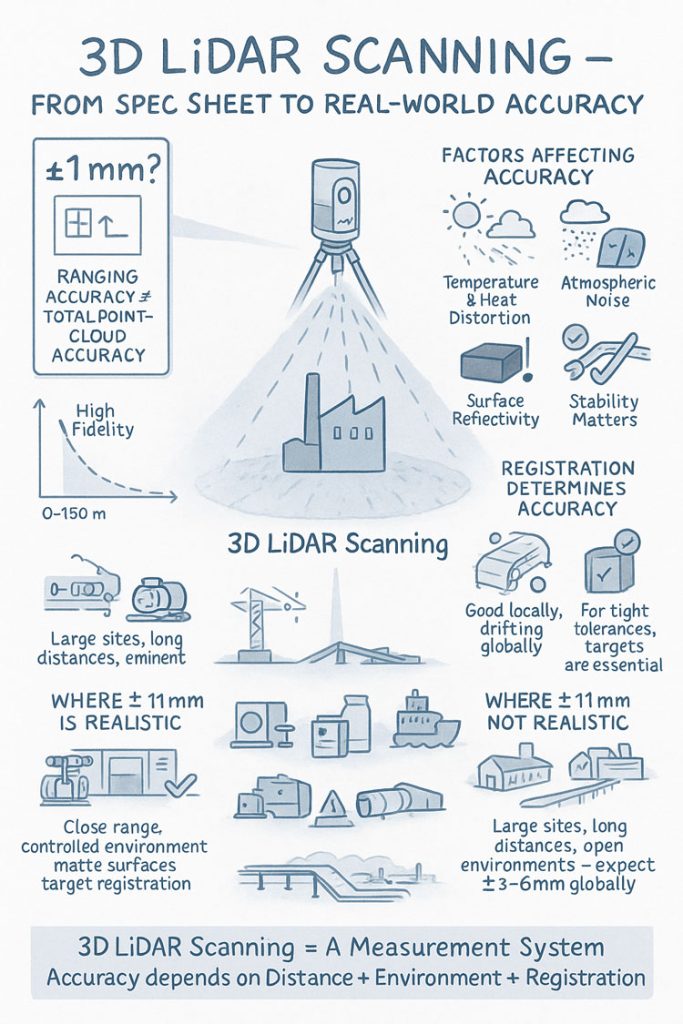
Infographic explaining 3D LiDAR scanning accuracy, showing a scanner capturing a building and highlighting factors that affect accuracy such as temperature, atmospheric noise, surface reflectivity and tripod stability. Includes diagrams comparing realistic versus unrealistic ยฑ1 mm accuracy, the impact of distance, environment and registration quality, and notes that large open sites typically achieve ยฑ3โ€“6 mm global accuracy.

1. What FAROโ€™s โ€œยฑ1 mm Accuracyโ€ Really Means in 3D LiDAR Scanning

The ยฑ1 mm number applies only to the internal distance measurement unit inside the scanner. It reflects how accurately the laser measures a single distance in controlled conditions.

It does not guarantee:

  • ยฑ1 mm for every point in a full plant model
  • ยฑ1 mm for every dimension extracted for engineering
  • ยฑ1 mm global accuracy across large multi-scan datasets

In 3D LiDAR scanning, ranging accuracy is just one ingredient. Real-world accuracy is shaped by distance, reflectivity, scan geometry and how multiple scans are registered together.


2. How Accuracy Changes With Distance in Real Projects

Even though the S150 and S350 list the same ranging accuracy, their 3D LiDAR scanning performance changes as distance increases. This is due to beam divergence, angular error, environment and surface reflectivity.

Typical real-world behaviour:

  • 0โ€“10 m: extremely precise, often sub-millimetre
  • 10โ€“25 m: excellent for engineering work, only slight noise increase
  • 25โ€“50 m: more noticeable noise and increasing angular error
  • 50โ€“100 m: atmospheric distortion and reduced overlap become evident
  • Near maximum range: still useful for mapping conveyors, yards and structures, but not suitable for tight fabrication tolerances

This distance-based behaviour is one of the most important truths to understand about 3D LiDAR scanning in field conditions.


3. Ranging Accuracy vs Positional Accuracy vs Global Accuracy

Anyone planning a project involving 3D LiDAR scanning must distinguish between:

Ranging Accuracy

The ยฑ1 mm value โ€” only the distance measurement.

3D Positional Accuracy

The true X/Y/Z location of a point relative to the scanner.

Global Point Cloud Accuracy

How accurate the entire dataset is after registration.

Global accuracy is the number engineers depend on, and it is normally around ยฑ3โ€“6 mm for large industrial sites โ€” completely normal for terrestrial 3D LiDAR scanning.


4. What Real Field Testing Reveals About FARO S-Series Accuracy

Independent practitioners across mining, infrastructure, CHPPs, plants and structural environments report similar results when validating 3D LiDAR scanning against survey control:

  • ยฑ2โ€“3 mm accuracy in compact plant rooms
  • ยฑ5โ€“10 mm across large facilities
  • Greater drift across long, open, feature-poor areas

These outcomes are not equipment faults โ€” they are the natural result of how 3D LiDAR scanning behaves in open, uncontrolled outdoor environments.


5. Why Registration Matters More Than the Scanner Model

Most real-world error in 3D LiDAR scanning comes from registration, not the laser itself.

Cloud-to-Cloud Registration

Good for dense areas, less reliable for long straight conveyors, open yards or tanks.

Target-Based Registration

Essential for high-precision engineering work.
Allows tie-in to survey control and dramatically improves global accuracy.

If your project needs ยฑ2โ€“3 mm globally, target control is mandatory in all 3D LiDAR scanning workflows.


6. Surface Reflectivity and Environmental Effects

Reflectivity dramatically affects measurement quality during 3D LiDAR scanning:

  • Matte steel and concrete return excellent data
  • Rusted surfaces return good data
  • Dark rubber, black plastics and wet surfaces reduce accuracy
  • Stainless steel and glass behave unpredictably

Environmental factors โ€” wind, heat shimmer, dust, rain โ€” also reduce accuracy. Early morning or late afternoon typically produce better 3D LiDAR scanning results on mining and industrial sites.


7. When ยฑ1 mm Is Actually Achievable

True ยฑ1 mm accuracy in 3D LiDAR scanning is realistic when:

  • Working within 10โ€“15 m
  • Surfaces are matte and reflective
  • Registration uses targets
  • Tripod stability is high
  • Conditions are controlled

This makes it suitable for:

  • Pump rooms
  • Valve skids
  • Structural baseplates
  • Reverse engineering
  • Small mechanical upgrades

But achieving ยฑ1 mm across a full plant, CHPP, or yard is outside the capability of any terrestrial 3D LiDAR scanning workflow.


8. S150 vs S350: Which One for Your Accuracy Needs?

S150 โ€“ Engineering-Focused Precision

Ideal for industrial rooms, skids, structural steel and retrofit design work where short-to-mid-range accuracy is essential.

S350 โ€“ Large-Area Coverage

Perfect for conveyors, rail lines, yards, and outdoor infrastructure.
Global accuracy must be survey-controlled for tight tolerances.

Both scanners deliver excellent 3D LiDAR scanning performance, but the S150 is the engineering favourite while the S350 is the large-site specialist.


9. What to Specify in Contracts to Avoid Misunderstandings

Instead of stating:

โ€œScanner accuracy ยฑ1 mm.โ€

Specify:

  • Local accuracy requirement (e.g., ยฑ2 mm at 15 m)
  • Global accuracy requirement (e.g., ยฑ5 mm total dataset)
  • Registration method (mandatory target control)
  • Environmental constraints
  • Verification method (e.g., independent survey checks)

This ensures everyone understands what 3D LiDAR scanning will realistically deliver.


10. When a Terrestrial Scanner Is Not Enough

Do not rely solely on 3D LiDAR scanning for:

  • Machine alignment <1 mm
  • Bearing or gearbox placement
  • Certified dimensional inspection
  • Metrology-level tolerances

In these cases, supplement scanning with:

  • Laser trackers
  • Total stations
  • Metrology arms
  • Hybrid workflows

Conclusion: The Real Truth About 3D LiDAR Scanning Accuracy

FAROโ€™s S150 and S350 are outstanding tools for industrial 3D LiDAR scanning, but the ยฑ1 mm spec does not tell the full story. Real-world accuracy is a combination of:

  • Distance
  • Registration method
  • Surface reflectivity
  • Site conditions
  • Workflow discipline

When used correctly, these scanners consistently deliver high-quality, engineering-grade point clouds suitable for clash detection, retrofit design, fabrication planning and as-built documentation.

3D LiDAR scanning is not just a laser โ€” it is an entire measurement system.
And when the system is applied with care, it produces reliable, repeatable data that reduces rework, improves safety, and strengthens decision-making across mining, construction, fabrication and industrial operations.

Where Is your project

3D Scanning Sydney CBD3D Scanning Brisbane CBD
3D Scanning across Melbourne3D Scanning across Perth
3D Scanning across Adelaide3D Scanning in The Hunter Valley
3D Scanning Mount Isa3D Scanning Emerald
3D Laser Scanning Central Coast3D Scanning in The Pilbara
3d Scanning other Areas of Australia3D Scanning Outside Australia
Hamilton By Design logo displayed on a blue tilted rectangle with a grey gradient background
Name
Address
You would like to:

3D CAD Modelling | 3D Scanning

3D Experience Platform Login

3D Scanning for Construction

Transforming Projects with 3D Scanning

3D LiDAR Scanning โ€“ Digital Quality Assurance

Why 3D Point Clouds + Expert Modelers Are a Game-Changer for Your Projects

Infographic illustrating the 3D project data workflow, showing LiDAR scanners and drones capturing millions of data points, a designer modelling on a computer, and project teams validating accurate 3D data, highlighting benefits such as speed, accuracy, cost savings and project success.

Level Up your 3D Scans

In todayโ€™s world, accuracy and efficiency can make or break a project. Whether youโ€™re working in architecture, construction, engineering, or product design, you need reliable data โ€” and you need it fast. Thatโ€™s where 3D point clouds come in.

But thereโ€™s an important catch: not all scans are created equal. The difference between an average scan and a great one often comes down to the person behind the scanner. Having someone who understands 3D modeling take the scans can dramatically improve your projectโ€™s accuracy, reliability, and overall success.

Letโ€™s break down why.


The Power of 3D Point Clouds

Point clouds are essentially millions of tiny data points that capture the shape of an object, room, or entire site. Together, they create a highly detailed digital snapshot of the real world.

Hereโ€™s why this matters:

  • Precision you can trust โ€“ Point clouds deliver incredibly detailed measurements, capturing even the smallest curves and angles.
  • Nothing gets missed โ€“ Multiple scan angles ensure a full, 360ยฐ view of your site or object.
  • Speed and efficiency โ€“ What used to take hours (or days) with manual measurements can be captured in minutes.
  • Built-in context โ€“ Youโ€™re not just getting numbers; youโ€™re getting a complete digital environment to work inside.
  • Future-proof data โ€“ Once you have a scan, you have a permanent record of your space, ready to use months or years later.

From clash detection to as-built verification, point clouds save time, reduce errors, and make collaboration across teams smoother than ever.


Why the Person Taking the Scan Matters

While technology is powerful, experience is what makes the results reliable. Having a skilled 3D modeler operate the scanner can be the difference between a good project and a great one.

Hereโ€™s why an expert makes all the difference:

  • They know what matters โ€“ A modeler understands which details are critical for your project and ensures theyโ€™re captured.
  • Fewer gaps, fewer surprises โ€“ Experienced pros know how to plan scan positions to cover every angle and avoid blind spots.
  • Cleaner, more accurate data โ€“ They reduce common issues like noise, misalignment, or missing sections that can throw off your model.
  • Time saved, headaches avoided โ€“ No one wants to redo a scan halfway through a project. A professional ensures you get it right the first time.
  • Confidence from start to finish โ€“ When you know your model is accurate, you can move forward with design and construction decisions without second-guessing.

In short: a great scanner operator doesnโ€™t just deliver data โ€” they deliver peace of mind.


The Bottom Line

3D point clouds are already transforming how projects are planned and delivered. But pairing them with an experienced 3D modeler takes things to the next level.

Youโ€™ll get better data, faster turnarounds, and a far lower risk of costly mistakes. And when your goal is to deliver projects on time, on budget, and with zero surprises, thatโ€™s an edge you canโ€™t afford to miss.

Hamilton By Design logo displayed on a blue tilted rectangle with a grey gradient background

3D Modelling | 3D Scanning | Point Cloud Scanning

Chute Design in the Mining Industry

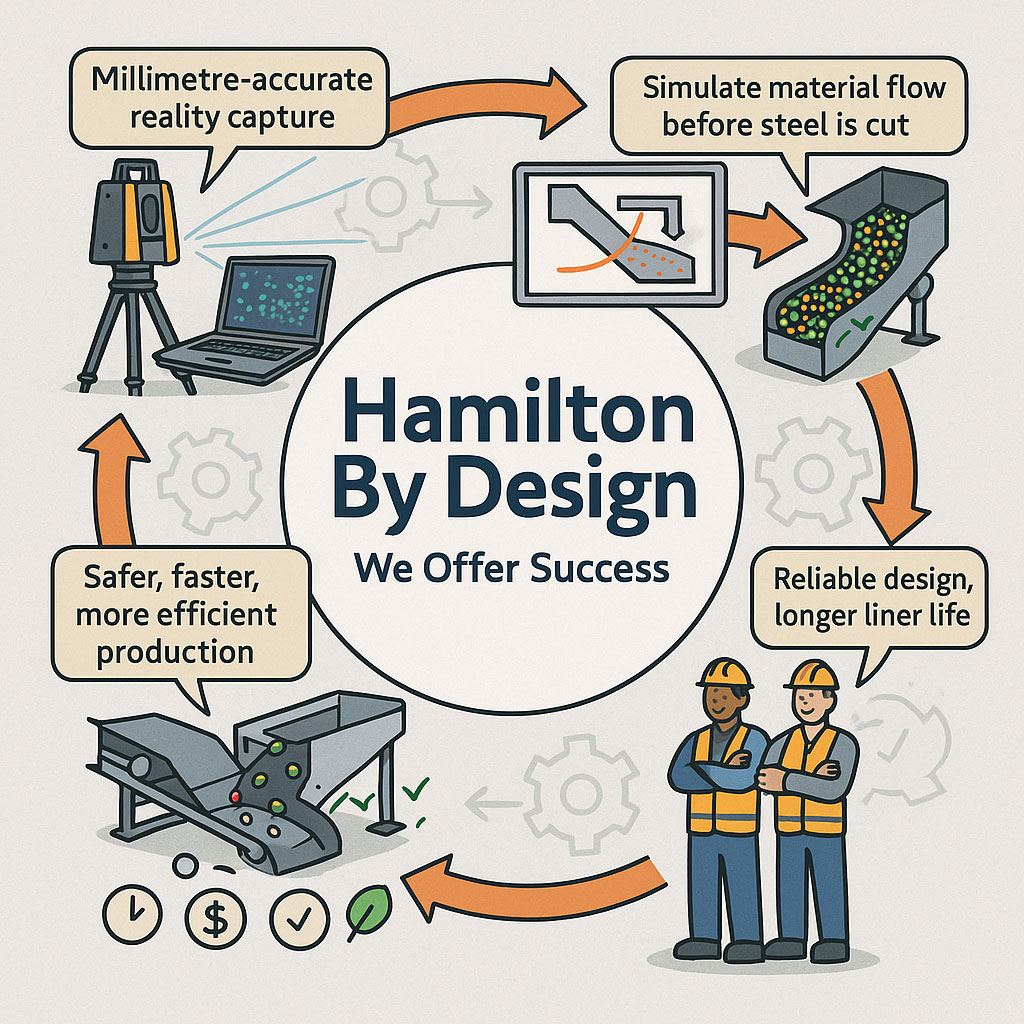
Infographic showing Hamilton By Designโ€™s engineering workflow, including millimetre-accurate LiDAR reality capture, material-flow simulation, optimised chute designs, and safer, more efficient production outcomes. Two workers in PPE highlight reliable design and longer liner life, with icons representing time, cost and quality benefits.

Getting Coal, Hard Rock, and ROM Material Flow Right

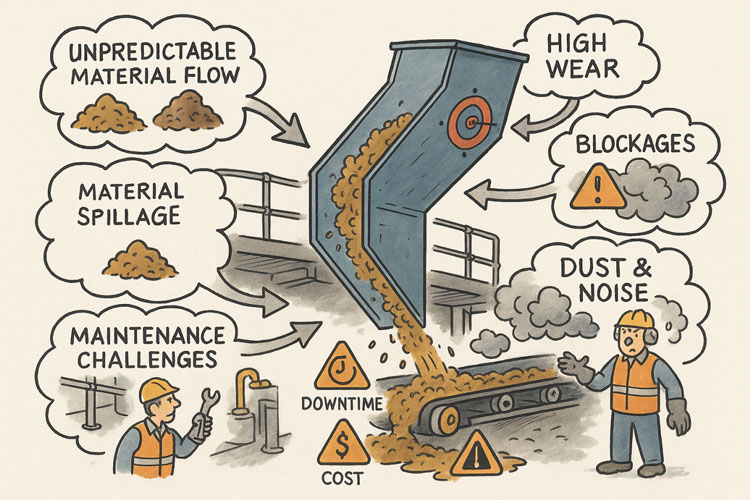
Chute design is one of the most critical yet challenging aspects of mining and mineral processing. Whether you are handling coal, hard rock ore, or raw ROM material, chutes and transfer stations are the unsung workhorses of every operation. When designed well, they guide material smoothly, minimise wear, and keep conveyors running. When designed poorly, they cause blockages, spillage, excessive dust, and expensive downtime.

Modern chute design has moved far beyond rules of thumb and back-of-the-envelope sketches. Today, successful projects rely on accurate as-built data, particle trajectory analysis, and advanced Discrete Element Method (DEM) simulation to predict, visualise, and optimise material flow before steel is cut. In this article, we explore why these tools have become essential, how they work together, and where software can โ€” and cannot โ€” replace engineering judgement.


Illustration showing common problems with poorly designed material-handling chutes. A chute discharges material onto a conveyor while issues are highlighted around it: unpredictable material flow, material spillage, maintenance challenges, high wear, blockages, and dust and noise. Warning icons for downtime and cost appear on the conveyor, and workers are shown dealing with the resulting hazards and maintenance tasks.

The Challenge of Chute Design

Coal and hard rock have very different flow behaviours. Coal tends to be softer, generate more dust, and be prone to degradation, while hard rock is more abrasive and can damage chutes if impact angles are not controlled. ROM material adds another level of complexity โ€” oversize lumps, fines, and moisture variation can cause hang-ups or uneven flow.

Chute design must balance several competing objectives:

  • Control the trajectory of incoming material to reduce impact and wear
  • Prevent blockages by maintaining flowability, even with wet or sticky ore
  • Manage dust and noise to meet environmental and workplace health requirements
  • Fit within existing plant space with minimal modification to conveyors and structures
  • Be maintainable โ€” liners must be accessible and replaceable without excessive downtime

Meeting all these goals without accurate data and simulation is like trying to design in the dark.


Illustrated graphic showing a tripod-mounted 3D laser scanner capturing millimetre-accurate as-built data in an industrial plant with conveyors and walkways. Speech bubbles highlight issues such as โ€œOutdated drawings donโ€™t tell the full storyโ€ and โ€œModifications rarely get documented.โ€ The scan data is shown being visualised on a laptop, with notes describing full coverage of conveyors, walkways, and services. Benefits listed along the bottom include faster data collection, fewer site revisits, safer shutdowns, accurate starting point for design simulation, and safer outcomes that ensure designs fit first time.

Capturing the Truth with 3D Scanning

The first step in any successful chute project is to understand the as-built environment. In many operations, drawings are outdated, modifications have been made over the years, and the real plant geometry may differ from what is on paper. Manual measurement is slow, risky, and often incomplete.

This is where 3D laser scanning changes the game. Using tripod-mounted or mobile LiDAR scanners, engineers can capture the entire transfer station, conveyors, surrounding steelwork, and services in a matter of hours. The result is a dense point cloud with millimetre accuracy that reflects the true state of the plant.

From here, the point cloud is cleaned and converted into a 3D model. This ensures the new chute design will not clash with existing structures, and that all clearances are known. It also allows maintenance teams to plan safe access for liner change-outs and other work, as the scanned model can be navigated virtually to check reach and access envelopes.


Understanding Particle Trajectory

Once the physical environment is known, the next challenge is to understand the particle trajectory โ€” the path that material takes as it leaves the head pulley or previous transfer point.

Trajectory depends on belt speed, material characteristics, and discharge angle. For coal, fine particles may spread wider than the coarse fraction, while for ROM ore, large lumps may follow a ballistic path that needs to be controlled to prevent impact damage.

Accurately modelling trajectory ensures that the material enters the chute in the right location and direction. This minimises impact forces, reducing wear on liners and avoiding the โ€œsplashโ€ that creates spillage and dust. It also prevents the material from hitting obstructions or dead zones that could lead to build-up and blockages.

Modern software can plot the trajectory curve for different loading conditions, providing a starting point for chute geometry. This is a critical step โ€” if the trajectory is wrong, the chute design will be fighting against the natural path of the material.


The Power of DEM Simulation

While trajectory gives a first approximation, real-world flow is far more complex. This is where Discrete Element Method (DEM) simulation comes into play. DEM models represent bulk material as thousands (or millions) of individual particles, each following the laws of motion and interacting with one another.

When a DEM simulation is run on a chute design:

  • You can visualise material flow in 3D, watching how particles accelerate, collide, and settle
  • Impact zones become clear, showing where liners will wear fastest
  • Areas of turbulence, dust generation, or segregation are identified
  • Build-up points and potential blockages are predicted

This allows engineers to experiment with chute geometry before fabrication. Angles can be changed, ledges removed, and flow-aiding features like hood and spoon profiles or rock-boxes optimised to achieve smooth, controlled flow.

For coal, DEM can help ensure material lands gently on the receiving belt, reducing degradation and dust. For hard rock, it can ensure that the energy of impact is directed onto replaceable wear liners rather than structural plate. For ROM ore, it can help prevent oversize lumps from wedging in critical locations.


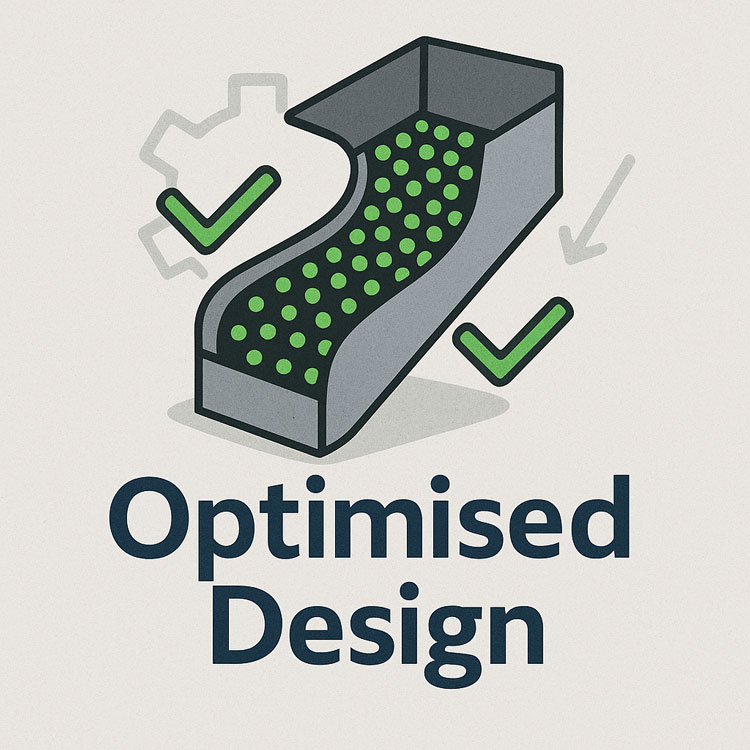
Illustration of an optimised chute design showing material flow represented by green particles, with check marks and gear icons indicating improved efficiency and engineered performance.

๐Ÿ–ฅ Strengths and Limitations of Software

Modern DEM packages are powerful, but they are not magic. Software such as EDEM, Rocky DEM, or Altairโ€™s tools can simulate a wide range of materials and geometries, but they rely on good input data and skilled interpretation.

Key strengths include:

  • Ability to model complex, 3D geometries and particle interactions
  • High visualisation power for communicating designs to stakeholders
  • Capability to run multiple scenarios (different feed rates, moisture contents, ore types) quickly

However, there are limitations:

  • Material calibration is critical. If the particle shape, friction, and cohesion parameters are wrong, the results will not match reality.
  • Computational cost can be high โ€” detailed simulations of large chutes with millions of particles may take hours or days to run.
  • Engineering judgement is still needed. Software will not tell you the โ€œbestโ€ design โ€” it will only show how a proposed design behaves under given conditions.

Thatโ€™s why DEM is best used as part of a holistic workflow that includes field data, trajectory analysis, and experienced design review.


From Model to Real-World Results

When the simulation results are validated and optimised, the design can be finalised. The point cloud model ensures the chute will fit in the available space, and the DEM results give confidence that it will perform as intended.

This means fabrication can proceed with fewer changes and less risk. During shutdown, installation goes smoothly, because clashes have already been resolved in the digital model. Once commissioned, the chute delivers predictable flow, less spillage, and longer liner life.


Why It Matters More Than Ever

Todayโ€™s mining operations face tighter production schedules, stricter environmental compliance, and increasing cost pressures. Downtime is expensive, and the margin for error is shrinking.

By combining 3D scanning, trajectory modelling, and DEM simulation, operations can move from reactive problem-solving to proactive improvement. Instead of waiting for blockages or failures, they can design out the problems before they occur, saving both time and money.


Partnering for Success

At Hamilton by Design, we specialise in turning raw site data into actionable insights. Our team uses advanced 3D scanning to capture your transfer stations with precision, builds accurate point clouds and CAD models, and runs calibrated DEM simulations to ensure your new chute design performs from day one.

Whether youโ€™re working with coal, hard rock, or ROM ore, we help you deliver designs that fit first time, reduce maintenance headaches, and keep production running.

Contact us today to see how our integrated scanning and simulation workflow can make your next chute project safer, faster, and more reliable.

Mechanical Engineering | Structural Engineering

Mechanical Drafting | Structural Drafting

3D Laser Scanning | 3D CAD Modelling | 3D Scanning

Chute Design

SolidWorks Contractors in Australia

Hamilton By Design โ€“ Blog

Consulting Engineers

About Us โ€“ Hamilton By Design

Hamilton By Design | 3D Scanning | Sydney | Perth | Brisbane | Mount Isa | Lidar Scanning

Contact us

3D Scanning

How 3D Laser Scanning is Redefining Reality for Design, Construction & Heritage

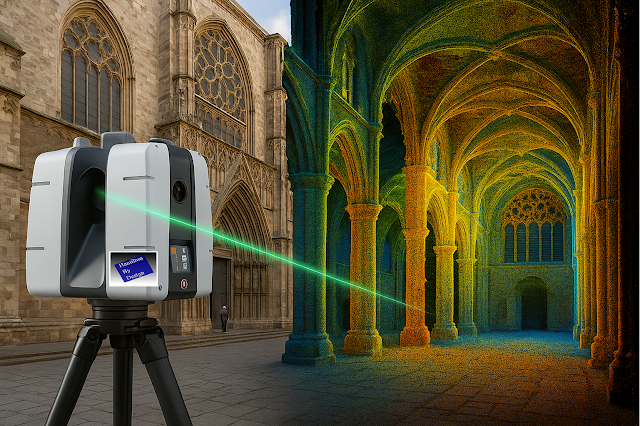
Imagine standing before a centuries-old cathedral, where every carved arch, every stained-glass pane, every weathered stone holds centuries of stories. Capturing its true form and condition with tape measure and camera? Tedious and prone to errors. But with 3D laser scanning, you can digitally freeze every detailโ€”down to the imperfectionsโ€”turning reality into an exact, manipulable model.

In an age where precision, speed, and data-driven decisions are non-negotiable, 3D laser scanning is no longer โ€œnice to haveโ€โ€”itโ€™s essential. Letโ€™s explore what it is, why itโ€™s transformative, where itโ€™s being used most powerfully, and how you can harness its potential.

What Is 3D Laser Scanning?

At its core, 3D laser scanning sometimes called terrestrial laser scanning, (TLS) is the emission of laser pulses toward surfaces, recording the time it takes for those pulses to bounce back. From that comes a dense โ€œpoint cloudโ€ โ€” billions of precise data points mapping shape, texture, orientation, and distance.

These point clouds become high-fidelity models, maps, meshes, or BIM ready files. Whether youโ€™re scanning building exteriors, interiors, or industrial components, the result is more than just imageryโ€”itโ€™s measurable, analyzable geometry.

How It Works โ€” The Process

  1. Preparation & Planning

    Define what you need: the level of detail (LOD), resolution, range, and whether external conditions (light, weather) will interfere.

  2. Data Capture

    Position the scanner at multiple stations to cover all surfaces. Use targets or reference markers for alignment and capture with overlapping scans.

  3. Processing & Registration

    Merge scans to align them properly, clean noise, filter out irrelevant data (like people, moving objects), calibrate.

  4. Post-processing & Deliverables

    Convert point clouds into usable outputsโ€”floorplans, sections, elevations, 3D meshes, BIM models, virtual walkthroughs. Run analyses (clash detection, deformation etc.).

  5. Integration & Use

    Use the data in design, restoration, facility management, or documentation. The quality of integration (into BIM, GIS, CAD) is key to unlocking value.

ย 

Key Benefits

Benefit What It Means in Practice Real-World Impact
Extreme Precision Sub-millimetre to millimetre accuracy depending on the scanner and conditions. Less rework. Better fit for retrofit, renovation, or mechanical systems in tight tolerances.
Speed + Efficiency Collect large amounts of spatial data in far less time than traditional measurement. Faster project turnaround. Reduced site time costs.
Non-Contact / Low Disruption Good for fragile structures, hazardous or difficult-to-access places. Preserves integrity of heritage buildings; safer for workers.
Comprehensive Documentation Full visual & geometric context. Informs future maintenance. Acts as an archival record.
Better Decision Making & Conflict Detection Early clash detection; scenario simulation; what-if modelling. Avoids costly mistakes; helps build consensus among stakeholders.
Enhanced Visualisation & Communication Stakeholders can see exactly what exists vs. whatโ€™s being proposed. Improves client buy-in, regulatory approvals, fundraising.

ย 

Applications: Where It Shines

  • Architecture & Renovation: As-built models, restoration of heritage sites.

  • Infrastructure & Civil Engineering: Bridges, tunnels, rail track alignments.

  • Industrial & Manufacturing: Machine part audits, reverse-engineering, plant layout.

  • Heritage & Preservation: Documenting fragile monuments, archaeological sites.

  • Facility Management: Digital twins, maintenance, asset tracking.

  • Environment & Surveying: Terrain mapping, forestry, flood risk mapping (especially when combined with aerial systems or mobile scanning).

Challenges & Best Practices

Nothing is perfect. To get the most out of 3D laser scanning, anticipate and mitigate:

  • Environmental factors: Light, dust, rain, reflective surfaces can introduce noise.

  • Data overload: Massive point clouds are large; need strong hardware & efficient workflows.

  • Alignment & registration errors: Overlaps, control points, and calibration are vital.

  • Skill & Planning: Good operators + good planning = much better outcomes.

Key best practices:

  • Use reference targets for precise registration.

  • Capture overlap of 30-50% between scan positions.

  • Break project into manageable segments.

  • Clean noise early.

  • Think ahead about deliverables and how clients will use the data (design, BIM, VR etc.).
Case Studies & Stories

  • Heritage in Danger: A cathedral in Europe threatened by pollution and structural decay was laser scanned. The point cloud revealed minute deformations, enabling an accurate restoration planโ€”saving costs and preserving history.

  • Infrastructure Efficiency: A civil engineering firm reduced design clashes by 80% on a complex highway project by integrating scans with their BIM workflow.

  • Industrial Switch-Over: Manufacturing plant layout was reconfigured using scan data; downtime reduced because the virtual model matched reality better than the old blueprints.

Software, Tools & Ecosystem

While scanners are vital, the software ecosystem is what unlocks value. Tools that turn raw data into actionable insights include:

  • Reality capture tools (processing point clouds).

  • BIM / CAD integration (e.g. Revit, AutoCAD).

  • Visualization tools (VR, AR, walkthrough).

  • Data sharing & collaboration platforms.

  • Cloud storage / processing if large point clouds.

SaaS/cloud-based workflows are increasingly important to share among remote teams, facilitate stakeholder review, and ensure data is accessible beyond just technical users.

Why It Matters Now

  • Global pressures (heritage, sustainability, faster build cycles, remote work) are raising the bar.

  • Clients expect transparency, accuracy, minimized risk.

  • Regulatory compliance and โ€œas-builtโ€ requirements are stricter.

  • Digital twins & smart infrastructure demand high fidelity data.

3D laser scanning acts as a bridge: between physical world and digital twin; between heritage past and future; between design promise and build reality. Ifย you have a survey scan and want to make sense of point cloud data, contact Hamilton By Design

ย 
ย 
ย 
ย 

Our clients:

Name
Would you like us to arrange a phone consultation for you?
Address