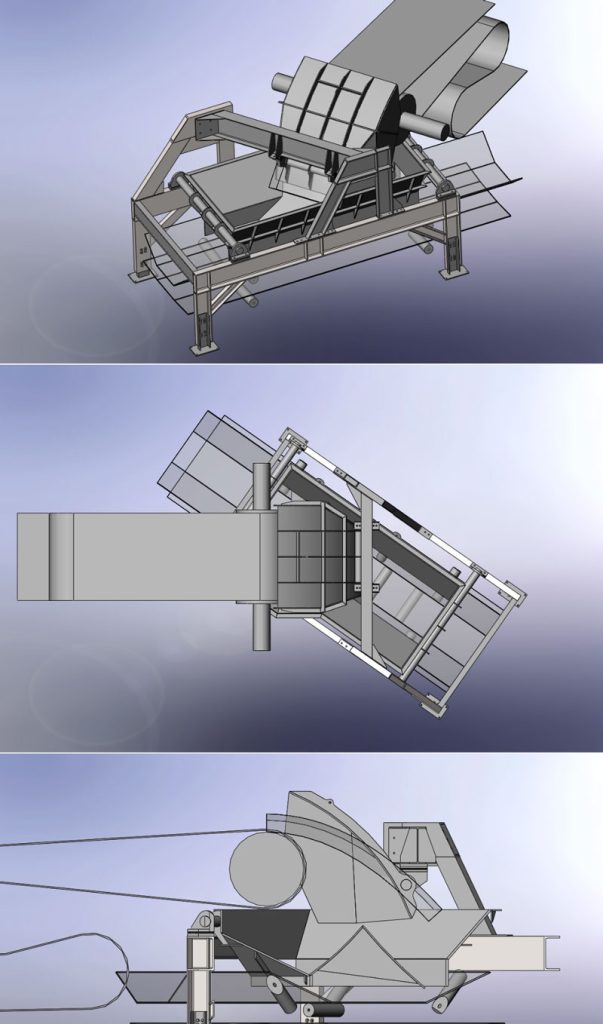
Systems Engineering, Hazard Identification and Mining Safety

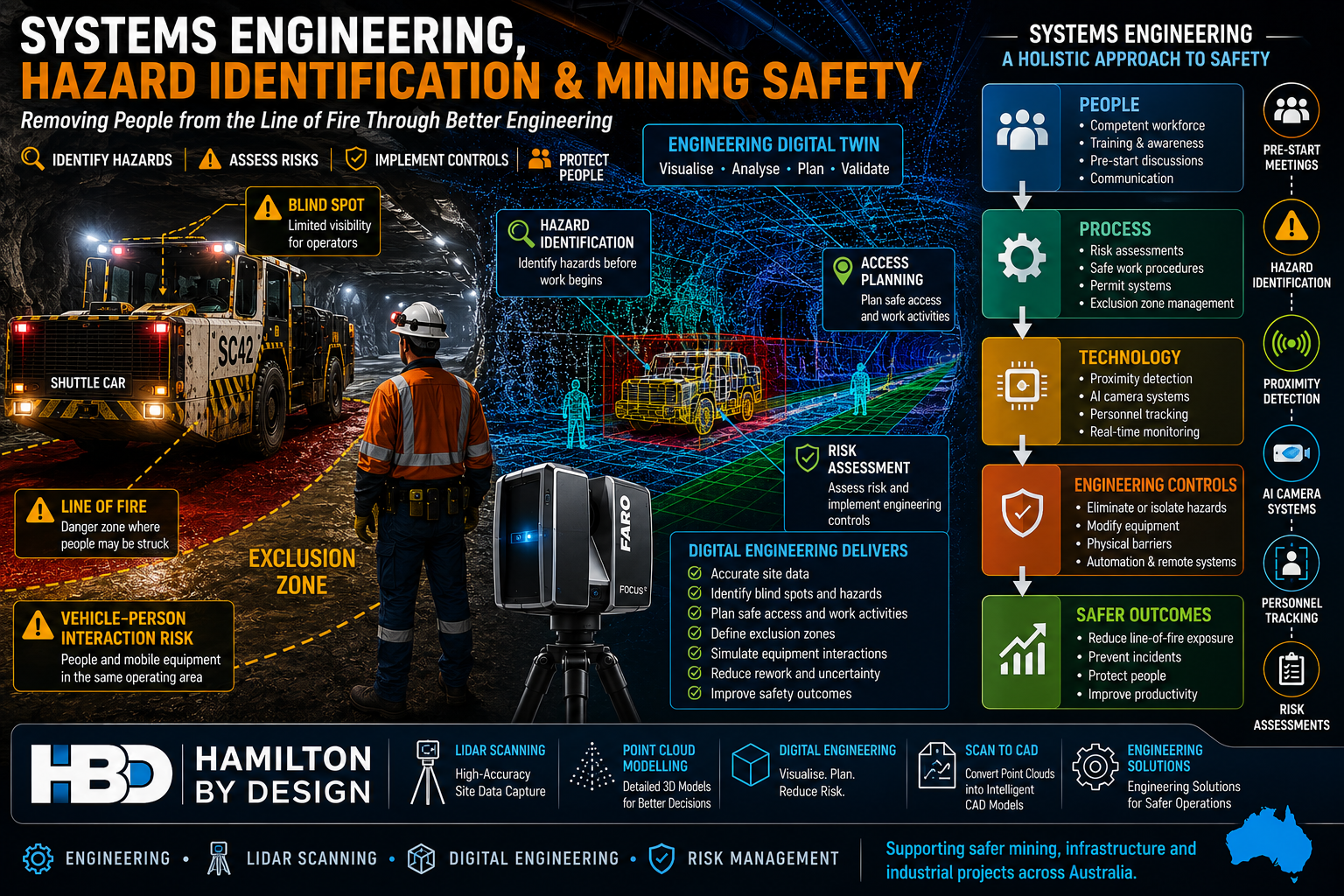
Systems engineering and mining safety infographic showing an underground shuttle car, exclusion zones, hazard identification, engineering digital twin, LiDAR scanning, risk assessment and engineering controls used to reduce line-of-fire risks and improve workplace safety in mining operations.

Lessons from a Preventable Underground Coal Mine Incident

The Technology Exists โ€“ So Why Are We Still Seeing These Incidents?

A recent Resources Safety & Health Queensland (RSHQ) investigation into a near-fatal underground coal mining incident has once again highlighted a challenge that continues to confront the mining industry.

The incident occurred at an underground coal mine near Emerald in Queensland’s Bowen Basin when a worker entered the blind spot of a shuttle car and was struck by the machine. Investigators identified several contributing factors including poor visibility, inadequate communication, high background noise, blind spots around mobile equipment and the absence of proximity detection technology. RSHQ described the event as entirely preventable and encouraged operators to consider technologies already being used successfully at other Queensland mines.

While incidents such as this are often discussed from an operational perspective, they also highlight a broader engineering challenge.

The real question is:

How do we design systems that prevent workers from being exposed to hazards in the first place?

This is where systems engineering becomes critically important.


What is Systems Engineering?

Systems engineering is the disciplined approach of understanding how people, equipment, processes, technology, procedures and the operating environment interact as a complete system.

Rather than focusing on individual components, systems engineering examines:

  • Human factors
  • Equipment design
  • Communication systems
  • Work procedures
  • Environmental conditions
  • Technology controls
  • Organisational culture
  • Training and competency
  • Risk management processes

When a serious incident occurs, it is rarely caused by a single failure.

Instead, multiple weaknesses align simultaneously.

In the Emerald incident, the shuttle car itself was not necessarily defective.

The system failed because:

  • Workers changed position without positive communication.
  • The vehicle operator was unaware of the workers’ location.
  • Visibility was limited.
  • Background noise masked movement.
  • No proximity detection technology was available.
  • Workers entered a line-of-fire zone.

A systems engineering approach asks:

What combination of controls could have prevented the event regardless of human error?


The Hierarchy of Controls

One of the most important principles in safety engineering is the Hierarchy of Controls.

Controls are generally ranked from most effective to least effective:

  1. Elimination
  2. Substitution
  3. Engineering Controls
  4. Administrative Controls
  5. Personal Protective Equipment

Many organisations rely heavily on procedures, training and pre-start discussions.

While these are important, they sit relatively low in the hierarchy.

Engineering controls are often more reliable because they do not depend entirely on human behaviour.

Examples include:

  • Proximity detection systems
  • AI camera systems
  • Collision avoidance systems
  • Personnel tracking systems
  • Physical barriers
  • Interlocks
  • Remote operation technology
  • Autonomous equipment

The objective should always be to engineer hazards out of the system wherever practical.


Hazard Identification Starts Before Work Begins

One of the most effective safety tools available is proactive hazard identification.

Many incidents occur because hazards are recognised only after work has commenced.

Hazard identification should occur during:

Project Planning

Before construction or maintenance work begins.

Design Reviews

Before equipment is fabricated or modified.

Shutdown Planning

Before personnel enter operational areas.

Pre-Start Meetings

Before workers commence each shift.

Field Risk Assessments

Immediately before performing a task.

A robust hazard identification process considers:

  • Mobile equipment interactions
  • Blind spots
  • Stored energy
  • Working at heights
  • Falling objects
  • Confined spaces
  • Vehicle movements
  • Emergency access
  • Simultaneous operations
  • Human factors

The goal is simple:

Identify hazards before they have an opportunity to cause harm.


Why Pre-Start Meetings Matter

In many operations, pre-start meetings can become routine.

Unfortunately, routine often leads to complacency.

The most effective pre-start meetings are not simply administrative exercises.

They provide an opportunity to discuss:

What Has Changed?

  • New equipment
  • New personnel
  • Different environmental conditions
  • Weather impacts
  • Operational changes

What Are Today’s Hazards?

  • Vehicle interactions
  • Exclusion zones
  • Ground conditions
  • Overhead hazards
  • Isolation requirements

What Are the Critical Controls?

  • Spotters
  • Communication methods
  • Isolation procedures
  • Permit requirements
  • Emergency response arrangements

What Could Go Wrong?

This question alone can significantly improve hazard awareness.

A quality pre-start discussion encourages workers to actively think about risk before entering the workplace.


Line-of-Fire Hazards Remain a Major Industry Risk

Across mining, construction, manufacturing and heavy industry, line-of-fire incidents continue to be one of the leading causes of serious injury and fatalities.

Line-of-fire hazards include situations where workers are exposed to:

  • Moving vehicles
  • Rotating equipment
  • Suspended loads
  • Stored energy
  • Pressurised systems
  • Falling objects
  • Uncontrolled equipment movement

Recent Queensland mining safety alerts have repeatedly highlighted similar themes:

  • Workers trapped between vehicles.
  • Workers entering exclusion zones.
  • Poor communication.
  • Lack of positive isolation.
  • Mobile equipment interactions.

The underlying hazards are often well understood.

The challenge is ensuring controls remain effective in real-world operating environments.


The Role of Digital Engineering and LiDAR Scanning

Modern engineering tools are creating new opportunities to identify and manage risk before work begins.

Engineering-grade LiDAR scanning and digital engineering workflows allow project teams to create accurate digital representations of operational facilities.

Applications include:

Access Planning

Identifying safe access routes.

Equipment Interaction Analysis

Assessing vehicle and personnel separation.

Shutdown Planning

Visualising work fronts before crews arrive onsite.

Clash Detection

Identifying conflicts before installation.

Exclusion Zone Development

Understanding hazardous interaction areas.

Emergency Planning

Reviewing evacuation routes and emergency access.

Hamilton By Design regularly supports projects through:

  • Engineering-grade LiDAR scanning
  • Point cloud modelling
  • Scan-to-CAD workflows
  • Digital engineering
  • Mechanical engineering
  • Brownfield modifications
  • As-built documentation

These tools provide project teams with accurate information that can improve both productivity and safety outcomes.


Proximity Detection Technology is Not New

One of the most significant observations from the recent incident is that proximity detection technology already exists.

In fact, underground mining industries have been investigating and deploying proximity detection systems around continuous miners and shuttle cars for many years. These systems can identify personnel entering predefined warning or hazard zones and initiate alarms, slowdowns or machine intervention depending on the system design.

Modern systems can provide:

  • Warning zones
  • Slow-down zones
  • Automatic stop functions
  • Personnel tracking
  • Vehicle interaction monitoring
  • AI-assisted hazard detection

The question is no longer whether the technology is available.

The question is how quickly and consistently industry adopts it.


Building Safer Systems

A mature safety culture understands that procedures alone are rarely enough.

The strongest organisations focus on building multiple layers of protection.

This includes:

People

  • Training
  • Competency
  • Communication

Processes

  • Risk assessments
  • Safe work procedures
  • Permit systems

Technology

  • Proximity detection
  • AI vision systems
  • Personnel tracking

Engineering

  • Equipment redesign
  • Physical barriers
  • Elimination of hazards

Leadership

  • Safety culture
  • Accountability
  • Continuous improvement

When these elements work together, the likelihood of serious incidents is dramatically reduced.


Final Thoughts

The recent underground coal mining incident serves as a powerful reminder that safety is fundamentally a systems engineering challenge.

The objective should not simply be to react to incidents.

The objective should be to design work environments where incidents are far less likely to occur.

Hazard identification, risk assessment, effective pre-start meetings, engineering controls and modern technologies all play a critical role in achieving this outcome.

As the mining industry continues to embrace digital engineering, LiDAR scanning, automation, AI systems and proximity detection technologies, there is a significant opportunity to remove people from the line of fire and create safer workplaces.

The technology exists.

The challenge is ensuring it is implemented before the next near miss becomes a fatality.


Hamilton By Design logo displayed on a blue tilted rectangle with a grey gradient background

References

  1. Resources Safety & Health Queensland (RSHQ) โ€“ Safety Alert: Underground shuttle car incident.
  2. Resources Safety & Health Queensland (RSHQ) โ€“ Vehicle interaction and line-of-fire safety alerts.
  3. Proximity Detection Systems in Underground Mines โ€“ Queensland Mining Industry Health and Safety Conference.
  4. Proximity Detection Options on Underground Mining Equipment.
  5. Safe to Work โ€“ Coal mine collision highlights parking procedure risks.

Contact Us – Talk to Us
Name
Would you like us to arrange a phone consultation for you?
Address
Australian Drafting logo featuring bold white text reading "Australian Drafting" centred on a blue rounded rectangle background.
Engineering Governance title graphic featuring bold white text reading "Engineering Governance" centred on a blue rounded rectangle background.
Mechanical, Structural & Pipework Drafting service banner by Hamilton By Design featuring white text on a blue background.
Mechanical engineering services
Blue rounded button with the text โ€œSolidWorks Designโ€ in white.
Finite Element Analysis (FEA) engineering simulation button
3D LiDAR Scanning Darwin for engineering surveys, laser scanning, reality capture and point cloud modelling services
3D LiDAR Scanning Australia engineering services for laser scanning, reality capture, scan-to-CAD, Scan-to-BIM and as-built documentation across Australia
3D LiDAR scanning services on the Central Coast providing engineering-grade laser scanning, point cloud capture, scan-to-CAD modelling and industrial reality capture for infrastructure and industrial projects.
3D LiDAR Scanning Perth for engineering surveys, laser scanning, reality capture and point cloud modelling services
3D LiDAR Scanning Sydney for engineering surveys, laser scanning, reality capture and point cloud modelling services
3D LiDAR Scanning Brisbane for engineering surveys, laser scanning, reality capture and point cloud modelling services
3D LiDAR Scanning Canberra for engineering surveys, laser scanning, reality capture and point cloud modelling services
3D LiDAR Scanning Newcastle for engineering surveys, laser scanning, reality capture and point cloud modelling services
3D LiDAR Scanning Adelaide for engineering surveys, laser scanning, reality capture and point cloud modelling services

Reducing Shutdown Risk Using Digital Engineering Models

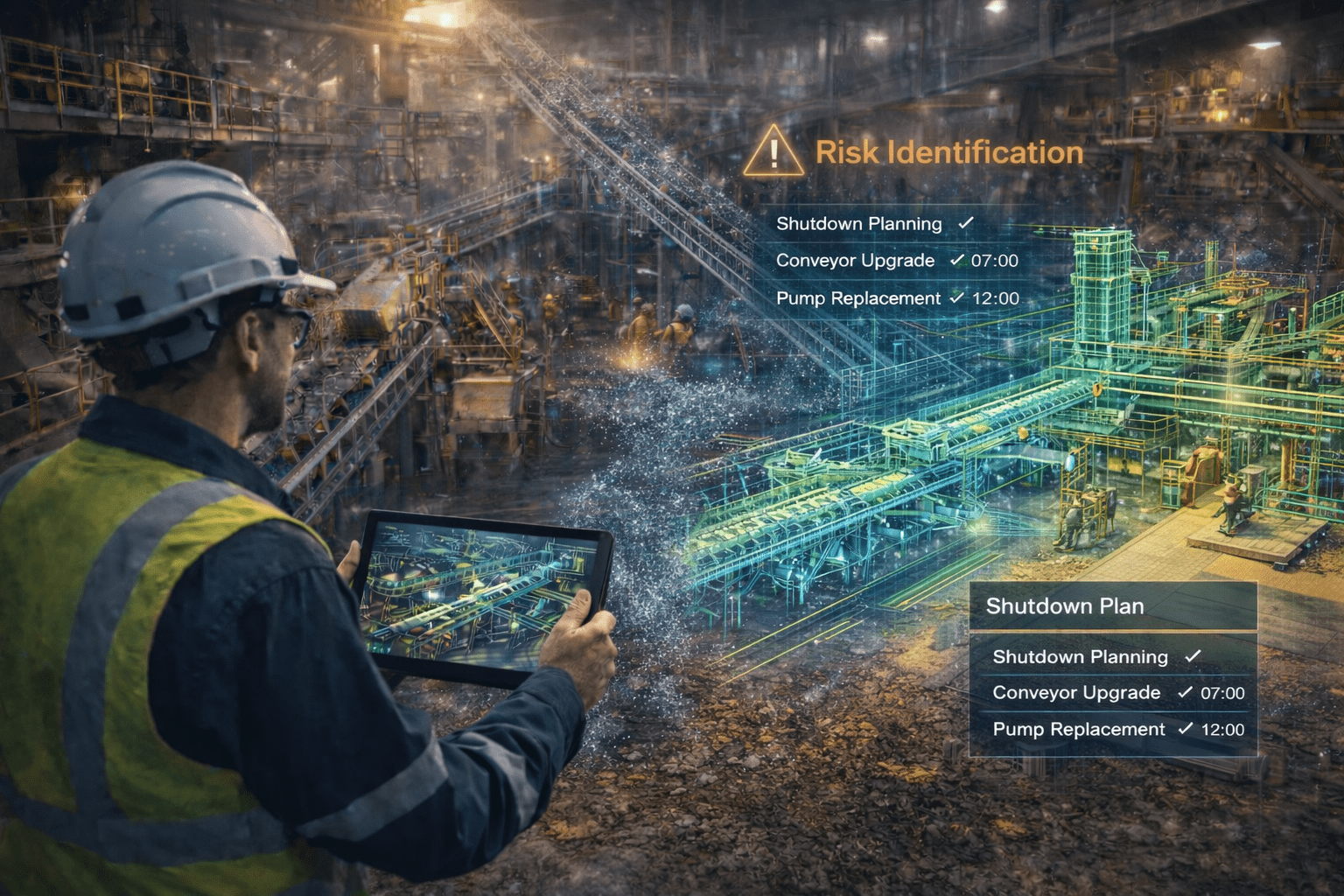
Mining shutdown planning using digital engineering models and plant layout visualisation.

How Digital Engineering Improves Shutdown Planning

Shutdown projects are among the most critical operational events in mining and industrial facilities. During these planned outages, maintenance work, equipment upgrades, inspections, and infrastructure modifications must all be completed within a limited timeframe.

Because production is halted during these periods, even small delays can significantly affect operations.

This is why shutdown planning engineering plays such an important role in reducing risk and improving shutdown performance.

Digital engineering models allow engineering teams to visualise the plant environment before shutdown work begins. By using accurate digital representations of existing infrastructure, engineers can identify potential issues early and ensure shutdown work is properly planned.

At Hamilton By Design, digital modelling is frequently used to support shutdown planning, helping operations teams reduce uncertainty and improve execution of shutdown projects.


Why Shutdown Projects Carry Significant Risk

Shutdown projects typically involve multiple teams performing complex work within a restricted time window.

Common shutdown risks include:

โ€ข equipment installation clashes
โ€ข inaccurate plant drawings
โ€ข limited access to equipment
โ€ข unexpected infrastructure conflicts
โ€ข delays caused by redesign during shutdown

When engineering teams rely solely on outdated drawings or manual measurements, these risks increase significantly.

Digital engineering models provide a way to analyse plant geometry and equipment layout before shutdown work begins.


What Are Digital Engineering Models?

Digital engineering models are accurate three-dimensional representations of plant infrastructure created using engineering data and site measurements.

These models are typically developed using technologies such as:

โ€ข 3D laser scanning
โ€ข point cloud modelling
โ€ข CAD engineering models
โ€ข plant layout modelling

By combining these technologies, engineers can create digital models that represent the current condition of plant infrastructure.

This approach allows engineers to perform planning and design work using reliable data before shutdown activities begin.


Using 3D Scanning to Capture Existing Infrastructure

One of the most effective ways to build digital engineering models is through 3D laser scanning.

Laser scanning captures millions of measurement points across plant infrastructure, producing a point cloud dataset that accurately represents the geometry of the facility.

Engineers can then use this data to develop digital models used for shutdown planning and equipment design.

Learn more about engineering-grade scanning services here:


From Scan Data to Engineering Models

Once scan data has been captured, engineers convert the point cloud data into engineering models used for design and planning.

This process typically includes:

  1. Processing scan data into a unified point cloud
  2. Creating engineering CAD models of equipment and structures
  3. Analysing plant layout and installation requirements
  4. Preparing fabrication drawings for shutdown work

This digital workflow allows engineers to evaluate installation scenarios before work begins.

You can read more about this process here:


Identifying Risks Before Shutdown Begins

Digital engineering models allow engineers to identify potential issues before shutdown activities begin.

Examples include:

โ€ข pipework clashes with structural steel
โ€ข insufficient installation clearance
โ€ข access restrictions for lifting equipment
โ€ข equipment alignment problems
โ€ข interference with existing infrastructure

By resolving these issues during the planning stage, engineering teams can significantly reduce the likelihood of delays during shutdown execution.


Supporting Safer Shutdown Operations

In addition to improving planning efficiency, digital engineering models also support safer shutdown operations.

Engineering teams can use digital plant models to:

โ€ข evaluate safe access routes
โ€ข plan equipment removal procedures
โ€ข coordinate multiple work crews
โ€ข verify installation tolerances

This helps ensure shutdown work is performed safely and according to engineering specifications.


Integrating Digital Engineering into Shutdown Planning

Digital engineering models are most effective when integrated into the broader shutdown planning process.

Shutdown planning typically involves:

โ€ข engineering design preparation
โ€ข plant scanning and documentation
โ€ข fabrication of new equipment
โ€ข contractor coordination
โ€ข installation planning

Digital models allow these activities to be coordinated more effectively.

You can read more about engineering planning for shutdown projects here:


Hamilton By Design logo displayed on a blue tilted rectangle with a grey gradient background

Conclusion

Shutdown projects represent critical operational windows for mining and industrial facilities.

Through the use of shutdown planning engineering and digital engineering models, organisations can significantly reduce risk and improve the efficiency of shutdown work.

By capturing accurate plant data and developing digital engineering models before shutdown begins, engineers can identify potential conflicts, improve installation planning, and ensure shutdown activities proceed as efficiently as possible.

Hamilton By Design supports mining and industrial operations by providing engineering services that assist with shutdown planning, digital modelling, and plant upgrade projects.

3D LiDAR scanning and 3D modelling service button โ€” laser scanner capturing a point cloud for engineering and CAD modelling
Mechanical engineering services
Name
Would you like us to arrange a phone consultation for you?
Address

Our Clients

3D CAD Modelling Australia service banner for Hamilton By Design
Australian Drafting logo featuring bold white text reading "Australian Drafting" centred on a blue rounded rectangle background.
Engineering Governance title graphic featuring bold white text reading "Engineering Governance" centred on a blue rounded rectangle background.
Mechanical, Structural & Pipework Drafting service banner by Hamilton By Design featuring white text on a blue background.
Mechanical engineering services
Blue rounded button with the text โ€œSolidWorks Designโ€ in white.
Finite Element Analysis (FEA) engineering simulation button
3D LiDAR Scanning Darwin for engineering surveys, laser scanning, reality capture and point cloud modelling services
3D LiDAR Scanning Australia engineering services for laser scanning, reality capture, scan-to-CAD, Scan-to-BIM and as-built documentation across Australia
3D LiDAR scanning services on the Central Coast providing engineering-grade laser scanning, point cloud capture, scan-to-CAD modelling and industrial reality capture for infrastructure and industrial projects.
3D LiDAR Scanning Perth for engineering surveys, laser scanning, reality capture and point cloud modelling services
3D LiDAR Scanning Sydney for engineering surveys, laser scanning, reality capture and point cloud modelling services
3D LiDAR Scanning Brisbane for engineering surveys, laser scanning, reality capture and point cloud modelling services
3D LiDAR Scanning Canberra for engineering surveys, laser scanning, reality capture and point cloud modelling services
3D LiDAR Scanning Newcastle for engineering surveys, laser scanning, reality capture and point cloud modelling services
3D LiDAR Scanning Adelaide for engineering surveys, laser scanning, reality capture and point cloud modelling services

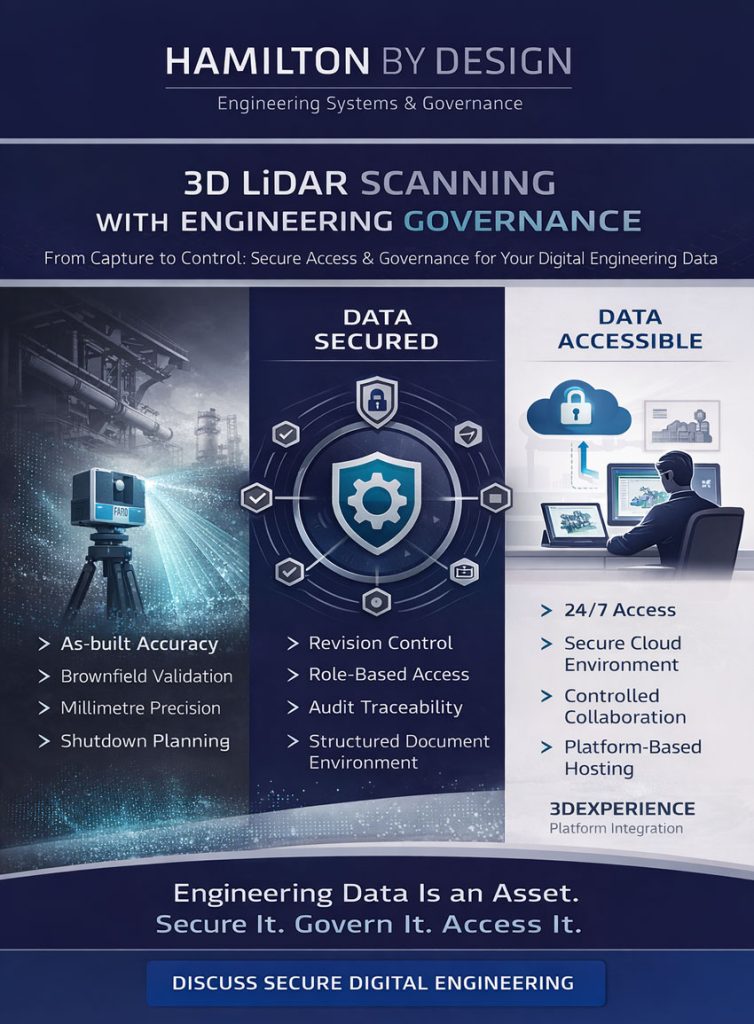
3D Scanning Sydney with Engineering Governance

Industrial LiDAR scanning and digital engineering governance model demonstrating secure data capture, revision control and secure platform access.

Reduce Rework. Protect Capital. Deliver Certainty.

In Sydneyโ€™s high-cost construction and industrial market, mistakes are expensive.

With Australian labour rates among the highest in the region โ€” and Sydney operating at premium commercial rates โ€” the cost of rework, design clashes, undocumented variations, and inaccurate site data can quickly exceed the cost of doing things correctly the first time.

Thatโ€™s where 3D scanning combined with engineering governance becomes essential.


Secure digital engineering workflow showing 3D point cloud capture, governance control and cloud-based 24-hour access.

Why Sydney Projects Need Engineering Governance

Sydney projects are:

  • Brownfield upgrades in live facilities
  • Tight commercial refurbishments
  • Infrastructure constrained by existing services
  • Industrial sites with layered legacy modifications

Without a verified โ€œsingle source of truth,โ€ teams rely on outdated drawings, assumptions, or partial information.

That leads to:

  • On-site clashes
  • Fabrication errors
  • Delays waiting for redesign
  • Contractual disputes
  • Escalating labour costs

In a market where skilled labour can exceed $120โ€“$200+ per hour once overheads and compliance are included, one preventable mistake can cost tens of thousands of dollars.

Rework is not just frustrating โ€” itโ€™s financially destructive.


What 3D Scanning Actually Solves

High-accuracy 3D laser scanning captures:

  • Structural steel
  • Services (mechanical, electrical, hydraulic)
  • Plant and equipment
  • Spatial constraints
  • Floor levels and tolerances

Instead of relying on legacy drawings, you design from reality capture data.

But scanning alone is not enough.


Raw point clouds donโ€™t protect your project.

Governance does.

Engineering governance ensures:

โœ” Controlled data access
โœ” Revision management
โœ” Clear drawing issue status (IFR / IFA / IFC)
โœ” Structured documentation
โœ” Auditability and traceability
โœ” Secure collaboration between contractors

When 3D scanning is integrated into a governed digital environment, your project moves from assumption-based to evidence-based engineering.


The Cost of Rework in Sydney

Letโ€™s be clear:

In Australia, rework costs are amplified by:

  • High skilled labour rates
  • Strict compliance requirements
  • Complex subcontractor structures
  • Extended programme impacts
  • Safety and shutdown penalties

A fabrication error might not just mean remaking steel โ€” it can mean:

  • Crane rebooking
  • Night shift penalties
  • Programme delay claims
  • Supervisor time
  • Engineering redesign

In many Sydney industrial environments, a single clash can cost more than the entire 3D scan.

Thatโ€™s why governance-backed scanning is not an expense โ€” itโ€™s risk insurance.


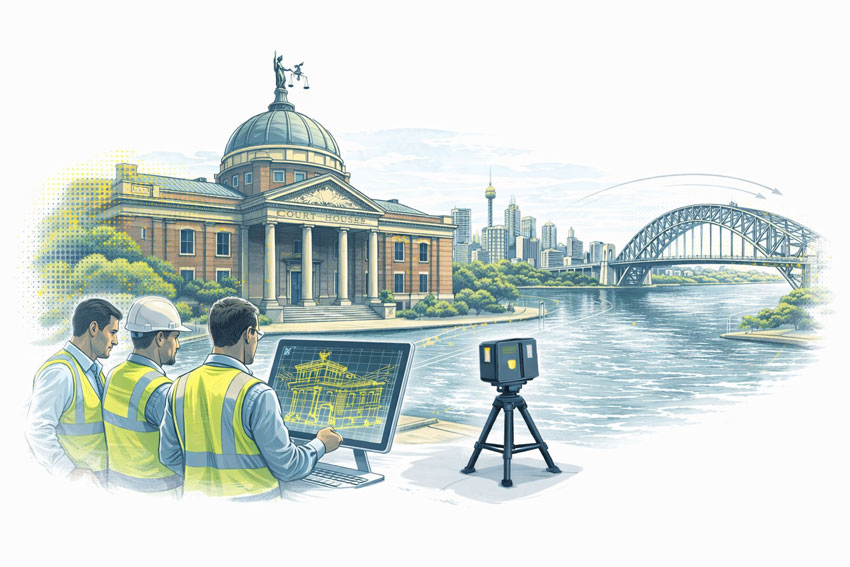
Engineers reviewing BIM documentation while a LiDAR scanner captures a Sydney courthouse with Sydney Harbour and the Harbour Bridge in the background

Sydney Doesnโ€™t Need More Data. It Needs Better Control.

Many projects already collect data.

What they lack is:

  • Structured control
  • Digital discipline
  • Lifecycle governance
  • Clear ownership

3D scanning with engineering governance delivers:

โ€ข A verified existing-conditions model
โ€ข Controlled drawing environments
โ€ข Reduced variation exposure
โ€ข Fewer RFIs
โ€ข Reduced fabrication error
โ€ข Improved contractor coordination


Who Benefits?

  • Industrial facility owners
  • Mining support infrastructure
  • Commercial refurbishments
  • Distribution centres
  • Brownfield automation upgrades
  • Engineering consultancies

If youโ€™re operating in Sydney, where labour is expensive and tolerance for error is low, governance-backed scanning is not optional โ€” itโ€™s strategic.


Hamilton By Design โ€“ Engineering-First Approach

At Hamilton By Design, we donโ€™t just scan.

We:

  • Capture high-accuracy reality data
  • Structure and govern the digital environment
  • Support drawing control and revision management
  • Align engineering documentation with delivery

Because scanning without governance is just a point cloud.

Governed scanning becomes a competitive advantage.


Hamilton By Design logo displayed on a blue tilted rectangle with a grey gradient background

If youโ€™re planning upgrades, expansions, or refurbishment in Sydney โ€”

protect your capital before fabrication begins.

Rework is expensive.

Governed reality capture is predictable.


Name
Would you like us to arrange a phone consultation for you?
Address
3D Scanning Sydney banner promoting engineering-grade 3D laser scanning, LiDAR scanning, and reality capture services by Hamilton By Design.
Mechanical Engineering Sydney banner with white text on a blue background representing Hamilton By Design's mechanical engineering services in Sydney.
Mechanical Drafting and 3D Modelling Sydney banner highlighting Hamilton By Design's CAD drafting, 3D modelling, and engineering design services in Sydney.

Mechanical Engineering | Structural Engineering


Hamilton By Design provides engineering-led 3D scanning, LiDAR scanning, mechanical engineering and digital engineering services throughout Sydney and Greater Sydney.

Explore our related Sydney services:


  • 3D Scanning Sydney โ€“ Engineering-grade terrestrial laser scanning, as-built surveys and point cloud capture for industrial, infrastructure and commercial projects.
  • Reality Capture Sydney โ€“ High-accuracy reality capture, digital twins, asset documentation and engineering-grade site verification.
  • Scan to CAD Sydney โ€“ Convert point cloud data into AutoCAD, SolidWorks, Inventor and other engineering-ready CAD deliverables.
  • Point Cloud Modelling Sydney โ€“ Engineering-grade point cloud processing, clash detection, as-built verification and 3D modelling.
  • Mechanical Engineering Sydney โ€“ Mechanical design, plant upgrades, materials handling systems, conveyors, chutes, platforms and engineering support.
  • Structural Drafting Sydney โ€“ Structural steel drafting, fabrication drawings, GA drawings, workshop detailing and as-built documentation.

Hamilton By Design supports projects throughout Sydney CBD, Parramatta, Liverpool, Penrith, Blacktown, Chatswood, Alexandria, Mascot, Newcastle and the Central Coast.


3D CAD Modelling Australia service banner for Hamilton By Design
Finite Element Analysis (FEA) engineering simulation button
Mechanical engineering services
3D LiDAR Scanning Darwin for engineering surveys, laser scanning, reality capture and point cloud modelling services
3D LiDAR Scanning Australia engineering services for laser scanning, reality capture, scan-to-CAD, Scan-to-BIM and as-built documentation across Australia
3D LiDAR scanning services on the Central Coast providing engineering-grade laser scanning, point cloud capture, scan-to-CAD modelling and industrial reality capture for infrastructure and industrial projects.

Brownfield Upgrades & Shutdowns

Engineering-grade LiDAR scanning of a dragline at a Hunter Valley mine producing CAD-ready data for SolidWorks and Autodesk Inventor

Brownfield Industrial Upgrades & Shutdown Engineering | Engineering-Led 3D Scanning

Engineering-Led Design, Reality Capture, and Scan-to-CAD for Existing Assets

Brownfield industrial upgrades are where engineering risk is highest โ€” and where assumptions cost the most.

Existing plant, undocumented modifications, restricted access, and shutdown-driven timeframes demand accurate site data, practical engineering judgement, and build-ready design. At Hamilton By Design, we support brownfield upgrades through an engineering-led digital workflow that connects reality capture, scan-to-CAD, and mechanical design to deliver safer, more reliable shutdown outcomes.


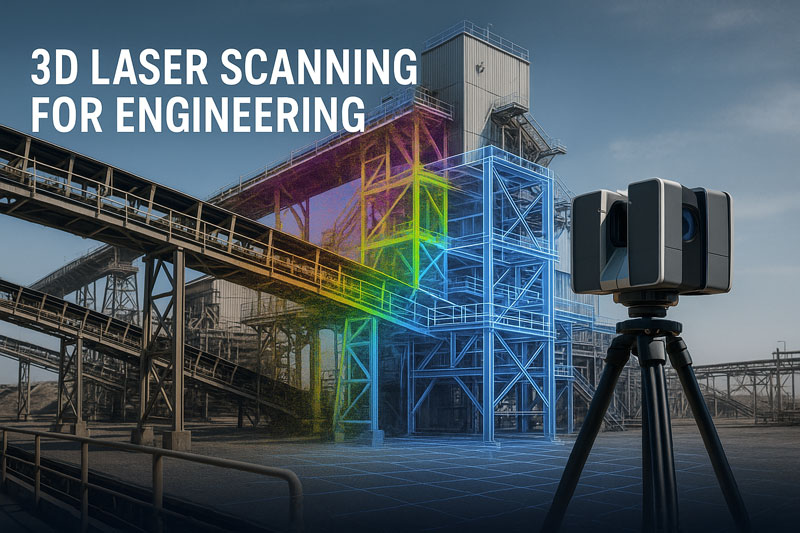
A 3D laser scanner on a tripod capturing an industrial plant structure, with a colourful point cloud and blue CAD wireframe overlay illustrating engineering-grade 3D laser scanning accuracy.

What Defines a Brownfield Upgrade?

A brownfield upgrade involves modifying, extending, or replacing existing operational assets, often under live plant or shutdown constraints.

Typical challenges include:

  • Incomplete or outdated drawings
  • Limited physical access for verification
  • Interfaces with existing structures and services
  • Shutdown windows measured in days, not weeks

These conditions make engineering-led verification essential before design and fabrication begin.


Engineering-Led Reality Capture for Existing Plant

Hamilton By Design uses engineering-grade 3D LiDAR scanning to capture existing conditions accurately, even in complex and congested environments.

This approach allows engineering teams to:

  • Verify as-built conditions without repeated site access
  • Identify clashes and interferences early
  • Design upgrades that fit first time
  • Reduce exposure hours in live plant environments

Reality capture becomes a risk-reduction tool, not just a documentation exercise.


Typical Brownfield Assets We Support

Brownfield upgrades frequently focus on high-wear, high-risk interfaces within industrial and mining facilities.

Hoppers & Chutes

  • ROM hoppers and surge bins
  • Transfer chutes and discharge transitions
  • Wear-prone interfaces and liners

Conveyors & Transfer Stations

  • Conveyor head and tail stations
  • Transfer points and discharge zones
  • Supporting steelwork and access structures

Pump Boxes & Process Interfaces

  • Pump boxes, sumps, and pipe interfaces
  • Structural supports and maintenance access
  • Integration with existing plant services

Vertical Shaft & Drop Structures

  • Vertical shaft hoppers
  • Ore passes and gravity-fed transfers
  • Confined and difficult-to-access assets

These assets are rarely isolated โ€” they sit within tightly constrained systems where accuracy matters.


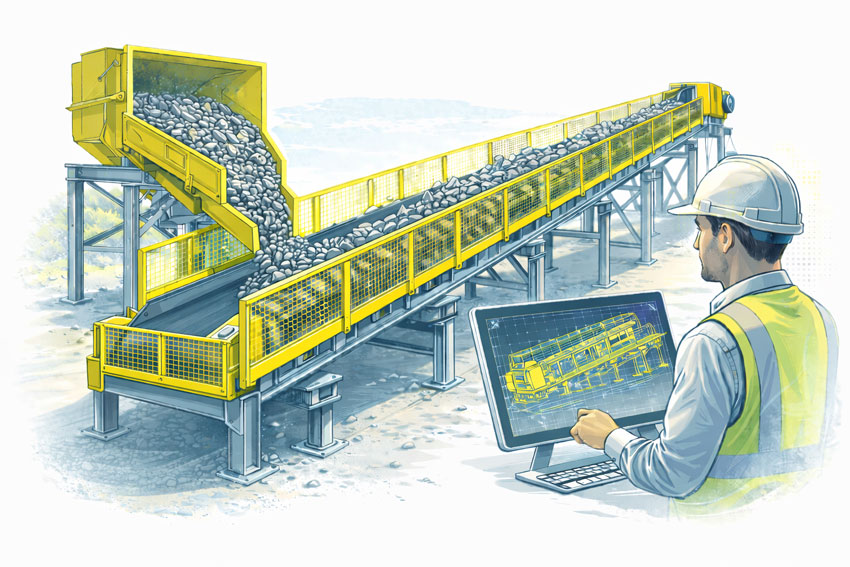
Bulk materials conveyor with compliant safety guarding at the hopper, tail end, and along the conveyor, shown with an engineer reviewing guarding design drawings.

Scan-to-CAD: Turning Reality Into Buildable Design

Point clouds alone donโ€™t deliver projects โ€” engineering-intent models do.

Our scan-to-CAD workflows are developed specifically for:

  • Mechanical and structural design
  • Fabrication-ready detailing
  • Brownfield integration and installation sequencing

By aligning LiDAR data directly with CAD and engineering workflows, we eliminate guesswork and support fit-first-time fabrication.


Reliable Support for Shutdown-Driven Projects

Shutdowns compress months of work into days. There is no tolerance for redesign on site.

Engineering-led reality capture supports shutdown success by:

  • Allowing design to be completed well in advance
  • Supporting off-site fabrication
  • Reducing RFIs and site queries
  • Increasing the amount of work completed per shutdown

Better information means more work done with fewer resources.


Safety Is an Engineering Outcome

Safety outcomes in brownfield environments are determined during planning and design, not during installation.

Accurate site data allows engineers to:

  • Design safer access and maintenance solutions
  • Reduce hot works and re-measurement on site
  • Identify hazards before shutdown execution
  • Improve compliance with Australian Standards

Engineering-led workflows reduce risk across the entire upgrade lifecycle.


Australian Engineering Quality You Can Rely On

Hamilton By Design delivers Australian engineering know-how, grounded in practical site experience.

We donโ€™t just capture data โ€” we:

  • Understand how plant is built and maintained
  • Design with fabrication and installation in mind
  • Take responsibility for engineering outcomes

This approach differentiates us from low-cost capture services that transfer risk downstream.


How This Integrates With Our Engineering Services

Brownfield upgrade support integrates directly with our broader capabilities, including:

  • Bulk material handling engineering
  • Mining and heavy-industry mechanical design
  • Engineering-led 3D scanning and scan-to-CAD workflows

This ensures continuity from site verification through to build-ready deliverables.


Hamilton By Design logo displayed on a blue tilted rectangle with a grey gradient background

3D LiDAR scanning and 3D modelling service button โ€” laser scanner capturing a point cloud for engineering and CAD modelling
Mechanical engineering services

Speak With an Engineer

If youโ€™re planning a brownfield upgrade involving:

  • Hoppers, chutes, or bins
  • Conveyor transfers
  • Pump boxes or process interfaces
  • Vertical shaft or gravity-fed systems
  • Shutdown-critical works

Early engineering-led verification can significantly reduce risk.

Speak with an engineer at Hamilton By Design to discuss your upgrade or shutdown requirements.

Name
Would you like us to arrange a phone consultation for you?
Address

Our clients:


Finite Element Analysis (FEA) engineering simulation button
Mechanical engineering services

3D Laser Scanning in Parramatta: Engineering-Grade Data for Safer Conveyor Systems and Better Risk Management

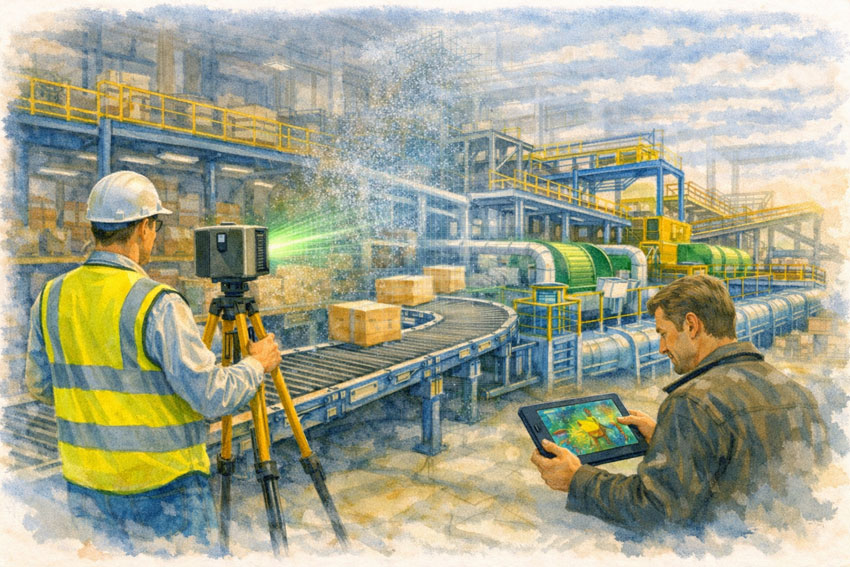
Watercolour illustration of engineers 3D laser scanning a warehouse conveyor system.

In consumer goods manufacturing, distribution centres and logistics facilities around Parramatta and Western Sydney, conveyor systems are mission-critical. Whether moving pallets, cartons, bottles, or bulk packaged goods, these systems must integrate with structural steel, mechanical equipment and building services without compromise.

Yet many existing facilities are built from legacy drawings, partial records or hand-measured surveys. This creates risk when planning upgrades, expansions or tie-ins โ€” especially where conveyors interface with mezzanines, sortation systems, robotics and utilities.

3D laser scanning provides a precise and reliable basis for understanding whatโ€™s actually on site before detailed engineering or shutdown activities begin.


Why Scan First? Engineering-Grade Reality Is the Backbone of Success

A good conveyor design solution depends on accurate understanding of:

  • where conveyors really sit in 3D space
  • how structural beams, columns and supports interact
  • exact locations of mechanical equipment
  • existing pipework, ducts and cable trays
  • access clearances for maintenance and shutdown execution

Traditional tape measures and manual field sketches are slow, error-prone and not suitable for complex conveyor networks. In contrast, 3D laser scanning captures millions of points in minutes and produces engineering-grade point clouds that reflect every surface, pipe, beam and conveyor geometry exactly as it exists.

This scan becomes the backbone of your engineering workflow โ€” a verified digital reference that informs design, reduces risk and underpins safe execution.


3D scanning of FMCG conveyor line shown in soft watercolour style.

From Reality Capture to Practical Engineering Outputs

A registered 3D point cloud delivers value throughout the project lifecycle. Typical deliverables include:

  • Full as-built point clouds: a complete digital record of existing conditions
  • Clash analysis models: identify conflicts between conveyors, structures and services
  • Fabrication-ready geometry: for skid frames, guards, support steel and pipe spools
  • DXF/STEP/Parasolid exports: for mechanical and structural drafting
  • Compatibility with Revit, AutoCAD, Navisworks: for design coordination

The result? Engineers spend more time solving real problems and less time correcting assumptions.


Designing for Safer Conveyor Integration

Upgrading or modifying conveyor systems in FMCG and logistics environments often involves:

  • adding sortation or scanning stations
  • rerouting belt paths to accommodate new equipment
  • expanding mezzanines or catwalks
  • integrating with automated storage and retrieval systems
  • adjusting utilities like compressed air, water or power services
  • installing guarding and safety infrastructure

Each of these tasks intersects with steelwork, services and building elements. Using 3D scan data for design coordination enables:

โœ” accurate spatial modelling
โœ” reduced field rework
โœ” clearer installation instructions
โœ” fewer late changes during shutdowns

This translates directly to lower cost, higher safety and greater schedule confidence.


Better Risk Management Through Verified Data

Conveyor upgrades and expansions are typically scheduled during short shutdown windows. Risk drivers commonly include:

  • uncertainty about existing conditions
  • interference with critical services
  • tight clearances that limit access
  • unexpected clashes on installation
  • insufficient documentation for permits or safety reviews

With scan-derived data, these risks are mitigated early. Design teams can model scenarios before fabrication, check for clashes electronically and articulate installation sequences with confidence.

This isnโ€™t just better practice โ€” itโ€™s good risk management.


As-Built Scanning for Handover Confidence

At project completion, a final 3D laser scan provides an accurate digital as-built model of the upgraded systems. This has several benefits:

  • avoids tape measure as-builts
  • records exact installation geometry
  • supports maintenance planning
  • provides a robust platform for future works
  • becomes an asset for ongoing risk assessments

The organisation receives not just installed equipment, but a verified digital twin for operations and design.


Applications Around Parramatta & Western Sydney

3D laser scanning is highly effective in these local industries:

โœ” FMCG production facilities
โœ” Beverage and food processing plants
โœ” Automated distribution centres
โœ” Parcel sortation hubs
โœ” Packaging and assembly lines
โœ” Warehouse conveyor networks
โœ” Industrial plant upgrades

Across these environments, conveyors are fundamental to throughput โ€” and accurate data is fundamental to success.


Hamilton By Design logo displayed on a blue tilted rectangle with a grey gradient background

3D LiDAR scanning and 3D modelling service button โ€” laser scanner capturing a point cloud for engineering and CAD modelling
Mechanical engineering services

Unlock Better Project Outcomes with 3D Scanning

A robust reality capture strategy delivers measurable improvements to:

  • safety protocols
  • design accuracy
  • fabrication efficiency
  • shutdown predictability
  • project cost control

In an industrial region like Parramatta โ€” where competitiveness depends on efficiency and certainty โ€” laser scanning is not just technology, itโ€™s a strategic engineering enabler.


Ready to Elevate Your Conveyor Project?

If youโ€™re planning a conveyor upgrade, system extension, or facility modification in the Parramatta or Western Sydney region, start with accurate reality capture.

Hamilton By Design Co. provides tailored 3D laser scanning services that support safer, more reliable, and more successful industrial outcomes.

Scan first.
Design with confidence.
Finish with a verified as-built.

Name
Would you like us to arrange a phone consultation for you?
Address

Hamilton By Design provides engineering-led 3D scanning, LiDAR scanning, mechanical engineering and digital engineering services throughout Sydney and Greater Sydney.

Explore our related Sydney services:


  • 3D Scanning Sydney โ€“ Engineering-grade terrestrial laser scanning, as-built surveys and point cloud capture for industrial, infrastructure and commercial projects.
  • Reality Capture Sydney โ€“ High-accuracy reality capture, digital twins, asset documentation and engineering-grade site verification.
  • Scan to CAD Sydney โ€“ Convert point cloud data into AutoCAD, SolidWorks, Inventor and other engineering-ready CAD deliverables.
  • Point Cloud Modelling Sydney โ€“ Engineering-grade point cloud processing, clash detection, as-built verification and 3D modelling.
  • Mechanical Engineering Sydney โ€“ Mechanical design, plant upgrades, materials handling systems, conveyors, chutes, platforms and engineering support.
  • Structural Drafting Sydney โ€“ Structural steel drafting, fabrication drawings, GA drawings, workshop detailing and as-built documentation.

Hamilton By Design supports projects throughout Sydney CBD, Parramatta, Liverpool, Penrith, Blacktown, Chatswood, Alexandria, Mascot, Newcastle and the Central Coast.


Finite Element Analysis (FEA) engineering simulation button
Mechanical engineering services

Mechanical Engineering | Structural Engineering


3D Laser Scanning in Rockhampton QLD: Engineering-Grade Data for Safer Conveyor Design and Risk Management

Engineering-led SolidWorks drafting in Australia with 25 years of Hamilton By Design experience

3D Laser Scanning in Rockhampton QLD for Safer Conveyor Design & Risk Management

Rockhampton plays a critical role in Central Queenslandโ€™s heavy industry, supporting mining, bulk materials handling, agriculture, and transport infrastructure. Across these sectors, conveyor systems are essential โ€” and they are also one of the highest-risk assets on site.

As facilities age and production demands increase, many operators are upgrading or modifying conveyors within tight shutdown windows. In these environments, engineering-grade 3D laser scanning (LiDAR) is becoming a key tool for reducing design risk, improving safety outcomes, and avoiding costly site rework.

At Hamilton By Design, we use high-accuracy 3D scanning to capture existing plant conditions and convert them into reliable engineering models that support safer conveyor design and more effective risk management.

Conveyor Systems and Industry Incidents: Where Things Go Wrong

Industry incident investigations across Queensland repeatedly identify similar contributing factors in conveyor-related injuries:

  • Inadequate guarding at transfer points and pulleys
  • Restricted access forcing unsafe maintenance practices
  • Plant modifications made without updated drawings
  • Design reviews based on outdated or incomplete site data

In regional facilities around Rockhampton, conveyors are often extended, repaired, and repurposed over many years. What starts as a temporary modification can become permanent, and original drawings no longer reflect reality on the ground.

When new upgrades are designed using assumptions instead of accurate geometry, risk is built into the project from day one.


Bulk materials conveyor with compliant safety guarding at the hopper, tail end, and along the conveyor, shown with an engineer reviewing guarding design drawings.

Why Engineering-Grade Scanning Matters for Conveyor Design

Not all 3D scans are suitable for mechanical design or safety-critical decisions.

We use engineering-grade LiDAR scanning capable of delivering accuracy in the order of ยฑ2 mm over 70 metres, allowing engineers to:

  • Model conveyor structures, frames, and supports
  • Accurately locate rollers, drives, guards, and transfer chutes
  • Verify clearances for new equipment and walkways
  • Identify clashes before fabrication and installation

The resulting point clouds and CAD models form a reliable digital baseline that engineers, safety teams, and maintenance planners can all work from.

When plant modifications are driven by accurate data, both design quality and safety outcomes improve.

Safe Design Starts with Knowing What Actually Exists

Safe Design is not something that can be retrofitted easily once steel is fabricated and installed.

Scan-based models allow hazards to be assessed during the design phase, including:

  • Access and egress routes for maintenance
  • Reach distances and pinch point exposure
  • Guarding coverage around rotating equipment
  • Space constraints that may encourage unsafe shortcuts

This is particularly important in conveyor corridors where multiple services, structures, and walkways compete for limited space.

Designing from accurate site geometry allows risks to be eliminated or reduced before they reach the worksite.


Risk Management Through Reality Capture

From a risk management perspective, 3D scanning supports more than just design accuracy. It also improves:

  • Hazard identification and risk assessments
  • Method statements and installation planning
  • Shutdown coordination and contractor interfaces
  • Compliance documentation and audit trails

Point cloud data also provides a permanent record of asset condition at a point in time, which can be invaluable for:

  • Future upgrade planning
  • Incident investigations
  • Asset integrity assessments

In high-risk conveyor environments, reliable data is a control measure in its own right.

Supporting Rockhampton Industry with Integrated Engineering Services

Hamilton By Design provides on-site 3D scanning and mechanical engineering support for projects in Rockhampton and Central Queensland, including:

  • Conveyor upgrades and replacements
  • Transfer point redesigns
  • Guarding and access improvements
  • Brownfield plant modifications
  • Fabrication and installation planning

Because we are an engineering-led team, scanning is directly integrated into mechanical design, drafting, and fabrication support โ€” not treated as a standalone survey service.

This ensures models are built to suit engineering workflows and deliver practical, buildable outcomes.


Hamilton By Design logo displayed on a blue tilted rectangle with a grey gradient background

3D LiDAR scanning and 3D modelling service button โ€” laser scanner capturing a point cloud for engineering and CAD modelling
Mechanical engineering services

From Point Cloud to Practical Results

Our typical workflow includes:

  1. On-site LiDAR scanning with minimal operational disruption
  2. Registration and processing of point cloud data
  3. Conversion into CAD models suitable for mechanical design
  4. Design development, safety reviews, and shop drawings

This approach reduces shutdown risk, improves installation accuracy, and helps ensure safety improvements are achieved in practice โ€” not just on paper.

Name
Would you like us to arrange a phone consultation for you?
Address
3D LiDAR scanning and 3D modelling service button โ€” laser scanner capturing a point cloud for engineering and CAD modelling
Mechanical engineering services
Finite Element Analysis (FEA) engineering simulation button
Mechanical engineering services