Port of Brisbane Engineering & 3D Laser Scanning

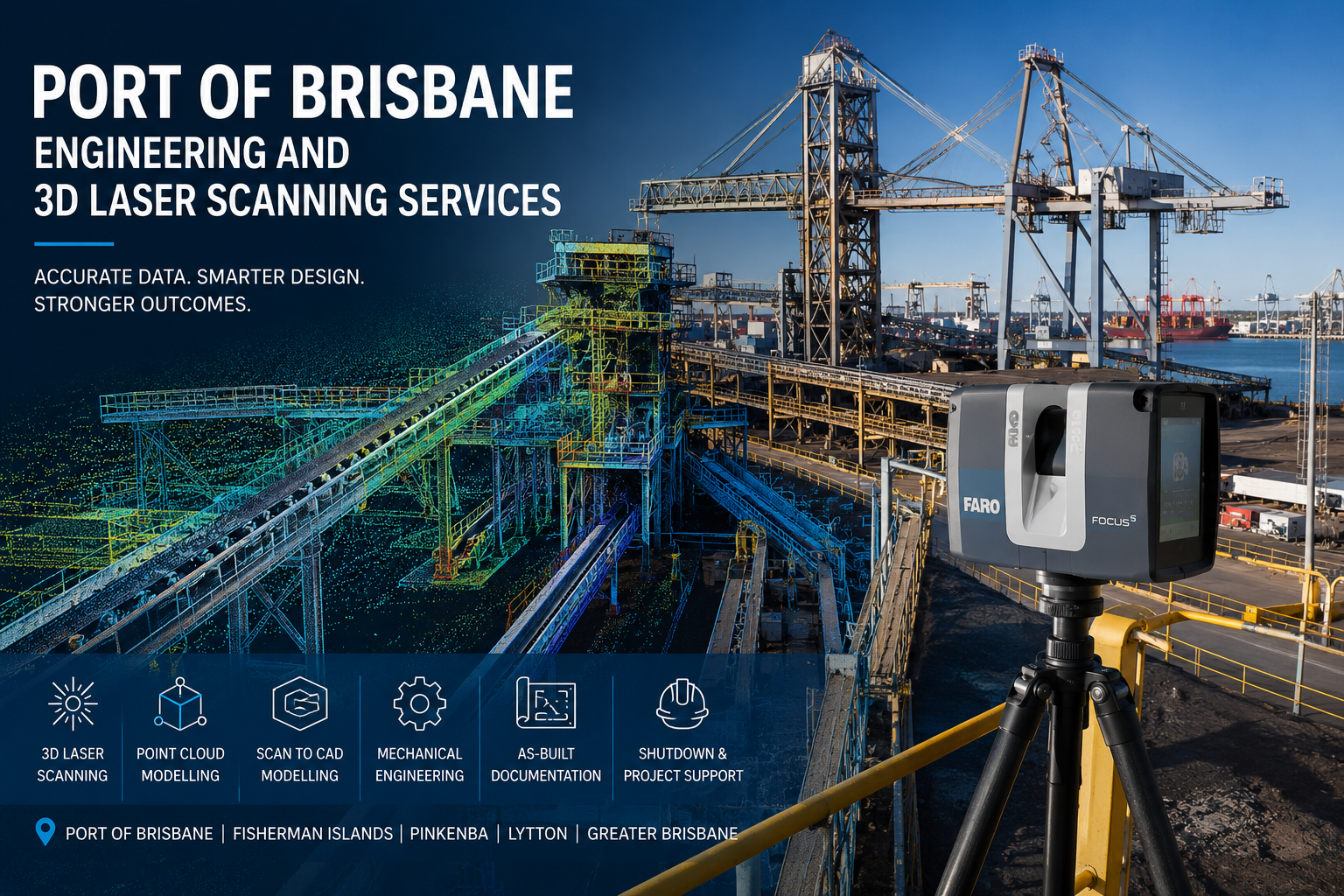
Port of Brisbane container terminal and bulk-handling infrastructure being captured with a FARO 3D laser scanner and coloured point-cloud overlay.

Port of Brisbane Engineering and 3D Laser Scanning Services

Engineer-Led LiDAR Scanning, Mechanical Design and As-Built Documentation for Brisbane Port Facilities

The Port of Brisbane is a major multi-cargo port supporting container handling, general cargo, motor vehicles, roll-on/roll-off operations, bulk commodities, warehousing and associated logistics activities. Its terminals and industrial precincts contain a complex mix of wharves, cranes, conveyors, storage systems, buildings, roads and mechanical infrastructure.

Hamilton By Design provides engineering and 3D laser scanning services for projects at and around the Port of Brisbane, Fisherman Islands, Pinkenba, Lytton and surrounding Brisbane industrial areas.

Our services combine engineering-grade LiDAR scanning with mechanical engineering, point-cloud processing, reverse engineering, 3D CAD modelling and fabrication-ready drafting.

This integrated approach allows port operators, terminal operators, engineering consultants, maintenance teams, contractors and fabricators to work from reliable existing-condition information rather than incomplete drawings or manually measured approximations.

Accurate site capture, engineering-ready point clouds and practical design documentation for complex port and industrial environments.


Engineering Services for Port of Brisbane Projects

Port facilities are continually maintained, upgraded and modified. Original drawings may no longer accurately represent what is physically installed because of previous repairs, plant modifications, equipment replacements and undocumented site changes.

Traditional measurement can also be difficult where equipment is:

  • Large or geometrically complex
  • Installed above conveyors or operating machinery
  • Surrounded by structural steel, services or pipework
  • Close to wharves or exposed water edges
  • Located within active vehicle or cargo-handling areas
  • Accessible only during a planned shutdown
  • Difficult to measure safely using tapes and hand tools

Our 3D scanning services in Brisbane capture millions of spatial measurements from multiple scanner positions to create a detailed three-dimensional record of the facility.

The resulting point cloud can support engineering, design, verification, fabrication, construction planning and maintenance without relying solely on repeated site measurements.


Port of Brisbane 3D Laser Scanning

Hamilton By Design uses terrestrial LiDAR scanning to document the visible geometry of port infrastructure, industrial equipment and surrounding structures.

Our broader Brisbane 3D scanning service can be applied to projects involving:

  • Container-terminal infrastructure
  • General-cargo facilities
  • Bulk-material handling systems
  • Conveyor systems
  • Transfer stations
  • Hoppers and bins
  • Chutes and wear liners
  • Wharves and berths
  • Crane rails and support structures
  • Loading and unloading equipment
  • Maintenance platforms
  • Stairs and handrails
  • Pipework and mechanical services
  • Warehouses and workshops
  • Equipment foundations
  • Roads, hardstands and vehicle clearances
  • Marine and waterfront infrastructure

The captured point cloud provides a measurable digital representation of the existing area. Engineers, designers and project personnel can navigate the dataset, extract measurements and review spatial relationships after the site visit.

For projects requiring engineering or fabrication decisions, our approach is based on collecting the right information for the intended purposeโ€”not simply creating the largest possible point cloud. This principle is explained further in Not All Scans, Point Clouds or Meshes Are Equal.


Existing-Condition and As-Built Documentation

Accurate existing-condition information is particularly important when new equipment must connect to older port infrastructure.

Hamilton By Design can use registered scan data to prepare:

  • Existing-condition plans
  • General arrangement drawings
  • Floor plans
  • Sections and elevations
  • Structural-steel layouts
  • Equipment-location drawings
  • Pipe and service layouts
  • Interface drawings
  • Clearance envelopes
  • Dimensional verification drawings
  • Three-dimensional as-built models

Our engineering-grade 3D point-cloud scanning service in Brisbane can help verify existing geometry, identify spatial constraints and create an accurate foundation for proposed modifications.


Scan-to-CAD Modelling

A registered point cloud contains valuable measurement information, but many engineering projects also require usable CAD geometry.

Hamilton By Design can convert selected point-cloud information into models representing:

  • Structural steel
  • Mechanical equipment
  • Conveyor assemblies
  • Chutes and transfer stations
  • Platforms and access systems
  • Pipework and services
  • Machinery guards
  • Buildings and industrial rooms
  • Equipment foundations
  • Proposed replacement components

Depending on the project requirements, deliverables may include:

  • SolidWorks models
  • Autodesk Inventor models
  • AutoCAD drawings
  • STEP files
  • SAT files
  • Parasolid files
  • DWG files
  • DXF files
  • Navisworks-compatible coordination models
  • Registered E57 point clouds
  • Autodesk RCP or RCS files
  • LAS point-cloud files

The level of modelling can be matched to the intended project outcome, whether the client requires general spatial coordination, detailed reverse engineering or fabrication documentation.


Mechanical Engineering for Port Infrastructure

Hamilton By Design provides mechanical-engineering support for port, logistics, industrial and materials-handling projects.

Our services can include:

  • Existing-equipment assessments
  • Engineering studies
  • Concept and feasibility development
  • Mechanical arrangement design
  • Conveyor modifications
  • Transfer-chute design
  • Hopper and bin modifications
  • Machine-guarding design
  • Maintenance-access improvements
  • Equipment replacement planning
  • Platforms, stairs and handrails
  • Structural-support concepts
  • Reverse engineering
  • Wear and erosion assessments
  • Design verification
  • Fabrication drawings
  • Installation planning
  • Shutdown planning

Our wider engineering studies and assessments can be combined with LiDAR data to establish the existing condition of an asset before a design or maintenance decision is made.

The principal advantage of integrating engineering and scanning is that proposed designs can be developed directly around verified site geometry.


Conveyor and Bulk-Materials-Handling Projects

Port facilities may include extensive conveyor, loading, storage and transfer infrastructure. These systems frequently contain worn components, irregular geometry, restricted access and modifications that are not shown on the original drawings.

LiDAR scanning can capture:

  • Conveyor stringers
  • Conveyor gantries
  • Head and tail pulley arrangements
  • Drive stations
  • Transfer towers
  • Chutes
  • Hoppers
  • Bins
  • Wear liners
  • Walkways
  • Maintenance platforms
  • Support frames
  • Adjacent pipework
  • Electrical services
  • Access restrictions

The resulting point cloud can support the design of replacement equipment and help determine how proposed components will interface with the surrounding plant.

This is especially valuable where shutdown time is limited and equipment must be designed and fabricated before the existing assembly is removed.

Our approach to establishing a reliable digital baseline for mechanical, structural and piping work is also described in 3D Laser Scanning for SMP Project Delivery.


Wharf, Berth and Marine Infrastructure Scanning

Port projects may involve a combination of mechanical, structural, civil and marine infrastructure.

Three-dimensional laser scanning may assist with:

  • Wharf-access structures
  • Loading and unloading equipment
  • Fender-support arrangements
  • Mooring infrastructure
  • Gangways
  • Access platforms
  • Crane-support structures
  • Pipe bridges
  • Marine-loading equipment
  • Equipment foundations
  • Structural-steel verification
  • Service connections
  • Clearance studies

Terrestrial LiDAR can document visible above-water geometry from safe and accessible scanner positions.

Where below-water geometry is required, terrestrial laser scanning may need to be coordinated with hydrographic, bathymetric or specialist subsea-survey methods.


Crane and Heavy-Equipment Scanning

Port cranes and heavy mechanical equipment can be difficult to measure using conventional site techniques.

LiDAR scanning may support:

  • Crane-rail assessments
  • Existing-geometry verification
  • Equipment-envelope studies
  • Structural-member location
  • Access-platform modifications
  • Replacement-machinery planning
  • Guarding design
  • Exclusion-zone planning
  • Maintenance-clearance assessment
  • Clash detection
  • Installation-path planning

A coordinated point cloud can show the relationship between the crane or mechanical equipment and the surrounding wharf, structural steel, services, access areas and operating environment.

Where formal rail alignment, deformation, settlement or high-precision tolerance reporting is required, the laser-scanning work may need to be supplemented by specialist survey control or metrology.


Reverse Engineering of Existing Port Equipment

Original drawings are not always available for older port equipment. Existing drawings may also be inaccurate because the machinery has been repaired or modified during its operating life.

Hamilton By Design can use laser scanning, direct measurements and 3D CAD modelling to reverse engineer:

  • Chutes
  • Hoppers
  • Machinery guards
  • Covers
  • Frames
  • Brackets
  • Platforms
  • Ducting
  • Pipe supports
  • Access structures
  • Wear liners
  • Replacement structural assemblies
  • Mechanical components

The resulting CAD model can form the basis for design review, equipment modification and the preparation of fabrication drawings.

Where components contain fine tolerances or small features, LiDAR data may be supplemented with direct measurement, close-range scanning, photogrammetry or specialist metrology.


Brownfield Port Upgrades

Brownfield projects are challenging because new equipment must often fit within an operating facility containing existing structures, services and machinery.

A scan-based project workflow can involve:

  1. Capturing the existing area before detailed design begins
  2. Registering the individual scans into a coordinated point cloud
  3. Identifying relevant interfaces and surrounding obstructions
  4. Creating a model of the proposed equipment
  5. Positioning the proposed design within the point cloud
  6. Reviewing access, clearances and possible clashes
  7. Preparing drawings around verified site geometry
  8. Supporting off-site fabrication
  9. Reviewing installation conditions before mobilisation

This approach can reduce the likelihood of replacement equipment arriving on site and failing to fit the existing interfaces.


Shutdown Planning

Port shutdowns and operational interruptions can be expensive and tightly controlled.

Incomplete drawings, missing dimensions and unexpected obstructions can delay demolition, fabrication or installation activities.

Pre-shutdown laser scanning can assist project teams with:

  • Confirming equipment interfaces
  • Planning demolition boundaries
  • Locating structural members
  • Checking available lifting space
  • Reviewing crane access
  • Planning removal routes
  • Planning installation routes
  • Coordinating temporary works
  • Identifying potential service clashes
  • Verifying replacement-component dimensions
  • Developing contractor work packs
  • Reviewing maintenance access

Project personnel can use the registered point cloud to become familiar with the work area before the shutdown begins.

A detailed digital record can also support future engineering studies and asset assessments after the immediate project has been completed.


Clash Detection and Constructability Review

New equipment can be modelled within the existing-condition point cloud to check how it relates to surrounding infrastructure.

Potential clashes may involve:

  • Structural steel
  • Conveyor frames
  • Pipework
  • Cable trays
  • Electrical equipment
  • Handrails
  • Access platforms
  • Existing machinery
  • Building elements
  • Vehicle envelopes
  • Maintenance-removal zones

Clash detection does not replace formal engineering review. However, it can identify obvious spatial conflicts while the proposed design can still be adjusted economically.

Our Brisbane structural drafting and 3D scanning services can also support projects where structural arrangements must be developed around the verified existing environment.


Machine Guarding and Safe Access

Port and materials-handling equipment may require new or upgraded guarding around conveyors, drives, pulleys, shafts, couplings and other moving components.

Laser scanning can help establish:

  • Existing machinery geometry
  • Hazard locations
  • Available mounting positions
  • Access requirements
  • Maintenance-removal zones
  • Guard clearances
  • Structural attachment points
  • Relationships with platforms and walkways

Hamilton By Design can then develop machine-guarding concepts and fabrication drawings appropriate to the identified machinery and project requirements.

The final design must be assessed against the legislation, standards, site rules and risk controls applicable to the particular facility and item of equipment.


Platforms, Stairs, Walkways and Handrails

Port and terminal facilities frequently require access improvements to support operation, inspection and maintenance.

Hamilton By Design can assist with the scanning and design of:

  • Maintenance platforms
  • Conveyor walkways
  • Access stairs
  • Step-over platforms
  • Crossovers
  • Handrails
  • Guardrails
  • Access ladders
  • Equipment-support frames
  • Removable access sections

Capturing the surrounding area helps ensure that the proposed access system accounts for existing machinery, operating clearances and maintenance requirements.


Wear and Erosion Studies

Chutes, hoppers, transfer points and other materials-handling equipment are subject to progressive wear and erosion.

Periodic scanning may help engineering and maintenance teams:

  • Establish a baseline geometry
  • Compare an asset at different points in time
  • Identify visible geometric changes
  • Locate concentrated wear areas
  • Quantify material loss where suitable data is available
  • Plan liner replacement
  • Prioritise maintenance
  • Create replacement geometry
  • Develop a digital condition record

Hamilton By Designโ€™s wear and erosion studies can combine site observations, engineering assessment and digital measurement to support maintenance and refurbishment decisions.

Repeat scans should be collected using a controlled methodology where meaningful comparison between datasets is required.


Typical Port of Brisbane Projects

Hamilton By Design can assist with projects involving:

  • Container-terminal upgrades
  • Conveyor modifications
  • Transfer-chute replacement
  • Bulk-material handling equipment
  • Wharf-access improvements
  • Crane infrastructure
  • Crane rails and support structures
  • Maintenance platforms
  • Machine guarding
  • Warehouse alterations
  • Pipework modifications
  • Equipment relocation
  • Fabrication verification
  • Structural-steel detailing
  • As-built documentation
  • Shutdown planning
  • Reverse engineering
  • Asset-condition capture
  • Equipment-interface verification
  • Installation planning
  • Lift and access planning

Our Engineering and Scanning Workflow

1. Define the Project Requirements

We review the asset, required scan coverage, access conditions, site restrictions, accuracy requirements, final deliverables and intended engineering use of the information.

2. Plan the Site Capture

The scanning methodology is developed around site inductions, work permits, exclusion zones, operating equipment, vehicle movements, water-edge risks and access limitations.

3. Complete the On-Site Scanning

Multiple scanner positions are used to capture the equipment and surrounding environment.

Critical dimensions or important interfaces can also be independently checked where required.

4. Register the Point Cloud

The individual scans are aligned into a coordinated three-dimensional dataset and reviewed for coverage and registration quality.

5. Conduct the Engineering Review

The registered point cloud is examined to identify important interfaces, clearances, obstructions and areas that may require further investigation.

6. Prepare CAD Models and Drawings

Selected geometry is converted into the required CAD models, general arrangements, sections, details or fabrication drawings.

7. Coordinate the Proposed Design

Proposed equipment can be positioned within the point cloud to support clash detection, access assessment and constructability review.

8. Deliver the Project Information

The final information is supplied in the agreed point-cloud, CAD, drawing or report formats.


Why Choose Hamilton By Design?

Engineer-Led Reality Capture

Our scanning work is planned with an understanding of how the captured information will be used for engineering, design, fabrication and installation.

Industrial and Materials-Handling Experience

Our project experience includes conveyors, chutes, hoppers, machine guarding, access structures, mechanical equipment and brownfield plant modifications.

Integrated Project Delivery

Site capture, point-cloud registration, CAD modelling, mechanical engineering and drafting can be delivered through one coordinated workflow.

Reduced Site Reattendance

A comprehensive point cloud allows many measurements and interfaces to be reviewed remotely after the site visit.

Support for Off-Site Fabrication

Fabricators can receive models and drawings developed around captured existing conditions.

Engineering-Ready Information

Our focus is on creating information that engineers, project managers, maintenance teams, contractors and fabricators can use.

Hamilton By Design also provides engineering-grade 3D laser scanning throughout Australia for clients with projects across multiple states or industrial locations.


Port Safety and Site Requirements

Work at an operational port may require:

  • Site-specific inductions
  • Maritime Security Identification Card requirements
  • Work permits
  • Safe work method statements
  • Take 5 or task-risk assessments
  • Working-at-heights controls
  • Water-edge controls
  • Traffic-management arrangements
  • Exclusion zones
  • Personal protective equipment
  • Site escorts
  • Coordination with terminal operations
  • Weather and lighting considerations
  • Tidal or marine-operational considerations

The final scanning methodology will be developed around the access, safety and operational requirements established by the relevant site operator.


Areas Serviced

Hamilton By Design can support port, industrial and infrastructure projects throughout:

  • Port of Brisbane
  • Fisherman Islands
  • Pinkenba
  • Lytton
  • Hemmant
  • Murarrie
  • Wynnum
  • Manly
  • Eagle Farm
  • Brisbane Airport industrial precinct
  • Greater Brisbane
  • South-East Queensland

Our main LiDAR scanning Brisbane service also supports industrial, manufacturing, infrastructure, construction and regional Queensland projects.

Travel can be arranged for port, mining and industrial projects throughout Queensland and other Australian locations.


Frequently Asked Questions

What can be scanned at the Port of Brisbane?

LiDAR can capture visible geometry including conveyors, buildings, platforms, structural steel, pipework, machinery, crane infrastructure, wharf equipment and surrounding industrial areas.

Can scanning be completed while a port facility remains operational?

Scanning can often be completed while surrounding operations continue, provided suitable access, permits, exclusion zones and operating controls are established.

Some equipment may need to be stopped where accurate capture of moving components is required.

How accurate is 3D laser scanning?

Accuracy depends on the scanner, distance, site geometry, surface characteristics, environmental conditions, registration method and required deliverable.

The project accuracy requirements should be established before the scanning methodology is selected.

Can point-cloud information be used in SolidWorks?

Yes. Registered point clouds can be used as references when developing SolidWorks models. Selected equipment and structural geometry can also be converted into usable CAD models.

Can Hamilton By Design produce fabrication drawings?

Yes. Fabrication drawings can be prepared for suitable mechanical and structural assemblies, subject to the agreed engineering scope and required design review.

Can equipment above water be scanned?

Visible above-water infrastructure can generally be captured from safe and accessible scanner positions.

Below-water geometry requires an appropriate hydrographic, bathymetric or subsea-survey method.

Can moving conveyors and machinery be scanned?

Stationary infrastructure surrounding operational equipment can often be captured safely, subject to site controls.

Moving belts, rotating machinery and other moving surfaces may appear incomplete or distorted. The equipment may need to be stopped when accurate component geometry is required.

Can scans from different dates be compared?

Yes. Repeat scan datasets may be compared to identify geometric changes where suitable survey control, coverage, resolution and registration methods have been used.

Can Hamilton By Design provide the registered point cloud without modelling?

Yes. A project can be scoped for site scanning and registered point-cloud delivery only.

Additional services such as scan-to-CAD modelling, engineering assessment and drafting can be included where required.

Is Hamilton By Design affiliated with Port of Brisbane Pty Ltd?

No. Hamilton By Design is an independent engineering and 3D laser scanning service provider.

This page describes services that may be provided for projects located at or around the Port of Brisbane. It does not imply endorsement, appointment, partnership or affiliation with Port of Brisbane Pty Ltd.


Discuss a Port of Brisbane Project

Reliable existing-condition information can reduce uncertainty before design, fabrication and installation begin.

Hamilton By Design can assist with:

  • Engineering-grade 3D laser scanning
  • Registered point-cloud creation
  • Existing-condition documentation
  • Scan-to-CAD modelling
  • Mechanical engineering
  • Reverse engineering
  • Conveyor and chute modifications
  • Machine guarding
  • Platforms and access structures
  • Fabrication drawings
  • Clash detection
  • Brownfield upgrade planning
  • Shutdown engineering support

Explore our broader 3D laser scanning services or contact Hamilton By Design to discuss the equipment, facility, required accuracy and intended deliverables for your Port of Brisbane project.

Hamilton By Design logo displayed on a blue tilted rectangle with a grey gradient background

Contact Us – Talk To Us

Name
Would you like us to arrange a phone consultation for you?
Address

Our clients:

Mechanical Engineering Sydney Ports

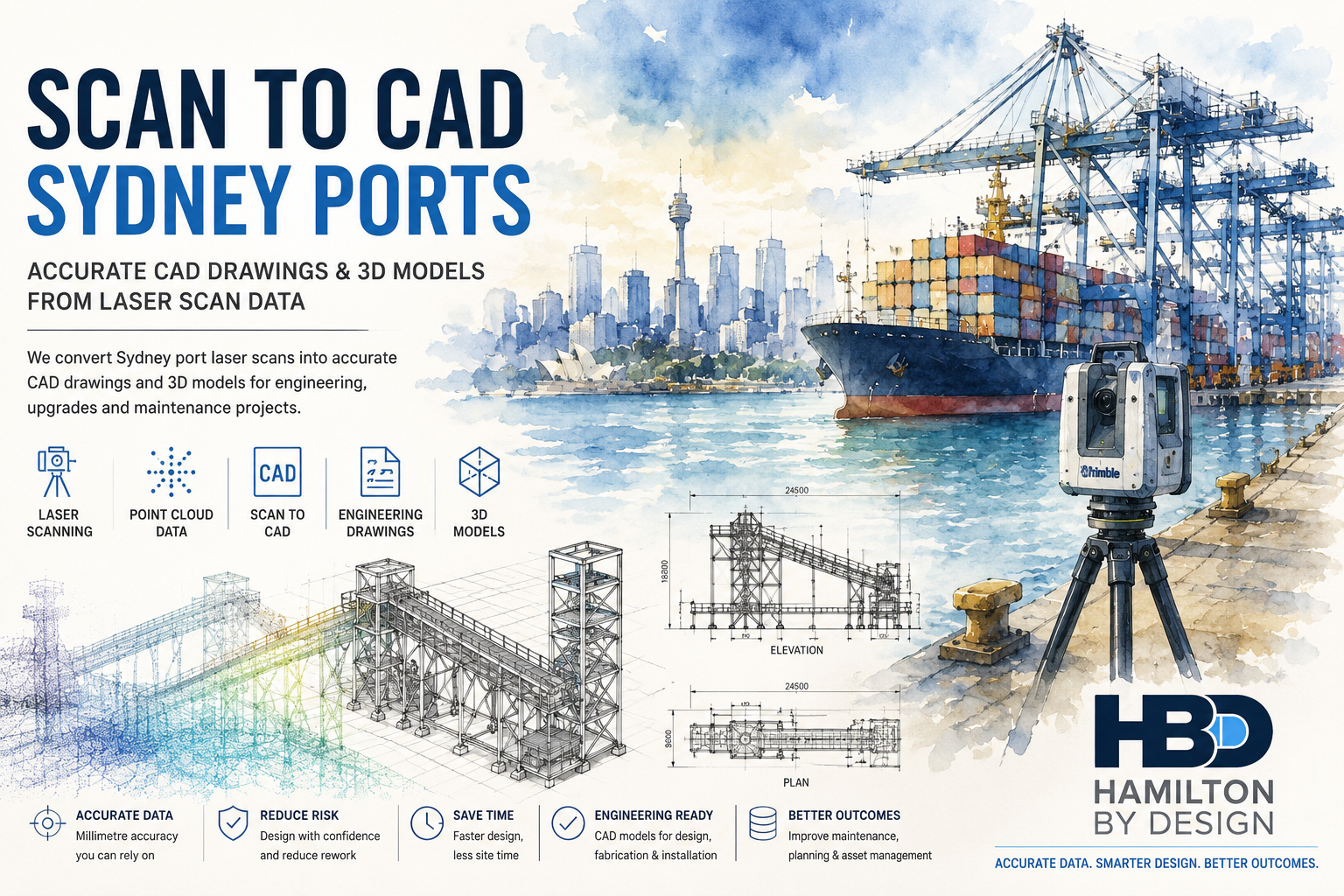
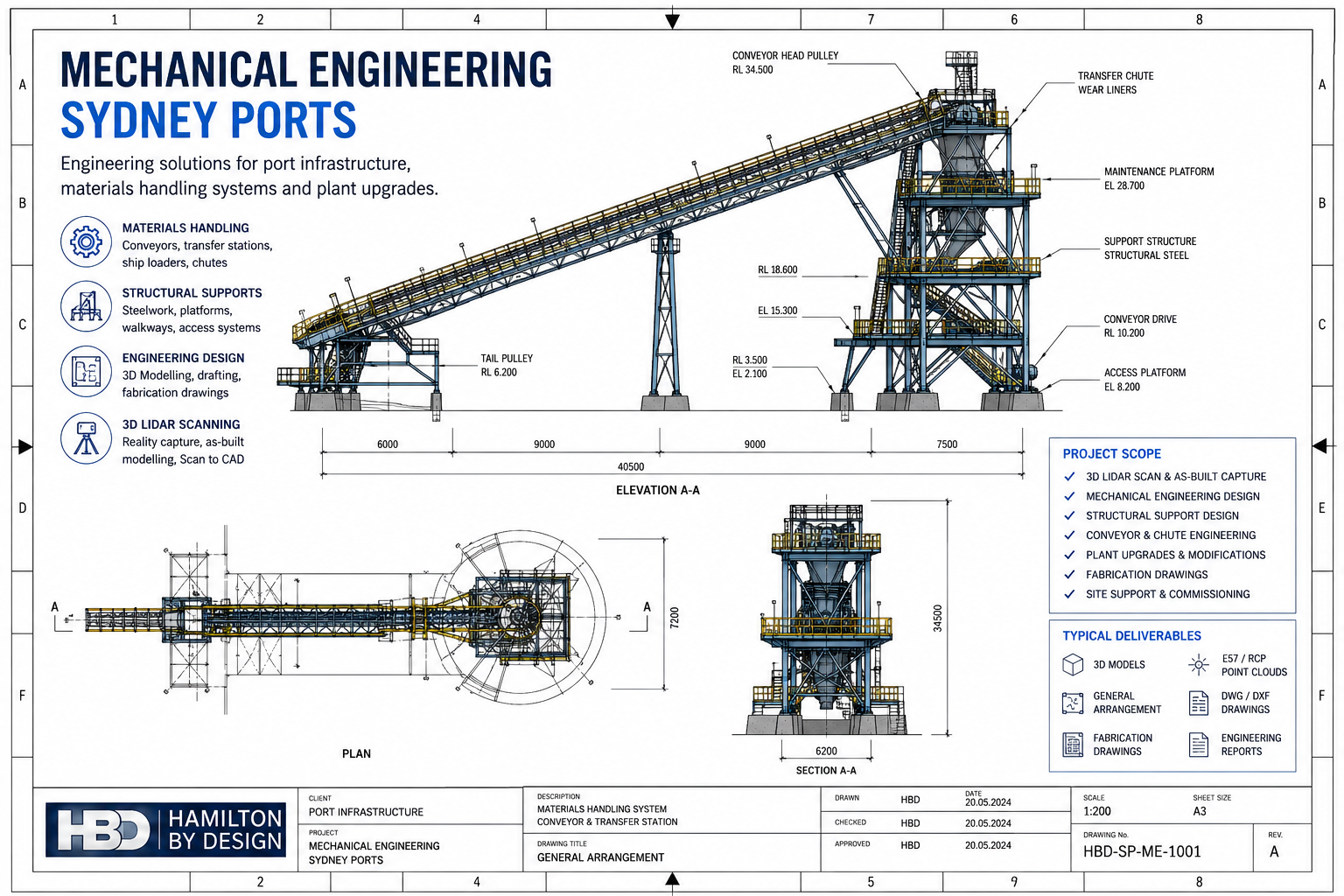
Mechanical Engineering Sydney Ports technical drawing showing conveyor systems, transfer stations, structural steel, materials handling infrastructure, 3D LiDAR scanning services and engineering deliverables by Hamilton By Design.

Mechanical Engineering Sydney Ports | Hamilton By Design

Blue 3D LiDAR scanner icon on a tripod with scanning waves

Sydney’s ports are critical infrastructure assets that support Australia’s import, export, logistics and maritime industries. Maintaining, upgrading and expanding port facilities requires practical mechanical engineering expertise capable of working within live operating environments while minimising disruption to ongoing operations.

Hamilton By Design provides mechanical engineering services for Sydney ports, marine terminals, bulk handling facilities, container terminals, wharves and associated industrial infrastructure. Our services support asset owners, port operators, contractors, manufacturers and maintenance teams requiring engineering solutions for materials handling systems, plant upgrades, structural modifications and brownfield developments.

Based in NSW and supporting projects throughout Sydney and regional Australia, we combine mechanical engineering, 3D LiDAR scanning, CAD design and engineering documentation to deliver practical, engineering-led outcomes.


Mechanical Engineering Services for Sydney Ports

Port facilities contain a wide range of mechanical systems that require ongoing maintenance, modification and improvement. Our engineering services are tailored to support both day-to-day operational requirements and major capital projects.

Typical services include:

  • Mechanical engineering design
  • Materials handling system design
  • Conveyor upgrades and modifications
  • Transfer chute design
  • Structural steel support design
  • Walkways, platforms and access systems
  • Equipment relocation projects
  • Plant upgrade engineering
  • Mechanical drafting and documentation
  • Reverse engineering of components
  • Engineering inspections and assessments
  • Brownfield infrastructure modifications
  • 3D LiDAR scanning and reality capture
  • Scan to CAD services
  • As-built documentation

Our experience across industrial and mining environments provides practical insight into maintaining operational facilities while delivering engineering improvements.


Industries and Port Infrastructure We Support

Sydney ports contain a diverse range of infrastructure requiring specialised engineering support.

We regularly assist with:

Bulk Materials Handling Facilities

  • Conveyor systems
  • Transfer stations
  • Ship loaders
  • Hopper systems
  • Stockpile conveyors
  • Materials handling equipment
  • Dust collection systems

Container Terminal Infrastructure

  • Container handling equipment
  • Mechanical support structures
  • Equipment foundations
  • Maintenance access systems
  • Service platforms

Marine and Wharf Facilities

  • Wharf structures
  • Mechanical services infrastructure
  • Pipework systems
  • Utility installations
  • Maintenance access platforms

Industrial Port Facilities

  • Warehouses
  • Processing plants
  • Storage facilities
  • Bulk liquid terminals
  • Manufacturing facilities
  • Logistics infrastructure

Engineering Design for Brownfield Port Facilities

Many Sydney port facilities have been operating for decades and contain limited or outdated engineering documentation.

Before modifications can commence, accurate information about existing conditions is essential.

Hamilton By Design specialises in engineering support for brownfield environments through:

  • Existing condition surveys
  • 3D LiDAR scanning
  • Point cloud capture
  • As-built modelling
  • Scan to CAD conversion
  • Equipment verification
  • Clash detection
  • Layout development

By capturing existing infrastructure before design begins, project risks can be significantly reduced while improving installation accuracy.


3D LiDAR Scanning and Mechanical Engineering

Modern engineering projects increasingly rely on accurate digital representations of existing facilities.

Our engineering team uses advanced 3D LiDAR scanning technology to capture:

  • Conveyors
  • Pipework
  • Structural steel
  • Transfer stations
  • Ship loading infrastructure
  • Equipment layouts
  • Processing plant assets
  • Mechanical services

The resulting point cloud data can be converted into engineering models and drawings used for:

  • Upgrade design
  • Retrofit projects
  • Structural modifications
  • Equipment replacements
  • Maintenance planning
  • Fabrication detailing

This approach reduces site rework, minimises clashes and improves project confidence.


Materials Handling Engineering

Materials handling systems form the backbone of many port operations.

Our mechanical engineering services include:

Conveyor System Design

We provide engineering support for:

  • New conveyor installations
  • Conveyor upgrades
  • Conveyor extensions
  • Transfer point modifications
  • Conveyor guarding
  • Structural support systems

Transfer Chute Design

Efficient transfer chutes are critical for reducing wear, dust generation and material spillage.

Services include:

  • Chute assessments
  • Flow analysis
  • Wear reduction solutions
  • Maintenance improvements
  • Upgrade concepts

Maintenance and Asset Improvement

Engineering support can assist with:

  • Reliability improvements
  • Equipment modifications
  • Replacement strategies
  • Asset life extension
  • Shutdown planning

Mechanical Drafting and Documentation

Clear engineering documentation is essential for fabrication, installation and maintenance activities.

Deliverables may include:

  • General arrangement drawings
  • Mechanical layouts
  • Fabrication drawings
  • Assembly drawings
  • Equipment models
  • Structural details
  • Site layouts
  • Installation drawings
  • CAD documentation

We work with commonly used engineering platforms including:

  • SolidWorks
  • Autodesk Inventor
  • AutoCAD
  • Autodesk ReCap
  • Navisworks

Typical Deliverables

Depending on project requirements, deliverables may include:

  • Mechanical engineering reports
  • Concept designs
  • Detailed engineering drawings
  • General arrangement drawings
  • CAD models
  • SolidWorks models
  • STEP files
  • DWG files
  • DXF files
  • Point cloud data
  • E57 files
  • RCP and RCS files
  • As-built documentation
  • Equipment layouts
  • Engineering recommendations

Our objective is to provide practical deliverables that can be directly used by project teams, fabricators and contractors.


Why Choose Hamilton By Design?

Hamilton By Design combines practical engineering experience with modern digital engineering technologies.

Our clients benefit from:

  • Mechanical engineering expertise
  • Engineering-led LiDAR scanning services
  • Brownfield project experience
  • Materials handling knowledge
  • Practical design solutions
  • Fast project mobilisation
  • Australia-wide support
  • Accurate engineering documentation

By combining engineering design with reality capture technologies, we help reduce project uncertainty while improving the quality of engineering outcomes.


Frequently Asked Questions

What mechanical engineering services do you provide for Sydney ports?

We provide engineering design, conveyor upgrades, materials handling engineering, plant modifications, structural support design, drafting and 3D LiDAR scanning services.

Can you scan existing port infrastructure before design work begins?

Yes. We provide engineering-grade 3D LiDAR scanning services to accurately capture existing facilities and create as-built models.

Do you work on operational port facilities?

Yes. Many projects are completed within live operational environments, allowing engineering work to be undertaken while minimising disruption.

Can you convert point clouds into CAD models?

Yes. Point cloud data can be converted into CAD drawings, SolidWorks models and engineering documentation.

Do you support conveyor upgrade projects?

Yes. We regularly assist with conveyor modifications, transfer chute improvements and materials handling upgrades.

Can you provide fabrication drawings?

Yes. Detailed fabrication and installation drawings can be produced where required.

What software do you use?

We commonly use SolidWorks, Autodesk Inventor, AutoCAD, Autodesk ReCap and Navisworks.

Do you provide Scan to CAD services?

Yes. We convert laser scan data into accurate engineering drawings and 3D models.

Do you work outside Sydney?

Yes. We support projects throughout NSW and Australia, including ports, mining operations, manufacturing facilities and industrial sites.

How do I obtain a quote?

Contact Hamilton By Design with your project requirements, available drawings and site information. We can then prepare a tailored proposal for your Sydney port engineering project.

Hamilton By Design logo displayed on a blue tilted rectangle with a grey gradient background

Contact Hamilton By Design

If you require Mechanical Engineering Sydney Ports services, Hamilton By Design can assist with engineering design, plant upgrades, materials handling systems, 3D LiDAR scanning, Scan to CAD and engineering documentation.

Contact our team today to discuss your Sydney port infrastructure project and obtain a tailored engineering solution.

Talk to Us – Contact Us

Name
Would you like us to arrange a phone consultation for you?
Address

Our clients:


3D LiDAR Scanning Darwin for engineering surveys, laser scanning, reality capture and point cloud modelling services
3D LiDAR Scanning Australia engineering services for laser scanning, reality capture, scan-to-CAD, Scan-to-BIM and as-built documentation across Australia
3D LiDAR scanning services on the Central Coast providing engineering-grade laser scanning, point cloud capture, scan-to-CAD modelling and industrial reality capture for infrastructure and industrial projects.

Scan to CAD Services for Sydney Ports

Scan to CAD Sydney Ports hero image showing Sydney Harbour port infrastructure, container terminal operations, LiDAR scanning equipment, point cloud data and engineering CAD models used for mechanical engineering, drafting and asset management projects.

Sydney’s ports and marine infrastructure are constantly evolving through maintenance programs, equipment upgrades, expansion projects and operational improvements. Accurate information about existing assets is essential for successful engineering design, fabrication and construction.

Hamilton By Design provides professional Scan to CAD services for Sydney ports, transforming laser scan and LiDAR point cloud data into accurate CAD drawings, 3D models and engineering documentation.

Our engineering-led approach ensures point cloud data is converted into practical deliverables that support mechanical engineering, drafting, fabrication, asset management and infrastructure upgrades.

Whether you require a simple as-built drawing or a complete 3D plant model, our Scan to CAD services provide accurate digital information that helps reduce project risk and improve engineering outcomes.


What is Scan to CAD?

Scan to CAD is the process of converting laser scan data into usable engineering drawings and 3D models.

Using point cloud data captured through terrestrial LiDAR scanning, engineers and drafters can create:

  • AutoCAD Drawings
  • General Arrangement Drawings
  • Plant Layouts
  • Structural Models
  • Mechanical Equipment Models
  • Pipework Models
  • As-Built Documentation
  • BIM Models
  • Digital Twin Assets

This process allows existing facilities to be accurately documented without relying on outdated or incomplete drawings.


Why Sydney Ports Require Scan to CAD Services

Many port facilities have been modified numerous times throughout their operational life.

Common challenges include:

  • Missing documentation
  • Outdated drawings
  • Unknown modifications
  • Congested infrastructure
  • Limited access areas
  • Restricted shutdown windows
  • Complex equipment layouts

By converting reality capture data into engineering-ready CAD models, project teams can work from accurate information that reflects actual site conditions.


Typical Sydney Port Infrastructure We Model

Container Terminals

We create CAD models and drawings for:

  • Container handling equipment
  • Crane support structures
  • Storage facilities
  • Maintenance workshops
  • Access infrastructure

Bulk Materials Handling Facilities

Our Scan to CAD services support:

  • Conveyors
  • Transfer stations
  • Chutes
  • Hoppers
  • Ship loaders
  • Stackers
  • Reclaimers

Marine Infrastructure

We can model:

  • Wharves
  • Jetties
  • Berths
  • Marine loading facilities
  • Access walkways
  • Structural steelwork

Industrial Plant Infrastructure

Including:

  • Pipework systems
  • Pump stations
  • Mechanical equipment
  • Structural steel
  • Maintenance platforms
  • Process infrastructure

Engineering Applications of Scan to CAD

Mechanical Engineering

Accurate CAD models provide the foundation for:

  • Equipment replacement projects
  • Plant upgrades
  • Retrofit design
  • Conveyor modifications
  • Maintenance planning
  • Shutdown engineering

Engineers can design around actual site conditions, reducing installation risks and minimising costly modifications.


Engineering Drafting

Point cloud data can be converted into:

  • Fabrication Drawings
  • General Arrangement Drawings
  • Layout Drawings
  • Equipment Drawings
  • Structural Steel Drawings
  • Installation Documentation

This allows engineering teams to produce reliable documentation from accurate site information.


Brownfield Engineering Projects

Scan to CAD is particularly valuable for brownfield projects where original drawings may no longer reflect existing conditions.

Benefits include:

  • Reduced site visits
  • Improved design accuracy
  • Clash detection
  • Better installation planning
  • Reduced construction risk

Shutdown Planning

Port shutdowns involve significant planning and coordination.

Accurate CAD models allow project teams to:

  • Verify clearances
  • Plan installations
  • Assess access requirements
  • Identify clashes
  • Improve shutdown efficiency

CAD Deliverables Available

Hamilton By Design can provide a range of engineering deliverables depending on project requirements.

2D Deliverables

  • AutoCAD Drawings
  • Floor Plans
  • Elevations
  • Sections
  • Layout Drawings
  • General Arrangement Drawings
  • As-Built Documentation

3D Deliverables

  • SolidWorks Models
  • Inventor Models
  • STEP Files
  • SAT Files
  • Parasolid Files
  • Plant Models

BIM Deliverables

  • Revit Models
  • IFC Models
  • Asset Information Models
  • Scan to BIM Models

Benefits of Scan to CAD for Sydney Port Projects

Accurate Engineering Information

CAD models are created directly from point cloud data, providing confidence that designs are based on actual site conditions.


Reduced Design Risk

Accurate models help identify clashes and installation issues before fabrication begins.


Faster Project Delivery

Engineering teams can begin work immediately without waiting for extensive site measurements.


Improved Asset Management

Accurate CAD documentation supports maintenance planning, inspections and future upgrades.


Better Project Outcomes

Reliable information results in improved decision making throughout the project lifecycle.


Why Choose Hamilton By Design?

Hamilton By Design combines:

  • Scan to CAD Services
  • 3D LiDAR Scanning
  • Mechanical Engineering
  • Engineering Drafting
  • Reverse Engineering
  • Scan to BIM
  • Asset Management Support

Unlike traditional drafting providers, we understand how engineering models are used throughout design, fabrication, installation and maintenance activities.

Our engineering-first approach ensures practical outcomes that support the long-term management and improvement of port infrastructure assets.


Sydney Port Facilities We Support

We provide Scan to CAD services throughout:

  • Port Botany
  • White Bay
  • Glebe Island
  • Sydney Harbour Industrial Facilities
  • Container Terminals
  • Bulk Handling Facilities
  • Marine Infrastructure Assets
  • Intermodal Freight Terminals

We also support projects throughout:

  • Sydney
  • Newcastle
  • Central Coast
  • Wollongong
  • Regional NSW
  • Australia-wide

Hamilton By Design logo displayed on a blue tilted rectangle with a grey gradient background

Need Scan to CAD Services for a Sydney Port Project?

Whether you require accurate as-built drawings, 3D plant models, mechanical engineering support or asset documentation, Hamilton By Design can convert your laser scan data into engineering-ready CAD deliverables.

Our Services Include:

โœ” Scan to CAD
โœ” 3D LiDAR Scanning
โœ” Mechanical Engineering
โœ” Engineering Drafting
โœ” Reverse Engineering
โœ” Scan to BIM
โœ” Digital Twin Development
โœ” Asset Documentation

Contact Hamilton By Design today to discuss your Sydney port infrastructure project and obtain a tailored proposal.

Talk to Us – Contact Us

Name
Would you like us to arrange a phone consultation for you?
Address

Our clients:


Frequently Asked Questions โ€“ Scan to CAD Sydney Ports

1. What is Scan to CAD and how is it used in Sydney ports?

Scan to CAD is the process of converting laser scan or LiDAR point cloud data into accurate 2D drawings and 3D CAD models. Sydney port operators use Scan to CAD for engineering design, maintenance planning, equipment upgrades and asset management projects.


2. What types of port infrastructure can be converted into CAD models?

Hamilton By Design can create CAD models of:

  • Container terminals
  • Wharves and jetties
  • Ship loaders
  • Conveyors
  • Chutes and hoppers
  • Pipework systems
  • Structural steelwork
  • Pump stations
  • Marine loading facilities
  • Industrial plant equipment

3. Why use Scan to CAD instead of traditional site measurements?

Scan to CAD uses millions of measured data points captured by LiDAR scanners, creating a far more detailed and accurate representation of existing conditions than traditional manual measurements.


4. What CAD deliverables can be produced from point cloud data?

Common deliverables include:

  • AutoCAD drawings
  • General arrangement drawings
  • Layout drawings
  • Structural steel models
  • Mechanical equipment models
  • Pipework models
  • Fabrication drawings
  • As-built documentation

5. Can Scan to CAD support brownfield port upgrades?

Yes. Scan to CAD is particularly valuable for brownfield projects where original drawings may be outdated, missing or no longer reflect actual site conditions. Accurate models help reduce design risks and improve project outcomes.


6. What file formats can Hamilton By Design provide?

We can provide deliverables in formats including:

  • DWG
  • DXF
  • STEP
  • SAT
  • Parasolid
  • SolidWorks
  • Inventor
  • IFC
  • Revit

Depending on project requirements.


7. How does Scan to CAD reduce engineering project risk?

Accurate CAD models allow engineers to verify dimensions, identify clashes, check clearances and develop designs based on actual site conditions. This reduces rework, installation issues and costly construction delays.


8. Can point cloud data be used for mechanical engineering projects?

Absolutely. Point cloud data provides the foundation for equipment upgrades, conveyor modifications, plant expansions, structural changes and reverse engineering projects commonly undertaken within Sydney ports.


9. Can Scan to CAD data be used for BIM and digital twin projects?

Yes. CAD models generated from laser scan data can be incorporated into BIM workflows, digital twin platforms, asset management systems and future infrastructure planning projects.


10. Why choose Hamilton By Design for Scan to CAD services in Sydney ports?

Hamilton By Design combines:

  • 3D LiDAR Scanning
  • Scan to CAD
  • Mechanical Engineering
  • Engineering Drafting
  • Reverse Engineering
  • Scan to BIM
  • Digital Twin Development

Unlike drafting-only providers, we understand how engineering models are used throughout design, fabrication, construction and maintenance, ensuring practical outcomes for port infrastructure projects.


3D Scanning for Marine & Ship Repair in Perth

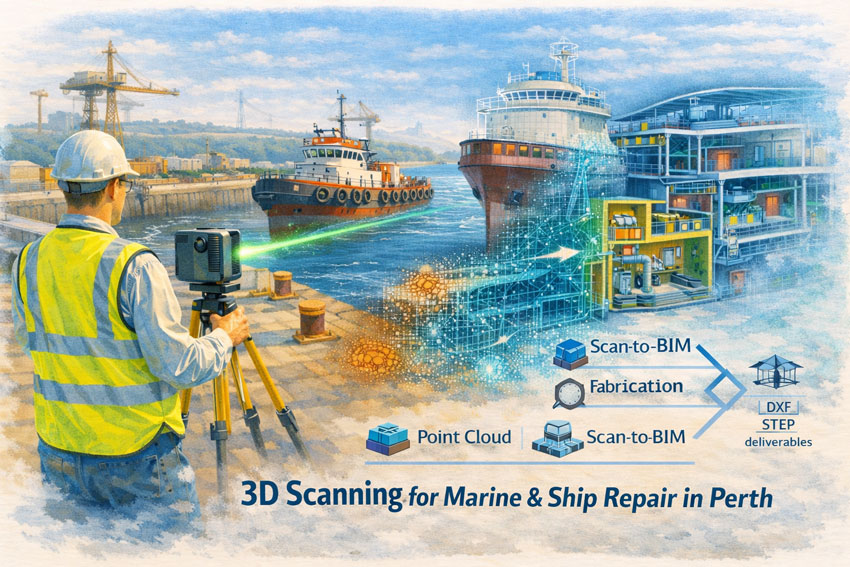
3D scanning for marine and ship repair in Perth showing laser capture of a vessel transitioning into a point cloud and BIM model.

3D Scanning for Marine & Ship Repair in Perth | Scan-to-BIM

Engineering Certainty for Vessels, Structures and Waterfront Assets

Perth is home to one of Australiaโ€™s most active marine maintenance corridors. From commercial vessels and defence platforms to offshore support craft and port infrastructure, every repair decision must be based on accurate geometry rather than assumptions. 3D Scanning for Marine & Ship Repair in Perth provides that certaintyโ€”delivering millimetre-accurate digital records of hulls, decks, pipe systems and mechanical spaces before fabrication begins.


Laser scanning of a Perth vessel for Scan-to-BIM marine refit and ship repair engineering.

The Digital Backbone of Marine Repairs

A marine laser scan is more than a survey; it is the backbone of the repair process. The quality of the initial capture determines how smoothly every downstream task will runโ€”steel replacement, pipe spool fabrication, equipment retrofits and alignment works. If the backbone is broken, even simple jobs become complex. Poor measurement leads to rework on the wharf, schedule blowouts and costly vessel downtime.

Terrestrial and handheld scanners capture millions of measured points across:

  • Hull plating and frames
  • Engine rooms and machinery spaces
  • Pipework and HVAC systems
  • Deck structures and cranes
  • Jetty and berth interfaces

This data forms a single source of truth for naval architects, engineers and fabricators working across Fremantle, Henderson and the wider Perth maritime precinct.

From Point Cloud to Fabrication

The real value of 3D Scanning for Marine & Ship Repair in Perth lies in the engineering deliverables created after capture:

  • Point clouds for AutoCAD, Rhino and ShipConstructor
  • Scan-to-BIM or Scan-to-CAD models of hull and structure
  • Fabrication-ready DXF, STEP and Parasolid files
  • Navisworks meshes for clash detection
  • As-built verification for class and regulatory submissions

These outputs allow workshops to prefabricate with confidence while the vessel remains in service, reducing time alongside and improving safety.

Protecting the Project Team

Marine refits involve tight schedules, confined spaces and multiple contractors. High-quality scanning protects project managers, engineers, designers and fabricators by removing interpretation from the process. Decisions are based on measured reality, not tape measures in awkward bilges.

For older vessels with decades of undocumented modifications, scanning becomes the neutral reference that aligns owners, class surveyors and repair yards around the same dataset.

Applications Across Perthโ€™s Marine Sector

3D Scanning for Marine & Ship Repair in Perth supports:
  • Steel renewal and insert design
  • Pipe spool prefabrication
  • Propulsion and shaft alignment checks
  • Engine change-outs and foundation design
  • Ballast and fuel system upgrades
  • Accommodation refits
  • Jetty and berth interface surveys
  • Class compliance documentation

Whether the project is a tug in Fremantle, an offshore support vessel in Henderson, or port infrastructure along the Swan River, accurate capture reduces risk.

Working Around Operational Constraints

Marine assets rarely stop for long. Scanning can be completed during short alongside windows, at night shifts, or between tide movements. A single visit can capture enough information for months of design work without repeated access to restricted areas.

Engineer-Led Capture

Effective marine scanning must be driven by engineering outcomes. Accuracy tolerances, control networks and target placement are defined around the repair deliverables, not the scanner. This ensures the final models support fabrication, alignment and class approval.

3D LiDAR scanning and 3D modelling service button โ€” laser scanner capturing a point cloud for engineering and CAD modelling
Mechanical engineering services

Hamilton By Design logo displayed on a blue tilted rectangle with a grey gradient background

Start With a Measured Foundation

3D Scanning for Marine & Ship Repair in Perth enables safer, faster and more predictable refits. When the digital backbone is strong, fabrication fits first time and vessels return to service sooner.

If your vessel or waterfront asset requires accurate as-built data, our team can attend site, capture the geometry and deliver engineering-ready models tailored to your workflow.

Mechanical Engineering Perth WA banner for Hamilton By Design featuring white text on a blue background.
3D Laser Scanning Perth WA banner for Hamilton By Design with white text on a blue background.
SolidWorks Perth WA banner for Hamilton By Design featuring white text on a blue background.

Talk to Hamilton By Design about:
  • Marine Scan-to-BIM
  • Hull and pipework digitisation
  • Fabrication models
  • Class documentation support
  • Jetty and berth scanning
Name
Would you like us to arrange a phone consultation for you?
Address


3D CAD Modelling Australia service banner for Hamilton By Design
Mechanical Engineering Perth WA banner for Hamilton By Design featuring white text on a blue background.
3D Laser Scanning Perth WA banner for Hamilton By Design with white text on a blue background.
SolidWorks Perth WA banner for Hamilton By Design featuring white text on a blue background.
3D LiDAR scanning and 3D modelling service button โ€” laser scanner capturing a point cloud for engineering and CAD modelling
Mechanical engineering services

3D CAD Modelling Australia service banner for Hamilton By Design


CHPP Engineering title graphic featuring bold white text reading "CHPP Engineering" centred on a blue rounded rectangle background.
Pipework Drafting title graphic featuring bold white text reading "Pipework Drafting" centred on a blue rounded rectangle background.
3D LiDAR Scanning for Engineering Projects title graphic featuring bold white text on a blue rounded rectangle background.


Finite Element Analysis (FEA) engineering simulation button
Structural drafting services button
Mechanical drafting services button


Australian Drafting logo featuring bold white text reading "Australian Drafting" centred on a blue rounded rectangle background.
Engineering Governance title graphic featuring bold white text reading "Engineering Governance" centred on a blue rounded rectangle background.
Engineering-Grade LiDAR Scanning title graphic featuring bold white text on a blue rounded rectangle background.


Mechanical drafting services button
Structural drafting services button


Fabrication and product design services
3D CAD Modelling Australia service banner for Hamilton By Design
Mechanical, Structural & Pipework Drafting service banner by Hamilton By Design featuring white text on a blue background.


3D LiDAR scanning and 3D modelling service button โ€” laser scanner capturing a point cloud for engineering and CAD modelling
Mechanical engineering services
Mining & Processing Perth WA banner for Hamilton By Design featuring white text on a blue background.
Scan to BIM Perth WA banner for Hamilton By Design featuring white text on a blue background.
Ship Building Perth WA banner for Hamilton By Design featuring white text on a blue background.
Structural drafting services button
3D LiDAR scanning and 3D modelling services button
Mechanical drafting services button