


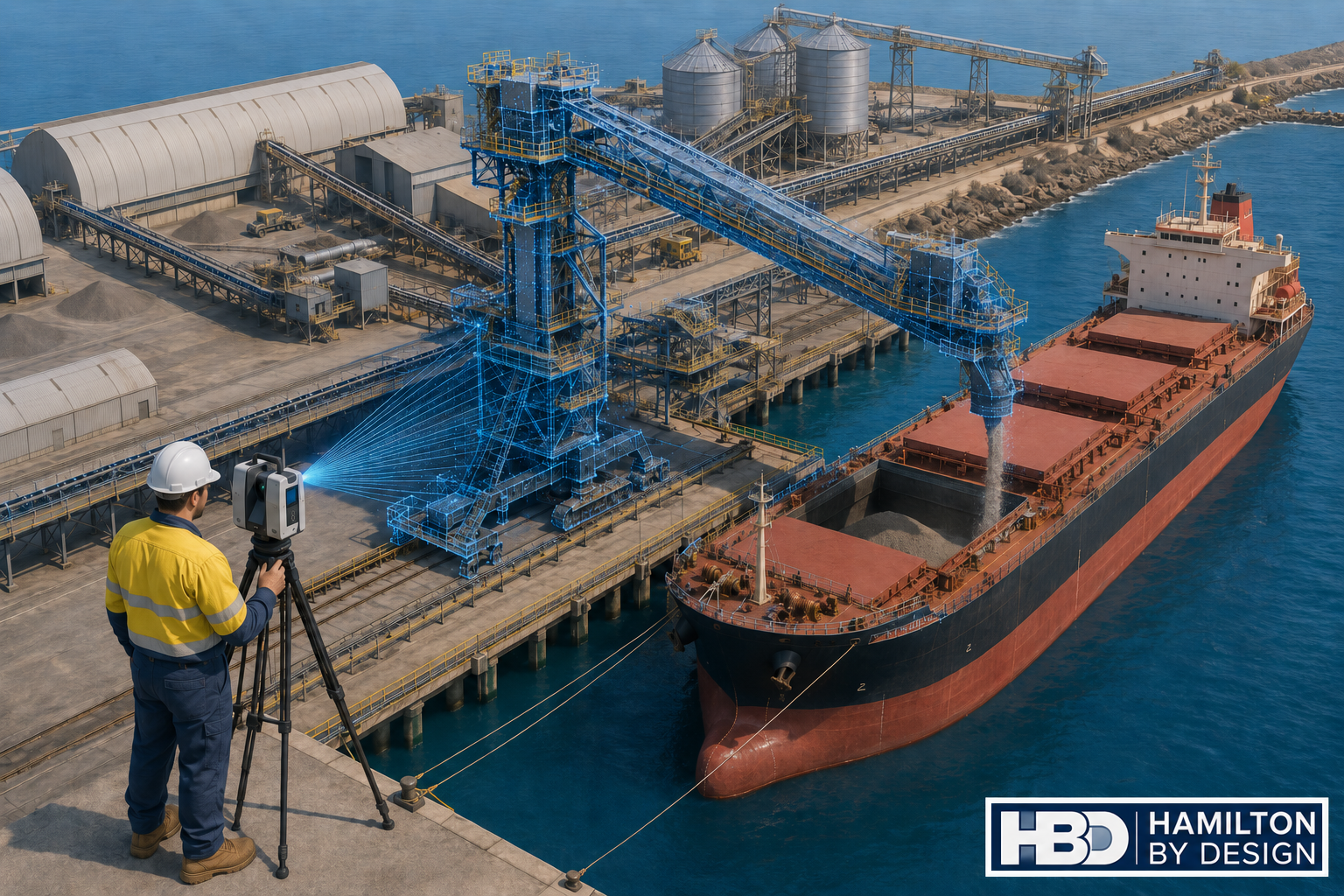
Engineering-Grade LiDAR Scanning for Ports, Bulk Handling and Brownfield Shiploader Upgrades
Hamilton By Design provides shiploader 3D scanning in Perth for port operators, bulk handling facilities, engineers, fabricators and maintenance teams working with ageing shiploaders, conveyors, chutes, booms, wharf structures and access platforms.
Shiploaders are large, complex and difficult assets to modify safely. They operate in harsh marine environments, often handling abrasive bulk materials such as minerals, grain, fertiliser, alumina, coal, ore or other export products. Over time, these machines are repaired, strengthened, modified and upgraded. The problem is that the drawings do not always keep up with the real asset.
That creates risk.
When a port operator needs to replace a chute, modify a conveyor, inspect a boom, upgrade access platforms, install guarding, check clearances or plan a shutdown, the team needs accurate existing-condition data. If the project starts with old drawings or incomplete site measurements, the risk of fabrication errors, installation clashes and shutdown delays increases quickly.
Hamilton By Design uses engineering-grade LiDAR scanning to capture accurate site geometry before design, fabrication or shutdown work begins. The scan data can then be used for point cloud review, Scan-to-CAD modelling, clash checking, general arrangement drawings, fabrication support and as-built documentation.
For broader Western Australian site capture and engineering support, see our 3D Scanning Perth services.
Why Shiploader 3D Scanning Matters
A shiploader is not a simple conveyor. It is a complete mechanical, structural and operational system. A typical shiploader may include boom structures, conveyor galleries, transfer chutes, hoppers, skirts, drives, pulleys, take-up systems, dust control equipment, hydraulic systems, electrical routes, access platforms, walkways, stairs, handrails, guarding, rails, wharf interfaces and surrounding port infrastructure.
Many of these areas are difficult to measure manually. Some areas are elevated. Some are close to operating plant. Some are affected by corrosion, impact damage, product build-up, wear or previous modifications. Manual measurement may be suitable for small items, but it is often not enough when the design team needs to understand how the whole asset fits together.
3D scanning captures millions of measured points across the shiploader and surrounding infrastructure. The result is a digital point cloud that can be measured, reviewed and converted into usable engineering deliverables.
This is especially valuable for brownfield port environments where the installed condition often differs from the original drawings.
The Biggest Problem: Inaccurate As-Built Data
The biggest problem for port operators and engineers is that ageing shiploaders often do not have accurate as-built data.
Original drawings may exist, but they may no longer reflect the current condition of the machine. Over many years, shiploaders are maintained, repaired and modified. Chutes are replaced. Guards are added. Platforms are changed. Steelwork is strengthened. Conveyor components are adjusted. Services are rerouted. Dust control systems are modified. Access systems are upgraded.
Each change may make sense at the time, but unless the drawings are updated properly, the asset slowly drifts away from the documentation.
This creates problems when new work is planned.
An engineer may design a replacement chute based on old drawings, only to find that the surrounding structure has changed. A fabricator may manufacture a component that clashes with existing steelwork. A shutdown team may plan an installation sequence without knowing that access is restricted. A maintenance team may discover during the shutdown that the lifting path is blocked.
For a shiploader, these problems can become expensive quickly. Shutdown windows are limited. Port operations are time-sensitive. Fabrication rework can delay installation. A small measurement error can become a major site issue.
3D scanning helps reduce this risk by capturing the real installed condition before design and fabrication decisions are made.
Who Uses Shiploader 3D Scanning?
Shiploader 3D scanning is useful for several project groups.
Port operators use scan data to understand existing assets, plan maintenance and reduce shutdown risk.
Mechanical engineers use point clouds and CAD models to design chute modifications, conveyor interfaces, guards, brackets, transfer points and replacement components.
Structural engineers use scan data to review steelwork, access platforms, stairs, handrails, supports, boom structures and wharf interfaces.
Fabricators use accurate geometry to reduce site fit-up problems and improve confidence before manufacturing.
Maintenance planners use scan data to plan access, lifting, removal sequences and installation work before the asset is taken offline.
EPCM contractors use point cloud information for design coordination, clash checking and constructability review.
Bulk handling operators use scan data to support conveyors, transfer towers, shiploaders, wharf structures and associated plant.
What Can Be Scanned?
Hamilton By Design can scan shiploader and port infrastructure elements including:
- Shiploader boom structures
- Conveyor galleries
- Transfer chutes
- Hoppers and skirts
- Belt feeders
- Drive stations
- Pulley areas
- Take-up systems
- Dust extraction systems
- Spray systems
- Access platforms
- Walkways and stairs
- Handrails and guarding
- Wharf structures
- Rail interfaces
- Structural supports
- Pipework and services
- Cable trays and equipment routes
- Maintenance access zones
- Adjacent conveyors and transfer points
The aim is not just to create a visual record. The aim is to produce engineering information that can support real project decisions.
Where We Support Shiploader 3D Scanning
Hamilton By Design supports shiploader 3D scanning and port infrastructure projects across Perth and Western Australia, including Perth, Fremantle, Kwinana, Henderson, Cockburn Sound, Rockingham, Bunbury, Geraldton, Port Hedland, Karratha and regional WA bulk handling facilities.
The page focus is Shiploader 3D Scanning Perth, but the same workflow can support port and bulk handling infrastructure across Western Australia.
Perth is a practical engineering base for this work because many WA port, mining, processing and bulk handling projects are planned, managed and engineered from Perth, even when the assets themselves are located across regional WA.
How the 3D Scanning Process Works
1. Project Review
The first step is understanding why the scan is required.
A scan for chute replacement is different from a scan for access platform upgrades. A scan for shutdown planning is different from a scan for fabrication verification. Before scanning begins, Hamilton By Design reviews the project objective, required deliverables, areas of interest and level of detail required.
This helps make sure the scan captures the information that the engineering, maintenance or fabrication team actually needs.
2. Site Walkdown and Scan Planning
The shiploader and surrounding work areas are reviewed to identify key scan locations. The aim is to capture the asset with enough coverage and overlap to produce a reliable point cloud.
Important areas may include transfer points, boom sections, conveyor routes, access platforms, drive areas, structural supports, wharf interfaces and installation paths.
Safety and access requirements are also considered, especially around live plant, elevated work areas, marine environments and shutdown conditions.
3. LiDAR Site Capture
Hamilton By Design uses terrestrial LiDAR scanning to capture the asset. The scanner records millions of measured points, creating a detailed point cloud of the shiploader and surrounding infrastructure.
This method is faster and more complete than relying on manual measurements for large and complex brownfield assets.
4. Point Cloud Registration
After scanning, the scan data is registered into a coordinated point cloud. This creates a single usable dataset that can be opened, reviewed, measured and used for downstream modelling.
Typical point cloud deliverables may include E57, RCP, RCS or LAS files.
These files can support engineering review, CAD modelling, coordination and documentation.
5. Engineering Review
Once the point cloud is prepared, engineers and designers can review the captured asset. They can check clearances, confirm interfaces, measure existing geometry and identify areas that may affect design, fabrication or installation.
This is where engineering-led scanning becomes valuable. Hamilton By Design understands how scan data is used for design, fabrication, maintenance and brownfield modification work.
6. Scan-to-CAD Modelling
Where required, the point cloud can be converted into CAD models or drawings. This may include mechanical components, structural steel, platforms, chutes, guards, conveyor interfaces or general arrangement layouts.
For more detailed point cloud conversion support, see our Scan to CAD Perth services.
7. Drawings and Deliverables
Depending on the project, Hamilton By Design can provide registered point clouds, 2D plans, sections, elevations, general arrangement drawings, 3D CAD models, STEP files, SAT files, Parasolid files, DWG drawings, fabrication drawings, as-built documentation and clash review models.
The deliverables are selected based on the project need. Some clients only require point cloud data. Others require a full scan-to-CAD workflow with engineering drawings and fabrication support.
Tools That Assist Shiploader 3D Scanning
Hamilton By Design uses practical digital engineering tools suitable for industrial, port and bulk handling environments.
These may include FARO Focus terrestrial LiDAR scanning, FARO SCENE point cloud registration, Autodesk ReCap for RCP and RCS workflows, AutoCAD for plans and sections, SolidWorks for mechanical modelling, Autodesk Inventor for mechanical assemblies and Navisworks for coordination and clash checking.
Deliverable formats may include E57, RCP, RCS, LAS, DWG, STEP, SAT and Parasolid.
The purpose of these tools is to move the project from site capture to usable engineering information.
Services Hamilton By Design Can Provide
Hamilton By Design can support shiploader and port infrastructure projects with engineering-grade 3D laser scanning, point cloud registration, Scan-to-CAD modelling, mechanical engineering support, structural drafting, as-built documentation, fabrication drawings and shutdown planning support.
Our work can assist with chute modifications, conveyor interfaces, guarding, brackets, access platforms, walkways, stairs, handrails, support frames, replacement components and surrounding infrastructure.
For broader design and engineering capability in Western Australia, see our Perth engineering services page.
Common Shiploader Project Problems We Help Solve
Hamilton By Design can assist when existing drawings are missing, outdated or unreliable.
We can also assist when a chute needs to be replaced, a conveyor interface needs to be checked, a boom structure needs to be documented, access platforms need modification, new guarding is being installed, fabricated parts need accurate site geometry or shutdown work needs better planning.
Shiploader projects often fail because the project team discovers the real site condition too late. A point cloud gives engineers, fabricators and maintenance teams a better understanding before work moves too far into design or fabrication.
Example Use Case: Chute and Conveyor Upgrade
A common shiploader problem is a transfer chute or conveyor interface that needs modification.
The original drawing may show the design intent, but the installed condition may have changed. There may be additional steelwork, modified guards, worn liners, dust control equipment, services or access restrictions.
By scanning the area first, Hamilton By Design can capture the surrounding geometry and provide accurate information for the design team.
This helps engineers confirm available space, model replacement components, check access, reduce clashes and improve fabrication accuracy.
The result is a better chance that the new work will fit during the planned shutdown.

Example Use Case: Access Platform Modification
Shiploaders often require access improvements for inspection, maintenance and safety. This may involve stairs, platforms, handrails, ladders, guards or local structural modifications.
A scan can capture the existing structure and surrounding obstructions so that new access systems can be designed around real site conditions.
This is particularly useful when the asset has been modified over many years and the original access drawings are no longer reliable.
Example Use Case: Shutdown Planning
Shutdown time is expensive. Every hour matters.
By scanning the shiploader before the shutdown, project teams can inspect the asset digitally, measure key areas, plan removal paths, check lifting constraints, model replacement components and identify potential clashes before work begins.
This does not remove every risk, but it gives the project team better information before the asset is taken offline.
Why Engineering-Led Scanning Is Different
Not all 3D scanning is the same.
For a shiploader project, the value is not just in capturing a point cloud. The value is in understanding what the point cloud is needed for.
A survey-only approach may capture the site, but an engineering-led approach considers how the information will be used for design, fabrication, installation and maintenance.
Hamilton By Design combines LiDAR scanning with mechanical engineering, drafting and fabrication-aware modelling. That means the scan is planned around the downstream engineering outcome, not just the visual capture.
This is important for port assets because the cost of getting it wrong can be high. A small clash, incorrect bracket location, missed access constraint or outdated drawing can create real shutdown delays.
For broader mechanical design support, see our Mechanical Engineering Perth page.
FAQs
What is shiploader 3D scanning?
Shiploader 3D scanning is the process of using LiDAR scanning equipment to capture accurate three-dimensional data of a shiploader and its surrounding infrastructure. The scan creates a point cloud that can be measured, reviewed and converted into CAD models or drawings.
Why scan a shiploader before an upgrade?
A shiploader should be scanned before an upgrade because existing drawings are often outdated or incomplete. Scanning captures the real installed condition, helping engineers reduce assumptions before design, fabrication and shutdown work begins.
What parts of a shiploader can be scanned?
Hamilton By Design can scan boom structures, conveyors, transfer chutes, hoppers, guards, access platforms, stairs, handrails, wharf interfaces, drives, pulleys, services, dust control systems and surrounding port infrastructure.
Can scan data be converted into CAD drawings?
Yes. Point cloud data can be converted into 2D drawings, 3D CAD models, general arrangement drawings, sections, elevations and fabrication drawings, depending on the project requirements.
What file formats can be supplied?
Typical deliverables may include E57, RCP, RCS, LAS, DWG, STEP, SAT and Parasolid formats. The final format depends on the client’s software and required workflow.
Is shiploader scanning useful for shutdown planning?
Yes. Scanning before a shutdown helps teams check clearances, plan installation paths, identify clashes, review access and reduce the risk of discovering problems after the asset is offline.
Can 3D scanning help with chute replacement?
Yes. Chute replacement is one of the best uses for 3D scanning. The scan captures the surrounding structure, conveyor interfaces, access restrictions and existing geometry so the replacement chute can be designed with better information.
Does Hamilton By Design only work in Perth?
No. Hamilton By Design supports projects across Perth and Western Australia, including Fremantle, Kwinana, Henderson, Bunbury, Geraldton, Port Hedland, Karratha and regional bulk handling sites.

Shiploader 3D Scanning Perth
If you are planning a shiploader upgrade, chute replacement, conveyor modification, access platform change, shutdown project or port infrastructure review, accurate as-built information is the best place to start.
Hamilton By Design provides shiploader 3D scanning Perth services for port operators, engineers, fabricators and maintenance teams working across Perth and Western Australia.
By combining engineering-grade LiDAR scanning, point cloud registration, Scan-to-CAD modelling, mechanical engineering and drafting support, Hamilton By Design helps project teams reduce assumptions, improve fabrication accuracy and plan brownfield work with greater confidence.
Contact Hamilton By Design to discuss your shiploader, conveyor, chute, wharf or port infrastructure scanning requirements.
Talk to Us – Contact Us
Our clients:
























