


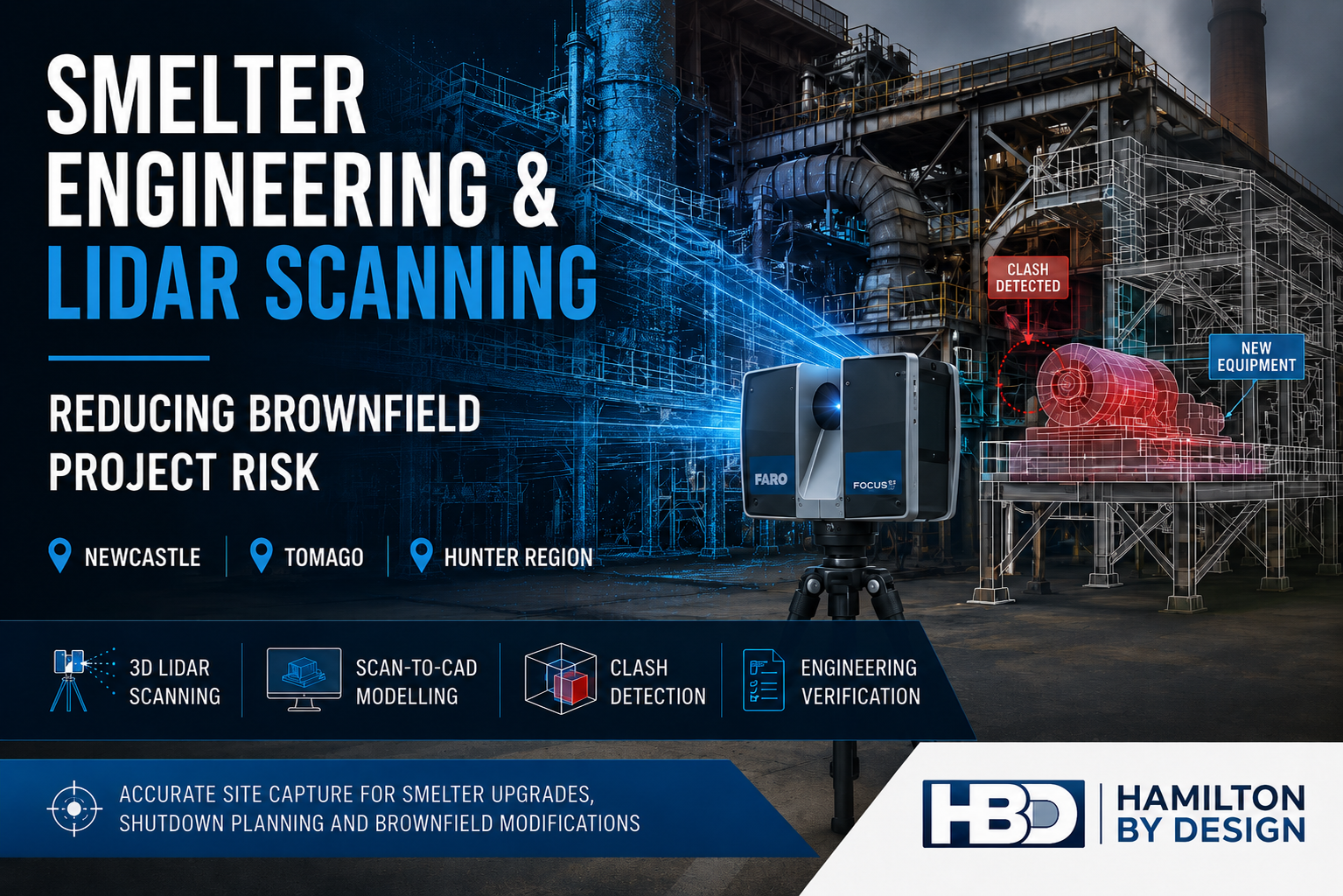
Reduce Brownfield Project Risk Before Shutdowns, Fabrication and Installation
Hamilton By Design provides engineering-led 3D LiDAR scanning, Scan-to-CAD modelling and brownfield engineering support for smelters, aluminium plants and heavy industrial facilities across Newcastle, Tomago and the Hunter Region.
Smelter environments are complex, congested and often difficult to measure accurately using traditional site methods. Existing drawings may be incomplete, outdated or no longer match the real plant. Pipework, structural steel, platforms, conveyors, ducting, access ways, services and existing equipment can all create problems when new equipment is designed from poor information.
The result is often costly: equipment clashes during installation, shutdown delays, site rework, fabrication changes, access issues and increased project risk.
Hamilton By Design helps reduce these risks by capturing existing site conditions using 3D LiDAR scanning and converting that information into practical engineering deliverables, including point clouds, 3D CAD models, 2D drawings, clash reviews and brownfield verification models.
Whether you are planning a smelter upgrade, replacing existing equipment, modifying access platforms or preparing for a shutdown, accurate site data gives your engineering team a better foundation for decision-making.
Smelter 3D LiDAR Scanning Services Newcastle NSW
3D LiDAR scanning is the starting point for many brownfield smelter projects. Instead of relying only on old drawings, manual tape measurements or assumptions, LiDAR scanning captures millions of measured points across the existing facility.
This creates a detailed digital record of the plant, including structures, equipment, pipework, ducting, tanks, access platforms, walkways, conveyors and surrounding obstructions.
For smelter projects in Newcastle and the Hunter Region, LiDAR scanning can support:
- Brownfield upgrade planning
- Shutdown preparation
- Site verification before fabrication
- As-built documentation
- Access and maintenance planning
- Clash detection
- Mechanical and structural design
- Scan-to-CAD modelling
- Engineering verification
The key benefit is confidence. Your project team can design around the real site, not an outdated drawing set.
Learn more:
https://www.hamiltonbydesign.com.au/smelter-3d-lidar-scanning-services-newcastle/
Aluminium Smelter Laser Scanning Tomago NSW
Aluminium smelters have unique site challenges. They often include large process areas, high-temperature zones, heavy equipment, ducting, pipework, access platforms, structural steel and restricted work areas.
At Tomago and surrounding Newcastle industrial areas, accurate laser scanning can assist engineering and maintenance teams by creating reliable as-built information before works begin.
This is especially useful where brownfield upgrades are delayed because existing assets cannot be measured accurately. A laser scan can capture the existing plant geometry quickly and safely, reducing the need for repeated site visits and helping designers understand the real constraints before new equipment is detailed.
Laser scanning can assist with:
- Potline and process area upgrades
- Mechanical equipment replacement
- Access platform modifications
- Existing structure verification
- Ducting and pipework layouts
- Maintenance planning
- Shutdown work packs
- As-built documentation
The goal is to reduce uncertainty before design, fabrication and installation.
Learn more:
https://www.hamiltonbydesign.com.au/aluminium-smelter-laser-scanning-tomago-nsw/
Smelter Scan-to-CAD Services Newcastle NSW
A point cloud is valuable, but many engineering teams also need usable CAD models. Scan-to-CAD services convert laser scan data into practical engineering models that can be used for design, drafting, coordination and verification.
For smelter projects, this is useful when the engineering team has no reliable 3D CAD model of the existing facility.
Hamilton By Design can convert scan data into engineering-focused CAD deliverables such as:
- 3D CAD models
- SolidWorks models
- Autodesk Inventor models
- AutoCAD drawings
- STEP files
- Existing equipment models
- Structural layout models
- Pipework and platform layouts
- General arrangement drawings
- Navisworks coordination models
Scan-to-CAD is not just about creating a visual model. It is about producing a model that helps engineers check fit, access, clearances and installation risk before the work reaches site.
This is particularly valuable where new equipment must be installed into an existing smelter environment with limited space, limited shutdown time and many surrounding obstructions.
Learn more:
https://www.hamiltonbydesign.com.au/smelter-scan-to-cad-services-newcastle-nsw/
Smelter Brownfield Engineering Services Newcastle NSW
Brownfield smelter projects are often high-risk because new equipment must fit around existing plant. The biggest issue is simple: what looks correct in a drawing may not fit on site.
New equipment can clash with platforms, pipework, structural steel, conveyors, handrails, cable trays, ducting or maintenance access zones. These clashes may not be discovered until installation, when they are expensive and disruptive to fix.
Hamilton By Design supports brownfield engineering by combining LiDAR scanning, CAD modelling and engineering verification.
This can help project teams:
- Confirm existing site conditions
- Identify potential clashes early
- Check equipment fit before fabrication
- Review installation access
- Verify clearances
- Support shutdown planning
- Reduce rework
- Improve design confidence
- Create practical engineering documentation
For smelters in Newcastle and the Hunter Region, this service is particularly useful before shutdowns, plant upgrades, mechanical replacements and structural modifications.
The aim is to solve problems before they reach site.
Learn more:
https://www.hamiltonbydesign.com.au/smelter-brownfield-engineering-services-in-newcastle-nsw/
Why Smelter Projects Need Accurate Existing Conditions
Smelter facilities are rarely simple. Over time, equipment is replaced, access platforms are modified, pipe routes change, structural steel is added, and maintenance improvements are made. In many cases, the original drawings are no longer accurate.
This creates a problem for engineering teams.
If the design is based on incorrect information, the project may face:
- Equipment clashes during installation
- Poor access for maintenance
- Fabrication rework
- Shutdown delays
- Extra site measurements
- Design changes after fabrication
- Safety and access issues
- Lost production time
- Increased project cost
LiDAR scanning and Scan-to-CAD workflows help reduce these problems by giving the project team a more accurate picture of the existing facility.
How Hamilton By Design Supports Smelter Projects
Hamilton By Design provides an engineering-led workflow for brownfield smelter projects.
1. Site Capture
The existing plant is captured using 3D LiDAR scanning. This records the geometry of the site, including equipment, structures, platforms, pipework and surrounding obstructions.
2. Point Cloud Registration
The scan data is processed and registered into a usable point cloud. This becomes the digital reference for the existing site conditions.
3. Engineering Review
The point cloud is reviewed from an engineering perspective to identify important features, constraints and potential design risks.
4. CAD Modelling
Where required, the point cloud is converted into 3D CAD models, 2D drawings or simplified coordination models.
5. Clash and Fit Verification
New equipment, structures or modifications can be reviewed against the existing plant to check for clashes, access problems and installation constraints.
6. Deliverables for Design and Installation
Deliverables may include point clouds, CAD files, drawings, marked-up layouts, verification models and coordination files for design teams, fabricators and project managers.
Typical Smelter Applications
Hamilton By Design can assist with a wide range of smelter and heavy industrial projects, including:
- Mechanical equipment upgrades
- Existing plant verification
- Brownfield modifications
- Shutdown planning
- Access platform upgrades
- Conveyor modifications
- Pipework and ducting layouts
- Structural steel verification
- Maintenance access reviews
- Scan-to-CAD modelling
- Reverse engineering
- Clash detection
- Fabrication support
- Installation planning
- As-built documentation
Newcastle, Tomago and Hunter Region Support
Hamilton By Design supports smelter and heavy industrial projects across Newcastle, Tomago, the Hunter Region and wider NSW.
This includes support for:
- Smelters
- Aluminium plants
- Processing facilities
- Heavy industrial plants
- Materials handling facilities
- Brownfield upgrade projects
- Maintenance and shutdown works
- Mechanical and structural engineering projects
Being able to capture, model and verify existing conditions helps project teams reduce uncertainty before committing to fabrication or installation.
Smelter Engineering Services Summary
Hamilton By Design provides the following smelter-focused services:
3D LiDAR Scanning
Accurate site capture for existing smelter assets, structures, equipment and access areas.
Laser Scanning
Fast and detailed measurement of complex plant environments where manual measurement is difficult or unsafe.
Scan-to-CAD
Conversion of point cloud data into usable 3D CAD models, 2D drawings and engineering documentation.
Brownfield Engineering
Engineering support for upgrades, modifications, clash checks, fit verification and shutdown planning.
CAD Modelling
SolidWorks, Inventor, AutoCAD and STEP-based deliverables for design, coordination and fabrication support.
Clash Review
Visual and model-based checking to reduce the risk of equipment clashes during installation.
Why Use Hamilton By Design?
Hamilton By Design combines site scanning, CAD modelling and engineering understanding. This means the scan data is not treated as a standalone deliverable. It is used as part of an engineering process to help reduce risk.
The key benefits include:
- Fewer site assumptions
- Better design information
- Reduced rework
- Better shutdown planning
- Improved clash detection
- More accurate CAD models
- Better communication between site and design teams
- Practical engineering deliverables
- Support from scanning through to modelling and verification
For brownfield smelter projects, this approach helps engineering teams make better decisions before fabrication and installation.

https://www.hamiltonbydesign.com.au/
Planning a Smelter Upgrade in Newcastle or Tomago?
If you are planning a smelter upgrade, equipment replacement, shutdown project or brownfield modification, Hamilton By Design can assist with 3D LiDAR scanning, Scan-to-CAD modelling and engineering verification.
Accurate site capture at the start of the project can help reduce costly problems later.
Contact Hamilton By Design to discuss your smelter scanning, CAD modelling or brownfield engineering requirements.
Our clients:

Frequently Asked Questions
What are smelter engineering services?
Smelter engineering services support the planning, design, verification and modification of equipment and structures within smelter and heavy industrial facilities. This can include 3D LiDAR scanning, Scan-to-CAD modelling, brownfield engineering, clash detection, shutdown support, mechanical design and as-built verification.
For brownfield smelter projects, the main goal is to confirm what already exists on site before new equipment is designed, fabricated or installed.
Why is 3D LiDAR scanning useful for smelter projects?
3D LiDAR scanning is useful because smelter sites are often congested, difficult to measure and full of existing equipment, pipework, ducting, platforms and structural steel. Traditional measurements can miss important details or require multiple site visits.
LiDAR scanning captures the existing plant in 3D, creating a point cloud that can be used for design checks, CAD modelling, clash detection and installation planning.
What problem does LiDAR scanning solve in brownfield smelter upgrades?
The biggest problem is uncertainty. Existing drawings may be outdated, incomplete or different from the real plant. If new equipment is designed using incorrect information, it may clash with existing structures, platforms, pipework or access areas during installation.
LiDAR scanning helps reduce this risk by capturing the actual site conditions before design and fabrication.
What is Scan-to-CAD for smelters?
Scan-to-CAD is the process of converting 3D laser scan data into usable CAD models or engineering drawings. For smelter projects, this may include modelling existing equipment, structural steel, platforms, pipework, ducting, access ways and surrounding plant.
The CAD model can then be used for design, drafting, clash checking, verification and project planning.
What deliverables can Hamilton By Design provide?
Depending on the project scope, deliverables may include registered point clouds, E57 files, RCP/RCS files, 3D CAD models, SolidWorks models, Autodesk Inventor models, AutoCAD drawings, STEP files, general arrangement drawings, sections, elevations, marked-up verification drawings and Navisworks coordination models.
The deliverables can be tailored to suit the needs of the engineering team, fabricator, project manager or site maintenance team.
Can LiDAR scanning help detect equipment clashes before installation?
Yes. LiDAR scanning can be used with CAD models to check whether new equipment will fit within the existing plant. This can help identify clashes with structural steel, platforms, handrails, pipework, ducting, cable trays, conveyors or nearby equipment before fabrication or installation begins.
This is particularly useful for shutdown projects where there is limited time available to resolve problems on site.
Is LiDAR scanning suitable for shutdown planning?
Yes. LiDAR scanning is well suited to shutdown planning because it helps engineering and maintenance teams understand the existing site before work begins. The scan data can support access planning, lifting studies, installation sequencing, fabrication checks and brownfield design reviews.
Capturing site conditions before a shutdown can help reduce rework, delays and unexpected clashes.
Do you service Newcastle, Tomago and the Hunter Region?
Yes. Hamilton By Design provides smelter engineering, 3D LiDAR scanning, Scan-to-CAD and brownfield engineering support across Newcastle, Tomago, the Hunter Region and wider NSW.
This includes support for aluminium smelters, process plants, heavy industrial facilities, materials handling sites and brownfield upgrade projects.
How accurate is 3D LiDAR scanning?
Accuracy depends on the scanner setup, site conditions, scan registration, distance from the scanner and the required deliverable. For many industrial brownfield projects, LiDAR scanning provides a practical and reliable way to capture existing site geometry for engineering review, CAD modelling and clash detection.
Project-specific accuracy requirements should be confirmed before scanning, especially where fabrication tolerances or tight equipment clearances are involved.
Can you create a CAD model from an existing smelter plant?
Yes. Hamilton By Design can use point cloud data to create CAD models of existing smelter plant areas. These models can be developed at different levels of detail depending on the project requirement.
For example, a basic layout model may be suitable for clash checking, while a more detailed model may be required for fabrication planning, reverse engineering or engineering documentation.
Can you work from old drawings as well as scan data?
Yes. Old drawings can be used as a reference, but they should be verified against current site conditions. In many brownfield plants, drawings may not reflect years of modifications, repairs and equipment changes.
Combining existing drawings with LiDAR scan data provides a stronger basis for design and engineering verification.
What types of smelter assets can be scanned?
Typical assets include platforms, walkways, structural steel, pipework, ducting, tanks, conveyors, mechanical equipment, access stairs, handrails, process areas, maintenance zones and surrounding plant interfaces.
The scan can capture both the main equipment and the nearby obstructions that may affect installation, access or future modification work.
Why use Hamilton By Design for smelter scanning and engineering?
Hamilton By Design combines 3D LiDAR scanning with practical engineering and CAD modelling experience. This means the scan data is not just captured; it can be interpreted and converted into useful engineering deliverables.
The focus is on helping project teams reduce brownfield risk, improve design confidence, identify clashes early and avoid costly installation problems.
When should LiDAR scanning be completed on a smelter project?
LiDAR scanning should ideally be completed early in the project, before detailed design, fabrication or shutdown planning is finalised. Early scanning gives the engineering team time to check site conditions, update drawings, model existing assets and resolve potential clashes before they become site problems.
It can also be useful after installation to create updated as-built records.
How do we start a smelter LiDAR scanning or Scan-to-CAD project?
The first step is to define the project area, the purpose of the scan and the required deliverables. Useful information includes site location, existing drawings, photos, equipment details, access restrictions, shutdown dates, required accuracy and preferred file formats.
Hamilton By Design can then review the scope and recommend a practical scanning, modelling and engineering verification approach.