


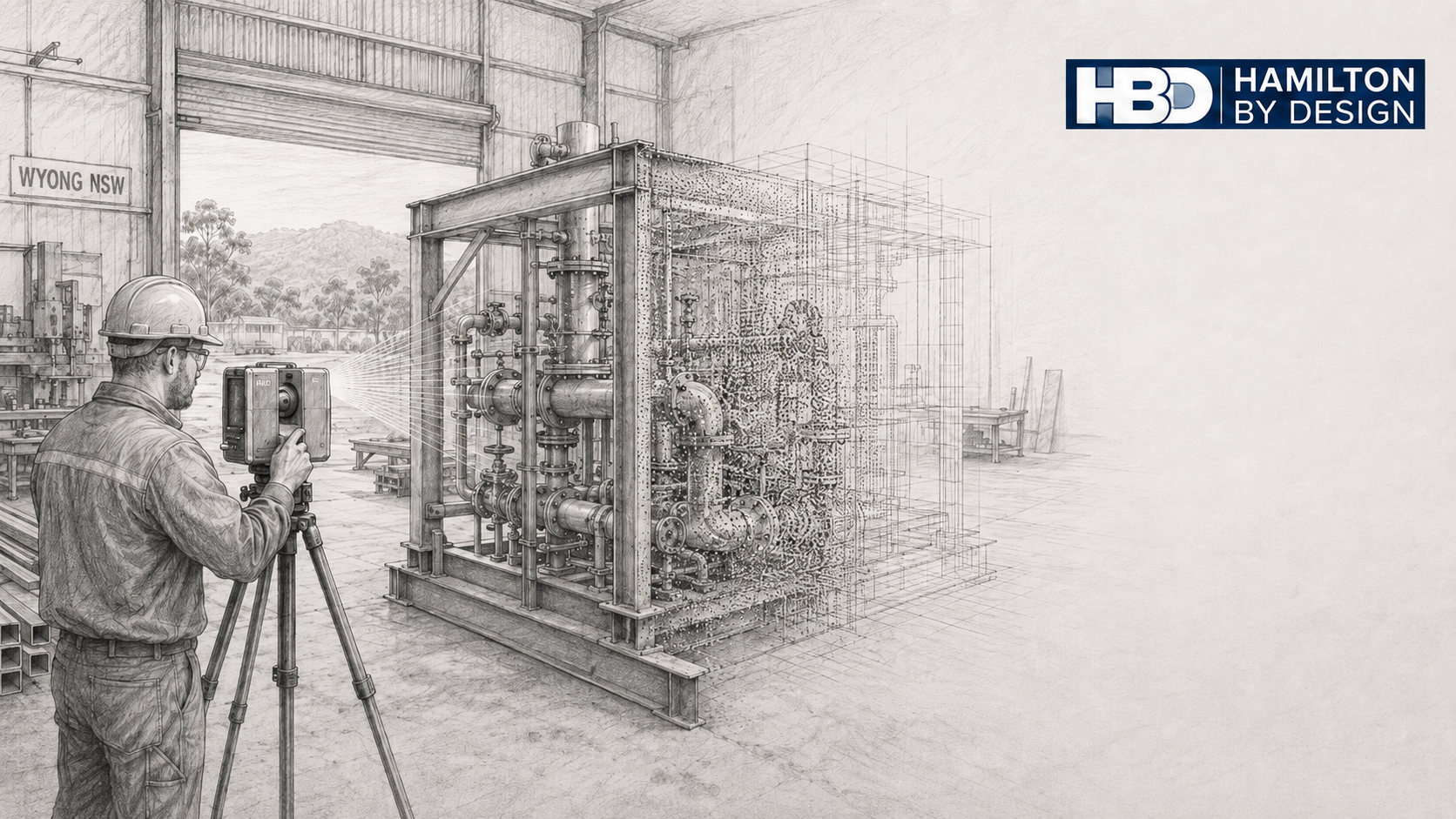
Hamilton By Design provides engineer-led 3D scanning for fabrication in Wyong, supporting local manufacturers, fabricators, maintenance contractors and industrial businesses with accurate site and component measurement.
Using professional 3D laser scanning and scan-to-CAD technology, we capture existing machinery, structural steel, pipework, equipment interfaces and fabricated components. The resulting point-cloud data can be used to develop accurate 3D CAD models, fabrication drawings, replacement parts and installation layouts.
Our Wyong location allows us to provide responsive 3D scanning services throughout North Wyong, Tuggerah, Warnervale, Berkeley Vale, Somersby and the wider NSW Central Coast.
Accurate Measurements for Fabrication Projects
Fabrication projects often rely on measurements taken from existing equipment, buildings or industrial plant.
Traditional manual measurement can be difficult where:
- equipment has complex or curved geometry;
- access is restricted;
- machinery cannot be dismantled;
- original drawings are unavailable;
- existing structures have moved or changed;
- multiple connection points must align;
- fabrication must fit correctly during a limited shutdown.
3D scanning captures the existing conditions as a detailed point cloud. This provides designers and fabricators with a reliable digital record before new components are designed or manufactured.
Supporting Wyong’s Manufacturing and Industrial Businesses
Wyong and the surrounding Central Coast contain an established mix of manufacturers, fabrication workshops, engineering businesses, food-production facilities, equipment suppliers and industrial service providers.
The North Wyong Industrial Estate and nearby industrial areas support businesses involved in:
- machinery and equipment manufacturing;
- metal fabrication and structural steelwork;
- CNC machining;
- filtration and process equipment;
- compressed-air systems;
- construction-product manufacturing;
- food production and packaging;
- pumping and water infrastructure;
- warehousing and materials handling;
- industrial maintenance and plant upgrades.
Hamilton By Design supports these industries by combining 3D scanning with practical mechanical engineering, CAD modelling and fabrication experience.
3D Scanning for Local Fabricators
Fabricators are often asked to manufacture replacement steelwork or equipment for sites where the original dimensions are uncertain.
We can scan the existing installation and capture:
- structural connection locations;
- bolt-hole positions;
- flange faces;
- machinery mounting points;
- pipework interfaces;
- concrete slabs and foundations;
- existing platforms and access structures;
- surrounding equipment and access clearances.
The scan data can then be converted into usable CAD geometry for design and fabrication.
This helps reduce repeated site visits and lowers the risk of components being fabricated from incomplete or inaccurate measurements.
Reverse Engineering of Components
3D scanning can also be used to reverse engineer existing components where drawings or CAD files are unavailable.
Suitable items may include:
- machine guards;
- covers and enclosures;
- brackets and mounting plates;
- cast components;
- pump parts;
- housings;
- chutes and transitions;
- ducts and pipe fittings;
- worn or obsolete components;
- fabricated machine parts.
Depending on the component and required accuracy, we can produce a 3D CAD model suitable for modification, machining, pattern development or fabrication.
Scan-to-CAD Services in Wyong
Point-cloud data can be converted into practical CAD deliverables based on the requirements of the project.
Hamilton By Design can provide:
- SolidWorks models;
- STEP files;
- Parasolid files;
- SAT files;
- AutoCAD drawings;
- DWG and DXF files;
- general arrangement drawings;
- fabrication drawings;
- sections and elevations;
- equipment layouts;
- as-built models;
- point-cloud files.
Common point-cloud formats include E57, RCP, RCS and LAS.
Reducing Fabrication Fit-Up Problems
An incorrect measurement discovered during design can usually be corrected quickly.
The same problem discovered after fabrication may require:
- cutting and re-welding;
- additional workshop labour;
- replacement materials;
- revised drawings;
- transport delays;
- another site visit.
When the problem is discovered during installation, the cost can be considerably higher, particularly where cranes, shutdown crews, permits or restricted site access are involved.
3D scanning helps identify spatial constraints and connection positions earlier, before materials are ordered and components are fabricated.
Fabrication Applications
Our 3D scanning services can support the design and fabrication of:
- structural steel frames;
- platforms and access structures;
- stairs and handrails;
- machinery guards;
- pipe supports;
- equipment bases;
- replacement pipework;
- chutes and hoppers;
- ductwork;
- conveyor modifications;
- tanks and vessels;
- pump skids;
- equipment enclosures;
- brackets and mechanical components.
The service can be used for both new installations and modifications to existing plant.
Machinery and Equipment Installation
New machinery must often be installed into an existing building or production area.
A 3D scan can capture:
- floor and wall positions;
- column locations;
- overhead structures;
- services and pipework;
- door openings;
- access routes;
- existing machines;
- maintenance clearances;
- lifting and installation constraints.
The proposed equipment can then be positioned within the scanned environment to assess fit, access and potential clashes before installation begins.
Food Manufacturing and Packaging Facilities
The wider Wyong, Tuggerah and Berkeley Vale area includes food, consumer-product and packaging operations.
3D scanning can assist with modifications involving:
- conveyors;
- packaging equipment;
- stainless-steel pipework;
- access platforms;
- machine guards;
- tanks and hoppers;
- processing equipment;
- production-line changes;
- equipment relocation;
- utility and service connections.
Scanning can generally be completed with limited physical contact with the equipment, making it useful in operational manufacturing environments.
Chutes, Hoppers and Transfer Stations
Hamilton By Design has practical experience in the design and documentation of bulk-material-handling equipment.
3D scanning can be used to capture:
- existing chute geometry;
- flange and connection positions;
- support structures;
- liner arrangements;
- surrounding conveyors;
- discharge points;
- access restrictions;
- available maintenance space.
The scan data can support the development of replacement chutes, transitions, liners, access doors and surrounding structural modifications.
Pipework and Mechanical Services
Existing pipework can be difficult to measure accurately using tapes and hand-held instruments, particularly where multiple bends, branches and offsets are involved.
3D scanning can capture:
- pipe routes;
- flange locations;
- valve positions;
- equipment connections;
- pipe supports;
- surrounding structures;
- maintenance access;
- potential clashes.
The point cloud can then be used to design replacement pipework or assess a proposed route within the existing plant.
Structural Steel and Existing Buildings
For fabrication associated with existing buildings, the scanner can record:
- columns and beams;
- wall and roof geometry;
- slab levels;
- penetrations;
- connection points;
- existing platforms;
- stairs and handrails;
- nearby equipment.
This information can assist with the design of new steelwork that must connect to or fit around an existing structure.
As-Built and Dimensional Verification
3D scanning can also be used to compare fabricated or installed equipment against the design model.
This may help identify:
- incorrect dimensions;
- missing components;
- misaligned steelwork;
- flange misalignment;
- out-of-position equipment;
- clearance problems;
- deviations from the approved design.
Dimensional verification can be completed before equipment is transported to site or before surrounding work proceeds.
Engineer-Led 3D Scanning
Hamilton By Design provides more than a raw scanning service.
The scanning work is completed with consideration of how the information will be used for:
- mechanical design;
- fabrication;
- installation;
- maintenance;
- reverse engineering;
- drawing production;
- fit-up verification.
This engineering-led approach helps ensure that important interfaces, connections and surrounding constraints are captured during the site visit.
Our 3D Scanning Process
1. Project Review
We discuss the component, machinery or site area to be scanned and identify the required final deliverables.
2. Site or Component Scanning
The equipment or work area is captured using appropriate 3D scanning technology.
3. Point-Cloud Registration
Individual scans are combined into a coordinated point-cloud dataset.
4. CAD Modelling
Required equipment, components or structures are modelled from the point cloud.
5. Drawings and Deliverables
The agreed CAD files, drawings or point-cloud formats are prepared and issued.
Information Required for a Quotation
To prepare a quotation, it is helpful to provide:
- photographs of the component or site;
- approximate dimensions;
- the Wyong or Central Coast site location;
- the required CAD format;
- the intended use of the scan;
- required drawing deliverables;
- site-access restrictions;
- preferred timing;
- available existing drawings.
For smaller components, the item may also be delivered or posted to our NSW location for scanning.
Areas We Service
Hamilton By Design provides 3D scanning for fabrication throughout:
- Wyong;
- North Wyong;
- Tuggerah;
- Warnervale;
- Wadalba;
- Lake Haven;
- Charmhaven;
- Berkeley Vale;
- Somersby;
- Lisarow;
- Gosford;
- the wider NSW Central Coast.
We can also travel throughout Sydney, Newcastle, the Hunter Valley and regional NSW.
Why Choose Hamilton By Design?
- Local Central Coast engineering support
- Engineer-led 3D scanning
- Practical fabrication and machining experience
- SolidWorks and AutoCAD capability
- Point-cloud-to-CAD modelling
- Reverse engineering services
- Fabrication and general arrangement drawings
- Experience with industrial and brownfield environments
- Flexible deliverables to suit designers and fabricators
Request a Quote for 3D Scanning in Wyong
Accurate site and component information can reduce fabrication uncertainty, minimise rework and improve installation fit-up.
Contact Hamilton By Design to discuss 3D scanning for fabrication in Wyong.
Please include photographs, approximate dimensions, the project location and the required CAD or drawing format.
Hamilton By Design
Mechanical Engineering, 3D Scanning and Scan-to-CAD Services
Wyong and the NSW Central Coast

Talk to Us – Contact Us
Hamilton By Design can assist with 3D scanning, point cloud capture, CAD modelling, fabrication drawing support and site fit-up verification.
Our clients:
























