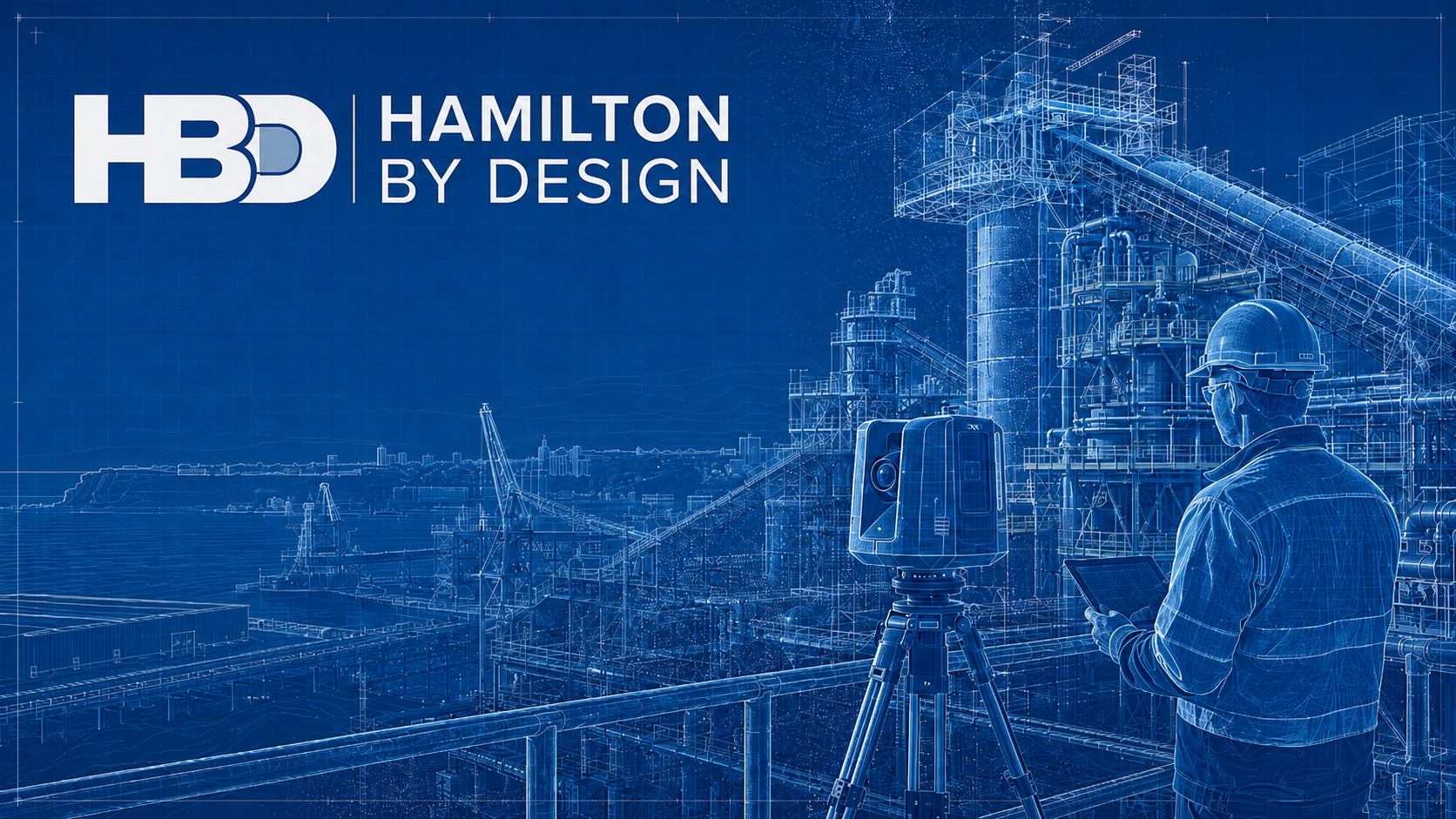
Hamilton By Design provides engineer-led 3D scanning for fabrication projects across Newcastle and the Hunter Region.
We capture existing structural steel, pipework, conveyors, machinery, platforms and connection points so proposed fabricated components can be designed and checked against actual site conditions before manufacture.
This approach is particularly valuable for brownfield industrial projects where original drawings may be unavailable, outdated or inconsistent with the existing installation.
By capturing the surrounding site geometry before fabrication begins, potential clashes, incorrect dimensions and installation difficulties can be identified while changes are still relatively simple to make.
3D Scanning Support for Newcastle Fabricators
Our scanning services can support:
- structural steel fabricators;
- mechanical contractors;
- pipe spool fabricators;
- conveyor and materials-handling suppliers;
- industrial maintenance contractors;
- engineering consultancies;
- equipment manufacturers;
- shutdown contractors;
- project managers;
- asset owners.
The point cloud can be used as a dimensional reference for 3D modelling, design development, fabrication detailing and fit-up verification.
For more information about the overall process, applications and available scanning technologies, visit our main 3D Scanning for Fabrication service page.
Newcastle Fabrication Projects Suited to 3D Scanning
Structural Steel Fabrication
3D scanning can capture the existing steelwork surrounding a proposed platform, access stair, equipment support, pipe bridge or machinery installation.
The point cloud can be used to identify:
- column and beam locations;
- flange faces;
- connection points;
- floor and platform levels;
- existing bolt patterns;
- handrail interfaces;
- nearby pipework and services;
- available installation clearances.
This information can then support the development of general arrangements, 3D fabrication models and installation drawings.
Pipe Spool Fabrication
Existing industrial pipework is not always positioned exactly as shown on older drawings.
Pipe runs may have been modified during previous maintenance work, and flange positions, rotations or centreline elevations may differ from the original design.
3D scanning can capture:
- pipe centreline positions;
- flange locations and orientation;
- equipment nozzles;
- valve locations;
- pipe-rack interfaces;
- structural obstructions;
- surrounding services;
- installation clearances.
This can be particularly useful when fabricating replacement pipe spools for shutdowns or connecting new pipework to existing plant.
Conveyor and Bulk-Materials-Handling Fabrication
Newcastle and the Hunter Region contain significant port, mining, manufacturing and bulk-material-handling infrastructure.
3D scanning can assist with the design and fabrication of:
- conveyor transfer chutes;
- hoppers and bins;
- loading zones;
- conveyor skirts;
- guards;
- wear liners;
- access platforms;
- equipment supports;
- replacement conveyor components;
- maintenance structures.
Capturing the surrounding structure and equipment allows proposed components to be positioned within the point cloud before fabrication begins.
Replacement and Reverse-Engineered Fabrication
Where reliable drawings are unavailable, scanning can provide a dimensional reference for replacement:
- machinery guards;
- equipment covers;
- steel frames;
- duct transitions;
- access platforms;
- brackets;
- pipe supports;
- fabricated housings;
- large welded assemblies;
- corroded structural components.
Critical holes, machined surfaces, press fits and precision interfaces may also require supplementary manual measurements or conventional metrology.
Port and Bulk-Handling Fabrication in Newcastle
Newcastle’s port and industrial precincts contain complex interfaces between conveyors, structural steel, pipework, mechanical equipment and existing services.
Terrestrial laser scanning allows these areas to be captured from multiple positions without relying only on tape measurements or isolated site dimensions.
The resulting point cloud can support projects involving:
- conveyor modifications;
- transfer chute replacements;
- shiploader and unloader interfaces;
- maintenance platforms;
- replacement guards;
- pipe-rack modifications;
- corroded steel replacement;
- handrail upgrades;
- equipment support frames;
- access improvements.
Scanning can also help identify surrounding obstructions that may affect installation, lifting or future maintenance access.
Supporting Newcastle and Hunter Industrial Precincts
Hamilton By Design can support fabrication projects throughout Newcastle and the wider Hunter Region, including:
- Newcastle;
- Mayfield;
- Carrington;
- Kooragang;
- Walsh Point;
- Hexham;
- Tomago;
- Beresfield;
- Thornton;
- Cardiff;
- Cameron Park;
- Lake Macquarie;
- Maitland;
- Raymond Terrace;
- Singleton;
- Muswellbrook.
These areas include heavy engineering, port infrastructure, manufacturing, mining support, bulk handling, process facilities and industrial maintenance activities.
3D Scanning for Hunter Valley Mining Fabrication
Newcastle and the Hunter are major engineering and fabrication centres supporting mines, coal handling and preparation plants and materials-handling facilities throughout the Hunter Valley.
3D scanning can support the fabrication of:
- CHPP chute replacements;
- conveyor components;
- pump skids;
- pipe spools;
- maintenance platforms;
- crusher and screen access structures;
- equipment bases;
- guards;
- wear liners;
- replacement steelwork.
Capturing the existing site before detailing begins can reduce the risk of incorrect interfaces being discovered during transport, shutdown or installation.
Marine and Waterfront Fabrication
3D scanning may also assist with fabrication projects around marine, waterfront and port facilities.
Applications may include:
- wharf equipment interfaces;
- marine access platforms;
- ladders;
- stairs;
- handrails;
- pipe supports;
- replacement brackets;
- service connections;
- loading equipment;
- maintenance structures.
Terrestrial scanning is generally suited to visible, above-water geometry where safe line of sight and scanner positioning can be achieved.
Capturing Corroded Structures Before Replacement
Port, coastal and industrial sites can experience corrosion of structural steel, platforms, guards, handrails and equipment supports.
Where a component requires replacement, scanning can record:
- the surrounding steelwork;
- remaining connection points;
- nearby pipework;
- access restrictions;
- floor and platform levels;
- equipment clearances;
- installation constraints.
The captured information can then be used to develop a like-for-like replacement or a modified design that improves access, maintainability or separation between dissimilar materials.
Example: Replacement Conveyor Platform in Newcastle
An existing conveyor access platform requires replacement due to corrosion and changes to the surrounding equipment.
The original drawings do not show several pipework, guarding and electrical modifications completed during previous maintenance work.
Hamilton By Design scans the existing platform, supporting steelwork, conveyor structure, floor levels, pipework and surrounding services.
The proposed replacement platform can then be modelled within the registered point cloud to confirm:
- support positions;
- stair clearance;
- handrail connections;
- conveyor access;
- pipework clashes;
- installation space;
- transport section sizes;
- site welding requirements.
This allows the fabrication package to be developed around the existing site rather than relying only on historical drawings or isolated manual measurements.
From Newcastle Site Scan to Fabrication Information
1. Review the Fabrication Scope
We review available drawings, sketches, photographs, proposed equipment and the required project deliverables.
2. Capture the Existing Site
The relevant structure, pipework, equipment and connection points are scanned from multiple positions.
3. Register and Review the Point Cloud
The individual scans are aligned into a coordinated point-cloud dataset and checked for suitable coverage.
4. Develop the Required CAD Information
Depending on the agreed scope, the point cloud can support:
- existing-condition CAD models;
- interface geometry;
- general arrangements;
- sections and elevations;
- fabrication models;
- installation drawings;
- clash-review models.
5. Check the Proposed Fabrication
The proposed component or assembly can be positioned within the point cloud to review surrounding interfaces, access and potential clashes before manufacture.
Available Deliverables
Depending on the project scope, Hamilton By Design can provide:
- registered point-cloud data;
- E57 files;
- Autodesk ReCap RCP or RCS files;
- LAS point clouds;
- SolidWorks parts and assemblies;
- STEP files;
- SAT files;
- Parasolid files;
- AutoCAD DWG or DXF drawings;
- general arrangements;
- sections and elevations;
- fabrication drawing support;
- interface and clash-review geometry.
The required deliverables should be agreed before scanning so the necessary coverage, modelling detail and dimensional requirements are clearly understood.
Why Use an Engineer-Led Scanning Service?
The scanning process should be planned around the fabrication problem rather than simply capturing the largest possible area.
Before scanning begins, consideration can be given to:
- critical connection points;
- fabrication interfaces;
- surrounding obstructions;
- installation routes;
- maintenance access;
- required modelling detail;
- precision requirements;
- final file formats.
This helps ensure the captured data is useful for the intended design and fabrication workflow.
3D Scanning Accuracy for Fabrication
The practical accuracy of a completed point-cloud dataset depends on:
- scanner position;
- distance to the measured surface;
- line of sight;
- surface condition;
- registration method;
- project scale;
- environmental conditions.
Individual terrestrial scans can capture suitable surfaces at millimetre-level detail. However, the final accuracy of a complete registered dataset will depend on site conditions and the required project tolerance.
Critical holes, machined faces, flange interfaces and precision fits may require additional manual verification.
Frequently Asked Questions
Can you scan operating industrial facilities around Newcastle?
Yes, subject to site access, inductions, permits, exclusion zones and safe scanner positioning. Some areas may need to be captured during a shutdown.
Can you scan before a Hunter Valley shutdown?
Yes. Scanning before a shutdown can allow replacement components and pipework to be modelled and checked before the existing equipment is removed.
Can the point cloud be supplied to our fabrication workshop?
Yes. Point clouds and CAD reference files can be supplied in agreed formats for use by fabricators, designers and engineering contractors.
Can you check our SolidWorks model against the existing site?
Yes. Proposed CAD geometry can be positioned within the registered point cloud to identify potential clashes and interface problems.
Can you produce fabrication drawings from the scan?
Yes, where fabrication drawings are included within the agreed project scope.
Does the scanner need to touch the equipment?
No. Terrestrial laser scanning is a non-contact measurement process. However, the scanner requires suitable line of sight to the surfaces being captured.
Do you travel to Singleton and Muswellbrook?
Yes. Hamilton By Design can support projects across Newcastle, the Hunter Valley and surrounding industrial areas.
Planning a Fabrication Project in Newcastle?
Send Hamilton By Design your available sketches, photographs, drawings and required installation timeframe.
We can review the project and recommend an appropriate scanning, point-cloud and CAD-deliverable scope.
Newcastle 3D Scanning and Fabrication Support
Hamilton By Design supports port, mining, manufacturing, process-plant and heavy-engineering fabrication projects across Newcastle and the Hunter Region.
Contact us to discuss site scanning, point-cloud processing, scan-to-CAD modelling and fabrication fit-up verification.

Talk to Us – Contact Us
Hamilton By Design can assist with 3D scanning, point cloud capture, CAD modelling, fabrication drawing support and site fit-up verification.
Our clients: