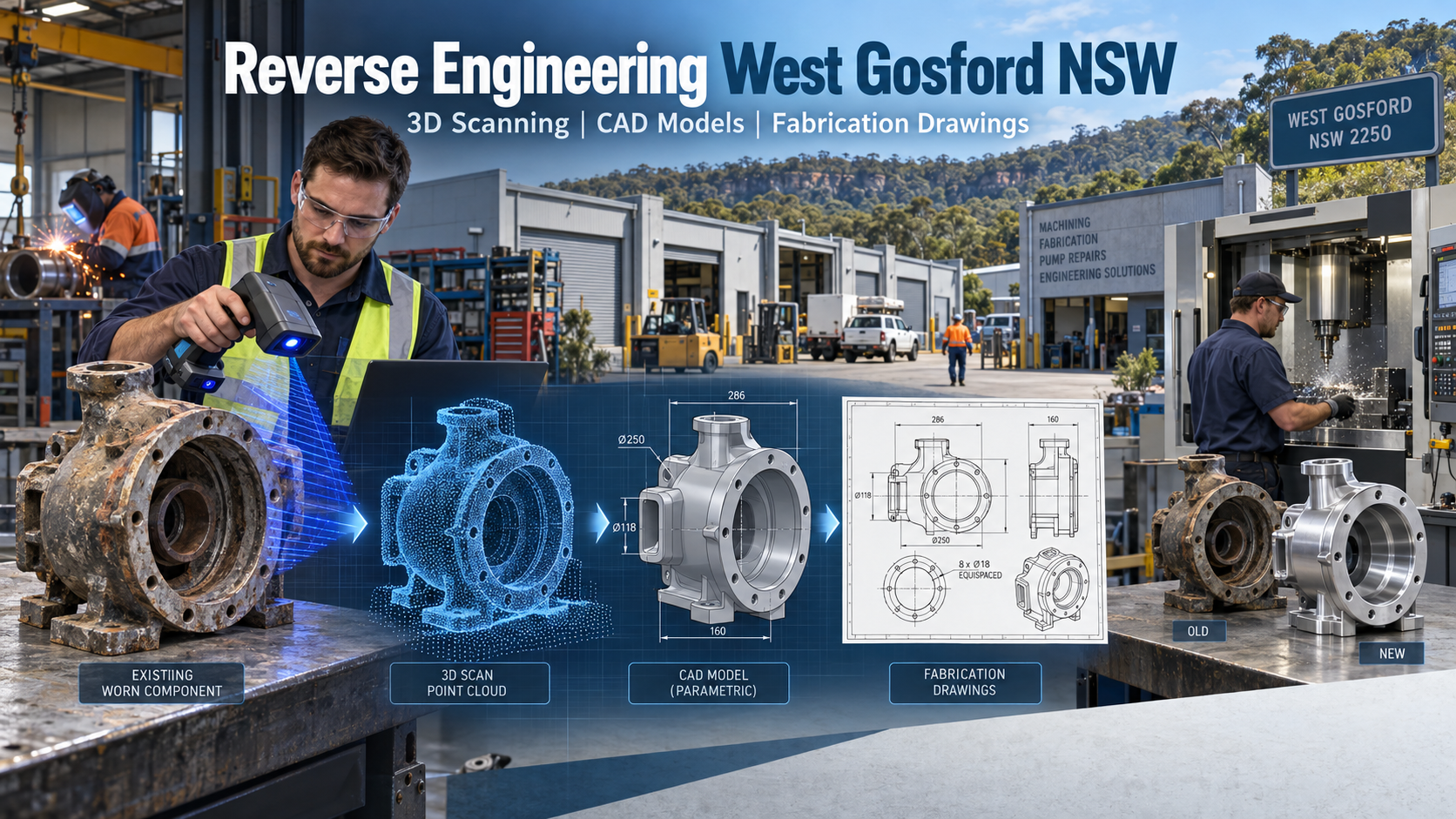
Reverse Engineering for Mining and Industrial Equipment: Extending Asset Life

Engineering-grade reverse engineering workflow showing LiDAR scanning, CAD modelling, and FEA analysis used to recreate industrial equipment components.

Mining and industrial facilities often operate equipment for many years beyond its original installation date. Over time, machinery evolves through repairs, modifications, upgrades, and changing operational requirements. While equipment may continue performing effectively, obtaining replacement components can become increasingly difficult.

One of the most common challenges faced by industrial operations is finding replacement parts for ageing equipment where:

  • Original equipment manufacturers (OEMs) no longer support the product
  • Engineering drawings are unavailable
  • Documentation has been lost
  • Components have become obsolete
  • Lead times are excessive
  • Full equipment replacement becomes expensive

In these situations, reverse engineering can provide a practical pathway to maintain equipment performance and extend asset life.

At Hamilton By Design, we support mining and industrial operations through engineering-grade reverse engineering workflows incorporating 3D LiDAR scanning, CAD modelling, engineering analysis, and fabrication-ready documentation.

What is Reverse Engineering?

Reverse engineering involves capturing and analysing an existing component or system to recreate accurate engineering information.

Rather than starting from a new concept design, the process begins with an existing asset and develops:

  • Digital geometry
  • Engineering drawings
  • CAD models
  • Dimensional information
  • Design documentation
  • Manufacturing information

The goal is creating accurate engineering data that supports maintenance, fabrication, and equipment improvement.

Why Mining and Industrial Operations Use Reverse Engineering

Many industrial facilities contain equipment that may have operated for decades.

Examples include:

  • Conveyors
  • Transfer chutes
  • Pumps
  • Crushers
  • Structural components
  • Wear liners
  • Shafts
  • Fabricated assemblies
  • Mechanical components
  • Materials handling systems

As equipment ages, facilities can encounter increasing challenges obtaining replacement parts.

3D CAD Modelling Australia service banner for Hamilton By Design

Common issues include:

  • Obsolete components
  • Long manufacturing lead times
  • Missing drawings
  • Unknown modifications
  • Reduced OEM support
  • Increased maintenance costs

Reverse engineering helps bridge this information gap.

Obsolete Components and Missing Documentation

A common situation occurs when maintenance teams identify a failed component but no manufacturing information exists.

Examples may include:

  • Worn shafts
  • Custom brackets
  • Conveyor components
  • Pump assemblies
  • Structural items
  • Wear components

Without engineering information, organisations may face:

  • Extended downtime
  • Emergency fabrication
  • Manual measurement errors
  • Increased costs

Reverse engineering can convert physical components into accurate engineering data.

Extending Equipment Life

Full equipment replacement is not always necessary.

In many situations:

  • The surrounding system remains functional
  • Only selected components require replacement
  • Minor improvements may improve performance
  • Existing equipment can continue operating effectively

Extending equipment life may provide:

  • Lower capital expenditure
  • Reduced project risk
  • Reduced downtime
  • Improved return on investment
  • Improved operational continuity

Replacement Part Creation

Hamilton By Design can support replacement component development through engineering workflows including:

Existing Condition Capture

Capture existing equipment using:

  • Engineering-grade LiDAR scanning
  • Physical measurements
  • Dimensional verification

CAD Modelling

Develop:

  • Editable CAD models
  • Mechanical assemblies
  • Manufacturing information

Engineering Drawings

Generate:

  • General arrangement drawings
  • Fabrication drawings
  • Manufacturing documentation

Engineering Validation

Support projects through:

  • Design assessment
  • Engineering analysis
  • Finite Element Analysis (FEA)
  • Structural validation

Reducing Downtime

Unexpected equipment failures can significantly affect production.

Potential impacts may include:

  • Lost production
  • Shutdown delays
  • Increased labour requirements
  • Emergency maintenance costs
  • Reduced operational efficiency

Reverse engineering can support maintenance planning by creating:

  • Digital spare part libraries
  • Engineering records
  • Manufacturing information
  • Improved replacement processes

This allows organisations to move from reactive responses toward more structured asset management.

Cost Versus Full Equipment Replacement

Replacing an entire system can involve:

  • High capital cost
  • Long procurement timeframes
  • Installation costs
  • Production interruptions
  • Project risk

Reverse engineering may provide an alternative where:

  • Existing equipment remains suitable
  • Only selected components require replacement
  • Performance improvements can be introduced

Engineering decisions can then focus on lifecycle value rather than simply replacing complete systems.

Industrial Applications

Reverse engineering can support:

Mining Operations

  • Conveyor systems
  • Transfer chutes
  • Crushers
  • Pump systems
  • Structural assets
  • Processing equipment

Manufacturing Facilities

  • Production equipment
  • Mechanical assemblies
  • Custom components

Industrial Processing Plants

  • Wear components
  • Mechanical equipment
  • Plant modifications
  • Existing assets
3D LiDAR scanning and 3D modelling service button โ€” laser scanner capturing a point cloud for engineering and CAD modelling
Mechanical engineering services

How Hamilton By Design Supports Reverse Engineering Projects

Hamilton By Design combines engineering tools and practical engineering experience to support reverse engineering projects through:

  • Engineering-grade 3D LiDAR scanning
  • Scan-to-CAD workflows
  • Mechanical design
  • CAD modelling
  • Engineering analysis and FEA
  • Fabrication documentation
  • Existing condition verification

The objective is not simply reproducing a component.

The objective is creating reliable engineering information that supports productivity, maintenance, and long-term asset performance.

Engineering-grade reverse engineering helps transform ageing assets from a limitation into an opportunity for improved operational performance.

Our Clients:

Why Existing Conditions Matter: Reducing Safety Risks with Engineering-Grade LiDAR Scanning

Engineering-grade LiDAR scanning workflow showing how existing condition capture reduces safety risks through clash detection, scan-to-CAD modelling, engineering analysis, and improved shutdown planning in industrial facilities.

Industrial projects are often built around a simple assumption:

“The existing drawings are correct.”

Unfortunately, in many industrial facilities that assumption can introduce significant risk.

Mining plants, processing facilities, manufacturing sites, and timber processing operations commonly undergo years or decades of modifications. Equipment changes, structural additions, maintenance alterations, temporary fixes, and undocumented upgrades can gradually move facilities away from their original engineering documentation.

When engineering decisions are based on outdated drawings or manual measurements, project teams may unknowingly introduce safety risks that affect shutdown activities, maintenance work, and plant upgrades.

At Hamilton By Design, engineering-grade LiDAR scanning supports safer project outcomes by replacing assumptions with measurable site information.

Why Existing Conditions Matter

Existing conditions represent the actual site environment rather than what historical drawings suggest exists.

In industrial environments, discrepancies can develop through:

  • Historical modifications
  • Unrecorded changes
  • Structural alterations
  • Equipment replacements
  • Temporary repairs becoming permanent solutions
  • Missing documentation
  • Inaccurate field measurements

A few centimetres of difference can appear minor on a drawing but become significant when:

  • Installing new equipment
  • Modifying conveyor systems
  • Designing platforms
  • Routing pipework
  • Planning shutdown activities
  • Fabricating structural steel

Small errors can create larger project impacts.

Safety Risks Created by Inaccurate Information

Assumptions can introduce several operational and safety challenges.

3D CAD Modelling Australia service banner for Hamilton By Design

Examples include:

Restricted Access Areas

Access routes may differ from original layouts, creating:

  • Maintenance access issues
  • Congestion
  • restricted clearances
  • Manual handling risks

Equipment Clashes

New designs based on incorrect information may result in:

  • Structural clashes
  • Pipework interferences
  • Equipment conflicts
  • Installation delays

Increased Exposure During Shutdown Activities

Shutdown periods often involve:

  • Tight schedules
  • Multiple work groups
  • Limited access windows
  • High activity levels

Unexpected site conditions discovered during shutdowns can increase:

  • Time pressure
  • Additional field modifications
  • Safety exposure
  • Project costs

Brownfield Projects Present Additional Challenges

Brownfield environments rarely match original design documentation.

Common challenges include:

  • Congested plant layouts
  • Existing services
  • Structural interferences
  • Legacy equipment
  • Multiple generations of modifications

Designing around assumptions in these environments increases uncertainty.

Existing Condition Capture Using Engineering-Grade LiDAR

Engineering-grade LiDAR scanning captures existing conditions by collecting highly accurate site geometry and generating point cloud data.

Capture can include:

  • Structural steel
  • Platforms
  • Conveyors
  • Pipework
  • Equipment
  • Buildings
  • Access systems
  • Existing plant layouts

Rather than relying solely on manual measurements, project teams gain access to measurable site information.

Benefits can include:

  • Improved accuracy
  • Existing condition verification
  • Better planning
  • Reduced uncertainty
  • Reduced installation risk

Clash Detection Before Construction

Once captured, point cloud information can be integrated into engineering workflows.

Scan-to-CAD processes allow:

  • Existing condition modelling
  • Design development
  • Clash detection
  • Constructability reviews
  • Layout optimisation

Potential problems can be identified before fabrication and site installation begin.

Finding issues digitally generally costs less than discovering them during construction activities.

Supporting Shutdown Planning

Shutdown windows are often measured in hours or days rather than weeks.

Unexpected field discoveries can quickly affect:

  • Production schedules
  • Labour requirements
  • Equipment availability
  • Project budgets

LiDAR scanning can support shutdown planning by:

  • Capturing actual site conditions
  • Identifying access restrictions
  • Verifying equipment locations
  • Improving work sequencing
  • Supporting prefabrication

Better information often leads to more predictable project execution.

Reducing Site Rework

Rework commonly results from:

  • Inaccurate dimensions
  • Design clashes
  • Existing condition errors
  • Fabrication mismatches

Reducing rework can improve:

  • Safety performance
  • Project schedules
  • Labour efficiency
  • Installation outcomes
  • Overall project cost

How Hamilton By Design Supports Safer Industrial Projects

Hamilton By Design combines practical engineering experience with digital engineering workflows to support safer project delivery.

Services can include:

Engineering-Grade LiDAR Scanning

Capture accurate site geometry and existing conditions.

Scan-to-CAD Workflows

Convert point cloud information into:

  • Editable CAD models
  • Engineering drawings
  • Existing condition layouts

Engineering Analysis

Support project decisions through:

  • Design validation
  • Engineering reviews
  • Structural assessment
  • Simulation and analysis
3D LiDAR scanning and 3D modelling service button โ€” laser scanner capturing a point cloud for engineering and CAD modelling
Mechanical engineering services

Engineering Documentation

Deliver:

  • General arrangement drawings
  • Fabrication drawings
  • Engineering models
  • Project information

Moving Beyond Assumptions

Existing conditions influence safety, constructability, and project outcomes.

When projects rely on assumptions rather than measurable information, risks can increase.

Engineering-grade LiDAR scanning helps organisations move from:

Estimated conditions โ†’ Verified conditions

The result is improved confidence, reduced risk, safer project execution, and better engineering decisions.

Finite Element Analysis (FEA) engineering simulation button
Mechanical engineering services

Engineering Standards & Condition Monitoring: Supporting Reliability in Timber and Mining Operations

Engineering-grade LiDAR scanning, condition monitoring, and FEA analysis workflow for timber processing and mining equipment reliability.

Industries such as timber processing and mining operate in demanding environments where equipment reliability directly affects productivity, maintenance costs, and operational performance. Conveyor systems, transfer chutes, rotating equipment, processing machinery, structural assets, and supporting infrastructure are often exposed to continuous loading, wear, vibration, fatigue, and harsh operating conditions.

While machinery failures may appear sudden, many develop gradually through changes in operating conditions, deterioration, or inadequate monitoring and maintenance practices.

Engineering standards and condition monitoring help organisations move from reactive maintenance toward informed engineering decisions and improved asset performance.

At Hamilton By Design, we support mining and timber processing industries through engineering-led approaches that combine engineering standards, digital engineering workflows, reality capture technologies, and practical engineering solutions.

Why Engineering Standards Matter

Engineering standards provide a structured framework for designing, assessing, operating, and maintaining equipment.

Standards help organisations achieve:

  • Improved safety
  • Greater consistency
  • Reduced risk
  • Improved reliability
  • Better maintenance planning
  • Regulatory compliance
  • Improved operational performance

Examples of standards commonly applied within industrial projects may include:

Structural and Mechanical Standards

  • AS 4100 โ€“ Steel structures
  • AS 1170 โ€“ Structural design actions
  • AS 3996 โ€“ Access covers and grates
  • AS 1657 โ€“ Fixed platforms, walkways, stairways and ladders
  • AS 1554 โ€“ Structural welding

Asset and Equipment Considerations

  • Fatigue assessment
  • Structural integrity
  • Mechanical reliability
  • Equipment life assessment
  • Materials handling performance

Engineering standards support more than design compliance. They help establish long-term operational reliability.

What is Condition Monitoring?

Condition monitoring involves collecting information about equipment performance and asset condition to identify potential issues before failures occur.

Rather than waiting for breakdowns, monitoring allows maintenance and engineering teams to make decisions using measurable data.

Condition monitoring can involve:

  • Equipment inspections
  • Structural assessments
  • Wear monitoring
  • Vibration monitoring
  • Alignment assessment
  • Existing condition capture
  • Thermal assessments
  • Trend analysis
  • Performance assessment

The objective is identifying deterioration before operational impacts occur.

Timber Industry Applications

Timber processing facilities operate continuously with significant material handling demands.

Common assets include:

  • Log conveyors
  • Timber handling systems
  • Chippers
  • Screening systems
  • Structural platforms
  • Transfer systems
  • Processing machinery

Typical challenges may include:

  • Equipment wear
  • Misalignment
  • Build-up
  • Fatigue
  • Structural deterioration
  • Conveyor performance issues

Engineering monitoring and assessment can improve:

  • Throughput
  • Reliability
  • Maintenance planning
  • Downtime reduction
  • Equipment life

Mining Industry Applications

Mining operations often involve harsh operating environments and heavy-duty equipment subjected to high loading conditions.

Applications can include:

  • Conveyor systems
  • Transfer chutes
  • Processing plants
  • Crushers
  • Pump systems
  • Structural assets
  • Materials handling systems

Common challenges may include:

  • Wear
  • Fatigue loading
  • Structural movement
  • Equipment deterioration
  • Production interruptions

Condition monitoring allows operational teams to move toward predictive maintenance approaches rather than emergency repairs.

How Hamilton By Design Supports Engineering Standards and Condition Monitoring

Hamilton By Design supports projects through a combination of engineering tools and practical experience.

Our services can include:

Engineering-Grade 3D LiDAR Scanning

Capture accurate existing conditions and generate point cloud information for:

  • Existing plant geometry
  • Structural assessment
  • Brownfield modifications
  • Asset verification
3D CAD Modelling Australia service banner for Hamilton By Design

Scan-to-CAD Workflows

Convert site information into:

  • Editable engineering models
  • Existing condition documentation
  • Engineering drawings

Engineering Analysis and Simulation

Support asset assessments through:

  • Finite Element Analysis (FEA)
  • Structural assessments
  • Load analysis
  • Design validation

Engineering Documentation

Deliver:

  • Drawings
  • Assessment reports
  • Design documentation
  • Asset information
3D LiDAR scanning and 3D modelling service button โ€” laser scanner capturing a point cloud for engineering and CAD modelling
Mechanical engineering services

Supporting Long-Term Asset Performance

Successful operations are not built around simply repairing equipment after failure.

Long-term value often comes from:

  • Improved reliability
  • Reduced maintenance costs
  • Better planning
  • Increased productivity
  • Reduced downtime
  • Improved asset life
  • Better engineering decisions

By combining engineering standards, condition monitoring, digital engineering workflows, and practical engineering solutions, organisations can move beyond assumptions and improve operational performance.

Hamilton By Design supports timber processing and mining industries by helping transform engineering information into practical decisions and measurable outcomes.

Hamilton By Design logo displayed on a blue tilted rectangle with a grey gradient background
Name
Would you like us to arrange a phone consultation for you?
Address

Our Clients:

Why Qualified Engineering Sign-Off Matters in the Timber, Forestry and Industrial Processing Industries

nfographic-style industrial engineering poster by Hamilton By Design showing why qualified engineering sign-off matters in the timber, forestry and industrial processing industries. The image includes a sawmill facility with conveyors, log handling systems, engineering risk assessments, SOLIDWORKS Simulation FEA analysis and 3DEXPERIENCE engineering governance workflows.

Across Australiaโ€™s forestry, sawmill and timber processing industries, industrial infrastructure continues to evolve through ongoing maintenance, shutdown upgrades, plant expansions and operational modifications. Conveyor systems are extended, timber transfer systems are upgraded, structural steel platforms are altered, machinery is relocated and new processing equipment is integrated into ageing brownfield facilities that may have operated continuously for decades.

While many of these changes are often completed to improve productivity or maintain operational continuity, one of the greatest hidden risks within industrial environments is modifying or designing plant equipment without proper engineering review, engineering governance and qualified engineering sign-off.

In many industrial workplaces, practical trade experience is highly respected โ€” and rightly so. Skilled tradespeople are essential to fabrication, installation, shutdown works, plant maintenance and operational reliability. However, building something that functions mechanically is not the same as engineering a system that is safe, compliant, reliable and suitable for long-term industrial operation.

This distinction becomes critically important in industries such as forestry, logging and timber processing where machinery regularly handles heavy loads, rotating equipment, moving conveyors, unstable timber products, stored energy and high-throughput material handling systems.

Across sawmills and timber processing facilities throughout Australia, industrial systems are exposed to continuous operational stresses involving vibration, shock loading, impact forces, moisture, abrasive materials, dust contamination and changing environmental conditions. Conveyor systems, debarkers, screw augers, bucket elevators, log transfer systems and structural platforms must all operate safely while supporting continuous production under demanding industrial conditions.

3D CAD Modelling Australia service banner for Hamilton By Design

Without proper engineering consideration, even seemingly simple modifications can introduce serious risk.

Over the past several decades, Australian workplace regulators and courts have repeatedly prosecuted companies following incidents involving timber handling systems, conveyors, rotating shafts, sawmill machinery and plant modifications that failed to adequately consider engineering safety requirements.

In one Victorian timber mill incident, a worker died after becoming entangled in a conveyor drive shaft. WorkSafe Victoria later found that engineering controls and guarding solutions were reasonably practicable and could have prevented the fatality. In Western Australia, a timber processing company was fined after a worker suffered catastrophic arm injuries involving inadequately guarded conveyor equipment. In Queensland, a timber company faced prosecution after a worker was killed by a log ejected from a debarker machine.

Although each incident involved different operational circumstances, the underlying engineering failures followed remarkably similar patterns:

  • inadequate guarding,
  • unengineered plant modifications,
  • failure to consider loads and moving forces,
  • unsafe maintenance access,
  • missing isolation procedures,
  • poor risk assessment,
  • insufficient structural verification,
  • lack of engineering review,
  • and failure to identify foreseeable operational hazards.

These are engineering failures โ€” not simply fabrication problems.

A tradesperson may know how to weld, fabricate, cut or assemble industrial equipment, but engineering requires a much deeper understanding of how systems behave under operational conditions over time.

Proper engineering design must consider:

  • static and dynamic loading,
  • fatigue and cyclic stresses,
  • vibration,
  • structural deflection,
  • torque and rotational forces,
  • impact loading,
  • material behaviour,
  • wear characteristics,
  • human interaction with machinery,
  • guarding requirements,
  • maintainability,
  • failure modes,
  • constructability,
  • Australian Standards compliance,
  • and long-term operational reliability.

This is why qualified engineering sign-off matters.

Engineering sign-off is not simply a signature placed on a drawing. It represents professional accountability that the design has been reviewed, assessed and verified against engineering principles, foreseeable operational conditions and applicable standards.

Without proper engineering oversight, industrial businesses expose themselves to major commercial, operational and legal risk.

Poorly engineered modifications can lead to:

  • worker injury or fatalities,
  • structural failure,
  • conveyor collapse,
  • equipment damage,
  • production downtime,
  • voided insurance claims,
  • failed audits,
  • regulatory prosecution,
  • expensive shutdown rework,
  • project delays,
  • and reputational damage.

In many industrial facilities, the risk develops gradually over time. Equipment modifications are often completed during shutdowns or urgent maintenance periods where production pressure overrides long-term engineering review. Small undocumented changes accumulate over years until facilities no longer reflect their original engineered design intent.

Drawings become outdated.
Loads change.
Access paths are altered.
Equipment is relocated.
Platforms are modified.
Conveyors are extended.
Additional services are added.

Over time, facilities can drift significantly away from their original engineered condition.

This is where engineering governance becomes critically important.

At Hamilton By Design, we are an engineer-led organisation focused on delivering engineered outcomes rather than simply trade-based solutions.

While practical trade experience remains essential within industrial environments, our approach extends beyond fabrication and installation alone. We apply engineering thinking, digital engineering workflows and industrial experience to support long-term operational reliability, constructability and risk reduction.

Using engineering-grade 3D laser scanning, terrestrial LiDAR capture and scan-to-CAD workflows, we help industrial clients establish accurate as-built conditions before design or fabrication work begins.

Rather than relying on outdated PDFs or manual measurements, project teams gain access to highly accurate point cloud data that reflects real-world plant conditions. This allows engineers, fabricators and project managers to identify operational risks earlier and improve confidence before fabrication or construction begins.

Engineering-grade point clouds can then be converted into detailed CAD models suitable for:

  • structural analysis,
  • equipment integration,
  • plant upgrades,
  • fabrication detailing,
  • conveyor layouts,
  • clash detection,
  • and engineering verification.

One of the major advantages of modern digital engineering workflows is the ability to perform engineering validation before equipment is manufactured or installed onsite.

Using SOLIDWORKS Simulation and Finite Element Analysis (FEA), industrial components and structures can be digitally tested under operational loading conditions to assess how equipment may behave before fabrication occurs.

FEA allows engineers to evaluate:

  • structural stress,
  • deflection,
  • load distribution,
  • fatigue performance,
  • vibration behaviour,
  • and potential failure points.

This becomes particularly valuable within forestry and timber processing facilities where conveyor systems, transfer structures, platforms and machinery supports are exposed to continuous operational loading and vibration.

Rather than relying on assumptions or โ€œrule of thumbโ€ workshop modifications, FEA allows engineering decisions to be supported by measurable analysis and engineering verification.

This significantly improves confidence in the design process while helping reduce the risk of structural failure, overloading or premature wear.

At Hamilton By Design, digital engineering workflows can also be supported through the 3DEXPERIENCE platform, providing engineering governance and controlled management of industrial drawing systems and project information.

Modern industrial projects increasingly require:

  • revision control,
  • controlled approvals,
  • drawing issue states,
  • engineering traceability,
  • audit history,
  • and a single source of truth across multiple project stakeholders.

The 3DEXPERIENCE platform supports this by allowing controlled management of CAD models, drawings, revisions and engineering workflows within a centralised digital environment.

This provides significant advantages for industrial and brownfield projects where multiple contractors, engineers, fabricators and maintenance teams may all be interacting with the same plant infrastructure over long operational lifecycles.

Engineering governance through structured drawing control helps ensure:

  • approved drawings remain current,
  • revision history is traceable,
  • superseded drawings are controlled,
  • engineering changes are documented,
  • and project teams are working from reliable information.

In industries such as forestry, timber processing, mining and manufacturing, poor drawing control can create major operational and safety risks if outdated or unverified information is used during fabrication or construction activities.

At Hamilton By Design, our workflows focus on engineering-grade deliverables designed to support practical industrial outcomes.

This includes:

  • engineering-grade 3D laser scanning,
  • terrestrial LiDAR capture,
  • scan-to-CAD workflows,
  • industrial drafting,
  • structural and mechanical modelling,
  • FEA-supported engineering workflows,
  • revision-controlled drawing systems,
  • and brownfield engineering support.
3D LiDAR scanning and 3D modelling service button โ€” laser scanner capturing a point cloud for engineering and CAD modelling
Mechanical engineering services

We do not simply create geometry or visualisation models.

We focus on engineering workflows designed to support real-world industrial reliability, constructability and operational performance.

Because in high-risk industrial environments, โ€œit worksโ€ is not the same as โ€œit has been engineered safely.โ€

Hamilton By Design logo displayed on a blue tilted rectangle with a grey gradient background

Qualified engineering sign-off matters because the consequences of poor engineering decisions can extend far beyond production downtime โ€” affecting worker safety, operational reliability, legal liability and the long-term success of industrial infrastructure.

If your business is seeking engineered outcomes that outlast short-term fixes, Hamilton By Design provides engineer-led digital engineering support designed to help reduce risk and engineer success across industrial operations throughout Australia.

3D Laser Scanning for Industrial Plants in Sydney

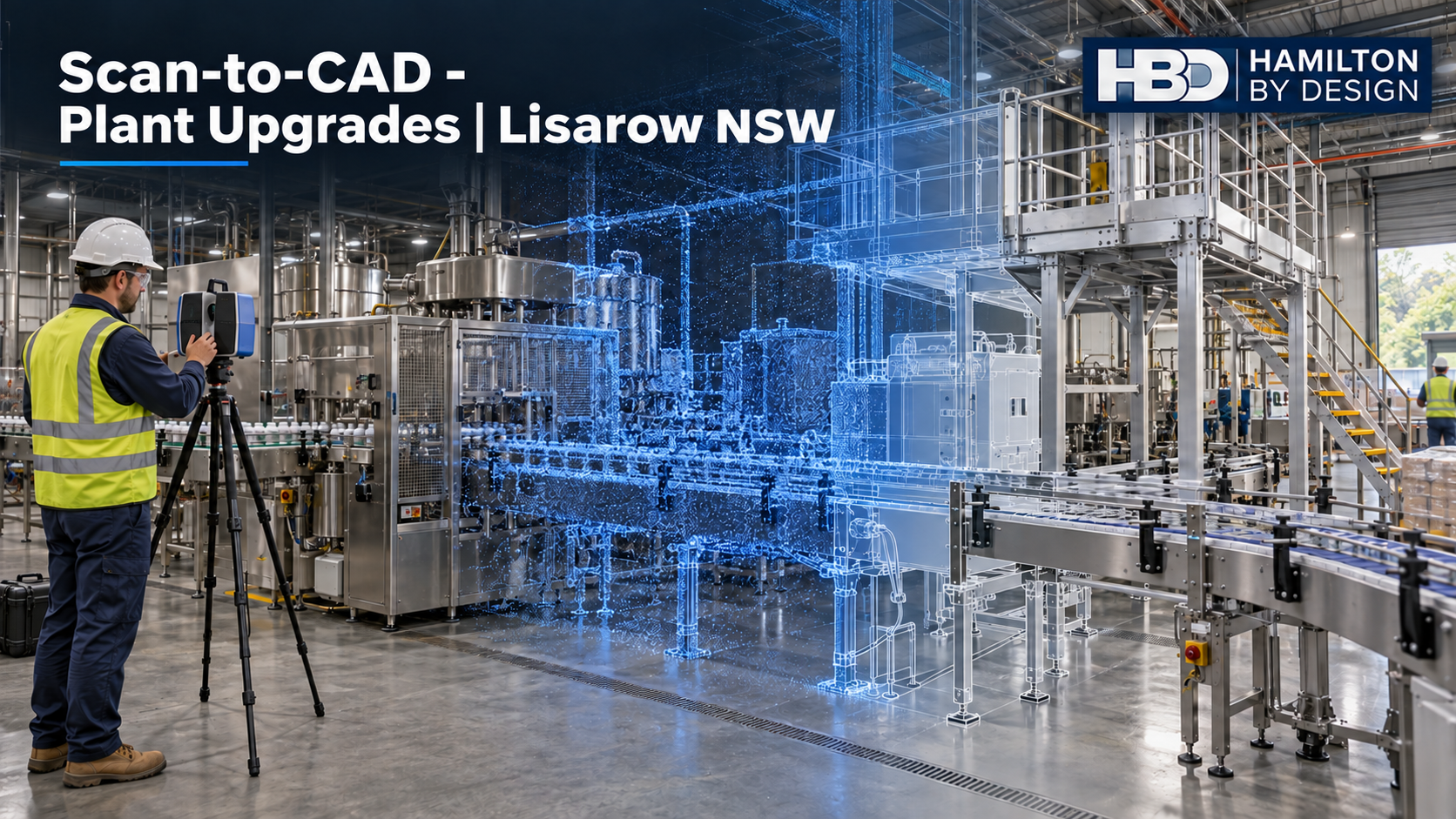
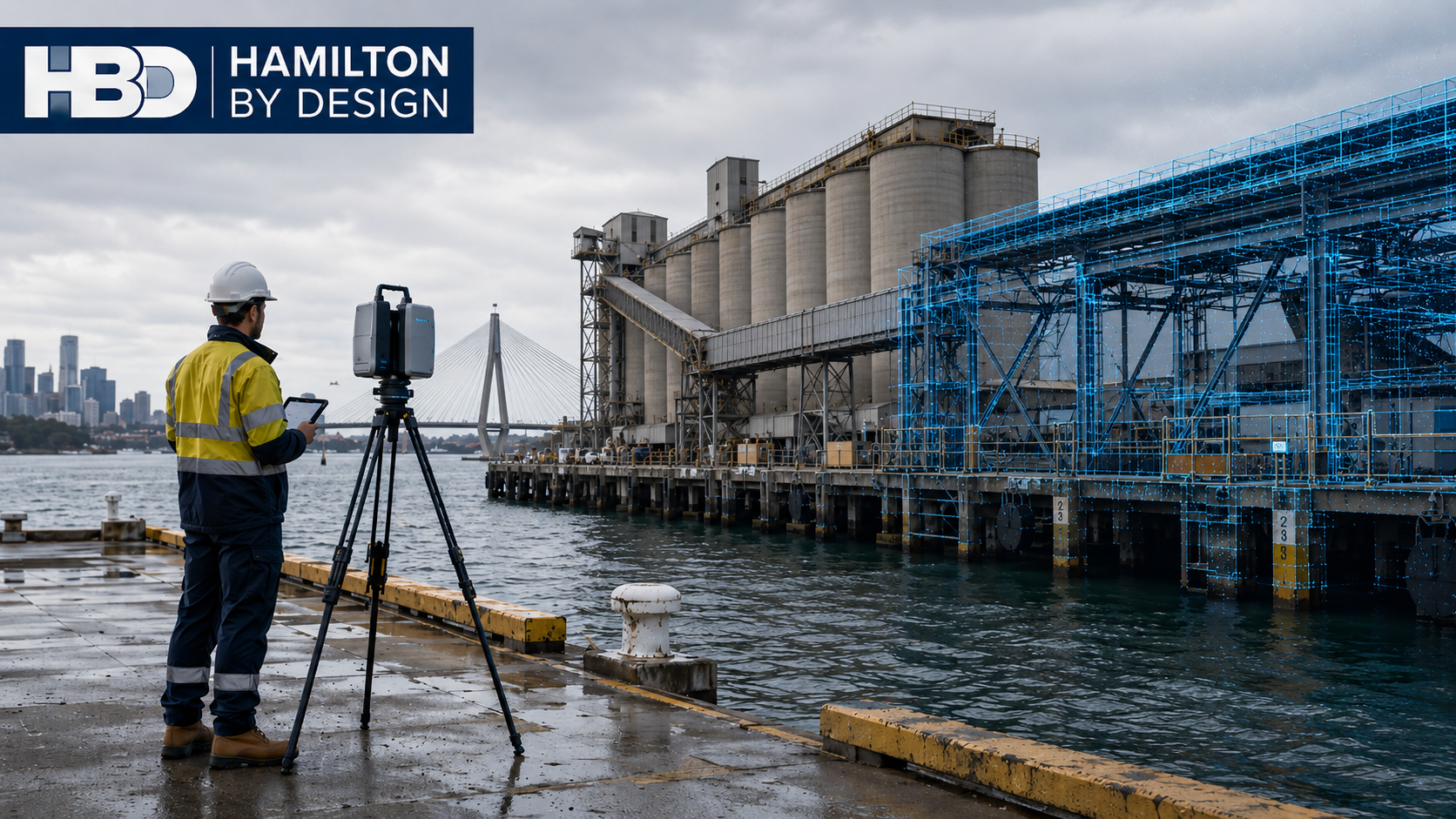
Industrial plant 3D laser scanning in Sydney showing engineer using LiDAR scanner with point cloud overlay and CAD modelling for engineering design

Point Cloud to CAD | Mechanical Engineering | Western Sydney Specialists

At Hamilton By Design, we provide engineering-grade 3D laser scanning for industrial plants, delivering accurate site data, detailed CAD models, and fit-for-purpose mechanical design solutions across Sydney, Parramatta, Penrith, and Liverpool.

Unlike typical 3D scanning companies, we are mechanical engineers first. That means every scan is captured with the end goal in mind โ€” design, fabrication, and real-world application.


3D Laser Scanning Services (Sydney & Western Sydney)

We offer onsite and mobile 3D scanning services across:

  • Parramatta
  • Penrith
  • Liverpool
  • Greater Western Sydney

Our LiDAR scanning services are ideal for:

  • Industrial plants
  • Manufacturing facilities
  • Processing plants
  • Construction and building upgrades

If youโ€™re searching for a โ€œ3D scanning company near meโ€, we deliver fast, accurate, and engineering-ready results.

3D CAD Modelling Australia service banner for Hamilton By Design

From Point Cloud to CAD (Engineering-Ready Models)

Scanning is only the first step.

We convert scan data into:

  • Point cloud modelling
  • 3D CAD models (SolidWorks, STEP, Parasolid)
  • 2D AutoCAD drawings
  • Scan-to-BIM models

This allows for:

  • Accurate design modifications
  • Clash detection
  • Fabrication-ready outputs

Mechanical Engineering Services

Hamilton By Design provides full mechanical engineering support, including:

  • Process equipment design
  • Structural and mechanical upgrades
  • Preventative maintenance design
  • Fit-for-purpose engineering solutions

All work is aligned with relevant Australian Standards, including AS 4991 where applicable.


Mining & Bulk Handling (High-Value Applications)

We specialise in mining and bulk materials handling systems, including:

  • Coal chutes and transfer stations
  • Conveyor systems
  • Outbye mining infrastructure
  • Header transition chutes

Custom Design vs Off-the-Shelf

Off-the-shelf chute designs often lead to:

  • Poor fit
  • Increased wear
  • High maintenance costs

Our approach:

  • Scan existing plant conditions
  • Develop custom designs based on real data
  • Deliver solutions that reduce downtime and improve performance

Building & Construction Scanning

We also support:

  • Building scanning services
  • Construction site verification
  • Scan-to-BIM for refurbishment projects

Ideal for commercial, industrial, and infrastructure upgrades.


Industries We Support

  • Industrial plants
  • Manufacturing facilities
  • Food processing plants
  • Mining and bulk handling
  • Construction and infrastructure

Locations We Service

We provide 3D laser scanning and engineering services across:

Sydney
Parramatta
Penrith
Liverpool
Western Sydney

With project capability across NSW and Australia.


Common Questions

What are the best 3D scanning platforms?

We use industry-leading LiDAR systems such as FARO and Leica. However, the real value comes from how the data is used in engineering design.


3D LiDAR scanning and 3D modelling service button โ€” laser scanner capturing a point cloud for engineering and CAD modelling
Mechanical engineering services

Do I need scan-to-CAD or just scanning?

Most industrial projects require CAD models and engineering input โ€” not just raw scan data.


Who provides professional 3D scanning near me?

Engineering-led companies like Hamilton By Design provide usable outcomes, not just visual data.


Hamilton By Design logo displayed on a blue tilted rectangle with a grey gradient background

Get Started

If you need accurate site data, modelling, or engineering support for an industrial project, contact Hamilton By Design today.


Related Sydney Services

Hamilton By Design provides engineering-led 3D scanning, LiDAR scanning, mechanical engineering and digital engineering services throughout Sydney and Greater Sydney.

Explore our related Sydney services:


  • 3D Scanning Sydney โ€“ Engineering-grade terrestrial laser scanning, as-built surveys and point cloud capture for industrial, infrastructure and commercial projects.
  • Reality Capture Sydney โ€“ High-accuracy reality capture, digital twins, asset documentation and engineering-grade site verification.
  • Scan to CAD Sydney โ€“ Convert point cloud data into AutoCAD, SolidWorks, Inventor and other engineering-ready CAD deliverables.
  • Point Cloud Modelling Sydney โ€“ Engineering-grade point cloud processing, clash detection, as-built verification and 3D modelling.
  • Mechanical Engineering Sydney โ€“ Mechanical design, plant upgrades, materials handling systems, conveyors, chutes, platforms and engineering support.
  • Structural Drafting Sydney โ€“ Structural steel drafting, fabrication drawings, GA drawings, workshop detailing and as-built documentation.

Hamilton By Design supports projects throughout Sydney CBD, Parramatta, Liverpool, Penrith, Blacktown, Chatswood, Alexandria, Mascot, Newcastle and the Central Coast.


Blue banner graphic displaying the text "Point Cloud to CAD - Australia" in large white lettering, representing point cloud processing, scan-to-CAD conversion and digital engineering services across Australia.
Blue banner graphic displaying the text "Scan to CAD Sydney" in large white lettering, representing engineering-led point cloud to CAD conversion, LiDAR scanning and digital engineering services in Sydney.
Blue banner graphic displaying the text "Reality Capture Sydney - CBD" in large white lettering, representing engineering-led reality capture, LiDAR scanning and digital engineering services within Sydney CBD commercial buildings and infrastructure.

Industrial Plant 3D Laser Scanning Across Western Sydney

Industrial plant at night with engineer using a FARO 3D laser scanner and tablet, capturing a digital point cloud of pipework in Western Sydney.

Parramatta | Penrith | Liverpool | Greater Western Sydney

At Hamilton By Design, we provide engineering-grade 3D laser scanning services across Western Sydneyโ€™s key industrial regions. Our focus is not just on capturing data, but on delivering accurate, usable models that support real-world engineering outcomes.

Western Sydney continues to grow as one of Australiaโ€™s most important industrial corridors. From high-rise developments in Parramatta to manufacturing hubs in Penrith and processing facilities in Liverpool, each region presents unique challenges that require a tailored approach to reality capture and engineering design.

Our services combine LiDAR scanning, point cloud processing, and mechanical engineering expertise to support industrial plants, infrastructure upgrades, and brownfield modifications. Learn more about our core service here:
๐Ÿ‘‰ https://www.hamiltonbydesign.com.au/3d-laser-scanning-for-industrial-plants-in-sydney/


Parramatta โ€“ Commercial Infrastructure & Building Services

Parramatta has evolved into Sydneyโ€™s second CBD, with a strong concentration of commercial buildings, government facilities, and infrastructure projects. Industrial plant work in this region is typically focused on building services, plant rooms, and refurbishment projects rather than heavy industry.

We support Parramatta-based projects involving:

  • Commercial towers and mixed-use developments
  • Government and institutional facilities
  • Building services and mechanical plant rooms
  • Construction and refurbishment works

3D scanning in Parramatta is commonly used to capture existing conditions for upgrades, ensuring accurate integration of new systems within constrained environments. Our scan-to-BIM and point cloud modelling workflows allow engineers and contractors to reduce risk, avoid clashes, and improve coordination across disciplines.


3D CAD Modelling Australia service banner for Hamilton By Design

Penrith โ€“ Manufacturing & Industrial Operations

Penrith represents one of Western Sydneyโ€™s key manufacturing and logistics corridors. The region is home to a wide range of industrial facilities, including production plants, warehouses, and distribution centres.

We work with Penrith-based industries such as:

  • Manufacturing facilities and production lines
  • Warehousing and logistics operations
  • Packaging and processing plants
  • Light industrial workshops

In these environments, 3D laser scanning is essential for capturing existing layouts before equipment upgrades or expansions. Whether integrating new machinery or optimising production flow, accurate point cloud data ensures that modifications are designed to fit first time.

Our point cloud to CAD services convert scan data into engineering-ready models, allowing for detailed design, fabrication, and installation planning.
๐Ÿ‘‰ https://www.hamiltonbydesign.com.au/point-cloud-to-cad


Liverpool โ€“ Processing Plants & Mixed Industrial Facilities

Liverpool supports a diverse mix of industries, including food processing, light manufacturing, healthcare infrastructure, and commercial facilities. This creates a demand for flexible engineering solutions that can adapt to different operational environments.

Typical industries we support in Liverpool include:

  • Food and beverage processing plants
  • Mechanical and fabrication workshops
  • Healthcare and large-scale facilities
  • Mixed-use industrial sites

3D scanning in Liverpool is often used to model complex pipework systems, process equipment, and building layouts. These models form the basis for plant upgrades, maintenance planning, and engineering design.

By combining scanning with mechanical engineering expertise, we ensure that all outputs are not only accurate but also aligned with Australian Standards and operational requirements.


Western Sydney โ€“ Heavy Industry & Infrastructure Growth

Across Greater Western Sydney, large-scale infrastructure and industrial developments continue to expand. This includes utilities, transport hubs, bulk handling facilities, and heavy industrial operations.

We support projects across Western Sydney involving:

  • Industrial plants and processing facilities
  • Infrastructure and utilities
  • Transport and logistics hubs
  • Bulk materials handling systems

In these environments, 3D laser scanning plays a critical role in supporting shutdown planning, structural upgrades, and mechanical modifications. High-accuracy data capture allows for better decision-making, reduced downtime, and improved project outcomes.


From Scanning to Engineering Outcomes

What sets Hamilton By Design apart is our ability to take projects beyond scanning.

Many providers deliver point clouds or visual models. We deliver:

  • Engineering-grade CAD models
  • Fabrication-ready drawings
  • Mechanical design solutions
  • Fit-for-purpose plant upgrades

Our workflow is simple and effective:

Scan โ†’ Model โ†’ Design โ†’ Deliver

This integrated approach ensures that clients receive not just data, but a complete engineering solution.


Supporting Industry Across Western Sydney

Across Parramatta, Penrith, Liverpool, and Greater Western Sydney, we support a wide range of industries including:

Commercial Infrastructure
Manufacturing
Processing Plants
Heavy Industry

Our services are designed to reduce risk, improve accuracy, and deliver reliable engineering outcomes for industrial projects of all sizes.


Hamilton By Design logo displayed on a blue tilted rectangle with a grey gradient background

Get Started

If you are planning an industrial project in Western Sydney and need accurate site data, modelling, or engineering support, we can help.

Explore our services or get in touch:

Contact Us – Talk to Us

Name
Would you like us to arrange a phone consultation for you?
Address

Related Sydney Services

Hamilton By Design provides engineering-led 3D scanning, LiDAR scanning, mechanical engineering and digital engineering services throughout Sydney and Greater Sydney.

Explore our related Sydney services:


  • 3D Scanning Sydney โ€“ Engineering-grade terrestrial laser scanning, as-built surveys and point cloud capture for industrial, infrastructure and commercial projects.
  • Reality Capture Sydney โ€“ High-accuracy reality capture, digital twins, asset documentation and engineering-grade site verification.
  • Scan to CAD Sydney โ€“ Convert point cloud data into AutoCAD, SolidWorks, Inventor and other engineering-ready CAD deliverables.
  • Point Cloud Modelling Sydney โ€“ Engineering-grade point cloud processing, clash detection, as-built verification and 3D modelling.
  • Mechanical Engineering Sydney โ€“ Mechanical design, plant upgrades, materials handling systems, conveyors, chutes, platforms and engineering support.
  • Structural Drafting Sydney โ€“ Structural steel drafting, fabrication drawings, GA drawings, workshop detailing and as-built documentation.

Hamilton By Design supports projects throughout Sydney CBD, Parramatta, Liverpool, Penrith, Blacktown, Chatswood, Alexandria, Mascot, Newcastle and the Central Coast.


Blue banner graphic displaying the text "Point Cloud to CAD - Australia" in large white lettering, representing point cloud processing, scan-to-CAD conversion and digital engineering services across Australia.
Blue banner graphic displaying the text "Scan to CAD Sydney" in large white lettering, representing engineering-led point cloud to CAD conversion, LiDAR scanning and digital engineering services in Sydney.
Blue banner graphic displaying the text "Reality Capture Sydney - CBD" in large white lettering, representing engineering-led reality capture, LiDAR scanning and digital engineering services within Sydney CBD commercial buildings and infrastructure.