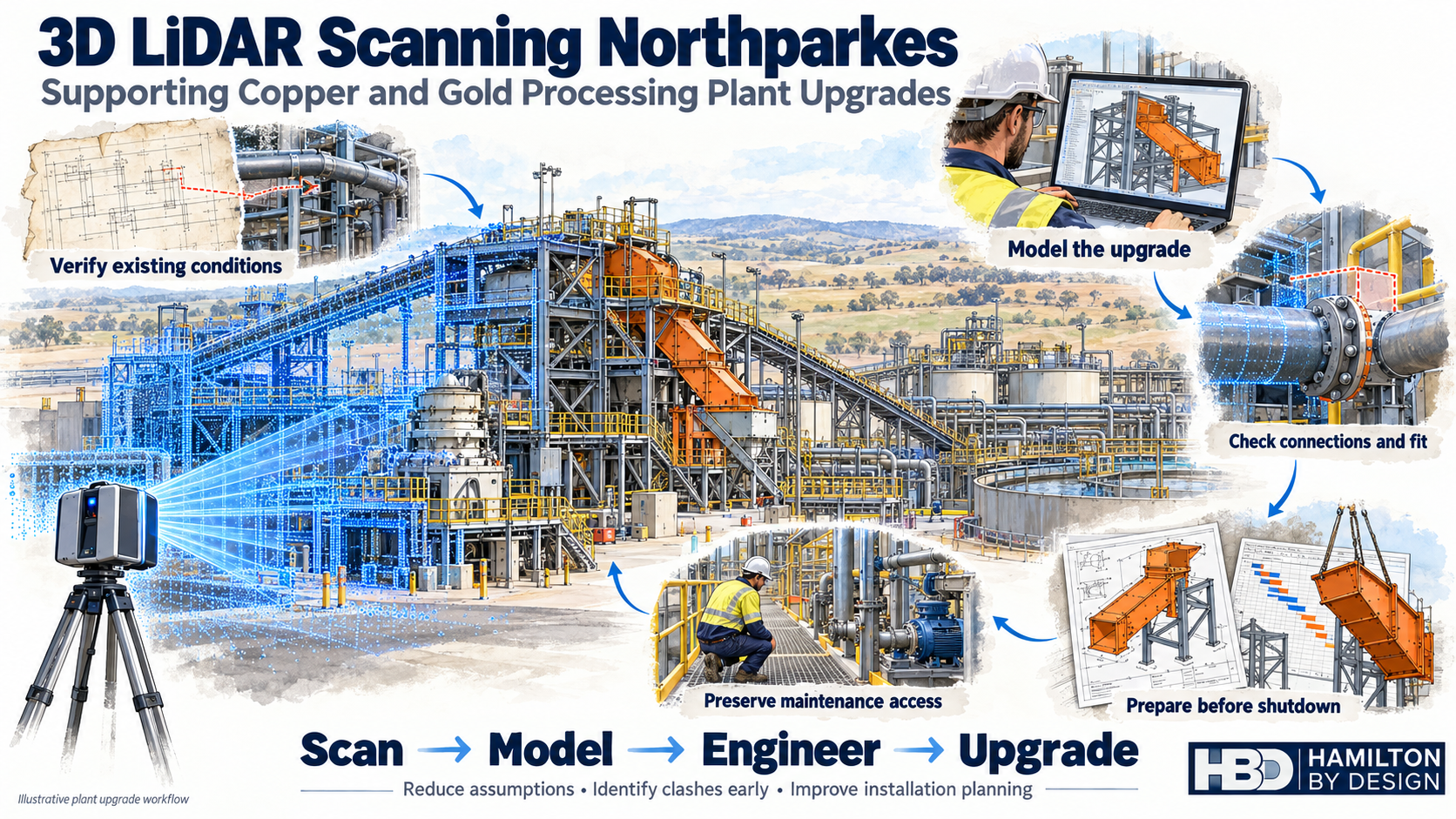
Capturing Brisbane’s industrial west—from established workshops to advanced production facilities
Darra and Richlands occupy an important place in Brisbane’s industrial story. Darra developed through rail-connected brick, cement and heavy industrial activity, while neighbouring Richlands has grown into a major location for manufacturing, logistics, food and beverage production and advanced materials.
Together with Wacol, these suburbs form a connected industrial corridor rather than two isolated business districts.
That distinction matters when planning engineering work. A factory in this corridor may occupy a modern warehouse, an older purpose-built plant or a building that has been extended and repurposed several times. Machinery may have moved while services, platforms and redundant foundations remained. Original drawings may exist, but they do not always describe the factory as it stands today.
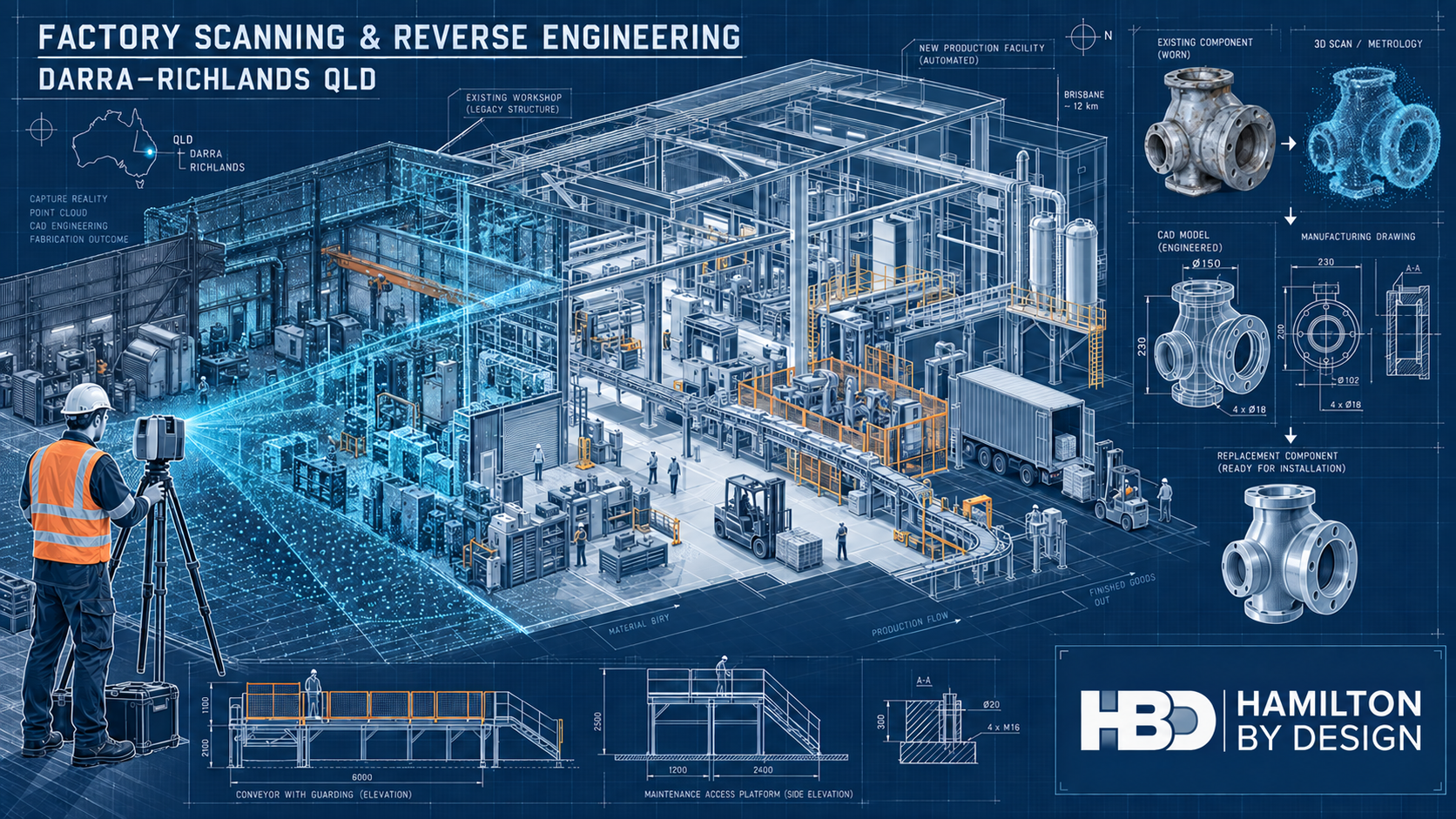
Hamilton By Design assists asset owners, manufacturers, maintenance teams and fabricators with factory scanning and reverse engineering in Darra and Richlands. Our work combines reality capture with practical mechanical understanding, turning physical plant and machinery into useful point clouds, CAD models, equipment layouts and fabrication drawings.
An industrial corridor shaped by movement and manufacturing
Darra’s industrial character predates many of Brisbane’s newer business parks. Its railway connection supported early manufacturing, while the former Queensland Cement and Lime works became an important part of the district’s twentieth-century development.
The cement plant once used a long conveyor system between the Brisbane River and the Darra works—an early example of industrial infrastructure responding to geography, materials handling and production demand.
Richlands presents the contemporary side of the same story. The suburb accommodates large manufacturing and distribution facilities, including high-throughput beverage production and logistics activities supporting the nearby Wacol truck-manufacturing cluster. It is also attracting newer fields such as graphene production and advanced materials.
This produces an unusual industrial mix: legacy buildings, modern automated production lines, local workshops, major distribution facilities and nationally significant manufacturers all operate within the wider corridor.
The resulting engineering problems are rarely generic. They are connected to the condition, history and operating constraints of each site.
A drawing can appear precise without being accurate.
Dimensions may have been taken from an early architectural plan, a previous tenancy layout or a machinery supplier’s proposal. Columns, services and equipment may be shown in their intended positions rather than their final installed positions. Later modifications may never have been added to the drawing set.
For a preliminary concept, these differences may initially seem minor. During fabrication or installation, however, a misplaced column, an unrecorded pipe or a changed mounting point can become expensive.
These discrepancies can cause:
- A conveyor section not to fit
- A fabricated frame to clash with existing services
- A replacement component to misalign with adjoining equipment
- A machine to be too large for the proposed installation route
- Access to a valve, bearing or motor to become restricted
- A shutdown to be extended while steelwork is modified on site
Engineering-led 3D laser scanning provides a reliable record of visible existing conditions.
A factory survey can capture building geometry, machinery, conveyors, platforms, pipework, structural steel and surrounding obstructions in a coordinated point cloud.
Scanning does not remove the need for engineering judgement or critical manual measurements. It does, however, provide a much stronger foundation than designing from incomplete drawings and isolated tape measurements.
From point cloud to practical factory planning
The value of a factory scan is not simply the visual impact of a coloured point cloud. Its real value comes from how the information is interpreted and used.
Hamilton By Design can use registered scan data to develop:
- Existing-condition factory plans
- Machinery and production-line layouts
- Building sections and elevations
- Equipment-clearance studies
- Conveyor and transfer arrangements
- Installation and removal-path assessments
- Models of selected machinery and structures
- As-built drawings for future modifications
For a plant-layout project, the scan may be used as the spatial reference while simplified equipment envelopes are developed for arrangement planning.
This allows alternative layouts to be tested against actual columns, walls, mezzanines, accessways and existing services.
The level of modelling should suit the decision being made. A machinery-relocation study may only require reliable equipment envelopes, maintenance clearances and connection points. Detailed fabrication requires closer modelling of interfaces, supports, fasteners and critical dimensions.
Defining that distinction early avoids spending money modelling features that do not influence the engineering outcome.
Reverse engineering machinery and replacement components
Factories in Darra and Richlands often depend on equipment that has remained productive long after its original drawings or suppliers have disappeared.
A failed component may be obsolete, imported with a long lead time or previously modified to suit the site. In some cases, the physical component may be the only reliable source of dimensional information.
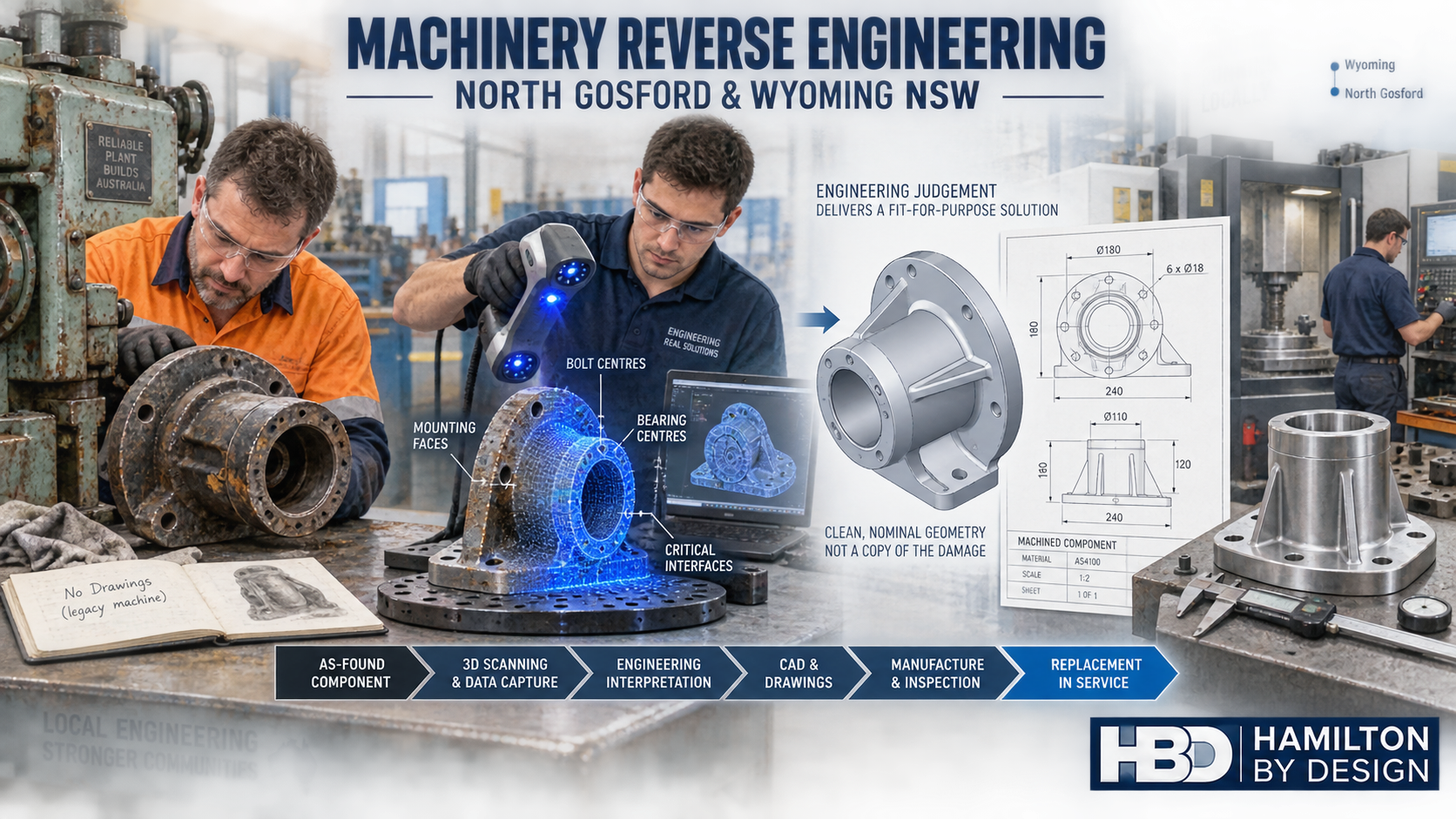
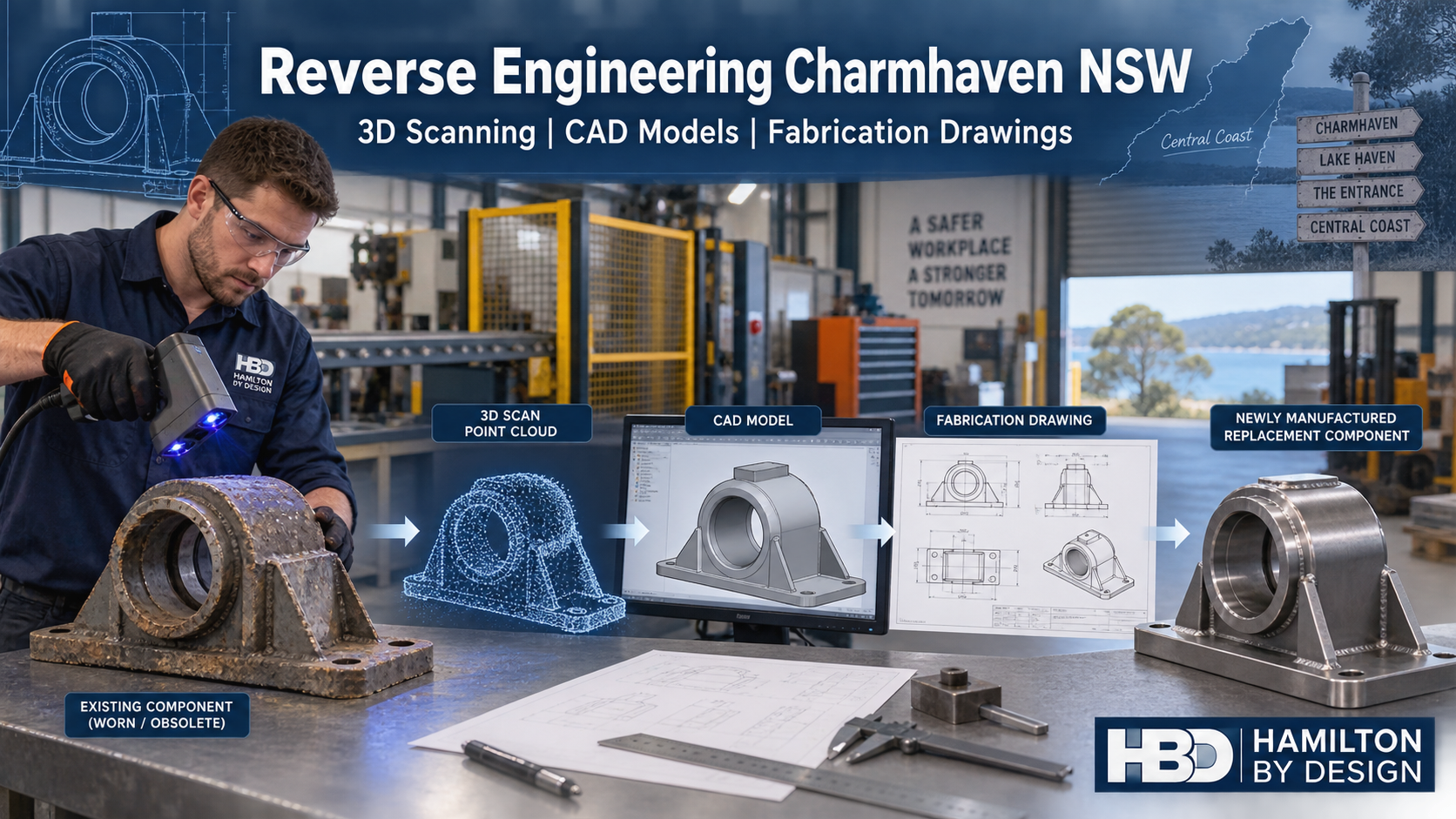
Reverse engineering can help recover the information needed to manufacture a replacement.
Depending on the component’s size, complexity and required accuracy, the process may combine laser scanning, metrology scanning, manual measurement, photographs and engineering inspection.
Hamilton By Design’s reverse-engineering and 3D-scanning services can support items such as:
- Rollers, pulleys and shafts
- Brackets, frames and supports
- Housings and covers
- Chutes and hoppers
- Guards and access panels
- Machine bases and mounting plates
- Worn or obsolete manufactured components
- Jigs, fixtures and special-purpose tooling
Good reverse engineering is not blind copying.
A worn part records both its original function and the effects of service. Wear, distortion, corrosion and earlier repairs must be considered before deciding which surfaces should be reproduced and which should be restored.
Critical dimensions, material requirements, tolerances and mating interfaces should be agreed as part of the engineering scope.
Mechanical design for brownfield factories
Brownfield mechanical design occurs inside an environment that already has operating rules, physical constraints and production priorities.
A technically sound concept must still be accessible, maintainable, fabricable and capable of being installed safely.
Hamilton By Design provides mechanical engineering consulting for plant and machinery modifications, including:
- Conveyors and conveyor modifications
- Chutes, hoppers and transfer arrangements
- Machinery-support frames
- Pump and equipment skids
- Guarding systems
- Access improvements
- Replacement assemblies
- Production-line modifications
- Machinery relocation
- Brownfield plant upgrades
Scan data can be incorporated into the design environment so that proposed equipment is reviewed in relation to the real factory.
This approach is particularly useful when a project involves:
- Adding equipment to a crowded production area
- Relocating machinery within an existing building
- Connecting a new conveyor to an older production line
- Replacing equipment during a limited shutdown
- Designing around services that cannot be moved
- Improving maintenance access without reducing production space
- Planning an installation before existing equipment is removed
The result should be more than a model that fits on a computer screen. It should provide a traceable path from the existing condition through design review to fabrication and installation.
Mechanical drafting and fabrication documentation
Manufacturers and fabricators require clear documentation that communicates what must be built.
Depending on the agreed scope, Hamilton By Design can prepare:
- General arrangement drawings
- Fabrication drawings
- Workshop details
- Machined-component drawings
- Sheet-metal developments
- Material and component schedules
- Bills of materials
- Cutting information
- Installation drawings
- As-built documentation
- Revision-controlled drawing registers
Our fabrication and product-design services connect the site-capture and design stages with the practical information required by the workshop.
Deliverables may include native CAD files, STEP or Parasolid models, DXF profiles and controlled PDF drawing packages.
Mechanical drawings may be developed with reference to the applicable parts of the AS 1100 technical-drawing series. Fabricated steelwork may also require consideration of AS/NZS 1554, AS 4100 or AS 3990, depending on its function and classification.
The applicable standards and required level of engineering verification must be established for each project rather than assumed from the drawing type alone.
Hamilton By Design provides mechanical engineering and structural drafting within its areas of competence. Where a project requires statutory structural certification, specialist electrical design or another regulated discipline, review should be completed by an appropriately qualified practitioner.
Machinery guarding and safer access
Machinery-safety problems often emerge gradually.
A motor is replaced, a platform is added or a conveyor is extended. A guard may then be cut back to clear the modification, or it may be removed so frequently for maintenance that it is eventually left off.
Hamilton By Design provides machine-guarding design and engineering for manufacturing and fixed-plant environments.
A site assessment can consider exposed:
- Belts and chains
- Pulleys and rollers
- Shafts and couplings
- Drive assemblies
- Conveyor nip points
- Rotating components
- Cutting or crushing mechanisms
- Pneumatic and hydraulic movement
The assessment should also consider how operators, cleaners and maintenance personnel interact with the equipment.
Potential improvements can include fixed guards, removable panels, mesh enclosures, access gates, inspection openings, mounting frames and maintenance-friendly modular arrangements.
Three-dimensional scanning is particularly useful where new guards must fit around irregular machinery, pipes, cable trays, platforms or nearby structural members.
Relevant requirements may include the AS/NZS 4024 Safety of Machinery series, AS 1755 for conveyor safety and Queensland work health and safety obligations. Platforms, stairs, walkways and ladders may require consideration of AS 1657.
Guarding remains only one part of the risk-control system. Isolation, interlocks, control-system safety, operating procedures, training and inspection must also be addressed by the appropriate parties.
Supporting logistics and materials movement
Richlands is also a substantial logistics location.
Warehouses and distribution facilities face engineering issues that differ from process plants but still depend on accurate spatial information. Vehicle movement, loading docks, conveyors, pallet handling, pedestrians and maintenance activities compete for limited space.
Factory and warehouse scanning can support:
- Loading-area layouts
- Conveyor coordination
- Fixed-equipment planning
- Equipment and racking interface checks
- Forklift and pedestrian-separation studies
- Access-platform planning
- Maintenance-clearance reviews
- Tenancy modifications
- Warehouse automation projects
- As-built documentation
Depending on the scope, relevant standards may include AS 1657 for fixed access, AS 1755 and AS/NZS 4024 for conveyors and machinery, AS 4084 for steel storage racking and the applicable parts of AS 2890 for vehicle facilities.
Specialist traffic, racking, fire, building and structural advice should be obtained where those disciplines fall outside the agreed mechanical-engineering scope.
The five recurring problems facing industrial sites
1. Missing or outdated drawings
Older factories often accumulate changes that are never incorporated into the original drawing package. New projects then begin with uncertain dimensions and incomplete information.
Scanning provides a record of the visible installed condition from which updated layouts and as-built documents can be developed.
2. Obsolete replacement components
A component may no longer be supported by its manufacturer, or a replacement may have an unacceptable delivery period.
Reverse engineering can recover its geometry and provide CAD models or manufacturing drawings, subject to verification of its material, function and critical tolerances.
3. Congested machinery layouts
New equipment must often fit around production machinery, services, structures and accessways that cannot be readily relocated.
A coordinated point cloud allows proposed equipment to be reviewed against the existing environment before fabrication begins.
4. Guarding and access deficiencies
Machinery modifications can create new hazards or make older guards ineffective. Poorly designed guards may also interfere with routine inspection, cleaning and maintenance.
An engineering-led review can help develop controls that consider both worker safety and the practical operation of the plant.
5. Shutdown and installation risk
Unexpected conditions discovered during a shutdown can delay installation and production restart.
Scanning, interface verification, clash review and controlled fabrication drawings help move more decisions into the planning stage, when they are generally easier and less costly to resolve.
The first modification at a factory often creates information that remains valuable for the next project.
With agreed security and retention arrangements, Hamilton By Design can retain:
- Registered factory point clouds
- Equipment layouts
- Machine models
- Component scans
- Manufacturing CAD
- Fabrication drawings
- Dimensional inspection records
- Site photographs
- Approved drawing revisions
- Replacement-component histories
This creates a practical digital engineering record.
When another component fails or a production line is altered, the client may be able to begin with known information rather than recommissioning the entire investigation. Revision states and documented assumptions also help distinguish surveyed conditions from proposed and approved designs.
Confidentiality remains essential. Proprietary machinery, production processes and site-security information should be handled according to the client’s requirements, with the intended retention period and permitted reuse defined at project commencement.
A scan-to-fabrication workflow suited to operating industry
A typical project may progress through the following stages.
1. Define the operational question
Establish whether the project concerns machinery relocation, component replacement, increased capacity, safety, fabrication or asset documentation.
Examine existing drawings, photographs, manuals, maintenance history and known operational constraints.
3. Capture existing conditions
Scan the relevant factory areas or components and manually verify critical features and interfaces.
4. Develop the engineering model
Convert the required geometry into fit-for-purpose CAD rather than modelling every visible feature.
5. Review interfaces and risk
Check clearances, access, clashes, fabrication constraints, installation requirements and design risks.
6. Prepare controlled deliverables
Issue models and drawings at the agreed review, approval or construction status.
7. Support fabrication and installation
Respond to technical queries and update the documentation where the approved or installed condition changes.
This workflow keeps responsibility connected from the factory floor to the drawing package.
Hamilton By Design’s strength lies in combining scanning, mechanical design and drafting rather than treating reality capture as a standalone survey exercise.
Frequently asked questions
Can a factory be scanned while production continues?
Often, yes. The survey can be staged around access restrictions, cleaning windows, work shifts and operating equipment.
Movement can create incomplete or noisy scan data, and some critical areas may require a planned production pause. The scanning plan should be agreed with operations and safety personnel before mobilisation.
A terrestrial laser scan can capture visible surfaces such as machinery, columns, floors, walls, conveyors, platforms, steelwork and pipework.
It cannot see through equipment, insulation, walls, product build-up or enclosed assemblies. Concealed services and inaccessible interfaces require existing drawings, supplementary inspection or another investigation method.
Can Hamilton By Design reverse engineer a component without an original drawing?
Yes, provided the physical component and its important interfaces can be inspected and measured.
The engineering scope should identify the component’s function, material, loading, manufacturing process and tolerances. It should also determine whether wear or deformation must be corrected rather than reproduced.
Is a point cloud the same as a finished CAD model?
No. A point cloud is a measured representation of visible site geometry.
A CAD model is an interpreted engineering deliverable developed from selected scan information. The amount and accuracy of modelling depend on the client’s intended use and the agreed level of detail.
Can scan data help plan a machinery relocation?
Yes. Existing machinery and building geometry can be compared with proposed equipment envelopes to assess clearances, access, service connections and possible clashes.
Detailed installation planning may still require verification of lifting points, floor capacity, temporary works and the proposed transport path.
What standards apply to machinery modifications?
The answer depends on the machine, workplace and nature of the modification.
Common references may include AS/NZS 4024, AS 1755, AS 1657, AS 3990, AS 4100, AS/NZS 1554 and the AS 1100 technical-drawing series. Client specifications, Queensland work health and safety requirements and equipment-specific standards may also apply.
The relevant standards should be identified during engineering scope development.
Does Hamilton By Design fabricate the equipment?
Hamilton By Design’s core role is scanning, mechanical design, modelling and drafting.
We can prepare fabrication-ready information and work with the client’s nominated fabricator, supporting technical queries and controlled drawing revisions throughout the manufacturing process.
Can Hamilton By Design retain the scan and models for later work?
Yes, where this is agreed with the client.
Retaining point clouds, CAD models and revision-controlled drawings can provide a valuable reference for future upgrades or replacement work. Confidentiality, access, permitted use and retention arrangements should be documented for each project.
Discuss a Darra or Richlands industrial project
Darra and Richlands combine industrial history with modern manufacturing, automation and logistics.
Their factories are often productive precisely because they have evolved—but that evolution can leave drawings, component information and machinery layouts behind.
Hamilton By Design helps reconnect the physical factory with reliable engineering information.
Whether the task involves scanning a production area, recovering an obsolete component, planning machinery relocation, redesigning a machine guard or producing fabrication drawings, our process begins with the equipment and conditions that actually exist.
Contact Hamilton By Design to discuss factory scanning, reverse engineering or mechanical design in Darra, Richlands and Brisbane’s western industrial corridor.
Our clients:
Reality Capture Brisbane
Engineer-led LiDAR scanning and reality capture for industrial,
manufacturing and brownfield facilities across Brisbane.
Explore Reality Capture Brisbane
Scan-to-CAD Brisbane
Convert point-cloud information into practical CAD models, factory
layouts and engineering drawings for plant modifications.
Explore Scan-to-CAD Brisbane
Manufacturing Layout Design
Factory planning, production-line layouts and equipment arrangements
developed around actual machinery, access and building constraints.
View Manufacturing Layout Design
As-Built and Brownfield LiDAR Scanning
Capture the installed condition of machinery, services and structures
before designing brownfield plant upgrades.
View Brownfield LiDAR Scanning
SolidWorks 3D Modelling
Parametric mechanical modelling for machinery, fabricated assemblies,
replacement components and industrial equipment.
View SolidWorks Modelling Services
Australian Design and Drafting Services
Engineering drafting support for plant layouts, mechanical equipment,
fabrication packages and industrial modifications.
Explore Design and Drafting Services
Mechanical Drafting Australia
Practical general arrangements, workshop drawings, equipment layouts
and as-built documentation for manufacturing projects.
View Mechanical Drafting Services
As-Built Drawings from LiDAR Scanning
Develop reliable plans, elevations, sections and engineering records
from measurable point-cloud information.
View As-Built Drawing Services