


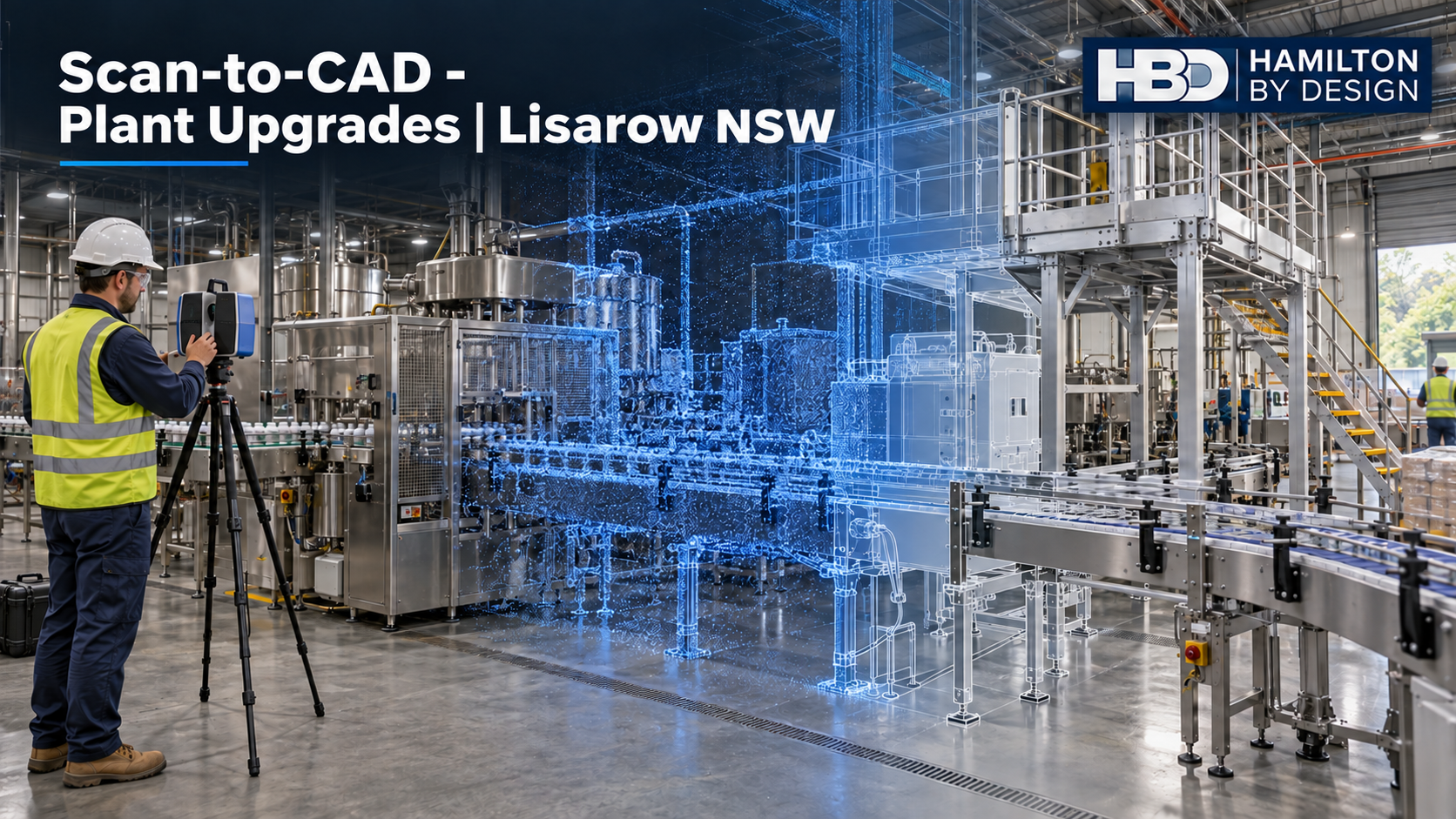

Lisarow is a compact but diverse industrial location on the NSW Central Coast. Positioned along the Pacific Highway and within practical reach of Gosford, Wyong, Tuggerah, Somersby and the M1 Pacific Motorway, the suburb supports food and beverage production, advanced manufacturing, equipment servicing, warehousing and distribution.
For businesses operating in this environment, engineering projects rarely begin with a clean sheet. Machinery may have been altered over many years, original drawings may no longer reflect the installed plant, and new equipment must often fit around existing conveyors, pipework, structural steel, services and access routes. Production schedules also leave little tolerance for installation errors or repeated site measurement.
Hamilton By Design provides industrial 3D laser scanning, reverse engineering, mechanical design and drafting support for Lisarow manufacturers and the wider Central Coast. Based from its Central Coast head office in Wyong, the company combines site capture with practical engineering and CAD capability. This means the scan is not treated as the final product; it becomes the verified starting point for design, documentation, fabrication and future asset management.
Lisarow’s industrial character
Lisarow contains a notable mixture of production and engineering activity. Publicly documented businesses in the suburb include beverage manufacturing and packaging, locally designed electronic products, frozen-food production, pump overhaul and rotating-equipment services. The area also contains industrial workshops and substantial warehouse facilities supporting distribution throughout the Central Coast and the Sydney–Newcastle corridor.
These businesses are not identified here as Hamilton By Design clients. They demonstrate the kinds of operations present in Lisarow and the engineering conditions commonly associated with the area.
Food and beverage plants may contain fillers, packaging machines, conveyors, tanks, pipework and wash-down areas. Advanced-manufacturing facilities require controlled component information, production layouts, fixtures and inspection data. Reliability workshops deal with worn components, pumps, shafts, housings and legacy equipment. Warehouses depend on functional loading areas, racking interfaces, materials-handling equipment and safe separation between workers, vehicles and machinery.
These different operations share one fundamental requirement: accurate information about the plant, equipment or component before changes are designed or manufactured.
Engineering-grade 3D laser scanning in Lisarow
Industrial laser scanning uses LiDAR technology to capture millions of measurable points from the surfaces of machinery, buildings, structural steel and services. The resulting point cloud provides a three-dimensional record of the accessible site at the time of capture.
Hamilton By Design’s approach connects reality capture to engineering outcomes. Its broader Central Coast 3D laser scanning and scan-to-CAD service supports brownfield upgrades, equipment replacement, structural modifications and fabrication planning. For projects requiring wider regional coverage, the NSW Central Coast service page explains HBD’s local engineering and scanning capability.
Depending on the agreed scope, scan data may be used to prepare:
- Registered point clouds
- Existing-condition plant models
- Factory and production-line layouts
- Plans, sections and elevations
- General arrangement drawings
- Mechanical and structural interface models
- Fabrication and manufacturing drawings
- Installation and modification drawings
- Clash and clearance reviews
- Reusable digital records for future projects
Scanning is particularly valuable where manual measurement would be slow, incomplete or disruptive. It can capture the spatial relationship between equipment, columns, conveyors, guards, platforms, pipework and services during a planned visit. Engineers and designers can then return to the point cloud for additional measurements without requiring a new site visit for every design question.
From point cloud to practical CAD information
A point cloud contains substantial geometric information, but it does not automatically become a fabrication drawing or engineered solution. The required objects must be interpreted, modelled and documented to a level suitable for the intended use.
Hamilton By Design provides 3D scanning and CAD modelling services that convert selected scan geometry into usable engineering information. This may include SolidWorks models, AutoCAD layouts, STEP files, general arrangements and detailed drawings.
The required modelling level should be agreed before work begins. A broad factory layout intended for equipment planning does not require every bolt and small pipe fitting to be modelled. Conversely, a replacement machine component may require close attention to critical interfaces, tolerances, fits, material, wear and function.
Defining the intended use prevents unnecessary modelling while ensuring that important engineering details are not omitted.
Recreating missing machinery drawings
Many established factories continue to operate machinery long after the original drawings, suppliers or spare parts have become unavailable. Other machines have been modified several times, leaving the documentation disconnected from the equipment on the floor.
HBD’s reverse-engineering and scan-to-CAD service can capture existing components and convert the required geometry into controlled CAD information. The workflow may include dimensional capture, identification of functional interfaces, CAD reconstruction and preparation of manufacturing drawings.
Reverse engineering should not simply reproduce every feature of a worn or damaged part. The engineer or designer must consider what the component is intended to do, which dimensions control fit and alignment, what material and manufacturing process are appropriate, and whether the observed geometry reflects wear or an earlier repair.
The article From Existing Component to Fabrication Drawing provides further detail on how scan-derived information can support replacement components and fabrication documentation.
Supporting plant modifications and production-line upgrades
Installing new equipment into an operating factory is a spatial and operational challenge. A concept may appear workable on a two-dimensional drawing but clash with an undocumented service, restrict maintenance access or interfere with product flow when installed.
By modelling proposed works within captured site conditions, HBD can assist with:
- Machinery replacement and relocation
- Production-line extensions
- Conveyor and transfer modifications
- Platforms, stairs, ladders and walkways
- Equipment-support frames
- Guarding and safety barriers
- Pipework and services coordination
- Maintenance and removal clearances
- Shutdown planning and installation sequencing
HBD’s mechanical engineering services on the Central Coast combine local site support with mechanical design and documentation. Where conveyors or product movement are involved, its digital engineering for conveyor and materials-handling systems illustrates how scanning, point clouds and CAD coordination can reduce brownfield design risk.
Although that materials-handling page discusses mining applications, the underlying principles also apply to many factories and warehouses: establish the actual geometry, understand the operating requirements, consider safe access, and verify the proposed arrangement before fabrication.
Reducing shutdown and installation risk
Production downtime can be considerably more expensive than the physical modification itself. Short shutdown windows place pressure on fabricators, installers, maintenance teams and project managers. If a support frame, guard, conveyor section or replacement component does not fit, the result may include site cutting, additional welding, crane delays, extended isolation and lost production.
An engineering-led scanning workflow allows more coordination to occur before the shutdown. Tie-in locations can be reviewed, surrounding obstructions identified and proposed components checked within the captured environment. This does not remove the need for appropriate verification or competent engineering judgement, but it provides a stronger baseline than incomplete legacy drawings or isolated tape measurements.
HBD’s 3D LiDAR scanning support for the Central Coast explains how local mobilisation and design-ready site capture can support plant upgrades and installation planning. Nearby operations can also refer to HBD’s dedicated industrial 3D laser scanning service for Tuggerah.
Mechanical drafting for Lisarow manufacturers
Accurate capture only creates value when the resulting information can be communicated to the people who must approve, manufacture, install and maintain the work.
Hamilton By Design’s engineering drafting services on the Central Coast can support projects with:
- General arrangement drawings
- Mechanical detail and assembly drawings
- Fabrication drawings
- Manufacturing drawings
- Equipment and factory layouts
- Bills of materials and part schedules
- Installation drawings
- Revision-controlled drawing packages
- As-existing and as-built documentation
Drawing packages should identify the status and source of the information. Scanned existing geometry, inaccessible or assumed areas, new design, reference dimensions and dimensions requiring site verification should be clearly distinguished.
Depending on the project, drawing and design work may consider the relevant parts of the AS 1100 technical-drawing series, AS/NZS 4024 for machinery safety, AS 1657 for fixed access, AS 4100 for steel structures, AS/NZS 1554 for structural welding and the AS/NZS 1170 structural-actions series. The applicable standards must be established for the actual equipment, hazards, loads and project scope rather than applied as a generic list.
Machinery safety and risk management
Plant modifications can introduce new hazards even when the production objective is achieved. Changes to equipment position, guarding, access or maintenance procedures may create trapping, crushing, shearing, entanglement or fall risks.
HBD can assist with mechanical aspects of plant safety by documenting existing conditions, identifying design interfaces and developing concepts for guards, barriers, platforms and maintenance access. Risk-management assistance may include plant hazard identification, design risk registers, guarding reviews, access assessments and documentation of residual risks requiring control by the client or another specialist.
Safety work must consider foreseeable operation, cleaning, inspection, adjustment, isolation and maintenance. Electrical interlocks, emergency-stop systems and functional-safety validation should be completed by appropriately qualified electrical or control-system specialists where required.
Retaining a reusable digital plant record
The data created for one project can remain valuable long after the immediate modification is finished. Subject to an agreed scope, ownership, confidentiality and retention period, HBD can retain point clouds, machine models, component measurements, plant layouts, replacement-part CAD, manufacturing drawings and modification histories.
This record can give a Lisarow manufacturer a verified starting point for future maintenance and capital projects. It can also reduce reliance on individual knowledge when experienced personnel leave the organisation.
Data arrangements should define permitted access, file formats, revision status, backup expectations, intellectual-property ownership and the period for which information will be retained.
Why engage Hamilton By Design?
Hamilton By Design combines local Central Coast access with engineering-led measurement and documentation. The company uses a connected workflow that can include FARO scanning systems, FARO SCENE, Autodesk ReCap, AutoCAD, SolidWorks and Navisworks. HBD discusses these capabilities in Why Hamilton By Design Has Invested in the FARO Ecosystem.
The practical advantage is continuity. The same project can progress from site capture to point-cloud processing, mechanical interpretation, CAD development and drawing preparation without treating each stage as an unrelated service.
HBD’s Central Coast head office is in Wyong, supporting site attendance in Lisarow and surrounding locations by appointment. Contact details and enquiry options are available on the Hamilton By Design contact page.
Frequently asked questions
Can Hamilton By Design scan an operating factory in Lisarow?
Scanning can often be performed around normal operations, subject to site safety, access and the required accuracy. Moving machinery, vehicles, people, steam, dust or product can affect data capture. Some areas may therefore require isolation or access during a planned stoppage.
Can HBD recreate a part when no drawing exists?
Yes, where the component can be accessed and the necessary engineering information can be established. HBD can capture the component and prepare a CAD model or manufacturing drawing. Material, tolerances, loading, wear and safety-critical functions may require further investigation before manufacture.
What can be produced from a laser scan?
Deliverables may include registered point clouds, plans, sections, elevations, plant layouts, 3D CAD models, general arrangements, equipment-interface models and fabrication drawings. The precise output depends on how the information will be used.
Does the whole factory need to be modelled?
No. Only the geometry relevant to the project normally needs to be converted into CAD. The surrounding point cloud can remain available as spatial reference information. Agreeing the modelling boundary and required detail helps control cost and delivery time.
Can scanning help with conveyor modifications?
Yes. Scanning can record conveyor frames, transfer points, supports, platforms, guards and nearby services. The captured information can support layout changes, clash reviews, access improvements, support design and fabrication documentation.
Can HBD prepare fabrication and manufacturing drawings?
Yes, where these deliverables are included in the agreed scope and the necessary engineering inputs are available. Drawings can be developed from scan data, CAD models and verified design information.
What information is required for a quotation?
Useful information includes the Lisarow site address, photographs, approximate scan area, type of machinery or facility, intended use of the data, required deliverables, preferred file formats, site-access constraints and required completion date.
How long does scanning and modelling take?
Timeframes depend on site size, access, complexity, accuracy, modelling detail and documentation requirements. A component scan and a full production-line capture require very different levels of effort. HBD can confirm a programme after reviewing the scope.
Does HBD service areas surrounding Lisarow?
Yes. HBD supports projects across the NSW Central Coast, including Wyong, Tuggerah, Ourimbah, Somersby, Gosford and surrounding industrial areas. Broader NSW and interstate project support is also available.
Can the scan and CAD information be retained for future work?
Yes, subject to agreed client permissions, confidentiality, ownership and storage arrangements. Retaining a controlled digital record can make future modifications faster and reduce repeated measurement.
Discuss a Lisarow industrial project
Whether the requirement involves a missing machine drawing, an obsolete component, a conveyor modification, a production-line upgrade or a verified record of existing plant, the first step is to define the intended engineering outcome.
Hamilton By Design can capture the existing conditions, convert the relevant information into practical CAD deliverables and support the mechanical design and documentation required for the next stage of the project.
Contact Hamilton By Design to discuss industrial 3D scanning, reverse engineering or mechanical drafting for a Lisarow or Central Coast facility.

Contact Us – Talk To Us
Our clients:
























