Understanding AS1657: Fixed Platforms, Walkways, Stairways and Ladders

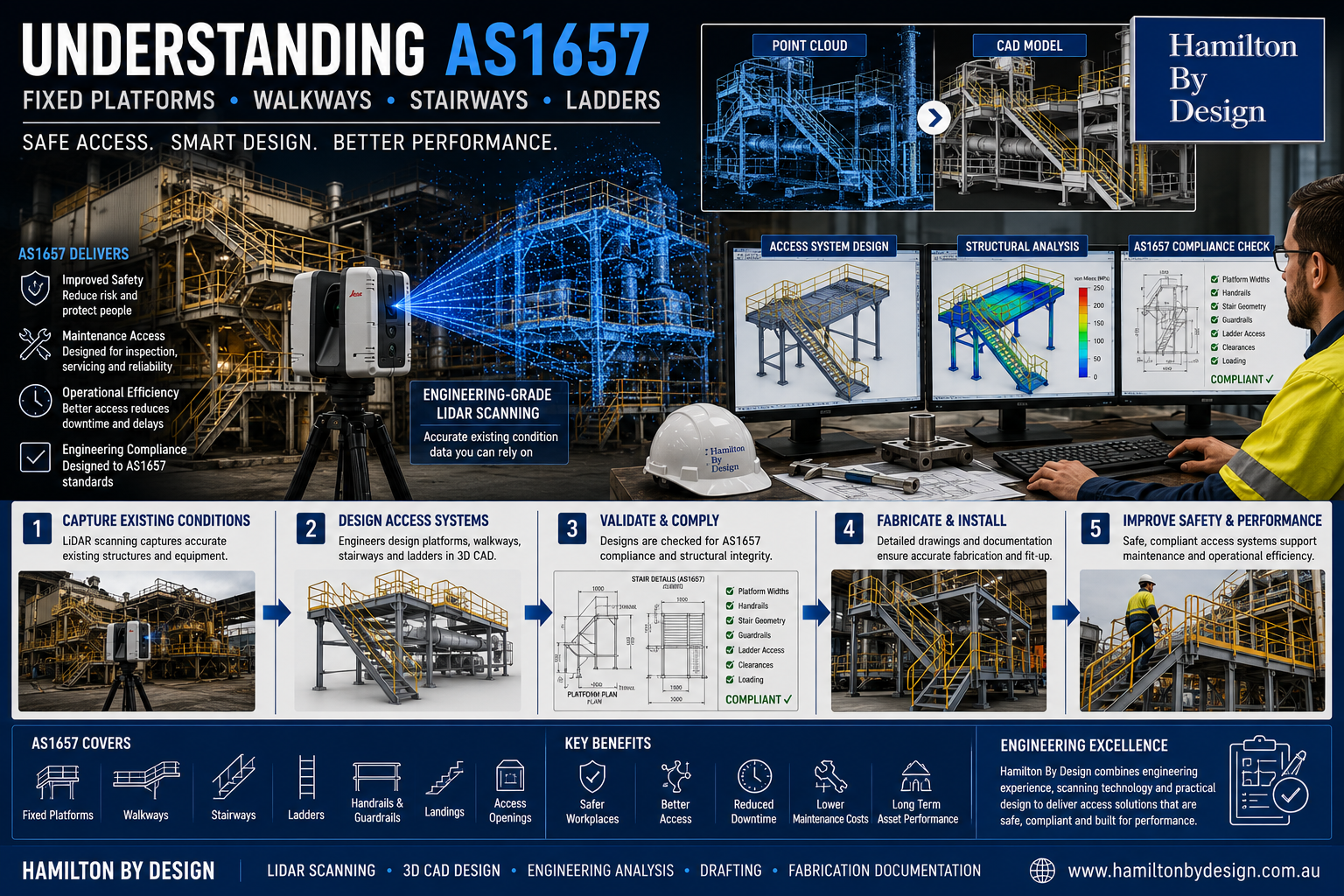
Engineering-grade LiDAR scanning and CAD modelling workflow for AS1657 industrial access systems including platforms, walkways, stairways, and ladders.

Industrial facilities are built around more than machinery and production systems. Personnel require safe and reliable access to equipment, maintenance areas, inspection locations, and operational assets. Whether within mining operations, manufacturing facilities, timber processing plants, or industrial processing environments, access systems play an important role in both safety and productivity.

Poorly designed access systems can create operational inefficiencies, increase maintenance time, and introduce unnecessary risk. Access systems designed around practical engineering requirements can improve not only safety outcomes but also long-term operational performance.

In Australia, one of the key standards governing these systems is AS1657 โ€“ Fixed Platforms, Walkways, Stairways and Ladders โ€“ Design, Construction and Installation.

Understanding the purpose of AS1657 helps organisations design access systems that support safer operations, maintenance efficiency, and engineering compliance.

What is AS1657?

AS1657 establishes requirements and guidance for the design, construction, and installation of fixed access systems within industrial facilities.

The standard applies to systems including:

  • Fixed platforms
  • Walkways
  • Stairways
  • Fixed ladders
  • Handrails
  • Guardrails
  • Landings
  • Access openings

The objective of the standard is providing safe and practical access throughout industrial facilities while reducing hazards associated with working at heights and movement around equipment.

AS1657 is commonly applied across:

  • Mining operations
  • Processing plants
  • Manufacturing facilities
  • Bulk materials handling facilities
  • Timber processing operations
  • Infrastructure projects
  • Industrial processing sites
3D CAD Modelling Australia service banner for Hamilton By Design

Why Proper Access Design Matters

Access systems are often viewed as secondary structures supporting primary equipment.

In practice, access systems influence:

  • Worker safety
  • Equipment accessibility
  • Maintenance efficiency
  • Shutdown performance
  • Operational productivity
  • Long-term operating costs

Poor access design can create:

  • Restricted access zones
  • Congestion around equipment
  • Increased manual handling risks
  • Longer shutdown activities
  • Reduced maintenance efficiency
  • Higher maintenance costs

Well-designed systems can improve operational performance while supporting safer working conditions.

Fixed Platforms and Walkways

Fixed platforms and walkways provide safe movement and work areas around equipment and operational assets.

Typical design considerations include:

  • Platform dimensions
  • Walkway widths
  • Surface materials
  • Guardrail systems
  • Toe plates
  • Access clearances
  • Slip resistance requirements
  • Structural loading considerations

Effective access design supports maintenance teams by improving movement around equipment and reducing access difficulties.

Stairways and Ladder Requirements

Stairways and ladders require practical engineering consideration beyond simply connecting two elevations.

Important design factors may include:

Stairways

  • Rise and going dimensions
  • Stair angles
  • Handrail requirements
  • Intermediate landings
  • Head clearances
  • User movement requirements

Ladders

  • Ladder height limitations
  • Cage requirements
  • Fall protection systems
  • Landing arrangements
  • Access openings

The frequency of use and maintenance requirements often influence whether ladders or stairways provide the most suitable solution.

Maintenance Access Considerations

Maintenance activities often represent one of the most frequent interactions personnel have with industrial assets.

Access systems should support:

  • Inspection activities
  • Equipment removal
  • Maintenance tasks
  • Shutdown work
  • Routine servicing

Poor maintenance access can lead to:

  • Extended downtime
  • Increased labour requirements
  • Manual handling issues
  • Higher operational costs

Designing around maintenance requirements during early project stages can reduce ongoing operational challenges.

Brownfield Applications Create Additional Challenges

Brownfield facilities rarely reflect original design documentation.

Industrial sites commonly contain:

  • Historical modifications
  • Existing structural steel
  • Congested layouts
  • Pipework interferences
  • Equipment additions
  • Legacy infrastructure

Designing new access systems in these environments can become challenging without accurate existing information.

Hamilton By Design supports brownfield projects using engineering-grade 3D LiDAR scanning to capture:

  • Existing structures
  • Platforms
  • Walkways
  • Equipment
  • Pipework
  • Access systems

Existing condition capture allows engineering decisions to be based on measured information rather than assumptions.

Supporting Engineering Compliance

Engineering compliance extends beyond simply meeting dimensional requirements.

Good engineering practice should also consider:

  • Safety outcomes
  • Practical useability
  • Constructability
  • Maintenance efficiency
  • Future modifications
  • Long-term operational performance

Compliance should support functionality rather than becoming a checklist exercise.

How Hamilton By Design Supports Industrial Access Projects

Hamilton By Design combines practical engineering experience with digital engineering workflows to support industrial access projects through:

  • Engineering-grade 3D LiDAR scanning
  • Existing condition capture
  • Scan-to-CAD workflows
  • Mechanical design
  • Structural assessment
  • Engineering analysis and simulation
  • CAD modelling
  • Fabrication documentation

Our approach supports projects from initial site capture through to fabrication-ready deliverables.
3D LiDAR scanning and 3D modelling service button โ€” laser scanner capturing a point cloud for engineering and CAD modelling
Mechanical engineering services

Moving Beyond Minimum Compliance

AS1657 exists to support safer and more effective industrial access systems.

However, successful access systems do more than satisfy compliance requirements.

They improve:

  • Safety performance
  • Maintenance efficiency
  • Operational productivity
  • Long-term asset performance

Well-designed access systems help people interact safely and effectively with industrial assets every day.

Better access systems support better operational outcomes.

Hamilton By Design logo displayed on a blue tilted rectangle with a grey gradient background
Name
Would you like us to arrange a phone consultation for you?
Address

Our Clients:
https://www.hamiltonbydesign.com.au/understanding-as1657-fixed-platforms-walkways-stairways-ladders
Finite Element Analysis (FEA) engineering simulation button
Mechanical engineering services

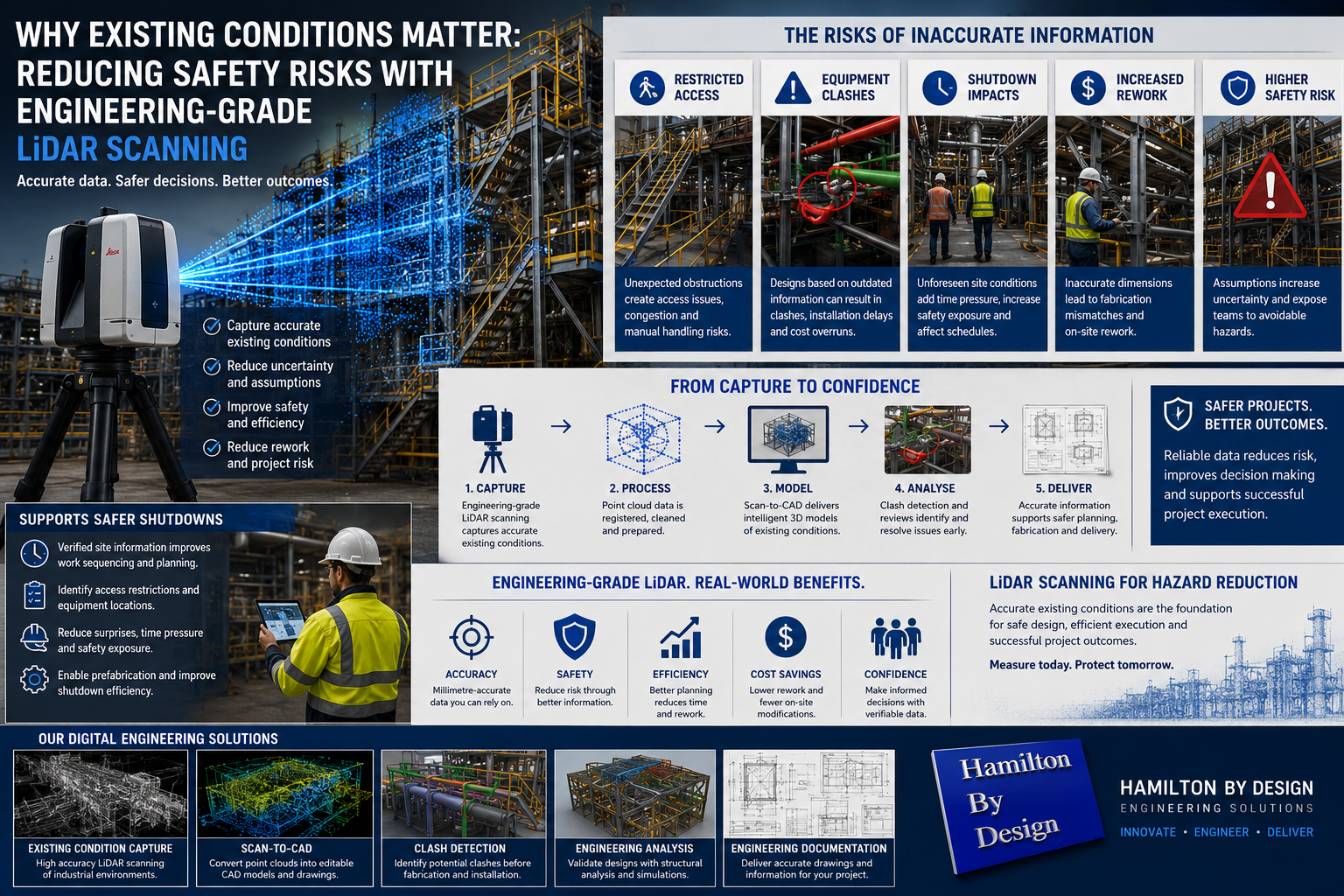
Why Existing Conditions Matter: Reducing Safety Risks with Engineering-Grade LiDAR Scanning

Engineering-grade LiDAR scanning workflow showing how existing condition capture reduces safety risks through clash detection, scan-to-CAD modelling, engineering analysis, and improved shutdown planning in industrial facilities.

Industrial projects are often built around a simple assumption:

“The existing drawings are correct.”

Unfortunately, in many industrial facilities that assumption can introduce significant risk.

Mining plants, processing facilities, manufacturing sites, and timber processing operations commonly undergo years or decades of modifications. Equipment changes, structural additions, maintenance alterations, temporary fixes, and undocumented upgrades can gradually move facilities away from their original engineering documentation.

When engineering decisions are based on outdated drawings or manual measurements, project teams may unknowingly introduce safety risks that affect shutdown activities, maintenance work, and plant upgrades.

At Hamilton By Design, engineering-grade LiDAR scanning supports safer project outcomes by replacing assumptions with measurable site information.

Why Existing Conditions Matter

Existing conditions represent the actual site environment rather than what historical drawings suggest exists.

In industrial environments, discrepancies can develop through:

  • Historical modifications
  • Unrecorded changes
  • Structural alterations
  • Equipment replacements
  • Temporary repairs becoming permanent solutions
  • Missing documentation
  • Inaccurate field measurements

A few centimetres of difference can appear minor on a drawing but become significant when:

  • Installing new equipment
  • Modifying conveyor systems
  • Designing platforms
  • Routing pipework
  • Planning shutdown activities
  • Fabricating structural steel

Small errors can create larger project impacts.

Safety Risks Created by Inaccurate Information

Assumptions can introduce several operational and safety challenges.

3D CAD Modelling Australia service banner for Hamilton By Design

Examples include:

Restricted Access Areas

Access routes may differ from original layouts, creating:

  • Maintenance access issues
  • Congestion
  • restricted clearances
  • Manual handling risks

Equipment Clashes

New designs based on incorrect information may result in:

  • Structural clashes
  • Pipework interferences
  • Equipment conflicts
  • Installation delays

Increased Exposure During Shutdown Activities

Shutdown periods often involve:

  • Tight schedules
  • Multiple work groups
  • Limited access windows
  • High activity levels

Unexpected site conditions discovered during shutdowns can increase:

  • Time pressure
  • Additional field modifications
  • Safety exposure
  • Project costs

Brownfield Projects Present Additional Challenges

Brownfield environments rarely match original design documentation.

Common challenges include:

  • Congested plant layouts
  • Existing services
  • Structural interferences
  • Legacy equipment
  • Multiple generations of modifications

Designing around assumptions in these environments increases uncertainty.

Existing Condition Capture Using Engineering-Grade LiDAR

Engineering-grade LiDAR scanning captures existing conditions by collecting highly accurate site geometry and generating point cloud data.

Capture can include:

  • Structural steel
  • Platforms
  • Conveyors
  • Pipework
  • Equipment
  • Buildings
  • Access systems
  • Existing plant layouts

Rather than relying solely on manual measurements, project teams gain access to measurable site information.

Benefits can include:

  • Improved accuracy
  • Existing condition verification
  • Better planning
  • Reduced uncertainty
  • Reduced installation risk

Clash Detection Before Construction

Once captured, point cloud information can be integrated into engineering workflows.

Scan-to-CAD processes allow:

  • Existing condition modelling
  • Design development
  • Clash detection
  • Constructability reviews
  • Layout optimisation

Potential problems can be identified before fabrication and site installation begin.

Finding issues digitally generally costs less than discovering them during construction activities.

Supporting Shutdown Planning

Shutdown windows are often measured in hours or days rather than weeks.

Unexpected field discoveries can quickly affect:

  • Production schedules
  • Labour requirements
  • Equipment availability
  • Project budgets

LiDAR scanning can support shutdown planning by:

  • Capturing actual site conditions
  • Identifying access restrictions
  • Verifying equipment locations
  • Improving work sequencing
  • Supporting prefabrication

Better information often leads to more predictable project execution.

Reducing Site Rework

Rework commonly results from:

  • Inaccurate dimensions
  • Design clashes
  • Existing condition errors
  • Fabrication mismatches

Reducing rework can improve:

  • Safety performance
  • Project schedules
  • Labour efficiency
  • Installation outcomes
  • Overall project cost

How Hamilton By Design Supports Safer Industrial Projects

Hamilton By Design combines practical engineering experience with digital engineering workflows to support safer project delivery.

Services can include:

Engineering-Grade LiDAR Scanning

Capture accurate site geometry and existing conditions.

Scan-to-CAD Workflows

Convert point cloud information into:

  • Editable CAD models
  • Engineering drawings
  • Existing condition layouts

Engineering Analysis

Support project decisions through:

  • Design validation
  • Engineering reviews
  • Structural assessment
  • Simulation and analysis
3D LiDAR scanning and 3D modelling service button โ€” laser scanner capturing a point cloud for engineering and CAD modelling
Mechanical engineering services

Engineering Documentation

Deliver:

  • General arrangement drawings
  • Fabrication drawings
  • Engineering models
  • Project information

Moving Beyond Assumptions

Existing conditions influence safety, constructability, and project outcomes.

When projects rely on assumptions rather than measurable information, risks can increase.

Engineering-grade LiDAR scanning helps organisations move from:

Estimated conditions โ†’ Verified conditions

The result is improved confidence, reduced risk, safer project execution, and better engineering decisions.

Finite Element Analysis (FEA) engineering simulation button
Mechanical engineering services

Engineer-Led Industrial LiDAR Scanning for Mining and Heavy Industry

Engineer performing industrial LiDAR scanning on an Australian mining plant with point cloud overlay and mechanical CAD modelling workflow

Engineering-Grade LiDAR Scanning Australia | Hamilton By Design

Engineer-Led Industrial LiDAR Scanning Australia | Hamilton By Design

At Hamilton By Design, we believe industrial 3D laser scanning should deliver far more than a visual model or virtual walkthrough. In mining, manufacturing and heavy industrial environments, scanning data must support engineering decisions, fabrication accuracy, shutdown planning and long-term asset management.

Many companies now offer โ€œ3D scanningโ€ services. However, not all scanning systems, workflows or providers are the same. Across Australia, the market has become crowded with companies focused on real estate visualisation, architectural walkthroughs and general BIM modelling. While these services have their place, industrial facilities require a very different level of technical understanding.

Hamilton By Design specialises in engineer-led industrial LiDAR scanning focused on mechanical and structural engineering outcomes.


Why Industrial Facilities Require a Different Approach

Industrial sites are complex environments involving:

  • conveyors,
  • transfer chutes,
  • structural steel,
  • pipework,
  • pump skids,
  • process equipment,
  • access platforms,
  • shutdown works,
  • and brownfield modifications.
3D CAD Modelling Australia service banner for Hamilton By Design

In these environments, inaccurate data can create significant commercial and operational risks.

Poor-quality scanning or incomplete site capture can lead to:

  • fabrication clashes,
  • installation delays,
  • shutdown overruns,
  • rework costs,
  • safety risks,
  • and engineering non-conformance.

Unlike architectural walkthroughs or property visualisation projects, industrial scanning must support measurable engineering outcomes.

This is why Hamilton By Design focuses on:

  • engineering-grade terrestrial LiDAR,
  • scan-to-CAD workflows,
  • controlled engineering documentation,
  • and engineering governance systems.

Engineer-Led Scanning vs General Scanning Services

Owning a scanner does not automatically make a company an engineering specialist.

Many scanning providers focus on:

  • virtual tours,
  • digital walkthroughs,
  • building visualisation,
  • or general BIM deliverables.

Hamilton By Design approaches scanning differently.

Our workflow is driven by:

  • mechanical engineering requirements,
  • structural engineering considerations,
  • fabrication suitability,
  • and industrial project delivery.

We understand:

  • plant shutdown environments,
  • fabrication tolerances,
  • maintenance access requirements,
  • structural modifications,
  • and brownfield installation challenges.

This allows us to deliver scanning outcomes aligned with real engineering applications rather than simply producing point cloud data.


Industrial LiDAR Applications

Our industrial LiDAR scanning services support a wide range of applications across Australia.

Mining and Processing Plants

We assist mining and processing facilities with:

  • conveyor system upgrades,
  • transfer chute modifications,
  • pump station upgrades,
  • SMP projects,
  • slurry transport systems,
  • structural steel modifications,
  • and brownfield plant expansions.

Shutdown Planning

Accurate point cloud capture allows engineering teams to:

  • verify as-built conditions,
  • reduce shutdown uncertainty,
  • improve prefabrication accuracy,
  • and minimise onsite fit-up issues.

Structural and Mechanical Engineering

LiDAR data can support:

  • General Arrangement (GA) drawings,
  • structural modelling,
  • equipment integration,
  • pipe routing,
  • and engineering verification workflows.

Digital Engineering and Asset Management

Our workflows support:

  • scan-to-CAD modelling,
  • controlled revisions,
  • engineering governance,
  • and long-term asset documentation.

Understanding the Different Types of 3D Scanning

Not all scanning technologies are designed for the same purpose.

Terrestrial LiDAR Scanning

Tripod-based terrestrial LiDAR systems are typically best suited for:

  • industrial facilities,
  • mining plants,
  • brownfield environments,
  • and engineering-grade capture.

These systems provide highly controlled and repeatable data suitable for engineering workflows.

Mobile SLAM Scanning

SLAM-based systems can rapidly capture large environments and are useful in some applications. However, depending on the project requirements, these systems may introduce drift or reduced control compared with fixed terrestrial workflows.

Handheld Scanners

Handheld systems are often useful for:

  • smaller components,
  • reverse engineering,
  • and detailed geometry capture.

Virtual Tour Systems

Matterport and walkthrough systems can provide excellent visualisation tools but may not always deliver the level of engineering control required for fabrication or detailed industrial design.

At Hamilton By Design, we work with the technology that best suits the engineering outcome required by the client.

We do not make promises we cannot keep.


Why Engineering Governance Matters

One of the largest risks in industrial projects is poor drawing and document control.

Many organisations continue operating with:

  • outdated PDFs,
  • disconnected revisions,
  • unmanaged redlines,
  • and uncontrolled drawing systems.

Hamilton By Design supports engineering governance through:

  • revision-controlled workflows,
  • issue states such as IFR / IFA / IFC,
  • audit-ready documentation,
  • and structured engineering deliverables.

We also support workflows using:

  • SolidWorks,
  • AutoCAD LT,
  • and the 3DEXPERIENCE platform.

This helps provide a controlled single source of truth for engineering information across the project lifecycle.


Supporting Australian Industry

Hamilton By Design supports clients across Australia including:

  • mining operations,
  • manufacturing facilities,
  • processing plants,
  • infrastructure projects,
  • and heavy industrial sites.

We understand the realities of:

  • remote site access,
  • shutdown windows,
  • operational constraints,
  • and industrial project delivery.

Our focus is not simply collecting scan data.

Our focus is helping clients reduce engineering risk and improve project outcomes.


Industrial Scanning Backed by Engineering Understanding

The value of LiDAR scanning is not only the scanner itself.

The true value comes from:

  • understanding the engineering problem,
  • capturing the correct information,
  • and delivering data that supports real project outcomes.

At Hamilton By Design, our engineer-led approach combines:
  • industrial LiDAR scanning,
  • mechanical engineering understanding,
  • structural engineering workflows,
  • and engineering governance systems.

This allows us to support projects from initial site capture through to engineering documentation and fabrication-ready deliverables.

3D LiDAR scanning and 3D modelling service button โ€” laser scanner capturing a point cloud for engineering and CAD modelling
Mechanical engineering services

Our clients

Contact Hamilton By Design

To discuss industrial LiDAR scanning, scan-to-CAD workflows or engineering support for your next project, contact:
Hamilton By Design

We support mining, manufacturing and industrial clients across Australia with engineer-led reality capture and engineering documentation solutions.

Hamilton By Design logo displayed on a blue tilted rectangle with a grey gradient background

FARO Technologies โ€” Industrial 3D laser scanning, metrology and reality capture hardware/software solutions.

SolidWorks โ€” Professional CAD, simulation and product development platform widely used in mechanical engineering.

Dassault Systรจmes 3DEXPERIENCE Platform โ€” Cloud-based engineering governance, collaboration and product lifecycle management platform.

3D CAD Modelling Australia service banner for Hamilton By Design
Australian Drafting logo featuring bold white text reading "Australian Drafting" centred on a blue rounded rectangle background.
Engineering Governance title graphic featuring bold white text reading "Engineering Governance" centred on a blue rounded rectangle background.
Mechanical, Structural & Pipework Drafting service banner by Hamilton By Design featuring white text on a blue background.
Mechanical engineering services
Blue rounded button with the text โ€œSolidWorks Designโ€ in white.
Finite Element Analysis (FEA) engineering simulation button
3D LiDAR Scanning Darwin for engineering surveys, laser scanning, reality capture and point cloud modelling services
3D LiDAR Scanning Australia engineering services for laser scanning, reality capture, scan-to-CAD, Scan-to-BIM and as-built documentation across Australia
3D LiDAR scanning services on the Central Coast providing engineering-grade laser scanning, point cloud capture, scan-to-CAD modelling and industrial reality capture for infrastructure and industrial projects.
3D LiDAR Scanning Perth for engineering surveys, laser scanning, reality capture and point cloud modelling services
3D LiDAR Scanning Sydney for engineering surveys, laser scanning, reality capture and point cloud modelling services
3D LiDAR Scanning Brisbane for engineering surveys, laser scanning, reality capture and point cloud modelling services
3D LiDAR Scanning Canberra for engineering surveys, laser scanning, reality capture and point cloud modelling services
3D LiDAR Scanning Newcastle for engineering surveys, laser scanning, reality capture and point cloud modelling services
3D LiDAR Scanning Adelaide for engineering surveys, laser scanning, reality capture and point cloud modelling services

From Reality to Design: How 3D Scanning Powers Engineering Outcomes in Sydney

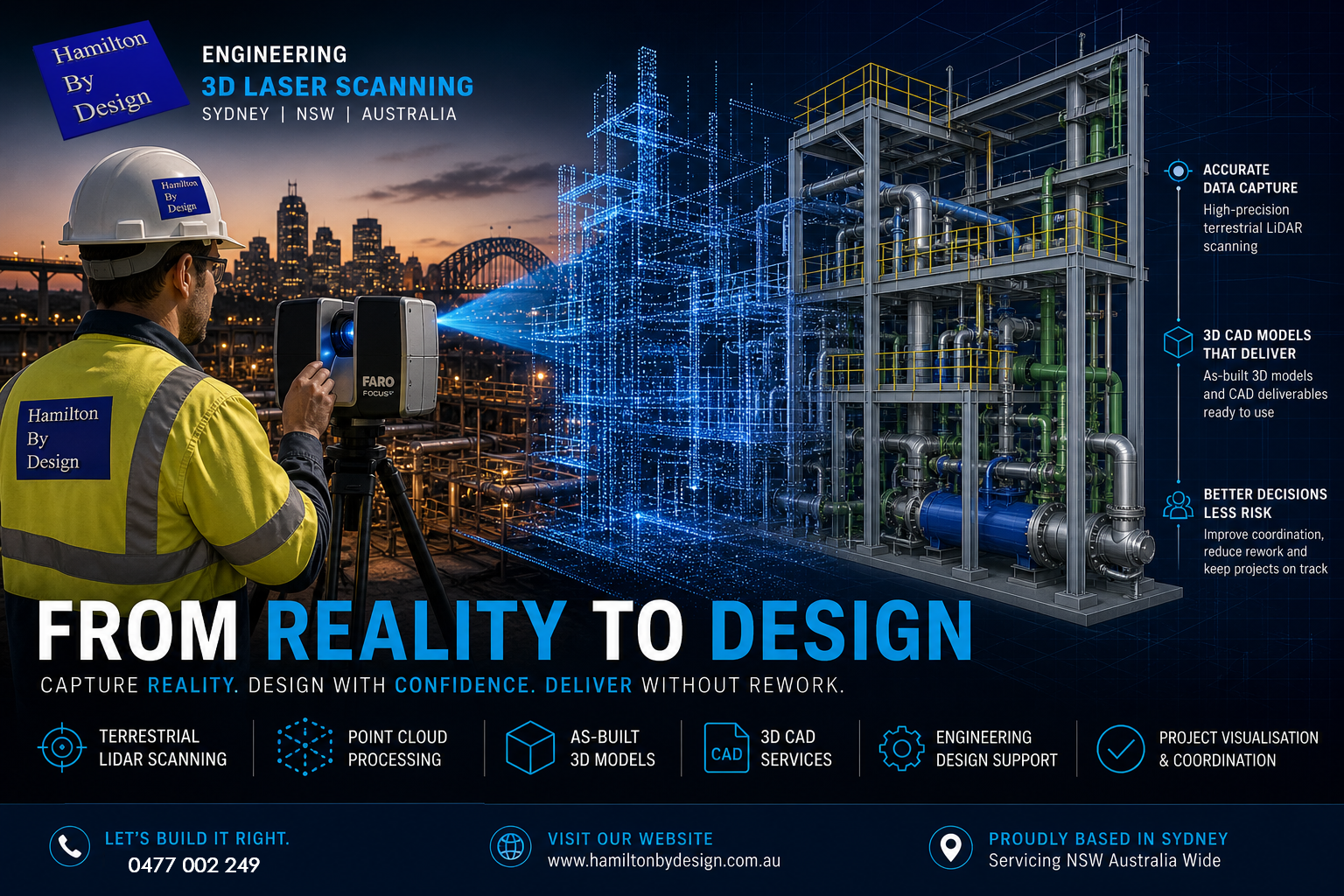
Engineer performing terrestrial LiDAR scanning on a Sydney construction site with point cloud transitioning into 3D CAD model

In todayโ€™s construction and industrial environment, the gap between what was designed and what actually exists on site is where most project risk lives.

Blue 3D LiDAR scanner icon on a tripod with scanning waves

Steel doesnโ€™t sit where drawings say it should. Pipework clashes with new installs. Structural tolerances stack up. And when projects move fast, those risks become expensive.

This is where engineering-led 3D scanning and design changes everything.

At Hamilton By Design, we donโ€™t just capture data โ€” we convert reality into accurate, buildable engineering outcomes.


The Shift from Measuring to Reality Capture

Traditional site measurement methods rely on tape measures, total stations, and assumptions. They work โ€” but they introduce risk.

Modern projects are moving toward terrestrial LiDAR scanning, using high-accuracy laser-based systems to capture millions of data points across a site.

A terrestrial LiDAR scanner works by emitting laser pulses and measuring the return time to build a precise 3D representation of the environment โ€” known as a point cloud.

This process, often referred to as a terrestrial scan, creates a true digital record of:

  • Structural steel
  • Pipework systems
  • Equipment layouts
  • Buildings and facades
  • Complex plant geometry

The result is not an interpretation โ€” it is reality.


From Point Cloud to As-Built 3D Model

Capturing data is only the first step.

The real value comes from converting that scan into an as-built 3D model that engineers, designers, and fabricators can actually use.

This is where many providers fall short.

At Hamilton By Design, we deliver:

  • Engineering-grade 3D CAD services
  • Parametric models (not mesh files)
  • Fabrication-ready geometry
  • Drawings aligned to Australian standards

We donโ€™t produce STL or OBJ files that sit unused.
We produce editable 3D engineering design models that integrate directly into your workflow.

Because ultimately โ€” scanning is not the deliverable.

Design is.


3D Scanning on Construction Sites

The use of 3D scanning on construction sites is growing rapidly โ€” and for good reason.

Projects across Sydney are using LiDAR to:

  • Verify structural installation before fit-up
  • Coordinate mechanical and piping systems
  • Reduce rework during shutdowns
  • Validate contractor work against design intent
  • Capture existing conditions for upgrades

Whether itโ€™s a building scan, plant upgrade, or infrastructure project, the ability to see the full site in 3D changes how teams make decisions.

Instead of relying on drawings โ€” teams work from reality.


Top 3D Scanning Platforms for Project Coordination

Not all scanning workflows are equal.

The top 3D scanning platforms for construction site visualisation and project coordination combine accurate capture with accessible data environments.

Typical platforms include:

  • FARO SCENE for registration and processing
  • Autodesk ReCap for cloud-based coordination
  • 3DEXPERIENCE for engineering governance and collaboration

However, the platform is only part of the equation.

Without engineering understanding, even the best software becomes a viewer โ€” not a solution.

Thatโ€™s why our workflow is built around:

Scan โ†’ Model โ†’ Design โ†’ Deliver


Engineering-Led 3D Design

What sets Hamilton By Design apart is simple:

We are a mechanical engineering business first โ€” not a scanning company.

Our team uses LiDAR to support:

  • 3D design engineering
  • Structural modifications
  • Conveyor and chute design
  • Pipework upgrades
  • Equipment integration

We scan with the intent of answering one question:

๐Ÿ‘‰ Will it fit?

Because in engineering โ€” thatโ€™s what matters.


Why โ€œ3D Scanner Service Near Meโ€ Isnโ€™t Enough

Many clients search for a โ€œ3D scanner service near meโ€ or look at 3D scanner hire as a cost-saving measure.

But scanning hardware alone does not solve engineering problems.

Without:

  • Proper scan planning (line of sight, density, coverage)
  • Registration accuracy
  • Engineering interpretation
  • CAD modelling capability

โ€ฆthe result is just raw data.

We often see projects where scanning was completed โ€” but nothing usable was produced.

Thatโ€™s why we offer both:

  • Full 3D scan services
  • 3D scanner hire (with guidance)
  • End-to-end modelling and design support

Applications Across Buildings and Industry

Our 3D scanning building services and industrial workflows support a wide range of sectors across Sydney and NSW:

Construction & Buildings

  • As-built verification
  • Facade capture
  • Structural coordination
  • Scan-to-BIM workflows

Industrial Plants

  • Brownfield upgrades
  • Shutdown planning
  • Equipment replacement
  • Pipe routing and clash detection

Infrastructure

  • Rail and transport assets
  • Utilities and pump stations
  • Structural assessments

Whether itโ€™s a commercial building or a complex processing plant, the principle is the same:

Capture reality. Design with confidence. Deliver without rework.


The Future: Digital Engineering Driven by LiDAR

LiDAR is not just a tool โ€” it is the foundation of modern digital engineering design.

As projects become more complex, the ability to:

  • Capture accurate site data
  • Build reliable 3D models
  • Coordinate across teams
  • Maintain a single source of truth

โ€ฆwill define successful delivery.

At Hamilton By Design, we combine:

  • Terrestrial LiDAR scanning
  • 3D CAD services
  • Engineering design expertise

to ensure that what gets built โ€” matches what was intended.


3D LiDAR scanning and 3D modelling service button โ€” laser scanner capturing a point cloud for engineering and CAD modelling
Mechanical engineering services

Work With an Engineer-Led 3D Scanning Team

If youโ€™re planning a project in Sydney or across NSW and need:

  • A 3D scan service
  • An as-built 3D model
  • 3D engineering design support

weโ€™re ready to help.

Because the difference between scanning and engineering is simple:

๐Ÿ‘‰ One captures data.
๐Ÿ‘‰ The other delivers outcomes.

Hamilton By Design logo displayed on a blue tilted rectangle with a grey gradient background


Mechanical Engineering | Structural Engineering


Hamilton By Design provides engineering-led 3D scanning, LiDAR scanning, mechanical engineering and digital engineering services throughout Sydney and Greater Sydney.

Explore our related Sydney services:


  • 3D Scanning Sydney โ€“ Engineering-grade terrestrial laser scanning, as-built surveys and point cloud capture for industrial, infrastructure and commercial projects.
  • Reality Capture Sydney โ€“ High-accuracy reality capture, digital twins, asset documentation and engineering-grade site verification.
  • Scan to CAD Sydney โ€“ Convert point cloud data into AutoCAD, SolidWorks, Inventor and other engineering-ready CAD deliverables.
  • Point Cloud Modelling Sydney โ€“ Engineering-grade point cloud processing, clash detection, as-built verification and 3D modelling.
  • Mechanical Engineering Sydney โ€“ Mechanical design, plant upgrades, materials handling systems, conveyors, chutes, platforms and engineering support.
  • Structural Drafting Sydney โ€“ Structural steel drafting, fabrication drawings, GA drawings, workshop detailing and as-built documentation.

Hamilton By Design supports projects throughout Sydney CBD, Parramatta, Liverpool, Penrith, Blacktown, Chatswood, Alexandria, Mascot, Newcastle and the Central Coast.


Our Clients

Contact Us – Talk to Us – Work with Us

Name
Would you like us to arrange a phone consultation for you?
Address
3D LiDAR Scanning Darwin for engineering surveys, laser scanning, reality capture and point cloud modelling services
3D LiDAR Scanning Australia engineering services for laser scanning, reality capture, scan-to-CAD, Scan-to-BIM and as-built documentation across Australia
3D LiDAR scanning services on the Central Coast providing engineering-grade laser scanning, point cloud capture, scan-to-CAD modelling and industrial reality capture for infrastructure and industrial projects.

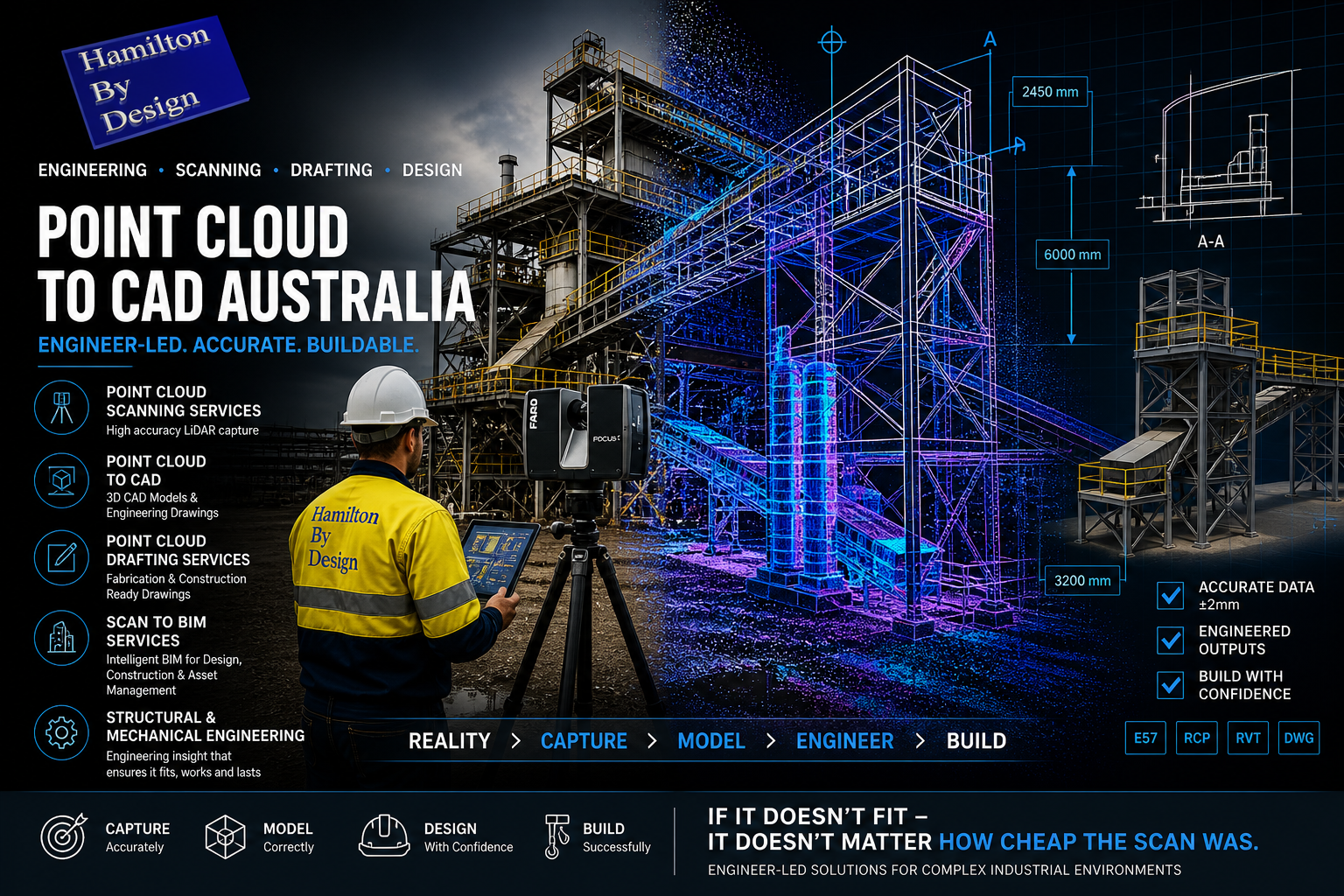
Point Cloud to CAD Australia

Engineer using LiDAR scanner capturing an industrial plant with overlay showing point cloud to CAD conversion and scan to BIM engineering workflow in Australia.

Engineer-Led Point Cloud to CAD Services Across Australia

At Hamilton By Design, we deliver engineering-grade point cloud to CAD services in Australia, purpose-built for industrial, mining, and complex mechanical environments.

We are not a visualisation or real estate scanning company.

We are a structural mechanical engineering-led organisation, using high-accuracy LiDAR scanning to support real-world design, fabrication, and construction outcomes.

3D CAD Modelling Australia service banner for Hamilton By Design

What We Do

We provide a complete workflow from point cloud scanning through to engineered deliverables, including:

  • Point cloud scanning services (LiDAR reality capture)
  • Point cloud to CAD conversion (2D & 3D)
  • Point cloud drafting services for fabrication and construction
  • Scan to BIM services for buildings and infrastructure
  • Mechanical and structural engineering integration

Our focus is simple:

๐Ÿ‘‰ Capture accurately. Model correctly. Design with confidence.


Point Cloud Scanning Service (Engineering Grade)

Our scanning services are built around engineering accuracy, not visual output.

Using high-precision LiDAR systems, we capture:

  • Industrial plants and processing facilities
  • Conveyor systems, chutes, and transfer stations
  • Structural steel and platforms
  • Pipework and mechanical systems
  • Existing buildings and infrastructure

Unlike low-cost scanning providers, we scan with design intent in mind โ€” ensuring the data can be used for:

  • Fabrication fit-up
  • Brownfield upgrades
  • Shutdown planning
  • Engineering verification

Point Cloud to CAD Australia

We convert raw point cloud data into usable engineering models and drawings, including:

  • 3D CAD models (SolidWorks-based workflows)
  • 2D AutoCAD drawings (plans, sections, elevations)
  • General Arrangement (GA) drawings
  • Fabrication-ready outputs

Our models are developed to support:

  • Clash detection
  • Design validation
  • Accurate measurement and geometry extraction
  • Integration into existing engineering workflows

Point Cloud Drafting Services

Our drafting services go beyond simple tracing.

We deliver engineering-controlled documentation, including:

  • Revision-controlled drawings (IFR / IFA / IFC)
  • Structured layouts driven from 3D models
  • Consistent drawing standards aligned with Australian practice
  • Clear geometry for fabrication and installation

This ensures your drawings are not just โ€œdrawnโ€ โ€” they are buildable.


Scan to BIM Services

For building and infrastructure projects, we offer Scan to BIM services tailored for:

  • Commercial buildings
  • Government assets
  • Industrial facilities
  • Upgrade and refurbishment projects

We create intelligent BIM models that support:

  • Asset management
  • Design coordination
  • Construction planning
  • Lifecycle management

Structural Mechanical Engineer-Led Approach

This is where Hamilton By Design is different.

We are not technicians capturing data.

We are engineers solving problems.

Our team understands:

  • Load paths and structural behaviour
  • Mechanical fit-up and tolerances
  • Fabrication constraints
  • Installation sequencing
  • Australian Standards and compliance requirements

This means:

๐Ÿ‘‰ We scan with purpose
๐Ÿ‘‰ We model with intent
๐Ÿ‘‰ We design for reality


Why Engineer-Led Scanning Matters

Low-cost scanning often leads to:

  • Incomplete data
  • Poor alignment
  • Unusable geometry
  • Costly rework during fabrication

Our approach eliminates that risk.

We provide:

  • Engineering-grade accuracy
  • Clear, structured deliverables
  • Confidence in fit and function

Because at the end of the day:

๐Ÿ‘‰ If it doesnโ€™t fit โ€” it doesnโ€™t matter how cheap the scan was.


Typical Applications

Our services are used across:

Mining & Heavy Industry

  • Conveyor upgrades
  • Transfer chute design
  • Plant modifications
  • Shutdown engineering

Industrial Plants

  • Brownfield expansions
  • Pipe routing and modifications
  • Structural upgrades

Buildings & Infrastructure

  • Scan to BIM for refurbishments
  • As-built documentation
  • Structural verification

Deliverables

Depending on your scope, we can provide:

  • Registered point clouds (.E57 / .RCP / .LAS)
  • Scan location plans
  • 3D CAD models
  • 2D engineering drawings
  • BIM models
  • Engineering review and input

Work With Hamilton By Design

If you are looking for:

  • Point cloud to CAD Australia
  • Reliable point cloud scanning service
  • Professional point cloud drafting services
  • High-quality scan to BIM services
  • A structural mechanical engineer who understands real-world constraints

Then weโ€™re ready to support your project.

3D LiDAR scanning and 3D modelling service button โ€” laser scanner capturing a point cloud for engineering and CAD modelling
Mechanical engineering services

Get Started

We typically operate on a day rate basis, with clear scope and deliverables.

๐Ÿ“ฉ Contact us today to:

  • Discuss your project
  • Arrange a site visit
  • Receive a proposal

Hamilton By Design logo displayed on a blue tilted rectangle with a grey gradient background

Final Word

At Hamilton By Design, we donโ€™t just capture data.

We deliver engineering certainty.

Our Clients

Finite Element Analysis (FEA) engineering simulation button
Mechanical engineering services

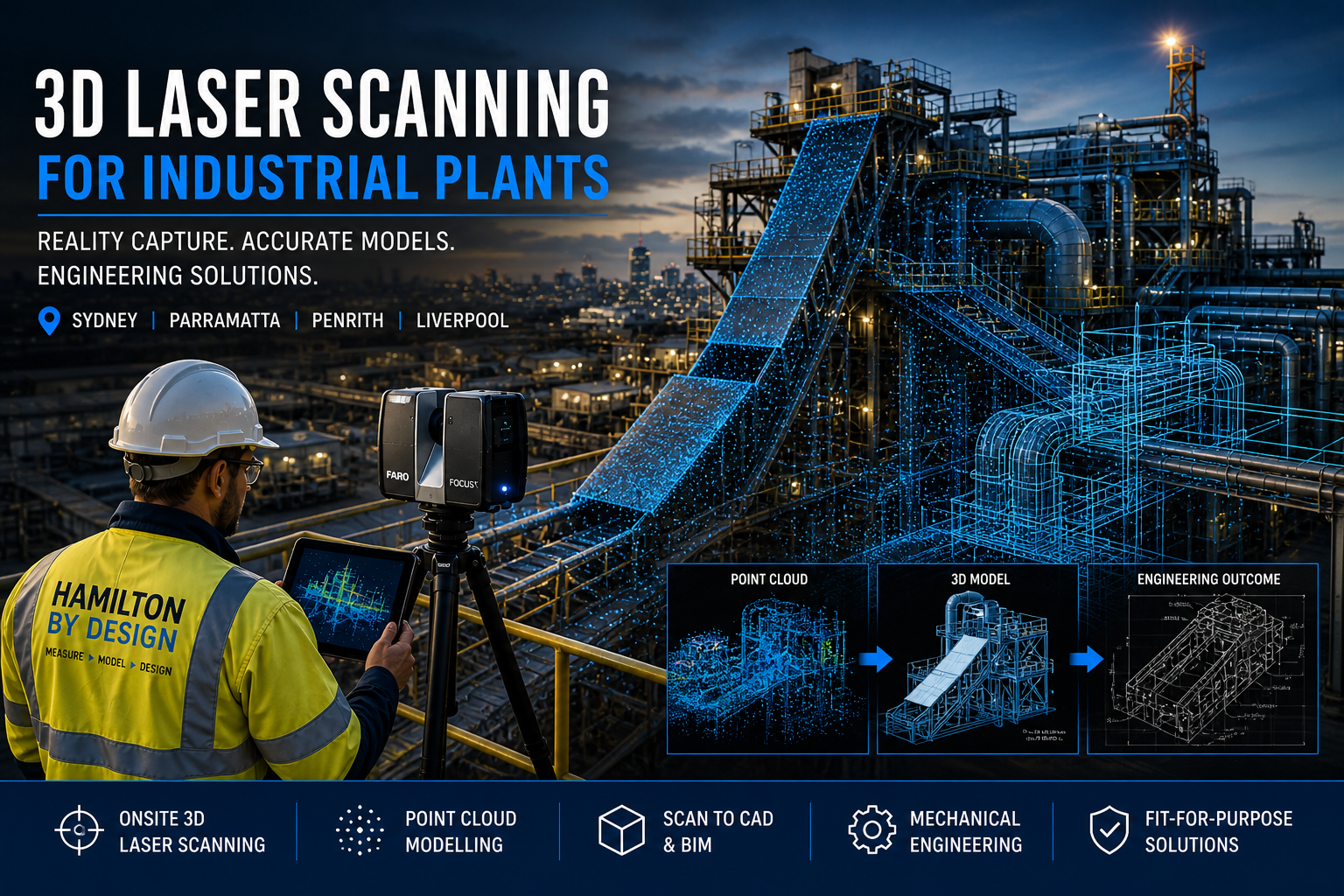
3D Scanning Industry Sydney

Industrial plant 3D laser scanning in Sydney showing engineer using LiDAR scanner with point cloud overlay and CAD modelling for engineering design

Point Cloud to CAD | Mechanical Engineering | Western Sydney Specialists

At Hamilton By Design, we provide engineering-grade 3D laser scanning for industrial plants, delivering accurate site data, detailed CAD models, and fit-for-purpose mechanical design solutions across Sydney, Parramatta, Penrith, and Liverpool.

Unlike typical 3D scanning companies, we are mechanical engineers first. That means every scan is captured with the end goal in mind โ€” design, fabrication, and real-world application.


3D Laser Scanning Services (Sydney & Western Sydney)

We offer onsite and mobile 3D scanning services across:

  • Parramatta
  • Penrith
  • Liverpool
  • Greater Western Sydney

Our LiDAR scanning services are ideal for:

  • Industrial plants
  • Manufacturing facilities
  • Processing plants
  • Construction and building upgrades

If youโ€™re searching for a โ€œ3D scanning company near meโ€, we deliver fast, accurate, and engineering-ready results.

3D CAD Modelling Australia service banner for Hamilton By Design

From Point Cloud to CAD (Engineering-Ready Models)

Scanning is only the first step.

We convert scan data into:

  • Point cloud modelling
  • 3D CAD models (SolidWorks, STEP, Parasolid)
  • 2D AutoCAD drawings
  • Scan-to-BIM models

This allows for:

  • Accurate design modifications
  • Clash detection
  • Fabrication-ready outputs

Mechanical Engineering Services

Hamilton By Design provides full mechanical engineering support, including:

  • Process equipment design
  • Structural and mechanical upgrades
  • Preventative maintenance design
  • Fit-for-purpose engineering solutions

All work is aligned with relevant Australian Standards, including AS 4991 where applicable.


Mining & Bulk Handling (High-Value Applications)

We specialise in mining and bulk materials handling systems, including:

  • Coal chutes and transfer stations
  • Conveyor systems
  • Outbye mining infrastructure
  • Header transition chutes

Custom Design vs Off-the-Shelf

Off-the-shelf chute designs often lead to:

  • Poor fit
  • Increased wear
  • High maintenance costs

Our approach:

  • Scan existing plant conditions
  • Develop custom designs based on real data
  • Deliver solutions that reduce downtime and improve performance

Building & Construction Scanning

We also support:

  • Building scanning services
  • Construction site verification
  • Scan-to-BIM for refurbishment projects

Ideal for commercial, industrial, and infrastructure upgrades.


Industries We Support

  • Industrial plants
  • Manufacturing facilities
  • Food processing plants
  • Mining and bulk handling
  • Construction and infrastructure

Locations We Service

We provide 3D laser scanning and engineering services across:

Sydney
Parramatta
Penrith
Liverpool
Western Sydney

With project capability across NSW and Australia.


Common Questions

What are the best 3D scanning platforms?

We use industry-leading LiDAR systems such as FARO and Leica. However, the real value comes from how the data is used in engineering design.


3D LiDAR scanning and 3D modelling service button โ€” laser scanner capturing a point cloud for engineering and CAD modelling
Mechanical engineering services

Do I need scan-to-CAD or just scanning?

Most industrial projects require CAD models and engineering input โ€” not just raw scan data.


Who provides professional 3D scanning near me?

Engineering-led companies like Hamilton By Design provide usable outcomes, not just visual data.


Hamilton By Design logo displayed on a blue tilted rectangle with a grey gradient background

Get Started

If you need accurate site data, modelling, or engineering support for an industrial project, contact Hamilton By Design today.


3D Scanning Sydney banner promoting engineering-grade 3D laser scanning, LiDAR scanning, and reality capture services by Hamilton By Design.
Mechanical Engineering Sydney banner with white text on a blue background representing Hamilton By Design's mechanical engineering services in Sydney.
Mechanical Drafting and 3D Modelling Sydney banner highlighting Hamilton By Design's CAD drafting, 3D modelling, and engineering design services in Sydney.

Mechanical Engineering | Structural Engineering


Hamilton By Design provides engineering-led 3D scanning, LiDAR scanning, mechanical engineering and digital engineering services throughout Sydney and Greater Sydney.

Explore our related Sydney services:


  • 3D Scanning Sydney โ€“ Engineering-grade terrestrial laser scanning, as-built surveys and point cloud capture for industrial, infrastructure and commercial projects.
  • Reality Capture Sydney โ€“ High-accuracy reality capture, digital twins, asset documentation and engineering-grade site verification.
  • Scan to CAD Sydney โ€“ Convert point cloud data into AutoCAD, SolidWorks, Inventor and other engineering-ready CAD deliverables.
  • Point Cloud Modelling Sydney โ€“ Engineering-grade point cloud processing, clash detection, as-built verification and 3D modelling.
  • Mechanical Engineering Sydney โ€“ Mechanical design, plant upgrades, materials handling systems, conveyors, chutes, platforms and engineering support.
  • Structural Drafting Sydney โ€“ Structural steel drafting, fabrication drawings, GA drawings, workshop detailing and as-built documentation.

Hamilton By Design supports projects throughout Sydney CBD, Parramatta, Liverpool, Penrith, Blacktown, Chatswood, Alexandria, Mascot, Newcastle and the Central Coast.


Blue banner graphic displaying the text "Point Cloud to CAD - Australia" in large white lettering, representing point cloud processing, scan-to-CAD conversion and digital engineering services across Australia.
Blue banner graphic displaying the text "Scan to CAD Sydney" in large white lettering, representing engineering-led point cloud to CAD conversion, LiDAR scanning and digital engineering services in Sydney.
Blue banner graphic displaying the text "Reality Capture Sydney - CBD" in large white lettering, representing engineering-led reality capture, LiDAR scanning and digital engineering services within Sydney CBD commercial buildings and infrastructure.
3D LiDAR Scanning Darwin for engineering surveys, laser scanning, reality capture and point cloud modelling services
3D LiDAR Scanning Australia engineering services for laser scanning, reality capture, scan-to-CAD, Scan-to-BIM and as-built documentation across Australia
3D LiDAR scanning services on the Central Coast providing engineering-grade laser scanning, point cloud capture, scan-to-CAD modelling and industrial reality capture for infrastructure and industrial projects.