Reality Capture Brisbane – Engineering-Led Terrestrial LiDAR Scanning, Drafting & Digital Engineering
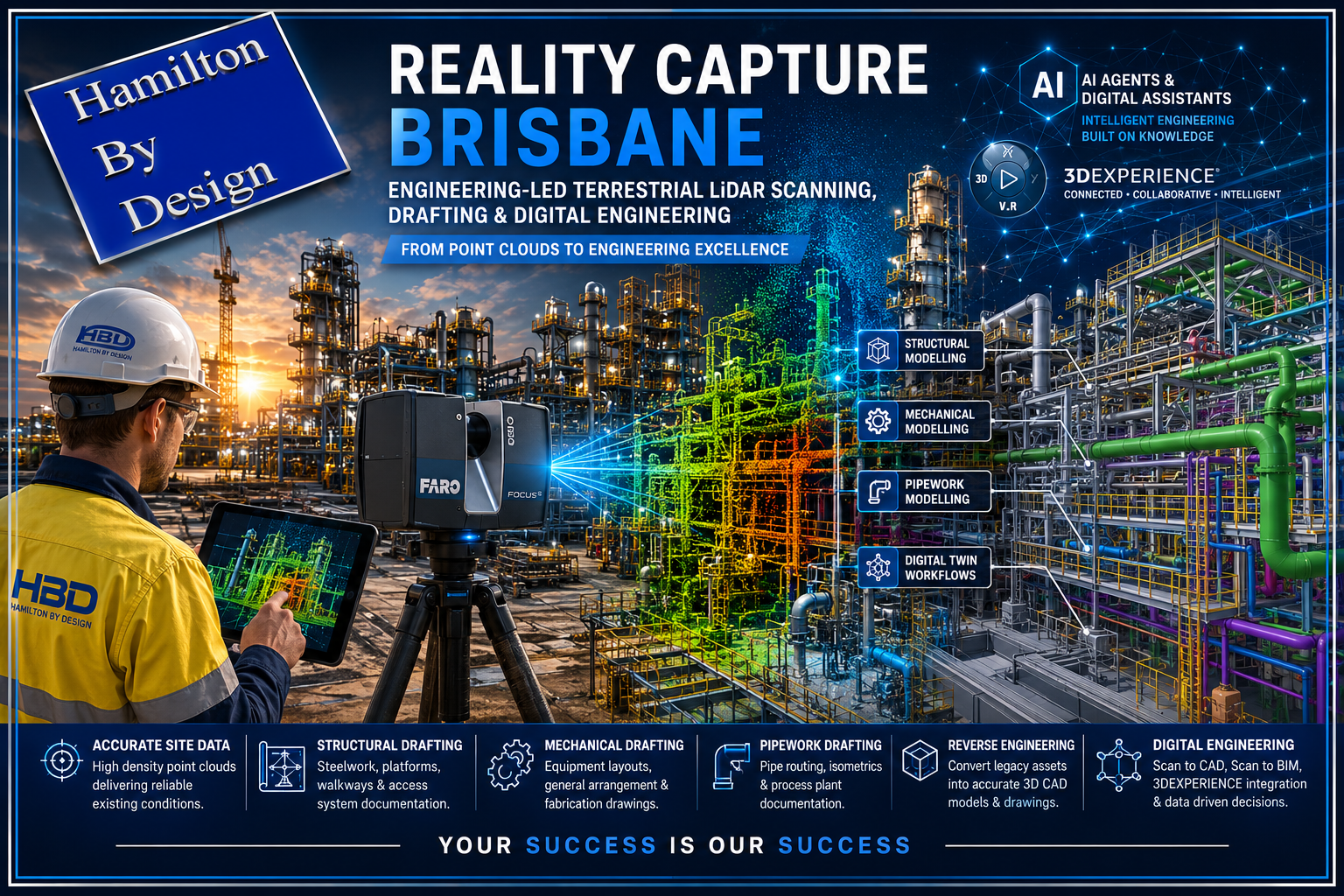
Reality Capture Brisbane

Hamilton By Design provides engineering-led reality capture services for Brisbane, South East Queensland and industrial sites across regional Queensland.
Our approach combines terrestrial LiDAR scanning, 3D point cloud capture, mechanical drafting, structural drafting, pipework drafting, reverse engineering and digital engineering capability. We do not see reality capture as simply collecting scan data. We see it as the first step in creating reliable engineering information that can support design, fabrication, construction, maintenance and asset management.
For large industrial sites, mining facilities, manufacturing plants and construction projects, accurate site information is critical. Historical drawings may be incomplete, outdated or unavailable. Equipment may have been modified over many years. Pipework, platforms, structural steel and mechanical assets may no longer reflect the original documentation.
Reality capture helps close this gap by creating a digital record of what is actually on site.
At Hamilton By Design, our team brings together mechanical experience, design experience, engineering experience and leadership experience. This includes practical trade knowledge, fitter machinist experience, drafting qualifications, poly welding experience, engineering leadership qualifications recognised by Engineers Australia and hands-on industrial project delivery experience.
This means our reality capture work is not only technically accurate. It is also interpreted through an engineering and drafting lens.
What Is Terrestrial LiDAR Scanning?
Terrestrial LiDAR scanning is a high-speed method of capturing existing site conditions using laser measurement technology.
A terrestrial scanner is positioned throughout a facility and captures millions of measurement points from the surrounding environment. These points are then registered together to create a detailed 3D point cloud of the site.
The point cloud can capture structural steel, pipework systems, mechanical equipment, conveyors, platforms, walkways, stairs, handrails, buildings, plant rooms, tanks and vessels, manufacturing equipment, mining infrastructure, construction works, services and access constraints.
This information can then be used for engineering review, drafting, modelling, design verification, clash detection, construction planning and asset documentation.
For large scan projects, terrestrial LiDAR scanning provides a major advantage because it can capture complex sites quickly and consistently. Rather than relying on manual measurements, photographs and assumptions, project teams can work from a detailed digital record of the existing environment.
Why Reality Capture Matters for Brisbane Industry

Brisbane and South East Queensland support a wide range of industrial, construction, infrastructure and manufacturing activity. Many businesses in the region operate complex facilities where accurate documentation is essential for ongoing improvement, compliance and project delivery.
Reality capture is valuable where sites include complex pipework, congested plant areas, restricted access zones, operating equipment, multiple levels, brownfield modifications, ageing infrastructure, missing drawings, shutdown constraints and fabrication fit-up risk.
For these environments, reliable site information can significantly reduce project risk. It allows engineers, designers, fabricators and construction teams to better understand the site before work begins.
This can help reduce rework, improve planning, reduce installation issues and support safer project delivery.
The Positive Aspects of Terrestrial LiDAR Scanning for Large Scan Projects
Large scan projects require more than simply placing a scanner on site. They require planning, technical understanding and an awareness of how the data will later be used.
Terrestrial LiDAR scanning provides several important benefits for large industrial and construction sites.
Faster Site Capture
Large sites can take significant time to measure manually. Terrestrial LiDAR scanning allows large areas to be captured efficiently while recording a high level of detail.
This is particularly valuable for operating plants where site access may be limited, shutdown windows may be short and repeated site visits may be difficult.
Reduced Reliance on Manual Measurement
Manual measurement can be slow, inconsistent and difficult in congested environments.
LiDAR scanning captures the surrounding environment in three dimensions, reducing the need to rely on hand sketches, tape measurements and incomplete photographs.
Improved Safety
Reality capture can reduce the need for personnel to repeatedly access elevated structures, congested plant areas, confined spaces or operating equipment zones.
Once a site has been scanned, many engineering and drafting checks can be completed from the office using the point cloud.
Better Engineering Decisions
A point cloud provides visual and dimensional context. Engineers and drafters can review existing conditions, measure clearances, assess access and understand how proposed modifications will interact with the current site.
This helps support better decisions during the design stage.
Reduced Fabrication and Installation Risk
Fabrication errors can be costly, particularly when working on brownfield sites.
By using scan data to support drafting and modelling, project teams can reduce the risk of components not fitting on site.
This is especially important for structural modifications, pipework upgrades, mechanical equipment replacement and conveyor improvements.
Improved Coordination
Large projects often involve multiple disciplines. Mechanical, structural, piping, electrical, construction and maintenance teams may all need to work around the same existing assets.
A registered point cloud gives project stakeholders a common reference point.
Long-Term Asset Value
A scan is not only useful for the immediate project. It can become a long-term digital record of the site.
This information can support future shutdowns, upgrades, maintenance planning and asset management activities.
Engineering-Led Reality Capture
Hamilton By Design is an engineering-led business.

Our team understands how scanned information is used after the site capture is complete. This is important because the value of reality capture is not only in the scan itself. The value comes from converting the scan into engineering information.
Our background includes mechanical engineering, engineering leadership, mechanical drafting, structural drafting, pipework drafting, fitter machinist trade experience, poly welding experience, industrial maintenance, design and fabrication support, site-based project experience, reverse engineering and digital engineering workflows.
This combination allows us to understand the practical needs of engineers, project managers, fabricators, construction teams and maintenance personnel.
We understand how things are built, how they are installed, how they are maintained and how they fail. This practical experience improves the way we approach reality capture and digital engineering.
Structural Drafting and Reality Capture
Structural drafting is one of the strongest applications for terrestrial LiDAR scanning.
Industrial sites often contain structural steel that has been modified over time. Existing drawings may not show current conditions. Platforms may have been extended. Handrails may have been altered. Conveyor structures, pipe racks and access systems may have been changed to suit operational needs.
Reality capture can support structural drafting for access platforms, walkways, stairs, handrails, pipe supports, equipment support frames, conveyor gantries, structural steel modifications, building frames, maintenance access systems, fabrication drawings and as-built drawings.
Using point cloud data, structural drafters can model existing conditions and prepare drawings that better reflect the real site environment.
This helps improve fit-up, reduce site clashes and support safer construction planning.
Mechanical Drafting and Reality Capture
Mechanical drafting is another important part of the Hamilton By Design reality capture workflow.
Many industrial sites include pumps, conveyors, tanks, chutes, hoppers, guards, rotating equipment, drive systems and process machinery. These assets often require modification, replacement or reverse engineering.
Reality capture can support mechanical drafting for equipment layouts, pump stations, conveyor systems, chutes and hoppers, machine guarding, mechanical access, replacement components, maintenance modifications, general arrangement drawings, fabrication packages and reverse engineering.
Because our team has mechanical and fitter machinist experience, we understand more than just the shape of equipment. We understand how mechanical components are manufactured, installed, aligned, maintained and replaced.
This practical understanding helps us produce drafting and modelling outputs that are useful for real engineering work.
Pipework Drafting and Reality Capture
Pipework can be difficult to document accurately using traditional methods.
Industrial facilities often contain process pipework, slurry lines, compressed air, water services, fire services, chemical dosing systems and utility piping. These systems may run through congested areas, across multiple levels and around structural and mechanical assets.
Terrestrial LiDAR scanning helps capture pipework in context.
Reality capture can support pipework drafting for pipe routing, existing pipework layouts, pipe supports, pump connections, tank connections, service corridors, plant room pipework, process plant modifications, general arrangement drawings, isometric support information, clash review and as-built documentation.
By combining scan data with pipework drafting experience, Hamilton By Design can support upgrades, replacements and modifications with greater confidence.
Reality Capture for Mining Sites
Mining operations across Queensland rely on accurate site information for maintenance, shutdowns, upgrades and capital projects.
Reality capture can support mining sites by documenting conveyors, transfer stations, CHPP infrastructure, crushing and screening areas, pump stations, structural steel, access platforms, pipework, tanks and process equipment and fixed plant assets.
Mining sites often include harsh operating conditions, ageing infrastructure and ongoing modifications. Reality capture provides a practical way to understand existing conditions before design and fabrication work begins.
For mining clients, this can support safer planning, improved shutdown preparation and reduced installation risk.
Reality Capture for Construction Sites
Construction projects can benefit from reality capture at multiple stages of the project.
Before work begins, LiDAR scanning can document existing conditions. During construction, scanning can help verify progress and check installed works. At completion, scan data can support as-built documentation.
Reality capture can assist construction projects with existing condition surveys, refurbishment planning, building upgrades, structural verification, services coordination, plant room documentation, construction progress records, clash detection and as-built records.
For Brisbane construction projects, this can be especially useful where new work must connect into existing structures, services or infrastructure.
Reality Capture for Manufacturing Facilities
Manufacturing facilities often need to upgrade equipment while keeping production running.
Reality capture can support manufacturing projects by capturing production lines, conveyors, machine layouts, maintenance access, structural supports, services, plant rooms, equipment footprints and factory expansion areas.
This allows engineering and drafting work to be completed offsite using accurate site data. It can help reduce disruption to production and improve installation planning.
Reverse Engineering and Digital Engineering
Reality capture is also a powerful tool for reverse engineering.
Many industrial components do not have reliable drawings. Some equipment may be old, modified or no longer supported by the original manufacturer.
Hamilton By Design can use scan data, mechanical experience and drafting knowledge to support reverse engineering of fabricated components, pump components, conveyor parts, machine frames, chutes, hoppers, access systems, custom equipment and replacement parts.
The objective is to convert physical assets into usable digital information. This can include CAD models, drawings and fabrication information.
From Point Cloud to CAD
Scan-to-CAD is where reality capture becomes practical engineering information.
A point cloud is useful, but many projects require drawings, models or design deliverables that can be used by engineers, fabricators and construction teams.
Hamilton By Design can support Scan-to-CAD workflows for mechanical models, structural models, pipework layouts, general arrangement drawings, fabrication drawings, as-built drawings, equipment layouts and construction support drawings.
By combining 3D LiDAR scanning with drafting and engineering knowledge, we help turn captured site data into usable project information.
From Point Cloud to BIM
For construction, infrastructure and facilities management, Scan-to-BIM workflows can help convert point cloud data into structured building or asset information.
Scan-to-BIM may support building upgrades, plant room modelling, services coordination, facilities management, asset information, construction verification and digital twin development.
While not every industrial project requires a full BIM model, the ability to convert scan data into structured digital information provides long-term value for asset owners and project teams.
Digital Engineering and AI-Ready Knowledge
Reality capture also plays an important role in the future of digital engineering.
As engineering businesses adopt AI Agents, Enterprise AI Assistants, Large Language Models and Digital Assistants, the quality of the knowledge base becomes increasingly important.
AI is only as useful as the information it can access.
A well-managed digital engineering environment may include point clouds, CAD models, drawings, inspection records, maintenance history, asset registers, project documentation, engineering standards, site photographs, vendor data and construction records.
Hamilton By Design sees reality capture as part of this broader knowledge system. A point cloud is not just a scan file. It is a digital record that can support future engineering decisions, project planning and asset management.
SolidWorks, 3DEXPERIENCE and Intelligent Engineering Workflows
Hamilton By Design has long-term experience with SolidWorks and digital engineering workflows.
The SolidWorks 3DEXPERIENCE platform represents a shift toward connected engineering, cloud-based collaboration, structured project information and intelligent design workflows.
As AI Agents and digital assistants become more common in engineering, platforms such as SolidWorks and 3DEXPERIENCE will continue to influence how teams manage design data, project knowledge and engineering collaboration.
Hamilton By Design understands that successful AI and digital engineering outcomes depend on a strong knowledge base.
This means organising information so it can be found, understood and reused.
For industrial clients, this may include CAD models, drawings, point clouds, engineering calculations, asset records, project correspondence, maintenance information, design decisions and lessons learned.
When this information is structured properly, AI Agents and Enterprise AI Assistants can help teams search, understand and apply knowledge more efficiently.
AI Agents, Enterprise AI Assistants and Reality Capture
AI Agents, Enterprise AI Assistants, Large Language Models and Digital Assistants are becoming increasingly relevant to engineering organisations.
These tools may help teams search project information, review technical documents, summarise engineering records, find historical drawings, support maintenance planning, assist project reporting, improve knowledge management, connect asset information and support decision-making.
However, AI must be built on accurate and relevant information.
Hamilton By Design’s reality capture, drafting and digital engineering workflows can help create the trusted information base that future AI systems need.
This is where practical engineering experience matters.
Our team has mechanical experience, design experience, engineering experience and leadership experience. We understand how engineering information is created, reviewed, used and relied upon.
This allows us to support clients who want to move toward smarter, more connected digital engineering systems.
Your Success Is Our Success
At Hamilton By Design, our goal is to provide more than scan data.
We aim to provide information that helps our clients make better decisions, reduce risk and improve project outcomes.
Whether the project involves terrestrial LiDAR scanning, structural drafting, mechanical drafting, pipework drafting, Scan-to-CAD, Scan-to-BIM, reverse engineering, SolidWorks modelling, 3DEXPERIENCE workflows or future AI-ready knowledge systems, our focus remains the same.
Your success is our success.
When your team has better information, projects can be planned with greater confidence.
When your site is accurately captured, fabrication and installation risk can be reduced.
When your drawings and models reflect real site conditions, engineering decisions improve.
When your knowledge base is structured properly, future AI Agents and Digital Assistants become more useful.
Hamilton By Design helps Brisbane and Queensland industry build stronger digital foundations by combining reality capture, drafting, engineering experience and intelligent digital workflows.
Brisbane’s Engineering-Led Reality Capture Partner
Hamilton By Design provides reality capture services for Brisbane, South East Queensland and industrial sites throughout regional Queensland.
Our services support mining, manufacturing, construction, industrial facilities, process plants, mechanical projects, structural projects, pipework projects, reverse engineering, digital engineering and asset documentation.
By combining terrestrial LiDAR scanning, point cloud processing, mechanical drafting, structural drafting, pipework drafting, SolidWorks modelling, 3DEXPERIENCE knowledge and engineering-led project understanding, we provide practical digital engineering solutions for complex industrial environments.
For Brisbane businesses seeking accurate site capture, reliable drafting support and a smarter pathway toward digital engineering, Hamilton By Design provides a practical and engineering-led reality capture service.

Brisbane’s Engineering-Led Reality Capture Partner
Hamilton By Design provides engineering-led reality capture services throughout Brisbane and Queensland.
Our unique combination of terrestrial LiDAR scanning, engineering expertise, drafting capability, fitter machinist experience and industrial knowledge allows us to deliver practical outcomes that extend well beyond simple point cloud collection.
Whether supporting mining operations, manufacturing facilities, industrial plants, construction projects or reverse engineering assignments, our team provides accurate digital information that helps reduce risk, improve accuracy and support successful project delivery.
By combining reality capture, structural drafting, mechanical drafting, pipework drafting and engineering design within a single workflow, Hamilton By Design delivers complete digital engineering solutions for Brisbane industry.
Frequently Asked Questions About Reality Capture Brisbane
What is reality capture?
Reality capture is the process of digitally recording existing assets, facilities and infrastructure using technologies such as terrestrial LiDAR scanning, laser scanning and photogrammetry. The resulting point cloud provides an accurate digital representation of the site for engineering, design and asset management purposes.
What is the difference between reality capture and laser scanning?
Laser scanning is one of the technologies used to perform reality capture. Reality capture is the broader process of creating accurate digital records of physical assets, while laser scanning is the method used to collect the data.
What industries benefit from reality capture?
Reality capture is widely used across mining, mineral processing, smelting, manufacturing, power generation, water treatment and infrastructure projects. Accurate digital information reduces site visits, improves safety and assists project teams during planning and design.
Can point clouds be converted into CAD models?
Yes. Hamilton By Design regularly converts point cloud data into AutoCAD, SolidWorks, Autodesk Inventor and Revit models. This allows project teams to work from accurate as-built information when planning upgrades, modifications and maintenance activities.
What accuracy can be achieved with LiDAR scanning?
Engineering-grade terrestrial LiDAR scanning can achieve millimetre-level accuracy depending on project requirements, scanning methodology and site conditions. Accurate registration and verification processes ensure reliable project deliverables.
Do you provide Scan to CAD services in Brisbane?
Yes. Hamilton By Design provides complete Scan to CAD services throughout Brisbane and Queensland, transforming point cloud data into engineering drawings, 3D models, plant layouts and fabrication-ready documentation.
Can reality capture be completed during shutdowns?
Yes. Reality capture is commonly performed during plant shutdowns, maintenance outages and brownfield upgrade projects where accurate site information is required within limited timeframes.
What deliverables can be provided?
Deliverables may include registered point clouds, AutoCAD drawings, SolidWorks models, Inventor models, Revit models, general arrangement drawings, equipment layouts, structural models, pipework models and digital engineering datasets.
Why Brisbane Industries Are Adopting Reality Capture
Brisbane continues to support major mining, processing, infrastructure and manufacturing projects throughout Queensland. Reality capture provides project teams with accurate site information before design work begins, reducing risk, improving project planning and minimising costly rework during construction and installation.
Hamilton By Design combines practical mechanical engineering, drafting and site-based project experience with advanced LiDAR scanning technologies to deliver engineering-ready information for industrial clients throughout Brisbane and regional Queensland.
Related Brisbane Engineering Services
Hamilton By Design provides a complete range of engineering-led digital engineering, reality capture and drafting services throughout Brisbane and South East Queensland.
Learn more about our related services:
- LiDAR Scanning Brisbane – Engineering-grade terrestrial laser scanning for industrial facilities, mining infrastructure and brownfield projects.
- 3D Laser Scanning for Engineering Projects – Accurate site capture supporting design, shutdown planning, asset management and project execution.
- Mechanical Engineering Brisbane – Mechanical design, plant upgrades, equipment design, materials handling systems and engineering support.
- Mechanical Drafting Brisbane – AutoCAD, SolidWorks and Inventor drafting services for fabrication, maintenance and construction projects.
- Engineering & 3D Scanning Locations Australia – National engineering and reality capture services supporting mining, manufacturing, infrastructure and processing industries throughout Australia.
By integrating reality capture with engineering design and drafting, Hamilton By Design delivers accurate point cloud data, Scan to CAD services, as-built documentation and digital engineering solutions that help reduce project risk and improve decision making.
Whether your project involves industrial laser scanning, point cloud modelling, plant upgrades, reverse engineering or engineering verification, our team can provide practical solutions backed by real-world engineering experience.
Talk to Us – Contact Us
Our clients




#Reality Capture Brisbane #Terrestrial LiDAR Scanning #Structural Drafting Brisbane #Mechanical Drafting Brisbane #Pipework Drafting Brisbane #Mining Engineering Queensland #Point Cloud Modelling #Reverse Engineering Brisbane