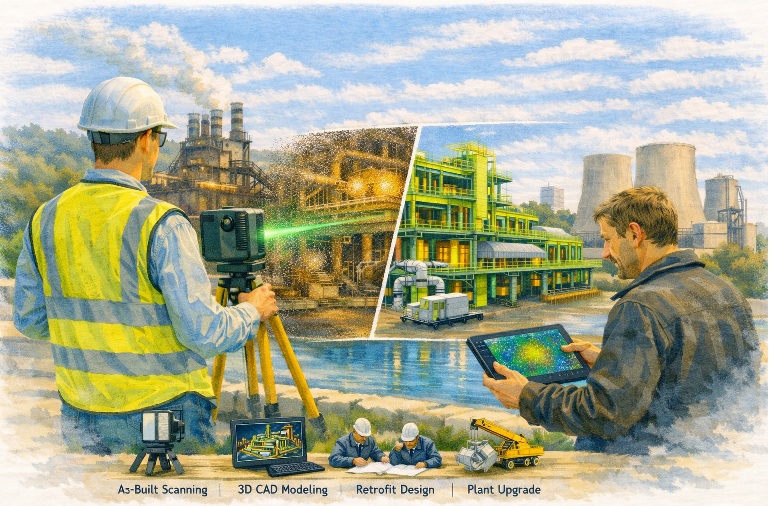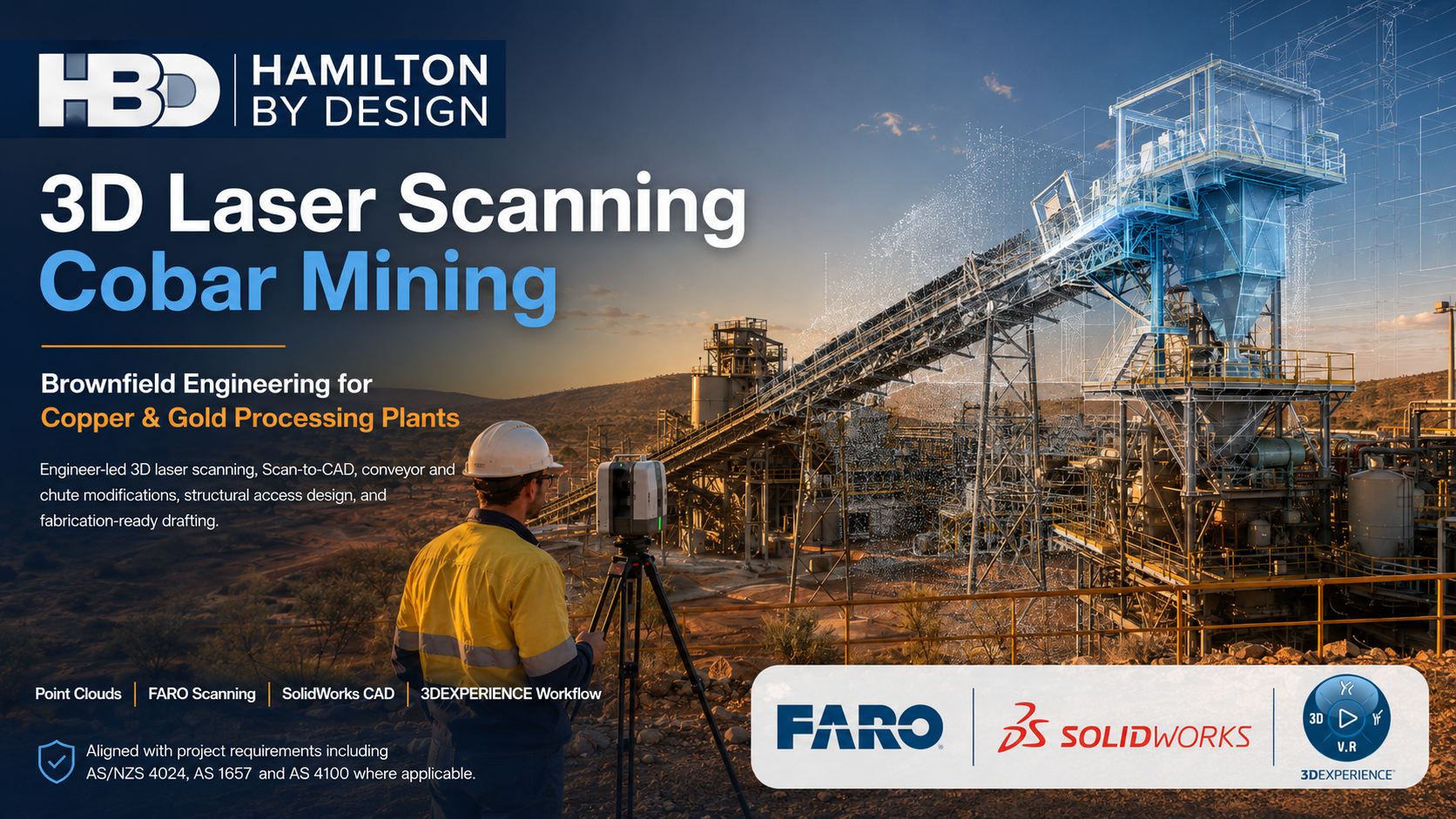

Mining and mineral processing facilities around Cobar and western New South Wales often operate with infrastructure that has been modified, repaired and upgraded over many years. Conveyors have been extended, transfer chutes replaced, platforms altered, equipment repositioned and structural steel added to meet changing production and maintenance requirements.
The challenge for engineers is that the drawings available in the document system do not always represent what is physically installed.
For a brownfield copper or gold processing project, a relatively small difference between a drawing and the existing plant can become a significant problem when new equipment arrives on site.
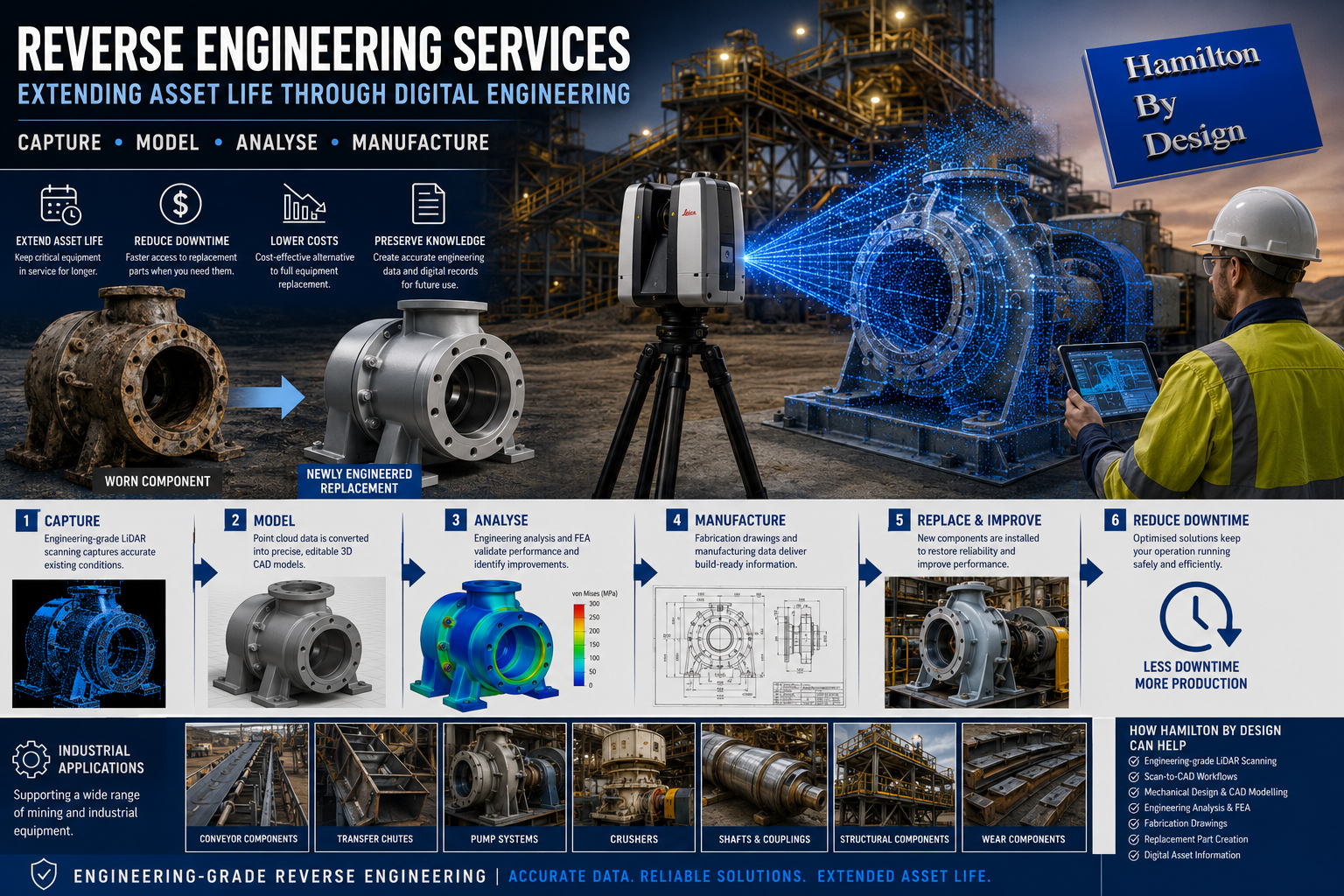
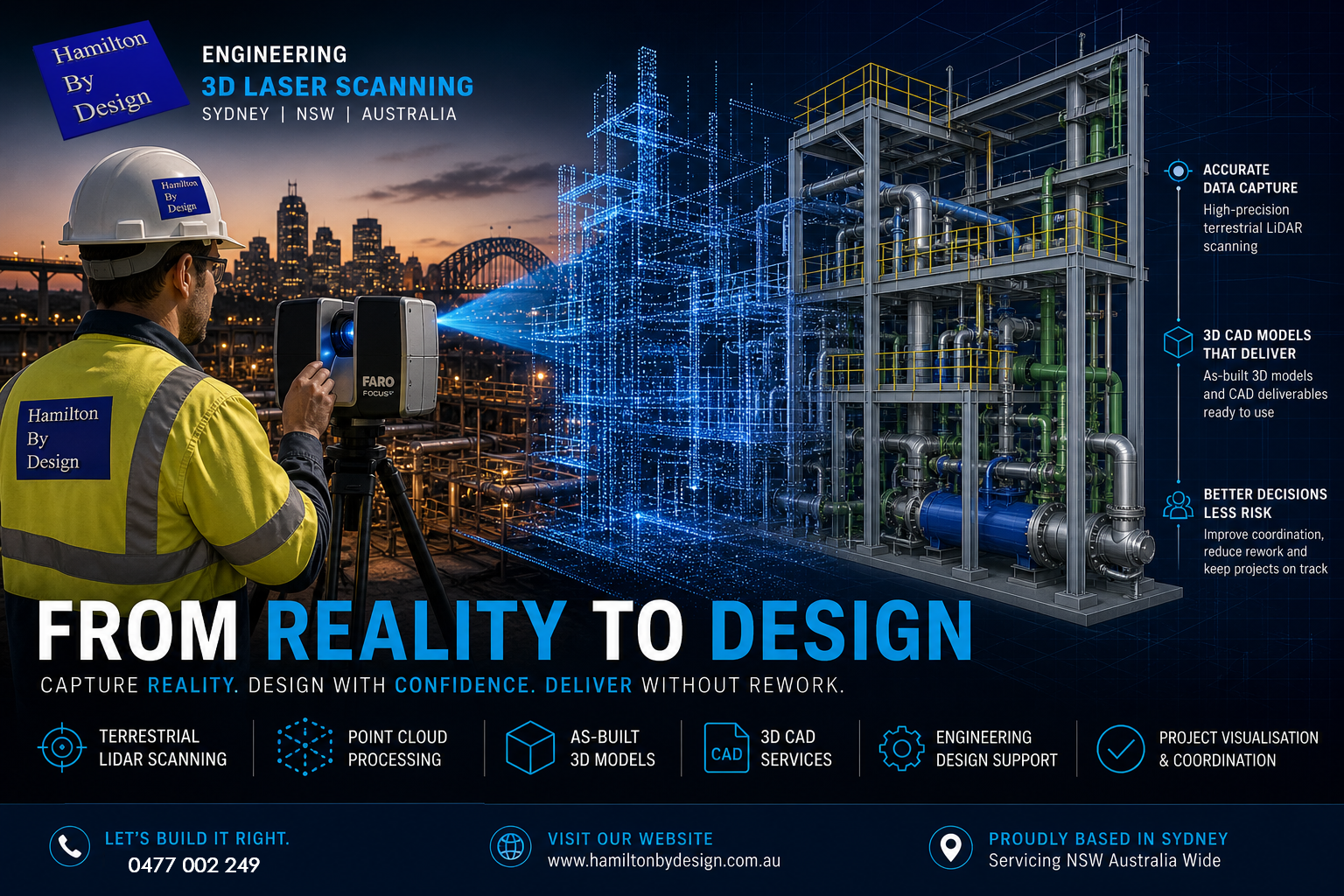
Hamilton By Design provides engineer-led 3D laser scanning, mechanical engineering, Scan-to-CAD modelling and drafting services to help mining and mineral-processing projects capture existing plant conditions before modifications are designed.
Our approach combines engineering-grade 3D laser scanning for mining and industrial plants with practical mechanical design experience.
Instead of designing around assumptions, we can design around the plant that actually exists.
Why Brownfield Mining Projects Are Difficult to Engineer
Brownfield mining projects are very different from designing a new processing facility.
A new plant begins with controlled design information. An existing plant may have undergone decades of modifications.
Common issues include:
- outdated arrangement drawings
- undocumented structural modifications
- relocated equipment
- replacement motors and gearboxes
- changed conveyor geometry
- modified chute arrangements
- additional pipework
- changed handrails and platforms
- temporary modifications that became permanent
- limited access for conventional measurement.
These problems become particularly important around crushers, screens, conveyors, transfer stations and process equipment where many mechanical and structural systems occupy a relatively small area.
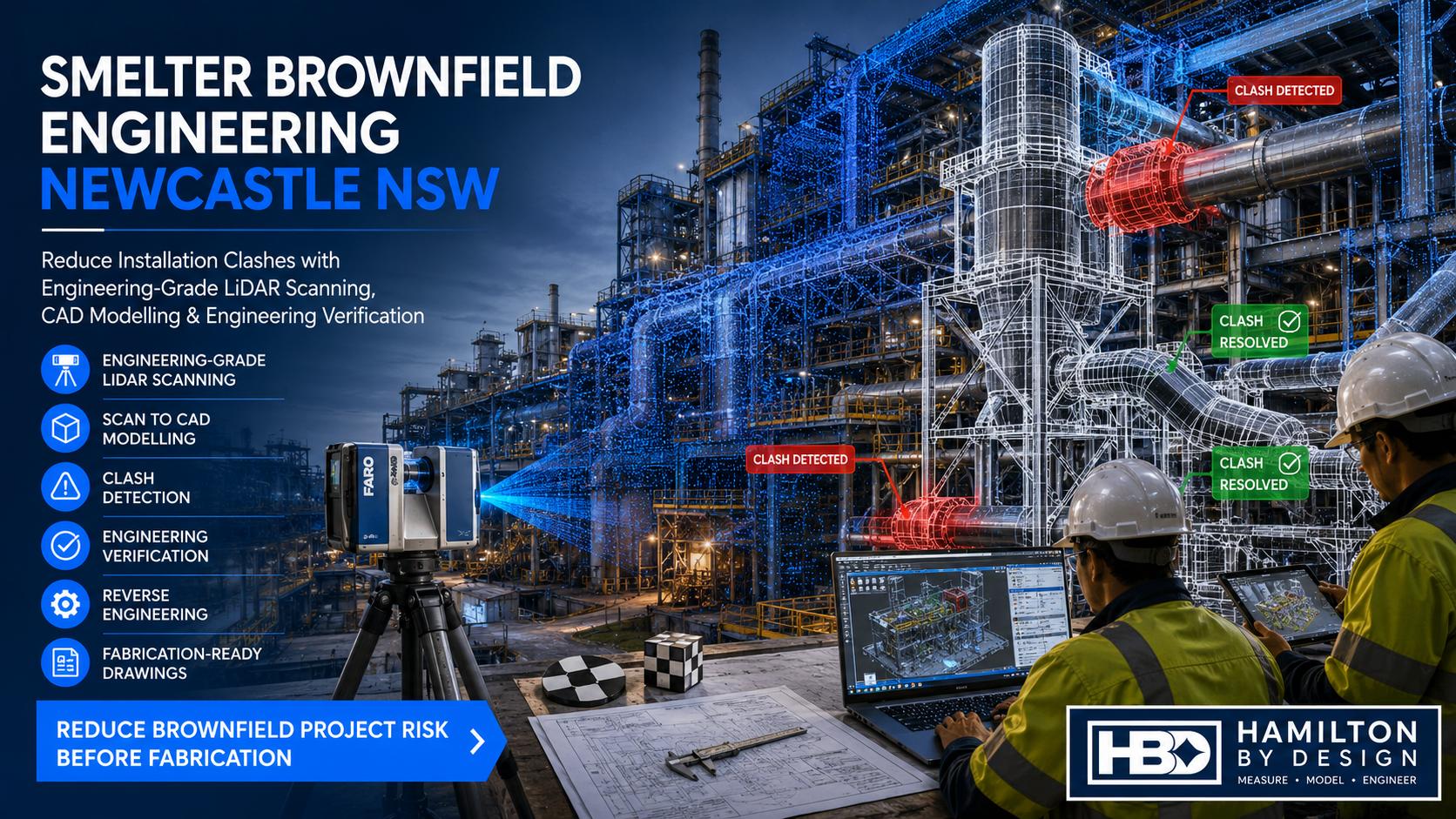
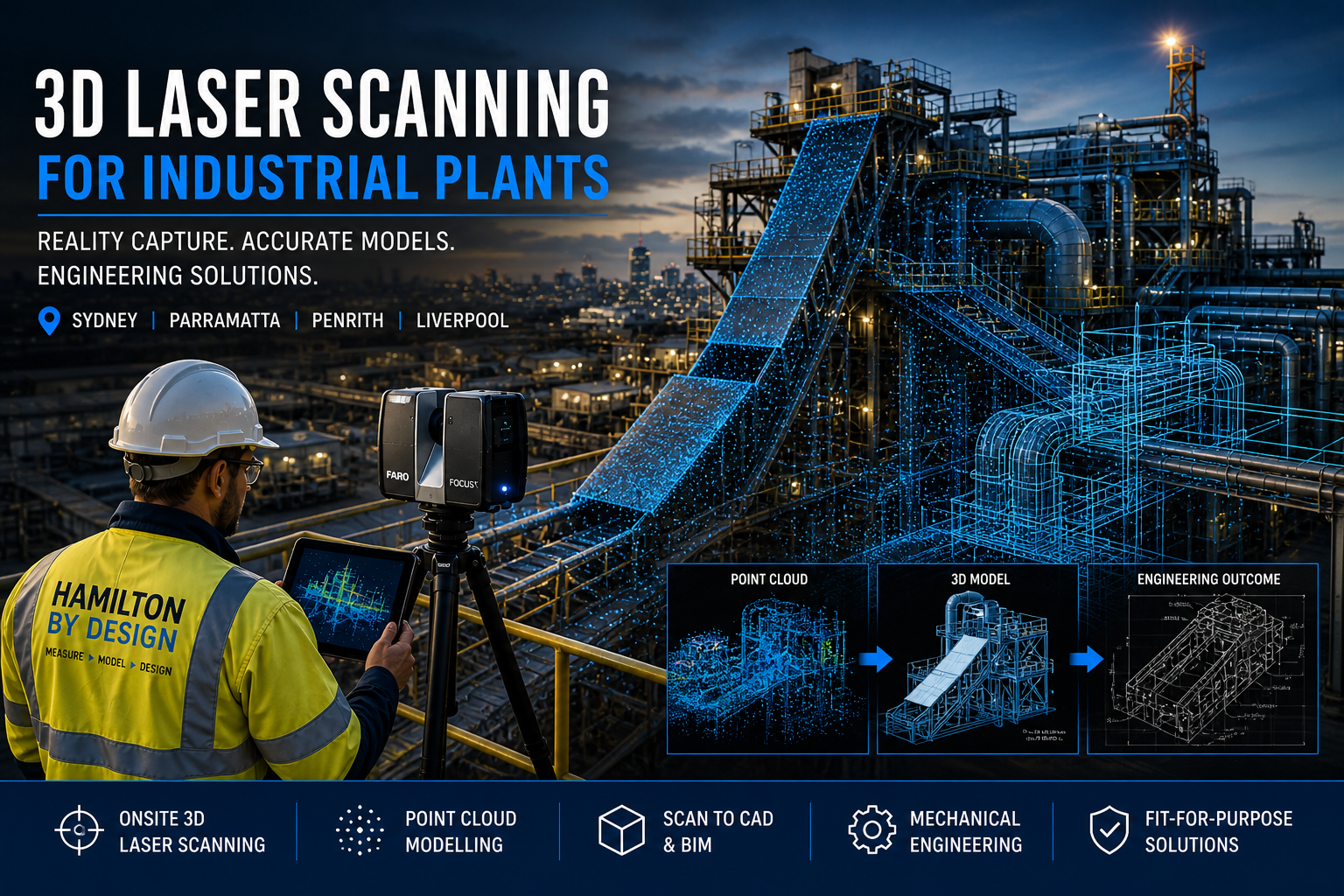
Hamilton By Design’s 3D laser scanning services provide a method of capturing this existing geometry as a detailed point cloud.
The resulting digital dataset can then become the dimensional reference for the engineering project.
Scan the Existing Plant Before Designing the Modification
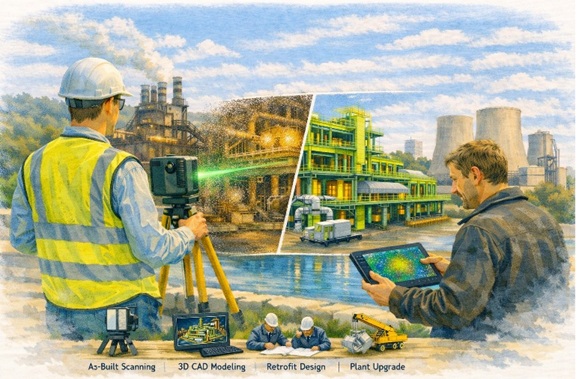
A terrestrial 3D laser scanner captures millions of measurement points around the surrounding plant.
Multiple scan positions can be registered together to build a three-dimensional representation of the existing facility.
Depending on the project requirements, Hamilton By Design can capture:
- conveyors
- transfer stations
- chutes
- hoppers
- bins
- structural steel
- platforms
- stairs
- handrails
- pipework
- pumps
- motors
- gearboxes
- guards
- equipment foundations
- access areas
- surrounding plant interfaces.
The point cloud can then be brought into the engineering design environment.
This is particularly useful when planning mining plant upgrades using engineering-grade laser scanning.
Rather than repeatedly sending personnel back to site to check individual dimensions, engineers can interrogate the captured plant digitally during the design process.
That can be extremely valuable when Cobar is hundreds of kilometres from the engineering office, fabrication workshop or equipment supplier.
Conveyor and Transfer Station Modifications
Conveyor systems are one of the strongest applications for brownfield 3D scanning.
A conveyor modification may involve much more than changing a belt or pulley.
Projects can affect:
- head and tail pulley arrangements
- drives
- take-ups
- skirts
- transfer chutes
- supporting steel
- walkways
- guarding
- maintenance access
- discharge geometry
- receiving conveyors.
Hamilton By Design supports bulk material handling systems including ROM areas, conveyors and transfer points for mining and processing environments.
AS/NZS 4024 and Conveyor Safety
Machinery and conveyor modifications should consider the applicable requirements of the AS/NZS 4024 Safety of Machinery series.
In particular, AS/NZS 4024.3610:2015 – Safety of machinery, Part 3610: Conveyors – General requirements establishes minimum lifecycle safety requirements for conveyor systems.
For Hamilton By Design, the standard becomes relevant when engineering changes affect items such as:
- guarding
- moving machinery
- access around conveyors
- maintenance areas
- conveyor interfaces
- hazard reduction.
3D scanning does not itself demonstrate compliance with AS/NZS 4024. Instead, it provides accurate existing-condition information that can support an engineering design developed with the relevant machinery-safety requirements in mind.
Chutes and Hard-Rock Transfer Points
Copper and gold processing plants typically handle hard, abrasive material.
Transfer chutes therefore present different challenges from many coal-handling applications.
The designer may need to consider:
- trajectory
- impact
- wear
- liner arrangement
- build-up
- blockages
- belt loading
- spillage
- dust
- maintainability
- access for liner replacement.
Hamilton By Design provides conveyor transfer chute design support for mining operations.
For an existing transfer station, our starting point can be to scan the structure, conveyor and surrounding equipment.
A new chute arrangement can then be modelled within the captured environment.
This allows interfaces to be checked before fabrication and provides far greater confidence than designing from an old general arrangement drawing alone.
Platforms, Walkways, Stairs and Maintenance Access
Plant modifications frequently create a secondary problem: how will maintenance personnel safely access the equipment?
Installing a new chute, motor, gearbox or conveyor component can interfere with an existing walkway or maintenance platform.
Hamilton By Design can use the point cloud to evaluate the relationship between the modified equipment and existing access infrastructure.
Where new or modified access systems are required, AS 1657:2018 – Fixed platforms, walkways, stairways and ladders – Design, construction and installation may be applicable.
AS 1657 establishes requirements relating to fixed access systems including platforms, walkways, stairs and ladders.
The standard becomes especially important during brownfield work because an apparently minor mechanical modification can change:
- access clearances
- platform dimensions
- handrail arrangements
- stair access
- maintenance space.
Capturing the surrounding plant rather than only the component being replaced provides the wider engineering context needed to identify these conflicts.
Structural Steel Supporting Mining Equipment
Conveyor and process-plant modifications can also introduce changes to structural steel.
A project may require:
- new equipment support frames
- chute support steel
- conveyor supports
- local strengthening
- platforms
- brackets
- access structures
- modifications to existing framing.
Where applicable, structural steel design can be considered against AS 4100:2020 – Steel Structures and its current amendments.
AS 4100 specifies requirements relating to the design and engineering aspects of fabrication, erection and modification of steelwork in structures.
Hamilton By Design’s broader engineering services combine reality capture with mechanical design, structural assessment, CAD modelling, drafting and verification.
This creates a useful workflow for projects where a mechanical modification cannot be separated from the structure supporting it.
From Point Cloud to Fabrication Drawings
Capturing the plant is only the beginning.
The real value for many mining projects comes from turning the captured geometry into useful engineering information.
A typical workflow may be:
Site Scan → Point Cloud Registration → Existing-Condition Review → 3D CAD Modelling → Engineering Design → Clash Checking → Fabrication Drawings → Site Installation
Hamilton By Design can provide mechanical drafting services for mining and industrial projects to develop drawings required for fabrication and project delivery.
Depending on the scope, deliverables may include:
- 3D CAD models
- general arrangements
- fabrication drawings
- assemblies
- sections and elevations
- DXF files
- PDFs
- bills of materials.
Where structural steelwork is being fabricated, AS/NZS 5131:2016 – Structural steelwork – Fabrication and erection may also form part of the applicable project requirements.
AS/NZS 5131 establishes requirements associated with construction of structural steelwork, including fabrication and erection activities.
Again, the applicable standards need to be determined for the particular design rather than automatically applying every standard to every project.
Shutdown Engineering and Reducing Installation Risk
Mining shutdowns create a simple commercial reality:
the modification needs to fit when it arrives on site.
Discovering during a shutdown that a chute clashes with structural steel or a platform interferes with a new drive can turn a small measurement error into hours or days of lost production.
This is where 3D scanning for mining shutdown projects becomes particularly useful.
New equipment can be modelled against the existing point cloud before fabrication.
Potential interference can be identified between:
- new and existing steelwork
- chutes and conveyors
- motors and platforms
- pipework and structures
- equipment and maintenance access.
The objective is straightforward: find the problem digitally before finding it during installation.
How Hamilton By Design Can Help Cobar Mining Projects
Hamilton By Design can support copper, gold and hard-rock processing facilities throughout Cobar and western NSW with an integrated engineering workflow.
Rather than engaging one business to scan the facility, another to interpret the scan and another to produce the mechanical design, our focus is connecting reality capture directly with engineering.
Services can include:
- engineering-grade terrestrial LiDAR scanning
- registered point-cloud creation
- existing-condition verification
- Scan-to-CAD
- mechanical engineering
- conveyor modifications
- transfer chute design
- structural support design
- platform and access modifications
- machine guarding
- reverse engineering
- wear and condition capture
- clash detection
- shutdown engineering
- SolidWorks modelling
- AutoCAD drafting
- fabrication drawings
- bills of materials.
For mines operating in regional NSW, this approach also reduces the dependence on repeated site measurement visits.
Capture once. Engineer from the captured environment. Verify before fabrication.
Frequently Asked Questions
Can you 3D scan an operating mineral processing plant?
Yes. Terrestrial laser scanning is particularly useful for brownfield industrial environments because large amounts of plant geometry can be captured without physically measuring every component individually. Site access, operating equipment and safety requirements are assessed as part of planning the scanning work.
Can you scan conveyors and transfer stations?
Yes. Conveyors, transfer stations, chutes, structural steel, platforms, drives and surrounding equipment are strong applications for engineering-grade 3D scanning.
Can Hamilton By Design design the modification after scanning it?
Yes. This is a major advantage of an engineer-led scanning workflow. The point cloud can provide the dimensional foundation for subsequent CAD modelling, mechanical design, clash checking and drafting.
What Australian Standards may apply to conveyor modifications?
Depending on the project, the AS/NZS 4024 Safety of Machinery series may apply. AS/NZS 4024.3610:2015 specifically addresses general conveyor safety requirements. The exact requirements should be established for the particular conveyor and modification.
What standard applies to mining platforms and walkways?
AS 1657:2018 addresses fixed platforms, walkways, stairways and ladders. It may be relevant where a mining plant modification changes existing access or requires new maintenance platforms, stairs or walkways.
What Australian Standard applies to structural steel?
AS 4100:2020 – Steel Structures, including applicable amendments, is an important Australian structural steel design standard. Fabrication and erection requirements may also involve AS/NZS 5131:2016.
Can you work from existing drawings as well as point clouds?
Yes. Existing drawings can be compared with the point cloud. This can help identify areas where the historical documentation differs from the installed plant.
Why use 3D scanning before a mining shutdown?
Scanning allows the proposed design to be checked against existing plant geometry before fabrication and installation. This can identify clashes and dimensional issues while there is still time to correct the CAD model rather than discovering them during the shutdown.
Do you service Cobar NSW?
Hamilton By Design supports mining and industrial projects across regional NSW and Australia. Projects can combine site-based laser scanning with off-site point-cloud processing, CAD modelling, mechanical engineering and drafting.
What is the main benefit for a brownfield copper or gold plant?
It is not simply obtaining a point cloud.
The main benefit is creating a reliable connection between what exists on site and what is being engineered to fit it.
For brownfield mining projects, that can mean fewer assumptions, fewer site measurements, better clash detection and greater confidence before equipment is fabricated and delivered to site.

Contact Us – Talk To Us
Our clients: