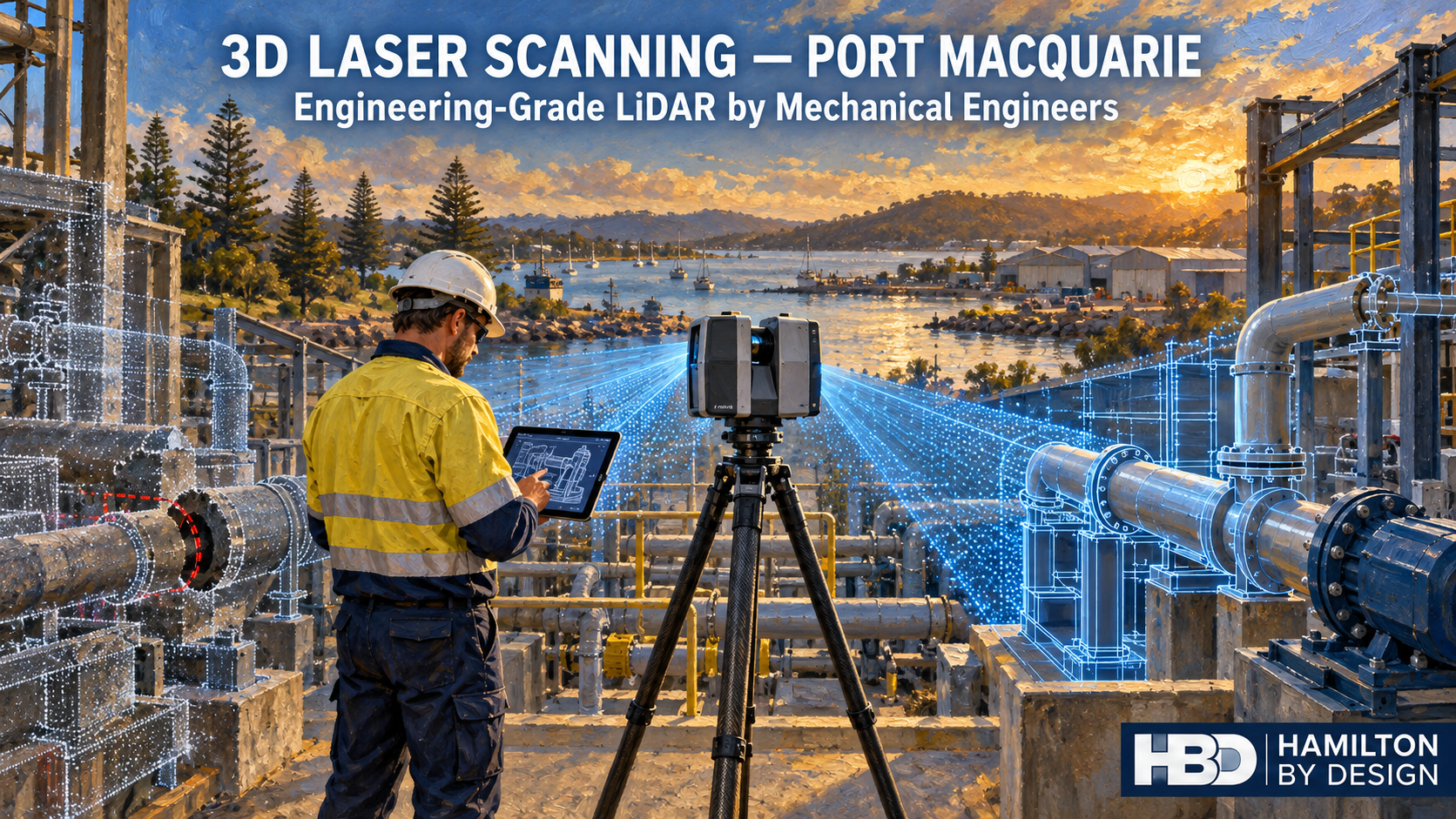
3D Laser Scanning Port Macquarie – Why Accuracy Matters for Engineering Projects
If you’re planning a plant upgrade, fabrication project, or site modification in Port Macquarie, the quality of your 3D scan data directly impacts the success of your project.
At Hamilton By Design, we provide engineering-grade 3D laser scanning services led by mechanical engineers, ensuring the data captured is not only accurate, but also suitable for real-world design, fabrication, and construction outcomes.
Not All 3D Scanning Is the Same
With the rise of low-cost scanning technology, many providers now offer handheld scanning solutions as a fast and affordable option.
While these systems can be useful for general visualisation, they often rely on SLAM-based positioning, which estimates location as the operator moves through a site.
This can introduce:
positional drift over distance
reduced dimensional accuracy
inconsistencies in large or complex environments
In many cases, these services are delivered by non-qualified operators using handheld equipment without a clear understanding of engineering requirements.
Why Mechanical Engineers Deliver Better Outcomes
3D scanning is only one part of the process. The real value comes from how the data is understood and applied.
A mechanical engineer-led scanning approach ensures:
critical areas are prioritised during capture
scan density aligns with fabrication requirements
line-of-sight limitations are identified and managed
downstream modelling and design risks are reduced
data is validated against real engineering constraints
Rather than simply collecting data, mechanical engineers focus on what the data needs to achieve.
The Risk of Handheld “Cowboy” Scanning
While handheld scanning has its place, relying solely on it — particularly when carried out by inexperienced or non-qualified operators — often leads to poor engineering outcomes.
These “fast and cheap” approaches can produce point clouds and 3D models that look correct visually but are not dimensionally reliable.
Typical issues include:
accumulated positional drift across the model
misalignment of structural and mechanical elements
missing critical geometry due to poor capture planning
inconsistent scaling across large areas
The result is 3D models that cannot be trusted for fabrication, retrofit design, or installation.
Why Tripod-Based LiDAR Scanning Is Different
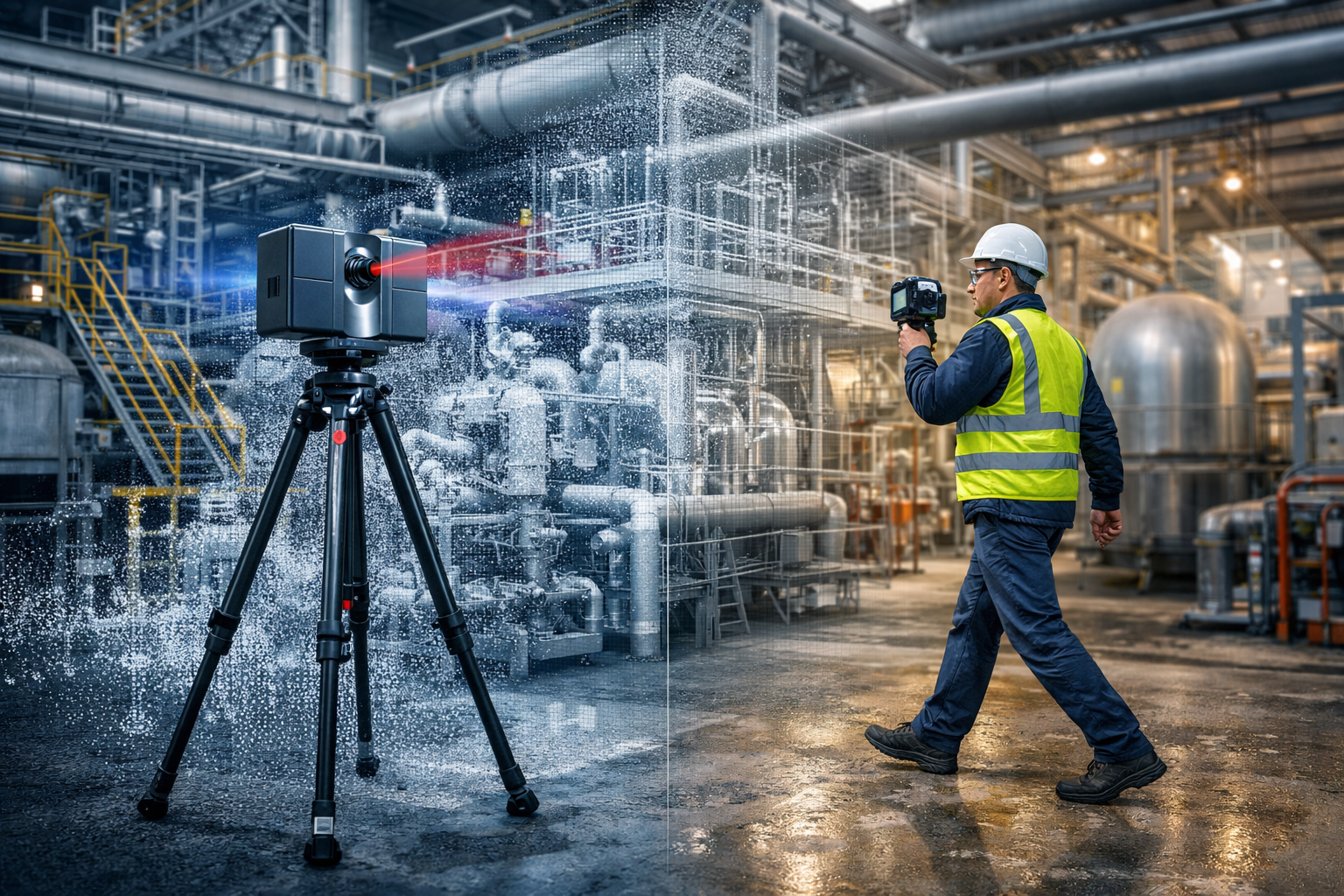
Tripod-mounted LiDAR scanners capture data from fixed, controlled positions, delivering a stable and repeatable dataset.
This is critical when your project requires:
accurate tie-in points
fabrication-ready measurements
structural or mechanical design
clash detection and modelling
confidence in as-built conditions
For engineering projects, the difference is clear:
Handheld scanning shows you what it looks like. LiDAR scanning — guided by mechanical engineers — tells you what it actually is.
The Risk of Low-Accuracy Data
Choosing the wrong scanning method — or the wrong provider — can lead to:
rework during fabrication
misalignment on installation
increased project costs
delays during shutdowns or upgrades
In industrial environments, even small dimensional errors can have significant downstream impacts.
A Smarter Approach to Reality Capture
At Hamilton By Design, we take an engineering-led approach to 3D scanning, combining the right technology with real engineering expertise.
Where required, we may use multiple capture methods — but critical areas are always captured using high-accuracy LiDAR scanning guided by mechanical engineering judgement.
Supporting Port Macquarie and Regional NSW
We support clients across Port Macquarie and regional New South Wales, delivering professional 3D laser scanning services for industrial facilities, manufacturing plants, infrastructure upgrades, and mechanical and structural projects.
LiDAR Scanning vs Handheld Scanning for Engineering Projects
When clients first look at 3D scanning solutions, one of the most common questions is whether they need a tripod-based LiDAR scanner or a handheld scanner. Both technologies have a place, but the right choice depends on the outcome required.
At Hamilton By Design, we focus on engineering-led reality capture. That means selecting the scanning method that best supports accurate design, fabrication, brownfield upgrades, and reliable project delivery.
What is the difference?
A tripod-based LiDAR scanner captures highly accurate point cloud data from fixed scan positions. This method is ideal when projects require dependable geometry, repeatable measurements, and engineering-grade outputs.
A handheld scanner is typically used to move quickly through a space and capture data on the go. It can be useful for general visualisation, rapid site understanding, and concept-level work, but it is not always the best fit where tight tolerances or fabrication-ready information is required.
Benefits of tripod-based LiDAR scanning
Higher accuracy
Tripod-based LiDAR scanning is better suited to projects where dimensional accuracy matters. This is particularly important for:
plant upgrades
tie-in design
structural modifications
pipework alterations
reverse engineering
fabrication support
Reliable fixed-position data
Because scans are captured from known stationary positions, the data can be registered into a stable point cloud. This gives engineers, designers, and project teams greater confidence in the model and the measurements taken from it.
Better for engineering and design
Where a project needs scan-to-CAD modelling, design development, clash checking, or digital twin support, tripod LiDAR scanning generally provides the more dependable base dataset.
Stronger project governance
Engineering projects need traceable and reviewable information. LiDAR scanning supports this by providing a robust record of existing conditions that can be referenced throughout the project lifecycle.
Benefits of handheld scanning
Faster capture over large areas
Handheld scanning can be useful where speed is more important than precision, or where the objective is to quickly understand a space.
Flexible for walkthrough-style capture
These systems can help capture general layouts, access routes, and broader site context in areas where rapid movement is an advantage.
Useful for concept and visualisation work
For early-stage planning or non-critical site representation, handheld scanning can sometimes provide a suitable outcome.
Which one is right for your project?
If your project involves fabrication, engineering design, plant modification, shutdown planning, or accurate as-built records, tripod-based LiDAR scanning is usually the better choice.
If your priority is speed, general layout capture, or conceptual understanding, handheld scanning may have a role.
In many cases, the best result comes from an engineering-led approach, where the required deliverables drive the capture method.
Why Hamilton By Design?
Hamilton By Design provides engineering-grade 3D laser scanning and reality capture services for industrial, mining, mechanical, and brownfield environments. Our focus is not just on collecting data, but on delivering data that supports real engineering outcomes.
We understand that a point cloud is only valuable if it helps reduce uncertainty, improve design confidence, and support practical decision-making.
Learn more
To explore our broader scanning and engineering services, visit:
If you need accurate site data for design, drafting, reverse engineering, or plant upgrades, Hamilton By Design can help you choose the right scanning approach for your project.
Contact us to discuss your site, deliverables, and required level of detail.
At Hamilton By Design, we provide engineering-grade drafting services in Sydney, supporting mechanical, structural, and industrial projects with accurate, build-ready documentation.
We don’t just draft — we engineer, verify, and deliver drawings that can be confidently used for fabrication, installation, and compliance.
What We Do
Our drafting services are tailored for real-world outcomes across industrial and infrastructure environments.
Mechanical Drafting
Conveyor systems and transfer stations
Pump systems and mechanical assemblies
Pipework layouts and isometrics
Equipment layouts and modifications
Structural Drafting
Structural steel detailing
Platforms, walkways, and access systems
Support frames and lifting structures
Connection detailing and fabrication drawings
Industrial & Plant Drafting
As-built documentation from point clouds
Brownfield plant upgrades
Shutdown scope drawings
Integration with existing infrastructure
Engineering-Led Drafting (What Sets Us Apart)
Most drafting services focus on producing drawings. We focus on producing drawings that work in the real world.
Engineering-backed drafting (not just CAD operators)
Integration with 3D laser scanning and point clouds
Fabrication-ready, workshop-friendly outputs
ISO-aligned CAD governance and revision control (IFR / IFA / IFC)
Software & Deliverables
We work within industry-standard platforms to ensure compatibility with your workflows:
SolidWorks (3D modelling + fabrication drawings)
AutoCAD (2D drafting and layouts)
Revit / BIM workflows (where required)
Typical Deliverables:
General arrangement (GA) drawings
Fabrication and shop drawings
Pipe spool drawings
Plan, elevation, and section views
3D models (STEP, SAT, Parasolid)
Point cloud referenced drawings (E57 / RCP compatible)
Drafting for Brownfield & Complex Sites
Sydney projects often involve existing infrastructure, limited access, and incomplete documentation.
We specialise in:
Working from point cloud data
Reverse engineering existing assets
Resolving clashes before fabrication
Delivering accurate as-built drawings
Typical Use Cases
Plant upgrades and modifications
Structural steel fabrication packages
Mechanical system design and documentation
Shutdown planning and execution
Asset documentation and compliance
Why Hamilton By Design?
Mechanical engineer-led consultancy
Proven industrial and mining experience
Fast turnaround (typically within 7 days)
Integrated scanning + drafting capability
Practical, site-ready deliverables
Our clients
Get Started
If you need reliable drafting services in Sydney, we can support your project from concept through to fabrication.
There’s a problem happening on projects across Australia right now:
Design says one thing. Site builds another.
And no one realises until it’s too late.
The Real Issue: Miscommunication Between Design and Build
It’s not that people aren’t doing their job.
It’s that the information they’re working from isn’t aligned.
Drawings don’t reflect reality
Existing plant conditions are assumed, not verified
Fabrication is based on outdated or incomplete data
Site modifications happen on the fly
👉 The result?
Rework
Delays
Cost blowouts
Frustrated teams
This is where most projects quietly bleed money.
“We Thought It Would Fit…” — The Most Expensive Words on Site
If you’ve ever heard:
“That’s not what we expected on site”
“We’ll just make it work”
“Can we modify it during install?”
You’re already in reactive mode.
And reactive mode is where projects lose control.
So What Are the Best 3D Scanning Platforms to Fix This?
Let’s be clear:
👉 It’s not just about the scanner 👉 It’s about how the data is captured, interpreted, and delivered
But here’s how the platforms stack up in the real world:
1. FARO Focus (Engineering-Grade Reality Capture)
✔ High accuracy (millimetre-level) ✔ Ideal for brownfield industrial environments ✔ Reliable for mechanical design, pipework, and structural interfaces
💡 This is where engineering-led scanning matters
Anyone can scan. Not everyone understands line-of-sight constraints, coverage, and design intent.
2. Leica RTC360 (Speed + Visualisation)
✔ Fast capture and good for large areas ✔ Strong visual workflows ✔ Great for general site documentation
⚠ But without engineering oversight, you still risk:
Missing critical geometry
Poor scan coverage
Misalignment with fabrication requirements
3. NavVis / Mobile Scanning (Speed Over Precision)
✔ Rapid walkthrough capture ✔ Useful for high-level coordination
⚠ Not suitable for:
Fabrication-level accuracy
Mechanical interfaces
Detailed engineering design
The Truth Most People Miss
The platform doesn’t fix the problem.
👉 Engineering-led scanning does.
Why Engineering-Led Scanning Changes Everything
At Hamilton By Design, we don’t just “scan a site”.
We capture it like engineers who have to design and build from it.
That means:
Understanding what needs to be modelled — and what doesn’t
Managing line-of-sight to eliminate data gaps
Delivering point clouds that actually support design decisions
Producing models and drawings that match real-world conditions
From Scan → Model → Build (No Guesswork)
When done properly, 3D scanning becomes:
✔ A single source of truth ✔ A digital twin of your site ✔ A way to align design, fabrication, and installation
No assumptions. No “we’ll fix it on site”. No disconnect.
If You’re Getting It Wrong on Site — This Is Why
It’s not your team.
It’s the gap between:
👉 What was designed 👉 And what actually exists
Fix the Gap — Not the Symptoms
If you’re serious about reducing rework, delays, and cost blowouts:
👉 Start with accurate, engineering-grade site data
Learn More
Explore how we deliver engineering-led 3D scanning in Sydney:
In industrial and mechanical projects, one of the most common — and costly — client concerns is simple:
“I don’t trust the design… and I don’t really know what I’m going to get.”
It usually starts with an existing asset.
Old drawings that don’t match reality
Missing documentation
Modifications made over time
Conflicting information between teams
At that point, every decision becomes a risk.
The Real Problem Isn’t the Design — It’s the Data
Most design issues don’t come from bad engineers.
They come from bad inputs.
If your base information is wrong:
Models won’t fit
Steel won’t align
Pipework clashes on install
Fabrication needs rework
And suddenly, what looked like a solid design becomes a site problem.
What Clients Are Actually Searching For
When clients say they don’t trust the design, they’re usually looking for:
point cloud to CAD conversion services
reverse engineering services
mechanical engineering models
engineering-grade verification
What they really mean is:
“I need to know this will fit before I spend money building it.”
Step 1: Capture Reality — Not Assumptions
The first step is removing uncertainty completely.
Using engineering-grade LiDAR scanning, you capture the real-world geometry of your asset — not what the drawings say, but what actually exists on site.
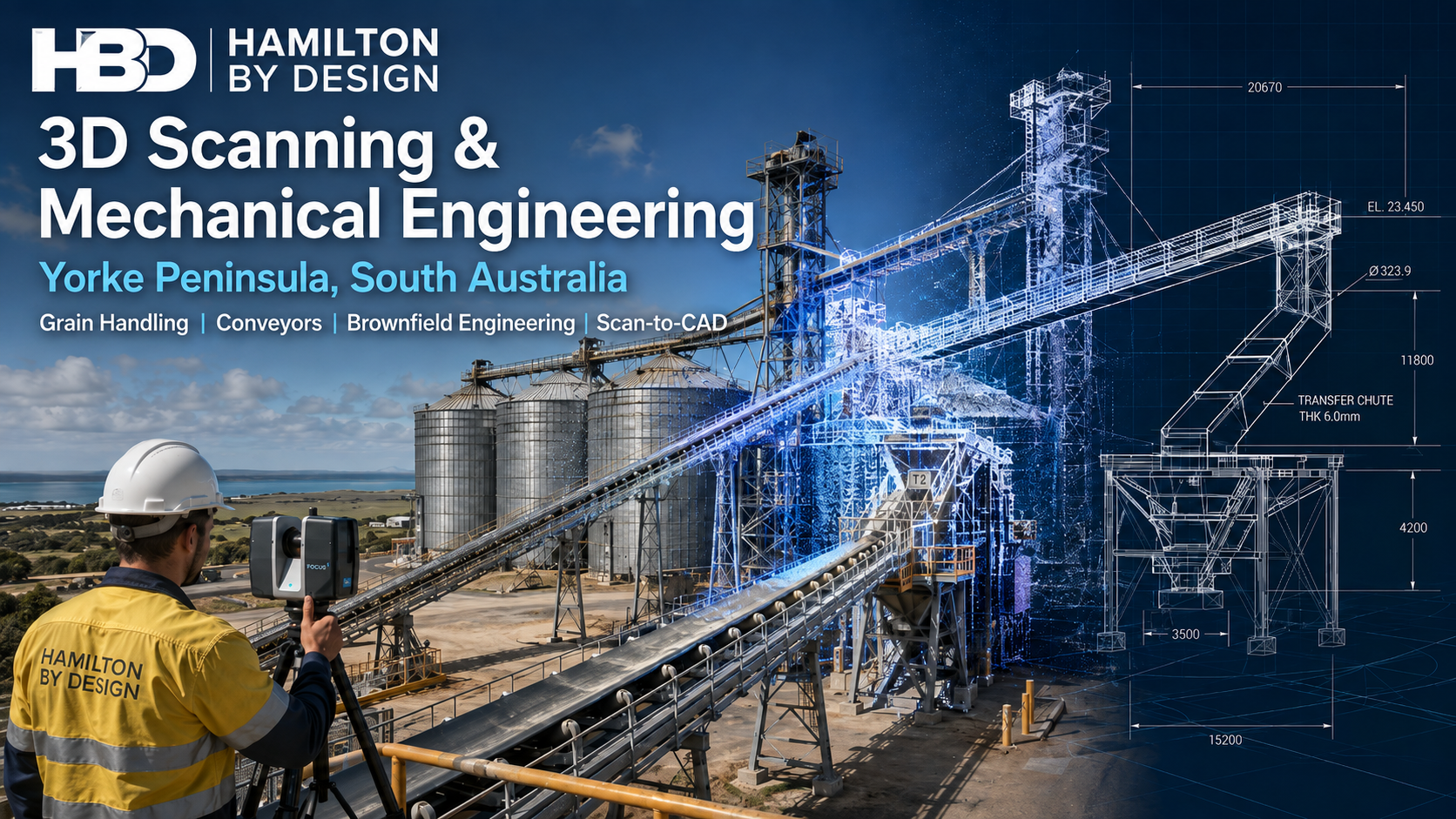
The Yorke Peninsula is an important regional area of South Australia, supporting agriculture, grain handling, bulk storage, transport infrastructure, manufacturing, maintenance activities and a wide range of regional businesses. When existing facilities require modification, replacement equipment, additional structures or improved documentation, one of the biggest challenges is often understanding exactly what is already installed.
Hamilton By Design provides 3D scanning, mechanical engineering, CAD modelling and drafting services across the Yorke Peninsula and regional South Australia, helping project teams capture existing conditions and convert that information into practical engineering deliverables.
Our approach combines site-based reality capture with engineering and design. Rather than treating scanning as an isolated surveying activity, the captured information can become the starting point for plant modifications, equipment replacement, fabrication, structural detailing, reverse engineering and brownfield project development.
For projects requiring accurate existing-condition information, our broader 3D LiDAR scanning services in Adelaide and South Australia support industrial, infrastructure, manufacturing and regional engineering projects throughout the state.
Engineering Support for Existing Yorke Peninsula Facilities
Regional facilities often develop progressively over many years. Equipment may have been replaced, conveyors extended, platforms modified, pipework rerouted or structural steel added without every change being accurately reflected in the original drawings.
This creates a problem when another modification is required.
A drawing may show what was originally designed, but not necessarily what exists today.
For brownfield engineering projects, Hamilton By Design uses engineering-grade 3D laser scanning to capture existing structures, mechanical equipment, access systems and surrounding infrastructure before detailed design begins.
The resulting point cloud provides a three-dimensional record of the site that can be reviewed and measured after the fieldwork has been completed.
This can reduce the need for repeated site visits and allows designers to work with existing geometry rather than assumptions.
What Can Be Captured Using 3D LiDAR Scanning?
3D scanning can be applied to individual pieces of equipment or large sections of an industrial facility.
Typical Yorke Peninsula applications may include:
grain handling equipment
conveyors and conveyor galleries
transfer stations
chutes and hoppers
silos and storage structures
structural steel
platforms, stairs and handrails
machinery and equipment
pipework and service routes
equipment foundations
building interiors
plant rooms
access areas
existing fabrication
equipment interfaces.
For engineering projects, accurate capture of the surrounding area can be just as important as capturing the equipment being replaced.
Our 3D laser scanning for engineering projects workflow provides engineers and designers with a digital representation of existing plant and structures that can then be used as the basis for engineering development.
This is particularly useful when a new component has to fit between existing structures, connect to established equipment or be installed during a limited shutdown period.
Grain Handling and Bulk Materials Engineering
Grain and bulk-material facilities present their own engineering challenges.
Conveyors, chutes, hoppers, transfer points and supporting structures operate as connected systems. A modification made to one part of the plant can affect material flow, maintenance access, clearances and the performance of equipment further downstream.
Hamilton By Design’s experience with bulk material handling systems can support projects where existing equipment needs to be modified, replaced or integrated with new plant.
While individual industries and materials differ, many of the engineering principles remain similar.
The objective is not simply to produce a CAD model. It is to understand how the equipment fits into the complete operating environment.
3D scanning can help establish:
existing conveyor positions
belt centre lines
chute geometry
support locations
surrounding structural steel
head and tail pulley arrangements
maintenance clearances
access requirements
equipment interfaces
available installation space.
Having this information available during design can significantly improve the coordination of modifications.
Conveyor, Chute and Transfer Station Projects
Transfer points can become maintenance-intensive areas when material flow, equipment geometry or operating conditions are not properly considered.
Excessive wear, spillage, dust, blockages and difficult maintenance access can all create operational problems.
Hamilton By Design provides engineering and design support for conveyor transfer chute design, including projects where existing structures and equipment need to be captured before new components can be developed.
For a Yorke Peninsula brownfield project, the process may begin by scanning the conveyor, chute, support structure and surrounding area.
The point cloud can then be imported into the engineering environment, allowing proposed equipment to be positioned relative to the actual plant.
This approach is particularly valuable where site access is difficult or where measuring individual components manually would require numerous dimensions to be recorded.
Scan-to-CAD for Brownfield Engineering
Capturing a point cloud is only the first stage.
The information can then be converted into engineering geometry suitable for design, documentation and coordination.
Depending on the project, Hamilton By Design can develop:
3D CAD models
existing-condition models
general arrangement drawings
sections and elevations
mechanical layouts
structural layouts
fabrication drawings
equipment models
interface geometry
installation concepts.
This allows the physical site to become part of the CAD design environment.
New equipment can be modelled around existing structures, and potential interference can be investigated before fabrication or installation.
For brownfield work, this creates an important connection between site capture and engineering design.
Reverse Engineering Existing Equipment
Regional facilities can contain machinery that has been operating for many years.
In some cases, original manufacturing drawings may no longer be available. Equipment may also have been repaired, modified or altered during its operating life.
When components require replacement, scanning can provide an effective starting point.
Hamilton By Design’s reverse engineering using 3D scanning workflow uses captured geometry together with engineering assessment, CAD modelling and dimensional verification.
Applications may include:
replacement components
obsolete machinery
worn equipment
guards and covers
fabricated structures
chutes and hoppers
equipment interfaces
legacy plant.
Importantly, reverse engineering does not necessarily mean blindly copying an existing component.
The existing geometry provides information about what fits the plant, while engineering review can consider whether the replacement can be improved for manufacture, installation, maintenance or service life.
Digital Verification and Quality Assurance
3D scanning can also be useful after fabrication or installation.
A scan of installed equipment can be compared with the design model to identify potential differences and confirm important geometry.
Hamilton By Design’s 3D LiDAR digital quality assurance services can assist project teams with dimensional verification and existing-condition documentation.
This may be useful where a project requires confidence that equipment, structures or interfaces have been installed as expected before the next stage of work proceeds.
For regional projects, having a permanent digital record can also reduce uncertainty during future modifications.
Supporting Shutdowns and Plant Upgrades
Shutdown projects often provide only a limited period in which existing equipment can be removed and replacement components installed.
Discovering an unexpected obstruction after fabrication has begun can create significant problems.
Capturing the existing plant before detailed design allows the project team to investigate many potential fit-up issues earlier.
The scanned environment can assist with:
checking equipment clearances
planning replacement components
developing installation concepts
identifying surrounding obstructions
reviewing access
coordinating structural and mechanical work
developing fabrication drawings.
This does not remove every risk associated with brownfield work, but it provides significantly more information than relying solely on old drawings and isolated manual dimensions.
Mechanical Engineering and Drafting From the Same Digital Dataset
A major advantage of engineering-led scanning is that the data does not have to stop at the point-cloud stage.
Hamilton By Design can use the captured information as part of a broader engineering workflow incorporating mechanical design, CAD modelling, drafting and fabrication documentation.
Our national 3D laser scanning services support projects where accurate site capture needs to connect directly with subsequent engineering work.
Depending on project requirements, deliverables can include registered point clouds, CAD models, drawings and engineering information suitable for continued project development.
This integrated approach is particularly useful for smaller and regional projects where having multiple companies separately responsible for site measurement, modelling and drafting can create unnecessary handover points.
3D Scanning Across the Yorke Peninsula
Hamilton By Design can support projects across the Yorke Peninsula and surrounding regional areas.
Projects do not necessarily need to involve an entire facility.
A scanning assignment may involve one conveyor transfer, an individual piece of machinery, a structural modification or a small area where accurate measurements are required.
For larger projects, scanning can be expanded to capture an entire working area and provide project teams with a broader existing-condition dataset.
The appropriate scope depends on what the client needs to design, modify, replace or document.
Why Use 3D Scanning Before Starting a Brownfield Design?
The greatest benefit is simple: designing around what actually exists.
Brownfield projects frequently involve compromises imposed by existing structures, equipment, access and operating requirements.
A point cloud provides engineers and designers with significantly more spatial information than a collection of individual measurements.
That can assist project teams in making better-informed decisions earlier in the project and can help reduce the risk of discovering dimensional problems during fabrication or installation.
For Yorke Peninsula businesses planning plant upgrades, equipment replacements or facility modifications, the objective is not simply to create a sophisticated 3D image.
The objective is to turn accurate existing-condition information into practical engineering decisions and buildable outcomes.
Frequently Asked Questions
What is 3D LiDAR scanning?
3D LiDAR scanning uses a laser scanner to capture large numbers of spatial measurement points around an existing environment. These measurements form a three-dimensional point cloud representing the geometry of the captured plant, structure or building.
Can you provide 3D scanning services on the Yorke Peninsula?
Yes. Hamilton By Design supports regional projects and can provide engineering-led 3D scanning, CAD modelling and drafting for suitable projects across the Yorke Peninsula and South Australia.
Can you scan grain handling equipment?
Yes. Depending on access and project requirements, equipment such as conveyors, chutes, transfer points, structural steel, platforms, silos and surrounding plant can be captured.
Can the scan data be converted into CAD?
Yes. Point-cloud information can be used to develop CAD geometry, general arrangement drawings, sections, equipment layouts and other engineering documentation depending on project requirements.
Is 3D scanning useful for conveyor modifications?
Yes. Scanning can capture the conveyor, support structure, transfer equipment and surrounding geometry, allowing proposed modifications to be developed relative to actual site conditions.
Can 3D scanning help with reverse engineering?
Yes. Existing equipment can be scanned and used as the basis for CAD modelling and engineering review where original drawings are unavailable, unreliable or no longer representative of the installed asset.
Is scanning suitable for shutdown projects?
Yes. Capturing existing conditions before a shutdown can help engineers investigate equipment fit-up, access, interfaces and potential clashes before fabricated components arrive on site.
What project deliverables can Hamilton By Design provide?
Depending on the agreed scope, deliverables may include registered point-cloud information, 3D CAD models, general arrangement drawings, sections, elevations, fabrication information and other engineering documentation.
Do you only undertake large scanning projects?
No. 3D scanning can be appropriate for anything from an individual component or transfer station through to large sections of an industrial facility. The scanning scope should be based on the information required for the engineering task.
Why combine 3D scanning with mechanical engineering?
Combining scanning with engineering allows the captured site information to become part of the design process. Instead of producing a point cloud and handing it over without engineering context, the information can be used to develop modifications, models and drawings around verified existing conditions.
Engineering-Led 3D Scanning for Yorke Peninsula Projects
For Yorke Peninsula businesses planning equipment upgrades, conveyor modifications, grain-handling improvements, structural changes, reverse engineering or brownfield plant work, accurate information at the beginning of the project can make a significant difference.
Hamilton By Design provides a connected workflow from 3D LiDAR site capture through to CAD modelling, mechanical engineering and drafting, helping regional project teams understand existing conditions and develop solutions that are designed around the plant that is actually there.
Whether the requirement involves one difficult-to-measure component or a larger industrial facility, 3D scanning provides a practical digital foundation for better-informed engineering and project development.
If you’re operating on the Yorke Peninsula and require:
Mechanical engineering support
3D LiDAR scanning
Mechanical or structural drafting
contact Hamilton By Design to discuss how we can support your next project.
🏷️ Labels
yorke peninsula engineering, 3d scanning south australia, lidar scanning australia, mechanical engineering services australia, point cloud to cad, grain handling engineering, conveyor design australia, regional engineering support
🔍 Search Description
Mechanical engineering, 3D LiDAR scanning, and drafting services for the Yorke Peninsula, South Australia. Supporting regional industry with accurate reality capture and practical design solutions.
Explore additional Hamilton By Design resources covering 3D LiDAR scanning,
mechanical engineering, Scan-to-CAD, reverse engineering, conveyors,
materials handling and brownfield industrial projects across South Australia
and regional Australia.
Engineering-grade LiDAR reality capture, point-cloud processing,
Scan-to-CAD and as-built documentation for industrial and infrastructure
projects throughout Adelaide and South Australia.
Engineer-led mechanical engineering support for South Australian
industrial, manufacturing and brownfield projects where constructability
and accurate existing-condition information matter.
Regional South Australian 3D scanning for ports, processing facilities,
conveyors, structural steel, pipework and space-constrained industrial
environments.
Engineering-focused terrestrial LiDAR scanning for brownfield,
industrial, mining and infrastructure projects across metropolitan,
regional and remote Australia.
Hamilton By Design’s core engineering-grade 3D laser scanning capability
for industrial facilities, processing plants, infrastructure and complex
existing assets.
Use accurate scan data to recreate worn, modified or undocumented
equipment and develop practical CAD models and drawings for replacement
and fabrication.
See how registered LiDAR point clouds can progress from site capture
through CAD modelling and engineering development for plant upgrades
and brownfield projects.
Understand the differences between point-cloud data and mesh files and
why engineering projects often require more than a visual representation
of existing plant.
Mechanical engineering support for conveyors, transfer stations,
hoppers, chutes and associated structural steel used throughout
bulk-material-handling facilities.
Use high-accuracy LiDAR scanning for dimensional verification,
installation checking, existing-condition documentation and digital QA
across industrial projects.
Convert point clouds, drawings, sketches and existing site information
into practical mechanical and industrial CAD models for design,
fabrication and plant modification.
Mechanical drafting and engineering documentation for plant upgrades,
fabrication, maintenance projects and brownfield modifications across
industrial facilities.
To provide the best experiences, we use technologies like cookies to store and/or access device information. Consenting to these technologies will allow us to process data such as browsing behaviour or unique IDs on this site. Not consenting or withdrawing consent, may adversely affect certain features and functions.
Functional
Always active
The technical storage or access is strictly necessary for the legitimate purpose of enabling the use of a specific service explicitly requested by the subscriber or user, or for the sole purpose of carrying out the transmission of a communication over an electronic communications network.
Preferences
The technical storage or access is necessary for the legitimate purpose of storing preferences that are not requested by the subscriber or user.
Statistics
The technical storage or access that is used exclusively for statistical purposes.The technical storage or access that is used exclusively for anonymous statistical purposes. Without a subpoena, voluntary compliance on the part of your Internet Service Provider, or additional records from a third party, information stored or retrieved for this purpose alone cannot usually be used to identify you.
Marketing
The technical storage or access is required to create user profiles to send advertising, or to track the user on a website or across several websites for similar marketing purposes.