LiDAR Scanning vs Handheld Scanning for Engineering Projects
When clients first look at 3D scanning solutions, one of the most common questions is whether they need a tripod-based LiDAR scanner or a handheld scanner. Both technologies have a place, but the right choice depends on the outcome required.
At Hamilton By Design, we focus on engineering-led reality capture. That means selecting the scanning method that best supports accurate design, fabrication, brownfield upgrades, and reliable project delivery.



What is the difference?
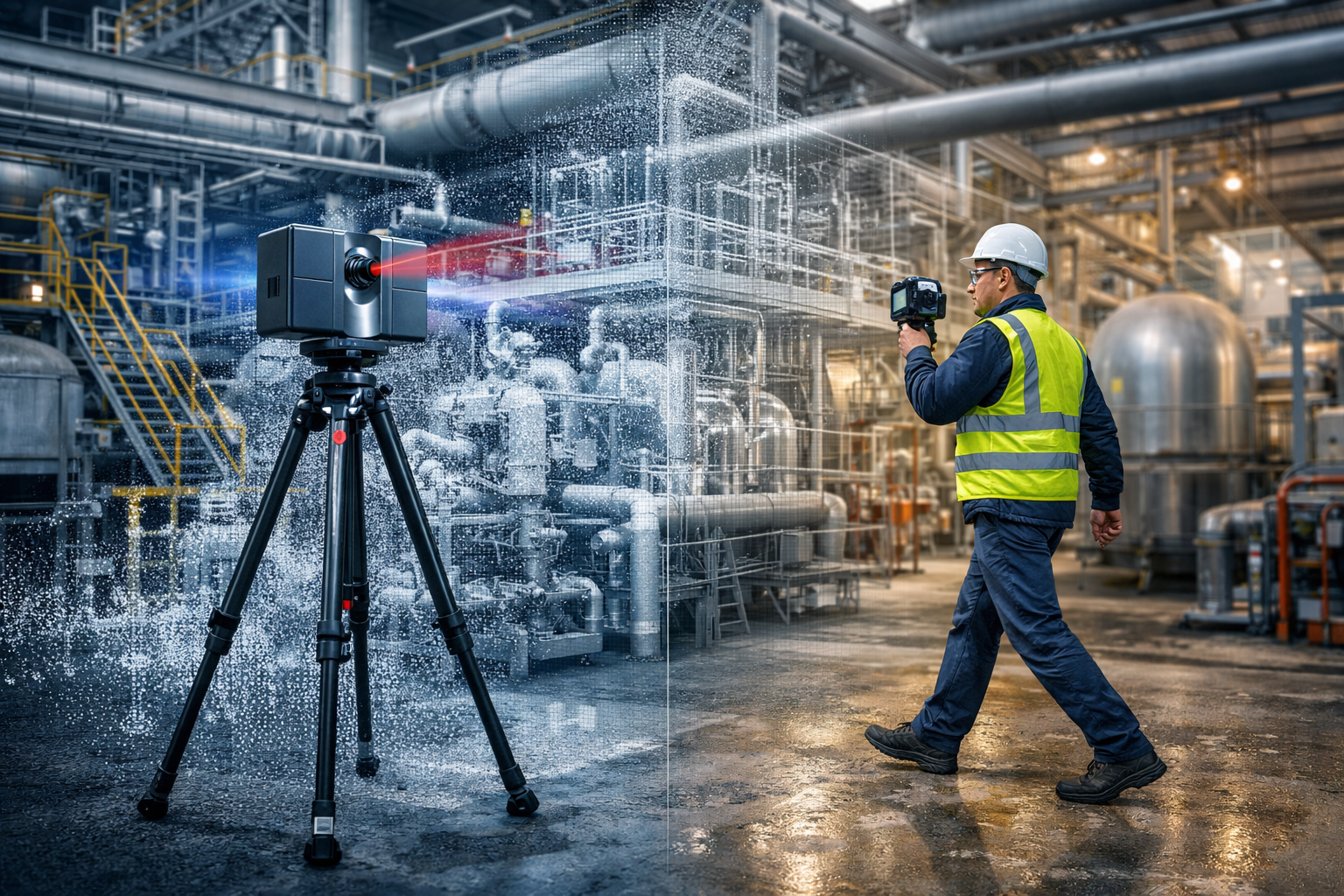
A tripod-based LiDAR scanner captures highly accurate point cloud data from fixed scan positions. This method is ideal when projects require dependable geometry, repeatable measurements, and engineering-grade outputs.
A handheld scanner is typically used to move quickly through a space and capture data on the go. It can be useful for general visualisation, rapid site understanding, and concept-level work, but it is not always the best fit where tight tolerances or fabrication-ready information is required.
Benefits of tripod-based LiDAR scanning
Higher accuracy
Tripod-based LiDAR scanning is better suited to projects where dimensional accuracy matters. This is particularly important for:
- plant upgrades
- tie-in design
- structural modifications
- pipework alterations
- reverse engineering
- fabrication support
Reliable fixed-position data
Because scans are captured from known stationary positions, the data can be registered into a stable point cloud. This gives engineers, designers, and project teams greater confidence in the model and the measurements taken from it.
Better for engineering and design
Where a project needs scan-to-CAD modelling, design development, clash checking, or digital twin support, tripod LiDAR scanning generally provides the more dependable base dataset.
Stronger project governance
Engineering projects need traceable and reviewable information. LiDAR scanning supports this by providing a robust record of existing conditions that can be referenced throughout the project lifecycle.
Benefits of handheld scanning
Faster capture over large areas
Handheld scanning can be useful where speed is more important than precision, or where the objective is to quickly understand a space.
Flexible for walkthrough-style capture
These systems can help capture general layouts, access routes, and broader site context in areas where rapid movement is an advantage.
Useful for concept and visualisation work
For early-stage planning or non-critical site representation, handheld scanning can sometimes provide a suitable outcome.
Which one is right for your project?
If your project involves fabrication, engineering design, plant modification, shutdown planning, or accurate as-built records, tripod-based LiDAR scanning is usually the better choice.
If your priority is speed, general layout capture, or conceptual understanding, handheld scanning may have a role.
In many cases, the best result comes from an engineering-led approach, where the required deliverables drive the capture method.
Why Hamilton By Design?
Hamilton By Design provides engineering-grade 3D laser scanning and reality capture services for industrial, mining, mechanical, and brownfield environments. Our focus is not just on collecting data, but on delivering data that supports real engineering outcomes.
We understand that a point cloud is only valuable if it helps reduce uncertainty, improve design confidence, and support practical decision-making.
Learn more
To explore our broader scanning and engineering services, visit:
Talk to Hamilton By Design
If you need accurate site data for design, drafting, reverse engineering, or plant upgrades, Hamilton By Design can help you choose the right scanning approach for your project.
Contact us to discuss your site, deliverables, and required level of detail.