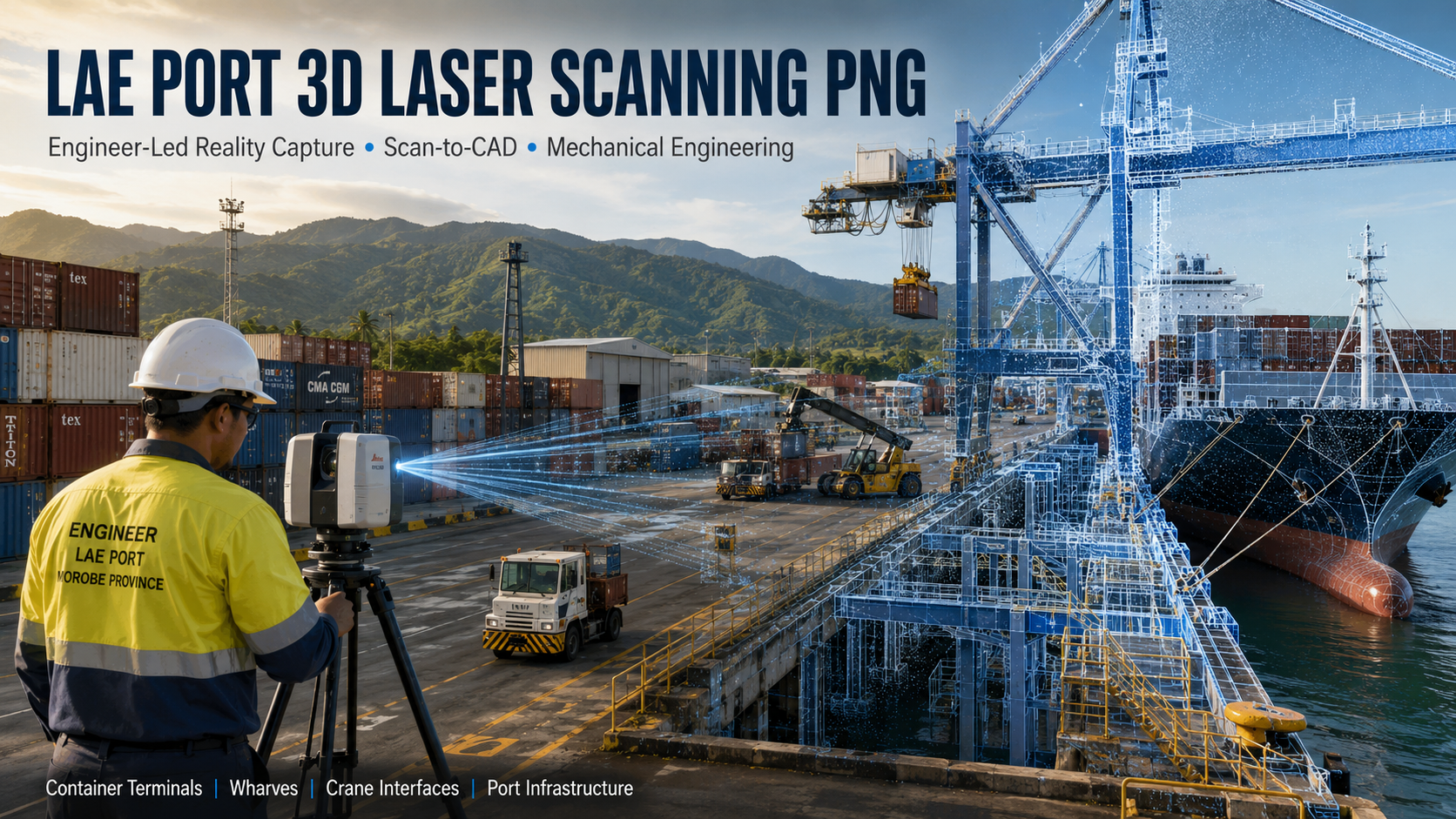
The Port of Lae and Lae Tidal Basin are critical pieces of transport and logistics infrastructure for Papua New Guinea, supporting containers, general cargo, mining supply chains and bulk-material movements throughout Morobe Province and beyond.
As container-terminal infrastructure develops, one of the major engineering challenges is ensuring that new cranes, equipment, structural steelwork, access systems and cargo-handling assets integrate correctly with the infrastructure already operating on site.
Hamilton By Design provides an engineer-led approach to Lae Port 3D laser scanning PNG, combining high-accuracy reality capture with mechanical engineering, CAD modelling, structural drafting, reverse engineering and fabrication-ready documentation.
Rather than treating laser scanning as an isolated surveying exercise, our approach creates an engineering workflow from:
Site Capture → Point Cloud → CAD Model → Engineering → Verification → Fabrication
Our 3D laser scanning services are suited to complex brownfield environments where reliable existing-condition information is essential before new infrastructure is designed, fabricated or installed.
Why 3D Laser Scanning Matters at an Operating Container Terminal
Port infrastructure rarely remains exactly as originally documented.
Wharves are repaired and extended. Structural steel is modified. Platforms and services are added. Equipment is replaced. Crane interfaces evolve, and new cargo-handling systems need to be installed around assets that may have been operating for decades.
As a result, historic drawings may no longer accurately represent what exists on site.
Engineering-grade LiDAR scanning provides a way to establish a new dimensional baseline.
A terrestrial laser scanner captures millions of three-dimensional points describing the actual position of structures, machinery, pipework, platforms, buildings and surrounding infrastructure.
This information can then be registered into a coordinated point cloud that engineering teams can use to measure and model the existing facility.
For brownfield projects, this can reduce reliance on repeated tape measurements, photographs, hand sketches and assumptions.
Hamilton By Design’s engineering-grade 3D laser scanning workflow is focused on producing data that can support actual engineering decisions rather than visualisation alone.
Container Terminal and Crane Interface Scanning
One of the strongest applications for 3D laser scanning at Lae is the integration of new container-terminal equipment with existing infrastructure.
This could include:
- ship-to-shore crane interfaces
- crane rails and supporting structures
- machinery platforms
- structural frames
- cable and service routes
- access stairs and walkways
- maintenance areas
- wharf structures
- container-handling equipment
- existing foundations and connection points.
Before new equipment is fabricated or shipped to Papua New Guinea, the existing infrastructure can be captured and converted into usable engineering geometry.
Vendor equipment models can then be positioned within the scanned environment to assess interfaces and potential clashes.
This provides engineers with the ability to ask practical questions before installation begins:
Will the equipment fit?
Are the existing connection points where the drawings say they are?
Is there enough maintenance access?
Will new steelwork interfere with existing services?
Can the equipment be installed without major site modification?
These are exactly the types of issues where accurate existing-condition data can reduce risk.
Point Cloud to CAD for Lae Port Infrastructure
Capturing the site is only the first stage.
Hamilton By Design can convert selected portions of the point cloud into engineering CAD models suitable for design development, equipment layouts and fabrication documentation.
Our Point Cloud to CAD services provide a pathway from LiDAR data into practical engineering deliverables.
Depending on the project, these can include:
- SolidWorks models
- AutoCAD drawings
- Inventor-compatible geometry
- general arrangement drawings
- sections and elevations
- structural models
- equipment layouts
- fabrication drawings
- STEP or SAT geometry
- registered point-cloud deliverables.
Not every object visible in a scan needs to be modelled.
For engineering work, it is often more efficient to model the geometry that influences the project: structural interfaces, machinery, connection points, access zones and potential clashes.
This keeps the model useful rather than unnecessarily complicated.
Mechanical Engineering for Port Assets
Hamilton By Design can take the project beyond scanning by applying mechanical engineering to the captured site information.
Typical port engineering opportunities can include:
Equipment Support Structures
Existing infrastructure can be scanned before new support frames, brackets or machinery bases are designed.
Machinery Modifications
Mechanical components can be redesigned or modified to suit the actual installed geometry.
Maintenance Access
Platforms, ladders, stairs, walkways and handrails can be developed around existing machinery and structural constraints.
Guards and Safety Improvements
Machine guarding and access-control structures can be designed around equipment captured directly from site.
Materials Handling Equipment
Conveyors, transfer points, chutes and associated structural interfaces can be developed using verified existing-condition data.
Equipment Replacement
Obsolete or undocumented machinery components can be reconstructed through scanning, measurement and engineering assessment.
Our reverse engineering 3D scanning capability is particularly useful where original manufacturing drawings no longer exist or where the installed asset has changed significantly during its service life.
Wharves, Structural Steel and Brownfield Port Infrastructure
Wharf areas can contain dense combinations of structural steel, concrete, services, lifting equipment, access structures and mechanical systems.
This makes conventional measurement difficult.
Laser scanning allows large areas to be documented while maintaining the spatial relationship between different assets.
For example, a proposed structural modification may require the engineering team to understand:
- column locations
- beam elevations
- connection geometry
- platform heights
- nearby machinery
- service penetrations
- access restrictions
- maintenance clearances.
The scan becomes a common dimensional reference that can be reviewed by engineering, fabrication and construction teams.
Hamilton By Design applies similar workflows to Australian port environments through services such as mechanical engineering for the Port of Newcastle, where site capture can feed directly into CAD development and fabrication documentation.
Scan-to-CAD for Equipment Upgrades
The real value of 3D scanning becomes clearer when new equipment needs to be fitted into an existing operating facility.
Consider a new container-terminal system being manufactured outside PNG.
A traditional workflow might rely on old drawings and a limited site survey. Problems may only become apparent after fabricated equipment reaches Lae.
A scan-to-CAD workflow changes that process.
Hamilton By Design can:
- capture the existing installation;
- register the scan data;
- create CAD geometry around critical interfaces;
- import the proposed equipment model;
- check clearances and clashes;
- identify structural or mechanical modifications;
- develop revised engineering;
- produce fabrication drawings.
This approach is similar to our Scan to CAD Port of Brisbane services, where LiDAR data can be converted into practical engineering information for existing port assets.
The objective is straightforward:
find problems digitally before they become fabrication or installation problems on site.
Structural Steel, Platforms and Maintenance Access
Port infrastructure often requires ongoing modification as equipment and operating practices change.
Hamilton By Design can assist with the development of:
- structural equipment frames
- machinery platforms
- access platforms
- stairs
- ladders
- handrails
- maintenance walkways
- guards
- equipment supports
- connection details.
Laser scanning is particularly valuable because these structures must often fit around existing machinery.
Instead of designing from an idealised drawing, the engineer can develop the modification around the actual asset.
Reverse Engineering Port Equipment
Ports frequently operate mechanical equipment for long periods.
Some components may no longer have reliable drawings, while others may have been repaired or modified several times.
Reverse engineering can provide a pathway to replacement or improvement.
Hamilton By Design can combine:
- 3D scanning
- physical measurement
- dimensional verification
- CAD modelling
- engineering assessment
- material consideration
- fabrication documentation.
Rather than simply copying an old component, the objective is to understand how the part functions and how the replacement must interface with surrounding equipment.
Our broader reverse engineering for mining and industrial equipment experience applies particularly well to ports supporting mining and heavy-industry supply chains.
Australian Standards and Engineering for PNG Projects
Projects at Lae Port are located in Papua New Guinea, so applicable PNG legislation, project specifications, PNG Ports Corporation requirements and client engineering standards must be established for each project.
Where nominated as part of the project engineering basis, Hamilton By Design can also work with relevant Australian Standards.
Depending on the scope, these may include:
AS 4100 – Steel Structures
For structural steelwork and equipment support structures.
AS/NZS 1170 series – Structural Design Actions
For structural actions and engineering load combinations where applicable to the project design basis.
AS 1657 – Fixed Platforms, Walkways, Stairways and Ladders
For industrial access systems around machinery and port infrastructure.
AS/NZS 4024 series – Safety of Machinery
For machinery safety, guarding and materials-handling systems.
AS 4991 – Lifting Devices
For appropriate below-the-hook lifting devices and maintenance lifting arrangements.
AS 2550 series – Cranes, Hoists and Winches – Safe Use
Potentially relevant where engineering interfaces with crane and lifting operations.
AS/NZS 1554 series
For welding of structural steelwork where applicable.
Engineering requirements should always be confirmed against the specific asset, duty, client specification and PNG regulatory requirements before design begins.
Engineering Before Fabrication
The principal advantage of combining scanning with engineering is the opportunity to resolve problems earlier.
A point cloud provides dimensional evidence.
A CAD model makes that information easier to design around.
Engineering turns the captured geometry into a practical solution.
Fabrication drawings then allow the solution to be manufactured.
This is why Hamilton By Design focuses on an integrated engineering approach rather than treating 3D scanning as the final deliverable.
Our broader Scan to BIM and point-cloud modelling services can also support warehouse, building and infrastructure documentation where the project requires more extensive digital asset information.
Lae Port 3D Laser Scanning PNG
For developing port infrastructure, accurate existing-condition information can make the difference between a modification that fits first time and one that requires extensive site rework.
Hamilton By Design can support Port of Lae projects involving container terminals, wharves, structural steelwork, warehouses, mechanical equipment and materials-handling infrastructure.
Our engineer-led workflow combines:
3D laser scanning + point clouds + CAD modelling + mechanical engineering + reverse engineering + fabrication documentation.
For brownfield port upgrades, the goal is not simply to scan what exists.
It is to understand what exists well enough to design what comes next.
Frequently Asked Questions
Can Hamilton By Design provide 3D laser scanning at Lae Port?
Hamilton By Design can support engineering-grade 3D laser scanning for port and industrial infrastructure projects subject to project requirements, site access, mobilisation arrangements and client approvals.
What port assets can be scanned?
Typical assets include wharves, structural steel, cranes and crane interfaces, cargo-handling equipment, warehouses, conveyors, pipework, machinery, platforms, stairs, handrails and surrounding infrastructure.
Can you convert the point cloud into CAD?
Yes. Selected scan data can be converted into engineering CAD geometry, drawings and models suitable for equipment integration, mechanical design, structural detailing and fabrication planning.
Can HBD work with equipment models supplied by another manufacturer?
Yes. Vendor CAD models can be coordinated with the captured existing-condition environment to assess positioning, clearances, access and potential clashes.
Can scanning help before a shutdown?
Yes. Capturing existing geometry before a shutdown can allow a substantial amount of measurement, modelling, clash checking and fabrication planning to occur before the shutdown begins.
Can you reverse engineer existing port equipment?
Where appropriate, HBD can combine scanning, measurement, engineering assessment and CAD modelling to develop replacement or modified components for undocumented or obsolete equipment.
Does HBD only provide the point cloud?
No. Point-cloud delivery can form part of the scope, but HBD’s key advantage is the ability to continue through CAD modelling, mechanical engineering, reverse engineering and fabrication-ready drafting.
Are Australian Standards applicable in Papua New Guinea?
Australian Standards should not automatically be assumed to govern a PNG project. Applicable PNG legislation, project specifications, client requirements and asset-owner standards must first be identified. Relevant Australian Standards can then be incorporated where they form part of the agreed engineering basis.
Why use engineer-led 3D laser scanning for Lae Port?
Because the scan can be captured with the eventual engineering problem in mind. Critical interfaces, access areas, structural connections and surrounding equipment can be captured so the resulting data supports real design, fabrication and installation decisions.
What is the main advantage for brownfield port upgrades?
The principal advantage is the ability to design against the actual installed condition rather than relying solely on historic drawings. This can help identify clashes and fit-up issues before equipment is fabricated, transported to Papua New Guinea or installed on site.

Contact Us – Talk To Us
Our clients: