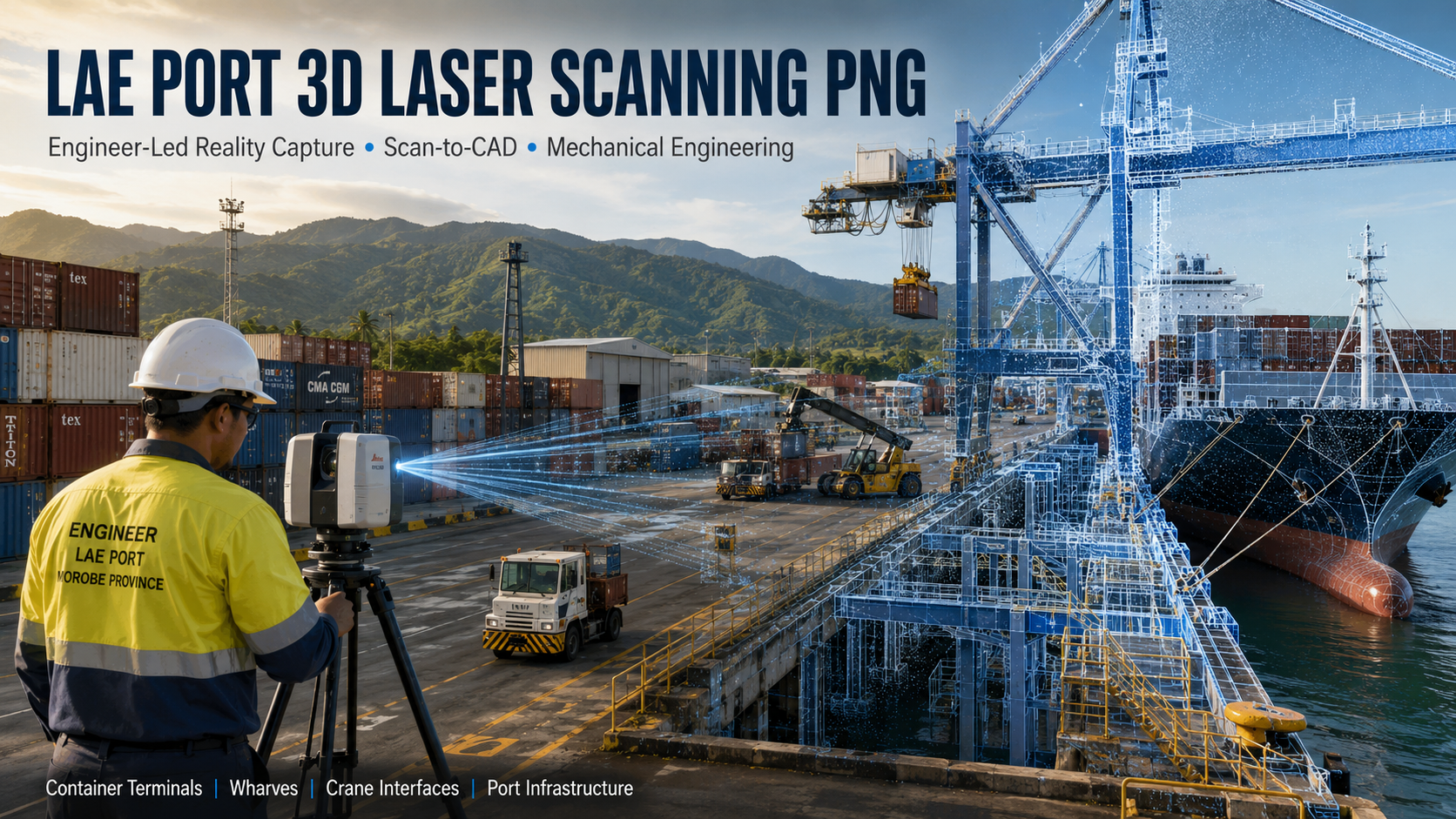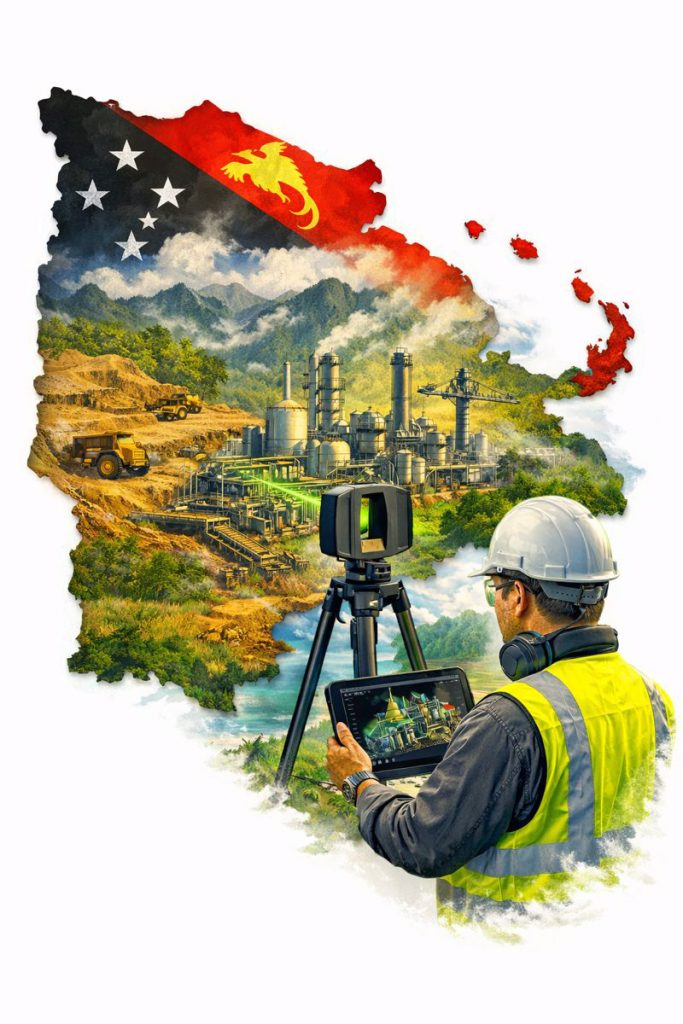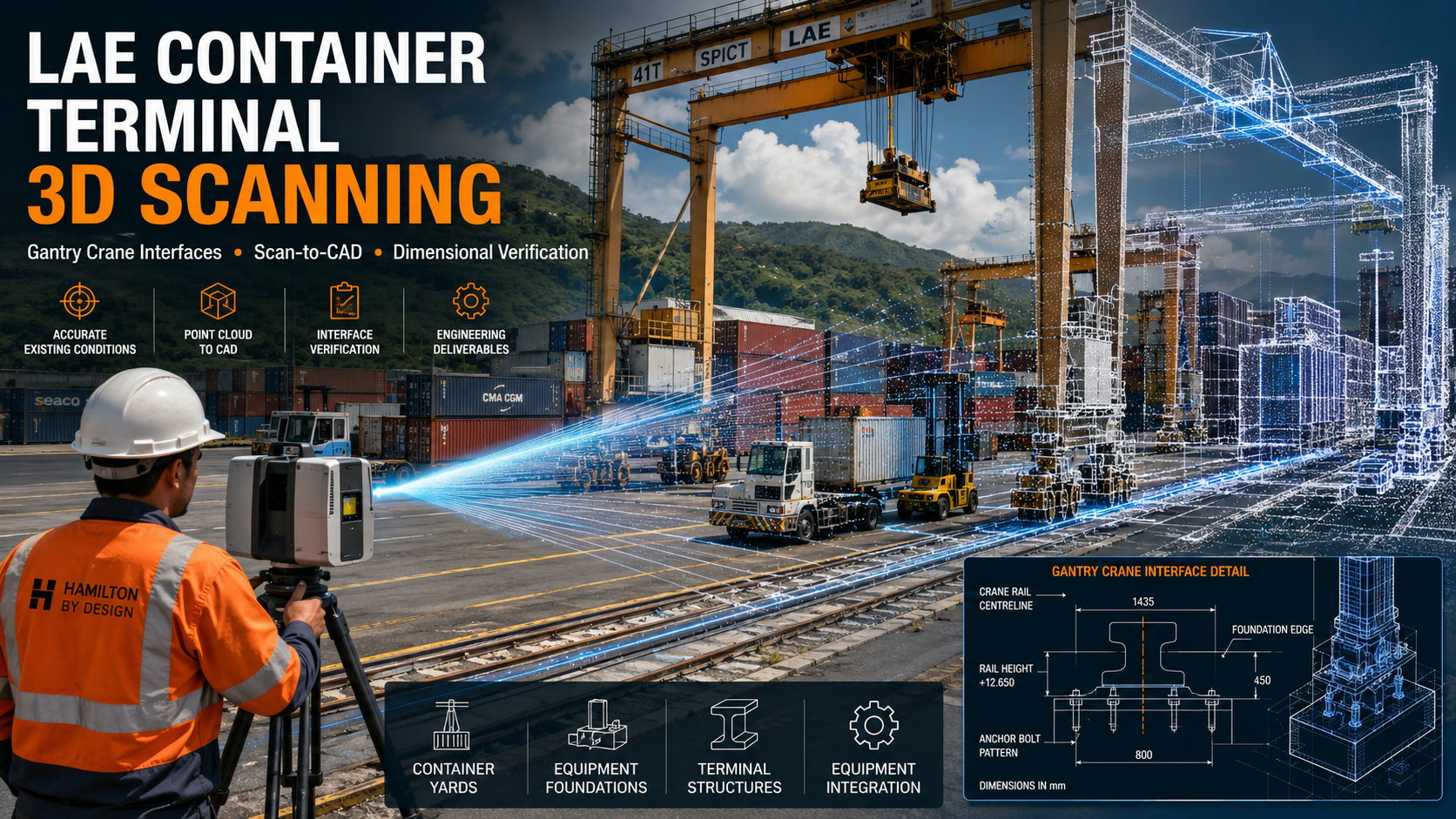
The South Pacific International Container Terminal in Lae, Morobe Province, is an important part of Papua New Guinea’s freight and logistics network. As terminal infrastructure develops, new cranes, handling equipment, foundations, services and structural systems must be integrated with existing operating assets.
This creates a practical engineering challenge: new equipment must fit accurately within an existing brownfield environment.
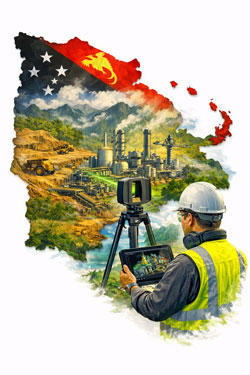
Hamilton By Design provides engineer-led Lae Container Terminal 3D Scanning, combining terrestrial LiDAR scanning with mechanical engineering, CAD modelling, reverse engineering, dimensional verification and fabrication documentation.
The objective is not simply to capture a point cloud. The objective is to create reliable engineering information that can support design, equipment integration, fabrication and installation planning.
A typical workflow may include:
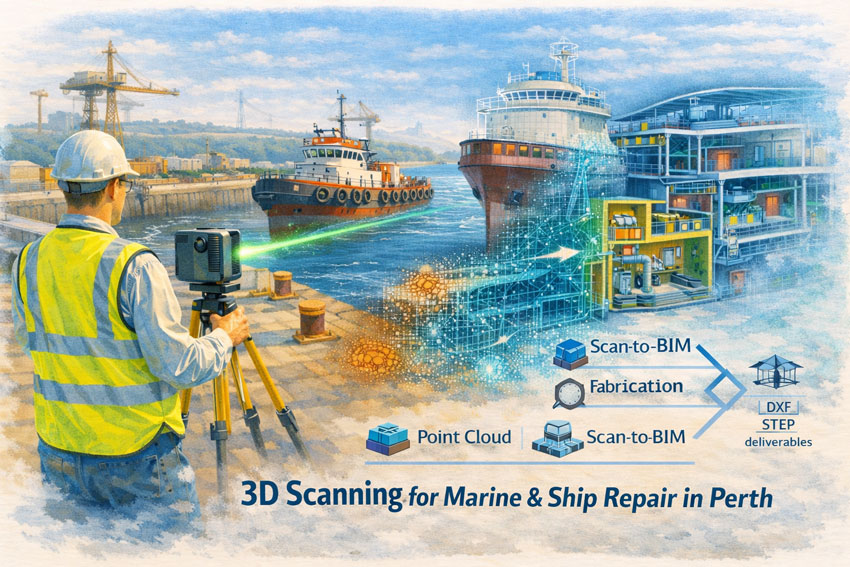
3D Scanning → Point Cloud → CAD Model → Interface Verification → Engineering Design → Fabrication Documentation
Hamilton By Design’s engineering-grade 3D laser scanning services are suited to brownfield industrial and infrastructure projects where dimensional accuracy and reliable existing-condition information are important to the success of the project.
Why Existing-Condition Accuracy Matters at a Container Terminal
Container terminals are complex operating environments.
Cranes, foundations, structural steel, service routes, access systems, buildings and mobile equipment all occupy limited space. Over time, many of these assets may also be modified, repaired or replaced.
As a result, historical drawings do not always represent the current installed condition.
This can create problems when new equipment is introduced.
A crane rail may not be positioned exactly as shown on an old drawing. A foundation may have been modified. A service may pass through an area that appears clear on the design documentation. Existing structural steel may also restrict the installation or maintenance envelope of new machinery.
Hamilton By Design’s 3D laser scanning services provide a practical method of recording the physical condition of the terminal before design or fabrication begins.
The resulting point cloud can provide a coordinated three-dimensional reference for engineers, designers and project teams.
Gantry Crane Interface Scanning
Gantry cranes and container-handling equipment rely on a number of critical physical interfaces.
Depending on the project, these may include:
- crane rails
- equipment foundations
- structural support points
- anchor locations
- access platforms
- maintenance clearances
- cable routes
- service corridors
- adjacent buildings
- surrounding mechanical equipment.
3D laser scanning allows these features to be captured within a common spatial environment.
For a proposed crane upgrade or new equipment installation, Hamilton By Design can use the scan data to create CAD geometry around the areas that are most important to the engineering scope.
The proposed equipment model can then be coordinated with the existing-condition model.
This allows the design team to assess questions such as:
- Will the new equipment fit within the available space?
- Are the existing foundations located where expected?
- Are the critical structural interfaces aligned?
- Is there adequate maintenance access?
- Will the installation interfere with existing services?
- Is additional steelwork or modification required?
The purpose is to identify potential interface problems before they become fabrication or site-installation problems.
Point Cloud to CAD for Terminal Engineering
A registered point cloud provides extensive dimensional information, but not every part of the scan needs to be converted into a detailed engineering model.
Hamilton By Design can develop selected geometry from the point cloud based on the requirements of the project.
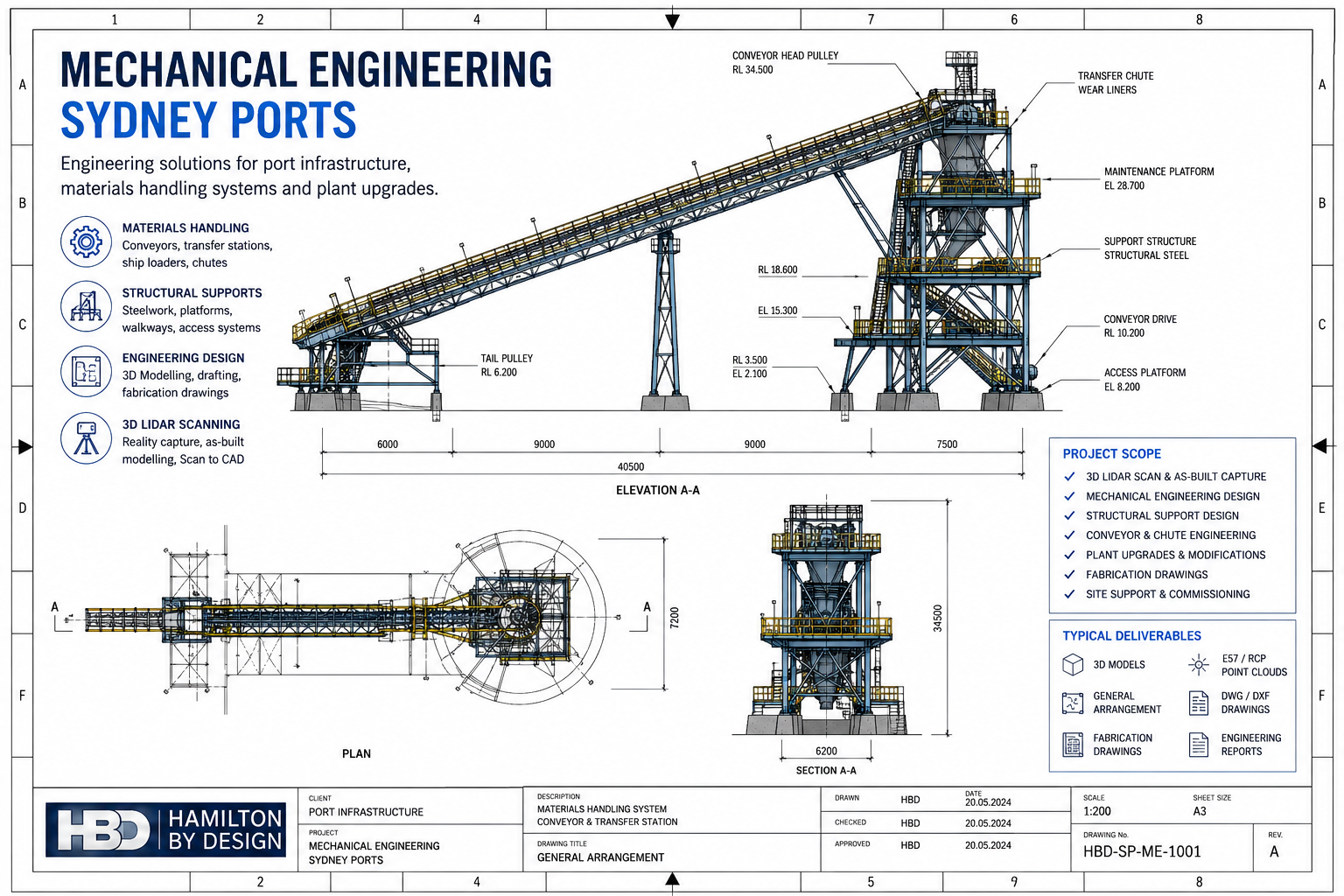
Its Point Cloud to CAD services can support mechanical, structural and infrastructure projects where existing-condition geometry is needed for design and coordination.
For a container-terminal project, CAD modelling may focus on:
- foundations
- crane rails
- columns
- beams
- bracing
- machinery frames
- platforms
- walkways
- equipment interfaces
- service routes
- surrounding structures.
This targeted modelling approach keeps the CAD model practical and relevant to the engineering task.
Dimensional Verification of Equipment Foundations
Equipment foundations are one of the most important interfaces in brownfield terminal projects.
Where new machinery or crane components are fabricated remotely, incorrect foundation information can lead to significant installation delays.
3D scanning can assist with the verification of existing foundation geometry before fabrication or mobilisation.
Depending on the scope, HBD can assess:
- foundation location
- relative position
- equipment footprint
- levels and elevations
- centre distances
- surrounding clearances
- existing structural interfaces
- visible anchor and connection geometry.
Where high-precision survey control or specialised metrology is required, the measurement strategy should be selected to suit the project tolerance.
The broader objective remains the same: verify critical interfaces before the new equipment reaches site.
Mechanical Engineering for Container-Terminal Assets
The value of reality capture increases when the scan data is directly connected to engineering.
Hamilton By Design’s engineering services combine 3D scanning with mechanical engineering, CAD modelling, drafting, verification and brownfield design support.
For Lae container-terminal infrastructure, potential services include the following.
Equipment Support Structures
Existing geometry can be scanned before new support frames, brackets, machinery bases or structural interfaces are designed.
This allows new components to be developed around the actual installed condition rather than relying entirely on historic documentation.
Access Platforms, Stairs and Walkways
Maintenance access is an important part of container-terminal operation.
Hamilton By Design can support the design and drafting of:
- access platforms
- walkways
- stairs
- ladders
- handrails
- maintenance structures.
These systems can be coordinated with existing machinery and structural steel captured in the point cloud.
Machinery Guarding
Mechanical equipment may require new or modified guarding as part of an upgrade.
3D scanning can assist with documenting the available space around machinery so that guards and access systems can be designed to suit the actual installation.
Equipment Modifications
Existing machinery can be scanned and modelled where a modification is required to accept new equipment, improve access or resolve an interface problem.
Structural and Mechanical Coordination
Mechanical equipment models can be coordinated with structural steel and surrounding services to identify clashes before fabrication.
Reverse Engineering Existing Terminal Equipment
Container terminals often operate mechanical equipment over long service periods.
During that time, original drawings may become incomplete, outdated or unavailable.
Hamilton By Design’s reverse engineering 3D scanning services can support the redevelopment of existing equipment where accurate dimensional information is required.
Potential applications include:
- brackets
- covers
- guards
- equipment supports
- structural frames
- machinery interfaces
- replacement components
- maintenance assemblies.
Reverse engineering should not be treated as simply copying an existing component.
Where appropriate, scanning can be combined with physical measurement, material assessment, engineering calculations and CAD modelling to develop a replacement or modified component that is suitable for its intended duty.
Brownfield Port Engineering
An operating container terminal is a brownfield engineering environment.
New equipment must often be installed around assets that cannot easily be relocated.
Hamilton By Design’s approach to brownfield port engineering combines reality capture with engineering design to reduce uncertainty around existing conditions.
At Lae, this methodology could support:
- crane replacement
- terminal expansion
- equipment relocation
- new machinery installation
- structural modifications
- service coordination
- access improvements
- maintenance upgrades.
The principal advantage is that the design can be developed around the existing installed condition.
This is particularly useful where the available space is limited or where site access is difficult.
Scan-to-CAD Before Equipment Is Mobilised to PNG
Remote projects benefit from resolving engineering issues as early as possible.
If equipment is fabricated outside Papua New Guinea, a dimensional error discovered after delivery can lead to rework, additional mobilisation and installation delays.
A scan-to-CAD workflow can reduce this risk.
Hamilton By Design can:
- capture the existing terminal area;
- register the point-cloud data;
- identify critical interfaces;
- develop the required CAD geometry;
- import the proposed equipment model;
- assess clearances and clashes;
- develop engineering modifications where required;
- prepare fabrication and installation drawings.
This approach is consistent with HBD’s Scan to CAD port engineering services.
The engineering objective is straightforward:
identify interface problems digitally before they become problems on site.
Mechanical Engineering Support for Papua New Guinea
Projects in Papua New Guinea can involve significant mobilisation costs and limited access to specialist engineering resources.
For this reason, it can be valuable to capture the required site information efficiently and then continue a large portion of the engineering work remotely.
Hamilton By Design provides mechanical engineering support for Papua New Guinea across industrial, mining and infrastructure projects.
Once suitable reality-capture data has been obtained, engineering development can continue through CAD modelling, design review, clash assessment and fabrication documentation.
This approach can reduce unnecessary repeat site visits while maintaining access to detailed existing-condition information.
Australian Standards and Engineering Requirements
Projects undertaken at Lae must be designed in accordance with applicable Papua New Guinea legislation, client requirements, terminal standards and the project-specific engineering design basis.
Australian Standards should not automatically be assumed to govern a project in PNG.
However, where Australian Standards are nominated or accepted by the client, relevant standards may include:
AS 4100 – Steel Structures
Relevant to structural steelwork and equipment support structures.
AS/NZS 1170 series – Structural Design Actions
Relevant to structural actions and load combinations where adopted by the project.
AS 1657 – Fixed Platforms, Walkways, Stairways and Ladders
Relevant to industrial access systems around terminal equipment.
AS/NZS 4024 series – Safety of Machinery
Relevant to machinery guarding, access and mechanical safety.
AS 4991 – Lifting Devices
Potentially relevant to below-the-hook lifting devices and maintenance lifting arrangements.
AS 1418 series – Cranes, Hoists and Winches
Potentially relevant to crane-related engineering depending on the equipment and scope.
AS 2550 series – Cranes, Hoists and Winches – Safe Use
Potentially relevant where engineering work affects crane operation, maintenance or access.
AS/NZS 1554 series – Structural Steel Welding
Relevant to welded structural-steel fabrication where applicable.
The final engineering standards should always be confirmed for the specific project, asset and contractual requirements.
From 3D Scanning to Engineering Delivery
The purpose of engineering-grade scanning is not simply to produce a visual representation of the terminal.
Its greatest value is achieved when the information is used to support better engineering decisions.
For Lae container-terminal projects, Hamilton By Design can combine:
3D laser scanning + point-cloud processing + CAD modelling + dimensional verification + mechanical engineering + fabrication documentation
This integrated approach can support the installation of new cranes, container-handling equipment, structural steel and terminal infrastructure.
By establishing accurate existing-condition information early, project teams can reduce uncertainty and improve confidence in the design before fabrication and mobilisation begin.
For brownfield terminal upgrades, the key principle is simple:
Capture the existing asset accurately, verify the critical interfaces and engineer the new installation around what is actually on site.
Frequently Asked Questions
What is Lae Container Terminal 3D Scanning?
Lae Container Terminal 3D Scanning involves the use of terrestrial LiDAR technology to capture the existing geometry of cranes, foundations, structural steel, equipment, buildings, services and associated terminal infrastructure.
What assets can Hamilton By Design scan at a container terminal?
Potential assets include crane interfaces, crane rails, foundations, structural steelwork, container-handling equipment, warehouses, access platforms, stairs, walkways and surrounding infrastructure.
Can 3D scanning be used to verify equipment foundations?
Yes. Scanning can assist with documenting foundation geometry, location and surrounding interfaces. The measurement method should be selected to suit the required project tolerance.
Can new equipment be checked against the point cloud?
Yes. Proposed equipment or vendor CAD models can be coordinated with the existing-condition point cloud or derived CAD geometry to assess fit, clearance and possible clashes.
Can Hamilton By Design convert scan data into CAD?
Yes. Selected parts of the point cloud can be converted into engineering CAD geometry to support design, coordination, drafting and fabrication.
Can scanning reduce installation risk?
It can help reduce uncertainty by allowing the design team to identify potential dimensional and interface problems before equipment is fabricated or installed.
Does Hamilton By Design provide mechanical engineering as well as scanning?
Yes. Hamilton By Design combines 3D laser scanning with mechanical engineering, CAD modelling, reverse engineering, drafting and verification.
Can existing terminal equipment be reverse engineered?
Yes, where appropriate. Scanning can be combined with measurement, engineering assessment and CAD modelling to support the replacement or modification of existing components.
Do Australian Standards automatically apply in Papua New Guinea?
No. Applicable PNG legislation, client requirements and the project engineering basis must first be established. Australian Standards may be incorporated where they are formally adopted for the project.
Why is 3D scanning useful before equipment is shipped to Lae?
It allows critical existing interfaces to be verified before fabrication and mobilisation. This can help identify fit, clearance and coordination issues while they are still easier to resolve in the engineering model.

Contact Us – Talk To Us
Our clients: